I. Introduction
Overweight and obesity are defined as “abnormal or exces- sive fat accumulation resulting in health risks” [1]. In May 2004, the World Health Organization (WHO) declared war on obesity through its “Global Strategy on Diet, Activity, and Health” [2]. According to a study by the Non-Communicable Disease Risk Factor Collaboration (a network of scientists in 186 countries), one out of every five people in the world is now obese with a body mass index (BMI) greater than 30 kg/m2 [3]. Obesity is not a cosmetic problem but a direct threat to survival. Fortunately, obesity is preventable.
Obesity is often associated with a variety of risk factors, such as age, race, genetic influences, diet, and lifestyle; it
Effect of Mobile Health on Obese Adults:
A Systematic Review and Meta-Analysis
Seong-Hi Park1, Jeonghae Hwang2, Yun-Kyoung Choi3
1School of Nursing, Soonchunhyang University, Asan, Korea
2Department of Health Administration, Hanyang Cyber University, Seoul, Korea
3Department of Nursing, College of Natural Sciences, Korea National Open University, Seoul, Korea
Objectives: This study was conducted to examine the effects of mobile health (mHealth), using mobile phones as an inter- vention for weight loss in obese adults. Methods: An electronic search was carried out using multiple databases. A meta- analysis of selected studies was performed. The effects of mHealth were analyzed using changes in body weight and body mass index (BMI). Results: We identified 20 randomized controlled trials (RCTs) involving 2,318 participants who fit our in- clusion criteria. The meta-analysis showed that body weight was reduced with a weighted mean difference (WMD) of –2.35 kg (95% confidence interval [CI], –2.84 to –1.87). An examination of the impact of duration of intervention showed that weight loss was greater after 6 months of mHealth (WMD = –2.66 kg) than between three and four months (WMD = –2.25 kg); it was maintained for up to 9 months (WMD = –2.62 kg). At 12 months, weight loss was reduced to a WMD of –1.23 kg. BMI decreased with a WMD of –0.77 kg/m2 (95% CI, –1.01 to –0.52). BMI changes were not statistically significant at 3 months (WMD = –1.10 kg/m2), but they were statistically significant at 6 months (WMD = –0.67 kg/m2). Conclusions: The use of mHealth for obese adults showed a modest short-term effect on body weight and BMI. Although the weight loss asso- ciated with mHealth did not meet the recommendation of the Scottish Intercollegiate Guideline Network, which considers a reduction of approximately 5 to 10 kg of the initial body weight as a successful intervention. Well-designed RCTs are needed to reveal the effects of mHealth interventions.
Keywords: Adult, Obesity, Cell Phone, Mobile Applications, Meta-analysis
Healthc Inform Res. 2019 January;25(1):12-26.
https://doi.org/10.4258/hir.2019.25.1.12 pISSN 2093-3681 • eISSN 2093-369X
Submitted: December 16, 2018 Revised: January 19, 2019 Accepted: January 23, 2019 Corresponding Author Jeonghae Hwang
Department of Health Administration, Hanyang Cyber University, 220, Wangsimni-ro, Seongdong-gu, Seoul 04763, Korea. Tel: +82- 2-2290-0811, E-mail: [email protected] (https://orcid.org/0000- 0002-7428-5761)
This is an Open Access article distributed under the terms of the Creative Com- mons Attribution Non-Commercial License (http://creativecommons.org/licenses/by- nc/4.0/) which permits unrestricted non-commercial use, distribution, and reproduc- tion in any medium, provided the original work is properly cited.
ⓒ 2019 The Korean Society of Medical Informatics
cannot be explained by any one cause [4]. However, obese people tend to overeat and rarely engage in sufficient physi- cal activity [5]. As these habitual behaviors play a major role in causing people to become overweight and obese, they are the main targets for preventive and therapeutic activi- ties. The treatment of obesity begins by targeting weight loss through diet, exercise, and lifestyle changes, rather than medication [6]. However, changing a person’s lifestyle is not easy. Obesity treatment is perceived in a more distorted way than treatments for other diseases, so it is important for a patient to be actively motivated. In addition, since the health problems that result from obesity, as well as motivation and weight loss goals, vary from one person to the next, it is de- sirable to develop individualized treatment strategies tailored to the characteristics of individual patients [7].
Information and communication technologies have been using eHealth and uHealth to provide healthcare since the 1990s as a way of managing chronic diseases caused by multiple factors [8]. They provide interventions that aim to change the lifestyle of patients or prevent risky behavior through individually tailored contact [9]. Taken as a group, the functions of personal computers and digital devices as applied to health are described as mHealth or digital health [10]. Because of its portability, mHealth can provide life log- ging, feedback, and pervasive interaction and intervention anytime and anywhere [11]. Thus, mHealth can potentially provide customized treatment for individual patients at a low cost with minimum need for therapeutic intervention [12].
For these reasons, mHealth has been actively used in the treatment of chronic diseases, including heart disease, smok- ing, and obesity, which require timely intervention to change patients’ lifestyles [13,14]. A systematic review of mHealth’s effect on obesity was carried out [15,16], and the findings showed that the effect was insignificant. Since then, several published articles have explored the use of mHealth in 2014 with obese patients [1-7]. Moreover, mobile phones have become more widely available globally, and mHealth has become simpler to access and use. Therefore, this is an ideal time to add to the evidence base surrounding the impact of mHealth. In this context, mHealth can be a new alternative to play a key role in modern healthcare solutions.
Thus, the purpose of this study was to evaluate the effect of mHealth on the weight loss of adult obesity through a systematic review focusing on randomized controlled trials (RCTs) with a high methodological standard and to provide scientific evidence regarding mHealth.
Table 1. Search strategies used to search Ovid MEDLINE Search strategies
1 exp Obesity/ or obesity.mp.
2 obesity abdominal.mp. or exp Obesity, Abdominal/
3 overweight.mp. or Overweight/
4 weight gain.mp. or exp Weight Gain/
5 body mass index.mp. or exp Body Mass Index/
6 (overweight or over weight).mp.
7 fat overload syndrom$.mp.
8 exp Metabolic Syndrome X/ or metabolic syndrome.mp.
9 (overeat or over eat).mp.
10 (overfeed or over feed).mp.
11 or/1-10
12 cellular phone.mp. or exp Cell Phones/
13 text messag$.mp.
14 texting.mp.
15 short messag$.mp.
16 mobile health.mp. or exp Telemedicine/
17 sms.mp.
18 (multimedia messag$ or multi-media messag$).mp.
19 mms.mp.
20 ((cellular phone$ or cell phone$ or mobile phone$) and (messag$ or text$)).mp.
21 (phone adj3 call*).mp.
22 ((cell* or mobile or smart or google or nexus or iphone) adj3 (phone* or telephone*)).mp.
23 smartphone*.mp.
24 smart-phone*.mp.
25 ((mobile or smartphone or smart-phone or phone or software) adj3 app*).mp.
26 multimedia messaging service.mp.
27 palmtop computer$.mp.
28 (tablet adj3 (device? or comput$)).mp.
29 (Blackberry or Nokia or Symbian or Samsun or iPhone or Ipad).mp.
30 (windows adj3 (mobile? or phone?)).mp.
31 smart?pad.mp.
32 bluetooth headset*.mp.
33 (smart adj (watch$ or band$ or shoe$ or glasse$)).mp.
34 (patch and tattoos).mp.
35 smart implant$.mp.
36 fuelband.mp.
37 google glass$.mp.
38 fitbit.mp.
Continued on next page.
II. Methods
This study was conducted in accordance with guidelines provided in the Cochrane Handbook for Systematic Reviews of Intervention [17] and the Preferred Reporting Items for Systematic Reviews and Meta-Analyses [18].
1. Search Strategies
An electronic database search was executed on October 1, 2016, using the Ovid MEDLINE, EMBASE, Cochrane Li- brary, and CINAHL Complete databases. The search strategy relied on Medical Subject Heading (MeSH) search terms, including ‘obesity’, ‘overweight’, ‘cellular phone’, and ‘mobile health’. To search for RCTs, we used the Scottish Intercol- legiate Guidelines Network search filter [19] in the Ovid MEDLINE database. The combinations of search terms are shown in Table 1.
2. Eligibility Criteria
The selection criteria used to retrieve documents were the following: (1) study designs, RCTs; (2) participants, over- weight or obese adults over 18 years of age with a BMI above 25 kg/m2 [20]; (3) interventions, mobile healthcare programs providing health promotion services and health information through mobile phones (These included health management and personal guidance systems provided remotely via SMS, as well as applications connected to health-information de- vices); (4) comparators, no treatment or counseling provid- ing educational materials not via mobile devices as a weight- loss interventions; and (5) outcomes, changes in body weight and BMI.
The exclusion criteria for the literature were the following:
(1) non-original studies; (2) studies including adults within a normal range of BMI; (3) persons with specific illnesses; (4) non-mobile phone-based health programs; (5) studies that
did not report body weight or BMI among their results; and (6) non-RCTs. The language options were not limited.
3. Study Selection and Data Extraction
First, duplicate documents were eliminated. The title and abstract of each article were then reviewed. If an inclusion was still unclear following title/abstract screening, the full text was evaluated and exclusion criteria applied. Data were extracted after the evidence was reviewed in table form.
The data extracted from the included literature related to study location, the randomized allocation method, blinding, subjects, selection criteria, age, sex ratio, BMI, mHealth pro- grams, and research outcomes. All processes were indepen- dently carried out by the three authors, and the final selec- tion was based on consensus. Disagreements were resolved through third party involvement.
4. Risk of Bias Assessment
The quality of the literature was assessed independently by the three authors using Cochrane’s risk of bias tool [17].
This is a quality assessment method for RCTs that includes the following seven items: random sequence generation, allocation concealment, the blinding of participants and personnel, the blinding of outcome assessments, incomplete outcome data, and other biases. In addition, each item was judged as having a high, low, or unclear risk of bias, depend- ing on the content of the study.
5. Statistical Analysis
A meta-analysis of extracted data was carried out, using Cochrane’s Review Manager (RevMan) 5.3 program (The Nordic Cochrane Center, Copenhagen, Denmark). Because the estimated effect is a continuous variable, it was described as a weighted mean difference (WMD) and 95% confidence interval (CI) and analyzed using a random-effect model. The mean effect on the outcome variable and the 95% CI were based on the general inverse variance estimation method.
For studies in which the standard deviation was not re- ported, these were converted and analyzed by the RevMan 5.3 program’s automatic calculation tool using the standard error or CI presented in the studies. Body weights reported in pounds were converted into kilograms; cases that cited a percentage of reduced body weight were also recalculated to reflect baseline body weights. The difference in effect between groups was analyzed at a 5% significance level. To measure the heterogeneity among the studies, a forest plot was initially used to visually identify the common factors in CI and effect estimates, and Cochran’s Q statistics and Hig- Table 1. Contiuned
Search strategies 39 fitness tracking.mp.
40 iBGstar.mp.
41 iRhythm.mp.
42 iRobot.mp.
43 or/12-42 44 11 and 43
45 Search filter of SIGN for randomized controlled trials 46 44 and 45
gins’s I2 statistics were used. Here, I2 ≤ 25% indicated low heterogeneity; 25% < I2 ≤ 75%, medium heterogeneity; and I2 > 75%, high heterogeneity [17]. The presence of publica- tion bias was confirmed through a funnel plot.
III. Results
1. Description of Included Studies
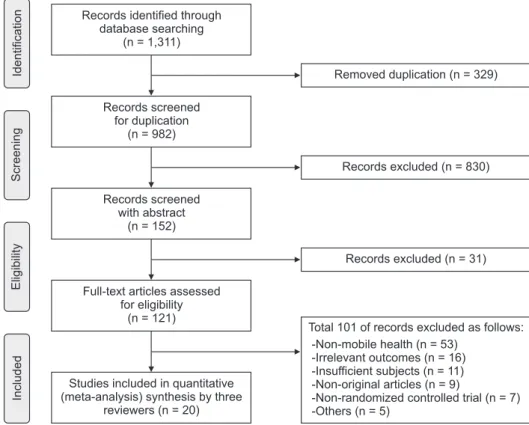
In total, 1,311 studies were retrieved from the following electronic databases: Ovid MEDLINE (477), EMBASE (617), Cochrane Library (145), and CINAHL Complete (72). Of these, 329 studies were excluded as duplicates. The titles and abstracts of 982 studies were screened using the specified se- lection and exclusion criteria, and 121 studies were reviewed based on their full texts. Finally, 962 studies (98.0%) were excluded, and 20 studies were selected for review. Full details of the literature review are shown in the flow diagram (Figure 1).
2. Methodological Quality of Included Studies
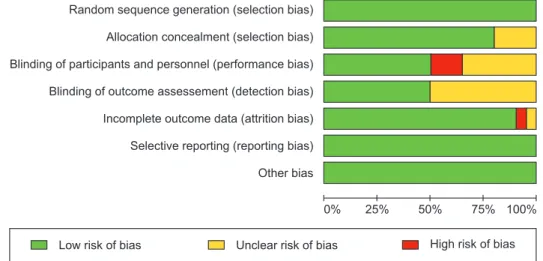
By evaluating the quality of the 20 selected studies (Appen- dix 1), we ensured that none showed a high risk of bias in any of the seven items. All of the chosen studies were RCTs.
Concealment was performed using an opaque envelope or computerized number generator for 12 studies [A1, A3, A4, A7, A9, A10, A13, A14, A17–A20]. Some studies used strati-
fied randomized block design [A2, A15, A16] and minimi- zation [A6, A12] for random allocation. Ten of the studies used blinding of either the participants or the assessors.
Some studies [A12, A19, A20] suggested that the blinding of participants was not practicable in the research process. The lack of blinding may not have affected the results of these studies. There were seven studies that did not include a de- scription of blinding [A1, A5, A7, A11, A15, A16, A18]. One study [A19] showed a dropout rate of more than 20% during the follow-up period, but this was a long-term follow-up pe- riod of 1 year. Six of the studies were of high quality and met all of the seven items [A2, A3, A6, A9, A14, A17]. There was no disagreement among the authors when it came to quality evaluation. The results are shown in Figure 2.
3. Characteristics of Selected Studies
The total number of subjects was 2,318 across the 20 includ- ed studies. Of the selected studies, 15 were performed in the United States, 2 each in the United Kingdom [A4, A12] and Australia [A2, A13], and 1 in China [A10]. All of the stud- ies were published after 2011. There were seven large-scale RCTs with more than 100 subjects [A2, A4, A7–A10, A19]
and two small studies [A6, A11] with fewer than 50 subjects.
The average age of participants was in the 60s in only one study [A5], in the 20s in two studies [A7, A13], in the 30s in three studies [A2, A10, A18], and in the 50s in four stud-
IncludedEligibilityScreeningIdentification
Records screened for duplication
(n = 982)
Full-text articles assessed for eligibility
(n = 121)
Studies included in quantitative (meta-analysis) synthesis by three
reviewers (n = 20)
Removed duplication (n = 329) Records identified through
database searching (n = 1,311)
Total 101 of records excluded as follows:
-Non-mobile health (n = 53) -Irrelevant outcomes (n = 16) -Insufficient subjects (n = 11) -Non-original articles (n = 9)
-Non-randomized controlled trial (n = 7) -Others (n = 5)
Records screened with abstract
(n = 152)
Records excluded (n = 830)
Records excluded (n = 31)
Figure 1. Flow diagram of study se- lection.
ies [A3, A9, A15, A16]. The majority of participants were in their 40s in 10 studies [A1, A4, A6, A8, A11, A12, A14, A17, A19, A20]. The subjects were pre-obese with BMI scores in the range of 25 to 30 kg/m2 in three studies [A5, A10, A13], Class I obese with BMI scores in the range of 30.0 to 34.99 kg/m2 in 10 studies [A1, A4, A6, A8, A11, A12, A14, A17, A19, A20], and Class II obese with BMI scores of 35.0 kg/m2 or higher in five studies.
The mHealth program was relatively simple. In six stud- ies [A1, A8, A13, A17, A19, A20], using a smartphone ap- plication, subjects were able to input their daily calories and various life activities such as exercise, providing informa- tion to be monitored. Seven studies [A6, A7, A9, A12, A14, A15, A18] were monitoring services that send and receive information with fixed times, and there were customized programs involving some devices, such as Fitbits or pedom- eters [A2, A3, A5], or personalized feedback like coaching was provided based on the monitored results [A4, A10, A11, A16]. The mHealth programs lasted for 3 months in five studies [A1, A2, A4, A6, A13], 4 months in three studies [A5, A14, A15], and 6 months in 10 studies [A3, A8–A12, A16–
A18, A20]. One study ran for 12 months [A19] and another for 24 months [A7] (Table 2).
4. Effects of Mobile Health on Weight Loss
All of the studies measured weight loss (Figure 3). Analy- sis showed that body weight was reduced with a WMD of –2.35 kg (95% CI, –2.84 to –1.87) in obese adults, which was statistically significant (Z = 9.53, p < 0.001) in intervention groups in comparison to the control. However, heterogeneity among the studies was high, at 94% (χ2 = 520.08, p < 0.001).
A detailed analysis of the length of intervention showed that mHealth could reduce body weight with a WMD of –2.25 kg (95% CI, –3.34 to –1.16) between 3 and 4 months, a WMD
of –2.66 kg (95% CI, –3.94 to –1.38) at 6 months, a WMD of –2.62 kg (95% CI, –4.81 to –0.43) at 9 months, and –1.23 kg (95% CI, –2.25 to –0.21) beyond 12 months. These results were statistically significant. However, the heterogeneity among the studies was higher than 85%, except in those that ran for 12 months or more (I2 = 0.0%, χ2 = 1.49, p = 0.68).
Because there was a high degree of heterogeneity among the studies, a sub-group analysis was performed, using the average age of the subjects, the type of obesity, BMI level, and the year of publication. However, this did not succeed in reducing the level of heterogeneity.
5. Effects of Mobile Health on BMI Changes
BMI changes were measured in six studies [A1, A10–A13, A18] (Figure 4). The meta-analysis showed that BMI de- creased with a WMD of –0.77 kg/m2 (95% CI, –1.01 to –0.52) in obese adults, which was statistically significant (Z = 6.08, p < 0.001); the heterogeneity among studies was 95% (χ2 = 121.22, p < 0.001). The mHealth program results varied by the length of intervention, decreasing BMI with a WMD of –1.10 kg/m2 (95% CI, –2.79 to 0.59) at 3 months.
There was a high level of heterogeneity among studies and no statistically significant difference in BMI (I2 = 95.0%, χ2
= 36.90, p < 0.001). At six months, the change in BMI was a WMD of –0.67 kg/m2 (95% CI, –0.71 to –0.63); this was sta- tistically significant. There was 0.0% heterogeneity (χ2 = 1.00, p = 0.80).
6. Publication Bias
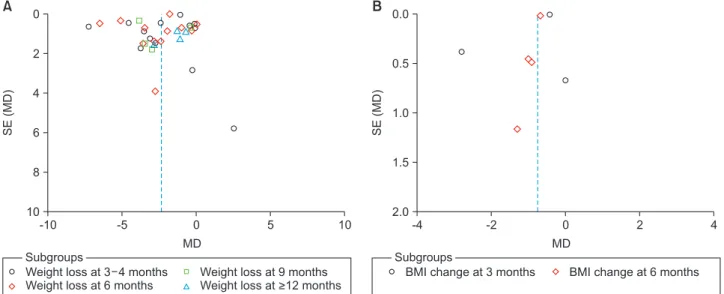
The RevMan 5.3 program does not provide the statistical findings for the funnel plot. No distinct asymmetry was ob- served in the funnel plot, but there was mild publication bias shown in weight loss (Figure 5).
Random sequence generation (selection bias) Allocation concealment (selection bias) Blinding of participants and personnel (performance bias) Blinding of outcome assessement (detection bias) Incomplete outcome data (attrition bias) Selective reporting (reporting bias) Other bias
0% 25% 50% 75% 100%
Low risk of bias Unclear risk of bias High risk of bias
Figure 2. Risk of bias graph.
Table 2. Characteristics of selected studies Studya YearCountryMethodParticipantsFollow- up (mo)InterventionsOutcomes ConcealmentBlindingInclusion criteriaGroupTotalAnal- ysisSex (M:F)Age (yr)BMI (kg/m2 )WeightBMI Hale et al. [A1]2016USAList of random numbers
Overweight and obese adults; BMI 25.0–49.9 kg/m2
Con.25215:2043.9±12.933.2±5.33Standard tracking app○○ Exp.26214:2248.4±11.936.2±6.3The Social Pound Off Digi- tally mobile app include diet, PA, and weight-track- ing features, and calorie database with commonly consumed food and bever- age for 3 months Partridge et al. [A2]
2016AustraliaStratified randomized block design
Subjects & researchersAge 18–35 years with a high risk of weight gain; BMI 25.0–49.9 kg/m2
Con.12546:79--3 & 9Dietary guideline with 2 page handout○ Exp.12350:73--TXT2BFiT program; 8 week- ly motivation text messag- es; 5 personalized coaching calls; weekly e-mail; educa- tion using mobile phone apps and support resources included diet, PA, meals, etc. for 3 months Ross & Wing [A3]
2016USAComputer generatedResearchersAge 18–70 years; BMI 27–40 kg/m2
Con.26264:2254.2±9.5-6Traditional weight manage- ment ○ Exp.27274:2352.9±0.3-Phone based weight loss program; Fitbit Zip activity monitor and phone-based intervention contact for 6 months
Table 2. Contiuned 1 Studya YearCountryMethodParticipantsFollow- up (mo)InterventionsOutcomes ConcealmentBlindingInclusion criteriaGroupTotalAnal- ysisSex (M:F)Age (yr)BMI (kg/m2 )WeightBMI Sidhu et al. [A4]
2016UKComputer generatedSubjects assessorsAge ≥18 yearsCon.19015519:17147.0±13.734.4±5.33 & 9Usual care○ Exp.19015120:17047.8±13.134.5±4.8SMS-text based Lighten Up Plus intervention; weekly texts asking for weight, ad- vice diet and PA, etc. for 3 months Cadmus- Bertram et al. [A5]
2015USAOverweight, menopausal women with BMI ≥25 kg/m2
Con.260:2661.3±7.529.1±3.24Pedometer○ Exp.250:2558.6±6.529.2±3.8Web-based tracking; Fitbit based PA intervention for 4 months Martin et al. [A6]
2015USAMinimization allocation method
ResearchersOverweight and obese adults; Age 18–65 years; BMI 25–35 kg/m2
Con.203:1743.3±2.629.5±3.23Health education○ Exp.204:1645.6±2.730.2±2.7SmartLoss intervention by a smartphone (Blackberry VR Curve 8320; Waterloo, Ontario, Canada); provided weight graph and feedback for 3 months Svetkey et al. [A7]
2015USAEqual allocationOverweight or obesity; Age 18–35 years; BMI ≥25 kg/m2
Con.12338:8529.6±4.335.1±7.56 & 12 & 24Three handouts on healthy eating and PA ○ Exp.12138:8429.2±4.235.7±8.2Personal coaching enhanced by smartphone self-mon- itoring; trawcking weight, dietary intake and PA, etc. for 24 months
Table 2. Contiuned 2 Studya YearCountryMethodParticipantsFollow- up (mo)InterventionsOutcomes ConcealmentBlindingInclusion criteriaGroupTotalAnal- ysisSex (M:F)Age (yr)BMI (kg/m2 )WeightBMI Laing et al. [A8]
2014USAResearchersPrimary care patients; Age ≥18 years; BMI ≥25 kg/m2
Con.10726:8143.2±15.033.3±7.06Usual primary care○ Exp.10532:7343.1±14.033.3±7.0Mobile Fitness Project us- ing various message-based programs and smartphone apps for 6 months Lin et al. [A9]2014USAWeb-based programResearchersAged ≥21 years; BMI >27 kg/m2
Con.614913:4852.3±12.037.5±8.96Standard care○ Exp.63506:5749.2±12.738.0±7.6Tailored Rapid Interactive Mobile Massaging inter- vention, delivered 3–4 times per day for 6 months Lin et al. [A10]2014ChinaComputer generatedResearchersOverweight adults; Age 30–50 years; BMI ≥24 kg/m2
Con.6024:3638.1±8.128.4±0.56Brief advice session○○ Exp.6325:3838.4±8.028.2±0.5Lifestyle weight loss; 5 coach- ing calls, and a daily text message for 6 months Allen et al. [A11]
2013USAVolunteers with age 21–65 years and BMI 28–42 kg/m2
Con.184:1442.5±12.134.1±4.16Intensive counseling○○ Exp.165:1145.6±9.334.1±4.1Smart Coach for Life Style Management for 6 months; intensive diet and exercise counselling plus self-moni- toring smartphone Carter et al. [A12]
2013UKMinimization allocation method Assessors Age 18–65 years; BMI ≥27 kg/m2
Con.43209:3442.5±8.334.5±5.76Paper food diary, calorie- counting book and calcula- tor
○○ Exp.434010:3341.2±8.533.7±4.2My Meal Mate app; detailed self-monitoring (of diet, PA, and weight) and feed- back for 6 months
Table 2. Contiuned 3 Studya YearCountryMethodParticipantsFollow- up (mo)InterventionsOutcomes ConcealmentBlindingInclusion criteriaGroupTotalAnal- ysisSex (M:F)Age (yr)BMI (kg/m2 )WeightBMI Hebden et al. [A13]
2013AustraliaComputer generatedSubjectsUniversity students; Age 18–35 years; BMI 23–31.9 kg/m2
Con.256:1923.1±3.727.2±2.53Diet booklet○○ Exp.264:2222.6±5.427.3±2.1mHealth program; gender- specific SMS messages (4 weeks), e-mail (4 weeks) for 3 months Norman et al. [A14]
2013USAComputer generatedSubjects and study staff
Overweight or obesity; Age 25–55 years; BMI 25–39.9 kg/m2
Con.3313:5246.0±7.032.8±3.94Usual care using print mate- rials○ Exp.32---2–5 weight management text-message per day; Three 24-hour recalls assessed fruit/vegetable intake change for 4 months Shaw et al. [A15]
2013USAPermuted block randomization Participants on Duke Diet and Fitness Center
Con.39354:2554.8±15.937.3±6.34General health message○ Exp.413915:2651.0±12.938.6±8.6Received a daily mobile health message; PA, low-calories healthy diet and monitor- ing of body weight for 4 months Spring et al. [A16]
2013USAStratified randomizationOverweight and obese adults; BMI 25–40 kg/m2
Con.353030:557.7±10.235.8±3.83 & 6 & 9 & 12
Standard care ○ Exp.342929:557.7±13.536.3±4.6Mobile technology system; personal digital assistants to self-monitor diet and PA; biweekly coaching calls for 6 months
Table 2. Contiuned 4 Studya YearCountryMethodParticipants Follow- up (mo)InterventionsOutcomes ConcealmentBlindingInclusion criteriaGroupTotalAnal- ysisSex (M:F)Age (yr)BMI (kg/m2 )WeightBMI Steinberg et al. [A17]
2013USABlind randomizationSubjects and study staff
Age 18–60 years; BMI 25–40 kg/m2 and maximum weight of 330 lbs.
Con.44449:3544.7±10.631.0±3.13 & 6Delayed intervention○ Exp.474514:3343.0±11.433.2±4.0Daily self-weighing weight loss intervention using smart scale and e-mail for 6 months Steinberg et al. [A18]
2013USAComputer generatedAge 25–50 years; BMI ≥25 kg/m2
Con.240:2439.0±9.034.6±5.86Education○○ Exp.260:2637.6±7.436.9±6.2Daily text messaging for weight control; self-moni- toring tailored behavioral goals along with feedback and tips for 6 months Shapiro et al. [A19]
2012USAComputer generated and sealed envelope NoAge 21–65 years; BMI 25–39.9 kg/m2
Con.897334:5540.9±12.132.0±4.06 & 12Monthly e-newsletter○ Exp.815727:5443.1±11.432.4±4.2Text4Diet message include sugar-sweetened bever- ages, sedentary time, PA; daily step monitoring via pedometers, etc. for 12 months Turner- McGrievy & Tate [A20]
2011USAComputer generatedNoOverweight and obese adults; Age 18–60 years; BMI 25–45 kg/m2
Con.4913:3643.2±11.732.2±4.53 & 6Podcast○ Exp.4711:3642.6±10.732.9±4.8Podcast plus enhanced mo- bile media; monitoring apps (FatSecret’s Calorie Counter) for 6 months BMI: body mass index, SMS: Short Message Service, PA: physical activity. a A list of studies is in Appendix 1.
IV. Discussion
This study examined the effects of mHealth, using mobile phones as a weight loss intervention for obese adults. The results obtained by the meta-analysis of 20 RCTs involving 2,318 obese adults provided scientific evidence that mobile
phone-based interventions have some effect in reducing body weight and BMI in the short term.
Of the 20 studies included in this study, 16 were conducted in the United States. This seems to be related to the spread of mobile phones. In July 2008, access to apps was revolution- ized with the release of the App Store, which allows apps
1.1.1 Weight loss at 3 4 months Tuner-McGrievy & Tate 2011 Hebden et al. 2013
Norman et al. 2013 Spring et al. 2013 Steinberg (1) et al. 2013 Shaw et al. 2013 Laing et al. 2014 Lin et al. (China) 2014 Lin et al. (USA) 2014 Cadmus-Bertram et al. 2015 Martin et al. 2015
Hales et al. 2016 Partridge et al. 2015 Sidhu et al. 2016 Subtotal (95% CI)
Heterogeneity: Tau = 3.16; Chi = 165.11, df = 13 ( < 0.00001); I = 92%
Te t for overall effect: Z = 4.05 ( < 0.0001)
2 2 2
p p s
Study of Subgroup SD Weight
Experimental Control
IV, Random, 95% CI
Mean Difference Mean Difference
IV, Random, 95% CI
3.4 9.3 7.9 4.5 2.2 28.3 4.4 0.3 2.9 2.4 2.1 4.8 10.7 4.0
Mean Total
47 26 32 30 45 41 104 56 54 25 20 21 123 151 775
-2.3 75.5 -1.4 -0.9 0.3 104.2 0.2 0.08 -0.2 0.01 -0.6 -2.2 78.8 -1.78
49 25 33 30 44 39 107 54 51 26 20 21 125 155 779
-0.10 [-1.44, 1.24]
-0.30 [-5.90, 5.30]
-3.70 [-7.10, -0.30]
-3.50 [-5.29, -1.71]
-4.50 [-5.41, -3.59]
2.50 [-8.90, 13.90]
-0.50 [-1.69, 0.69]
-1.08 [-1.19, -0.97]
-2.40 [-3.30, -1.50]
-0.31 [-1.60, 0.98]
-7.20 [-8.50, -5.90]
-3.10 [-5.54, -0.66]
-2.80 [-5.71, 0.11]
-0.12 [-1.15, 0.91]
-2.25 [-3.34, -1.16]
SD Mean Total
3.6%
0.6%
1.4%
3.0%
4.2%
0.2%
3.8%
5.0%
4.3%
3.7%
3.7%
2.2%
1.8%
4.1%
41.6%
Favours_mHealth Favours_control-10 -5 0 5 10 -2.4
75.2 -5.1 -4.4 -4.2 106.7 -0.3 -1 -2.6 -0.3 -7.8 -5.3 76 -1.9
3.3 11 5.9 2.2 2.2 23.6 4.4 0.3 1.7 2.3 2.1 3.1 12.6 5.1
Year
2011 2013 2013 2013 2013 2013 2014 2014 2014 2015 2015 2016 2016 2016
1.1.2 Weight loss at 6 months Tuner-McGrievy & Tate 2011 Shapiro et al. 2012
Steinberg (2) et al. 2013 Steinberg (1) et al. 2013 Spring et al. 2013 Allen et al. 2013 Carter et al. 2013 Lin et al. (USA) 2014 Lin et al. (China) 2014 Laing et al. 2014 Svetkey et al. 2015 Ross & Wing 2016 Subtotal (95% CI)
Heterogeneity: Tau = 4.09; Chi = 210.37, df = 11 ( < 0.00001); I = 95%
Te t for overall effect: Z = 4.06 ( < 0.0001)
2 2 2
p p s
3.0 4.3 6.5 3.3 6.0 4.0 16.9 4.3 0.3 6.2 6.8 1.2
47 57 26 45 29 16 43 54 56 104 115 27 619
-2.6 -0.7 1.1 0.3 -0.9 -2.5 95 -0.2 0.2 0.3 -1.1 -1.3
49 73 24 42 28 18 43 51 54 107 123 26 638
0.00 [-0.99, 0.99]
-1.00 [-2.38, 0.38]
-2.40 [-5.09, 0.29]
-6.50 [-7.47, -5.53]
-3.60 [-6.54, -0.66]
-2.90 [-5.63, -0.17]
-2.80 [-10.51, 4.91]
-3.50, [-4.85, -2.15]
-1.80 [ -1.91, -1.69]
-0.33 [-2.00, 1.34]
-2.00 [-3.73, -0.27]
-5.10 [-5.75, -4.45]
-2.66 [-3.94, -1.38]
4.1%
3.6%
2.0%
4.2%
1.8%
1.9%
0.4%
3.6%
5.0%
3.1%
3.0%
4.6%
37.2%
-2.6 -1.7 -1.3 -6.2 -4.5 -5.4 92.2 -3.7 -1.6 -0.03 -3.1 -6.4
1.8 3.5 2.5 0.2 5.3 4.1 19.5 2.6 0.3 6.2 6.8 1.2
2011 2012 2013 2013 2013 2013 2013 2014 2014 2014 2015 2016
1.1.3 Weight loss at 9 months Steinberg (1) et al. 2013 Spring et al. 2013 Partridge et al. 2016 Sidhu et al. 2016 Subtotal (95% CI)
Heterogeneity: Tau = 3.77; Chi = 19.87, df = 3 ( = 0.0002); I = 85%
Te t for overall effect: Z = 2.35 ( = 0.02)
2 2 2
p p s
1.9 7.8 10.8 6.2
29 27 123 151 330
-0.02 -0.9 78.4 1.8
30 29 125 155 339
-3.88 [-4.57, -3.19]
-3.00 [-6.52, 0.52]
-3.50 [-6.45, -0.55]
-0.40 [-1.77, 0.97]
-2.62 [-4.81, -0.43]
4.5%
1.4%
1.8%
3.6%
11.2%
-3.9 -3.9 74.9 1.4
0.01 5.3 12.8 6
2013 2013 2016 2016
1.1.4 Weight loss at > 12 months Shapiro et al. 2012
Spring et al. 2013 Svetkey et al. 2015 Svetkey et al. 2015 Subtotal (95% CI)
Heterogeneity: Tau = 0.00; Chi = 1.49, df = 3 ( = 0.68); I = 0%
Te t for overall effect: Z = 2.36 ( = 0.02)
2 2 2
p p s
5.4 6.1 6.6 9.6
57 27 113 108 305
-1 -0.02 -2.3 -1.4
73 27 123 123 346
-0.70 [-2.41, 1.01]
-2.88 [-5.95, 0.19]
-1.30 [-2.99, 0.39]
-1.10 [-3.58, 1.38]
-1.23 [-2.25, -0.21]
3.1%
1.7%
3.1%
2.2%
10.0%
-1.7 -2.9 -3.6 -2.5
4.3 5.4 6.6 9.6
2012 2013 2015 2015
Total (95% CI)
Heterogeneity: Tau = 1.22; Chi = 520.08, df = 33 ( < 0.00001); I = 94%
Test for overall effect: Z = 9.53 ( < 0.00001)
Test for subgroup differences: Chi = 3.73, df = 3 ( = 0.29); I = 19.6%
2 2 2
2 2
p p
p
2,029 2,102 100.0% -2.35 [-2.84, -1.87]
Figure 3. Weight-loss responses to mobile health.
to be downloaded from online marketplaces [21,22]. This technological advance has led to the development of apps for the prevention and management of chronic diseases, such as diabetes, obesity, and heart disease [23]. The 20 studies se- lected demonstrate that mHealth research using apps began in 2010 and gradually increased.
As a result, the body weight of obese adults has been re- duced, with a WMD of –2.35 kg (95% CI, –2.84 to –1.87).
According to the guideline for the management of obesity of SIGN [24], weight loss programs are successful when there is a decrease in weight by 5% to 10% (approximately 5 to 10 kg) minimum compared to the initial body weight. Therefore, a 2 kg weight loss in obese adults with a BMI of 25 kg/m2 or
more is not sufficient to interpret as an effective result. How- ever, the effect of mHealth on obese adults seems evident in comparison to the results of six weight loss studies (WMD –1.09 kg; 95% CI, –2.12 to –0.05) presented by Khokhar et al. [15]. It is worth noting that mHealth programs of dif- ferent durations produced different results. Analyzing the weight-loss effect every 3 months for 1 year showed that the effect slightly increased at 6 months (WMD = –2.66 kg), in comparison to 3 months (WMD = –2.25 kg). At 9 months (WMD = –2.62 kg), the weight loss tended to be maintained, but at 12 months, the WMD decreased to –1.23 kg.
In addition, only six studies that reported changes in mHealth BMI were analyzed at the 3- and 6-month marks. A
2.1.1 BMI change at 3 months Hebden et al. 2013
Lin (China) et al. 2014 Hales et al. 2016 Subtotal (95% CI)
Heterogeneity: Tau = 2.03; Chi = 36.90, df = 2 ( < 0.00001); I = 95%
Test for overall effect: Z = 1.28 ( = 0.20)
2 2 2
p p
Study of Subgroup SD Weight
Experimental Control
IV, Random, 95% CI
Mean Difference Mean Difference
IV, Random, 95% CI
2.0 0.1 1.5
Mean Total
26 56 21 103
26.7 0.02 0.9
25 54 21 100
0.00 [-1.34, 1.34]
-0.42 [-0.46, -0.38]
-2.80 [-3.57, -2.03]
-1.10 [-2.79, 0.59]
SD Mean Total
3.1%
38.0%
8.1%
49.3%
Favours_mHealth Favours_control
-4 -2 0 2 4
26.7 -0.4 -1.9
2.8 0.1 1.0
Year
2013 2014 2016
2.1.2 BMI change at 6 months Carter et al. 2013
Allen et al. 2013 Steinberg (2) et al. 2013 Lin (China) et al. 2014 Subtotal (95% CI)
Heterogeneity: Tau = 0.00; Chi = 1.00, df = 3 ( = 0.80); I = 0%
Test for overall effect: Z = 35.24 ( < 0.00001)
2 2 2
p p 4.5 1.3 2.4 0.1
43 16 26 56 141
33.4 -0.8 0.4 0.07
43 18 24 54 139
-1.30 [-3.59, 0.99]
-1.00 [-1.91, -0.09]
-0.90 [-1.89, 0.09]
-0.67 [-0.71, -0.63]
-0.67 [-0.71, -0.63]
1.1%
6.2%
5.4%
38.0%
50.7%
32.1 -1.8 -0.5 -0.6
6.2 1.4 0.9 0.1
2013 2013 2013 2014
Total (95% CI)
Heterogeneity: Tau = 0.04; Chi = 121.22, df = 6 ( < 0.00001); I = 95%
Test for overall effect: Z = 6.08 ( < 0.00001)
Test for subgroup differences: Chi = 0.25, df = 1 ( = 0.62); I = 0%
2 2 2
2 2
p p
p
244 239 100.0% -0.77 [-1.01, -0.52]
Figure 4. Body mass index (BMI) change responses to mobile health.
-10 0
2
4
6
8
10
SE(MD)
MD 10
A
Weight loss at 3 4 months Weight loss at 6 months
Weight loss at 9 months Weight loss at >12 months
-5 0 5 -4
0.0
0.5
1.0
1.5
4
SE(MD)
MD 2.0
B
BMI change at 3 months BMI change at 6 months
-2 0 2
Subgroups Subgroups
Figure 5. Funnel plots of weight loss (A) and BMI change (B). BMI: body mass index, SE: standard error, MD: mean difference.
meta-analysis showed that BMI decreased by –1.10 kg/m2 at 3 months, but was not statistically significant. At 6 months, the reduction was –0.67 kg/m2, which was statistically signif- icant; there was also no heterogeneity between studies (0.0%).
Therefore, combining these two results suggests that weight loss through the mHealth program shows a modest short- term effect among obese adults. However these results were analyzed according to the follow-up months presented in the included studies. In most studies [A1, A3, A5, A6, A8–A15], the duration of intervention and follow-up was the same.
However, in some studies [A2, A4, A16], they were followed up either after intervention or showed outcomes like weight loss at some point during intervention [A7, A17, A19, A20].
Therefore, this may be the result of discrepancies between intervention periods and follow-up periods, and this is one of the limitations of this study.
Obesity is caused by an imbalance in dietary intake and en- ergy consumption. The main interventions used to control obesity are diet, energy and nutrient balance, and exercise.
At this point, mHealth should provide the necessary infor- mation to maximize the effects of diet and exercise, giving warning messages and feedback to prevent inappropriate be- havior. In addition, it should actively intervene in real-time weight-loss programs by using devices connected to mobile phones. Among the advantages of mHealth are quick access to information and multimedia resources, flexible intercom- munications, portability, and convenience [25].
The content of the mHealth programs covered in the 20 studies has evolved. In 2011 and 2012, these programs sent text messages, providing simple information about calories and daily life activities. These programs have now become monitoring services that send and receive fixation infor- mation as part of a customized program involving other devices, such as Fitbits and pedometers; they also provide feedback, such as coaching. This study has not analyzed ver- sions of mHealth that use recently developed biosensor or wearable devices. It is therefore premature to argue that the effects of mHealth can be precisely determined. The types of mHealth intervention in the included studies were different.
Therefore, this is one of the limitations of this study. Various recent advances in the program, coupled with the inefficien- cies of users entering information, have not yet been ana- lyzed through research. In the future, mHealth will not only measure and provide feedback on behavioral changes, it will also need to innovate by intervening more actively to deter- mine the behavior of obese adults based on evidence, such as cognitive behavior theory.
There are few limitations in this study. The high heteroge-
neity among studies in this study remains a critical issue. In all of the studies, the results of weight change were analyzed and sub-group analyses were carried out, focusing on the mean age, type of obesity, the BMI levels of participants and so forth; this extra layer of analysis did not reduce heteroge- neity. Therefore, we did not describe the results in detail in this paper. This may be the cause of the difference between the intervention period and the follow-up period, as men- tioned above. This is because mHealth is not a mediator that directly affects weight loss, such as calorie restriction or exercise; rather, it acts as a mediator to stimulate dieting and exercise programs in obese adults. This may be attributed to the fact that the work was a pilot study with a small number of subjects. We therefore propose a large-scale RCT of the effect of duration in the mHealth program and on mHealth content for diverse age groups.
The results of this study showed that mHealth intervention for obese adults led to a modest short-term effect on body weight and BMI. The mobile phone provides convenience in everyday life; weight-loss options using mHealth have recently expanded. It is therefore difficult to definitively determine the effect of mHealth at this point. In the future, mHealth is expected to have a significant impact on reduc- ing adult obesity, given improved service content available through mHealth, the convenience of the mobile phone, and mHealth’s ability to actively intervene in the daily life of obese adults in real time. It is therefore necessary to expand studies applying mHealth interventions not only to obese adults but also to various age groups.
Conflict of Interest
No potential conflict of interest relevant to this article was reported.
Acknowledgments
This study was funded by the Ministry of Health & Welfare (No. 11-1352000-001926-01) and the Soonchunhyang Uni- versity.
ORCID
Seong-Hi Park (https://orcid.org/0000-0002-5495-3291) Jeonghae Hwang (https://orcid.org/0000-0002-7428-5761) Yun-Kyoung Choi (https://orcid.org/0000-0001-7591-0277)
References
1. World Health Organization. Obesity and overweight fact sheet [Internet]. Geneva, Switzerland: World Health Organization; 2018 [cited at 2019 Jan 10]. Available from: https://www.who.int/news-room/fact-sheets/de- tail/obesity-and-overweight.
2. World Health Organization. Global strategy on diet, physical activity and health [Internet]. Geneva, Switzer- land: World Health Organization; 2004 [cited at 2019 Jan 10]. Available from: http://www.who.int/dietphysi- calactivity/strategy/eb11344/strategy_english_web.pdf.
3. NCD Risk Factor Collaboration (NCD-RisC). Trends in adult body-mass index in 200 countries from 1975 to 2014: a pooled analysis of 1698 population-based mea- surement studies with 19·2 million participants. Lancet 2016;387(10026):1377-96.
4. Rosenbaum M, Leibel RL, Hirsch J. Obesity. N Engl J Med 1997;337(6):396-407.
5. Wadden TA, Foster GD. Behavioral assessment and treatment of markedly obese patients. In: Wadden TA, Van Itallie TB, editors. Treatment of the seriously obese patient. New York (NY): Guilford Press; 1992. p. 290- 330.
6. National Institutes of Health. Methods for voluntary weight loss and control: National Institutes of Health Technology Assessment Conference statement Mar 30-Apr 1, 1992. Bethesda (MD): National Institutes of Health; 1992.
7. Kim MK, Lee WY, Kang JH, Kang JH, Kim BT, Kim SM, et al. 2014 Clinical practice guidelines for overweight and obesity in Korea. Korean J Obes 2014;23(4):217-21.
8. Silva BM, Rodrigues JJ, de la Torre Diez I, Lopez-Coro- nado M, Saleem K. Mobile-health: a review of current state in 2015. J Biomed Inform 2015;56:265-72.
9. Vital Wave Consulting. mHealth for development: the opportunity of mobile technology for healthcare in the developing world. Washington (DC): Vodafone Founda- tion; 2009.
10. Woo HK, Sim EY, Cho YT. Big data and mobile health:
public health values and future challenges. Statistical Research 2016;(special issue):96-111.
11. Boulos MN, Wheeler S, Tavares C, Jones R. How smart- phones are changing the face of mobile and participa- tory healthcare: an overview, with example from eCAA- LYX. Biomed Eng Online 2011;10:24.
12. Lee MH, Kim J, Jee SH, Yoo SK. Integrated solution for
physical activity monitoring based on mobile phone and PC. Healthc Inform Res 2011;17(1):76-86.
13. Ghorai K, Akter S, Khatun F, Ray P. mHealth for smok- ing cessation programs: a systematic review. J Pers Med 2014;4(3):412-23.
14. Cajita MI, Gleason KT, Han HR. A systematic review of mHealth-based heart failure interventions. J Cardiovasc Nurs 2016;31(3):E10-22.
15. Khokhar B, Jones J, Ronksley PE, Armstrong MJ, Caird J, Rabi D. Effectiveness of mobile electronic devices in weight loss among overweight and obese populations:
a systematic review and meta-analysis. BMC Obes 2014;1:22.
16. Lyzwinski LN. A systematic review and meta-analysis of mobile devices and weight loss with an intervention content analysis. J Pers Med 2014;4(3):311-85.
17. Higgins JP, Green S; Cochrane Collaboration. Cochrane handbook for systematic reviews of interventions.
Chichester, UK: John Wiley & Sons; 2011.
18. Moher D, Liberati A, Tetzlaff J, Altman DG; PRISMA Group. Preferred reporting items for systematic reviews and meta-analyses: the PRISMA statement. Ann Intern Med 2009;151(4):264-9, W64.
19. Scottish Intercollegiate Guidelines Network. Search filters [Internet]. Edinburgh: Scottish Intercollegiate Guidelines Network; c2019 [cited at 2019 Jan 10].
Available from: https://www.sign.ac.uk/search-filters.
html#diag.
20. Pi-Sunyer FX. Obesity: criteria and classification. Proc Nutr Soc 2000;59(4):505-9.
21. Murfin M. Know your apps: an evidence-based ap- proach to evaluation of mobile clinical applications. J Physician Assist Educ 2013;24(3):38-40.
22. Payne KB, Wharrad H, Watts K. Smartphone and medi- cal related app use among medical students and junior doctors in the United Kingdom (UK): a regional survey.
BMC Med Inform Decis Mak 2012;12:121.
23. Robinson R. App revolution: avoiding the app trap.
PharmaVOICE 2014;14(2):24-8.
24. Scottish Intercollegiate Guidelines Network. Manage- ment of obesity [Internet]. Edinburgh: Scottish Intercol- legiate Guidelines Network; 2010 [cited at 2019 Jan 10].
Available from: http://www.sign.ac.uk/sign-115-man- agement-of-obesity.html.
25. Ventola CL. Mobile devices and apps for health care professionals: uses and benefits. P T 2014;39(5):356-64.
Appendix 1. List of studies included in a systematic review
A1. Hales S, Turner-McGrievy GM, Wilcox S, Fahim A, Davis RE, Huhns M, et al. Social networks for improving healthy weight loss behaviors for overweight and obese adults: a randomized clinical trial of the social pounds off digitally (Social POD) mobile app. Int J Med Inform 2016 Oct;94:81-90.
A2. Partridge SR, McGeechan K, Bauman A, Phongsavan P, Allman-Farinelli M. Improved eating behaviours mediate weight gain prevention of young adults: moderation and mediation results of a randomised controlled trial of TXT2BFiT, mHealth program. Int J Behav Nutr Phys Act 2016;13:44.
A3. Ross KM, Wing RR. Impact of newer self-monitoring technology and brief phone-based intervention on weight loss: a randomized pilot study. Obesity (Silver Spring) 2016;24(8):1653-9.
A4. Sidhu MS, Daley A, Jolly K. Evaluation of a text supported weight maintenance programme 'Lighten Up Plus' following a weight reduction programme: randomized controlled trial. Int J Behav Nutr Phys Act 2016;13:19.
A5. Cadmus-Bertram LA, Marcus BH, Patterson RE, Parker BA, Morey BL. Randomized trial of a Fitbit-based physical activ- ity intervention for women. Am J Prev Med 2015;49(3):414-8.
A6. Martin CK, Miller AC, Thomas DM, Champagne CM, Han H, Church T. Efficacy of SmartLoss, a smartphone-based weight loss intervention: results from a randomized controlled trial. Obesity (Silver Spring) 2015;23(5):935-42.
A7. Svetkey LP, Batch BC, Lin PH, Intille SS, Corsino L, Tyson CC, et al. Cell phone intervention for you (CITY): a ran- domized, controlled trial of behavioral weight loss intervention for young adults using mobile technology. Obesity (Silver Spring) 2015;23(11):2133-41.
A8. Laing BY, Mangione CM, Tseng CH, Leng M, Vaisberg E, Mahida M, et al. Effectiveness of a smartphone application for weight loss compared with usual care in overweight primary care patients: a randomized, controlled trial. Ann Intern Med 2014;161(10 Suppl):S5-12.
A9. Lin M, Mahmooth Z, Dedhia N, Frutchey R, Mercado CE, Epstein DH, et al. Tailored, interactive text messages for en- hancing weight loss among African American adults: the TRIMM randomized controlled trial. Am J Med 2015;128(8):896- 904.
A10. Lin PH, Wang Y, Levine E, Askew S, Lin S, Chang C, et al. A text messaging-assisted randomized lifestyle weight loss clinical trial among overweight adults in Beijing. Obesity (Silver Spring) 2014;22(5):E29-37.
A11. Allen JK, Stephens J, Dennison Himmelfarb CR, Stewart KJ, Hauck S. Randomized controlled pilot study testing use of smartphone technology for obesity treatment. J Obes 2013;2013:151597.
A12. Carter MC, Burley VJ, Nykjaer C, Cade JE. Adherence to a smartphone application for weight loss compared to website and paper diary: pilot randomized controlled trial. J Med Internet Res 2013;15(4):e32.
A13. Hebden L, Cook A, van der Ploeg HP, King L, Bauman A, Allman-Farinelli M. A mobile health intervention for weight management among young adults: a pilot randomised controlled trial. J Hum Nutr Diet 2014;27(4):322-32.
A14. Norman GJ, Kolodziejczyk JK, Adams MA, Patrick K, Marshall SJ. Fruit and vegetable intake and eating behaviors me- diate the effect of a randomized text-message based weight loss program. Prev Med 2013;56(1):3-7.
A15. Shaw RJ, Bosworth HB, Silva SS, Lipkus IM, Davis LL, Sha RS, et al. Mobile health messages help sustain recent weight loss. Am J Med 2013;126(11):1002-9.
A16. Spring B, Duncan JM, Janke EA, Kozak AT, McFadden HG, DeMott A, et al. Integrating technology into standard weight loss treatment: a randomized controlled trial. JAMA Intern Med 2013;173(2):105-11.
A17. Steinberg DM, Tate DF, Bennett GG, Ennett S, Samuel-Hodge C, Ward DS. The efficacy of a daily self-weighing weight loss intervention using smart scales and e-mail. Obesity (Silver Spring) 2013;21(9):1789-97.
A18. Steinberg DM, Levine EL, Askew S, Foley P, Bennett GG. Daily text messaging for weight control among racial and eth- nic minority women: randomized controlled pilot study. J Med Internet Res 2013;15(11):e244.
A19. Shapiro JR, Koro T, Doran N, Thompson S, Sallis JF, Calfas K, et al. Text4Diet: a randomized controlled study using text messaging for weight loss behaviors. Prev Med 2012;55(5):412-7.
A20. Turner-McGrievy G, Tate D. Tweets, apps, and pods: results of the 6-month mobile Pounds off digitally (mobile POD) randomized weight-loss intervention among adults. J Med Internet Res 2011;13(4):e120.