http://dx.doi.org/10.5369/JSST.2018.27.3.143 pISSN 1225-5475/eISSN 2093-7563
Flicker Prevention and Noise Reduction Using Edge-Spike Modulation in Visible Light Communication
Seong-Ho Lee
+Abstract
In this paper, we introduce an edge-spike modulation method for visible light communication (VLC). This method is effective in pre- venting LED flicker and 120 Hz noise interference in base-band VLC. In the VLC transmitter, edge-spikes are generated by passing the digital data through a simple RC-high pass filter (HPF). The LED modulation of the edge-spikes does not change the average power of the LED light; thus it prevents LED flicker. In the VLC receiver, the 120 Hz noise from other lighting lamps is easily eliminated by RC-HPF, while the edge-spike signal is detected normally. In our experiment, the message of an air-quality sensor was successfully transmitted using edge-spike modulation. This structure is useful in constructing, e.g., wireless gas monitoring sensor systems to warn and prevent harmful gas leakage accidents in buildings using LED light.
Keywords: Flicker, Noise reduction, Edge-spike modulation, High-pass filter, Visible light communication (VLC).
1. INTRODUCTION
Recent advances in semiconductor technology have led to the development of various types of high-power visible light emitting diodes (LEDs), with widespread and increasing applications such as street lighting, indoor lighting, and automobile lighting. The LEDs are advantageous because they have higher power efficiency, withstand mechanical impact better, and have a smaller radiating surface compared to conventional incandescent lamps and fluorescent lamps. In addition, the illumination of LEDs is easily controlled by adjusting the injection current. The modulation speed is also fast.
Due to the high-speed modulation characteristics of the LEDs, they have been widely used as light sources for visible light communication (VLC) in which illumination and communication are performed simultaneously [1-5]. VLC is a wireless short- distance communication method in which free space is used as the transmission medium between a light source and a photo-
detecting device. Visible light does not interfere with conventional radio frequencies and the signal exists only within the signal beam. Thus, VLC can be a good transmission method in places where it is required to prevent eavesdropping from outside the room or in places where electromagnetic interference should be prevented [2].
While VLC is advantageous because the same light source is used for both illumination and communication, much care should be taken in the system design so that the illumination and the communication do not affect each other. The base-band VLC system is simple and easy to implement. However, the LED light may change during communication due to irregular data transmission, which results in flicker. The flicker is an unstable illumination state in which the average power of the LED light changes, which might make people’s eyes uncomfortable [4].
To prevent the LED flicker in base-band VLC systems, special coding schemes such as the Manchester code or the pulse position modulation have been adopted generally in the transmitter.
However, the Manchester code or pulse position modulation requires additionally accurate clock sources for synchronizing the transmitter and the receiver.
Amplitude shift keying (ASK) and frequency shift keying (FSK) modulation, which use subcarriers of much higher frequency than the baseband signal, are good transmission methods to prevent the flickering of the LED light. In this case, additional oscillator circuits are required in the transmitter to provide carrier frequencies, and additional envelope detection Department of Electronics and IT Media Engineering, Seoul National
University of Science and Technology, 232 Gongneung-ro, Nowon-gu, Seoul 01811, Korea
+
Corresponding author: [email protected] (Received: Apr. 23, 2018, Accepted: May. 25, 2018)
This is an Open Access article distributed under the terms of the Creative Commons Attribution Non-Commercial License(http://creativecommons.org/
licenses/bync/3.0) which permits unrestricted non-commercial use, distribution,
and reproduction in any medium, provided the original work is properly cited.
circuits for the carrier frequency should be provided in the receiver. Thus, the system configuration becomes more complex than in the base-band VLC systems [5].
From another point of view, base-band VLC systems are sensitive to the 120 Hz noise interference from other lighting sources, such as incandescent or fluorescent lamps. Even some commercial LED lamps driven by adapters connected to a 60 Hz power line emit the 120 Hz noise depending on adapter type.
Because the VLC signal and the noise both are visible light, if the VLC receiver is exposed to the noise light from other lighting lamps, the noise causes interference. In the case that the noise is very weak compared to the signal amplitude, the noise can be easily eliminated using a simple electrical filter or threshold circuit. However, if the noise amplitude is not negligible, the base- band VLC system is not adequate and ASK and FSK modulation become effective methods to eliminate the noise interference.
In this paper, we introduce a new modulation method for base- band VLC systems, in which the LED light is modulated by the edge-spikes of the original data. By passing the data through a simple RC-high pass filter (HPF), edge-spikes are generated in the transmitter. The positive spikes appear at the leading edges, and the negative edge-spikes at the trailing edges of the original data.
The positive and the negative edge- spikes have the same amplitudes and the same shapes, however, they are inverted horizontally with respect to each other. Thus, when the LED is modulated by the edge-spikes, the average power of the LED light does not change and the LED light is kept flicker-free during data transmission.
In the receiver, the 120 Hz noise contained in the photodiode voltage is cut off by an RC-HPF and only the edge-spike signal is detected. A microprocessor recovers the original data by generating a high voltage at the time of the positive edge-spike and a low voltage at the negative edge-spike. This method is very simple and easy to implement because only RC-HPFs are required. In our experiment, we used the edge-spike modulation for transmitting air-quality sensor data. This configuration is useful in constructing a wireless gas monitoring sensor system to prevent harmful gas leakage accidents in buildings using LED light.
2. EDGE-SPIKE TRANSMISSION
2.1 Edge-spike modulation
To prevent LED light flicker in the VLC transmitter and noise
light interference in the VLC receiver, the LED is modulated by the edge-spikes of the original data. Figure 1 illustrates schematically the edge-spike modulation.
Figure 1(a) shows an example of the non-return-to-zero (NRZ) data to transmit, which denotes a character “V” in the universal asynchronous receiver-transmitter (UART) format. The American standard code for information interchange (ASCII) code of the eight-bit character “V” is “01010110”. In UART transmission, the least significant bit (LSB) is sent first, thus the bit sequence is reversed and becomes “01101010”. One start bit “0” and one stop bit “1” is added to the ASCII code, and the total bit sequence becomes the ten-bit signal “0011010101”. In a UART transmission, the high voltage (H) is assigned to bit “0” and the low voltage (L) to bit “1”. Thus, the character “V” has an NRZ waveform of “HHLLHLHLHL” as shown in Fig. 1(a).
In the VLC transmitter, an RC-high pass filter (RC-HPF) is used to generate the edge-spike signal. When the NRZ signal passes through an RC-HPF, the positive and the negative spikes appear at the leading edges and at the trailing edges, respectively, of the original NRZ signal as shown in Fig. 1(b). The positive and the negative edge-spikes have the same amplitude and the same shapes, but they are horizontally inverted with respect to each other. These edge-spikes are used to modulate the LED light for data transmission. In the VLC transmitter, when the LEDs are modulated by the edge-spikes, the average power of the LED light is kept constant because the positive and the negative edge-spikes have the same amplitude. Therefore, the LED light does not flicker during data transmission.
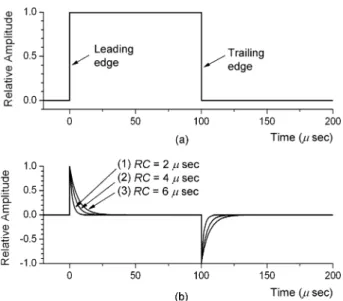
The edge-spike generation using an RC-HPF can be explained by a simple calculation. When a square wave passes through an RC-HPF, the positive and the negative spikes appear at the leading and the trailing edges, respectively. If a square wave input pulse has a leading edge at t=0 and a trailing edge at t=t
0, the positive and the negative edge-spikes appear at the RC-HPF output, which Fig. 1. The original data and the edge-spike waveforms. The original
data and (b) the edge-spike waveforms.
can be written as follows [6]
(1)
where V
0is the amplitude and RC the time constant. Figure 2 shows the edge-spike waveforms calculated from equation (1) when a square wave pulse is applied to an RC -HPF.
Figure 2(a) shows the square wave input and Fig. 2(b) the edge- spikes of the HPF output. In Fig. 2 (b), curves (1), (2), and (3) correspond to the RC-time constants 2, 4, and 6 μs, respectively.
The edge-spikes become sharper as the RC-time constant reduces.
The relation between the RC time constant and the 3-dB-cutoff frequency of the RC -HPF is
(2) The time constants of RC=2, 4, and 6 μs correspond to a RC- HPF cutoff frequency of f
c=80, 40, and 27 kHz, respectively. In the experiment, we used R=400 Ω, C=10 nF for RC-HPF, whose RC-time constant and cut-off frequency were about 4 μs and 40 kHz, respectively.
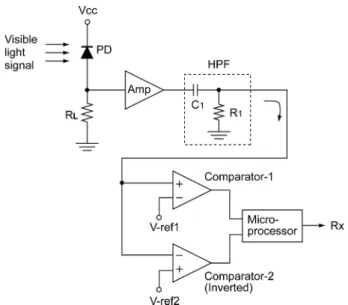
In the VLC receiver, we used the same RC-HPF as that in the transmitter to eliminate the 120 Hz noise from other lighting sources.
The cutoff frequency of the RC-HPF is much higher than the 120 Hz noise frequency; thus it cuts off the noise while receiving the edge- spike signal. Therefore, the edge-spike modulation is used for two purposes: to prevent the flicker of LED light in the VLC transmitter and to eliminate the 120 Hz noise in the VLC receiver.
2.2 VLC transmitter
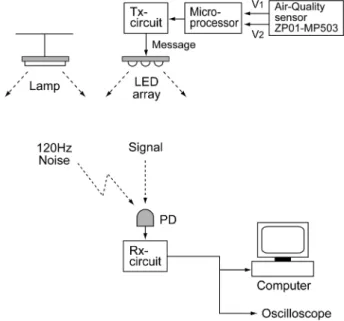
In the VLC transmitter, the LED current is modulated by the edge-spikes of the transmitted data. The schematic diagram of the VLC transmitter is shown in Fig. 3.
The input data is applied to an RC-HPF which is composed of a capacitor C
1and a resistor R
1. The RC-HPF generates the positive edge-spikes at the leading edges of the data and the negative edge-spikes at the trailing edges. The edge-spikes are applied to the gate of an FET, which is biased to operate in the linear region. The drain current passes through an LED array, and the LED light is proportional to the edge-spike signal. The LED light radiates into free space.
In our experiment, we used R
1=400 Ω, C
1=10 nF for RC-HPF, with a cut-off frequency of about 40 kHz. An OPA228 op-amp was used for the buffer, and an IRF540 FET for the LED current driver. The LED array was made of six 1W white LEDs in the form of a 2×3 planar array. To see the waveforms in the transmitter, the character “V” was generated by a microprocessor and applied to the input port of the VLC transmitter. Figure 4 shows the waveforms observed in the VLC transmitter with an oscilloscope.
Figure 4(a) shows the voltage waveform of the character “V” at the UART port of a microprocessor. It is an NRZ waveform at a
⎪⎩
⎪ ⎨
⎧
>
>
= +
− −− / 0 ) 0 (
0 /
; -
0 ) ;
( V e
0t t
t e
t V
v
t t RCRC t