• 검색 결과가 없습니다.

Rainfall and Water Quality Characteristics of Saemangeum Area

N/A
N/A
Protected

Academic year: 2021

Share "Rainfall and Water Quality Characteristics of Saemangeum Area"

Copied!
7
0
0

로드 중.... (전체 텍스트 보기)

전체 글

(1)

Abstract This study investigated characteristics of rainfall and water quality in Saemangeum area with attention to temporal and spatial distributions. A high variability in rainfall was noted during July and August. The temporal analysis of water quality data indicated that DO and TN as well as BOD, COD and SS were within national standards except for increased concentrations during spring and summer, unlike TP values that indicated poor water quality. Standard deviation showed a high variability in SS among the seasons most especially during summer. The high dispersion indicated variability in the chemical composition of pollutants where the temporal and spatial variations caused by polluting sources and/or seasonal changes were most evident for BOD and COD during winter and spring. The box plots and bar charts showed steadily low concentrations of BOD, COD, TN and TP except within Iksan and notable significant variations in SS concentrations among the monitoring stations. Thus, high pollution levels requiring intervention were identified in Mangyeong river basin with particular concern for areas represented by Iksan station.

It was noted that Iksan received a considerable amount of rainfall which meant high runoff which could explain the significant pollution levels revealed in the water quality spatial distribution.

Major pollution contributing pollutants within Saemangeum area were identified as SS, BOD, COD and TN. Therefore the present results could be used as a guideline for the temporal and spatial distributions analysis of both rainfall and water quality in Saemangeum watershed.

Keywords: rainfall, water quality, temporal, spatial, Saemangeum

Introduction

Water quality degradation can be a major cause of water scarcity.

Freshwater bodies have a limited capacity to process the pollution stemming from expanding urban, industrial and agricultural uses.

Water quality can also suffer in areas experiencing increases in rainfall. A decline in water quality can result from the increase in runoff and precipitation and while the water will carry higher levels of nutrients, it will also contain more pollutants. The amount of rainfall received over an area is an important factor in assessing the amount of water available to meet the various demands of agriculture, industry, and other human activities.

Therefore, the study of the distribution of rainfall in time and space is very important. Describing changes in the patterns of rainfall is an area that has received particular attention by researchers around the world (Pennycuick and Norton-Griffiths, 1976; Clavero et al., 1996; Ghosh et al., 2009).

The water quality in rivers is tending to get worse due to pollutants from surrounding watersheds (Bae, 2007; Kim, 2008).

In addition, changes in the flow rate of rivers between the rainy and dry seasons can create difficulties to maintain the water quality (Kang, 1995; Lee et al., 2005). While various factors can influence the water quality in rivers, rainfall events play an important role as carriers of NPS (non-point source) pollutants (Bae, 2007). Whitlock et al. (2002) disclosed a strong relationship between rainfall events and fecal coliform concentrations in Tempa Bay. Information on water quality and pollution sources is important for the implementation of sustainable management strategies (Sarkar et al., 2007; Zhou et al., 2007; Nouri et al., 2008; Bu et al., 2010; Soner Kara and Onut, 2010).

Water quality is important for assessing the state of a watershed and making necessary management decisions to control the current and future pollution of receiving water bodies (Khadam and Kaluarachchi, 2006; Behbahaninia et al., 2009). The degradation of water bodies due to high levels of pollution originating from watersheds is quite alarming around the world.

Increasing amounts of NPS pollution are being discharged into receiving waters, thereby deteriorating the water quality (Somura

*Corresponding author: Kyung-Sook Choi Tel: 82-53-950-5731; Fax: 82-53-950-6752 E-mail: [email protected]

This is an Open Access article distributed under the terms of the Creative Commons Attribution Non-Commercial License (http://creativecommons.

org/licenses/by-nc/3.0/) which permits unrestricted non-commercial use, distribution, and reproduction in any medium, provided the original work is properly cited.

© 2014 Institute of Agricultural Science and Technology, Kyungpook

National University

(2)

204 Monica and Choi

et al., 2012). The interpretation of water quality and rainfall data for extracting useful information and effective management of surface water can be approached through the use of statistical methods. Therefore, this study analyzed rainfall and water quality data in Saemanguem area to understand the temporal and spatial distributions for appropriate water quality management in that area.

Materials and Methods

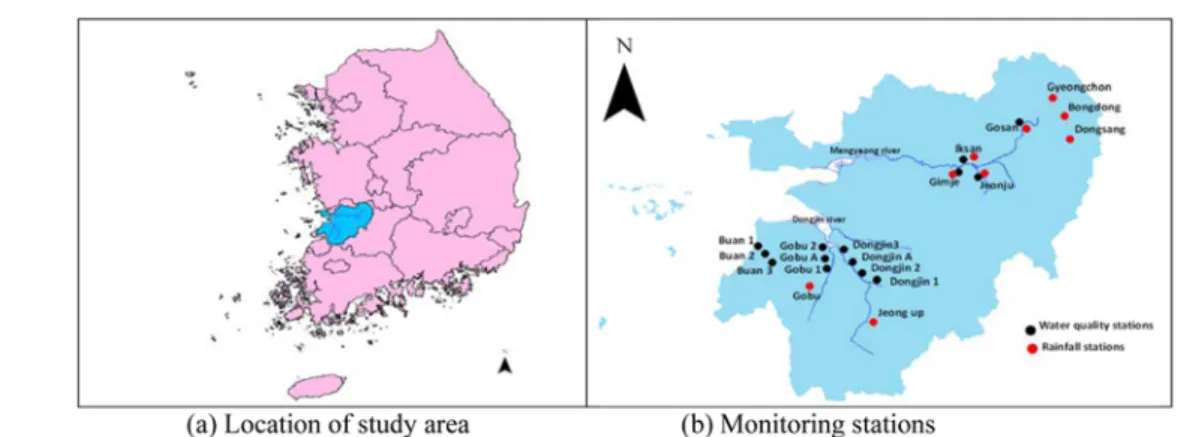
Saemangeum is located in southwest of the Korean Peninsula as shown in Figure 1 (a). A tidal flat in the estuaries of the Mangyeong and Dongjin rivers, Saemangeum has a unique significance among South Korea’s many coastal ecosystems. Its main purpose is to secure sufficient agricultural lands against shortage of provisions prior to the 1980s in Korea and to also create an economic hub. Thus, since water quality management is crucial to provide an adequate water supply for the newly reclaimed land, this study analyzed the rainfall and water quality data for this area.

For this purpose, the dataset included rainfall from 9 stations and water quality from 14 monitoring stations, as shown in Figure 1 (b). The rainfall stations were Bongdong, Dongsan, Gimje, Gobu, Gosan, Gyeongcheon, Jeong up, Jeonju and Iksan while the water quality monitoring stations were Dongjin 1, Gobu A, Gobu 1, Gobu 2, Dongjin 2, Dongjin 3 and Dongjin A, Buan 1, Buan 2, Buan 3, Jeonju, Gimje, Gosan and Iksan. The rainfall data were obtained from the Water Management Information system (WAMIS)/Korea Meteorological Association (KMA), while the water quality data were extracted from Water Information System (WIS)/Integrated Environment Information (IEI) websites. The data period was between Jan. 2006 and Dec. 2010 and the water quality items were considered 6 variables including Dissolved Oxygen (DO), Biochemical Oxygen Demand (BOD), Chemical Oxygen Demand (COD), Suspended Solids(SS), Total Nitrogen (TN) and Total Phosphorus (TP) surveyed on monthly/8-day basis. Descriptive statistics and box plots were all used in the

analysis of rainfall and water quality with the help of Microsoft Excel 2007 and SPSS 21. Descriptive statistics analyses of the parameters were carried out based on seasons and Mangyeong and Dongjin river basins. Table 1 shows the input data used in this study and its source.

Results and Discussion Rainfall analysis

Figure 2 shows the mean monthly and annual values derived from the daily rainfall records. The mean monthly values showed a significant increment in the rainfall distribution between June and September at all the monitoring stations which is indicative of the summer season when the maximum rainfall is received. The mean annual values showed relatively high variation among stations.

The lowest amount of rainfall occurred in Jeonju with 951.6 mm of annual rainfall while the maximum was recorded in Dongsang with 1,264.4 mm of annual rainfall. A significant amount of rainfall causes a high runoff which could explain the significant levels of pollution in the water quality spatial distribution.

Water quality analysis

Table 2 shows the temporal descriptive statistics based on the different seasons. The BOD, COD and SS on average were within national standards for good quality water except for the increased concentrations during spring and summer. Meanwhile, DO and TN values on average were within the required national standards for good quality water, although TP values indicated poor water quality. The standard deviation showed a higher variability in SS among the 4 seasons, and most especially during summer. Most Figure 1. Saemangeum area.

Table 1. Input data and source

Data Type Data description Period Source Rainfall Daily rainfall

(mm)

2006 to 2010

WAMIS/KMA

Water Quality DO, BOD, COD,

SS, TN, TP WIS/IEI

(3)

parameters exhibited a high dispersion, indicating a temporal variability in the chemical composition of the pollutants caused by the polluting sources and/or seasonal changes, which was most evident with BOD and COD, especially during winter and spring.

Figure 3 shows the temporal distribution of the parameters derived from grouping the data according to seasons. It was noted that the mean DO concentrations increased winter and spring and were lowest in autumn and summer, as oxygen dissolution is high at low water temperatures. Although there were no significant differences in BOD and COD concentrations, a slight increase

was noted in winter which may have been due to increased levels of aerobic processes like the decomposition of aquatic life.

However, there were significant variations in the TN and TP concentrations, where the decreased concentrations in winter and spring were likely due to the low in the agricultural activities during these seasons, with the reverse being true for summer and autumn.

Table 3 shows the descriptive results obtained by grouping of data according to the respective basins. In this case, the monthly mean COD levels were not within the national standards, Figure 2. Monthly and annual rainfall distributions.

Table 2. Temporal descriptive statistics of water quality

Season Item DO

(mg/l)

BOD (mg/l)

COD (mg/l)

SS (mg/l)

TN (mg/l)

TP (mg/l)

Winter

Min 01.40 000.10 001.80 000.10 000.34 00.00

Max 18.10 190.50 151.60 154.80 099.60 06.09

Mean 11.95 007.99 010.94 016.86 007.08 00.35

STDEV 02.50 021.88 018.51 022.68 012.72 00.80

Spring

Min 00.30 000.20 001.80 000.20 000.30 00.00

Max 17.60 574.50 318.30 479.00 124.62 13.55

Mean 10.47 010.08 011.24 023.17 005.68 00.36

STDEV 02.63 037.96 023.60 043.20 010.83 01.07

Summer

Min 01.60 000.20 002.10 000.10 000.71 00.00

Max 14.40 033.10 050.60 390.50 028.11 04.63

Mean 08.17 003.30 007.51 023.43 003.33 00.21

STDEV 01.94 003.56 005.26 038.64 002.95 00.40

Autumn

Min 02.30 000.20 001.90 000.20 000.34 00.00

Max 15.00 098.80 106.60 118.00 094.06 04.68

Mean 09.41 005.32 009.63 020.01 005.42 00.27

STDEV 02.37 011.40 013.12 023.57 011.66 00.54

(4)

206 Monica and Choi

Figure 3. Box plots of temporal distribution (*WI-winter; SP-spring; SU-summer; AU-autumn).

Table 3. Spatial descriptive statistics for water quality

Basin Item DO

(mg/l)

BOD (mg/l)

COD (mg/l)

SS (mg/l)

TN (mg/l)

TP (mg/l)

Dongjin

Min 03.90 000.10 001.80 000.10 000.30 00.00

Max 18.10 011.50 018.70 390.50 013.16 01.89

Mean 10.23 002.61 006.34 019.41 002.95 00.11

STDEV 02.52 001.93 003.31 029.18 002.09 00.12

Mangyeong

Min 00.30 000.20 001.80 000.10 000.66 00.00

Max 17.10 574.50 318.30 479.00 124.62 13.55

Mean 08.98 013.73 016.24 022.91 009.84 00.66

STDEV 03.14 041.12 028.68 045.47 017.01 01.29

(5)

requiring more emphasis on management. However, the mean values for DO, BOD, SS, TN and TP for both basins were within the required national standards. A significantly high dispersion of SS levels was noted in both basins. The high dispersion of BOD, COD and SS noted in Mangyeong basin were likely due to spatial variations caused by polluting sources and/ or spatial related sources. The Dongjin basin generally showed better water quality conditions than Mangyeong basin. Figure 4 presents the mean monthly values with standard error bars for the various monitoring stations. It was noted that the mean DO levels were consistently

high at all the stations, except for Iksan where it was extremely low, and a reverse trend was noted for the mean levels of BOD, COD, SS, TN and TP. This may have due to organic pollution and human related activities such as the application of fertilizers in agricultural fields.

A box plot representation of each water quality monitoring site

shown in Figure 5. This revealed that BOD, COD, TN, and TP

concentrations were consistently low, except at Iksan which

showed a high dispersion. A significant variation in the SS

concentration was noted at all the monitoring stations, which was

Figure 4. Mean monthly concentrations of each station.

(6)

208 Monica and Choi

likely due to human activities, such as construction. The dotted red lines indicate the required level III national standards for river water quality, which are DO>5 mg/l, BOD<5 mg/l, COD<7 mg/

l, and SS<25 mg/l for acceptable water for agriculture.

Conclusions

The temporal and spatial distribution of rainfall and water quality

data were analyzed using descriptive statistics and different

graphical representations. The annual rainfall showed relatively

high variation between stations with 951.6 mm of the lowest

rainfall from Jeonju and 1,264.4 mm of the highest rainfall from

Dongsang. Long term datasets on daily and monthly scale are

required which in turn can be used to study spatial and temporal

variability of rainfall over the study area. From the temporal

distribution analysis of the water quality data, DO showed an

Figure 5. Box plots of spatial distribution.

(7)

TN and TP. This may have been due to organic pollution and human-related activities such as the application of fertilizers in agricultural fields. Therefore, the rainfall distributions of the two basins exhibited different characteristics. In particular, areas represented by Iksan station and Mangyeong basin in general showed pollution levels that exceeded national standards. While SS appeared to be the main contributor of pollution, other pollutants included BOD, COD and TN. However, further investigation is needed with data from more stations and over a longer time period. Notwithstanding, the present results can still be used as a guide for the temporal and spatial distributions analysis of both rainfall and water quality within Saemangeum area.

References

Bae HK (2007) Modeling approaches to predict conditions of water quality using physical, chemical, and hydrological data focused on biological contaminations. Ph.D. dissertation, University of California, Irvine.

Behbahaninia A, Mirbagheri SA, Khorasani N, Nouri J, Javid AH (2009) Heavy metal contamination of municipal effluent in soil and plants. J Food Agric Environ 7: 851-856.

http://water.nier.go.kr/main/mainContent.do

http://www.wamis.go.kr/WKW/RF_DUBRFOBS.ASPX?

Kim CW (2008) Watershed Characteristics Affecting Water Quality in Urban Streams, Ph.D. dissertation, University of Seoul, Korea.

Lee JM, Park CK, Kim C (2005) A study for source and distribution of Boron in Nakdong River. Jaurnal of Korean Society On Water Environment 21: 236-241.

Nouri J, Karbassi AR, Mirkia S (2008) Environmental management of coastal regions in the Caspian Sea. Int J Environ Sci Tech 5: 43-52.

Pennycuick L, M Norton-Griffiths (1976) Fluctuations in the rainfall of the Serengeti ecosystem, Tanzania. J Biogeogr 3: 125-140.

Sarkar SK, Saha M, Takada H, Bhattacharya A, Mishra P, Bhattacharya B (2007) Water quality management in the lower stretch of the river Ganges, east coast of India: an approach through environmental education. J Clean Prod 15: 1559-1567.

Somura H, Takeda I, Arnold JG, Mori Y, Jeong J, Kannan N, Hoffman D (2012) Impact of suspended sediment and nutrient loading from land uses against water quality in the Hii River basin, Japan. J Hydrol 450:

25-35.

Soner Kara S, Onut S (2010) A stochastic optimization approach for paper recycling reverse logistics network design under uncertainty. Int J Environ Sci Tech 7: 717-730.

Whitlock JE, Jones DT, Harwood VJ (2002) Identification of sources of fecal coliforms in an urban watershed using antibiotic resistance analysis. Water Res 35: 4273-4282.

Zhou F, Huang GH, Guo HC, Zhang W, Hao Z (2007) Spatio-temporal

patterns and source apportionment of coastal water pollution in eastern

Hong Kong. Water Res 41: 3429-3439.

수치

Figure 2 shows the mean monthly and annual values derived from the daily rainfall records
Table 3 shows the descriptive results obtained by grouping of data according to the respective basins
Table 3. Spatial descriptive statistics for water quality

참조

관련 문서

Characteristics of water quality at East China Sea in southwestern sea of Jeju Island in summer..

Sources: metal plating, rechargeable batteries, smelting (제련), refining, mine drainage, industrial wastewater, corrosion of galvanized pipe in the water distribution

– Treat wastewater before it is discharged to maintain the water quality of the natural waters for the benefit of humans and aquatic ecosystem. • Wastewater management goal

A Study on the Meteorological Characteristics Associated with Heavy Rainfall Case of July 9, 2009 Using KLAPS Reanalysis Data..

The Analysis of Characteristics of Heavy Rainfall over the Korean Peninsular, through Case Studies of Heavy Rainfall Events.. during the On - and Off -

From result of this study, we could confirm that if we alternate existing clarifiers type of emission water treatment facilities into PCF of which site

20≤n : high water solubility, limited surfactant quality n&lt;5 : little significant water solubility... Molecular Basis

In this study, Sulgidduk was prepared with adding finger root ( Boesenbergia rotunda ) powder containing a large amount of functional substances, and the