• 검색 결과가 없습니다.

Mechanical and Hygroscopic Behaviour of Teak Wood Sawdust Filled Recycled Polypropylene Composites

N/A
N/A
Protected

Academic year: 2021

Share "Mechanical and Hygroscopic Behaviour of Teak Wood Sawdust Filled Recycled Polypropylene Composites"

Copied!
7
0
0

로드 중.... (전체 텍스트 보기)

전체 글

(1)

Paper

Mechanical and Hygroscopic Behaviour of Teak Wood Sawdust Filled Recycled Polypropylene Composites

Anil Kumar Yadav *

, Rajeev Srivastava *

ABSTRACT: In this paper, mechanical and hygroscopic properties of teak sawdust and recycled polypropylene (RPP) composites are evaluated and compared with virgin polypropylene (VPP) matrix based composites. Verities of composites are prepared by variation in the plastic types, wood plastic ratio and the addition of coupling agent in the formulations. Mixing of wood sawdust and polypropylene is done by a twin screw extruder, and then sheets of wood plastic composites (WPCs) are produced by using the compression molding method. The results show that recycled matrix composites exhibit better tensile, flexural strength with low impact strength than virgin matrix based composites. Recycled composites show low water absorption and thickness of swelling than virgin matrix based composites. The results confirm that wood content in the polymer matrix affects the performance of composites while presence maleated polypropylene (MAPP) improves the properties of the composites significantly. Developed RPP matrix composites are as useful as VPP matrix composites and have the potential to replace the wood and plastics products without any adverse effect of the plastics on the environment.

Key Words: Matrix, Water absorption, WPCs, Tensile strength, Flexural strength, Impact strength, MAPP

1. INTRODUCTION

In the present era, plastic waste is an emerging problem of the world and its safe disposal is a serious public concern. The total plastic waste generated by the world is approximately 100 million tons per annum. In India about 39031 tons of plastic waste is generated by domestic and industrial applications of the plastics, out of which 40-80% plastic waste is recycled and remaining used for landfill. Similarly, a huge amount of wood waste is generated at the different stages of wood processing, which is generally destined for landfill and energy resource for cooking of food [1-3]. These solid wastes generate green house gases when it uses for landfills and cooking which affect the environment adversity. Utilization of these wood-plastic wastes in the production of wood plastic composites (WPCs) can make its disposal cast effective and it can also reduce the car- bon footprint of the plastics. Wood plastic composites are the mixture of wood and plastics, generally, PP, PS, PVC, PE, PAT are thermoplastics utilized for the fabrication of WPCs. Repro-

cessing affects the properties of the polymer, which makes it different from its parent materials. Recycling of the polymer increases the tendency of polymer molecules to make covalent and ionic bonds with other molecules of the polymer. This tendency of polymer promotes cross-linking of the polymer chain which increases the chain length and affects the density and viscosity of the polymer, therefore recycled polymers can be considered as new polymer materials [4-6]. Mixing and adhesion of wood particles with polymers are difficult as wood and plastic are entirely different in nature. Bonding between wood particles and polymers is poor due to their chemical properties, which affects the performance of WPCs. The adhe- sion of polymers with the wood particle can be improved by using coupling agents in small amount (0-5%) in the matrix of the composites. The MAPP, MAP, EPOLE, and E-43 are gen- erally used as coupling agents in the fabrication of WPCs [1,7- 9]. The use of natural fiber and wood flour in the reinforce- ment of plastics has been increased significantly in some decades. There are a number of publications on reinforcement

Received 7 August 2018, received in revised form 23 September 2018, accepted 27 September 2018

*

*

Mechanical Engineering Department, MNNIT Allahabad, India (E-mail: [email protected])

Mechanical Engineering Department, MNNIT Allahabad, India (E-mail: [email protected])

(2)

of the plastics by wood fiber and wood particle, but the num- ber of studies on recycled polymer matrix based WPCs is very few [10,11]. In this paper, preparation and properties of WPCs made from VPP/RPP and teak wood sawdust are evaluated.

The effect of type of polymer (virgin/recycled), wood content and coupling agent (MAPP) on mechanical and hygroscopic properties of the composites are compared. Tensile, flexural and impact test are conducted for mechanical characterization of the composites. The water absorption and thickness of swell test are performed to ensure the dimensional stability of the composites. Aim this is to explore the possibility of utilization of post-consumed polypropylene and teak wood sawdust in the fabrication of strength-full, lightweight, eco-friendly and cost-effective wood-plastic composites in engineering and domestic applications.

2. MATERIALS AND METHODS

2.1 Polymer

Virgin polypropylene of Grade 110MA is collected from a local dealer of Repole (Reliance Petroleum, India) grade of and Recycled polypropylene is collected from a local recycler of polymer from Vishal polymers, Kanpur, India. The granules are dried in air circulatory oven for 12 h at 65

o

C to remove the moisture content of the polymer.

2.2 Wood Sawdust

Teak wood sawdust is used as filler material in the com- posites. Fresh teak wood sawdust is collected from a local sawmill. Teak wood contained 60-69% holocellulose 30-35%

lignin and remaining is water and others. Sawdust is dried in air circulatory oven for 24 h at 110

o

C for complete moisture removal. Sawdust particles of size 200-250 μm have been sep- arated by sieve separation method in the lab at room tem- perature of 23

o

C-25

o

C.

2.3 Coupling Agent

Maleated polypropylene (MAPP) is used as coupling agent in the fabrication of composites. Sigma adrich-427845 is used as coupling agent.

2.4 Composite Preparation

Virgin PP/recycled PP and wood particles are compounded by twin screw extruder according to formulation of Table 1 for homogeneous mixing of the wood sawdust and polypro- pylene. The twin screw extruder was PLC controlled and had four temperature zone of 160

o

C, 170

o

C, 180

o

C, 190

o

C respec- tively. The screws speed was of 90 r.p.m. at barrel pressure 40 bar at the time of mixing and extrusion of the compounded material (Fig. 1a). Compounded material comes out in the form of wire through a bath tub. This compounded wire are collected and separated according to their code (Fig. 1b).

Table 1. Formulation and specimen code

S. No. Composite code Wood sawdust

(%Weight)

Polypro-pylene (%Weight)

Coupling agent (%Weight) Virgin polypropylene Recycled polypropylene

1 V1 R1 00 100 00

2 V2 R2 20 80 00

3 V3 R3 30 70 00

4 V4 R4 40 60 00

5 V5 R5 50 50 00

6 V6 R6 50 47 03

7 V7 R7 50 45 05

Fig. 1. Manufacturing process of composites

Fig. 2. Scamatic diagram of twin screw extruder

(3)

These wire then cut into small pieces called granules by using a cutter (Fig. 1c).

These compounded granules have moisture, so they kept at 75

o

C for 4 h in air circulatory oven to remove moisture content from it. After removal of moisture, the composite sheet has been fabricated by compression molding method. The compounded granules are pressed at a load of 5 tons in a die of dimension 180 mm × 150 mm × 3 mm at 200

o

C for 4-5 minute (Fig. 1d).

3. EXPERIMENTS

3.1 Tensile test

Tensile test are conducted according to ASTM D638-14 [12]

standard using TINIUS OLSEN universal testing machine having 10 kN load cell. The dumb-bell shape standard test specimens were cut from their respective sheets. The tests are conducted at crosshead speed of 5 mm/min with the 5 kN load cell. The machine is computerized system and supported with Q MAT software. The data has been recorded by the Q- MAT software. Three specimens of each composition are tested and average values of them are reported. All tests were performed at room temperature 23 ± 2

o

C.

3.2 Flexural Test

Flexural strength of the WPCs was measured by three-point bending test according to ASTM standard D790-03 [13]. The flexural tests are conducted on the same machine at the cross- head speed of 2.8 mm/min with the 2.5 kN load cell. The test specimens of dimensions 76.2 mm × 25.4 mm × 3.2 mm were cut from their respective composite sheets. Three specimens of each formulation are tested at 23 ± 2

o

C with relative humidity 50 ± 5%.

3.3 Impact Test

Impact tests of the composite have been performed on Presto impact testing machine and results are recorded by presto impact testing software. The experiments are per- formed according to ASTM standard D256-10 [14]. The spec- imens of 63.5 mm × 12.5 mm × 3.2 mm were cut from their respective sheets and notch of 42

o

were cut in every specimen by notch cutting machine.

3.4 Water Absorption Test

Water absorption test is conducted according to ASTM standard D570-98 [15]. The specimens were heated in air cir- culatory oven for 24 h at 105

o

C to remove the moisture con- tent and cooled in desiccator. The test specimens we placed in the container of distilled water at a maintained temperature of 23 ± 1

o

C for 24 h. The specimens were properly weighted at an interval of 2 h and 24 h with the accuracy of .001 gm. The per- centage of water absorption is calculated by using the follow- ing equation

(1)

Where W

i

and W

f

are the initial and final weight of the spec- imen after immersion in the water.

3.5 Thickness of Swell Test

Thickness swelling of the composites is measured with micrometer having least cont of 0.01 mm. The percentage of thickness swell (TS) of specimens are calculated by using the following equation-

(2) Where δ

i

and δ

f

are the initial and final thickness of the spec- imen after immersion in the water.

4. RESULTS AND DISCUSSION

4.1 Tensile Test

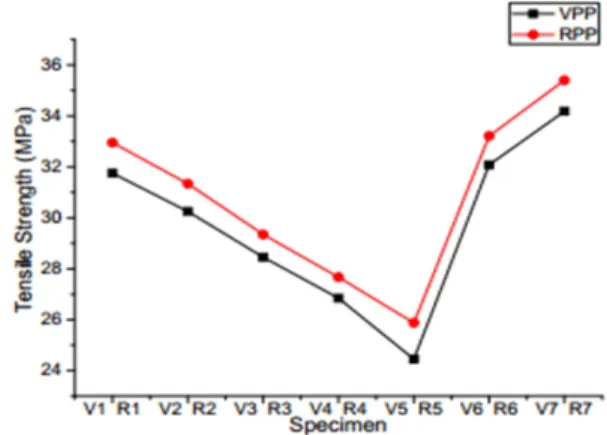
The tensile strength of each formulation have been tested and plotted in Fig. 3. The tensile strength of polymer RPP and VPP are 34.18 MPa and 35.40 MPa respectively. The plots show that maximum tensile strength of VPP and RPP matrix composites is 30.25 MPa (V2) and 31.24 MPa (R2) respec- tively. The minimum tensile strength of VPP and RPP matrix composite is 24.45 MPa (V5) and 25.88 MPa (R5). It has been observed that increase of wood content in the polymer matrix reduces the strength of the composites from 30.25 MPa (V2) to 24.45 MPa (V5) and 31.34 MPa (R2) to 25.88 MPa (R5) as shown in Fig. 3.

Incorporation of 3%wt MAPP in the matrix of the com- posite improves the tensile strength significantly as composite V6 (32.08 MPa) and R6 (33.21 MPa) have greater tensile strength than composites V5 (24.45 MPa) and R5 (25.88 MPa). The increase of MAPP from 3%wt to 5%wt in the matrix increases the tensile strength 32.08 MPa (V6) to 34.18 MPa (V7) and 33.21 MPa (R6) to 35.4 MPa (R7) [23]. Incor- poration of MAPP in the polymer matrix improved the inter-

WA % ( ) W

f

W

i

W

i

--- 100 ×

=

TS % ( ) δ

f

– δ

i

δ

i

--- 100 ×

=

Fig. 3. Tensile test of composites

(4)

facial bonding between wood particles and polymer which attributes to better tensile strength [11,16,17].

4.2 Flexural Strength Test

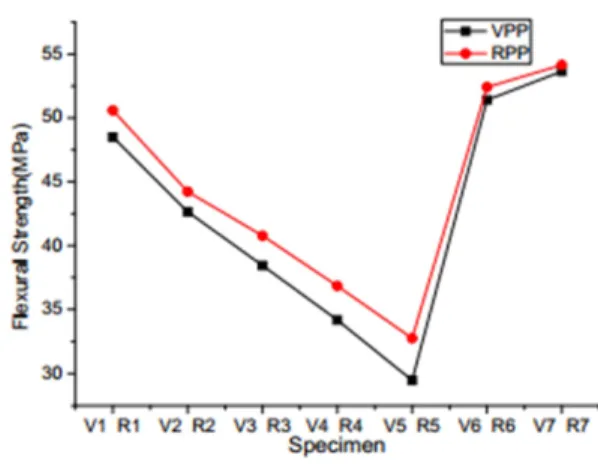
Flexural strength of the composites were recorded and plot- ted in Fig. 4. The VPP and RPP polymer show the flexural strength of 48.50 (MPa) and 50.59 MPa respectively. Virgin matrix based composite have maximum flexural strength 42.65 MPa (V2) and minimum flexural strength 29.47 MPa (V5). In the same way recycled matrix based composite have maximum flexural strength 44.23 MPa (R2) and minimum flexural strength 32.75 MPa (R5).

The flexural strength of virgin matrix based composites reduces from 42.65 MPa (V2) to 29.47 MPa (V5) and recycled matrix based composite reduce from 44.23 MPa (R2) to 32.75 MPa (R5) due to the increase of wood content in the matrix.

The brittleness of the composites increases as well as wood content increases in the polymer matrix [16].Flexural strength of VPP/RPP matrix based composites increased considerably by the addition of MAPP. The results show the flexural strength of V6 (51.41 MPa) and R6 (52.41 MPa) better than V5 (29.47 MPa) and R5 (32.75 MPa) after addition of 3%wt MAPP in the polymer. It has been observed that composites V7 (53.64 MPa) and R7 (54.15 MPa) show better strength than V6 (51.41 MPa) and R6 (52.41 MPa) after addition of 5%wt MAPP in the polymer matrix. The MAPP increases the interfacial adhesion between wood and polymer, which show the positive effect on the flexural strength of the composite [18].

4.3 Impact Test

The impact strength of the composite plotted in Fig. 5. The plots refer that the impact strength of the composite made by virgin pp decreases continuously from 329.01 J/m (V2) to 168.33 J/m (V5) due to loading of wood content, similarly impact strength of recycled PP matrix composite decreases from 267.5 J/m (R2) to 132.89 J/m (R5).

It has been observed that VPP (376.54 J/m) has higher

impact strength than RPP (323.76 J/m), likewise, VPP based composites have higher impact strength than RPP bases com- posites. Recycling of the polymer produces adverse effect on impact strength of the polymer. Impact strength of composites increases on addition of 3% MAPP in the matrix from V5 (168.33 J/m) to V6 (196.84 J/m) and R5 (132.89 J/m) to R6 (178.9 J/m). Composites V7 (222.5 J/m) and R7 (188.78 J/m) have better impact strength than V6 (196.84 J/m) and R6 (178.9 J/m), due to addition of 5%wt MAPP in the matrix. The coupling agent increases the bonding between wood and poly- mer which improves the impact strength of the composite sig- nificantly [18].

4.4 Water Absorption Test

Water absorption test for all formulations of VPP and RPP matrix based composites with and without MAPP were con- ducted. The percentages of water absorption by the compos- ites have been calculated by using equation (1). The outcomes of 2h and 24 h experiment are plotted in the Fig. 6 and Fig. 7.

It has been observed that water uptake of the composites increased with the increase of wood filler in the composites.

The VPP and RPP polymers show negligible water absorption during this investigation. The water absorbed by VPP and RPP during this experiment was 0.03% and 0.02% in 2 h, similarly 0.06% and 0.05% for the 24 h. The water absorption of VPP Fig. 4. Flexural test of composites

Fig. 5. Impact tests of composites

Fig. 6. Water absorption test for 2 h

(5)

matrix composite varies from 0.09% to 1.65% for 2 h test and from 0.28% to 5.17% for 24 h period. Similarly, the water uptake by RPP matrix based composite in 2 h varies from 0.08% to 1.46% and for the 24 h period from 0.25% to 4.68%.

Water absorption is maximum for the composite produced by VPP with 50% of wood filler (V5). The RPP based composite show low water absorption than VPP based composite (R5) at the same wood content [11]. Addition of 3% or 5% MAPP in the polymer matrix reduces the water absorption significantly as shown in Fig. 6 and 7. Reprocessing of polymer generates additional functional group and improves the adhesion between wood and plastic, which significantly reduces the water uptake of the composites [19].

4.5 Thickness of Swell Test

The thickness of swelling (TS) corresponds to water absorp- tion of the composite due to poor encapsulation of wood flour by the polymer matrix. Thicknesses of the swell of all for- mulations are given in Fig. 8 and Fig. 9 for 2 h and 24 h respec- tively. Initially, TS of the composite is high as water uptake by the composite is high. Percentage of swelling is calculated by using the equation (2) in the experiment. The result confirms

that 50:50 wt% wood flour–VPP composite (V5) show higher thickness of swelling, which corresponds to the highest water absorption.

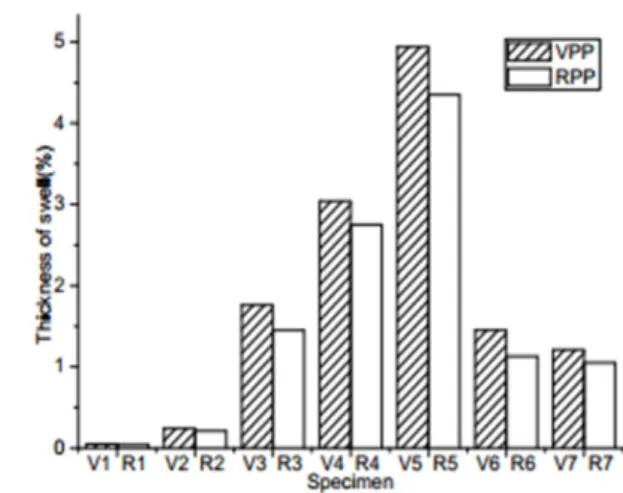
Thickness swelling of the composite increases with increase of wood content and follow the trend of water absorption. The thickness swelling in 2 h of the RPP matrix composite varies from 0.06 to 1.35% and VPP matrix composite from 0.05% to 1.48% (Fig. 8). Similarly in 24 h it varies from 0.21% to 4.35%

for RPP matrix composite and 0.24% to 4.94% for VPP matrix composite (Fig. 8). TS of the RPP matrix based composite (R5) is lower than VPP matrix bases composite (V5) in 2 h (Fig. 7) and it reveal the similar trend in 24 h experiment (Fig. 8).

The experiment confirms that RPP matrix based composite exhibits low thickness of swell than VPP matrix based com- posite. Incorporation of 3% of MAPP reduces the TS of RPP and VPP matrix composite from 1.35% (R5) to 0.61% (R6) and 1.48% (V5) to 0.68% (V6) for 2 h test, similarly for 24 hr test 4.35% (R5) to 1.13% (R6) and 4.94% (V5) to 1.45% (V6).

In the case of 5% addition of MAPP in RPP and VPP com- posites, it reduces from 1.35 % (R5) to 0.57% (R7) and 1.48 (V5) to 0.62% (V7) for 2 h and 4.35% (R5) to 1.05% ( R7) and 4.94% (V5) to 1.21% (V7) for 24 h respectively [11,20,21].

Fig. 7. Water absorption test for 24 h

Fig. 8. Thickness of swell test for 2 h

Fig. 9. Thickness of swell test for 24 h

Fig. 10. SEM of Virgin PP matrix composite V5

(6)

4.6 Scanning Electron Microscope (SEM) Analysis of Composites

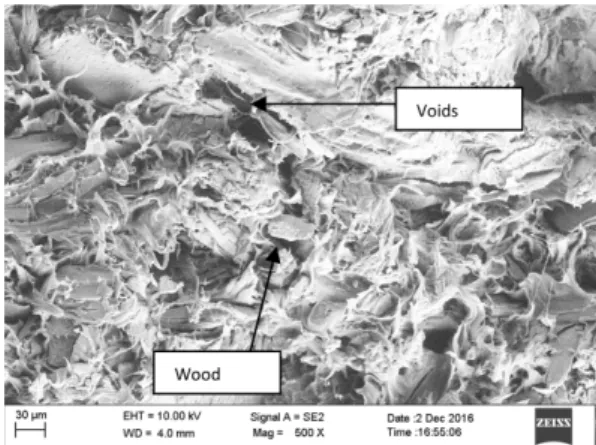
The microscopic image of the tensile test specimen have been examined at different magnification. The Fig. 10 and Fig.

11 are SEM image virgin and recycled matrix based composite having 50% wood and 50 polymer. SEM shows that the blend- ing of wood and polymer is homogeneous, the white flairs show the polymer content and black spot shows the void

forms due to pulling of wood particles from that place. Fig. 12 is image of Virgin PP matrix based composite having 3% of MAPP in the mixture and Fig. 13 is RPP matrix based com- posites having 3% MAPP.

The water absorption takes place in the WPCs at the inter- face of wood and polymers. It has been observed that wood particle is not properly encapsulated by polymer in Fig. 10 and Fig. 11 which are responsible for higher water uptake. The scan Fig. 12 show comparatively fine incorporation of wood and plastic. The distribution of the wood particle in the recy- cled matrix composite is uniform in compare to virgin PP matrix based composite in every scan. The incorporation of MAPP in the composite improves the adhesion properties of wood particles with polymer Fig. 12 and Fig. 13. MAPP increase the interfacial bonding between wood and polymer by formation of covalent bonds due to etherification mech- anism. These bonding mechanisms improve the mechanical and hygroscopic properties of the composite

5. CONCLUSION

The observation carried out from the mechanical and hygroscopic testing of different formulations of teak wood sawdust and recycled/virgin polypropylene composite are-

1. The mechanical strength of the composite depends upon the filler loading as well as wood content increases in the formulations the strength of the composites decreases sig- nificantly.

2. The types of polymer also affects the the mechanical strength of the composites. Recycled polymer matrix based composites exhibit good mechanical and tensile strength but poor impact strength.

3. Loading of wood content in the polymer affect the water absorption and thickness of swell properties of the com- posites. Increase of wood content in the matrix increases the water absorption and thickness of swell of the com- posites.

4. Incorporation of MAPP in the polymer matrix increases the mechanical strength of the composites and reduces the water absorption and thickness of swell of the com- posites it has been als confirmed by SEM.

5. The observation drawn from the above results show that recycled polymer matrix based composites are as useful as virgin matrix based composites for different industrial and domestic applications.

ACKNOWLEDGEMENT

The authors express their gratitude and sincere thanks to Shri Praveer Verma Scientist ‘F’ DMSRE, Kanpur and Prof.Anand Kumar, Head of Department Mechanical Engi- neering, HBTI Kanpur for their kind support and encour- agement.

Fig. 11. SEM of Recycled PP matrix composite R5

Fig. 12. SEM of Virgin PP matrix composite V6

Fig. 13. SEM of Recycled PP matrix composite R6 after Water

absorption test

(7)

REFERENCES

1. La Mantia, F.P., and Morreale, M., “Green Composites: A Brief Review,” Composites Part A: Applied Science and Manufactur- ing, Vol. 42, No. 6, 2011, pp. 579–588.

2. CPCB Annual Report 2014.

3. Najafi, S.K., and Englund, K.R., “Effect of Highly Degraded High-Density Polyethylene (HDPE) on Processing and Mechani- cal Properties of Wood Flour-HDPE Composites,” Journal of Applied Polymer Science, Vol. 129, No. 6, 2013, pp. 3404-3410.

4. Ashori, A., and Nourbakhsh, A., “Characteristics of Wood–

fiber Plastic Composites Made of Recycled Materials,” Waste Management, Vol. 29, No. 4, 2009, pp.1291–1295.

5. Adhikary, K.B., Shusheng, P., and Staiger, M.P., “Long Term Moisture Absorption and Thickness Swelling Recycled Ther- moplastics Reinforced with Pinus Radita Sawdust Recycled and Virgin High Density Polyethylene,” Chemical Engineering Jour- nal, Vol. 142, 2008, pp. 190-198.

6. Kurniawan, D., Kim, B.S., Lee, H.Y., and Lim, J.Y., “Effects of Repetitive Processing, Wood Content, and Coupling Agent on the Mechanical, Thermal, and Water Absorption Properties of Wood/ Polypropylene Green Composites,” Journal of Adhesion Science and Technology, Vol. 27, No. 12, 2013, pp. 1301–1312.

7. Bledzki, A.K., Faruk, O., and Huque, M., “Physico-mechanical Studies of Wood Fiber Reinforced Composites,” Polymer-Plas- tics Technology and Engineering, Vol. 41, No. 3, 2002, pp. 435–

451.

8. Adhikary, K.B., Pang, S., and Staiger, M.P., “Dimensional Sta- bility and Mechanical Behaviour of Wood–plastic Composites Based on Recycled and Virgin High-density Polyethylene (HDPE),” Composites Part B: Engineering, Vol. 39, 2008, pp.

807–815.

9. Polletto, M., Zani, M., and Zettra, A.J., “Effects of Wood Flour Addition and Coupling Agent Content on Mechanical Proper- ties of Recycled Polystyrene/wood Flour Composites,” Journal of Thermoplastic Composite Materials, Vol. 25, No. 7, 2012, pp.

821-833.

10. Butylina, S., Martikka, O., and Karki., T., “Comparison of Water Absorption and Mechanical Properties of Wood–plastic Com- posites Made from Polypropylene and Polylactic Acid,” Wood

Material Science & Engineering, Vol. 5, 2010, pp. 220-228.

11. Najafi, S.K., Marznaki, M.M., and Chaharmahali, M., “Effect of Thermo-mechanical Degradation of Polypropyleneon Hygro- scopic Characteristics of Wood Flour-polypropylene Compos- ites,” Journal of Polymers and the Environment, Vol. 18, 2010, pp. 720–726.

12. ASTM D 638-14. Standard Test Method for Tensile Properties of Plastics. Annual Book of ASTM Standard. West Consho- hocken, PA: ASTM, 2014.

13. ASTM D 790-03. Standard Test Method for Flexural Properties of Plastics. Annual Book of ASTM Standards. West Consho- hocken, PA:ASTM, 2003.

14. ASTM D 256-10. Standard Test Method for Impact Properties of Plastics. Annual Book of ASTM Standards. West Consho- hocken, PA: ASTM, 2010.

15. ASTM D 570-98. Standard Test Method for Water Absorption Properties of Plastics. Annual Book of ASTM Standards. West Conshohocken, PA: ASTM, 2010.

16. Bhaskar, J., Haq, S., Pandey, A.K., and Srivastava, N., “Evalua- tion of Properties of Propylene-pine Wood Plastic Composite,”

Journal of Materials and Environmental Science, Vol. 3, No. 3, 2012, pp. 605-612.

17. Nafaji, S.K., Marznaki, M.M., and Chaharmahali, M., “Effect of Thermomechanical Degradation of Polypropylene on Mechan- ical Properties of Wood-polypropylene Composites,” Journal of Composite Materials, Vol. 43, No. 22, 2009, pp. 2543-2554 . 18. Kord, B., “Influence of Maleic Anhydride on the Flexural, Ten-

sile and Impact Characteristics of Sawdust Flour Reinforced Polypropylene Composite,” World Applied Sciences Journal, Vol.

12, No. 7, 2011, pp. 1014-1016.

19. Bhaskar, J., Haq, S., and Yadaw, S.B., “Evaluation and Testing of Mechanical Properties of Wood Plastic Composite,” Journal of Thermoplastic Composite Materials, Vol. 25, No. 4, 2011, pp.

391-401.

20. Haq, S., and Srivastava, R., “Investigations of Wood Thermo- plastic Composites for Sustainable Product Applications,” J.

Discovery, Vol. 39, No. 176, 2015, pp. 8-14.

21. Kord, B., “Effect of Wood Flour Content on the Hardness and

Water Uptake of Thermoplastic Polymer Composites,” World

Applied Sciences Journal, Vol. 12, No. 9, 2011, pp. 1632-1634.

수치

Fig. 2. Scamatic diagram of twin screw extruder
Fig. 3. Tensile test of composites
Fig. 6. Water absorption test for 2 h
Fig. 7. Water absorption test for 24 h
+2

참조

관련 문서

Mean contraction stress(MPa ) values of Plasma curing groups at each measuring time... 복합레진을 와동에 접착 후 중합 초기에는 기질의 망상구조 형성이

The virtues of ordinary steel such as those listed in the below (which assure ductile behavior at member or structural level) tend to disappear in high strength

다양한 형태의 대기압 플라즈마 소스들이 연구되고 있음 에너지 구조형태. 산업적으로 응용되는

• For dry or semi-dry concrete exposed to water, capillary suction pressure has the same effect on flow as a pressure head of 2.4 MPa in saturated concrete.. •

In this study, Ply can be stacked on Different to predict the strength and stiffness using the fiber and Matrix properties obtained from

Effects of vacuum, mold temperature and cooling rate on mechanical properties of press consolidated glass fiber/PET composite , Composites Part A: Applied Science

However, the short beam strength of the basalt fiber reinforced composites was higher than those of the glass fiber reinforced composites in the case of the Vacuum

TMAP의 압력에 따른 구조변이 및 분자거동을 확인하기 위해선 메가파 스칼(MPa) 단위의 낮은 압력으로는 분자 거동을 확인하기 힘들기 떄문에 다이