Vol.6, No.2, May 2011. p.127~133
교신저자 한진태, E-mail: [email protected]:
논문접수일:2011년02월24일 / 수정접수일:2011년03월23일 / 게재승인일:2011년04월21일 1)
Effects of Auditory Cue AFO on
Spatio-temporal Gait Parameters in Hemiplegia
Jin-Tae Han, PT, PhD.
Department of Physical Therapy, Kyungsung University
편마비환자에서 청각 신호 단하지 보조기가 시 거리 보행 변수에 미치는 영향-
한 진 태
경성대학교 물리치료학과
<Abstract>
Purpose:본 연구는 단하지 보조기를 사용하는 뇌졸중환자의 시 거리 보행변수에 대한 청각신호 효과에 대한- 알아보고자 하는 것이다.
Methods:9명의 뇌졸중환자가 본 연구에 참여하였으며 대상자는 보조기 착용이 없는 경우 기존 보조기 착용, 의 경우 그리고 청각신호 보조기 착용의 경우에 각각 시 거리 보행 변수에 대해 측정하였다- . 8대의 동작분석 카메라 시스템(Motion Analysis Corporation, Santa Rosa, USA)을 사용하여 시 거리 보행 변수를 측정하였으며-
을 이용하여 양하지의 대칭성을 분석하였고 를 사용하여 다른 보조기 사
Wilcoxon rank sum test Friedman test
용에 따른 효과를 알아보았다.
Results:청각 신호 보조기의 경우 손상측과 비손상측의 보행속도 활보장 그리고 분속수가 대칭적으로 되었, , 다 손상측의 경우 단하지 보조기를 착용하였을 때가 착용하지 않았을 때보다 대체적으로 보행 변수들이 증가. , 하였다 청각 신호 단하지 보조기를 착용하였을 때 손상측 하지의 보행 속도 활보장 보장 양하지 지지 시간. , , , 이 증가하였고 단하지 지지 시간은 감소하였다.
Conclusion 청각 신호 단하지 보조기 착용 시 보행 속도 활보장 보장은 보조기를 착용하지 않았을 때보다는: , , 증가하였으나 청각 신호 단하지 보조기와 기존 단하지 보조기 착용 사이에는 차이가 없었다 하지만 본 연구. , 의 결과는 청각 신호 단하지 보조기가 뇌졸중 환자의 시 거리 보행 변수를 개선할 수 있음을 보여주었고 앞으- 로 다양한 보행 변수들에 대한 연구가 필요하다고 생각한다.
Key Words:Auditory cue, Ankle foot orthosis, Spatio-temporal parameters, Hemiplegia
Ⅰ. Introduction
A number of stroke survivors suffer from drop foot, the inability to dorsiflex the foot which can lead to insufficient toe clearance during the swing phase of gait(Cruz and Dhaher, 2009; An et al.
2010). The majority of hemiplegic patients exhibit motor dysfunction that affects their ability to walk.
Their gait patterns are often very different from normal. The differences include abnormal joint motion, altered muscle timing and disturbed spatio- temporal parameters(Leung and Moseley, 2003).
While changes in step length, duration of stance, midstance and swing phases, and double-support time are related to reduction in walking speed(Murray et al., 1984; Lehmann et al., 1987), asymmetry such as relative shorter step length, longer stance duration and shorter swing duration of the unaffected limb is independent of speed and unique to the hemiplegic gait(Hesse et al., 1997). Symmetry is an important gait characteristic that is increasingly reported, particularly after strokes(Patterson et al., 2010). Gait symmetry is more important clinically since it may be associated with a number of negative consequences such as inefficiency, challenges to balance control, risk of musculoskeletal injury to the nonparetic lower limb and loss of bone mass density in the paretic lower limb(Patterson et al., 2008; Jorgensen et al., 2000).
The indications for ankle foot orthoses(AFO) in rehabilitation of hemiplegia include foot drag and equinovarus posturing, particularly when walking safety is compromised as a result. Ankle foot orthoses are clinical devices designed to minimize gait deviations and to improve walking ability in the absence of adequate natural substitutive patterns.
Ankle foot orthoses are generally prescribed to provide mediolateral stability at the ankle in the stance phase, facilitating toe clearance in the swing phase and promoting heel strike(Leung and Moseley,
2003). The conventional approach to treat foot-drop is the prescription of an ankle foot orthosis, but this has a significant weak point(Kottink et al., 2004). The use of an AFO may block normal ankle kinematics during gait and disturb active ankle stability and balance reactions.
A sensory cue that is needed for integrated motor control may also be inhibited with an AFO(Ring et al., 2009). To overcome this drawback, we can use acoustic rhythms to improve gait after stroke(Roerdink et al., 2009; Thaut et al., 2007). The rhythmic behavior of human movement results form complex, dynamic, inter-connections of the central nervous system(Ford et al., 2007). Specially, auditory rhythm can improve timing and variability of motor responses(Prassas et al., 1997). Gait training with an external auditory rhythm lead to improved rhythmic and reciprocal movement of the legs in persons who have suffered a hemiplegia(Thaut et al., 1997;
Schauer and Mauritz, 2003). But the study of the effect of auditory cue AFO for stroke patients doesn't exist. I believe that auditory cue can be used to stimulate the biofeedback sensor and is a method that can improve the gait ability. Therefore, the purpose of this study was to examine the spatio- temporal gait parameters with and without conventional AFO and auditory cue AFO in patients with hemiplegia and to prove the effects of auditory cue AFO.
Ⅱ. Methods
1. SubjectsNine adults with hemiplegia from stroke(7 men and 2 women) participated in the experiment and all participants reported having no hearing disability.
Subjects with lower extremity hemiparesis (paretic
side: 5 right, 4 left) being able to walk for at least
5 minutes without walking aid were selected by a
local MD from a rehabilitation hospital in Daegu.
The subjects were on average 46.4 years old, 170.5cm in height and 68.4kg in weight. Prior to participation each participant signed an informed consent form after learning about the protocol.
2. Procedure
Three-dimensional kinematic data were collected at 100 ㎐ using an eight-infrared camera Motion Analysis System(Motion Analysis Corporation, Santa Rosa, USA) during walking with different AFO(Fig.
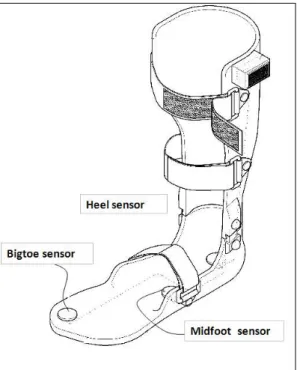
1). Reflective markers were attached to the entire body. Data processing was done by Orthotrak software(Motion Analysis Corporation, Santa Rosa, USA). Auditory cue AFO was developed that allowed for this study. Auditory cue AFO were made from plastic materials like conventional AFO.
Auditory cue AFO consist of three sensors(heel, midfoot, forefoot) on the bottom of AFO. When subjects walk, the sound of AFO rings in order
(heel-midfoot-forefoot) during the stance phase. So, we made the auditory cue AFO so that the subjects could know the period of stance phase. The subjects were measured randomly at three different conditions (no AFO, with conventional AFO, with auditory cue AFO).
Subjects were asked to walk at a comfortable speed in three different gait conditions(no AFO, with conventional AFO, with auditory cue AFO).
Prior to gait analysis, standard anthropometric data were collected. The mean of spatio-temporal gait data from two trial times was used in the analysis of gait condition with different AFO. The distance of gait was 5m and subjects were asked to walk five steps. We used the average of three steps without the first and final steps.
3. Data analysis
The Wilcoxon rank sum test was used to compare the spatio-temporal gait parameters between the involved and non-involved sides during walking with or without AFO. In addition, the Friedman test was used to examine the effects of barefoot and conventional AFO and auditory cue AFO on spatio- temporal gait parameters during the gait cycle. All statistical procedures were performed with the SPSS system version 17, and the critical P-value was defined as .05.
Ⅲ. Results
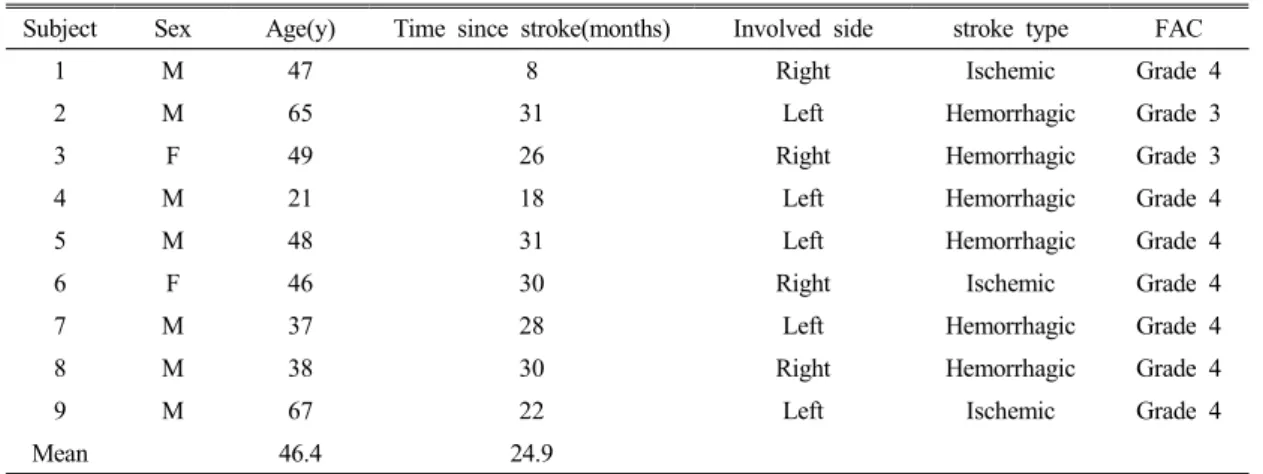
1. Subject characteristics.Table 1 summarizes the individual characteristics of the 9 stroke patients with respect to sex, age, post-stroke time, stroke type, involved side, and the functional ambulation category scale.
Fig. 1. Experimental auditory orthosis
2. Comparison of spatio-temporal gait parame- ters between the involved and non-involved sides in each orthosis.
The Wilcoxon rank sum test results of selective measures comparing involved/non-involved sides are presented in Table 2. In barefoot walking the
velocity, stride length and cadence of the involved/
non-involved sides were asymmetrical(p<.05) and step length, single support time, and double support time were symmetrical. The velocity of the involved side was slow and the stride length was short(table 2). In conventional AFO, the stride length and single support of the involved/non-involved sides were
Subject Sex Age(y) Time since stroke(months) Involved side stroke type FAC1 M 47 8 Right Ischemic Grade 4
2 M 65 31 Left Hemorrhagic Grade 3
3 F 49 26 Right Hemorrhagic Grade 3
4 M 21 18 Left Hemorrhagic Grade 4
5 M 48 31 Left Hemorrhagic Grade 4
6 F 46 30 Right Ischemic Grade 4
7 M 37 28 Left Hemorrhagic Grade 4
8 M 38 30 Right Hemorrhagic Grade 4
9 M 67 22 Left Ischemic Grade 4
Mean 46.4 24.9
FAC : functional ambulation category scale Table 1. Subject characteristics
Condition Parameters Involved side(M±SD) Non-involved side(M±SD) z p
Barefoot
Velocity(m/sec) 34.98±13.42 40.94±17.95 -1.96a .05*
Stride length(cm) 68.48±25.15 80.43±20.17 -2.52a .01*
Step length(cm) 34.83±14.43 37.79± 9.02 -.28a .77 Cadence(step/min) 57.13±14.08 61.06±16.81 -2.52a .01*
Single support time(%) 68.21± 7.26 71.17± 9.35 -.98a .32 Double support time(%) 20.51± 8.66 24.05±10.67 -.42a .67
Conventional AFO
Velocity(m/sec) 44.43±13.34 44.39±15.11 -.05a .95 Stride length(cm) 76.60±16.57 86.79±11.16 -2.66b .01*
Step length(cm) 41.45± 8.70 41.53± 7.94 -.88a .37 Cadence(step/min) 64.87±15.61 62.48±17.21 -.77a .44 Single support time(%) 63.00± 3.21 73.11± 6.83 -2.66b .01*
Double support time(%) 22.59± 7.39 17.68± 5.61 -1.24a .21
Auditory cue sensor AFO
Velocity(m/sec) 41.90±14.29 43.89±12.25 -1.01a .31 Stride length(cm) 82.59±12.01 87.41±11.89 -1.69a .09 Step length(cm) 43.99± 6.50 40.23± 6.09 -1.18b .23 Cadence(step/min) 62.59±15.41 60.77±13.72 -.16a .86 Single support time(%) 63.18± 3.71 69.71± 6.01 -1.69a .09 Double support time(%) 27.62±11.44 15.59± 4.35 -2.36b .02*
a. Based on positive ranks b. Based on negative ranks
Table 2. Comparison of spatiotemporal gait parameters between involved and non-involved sides with or without AFO(n=9)
asymmetrical(p<.05) but velocity and cadence became symmetrical(table 2). In the auditory cue sensor AFO, velocity, stride length and cadence of the involved/non-involved sides became symmetrical but double support became asymmetrical(p<.05)(table 2).
3. Comparison of spatio-temporal gait parame- ters amongst different orthosis in involved and non-involved sides.
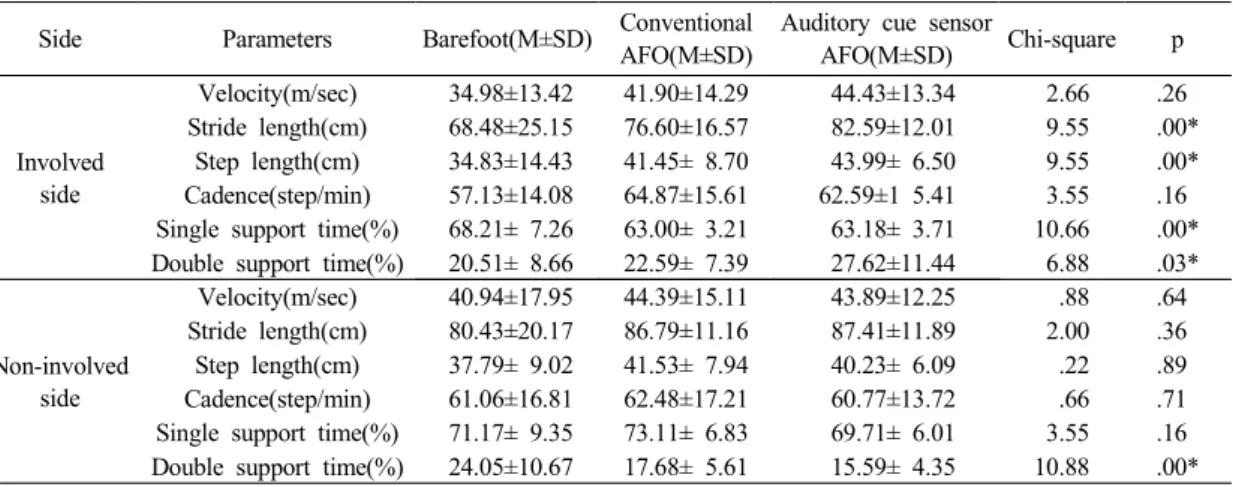
The results of the Friedman test on the differences according to gait conditions(barefoot, conventional AFO, auditory cue sensor AFO) are presented in Table 3. In the involved side, gait parameters with the AFO generally increased more than barefoot.
Conventional AFO cadence and single support time significantly increased(p<.05)(table 3). Auditory cue sensor AFO significantly increased in velocity, stride length, step length and decreased in double support time(p<.05)(table 3). In the non-involved side, most of the gait parameters depending on gait condition were not different but double support time with the AFO significantly decreased compared to bare feet (p<.05)(table 3).
Ⅳ. Discussion
Impaired balance control is a major problem for many patients who have sustained a stroke, as postural imbalance greatly restricts activities of daily life and gait (Geurts et al., 2005). In clinical practice, ankle-foot orthoses are often used to restore a more normal and safe walking pattern in people with stroke (Geboers et al., 2002). According to Leung and Moseley (2003), ankle-foot orthoses can provide lateral stability to the ankle in the stance phase, facilitate toe clearance in the swing phase and promote heel strike.
The most useful gait parameters are step length, swing time and stance time(Patterson et al., 2010).
The purpose of this study was to examine the effects of auditory cue AFO on spatio-temporal gait parameters in patients with hemiplegia.
Our analysis of spatio-temporal gait parameters showed positive modification in gait patterns of patients with hemiplegia due to auditory cue AFO.
First, velocity, stride length, and cadence of the involved and non-involved sides became more symmetrical. Second, auditory cue AFO increased the velocity, stride length, and step length of the
Side Parameters Barefoot(M±SD) Conventional AFO(M±SD)
Auditory cue sensor
AFO(M±SD) Chi-square p
Involved side
Velocity(m/sec) 34.98±13.42 41.90±14.29 44.43±13.34 2.66 .26 Stride length(cm) 68.48±25.15 76.60±16.57 82.59±12.01 9.55 .00*
Step length(cm) 34.83±14.43 41.45± 8.70 43.99± 6.50 9.55 .00*
Cadence(step/min) 57.13±14.08 64.87±15.61 62.59±1 5.41 3.55 .16 Single support time(%) 68.21± 7.26 63.00± 3.21 63.18± 3.71 10.66 .00*
Double support time(%) 20.51± 8.66 22.59± 7.39 27.62±11.44 6.88 .03*
Non-involved side
Velocity(m/sec) 40.94±17.95 44.39±15.11 43.89±12.25 .88 .64 Stride length(cm) 80.43±20.17 86.79±11.16 87.41±11.89 2.00 .36 Step length(cm) 37.79± 9.02 41.53± 7.94 40.23± 6.09 .22 .89 Cadence(step/min) 61.06±16.81 62.48±17.21 60.77±13.72 .66 .71 Single support time(%) 71.17± 9.35 73.11± 6.83 69.71± 6.01 3.55 .16 Double support time(%) 24.05±10.67 17.68± 5.61 15.59± 4.35 10.88 .00*
* p<.05
Table 3. Comparison of spatio-temporal gait parameters depending on orthosis in involved and non- involved sides(n=9)
involved sides of patients with hemiplegia more than anything else. In our study, single support time decreased and double support time increased in the involved side. We believe that it came from the AFO supporting ankle stability and restricting ankle movement. On the other hand, we think that it came from the inconvenience of AFO. The double support time of the non-involved side decreased.
We believe that the orthoses support the safety of the involved ankle.
The above results support and are in agreement with the previously presented results by Roerdink et al (2009). In that study, the use of acoustic rhythms or cue may be more effective when stroke patients walk. Thaut et al (1997) reported that the improve- ment in temporal gait control was attributed to the positive effects of auditory cues on physiological motor events. We believe that the results of our study support these results.
The positive effects of ankle foot orthoses have been found for various gait parameters (Tyson and Thornton, 2001; Wang et al., 2007). There have also been reports of improvements in functional tests like the Functional Ambulation Categories (Tyson and Thornton, 2001), the Timed up & Go test, and the stairs test (de Wit et al., 2004) when using an ankle-foot orthoses. However, other studies did not find beneficial effects of ankle-foot orthoses on gait parameters (Churchill et al., 2003) or functional tests (Wang et al., 2005). The contradictory results regarding the effect of ankle-foot orthoses might be explained by differences in subject inclusion, as the stroke subjects included showed a wide range of time since stroke, stroke severity, and ankle-foot orthosis types used (Simons et al., 2009). Therefore, future work should focus on the effect of ankle-foot orthosis as well as the auditory cue ankle-foot orthosis.
Ⅴ. Conclusion
Wearing an ankle-foot orthosis had a significant effect on spatio-temporal gait parameters, specifically, velocity and stride length. Step length with auditory cue ankle-foot orthoses was larger compared to barefoot walking but there was no difference between auditory cue and conventional AFO. However, these finding suggest that auditory cue ankle-foot orthoses can improve the spatio-temporal gait parameters in patients with hemiplgia.
Acknowledgement