Review Article
Current status of gynecologic cancer in Japan
Kimio Ushijima
Department of Obstetrics and Gynecology, Kurume University School of Medicine, Kurume, Japan
To make an overview of the current status of gynecologic cancer in Japan, we reviewed the recent incidence of cervical, endometrial, and ovarian cancer in Japanese women. The incidence of all three cancers has increased, but trends differ respectively. In age specific cancer site distribution data, the uterus and ovary are leading sites of high incidence among Japanese women younger than 40 years of age. Therefore, fertility sparing cancer treatment has received much attention. Several multicenter clinical trials have been done by Japanese groups, and some excellent evidence has been collected for endometrial and ovarian cancer. A promising international collaboration trial for ovarian clear cell carcinoma is also underway at the present time.
Key Words: Epidemiology, Cervical cancer, Endometrial cancer, Ovarian cancer, Fertility preservation, Adjuvant chemotherapy
Received June 11, 2009, Revised June 12, 2009, Accepted June 15, 2009
Address reprint requests to Kimio Ushijima
Department of Obstetrics and Gynecology, Kurume University School of Medicine, 67 Asahi machi, Kurume, 830-0011, Japan Tel: 81-942-31-7573, Fax: 81-942-35-0238
E-mail: [email protected]
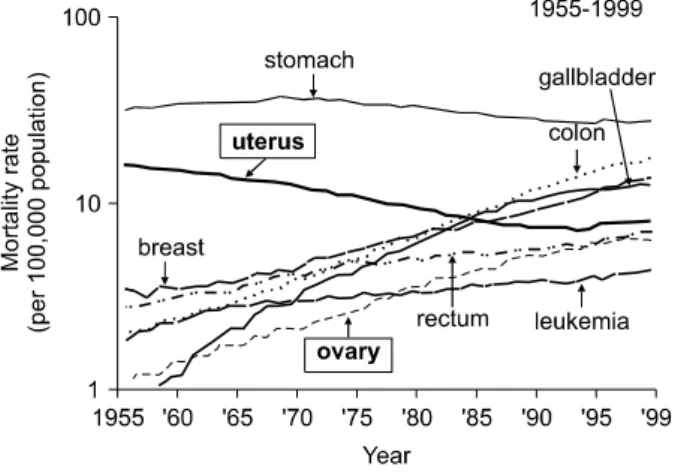
Fig. 1. Changes in site distribution of the cancer mortality rate of Japanese women. Uterine cancer decreased until 1995, then slightly increased. Ovarian cancer increased similar to breast, rectal and co- lon cancer.
INTRODUCTION
Incidence of disease and social environment has been changing.
Cancer has become to the leading cause of death and the num- ber of gynecologic cancer patients is constantly increasing.
The Japan Society of Gynecologic Oncology (JSOG) first pub- lished treatment guidelines for ovarian cancer in 2004, endo- metrial cancer in 2006, and cervical cancer in 2007. These guidelines are revised every 3 years and the 2nd edition of the guidelines for ovarian cancer treatment was published in 2007. An English version of the ovarian cancer (1st edition) guidelines was also published. These publications contribute to standardizing treatment for Japanese gynecologic cancer patients. This paper reviews recent trends in gynecologic can- cer incidence and treatment.
TRENDS OF GYNECOLOGIC CANCER INCIDENCE IN JAPAN
As in other developed countries, cancer has become the lead- ing cause of death in Japan since the 1980’s. Fig. 1 shows the change in mortality rate per 100,000 population.1 The mortal- ity rate of uterine cancer including the cervix and corpus con- sistently decreased from the 1960’s until 1995, as the cervical
cancer screening system spread nationwide across Japan. The mortality rate of ovarian cancer is increasing remarkably along with breast and gastrointestinal cancer.
The incidence of gynecologic cancer is site specific. Uterine cervix, uterine corpus, and ovary each have an individual trend. Over the past 20 years, the age specific incidence of cer- vical cancer has transfigured (Fig. 2). The incidence among women aged 40 to 80 has remarkably declined. Nevertheless, the incidence among women age in their 20’s and 30’s has increased. The increase in the incidence of high risk type HPV infection in this generation must be the cause of this peak.
The small number of young women who receive cervical can- cer screening is another serious problem. In addition, HPV
Fig. 2. Changes in the age-specific incidence rate of cervical cancer in Japanese women. The total number of incidences decreased re- markably between 1980 and 2000. Nevertheless, there was an ob- vious elevation in the incidence rate for women in their 20’s and 30’s in 2000 (Source: center for cancer control and information services, National Cancer Center, Japan).
Fig. 3. Changes in the age-specific incidence rate of endometrial cancer. Total number of incidences obviously increased. The rise in younger patients stands out (Source: center for cancer control and information services, National Cancer Center, Japan).
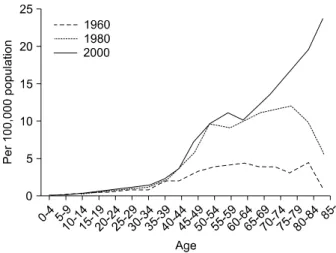
Fig. 4. Changes in the age-specific incidence rate of ovarian cancer.
A striking increase is shown in women at over sixty of age (Source:
center for cancer control and information services, National Cancer Center, Japan).
DNA testing is still not covered by national health insurance.
These problems must be solved to protect young women from cervical cancer.
Endometrial cancer has also increased remarkably. According to the Gynecologic tumor committee of the JSOG, the total number of endometrial cancer cases from registered in- stitutions was 976 cases in 1983, increasing to 2,115 cases in 1994, and reached to 4,267 cases in 2005.2 It accounts for 47%
of the total number of uterine cancer patients (excluding CIN). Also, the rate of young women under 40 years of age among all endometrial cancer patients has been increasing. It was 4.9% in 1983, rose to 5.1% in 1994, and hit 7.0% in 2005.2 It is obvious that endometrial cancer in Japanese women has a tendency to occur at a young age (Fig. 3). Ovarian cancer has also increased, but a remarkable increase in incidence has oc- curred in patients over 60 years of age (Fig. 4). There has been no reduction in the number of ovarian cancer deaths in the past 40 years (Fig. 1). In spite of the recent progress in medical technology, we have not been able to keep up with the in- crease in new patients.
TRENDS IN GYNECOLOGIC CANCER TREATMENT 1. Fertility preserving treatment
Recent changes in women’s life styles have lead to their late marriage, reduction in the birth rate and a rise in maternal age at delivery. According to data from the Ministry of Health, Labor, and Welfare, the average age at first delivery in 2005 was 29.1 years of age, which is 2.7 years older than in 1980.
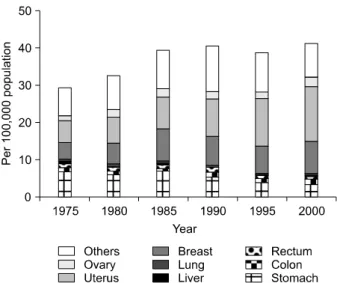
On the other hand, the number of younger cancer patients has been increasing. Among female cancer patients 39 years old and younger, uterine cancer now has the highest incidence rate since 1995, and the incidence of ovarian cancer is also
increasing. The incidence rates of uterine and ovarian cancer was 24% of all female cancer in 1975 made up 44% of all fe- male cancers in 2000 (Fig. 5). Thus, fertility preserving ther- apy for gynecologic cancer has received much attention.
2. Fertility management for cervical cancer
Recently, approximately half of all cervical cancer patients in Japan have stage 0 tumors. According to the 2007 data of the JSOG, conization or other uterine preserving surgery is em- ployed in approximately 85% of all CIN III and 45% of stage Ia1 patients, regardless of their wishes for fertility.3 In con- trast, data for 1995 showed that conization was done in only 40% of CIN III cases.4 Recent advances in surgical devices, such as laser or radio-wave knife have brought technical sim-
Fig. 5. Changes in site distribution of the cancer incidence rate for ages 0 to 39. The incidence of cancer in the female genital tract certainly has increased more than any other cancer site among younger women (Source: center for cancer control and information services, National Cancer Center, Japan).
plicity and safety to conization.
Recently, radical trachelectomy has been introduced for stage Ib1 invasive cervical cancers. In Japan, more institutions prefer the abdominal procedure than laparoscopy. In spite of eager efforts, only a few successful offspring have been re- ported so far, because of a low pregnancy rate and a high in- cidence of abortions. It has not become the standard treat- ment for invasive cervical cancer yet.
3. Fertility management for endometrial cancer
Progesterone has played the major role in conservative ther- apy for endometrial cancer. Only medroxyprogesterone (MPA) is available for endometrial cancer in Japan. Kaku et al.5 re- ported a multi-institutional retrospective study on the status of fertility sparing treatment for endometrial cancer in Japan.
In this report, there were discrepancies in many cases be- tween the original histological diagnosis and the final diag- noses by central pathological review. Patients were treated with MPA at 200-800 mg for 2-14 months by each institu- tional policy. According to this result, the Japanese Gynecologic Cancer Study Group conducted a multi-institutional pro- spective phase II study of fertility sparing treatment. Inclusion criteria is as follows, patients with histologically confirmed atypical endometrial hyperplasia or endometrioid adeno- carcinoma grade 1 at presumed stage Ia disease, and a strong desire to preserve fertility.6 MPA was administered 600 mg/
day with 81 mg of aspirin for 26 weeks. The overall complete response rate was 67% (26/39), which included 55% (12/22) endometrioid adenocarcinomas and 82% (14/17) atypical en- dometrial hyperplasias. In this study, among 20 patients de- siring to conceive, 7 normal full term deliveries were achieved out of 12 pregnancies. Most pregnancies were brought on by
assisted reproductive treatment, and five in particular were achieved by the in vitro fertilization and embryo transfer (IVF-ET) program. Nevertheless, the author also paid atten- tion to their high recurrence rate (47% of complete response cases) and 3 cases with synchronous ovarian and 1 peritoneal cancer in this study. According to the 2007 JSOG data, 13% of atypical endometrial hyperplasias were treated by hormonal therapy. Although the newest data on the incidence of con- servative therapy for stage Ia endometrial cancer is not avail- able, it may be one of the standard treatments for Japanese women with atypical hyperplasia or stage Ia endometrial can- cer who desire to preserve their fertility.
4. Fertility management for ovarian cancer
There is no definite consensus about the indication of fertil- ity preserving treatment for epithelial ovarian cancer. Accor- ding to the 2007 ovarian cancer treatment guidelines of the JSOG, patients with a strong desire for child bearing who are stage Ia with well differentiated or borderline tumor are per- mitted to receive conservative surgery. It is noted that there is no difference in prognosis between ruptured Ic (b) and stage Ia. Clear cell adenocarcinoma and moderate or poorly differ- entiated tumors are not included in this category.7 In clinical practice, each institution has a number of patients who have preserved their fertility violating this rule and some have con- ceived or recurred after treatment. Preserving fertility in stage Ia with clear cell histology or unilateral stage Ib or Ic tumor may be permitted with exception. The Japanese Gynecologic Cancer Study Group collected data on this issue from 30 major Japanese institutions. A new concept reflecting the present Japanese status regarding this issue will be revealed soon.
ADJUVANT THERAPY FOR ENDOMETRIAL OR OVARIAN CANCER
1. Adjuvant therapy for endometrial cancer
In western countries, external radiation therapy is still the standard treatment as a postoperative adjuvant for endo- metrial cancer. Chemotherapy has been employed for re- current or advanced disease. Many Japanese physicians switched their adjuvant therapy for endometrial cancer from radiation to chemotherapy in the early 90’s. Cyclophospha- mide, adriacin, cisplatin (CAP) combination became the standard regimen for endometrial cancer in Japan as well as ovarian cancer. The Japan Society Gynecologic Oncology Group (JGOG) conducted a randomized control study com- paring whole pelvic radiotherapy to platinum based chemo- therapy (CAP) to clarify which is more effective as the adjuvant therapy for stage Ic to IIIc endometrial cancer (JGOG 2033).
Four hundred seventy-five patients were recruited from 1994 to 2000, and were divided into the CAP and radiotherapy groups. This study showed that chemotherapy group had a significantly higher progression free survival and overall sur- vival rate than the pelvic radiotherapy group among patients
Table 1. Summary of JGOG 3016 study11)
∙631 patients were eligible.
∙Median follow-up is 29 months.
∙PFS in the c-TC group and dd-TC group was 17.1 and 27.9 months, overall survival at 2 years was 77.7% and 83.6%, respectively (p=0.05).
∙Objective response rates were 53.3% and 55.8% in the c-TC and dd-TC.
∙Grade 3 and 4 anemia were reported more frequently in the dd-TC group, and neurotoxicities were similar in both groups.
∙The dd-TC improves PFS as compared with c-TC in patients with ad- vanced epithelial ovarian cancer.
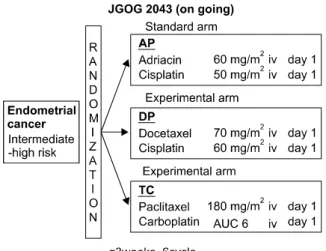
Fig. 6. Protocol scheme of JGOG 2043 for adjuvant chemotherapy for endometrial cancer. Patients eligibility: Patients who received surgical staging laparotomy, and pathologically confirmed endometrial cancer under the following conditions. 1) FIGO stage Ic to II, with grade 2 or 3 tumor (G3 included serous, clear, undifferentiated tumor). 2) FIGO stage III and IV tumor without distant metastasis. 3) age 20 to 75 years old, performance status 0-2, reasonable organ function.
in the high to intermediate risk group (stage Ic over 70 years old, with G3 endometrioid adenocarcinoma or stage II or IIIa by positive cytology).8 This was the first report showing supe- riority of chemotherapy over radiotherapy for early stage en- dometrial cancer, and was accepted at the oral presentation of ASCO in 2005. From a recent JGOG interior report, paclitaxel /carboplatin (TC) has been reported to be the most used com- bination for endometrial cancer in Japan. Although adria- cin/cisplatin (AP) has been approved, evidence in a GOG study shows that AP is used in only 8% of all chemotherapy regimens. JGOG is now carrying out a three-arm randomized control trial (JGOG 2043) to decide which is the best combi- nation as adjuvant therapy, TC, AP, or docetaxel/cisplatin (DP) (Fig. 6). Six hundred patients are expected to partic- ipate, and over 430 patients have participated in this trial already.
2. Adjuvant therapy for ovarian cancer
As in other countries, TC is the most frequently used combi- nation for adjuvant chemotherapy in ovarian cancer. A tri- weekly schedule is the standard regimen. A dose-dense weekly schedule showed promising effects in some phase II studies.9 Weekly administration of paclitaxel has also been employed in clinical practice in Japan for several reasons, not only for ef- fect, but also less toxicity, and high adjustability. JGOG con- ducted a large phase III study (JGOG 3016) comparing con- ventional dose paclitaxel 180 mg/m2 and carboplatin AUC 6 on day 1 every 21 days (c-TC) with a dose-dense weekly sched- ule of 80 mg/m2 of paclitaxel on days 1,8, and 15, and carbo- platin (AUC 6) on day1 (dd-TC). Among 637 patients en-
rolled, dd-TC (N=317) showed a statistically significant lon- ger PFS than c-TC (N=320). Also, the 2-year survival rates were 83.6 % in dd-TC, and 77.7% in c-TC (p=0.0496). Grade 3 and 4 anemia was reported more frequently in the dd-TC group, and other toxicities were similar in both groups (Table 1). This report had a great impact and was selected as one of the best of ASCO in 2008.10 It is still unclear whether the standard therapy should be changed to a weekly schedule or not. Nevertheless, weekly administration of TC must be a good option for epithelial ovarian cancer according to this result.
Clear cell adnocarcinoma (CCC) has a higher incidence rate in Japan, at 20-25% of all epithelial ovarian cancers, than in other Asian or Western countries (5-10%). It is still increasing in Japan. Most studies regarding CCC and its chemo-sensitivity are from Japan. Sugiyama et al showed the platinum resistance of CCC compared with serous carcinoma.11 The Osaka group showed that CCC had also a poor response with TC and poor prognosis compared with other histologic types.12 Irinotecan (CPT-11) combined with cisplatin were introduced as the fa- vorable regimen for refractory or recurrent ovarian cancer.13 A Japanese multi-center retrospective study showed that there was no difference in progression free survival between the CPT-P group (patients treated with CPT-11 plus cisplatin) and the TP group (patients treated with taxane plus platinum com- bination) in patients with stage I and patients with sub- optimally debulked stage II-IV tumor. Nevertheless, among patients with optimally debulked stage II- IV tumor, the CPT-P group showed a significantly better progression free survival than the TP group.14 The JGOG conducted phase II trials to find the safety and response rate for both TC and CPT-P chemo- therapy (JGOG 3014). Then the JGOG proposed a worldwide randomized control study of TC versus CPT-P chemotherapy (GCIG/GOG 3017), and is expecting a total of 652 patients to be enrolled (Fig. 7). It started at September 2006, and 337 pa- tients including 15 patients from the KGOG have already en- rolled as of the end of this April.
IN THE FUTURE
In response to national demand to receive excellent cancer
Fig. 7. Protocol scheme of GCIG/
JGOG 3017 for adjuvant chemo- therapy for ovarian clear cell carci- noma patients eligibility: Patients with a pathologically confirmed clear cell carcinoma of the ovary.
The histological diagnosis will be confirmed by central pathological review. Ages 18 or older, reason- able organ function.
PFS: progression-free survival, OS:
overall survival
treatment all over Japan, the JSGO started an authorization system for gynecologic oncologists since 2004, resembling the SGO of United States. Doctors wanting to be authorized need to pass written and oral tests organized by the JSGO.
Currently 460 specialists for gynecologic oncology have been authorized by the JSGO and they are working hard teaching young trainees to be gynecologic oncologists throughout Japan. They belong to major hospitals, authorized as training facilities, for teaching gynecologic oncologists. These hospi- tals are also acting as regional centers, trying new treatment strategies, and recruiting many patients for multicenter clin- ical trials including international collaboration. In the future, a more excellent outcome can be expected from Japanese and other Asian groups participating in these trials.
REFERENCES
1. Oshima A, Kuroisi T, Tajima K. Cancer statistic statement.
Tokyo: Shinohara Publishing; 2004.
2. Report from gynecologic tumor committee of JSOG. Acta Obstet Gynaecol Jpn 2007; 59: 952.
3. Report from gynecologic tumor committee of JSOG. Acta Obstet Gynaecol Jpn 2009; 61: 936.
4. Report from gynecologic tumor committee of JSOG. Acta Obstet Gynaecol Jpn 2000; 52: 855.
5. Kaku T, Yoshikawa H, Tsuda H, Sakamoto A, Fukunaga M, Kamura T, et al. Conservative therapy for adenocarcinoma and atypical endometrial hyperplasia of the endometrium in young women: central pathologic review and treatment outcome.
Cancer Lett 2001; 167: 39-48.
6. Ushijima K, Yahata H, Yoshikawa H, Konishi I, Yasugi T, Saito T, et al. Multicenter phase II study of fertility-sparing treatment with medroxyprogesterone acetate for endometrial carcinoma
and atypical hyperplasia in young women. J Clin Oncol 2007;
25: 2798-803.
7. Japan Society of Gynecologic Oncology. Ovarian cancer treat- ment guidelines 2007. Tokyo: Kanehara & Co. Ltd; 2007.
8. Susumu N, Sagae S, Udagawa Y, Niwa K, Kuramoto H, Satoh S, et al. Randomized phase III trial of pelvic radiotherapy versus cisplatin-based combined chemotherapy in patients with inter- mediate- and high-risk endometrial cancer: a Japanese Gyneco- logic Oncology Group study. Gynecol Oncol 2008; 108: 226-33.
9. Rose PG, Smrekar M, Fusco N. A phase II trial of weekly pacli- taxel and every 3 weeks of carboplatin in potentially plati- num-sensitive ovarian and peritoneal carcinoma. Gynecol Oncol 2005; 96: 296-300.
10. Isonishi S, Yasuda M, Takahashi F, Katsumata N, Kimura E, Aoki D, et al. Randomized phase III trial of conventional pacli- taxel and carboplatin (c-TC) versus dose dense weekly paclitax- el and carboplatin (dd-TC) in women with advanced epithelial ovarian, fallopian tube, or primary peritoneal cancer: Japanese Gynecologic Oncology [abstract]. J Clin Oncol 2008: 26(15S);
abstr 5506.
11. Taguchi K. Clinical characteristics of clear cell carcinoma of the ovary: a distinct histologic type with poor prognosis and resist- ance to platinum-based chemotherapy. Cancer 2000; 88: 2584-9.
12. Enomoto T, Kuragaki C, Yamasaki M, Sugita N, Otsuki Y, Ikegami H, et al. Is clear cell carcinoma and mucinous carcino- ma of the ovary sensitive to combination chemotherapy with paclitaxel and carboplatin? [abstract]. Proc Am Soc Clin Oncol 2003: 22; abstr 1797.
13. Sugiyama T, Yakushiji M, Nishida T, Ushijima K, Okura N, Kigawa J, et al. Irinotecan (CPT-11) combined with cisplatin in patients with refractory or recurrent ovarian cancer. Cancer Lett 1998; 128: 211-8.
14. Takano M, Kikuchi Y, Yaegashi N, Suzuki M, Tsuda H, Sagae S, et al. Adjuvant chemotherapy with irinotecan hydrochloride and cisplatin for clear cell carcinoma of the ovary. Oncol Rep 2006; 16: 1301-6.