Background and Objective : L-asparaginase is the chemotherapeutic agent for the treatment of acute lymphoblastic leukemia and is associated with hypersensitivity reactions. Because of the high rates of hypersensitivity reactions, skin test has been proposed. However, the method of skin test not standardized, and false-positive and false-negative results have been documented. We have con- ducted skin tests prior to every dose of L-asparaginase. In consideration of the convenience of administration, the skin test is changed to be conducted prior to the first dose of L-asparaginase and prior to restarting therapy after an interval of a week or more has elapsed between doses by inter- vention of a pediatric oncology pharmacist. The objective of this study was to evaluate the sensitivity and specificity of skin tests.
소아 급성림프구성백혈병 치료에서 L-asparaginase의 skin test 시행 방법의 적절성 평가
김경덕
a, 박애령
a, 김순주
a, 황보신이
a, 나현오
b,�가톨릭대학교 서울성모병원 약제부
a, 가톨릭대학교 약학대학
b,�Comparison of L-Asparaginase Skin Test According to Test Interval in the Treatment of Pediatric Acute Lymphoblastic
Leukemia
Kyung-Duck Kim
a, Ae-Ryoung Park
a, Soon-Joo Kim
a, Shin-Yi Hwangbo
aand Hyen-O La
b,�Department of Pharmacy, The Catholic University of Korea Seoul ST. Mary’ s Hospital
a, College of Pharmacy, The Catholic University of Korea
b222 Banpo-daero, Seocho-gu, Seoul, 06591, Republic of Korea
a43 Jibong-ro, Bucheon-si, Gyeonggi-do, 14662, Republic of Korea
b투고일자 2017.7.5; 심사완료일자 2017.8.18; 게재확정일자 2017.12.28
�교신저자 나현오 Tel:02-2164-6598 E-mail:[email protected]
Original Article
연구배경 및 목적
L-asparaginase (E. coli)는 급성, 만성림프구성백혈 병과 림프종 치료에 사용되는 항암제로서 asparagine 을 aspartic acid와 ammonia로 분해하여, 백혈병 세포 의 세포 내 단백질 합성에 필수적인 asparagine을 고갈 시켜 세포사멸을 유도한다. 정상세포에서는 asparagine synthetase의 작용으로 asparagine의 재합성이 용이 하여 백혈병세포에 비해 상대적으로 L-asparaginase 에 의한 세포사멸의 영향이 적다.
1)L-asparaginase는 E. coli에서 유래된 약물로 분자 량이 크며 항체 생성이 빈번하여 과민반응이 흔히 발생 하며 그 발생률은 5-45%에 이르는 것으로 알려져 있
다.
2),3)L-asparaginase의 과민반응의 발생기전은 아
직 정확하게 밝혀지지는 않았지만 항체 생성에 의한 IgE 매개성 과민반응, IgG 또는 IgM 매개성 보체반응 으로 설명되고 있다.
4),5)과민반응의 가장 흔한 증상으 로 두드러기가 있으며 국소적 발적부터 아나필락시스 까지 다양하게 나타난다. 다른 증상으로는 오한, 발열, 혈관부종, 저혈압 등이 보고되어 있다.
6),7)과민반응이 발 생할 경우 L-asparaginase를 중단하고 Erwinia에서 유래된 asparaginase 또는 polyethyleneglycol
(PEG)-asparaginase로 대체하는 것이 권장되지만 약 가가 고가이며 희귀의약품센터를 통해 구입해야 하는 불편이 있다. 과민반응의 위험을 줄이기 위해 투여 전 피부반응검사가 권장되고 있으나, 피부반응검사의 시 행 방법에 대한 표준화된 지침이 없으며 피부반응검사 결과 위양성(false-positive) 또는 위음성(false-neg- ative) 반응이 나타날 수 있다.
8)또한 L-asparagi- nase의 피부반응검사의 민감도 및 특이도에 대해 많이 알려져 있지 않으며 대규모 연구나 확립된 자료가 부족 한 실정이다.
서울시 한 대학병원(연구기관)에서는 2013년 4월 24 일부터 소아혈액종양 임상전담약사의 중재로 L- asparaginase의 피부반응검사 방법을 변경하였다. 변 경 전에는 약물의 매 투여 시마다 5 IU를 피내주사 한 후 15분간 관찰하여 음성인 경우에 약물을 투여하였 다. 변경 후에는, 투여 편의성을 고려하여 약물의 첫 투 여 시와 1주일 이상 휴약 후 재투여 시에 5 IU를 피내 주사 한 후 1시간 동안 관찰하여 음성인 경우에 약물을 투여하였다. 이에 본 연구에서는 L-asparaginase를 투여 받은 소아 급성림프구성백혈병 환자를 대상으로 피부반응검사에 대한 민감도와 특이도 등을 비교하여 시 행 방법 변경 전후의 적절성을 평가하여, L-asparag- Methods : From July-December 2012, patients that received skin tests prior to every dose of L- asparaginase were classified A group. From July-December 2013, patients that received skin tests prior to the first dose of L-asparaginase and prior to restarting therapy after an interval of a week or more has elapsed between doses were classified B group.
Results : 63 patients were included in the A group and received 402 cases of skin tests. 65 patients were included in the B group and received 126 cases of skin tests. The sensitivity of skin tests in the B group (52.2%) was superior to the A group (20%). This result showed statistically significant difference (p=0.047). The specificity of skin tests in the A group (96.1%) was superior to the B group (90.3%).
This result showed statistically significant difference (p=0.017).
Conclusion : In conclusion, reducing the number of skin tests by intervention of a pediatric oncolo- gy pharmacist improved convenience of administration and enhanced clinical safety of chemotherapy.
[Key words] L-asparaginase, Skin test, Hypersensitivity
inase의 피부반응검사의 시행 지침 정립에 이용하고자 하였다.
연구방법 1. 대상환자
연구기관의 소아청소년과 급성림프구성백혈병 환자 중 L-asparaginase를 투여 받은 환자를 대상으로 하 였다. 2012년 7월부터 12월까지 L-asparaginase의 매 투여 시마다 피부반응검사를 시행한 환자군을 A군, 2013년 7월부터 12월까지 L-asparaginase의 첫 투여 시와 1주일 이상 휴약 후 재투여 시에 피부반응검사를 시행한 환자군을 B군으로 분류하였다.
2. 연구방법
환자의 전자의무기록(electronic medical records) 을 통하여 후향적으로 검토하였으며, 본 연구는 연구기 관의 임상시험심사위원회의 승인 하에 시행되었다 (IRB No. KC15RISE0651).
(1) 대상 환자의 기본 특성 조사
대상 환자의 연령, 성별, 질병 위험군을 조사하였다.
질병 위험군은 연구기관 소아청소년과의 급성림프구성 백혈병 위험도 분류 기준에 따라 전자의무기록에 기재 된 내용을 바탕으로 저위험군(low risk), 표준위험군 (standard risk), 고위험군(high risk), 초고위험군 (very high risk)으로 분류하였다.
(2) L-asparaginase의 피부반응검사와 과민반응
피부반응검사시 L-asparaginase 5 IU를 전박부에 피내주사 하였다. A군은 매 투여 시마다 피부반응검사 를 시행하고 15분 동안 관찰하였으며, B군은 첫 투여 시와 1주일 이상 휴약 후 재투여 시에 피부반응검사를 시행하고 1시간 동안 관찰하였다. 피부반응검사의 양 성 판정은 지름 10 mm 이상의 팽진이 나타난 경우로, 과민반응 양성 판정은 L-asparaginase 투여 후 발열,
오한, 발진, 두드러기, 가려움증, 부종, 투여 부위 통증 의 증상을 호소한 경우로 하였다.
(3) L-asparaginase의 피부반응검사의 적절성 평가
피부반응검사의 적절성을 평가할 수 있는 주요 지표 로 각 군의 피부반응검사에 대한 민감도(sensitivity) 와 특이도(specificity)를 분석하였고, 추가적으로 양성 예측도(positive predictive values, PPV)와 음성예측 도(negative predictive value, NPV)를 분석하였다.
민감도란 과민반응이 나타난 환자 중 피부반응검사 결 과가 양성인 확률을 의미하며, 특이도는 과민반응이 나 타나지 않은 환자 중 피부반응검사 결과가 음성인 확률 을 의미한다. 양성예측도는 피부반응검사 결과가 양성 인 환자 중 과민반응이 나타난 확률이며, 음성예측도는 피부반응검사 결과가 음성인 환자 중 과민 반응이 나타 나지 않은 확률을 의미한다.
3. 자료 분석
연속형 변수의 경우 wilcoxon rank sum test를, 범 주형 변수의 경우 chi-square test 또는 Fisher exact test를 시행하였다. 연구결과의 통계분석은 SAS Enterprise Guide 4 (SAS Institute, Inc, Cary, NC) 으로 처리하였으며, p값이 0.05 미만인 경우를 유의한 것으로 정의하였다.
연구결과
1. 대상 환자군의 특성
대상환자는 A군이 63명이었고, B군이 65명이었다.
대상 환자군의 특성은(Table 1)과 같았다. 대상 환자 군의 성별은 두 군 모두 남자가 더 많았고, 질병 위험군 은 두 군 모두 고위험군, 초고위험군이 많았다.
2. 피부반응검사 결과 및 과민반응 양상
과민반응이 나타난 환자는 A군이 9명(14.3%), B군이
18명(27.7%)으로 B군이 더 많았으나 유의하지 않았다
(Table 2).
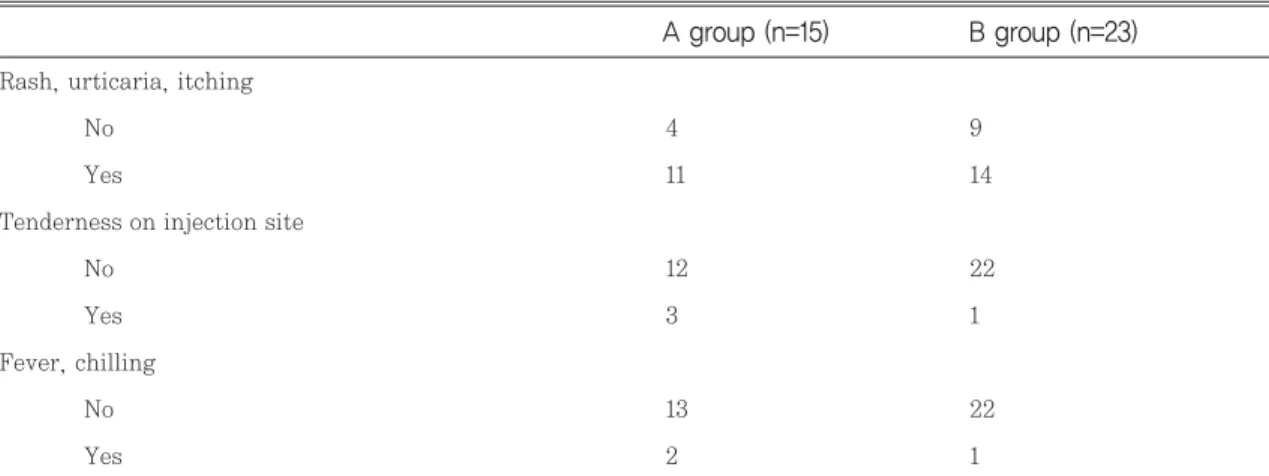
A군은 63명을 대상으로 피부반응검사가 총 402건 시행되었고, B군은 65명을 대상으로 피부반응검사가 총 126건 시행되었다. 이 중 피부반응검사가 양성인 경 우는 A군이 18건(4.5%)이었고, B군이 22건(17.5%)이 었다. 과민반응이 나타난 경우는 A군이 15건(3.7%), B 군이 23건(18.3%)이었다(Table 3). 과민반응 중 가장 많이 호소한 증상은 발진, 두드러기, 소양감이었다 (Table 4).
3. 각 군의 피부반응검사의 적절성 평가
A군에서 과민반응이 나타난 15건 중 피부반응검사 양성을 보인 경우는 3건으로 민감도는 20%, B군에서 과민반응이 나타난 23건 중 피부반응검사 양성을 보인 경우는 12건으로 민감도는 52.2%로 B군이 유의하게 높았다(p=0.047).
A군에서 과민반응이 나타나지 않은 387건 중 피부반 응검사 음성을 보인 경우는 372건으로 특이도는 96.1%,
Age, yr * 7.79±4.87 8.28±5.07 0.587
Gender, n(%)
Male 42(66.7) 38(58.5) 0.338
Female 21(33.3) 27(41.5)
ALL risk, n(%)
Low risk 11(17.5) 7(10.8) 0.595
Standard risk 12(19.0) 10(15.4)
High risk 16(25.4) 21(32.3)
Very high risk 24(38.1) 27(41.5)
p value B group (n=65)
A group (n=63) Table 1 Patients characteristics
*Mean±standard deviation(sd)
Incidence of hypersensitivity, n(%) 9(14.3) 18(27.7) 0.063
p value B group (n=65)
A group (n=63) Table 2 Incidence of hypersensitivity
Results of skin test, n(%)
Negative 384(95.5) 104(82.5) 0.0001
Positive 18(4.5) 22(17.5)
Hypersensitivity, n(%)
No 387(96.3) 103(81.7) 0.0001
Yes 15(3.7) 23(18.3)
p value B group (n=126)
A group (n=402)
Table 3 Results of skin test and incidence of hypersensitivity
B군에서 과민반응이 나타나지 않은 103건 중 피부반응 검사 음성을 보인 경우는 93건으로 특이도는 90.3%로
A군이 유의하게 높았다(p=0.017).
양성예측도는 B군이 유의하게 높았고(p=0.014), 음
Rash, urticaria, itchingNo 4 9
Yes 11 14
Tenderness on injection site
No 12 22
Yes 3 1
Fever, chilling
No 13 22
Yes 2 1
B group (n=23) A group (n=15)
Table 4 Symptoms of hypersensitivity
A group (n=402)
Results of skin test
Negative 372 12
Positive 15 3
B group (n=126)
Results of skin test
Negative 93 11
Positive 10 12
Yes No
Hypersensitivity Table 5 Results of skin test and hypersensitivity
A group 20.0% (4.3-48.1) 96.1% (93.7-97.8) 16.7% (3.6-41.4) 96.9% (94.6-98.4) B group 52.2% (30.6-73.2) 90.3% (82.9-95.3) 54.6% (32.2-75.6) 89.4% (81.9-94.6)
p value 0.047 0.017 0.014 0.003
음성예측도(NPV) (95% CI) 양성예측도(PPV)
(95% CI) 특이도(specificity)
(95% CI) 민감도(sensitivity)
(95% CI) Table 6 Validity of skin test
PPV: positive predictive values, NPV: negative predictive values, CI: confidence interval
성예측도는 A군이 유의하게 높았다(p=0.003)(Table 5, 6).
고찰 및 결론
L-asparaginase의 과민반응 발생률은 투여경로, 용 량에 따라 5-45%까지 다양하게 보고되고 있으며, 아 나필락시스 반응의 경우 10% 미만으로 보고되었다.
9)본 연구에서 L-asparaginase 투여 후 과민반응이 나 타난 경우는 대상환자 128명 중 27명으로 과민반응 발 생률은 약 21%였다. 약물 첫 투여 후에 과민반응이 나 타난 경우도 보고되었지만, 일반적으로 과거 투여 경험 이 있는 경우 과민반응이 발생한다고 알려져 있다.
10)본 연구의 과민반응이 나타난 환자들 중 L-asparagi- nase 첫 투여 시 과민반응이 나타난 환자는 없었으며, 모두 과거 L-asparaginase를 투여한 경험이 있으며 이후 재 투여한 경우 과민반응이 나타났다.
과민반응 발생의 위험요인에는 투여 경로, 항암프로 토콜, 투여 간격, 용량 등이 알려져 있다. 정맥주사가 근육주사보다 더 높은 과민반응을 나타내는 것으로 보 고되어 있어 L-asparaginase는 일반적으로 근육 또 는 피하로 투여한다.
11)Evans 등의 연구에서는 L- asparaginase 단독요법이 L-asparaginase, vin- cristine, prednisone 병용요법보다 더 높은 과민반응 발생률을 보였고, 투여 간격이 긴 경우와 과거 L- asparaginase를 투여한 경험이 있는 경우 과민반응 발생률이 높았다고 보고하였다.
9)또한 L-asparagi- nase 용량이 6,000 IU/m
2이상인 경우 과민반응 발생 률이 증가하는 것으로 보고되어 있다.
12)본 연구기관의 소아청소년과에서도 과민반응 예방을 위해 근육주사를 하며, 다른 약물과 병용요법으로 투여하고, 용량은 6,000 IU/m
2이나 1일 최대용량 10,000 IU로 설정하 여 투여하고 있다.
L-asparaginase에 과민반응이 나타날 경우 투여를 중단하고 Erwinia-asparaginase 또는 polyethylene glycol (PEG)-asparaginase로 대체하여 투여하는 방 법이 있다.
13),14)Erwinia-asparaginase는 Erwinia chrysanthemi에서 유래된 asparaginase 제제로 L- asparaginase와 알레르기 교차반응 발생률이 낮아 L-asparaginase에 과민반응을 보인 급성림프구성백
혈병 환자에서 사용할 수 있다.
15),16)하지만 L-aspa- raginase에 과민반응을 보인 환자 중 일부가 Erwinia-asparaginase에도 과민반응을 나타냈다는 보고가 있다. PEG-asparaginase는 Polyethy- leneglycol (PEG)에 L-asparaginase를 공유 결합시 킨 asparaginase 제제로 기존 제제에 비해 반감기가 길어 투여 횟수가 적고, 면역원성이 낮은 장점이 있 다.
15)그러나 L-asparaginase에 과민반응을 보이는 환자의 30%가 PEG-asparaginase에도 과민반응을 보인다는 보고도 있다.
17)L-asparaginase에 대한 과 민반응이 나타난 경우 투여를 중단하고 다른 약물로 대 체하는 대신 전처치, 탈감작 프로토콜을 사용한 연구도 보고되었다.
18),19)본 연구기관에서도 피부반응검사에서 양성결과를 보인 일부 환자에게 약물 투여 전처치로 methylprednisolone, hydroxyzine, ranitidine을 사 용하거나 탈감작 프로토콜을 사용한 경우도 있었다.
L-asparaginase의 높은 과민반응 발생률 때문에, 약물 투여 전 피부반응검사를 권고하고 있다. 하지만 피부반응검사 방법은 표준화되어 있지 않고, 피부반응 검사가 음성인 환자에게 L-asparaginase 투여 후 과 민반응이 발생하는 경우도 있다. 국내 여러 병원에서는 L-asparaginase 투여 전 피부반응검사를 시행하고 있으나 피부반응검사의 시행시기, 투여용량, 판독시간 등이 다양한 실정이다. 이에 본 연구에서 매 투여 시마 다 피부반응검사를 하는 방법과 약물의 첫 투여 시와 1 주일 이상 휴약 후 재투여 시에 피부반응검사를 하는 방법을 비교한 결과, 민감도 및 양성예측도는 약물의 첫 투여 시와 1주일 이상 휴약 후 재투여 시에 피부반 응검사를 하는 방법에서 향상된 결과를 보였다. 이는 피부반응검사에서 음성이었으나 과민반응이 나타나는 위음성이 감소된 것을 의미한다. 또한 소아 환자에게 L-asparaginase 매 투여 시마다 피부반응검사를 시 행하지 않음으로써 투여 시 편의성을 개선시키는 효과 도 있었던 것으로 평가되었다.
이에 본 연구기관에서는 현재까지 L-asparaginase
의 피부반응검사를 약물의 첫 투여 시와 1주일 이상 휴
약 후 재투여 시에 시행하는 방법으로 모든 진료과에
확대 적용하여 시행하고 있다. 그리하여 본 연구의 결
과는 L-asparaginase 피부반응검사 방법에 있어 국
내 의료기관들의 표준화 정립에 객관적 근거자료로 활
용될 수 있을 것으로 기대된다.
결론적으로, 소아혈액종양 전문약사의 중재로 L- asparaginase의 피부반응검사의 방법을 변경한 것은 검사의 시행 횟수 감소로 투여 편의성을 개선하였고, 민감도 및 양성예측도가 향상 된 것으로 나타나 환자에 게 안전한 항암화학요법을 시행하는데 도움을 줄 수 있 을 것으로 사료된다.
감사의 말씀
본 연구는 2017년도 가톨릭대학교 교비연구비의 지 원으로 이루어졌습니다.
참고문헌
1) Capizzi RL, Bertino JR, Skeel RT, et al. L- Asparaginase: Clinical, Biochemical, Phar- macological, and Immunological Studies.
Ann Intern Med. 1971;74(6):893-902.
2) Billett AL, Sallan SE, Carls A, et al. Allergic reactions to Erwinia asparaginase in chil- dren with acute lymphoblastic leukemia who had previous allergic reactions to escherichia coli asparaginase. Cancer. 1992;70(1):201-6.
3) Woo MH, Hak LJ, Storm MC, et al. Anti- asparaginase antibodies following E. coli asparaginase therapy in pediatric acute lymphoblastic leukemia. Leukemia. 1998;
12(10):1527-33.
4) Khan A, Hill JM. Atopic hypersensitivity to L-Asparaginase. Int Arch Allergy. 1971;
40(3):463-9.
5) Fabry U, Korholz D, Jurgens H, et al.
Anaphylaxis to L-asparaginase during treatment for acute lymphoblastic leukemia in children--evidence of a complement- mediated mechanism. Pediatr Res. 1985;
19(4):400-8.
6) Christina L, Mary G, William BK. Diagnosis and management of hypersensitivity reac-
tions related to common cancer chemothera- py agents. Ann Allergy Asthma Immunol.
2009;102(3):179-87.
7) Zanotti K, Markman M. Prevention and Management of Antineoplastic-Induced Hypersensitivity Reactions. Drug Safety.
2001;24(10):767-79.
8) AHFS Drug Information Essentials(2013) 9) Evans WE, Tsiatis A, Rivera D, et al.
Anaphylactoid reactions to Escherichia coli and Erwinia asparaginase in children with leukemia and lymphoma. Cancer. 1982;
49(7):1378-83.
10) Shepherd GM. Hypersensitivity Reactions to Chemotherapeutic Drugs. Clin Rev Allergy Immunol. 2003;24(3):253-62.
11) Nesbit M, Chard R, Evans A, et al.
Evaluation of intramuscular versus intra- venous administration of L-asparaginase in childhood leukemia. Am J Pediatr Hematol Oncol. 1979;1(1):9-13.
12) Weiss RB. Hypersensitivity reactions. Semin Oncol. 1992;19(5):458-77.
13) Inge MS, Lynda MV, Rob P, et al. Consen- sus expert recommendations for identifica- tion and management of asparaginase hypersensitivity and silent inactivation.
Haematologica. 2016;101(3):279-85.
14) Rachel AE, Sanjay PA, Yousif M. L- asparaginase in the treatment of patients with acute lymphoblastic leukemia. J Pharmacol Pharmacother. 2016;7(2):62-71.
15) Sara ES, Mary LB, Susannah EK. Managing hypersensitivity to asparaginase in pedi- atrics, adolescents, and young adults. J Pediatr Oncol Nurs. 2013;30(2):63-77.
16) Takahashi H, Koh K, Kato M, et al. The feasibility of Erwinia asparaginase for pediatric patients who developed an allergic reaction to E.coli asparaginase during
.. ..
treatment of acute lymphoblastic leukemia.
JPN J clin oncol. 2013;54(4):370-7.
17) Stock W, Douer D, DeAngelo DJ, et al.
Prevention and management of asparagi- nase/pegasparaginase-associated toxicities in adults and older adolescents: recommen- dations of an expert panel. Leukemia &
lymphoma. 2011;52(12):2237-53.
18) Ozge US, Selin A, Ayfer T, et al. Alternative algorithm for L-asparaginase allergy in children with acute lymphoblastic leukemia.
J Allergy Clin Immunol. 2009;123(4):895-9.
19) Akbayram S, Dogan M, Akgun C, et al. A desensitization protocol in children with L- asparaginase hypersensitivity. J Pediatr Hematol Oncol. 2010;32(5):187-91.
..