J Korean Surg Soc 2012;82:135-142 http://dx.doi.org/10.4174/jkss.2012.82.3.135
ORIGINAL ARTICLE
Journal of the Korean Surgical Society
JKSS
pISSN 2233-7903ㆍeISSN 2093-0488
Received November 16, 2011, Revised December 20, 2011, Accepted January 5, 2012 Correspondence to: Wook Kim
Department of Surgery, Yeouido St. Mary’s Hospital, The Catholic University of Korea School of Medicine, 1063-ro, Yeongdeungpo-gu, Seoul 150-713, Korea
Tel: +82-2-3779-1033, Fax: +82-2-786-0802, E-mail: [email protected]
cc Journal of the Korean Surgical Society is an Open Access Journal. All articles are distributed under the terms of the Creative Commons Attribution Non-Commercial License (http://creativecommons.org/licenses/by-nc/3.0/) which permits unrestricted non-commercial use, distribution, and reproduction in any medium, provided the original work is properly cited.
Comparison of laparoscopy-assisted and totally
laparoscopic Billroth-II distal gastrectomy for gastric cancer
Junhyun Lee, Dongjin Kim, Wook Kim
Department of Surgery, The Catholic University of Korea School of Medicine, Seoul, Korea
Purpose: In laparoscopic distal gastrectomy for gastric cancer, most surgeons prefer extra-corporeal anastomosis because of technical challenges and unfamiliarity with intra-corporeal anastomosis. Herein, we report the feasibility and safety of in- tra-corporeal Billroth-II anastomosis in gastric cancer. Methods: From April 2004 to March 2011, 130 underwent totally lapa- roscopic distal gastrectomy with intra-corporeal Billroth-II reconstruction, and 269 patients underwent laparoscopy-assisted distal gastrectomy with extra-corporeal Billroth-II reconstruction. Surgical efficacies and outcomes between two groups were compared. Results: There were no differences in demographics and clinicopathological characteristics. The mean operation and reconstruction times of totally laparoscopic distal gastrectomy were statistically shorter than laparoscopy-assisted distal gastrectomy (P = 0.019; P < 0.001). Anastomosis-related complications were observed in 11 (8.5%) totally laparoscopic distal gastrectomy and 21 (7.8%) laparoscopy-assisted distal gastrectomy patients, and the incidence of these events was not sig- nificantly different. Post-operative hospital stays for totally laparoscopic distal gastrectomy were shorter than laparo- scopy-assisted distal gastrectomy patients (8.3 ± 3.2 days vs. 9.9 ± 5.3 days, respectively; P = 0.016), and the number of times parenteral analgesic administration was required in laparoscopy-assisted distal gastrectomy patients was more frequent af- ter surgery. Conclusion: Intra-corporeal Billroth-II anastomosis is a feasible procedure and can be safely performed with the proper experience for laparoscopic distal gastrectomy. This method may be less time consuming and may produce a more cosmetic result.
Key Words: Laparoscopic distal gastrectomy, Extra-corporeal anastomosis, Intra-corporeal anastomosis, Billroth-II anasto- mosis
INTRODUCTION
Since the first performance by Kitano et al. [1], the use of laparoscopy-assisted distal gastrectomy (LADG) for early gastric cancer (EGC) in Korea and Japan has exploded be-
cause of the high prevalence of EGC and the merits of LADG, including less post-operative pain, earlier recov- ery and better cosmetic outcomes, over open gastrectomy [2-4]. Following laparoscopic distal gastrectomy (LDG), there are three major reconstructive methods, the Billroth-
I, Billroth-II and Roux-en-Y, that can be used, and several studies have reported their safety and efficacy [5-7]. In Korea and Japan, Billroth-I is the most common re- constructive modality because of the maintenance of the physiological passage of food. Roux-en-Y reconstruction, which has a low incidence for bile reflux, has also been em- ployed by some centers [5,7-10]. However, these re- constructive modalities have some problems, such as bile reflux, food stasis and complexity [11-13]. For this reason, Billroth-II reconstruction has commonly been performed after LDG because of its simplicity and the low rate of gas- tric stasis [13]. Although laparoscopy provides a wider surgical field than mini-laparotomy, in general, most sur- geons have chosen mini-laparotomy at the upper abdo- men for reconstruction because of the technical complex- ity of LDG and an unfamiliarity with intra-corporeal anastomosis. As surgeon experience in performing LDG has increased and improvements in laparoscopic instru- ments have been accomplished, for example, the develop- ment of the endoscopic linear stapler, totally laparoscopic distal gastrectomy (TLDG), including several intra-corpo- real anastomotic techniques, has been introduced and its usefulness reported [5,9,14,15]. However, these reports have been mainly restricted to the Billroth-I and Roux-en- Y for reconstruction. In this study, we evaluated the safety and short-term outcomes of TLDG with reverse T-shaped intra-corporeal Billroth-II anastomosis using linear sta- plers.
METHODS
Patients
A total of 399 patients underwent LDG with Billroth-II reconstruction for gastric cancer between April 2004 and March 2011. During this period, patients were divided in- to two groups according to reconstructive method, such as intra-corporeal or extra-corporeal reconstruction. From April 2004 to September 2009, we performed extra-cor- poreal Billroth-II reconstruction on 269 gastric cancer pa- tients (LADG group), and intra-corporeal Billroth-II re- construction was applied to 130 patients (TLDG group) from October 2009 to March 2011. The selection for re-
constructive method was based simply on the timing of operation. In the earlier period, we performed extra-cor- poreal anastomosis after LDG because of our unfamiliarity and lack of experience with intra-corporeal anastomotic procedures. As our experience with diverse intra-corpo- real anastomotic with laparoscopic sewing and linear sta- plers accumulated, we were able to applied this technique to LDG. There was no difference between groups in peri- operative and post-operative care. The patients resumed oral intake 2 to 3 days after surgery and were discharged 7 to 10 days after surgery. All patients received a continuous venous infusion of fentanyl for 2 days after surgery, and additional analgesics (one vial of ketorolac tromethamine) were injected intramuscularly if the patient complained of pain. The parameters for assessments were defined as follows. Morbidities related to anastomosis were leakage at the gastrojejunostomy and duodenal stump, bleeding at gastrojejunostomy site, gastric stasis and afferent loop syndrome. The run-time in anastomosis was from the ex- tension of the epigastric trocar site to the completion of gastrojejunostomy in LADG and from resection of the stomach and retrieval of specimen to the perfection of gas- trojejunostomy in TLDG.
Surgical procedure
All patients were placed in the supine position and sub- jected to a 15 to 20o reverse Trendelenberg position. An ini- tial 10-mm trocar for a 30o flexible electrolaparoscope was inserted through the infraumbilical area using a Hassan technique. After establishing a pneumoperitoneum with carbon dioxide (CO2), the operator stood on the right side of the patient, and the CO2 pneumoperitoneum was main- tained at 12 to 15 mmHg during the operation. The extent of resection was determined by the location of the primary tumor and lymph node status. Using ultrasonic-activated scissors (laparoscopic coagulation shears [LCS]; Ethicon Endo-Surgery Inc., Cincinnati, OH, USA), partial omen- tectomy with D1+β lymphadenectomy was performed mainly for EGC, but total omentectomy with D2 lympha- denectomy was performed in patients with advanced gas- tric cancer according to lymph node classification by the Japanese Gastric Cancer Association [16]. The duodenum was transected about 2 cm distal from the pylorus using a
Fig. 1. Brief illustration of intra-corporeal Billroth-II anastomosis. (A) Resection of the stomach using linear stapler. (B) Making entry hole at the tip of greater curvature side. (C) Making entry hole at the jejunum, about 10 to 15 cm from Treitz ligament. (D) Approximation of the stomach and jejunum using linear stapler. (E) Closure of the entry holes using linear stapler. (F) Completion of gastrojejunostomy, antecolic fashion.
45-mm endoscopic linear stapling device following the dissection of lymph nodes numbers 5 and 6. When an EGC was located mid-body, preoperative tumor localization using an endoscopic metallic clip (HX-600-090L, Olympus Co., Tokyo, Japan) was performed, and the identification of the tumor in LADG was performed by palpation of the metallic clip. The topographic location of the tumor was identified by intra-operative portable abdominal radio- graph in TLDG. Following these procedures, distal gas- trectomy and Billroth-II anastomosis was performed with a hand-sewing technique or using endoscopic stapling de- vices as described below.
Reconstruction in LADG
A total of 5 trocars were used in this procedure. Follow- ing establishment of pneumoperitoneum, two additional 12 mm and 5 mm trocars were introduced as main ports in- to the right side at 2 cm above the umbilicus and just below the costal margin, respectively. Then, a 10 mm trocar was inserted 4 cm below the xyphoid process for traction of the liver, and a 5 mm trocar was inserted in the left mid-clav- icular line 2 cm above the umbilicus as an accessory port.
After completion of lymphadectomy, a 10-mm trocar site at the epigastrium was extended approximately 5 to 6 cm vertically or transversely, and the distal part of the stom- ach was extra-corporeally resected with using a 100-mm linear stapling device. A segment of jejunum was adopted approximately 10 to 15 cm distal from Treitz’s ligament, and hand-sewn extra-corporeal anastomosis was per- formed in an antecolic fashion between the remnant stom- ach and the jejunum with a continuous interlocking suture of 3-0 absorbable suture material and an overlying Lembert reinforcement via this window.
Reconstruction in TLDG
Initially, we used 5 trocars, but in the TLDG series, we reduced the number to 4 channels. Instead of a 10-mm tro- car positioned at 4 cm below the xyphoid process for trac- tion of the liver, liver retraction was accomplished by a re- traction of the falciform ligament and the left lobe of the liver using a single suture on the mid-pars condensa of the lesser omentum. After distal gastrectomy was performed using one or two endoscopic liner stapling devices (Fig.
1A), the specimen was extracted via the vertically ex-
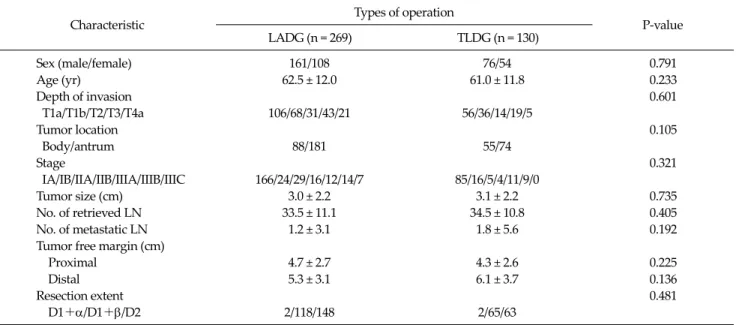
Table 1. Demographics and clinicopathological characteristics
Characteristic Types of operation
P-value
LADG (n = 269) TLDG (n = 130)
Sex (male/female) 161/108 76/54 0.791
Age (yr) 62.5 ± 12.0 61.0 ± 11.8 0.233
Depth of invasion 0.601
T1a/T1b/T2/T3/T4a 106/68/31/43/21 56/36/14/19/5
Tumor location 0.105
Body/antrum 88/181 55/74
Stage 0.321
IA/IB/IIA/IIB/IIIA/IIIB/IIIC 166/24/29/16/12/14/7 85/16/5/4/11/9/0
Tumor size (cm) 3.0 ± 2.2 3.1 ± 2.2 0.735
No. of retrieved LN 33.5 ± 11.1 34.5 ± 10.8 0.405
No. of metastatic LN 1.2 ± 3.1 1.8 ± 5.6 0.192
Tumor free margin (cm)
Proximal 4.7 ± 2.7 4.3 ± 2.6 0.225
Distal 5.3 ± 3.1 6.1 ± 3.7 0.136
Resection extent 0.481
D1+α/D1+β/D2 2/118/148 2/65/63
LN, lymph node; LADG, laparoscopy assisted distal agstrectomy; TLDG, totally laparoscopic distal gastrectomy.
tended about 2- to 3-cm window of the 10-mm umbilical trocar site. The tumor free margin was examined. A dou- ble-ring wound retractor (Alexis, Applied Medical Re- sources Co., Rancho Santa Margarita, CA, USA) was in- serted through the incision and rolled to cover the window. The device was comprised of a surgical glove, and one 10-mm trocar was latched onto the wound re- tractor ring, which was rolled over it to provide a seal.
Following the re-establishment of the pneumoperitoneum, entry holes were made at both the greater curvature side of stomach and jejunum approximately 10 to 15 cm distal from Treitz’s ligament using LCS (Fig. 1B, C). After the in- sertion of each arm of the endoscopic linear stapler into the remnant stomach and jejunum, vertical anastomosis along the greater curvature side of the remnant stomach was made by the firing of the endoscopic linear stapler via the 12-mm trocar site at the right abdomen (Fig. 1D). The com- mon entry hole was horizontally or obliquely closed with one endoscopic linear stapler (Fig. 1E, F).
Statistical analysis
All statistical analyses were performed using the SPSS ver. 15.0 (SPSS Inc., Chicago, IL, USA). Pathological results were classified by 7th Union for International Cancer Control classification scheme. The two groups were com-
pared using Student’s t-test for continuous variables and are expressed as the mean ± SD. Categorical variables were analyzed using the chi-squares test. P < 0.05 was consid- ered significant.
RESULTS
Patient characteristics
There was no conversion to an open procedure, and all procedures were completed under the given conditions.
Demographics and clinicopathological characteristics are listed in Table 1. Of the 399 patients, 130 underwent TLDG, and 269 patients underwent LADG. There were no stat- istical differences between the two groups in clinicopatho- logical features. EGCs were found in 92 (70.8%) and 172 (63.8%) patients out of the 130 and 269 patients, respec- tively, in the TLDG and LADG groups respectively. Mean tumor sizes and proximal resected margins were 3.1 ± 2.2 cm, 3.0 ± 2.2 cm and 4.3 ± 2.6 cm, 4.7 ± 2.7 cm, respectively.
D1+β or D2 lymph node dissections were performed in most cases.
Table 2. Comparison of surgical outcomes
Characteristic Types of operation
P-value
LADG (n = 269) TLDG (n = 130)
Operation times (min) 226.1 ± 55.6 212.5 ± 43.5 0.019
Anastomosis times (min) 18.2 ± 6.6 10.8 ± 3.9 <0.001
Estimated blood loss (mL) 150.0 ± 114.9 131.0 ± 77.6 0.298
Hospital stay (day) 9.9 ± 5.3 8.3 ± 3.2 0.016
No. of used staplers 2.0 ± 0 4.9 ± 0.5 <0.001
Total application of analgesics (no. of times) 2.5 ± 3.6 0.9 ± 1.4 <0.001 Serum C-reactive protein (mg/mL)
POD1 40.2 ± 29.2 36.1 ± 17.2 0.369
POD3 109.3 ± 65.6 122.7 ± 58.0 0.611
POD7 87.8 ± 73.0 112.9 ± 76.7 0.634
Serum white blood cell count (mm3)
POD1 10,659.0 ± 3,124.4 10,791.5 ± 3,112.3 0.808
POD3 8,992.9 ± 3,866.6 8,961.0 ± 2,785.0 0.965
POD7 8,157.7 ± 3,589.7 9,008.3 ± 4,015.0 0.581
POD, post-operative day; LADG, laparoscopy assisted distal agstrectomy; TLDG, totally aparoscopic distal gastrectomy.
Table 3.Anastomosis-related complications
Characteristic Types of operation
P-value LADG (n = 269) TLDG (n = 130) Intraluminal bleeding 2 (0.7) 4 (3.1) 0.073 Leakage
Gastrojejunostomy 3 (1.1) 1 (0.7) 0.745 Duodenal stump 10 (3.7) 3 (2.3) 0.457 Afferent loop obstruction 1 (0.4) 1 (0.7) 0.598 Gastric stasisa) 5 (1.9) 2 (1.5) 0.891 Values are presented as number (%).
LADG, laparoscopy assisted distal agstrectomy; TLDG, totally laparoscopic distal gastrectomy.
a)Functional stasis that was not improved after fasting for 2 days and was eventually relieved by gastric lavage.
Surgical results and anastomosis-related complica- tions
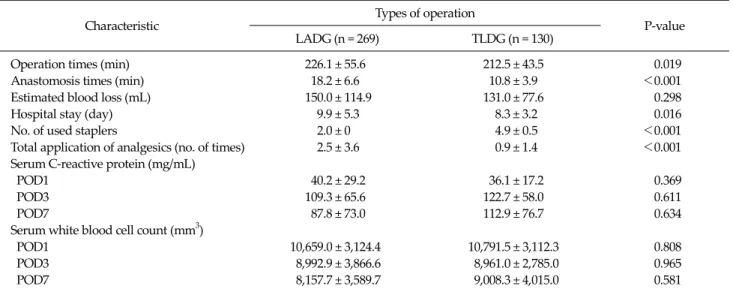
The outcomes of the operative procedures are listed in Table 2. The estimated blood loss was similar (131.0 mL vs.
150.0 mL) in both groups, but the mean operation and re- construction times of TLDG were statistically shorter than LADG (212.5 ± 43.5 minutes vs. 226.1 ± 55.6 minutes, P = 0.019; 10.8 ± 3.9 minutes vs. 18.2 ± 6.6 minutes, P < 0.001).
In addition, post-operative hospital stays of TLDG pa- tients were shorter than LADG patients (8.3 ± 3.2 days vs.
9.9±5.3 days, respectively; P = 0.016), and the total number of parenteral analgesic administration in the LADG group was more frequent after surgery. However, there were no significant differences in the post-operative level of serum C-reactive protein and white blood cell count 1, 3 and 7 days after surgery.
Anastomosis-related complications were defined as follows. Anastomosis leakage was diagnosed by contrast leakage on plain radiography. Bleeding from anastomosis was detected by a Levin tube with transfusion or endo- scopic therapy. Gastric stasis was not improved after fast- ing for 2 days and was eventually relieved by gastric lavage. Afferent loop obstruction, anastomotic leakage or bleeding, duodenal stump leakage and gastric stasis oc- curred in 11 (8.5%) TLDG and 21 (7.8%) LADG patients, and the incidence rate of these events was not significantly
different between the two groups (P = 0.655) (Table 3). Of these events, duodenal stump leakage was the most com- mon, followed by gastric stasis.
DISCUSSION
The major difference between LDG and conventional open distal gastrectomy is the length of the incision on the abdomen. Because of the smaller incision, LDG has advan- tages over open distal gastrectomy, such as early recovery with a less painful post-operative course and cosmetic
efficacy. Most surgeons perform LADG, which consists of an appropriate systemic lymph node dissection and the mobilization of the stomach. LADG makes an approx- imately 5- to 6-cm long mini-laparotomy on the upper ab- domen to perform extra-corporeal reconstruction. This re- constructive modality might lead to pain and increased in- jury from the forceful traction at the mini-laparotomy site.
In our result, additional analgesics were required more frequently in the LADG group. In addition, extra-corpo- real reconstruction via mini-laparotomy might be a com- plicated, stressful and time-consuming procedure. During extra-corporeal reconstruction, we performed hand-sewed anastomosis; however, extraction of the gastric remnant and jejunum via a narrow window was not easy and did not supply sufficient exposure of the lumens, especially in obese patients. We usually had a time restriction because the greater the length of time taken for an anastomosis, the greater the potential for congestion in the gastric remnant and jejunum, which might lead to anastomotic leakage. In contrast to the extra-corporeal procedure, intra-corporeal reconstruction offers a wider operative field than mini- laparotomy and requires a shorter time because it is com- pleted by the firing of the endoscopic linear staplers twice.
In this study, the mean time for operation and anastomosis was significantly shorter than in the LADG group.
Our intra-corporeal Billroth-II reconstruction had some differences from conventional Billroth-II reconstruction, which was made between the end of the remnant stomach and the side of the jejunum. Anastomosis in intra-corpo- real reconstruction was made at the posterior wall of the remnant stomach parallel to the greater curvature. The merits of this method were as follows. First, it was easy and safe to close the entry hole. During the enveloping of the entry hole, surgeons have generally positioned the en- doscopic linear stapler vertical to the direction of the jeju- num to prevent potential afferent loop narrowing or ob- struction in the proximal jejunal limb. However, it was dif- ficult to perform a vertical closure because of the difficulty in positioning the endoscopic linear stapler. In our proce- dure, the stapling line for closing the entry hole was obli- que to the direction of the jejunum. Although this closure might have potential for afferent loop obstruction, no af- ferent loop obstruction or related symptoms were obser-
ved. One afferent loop obstruction was due to an internal herniation of the entire jejunal segment through the poste- rior space of the remnant stomach (Petersen hernia).
Therefore, this modality was feasible and safe. Second, this procedure reduces the number of trocars. Generally, 5 to 6 trocars, including one or two 12-mm sizes, are used for the operation, and reconstruction is performed at either the right or left side of the patient. However, we used 4 tro- cars, and the reconstructive procedure was achieved on the right side of the patient without a change in the sur- geon’s position. This might also be related to the low dose of additional analgesics and the shorter post-operative stay in the TLDG group. Third, it was easy to examine and control the existence of bleeding from the anastomosis site. Bleeding from the stapled line occurred, and in this case, it was necessary to control it. If the entry side was lo- cated on the left side of the patient, it was hard to check the stapled line due to the limitation of the direction of the lap- aroscope.
There were no differences in anastomosis-related mor- bidities between groups. However, bleeding from the anastomosis site in the intra-corporeal procedure tended to be higher than the extra-corporeal method. With the en- doscopic linear stapling device, immediate or delayed bleeding at the stapled line might occur, especially at the anastomosis site between the remnant stomach and jejunum. Four patients actually developed bleeding in the TLDG group in the earlier series. After this series, we ex- amined the presence of bleeding focus by washing with normal saline, and we controlled bleeding with laparo- scopic clips to prevent post-operative intra-luminal bleed- ing. There was one leakage from gastrojejunostomy in the intra-corporeal procedure, which was managed by percu- taneous drainage. This rate was acceptable compared with other reports in with intra-corporeal and extra-corporeal reconstructions [13,17,18].
Although Billroth-I reconstruction was the typical choice after distal gastrectomy in Korea and Japan because of the preservation of the physiological passage and sim- ple closure using staplers, about 40% of Korean surgeons performed Billroth-II reconstruction [19]. The merits of Billroth-II reconstruction compared to Billroth-I are a low- er food stasis rate and a larger extent of resection. If the tu-
mor is located in the middle third of the stomach, it is diffi- cult to perform Billroth I reconstruction because excessive tension might develop at the anastomosis site if a safety margin was included. For this condition, Roux-en-Y re- construction is recommended as an alternative method [7-10]. The advantages of Roux-en-Y reconstruction are low bile reflux and prevention of bile reflux, thus prevent- ing gastritis and gastric cancer in the remnant stomach [7,20]. However, this procedure requires multiple anasto- mosis and involves a risk of Roux stasis. For food stasis, this procedure is stressful to both patients and surgeons, and most Korean surgeons have been reluctant to perform this procedure [6,19].
An accurate localization of the lesion and confirmation of the tumor-free margin are mandatory for oncological demand. The main concern for intra-corporeal anasto- mosis is how to determine the resection line for a sufficient proximal margin. During the extra-corporeal procedure, it was not difficult to confirm the resection line because it was possible to palpate the tumor or the clips that had been applied preoperatively. In the intra-corporeal proce- dure, although the preoperative endoscopic clipping was performed around the lesion, there was little tactile sensa- tion for the lesion, and it was hard to confirm the resection line, especially for a tumor that was located at the middle part of the stomach. For this reason, various methods, such as endoscopic tattooing, intraoperative endoscopy, lapa- roscopic ultrasonographic localization and intraoperative fluoroscopy, have been introduced to localize the tumor [21-24]. We usually performed an intraoperative portable abdominal radiograph if EGC was located in the middle part of the stomach and a sufficient tumor-free proximal resection margin could be achieved. In the present study, there was no difference in the proximal resection margin.
In conclusion, our results demonstrated that intra-cor- poreal Billroth-II anastomosis is a feasible procedure that can be safely performed with the proper experience for LDG. This procedure may be less time consuming and may produce a more cosmetic result. However, surgeons should pay attention to prevent bleeding from the staple line, especially when performing intra-corporeal anasto- mosis using endoscopic linear staples. This study was ret- rospective and TLDG procedure was performed after
many experiences in LADG. Therefore, there was a little limitation for comparing with absolute numerical value between two groups. Therefore, prospective study might be needed to confirm the feasibility and merits of TLDG.
CONFLICTS OF INTEREST
No potential conflict of interest relevant to this article was reported.
REFERENCES
1. Kitano S, Iso Y, Moriyama M, Sugimachi K. Laparoscopy- assisted Billroth I gastrectomy. Surg Laparosc Endosc 1994;4:146-8.
2. Adachi Y, Shiraishi N, Shiromizu A, Bandoh T, Aramaki M, Kitano S. Laparoscopy-assisted Billroth I gastrectomy compared with conventional open gastrectomy. Arch Surg 2000;135:806-10.
3. Kitano S, Shiraishi N, Fujii K, Yasuda K, Inomata M, Adachi Y. A randomized controlled trial comparing open vs laparoscopy-assisted distal gastrectomy for the treat- ment of early gastric cancer: an interim report. Surgery 2002;131(1 Suppl):S306-11.
4. Huscher CG, Mingoli A, Sgarzini G, Sansonetti A, Di Paola M, Recher A, et al. Laparoscopic versus open subtotal gas- trectomy for distal gastric cancer: five-year results of a randomized prospective trial. Ann Surg 2005;241:232-7.
5. Kanaya S, Gomi T, Momoi H, Tamaki N, Isobe H, Katayama T, et al. Delta-shaped anastomosis in totally lap- aroscopic Billroth I gastrectomy: new technique of intra- abdominal gastroduodenostomy. J Am Coll Surg 2002;195:
284-7.
6. Kang KC, Cho GS, Han SU, Kim W, Kim HH, Kim MC, et al. Comparison of Billroth I and Billroth II reconstructions after laparoscopy-assisted distal gastrectomy: a retro- spective analysis of large-scale multicenter results from Korea. Surg Endosc 2011;25:1953-61.
7. Kojima K, Yamada H, Inokuchi M, Kawano T, Sugihara K.
A comparison of Roux-en-Y and Billroth-I reconstruction after laparoscopy-assisted distal gastrectomy. Ann Surg 2008;247:962-7.
8. Bouras G, Lee SW, Nomura E, Tokuhara T, Nitta T, Yoshinaka R, et al. Surgical outcomes from laparoscopic distal gastrectomy and Roux-en-Y reconstruction: evolu- tion in a totally intracorporeal technique. Surg Laparosc Endosc Percutan Tech 2011;21:37-41.
9. Kim JJ, Song KY, Chin HM, Kim W, Jeon HM, Park CH, et al. Totally laparoscopic gastrectomy with various types of intracorporeal anastomosis using laparoscopic linear sta- plers: preliminary experience. Surg Endosc 2008;22:436-42.
10. Lee SW, Nomura E, Bouras G, Tokuhara T, Tsunemi S, Tanigawa N. Long-term oncologic outcomes from laparo- scopic gastrectomy for gastric cancer: a single-center expe- rience of 601 consecutive resections. J Am Coll Surg 2010;211:33-40.
11. Hirao M, Fujitani K, Tsujinaka T. Delayed gastric emptying after distal gastrectomy for gastric cancer. Hepatogastroen- terology 2005;52:305-9.
12. Gustavsson S, Ilstrup DM, Morrison P, Kelly KA. Roux-Y stasis syndrome after gastrectomy. Am J Surg 1988;155:490- 4.
13. Montesani C, D'Amato A, Santella S, Pronio A, Giovannini C, Cristaldi M, et al. Billroth I versus Billroth II versus Roux-en-Y after subtotal gastrectomy. Prospective [correc- tion of prespective] randomized study. Hepatogastroenter- ology 2002;49:1469-73.
14. Ikeda O, Sakaguchi Y, Aoki Y, Harimoto N, Taomoto J, Masuda T, et al. Advantages of totally laparoscopic distal gastrectomy over laparoscopically assisted distal gastrec- tomy for gastric cancer. Surg Endosc 2009;23:2374-9.
15. Kinoshita T, Shibasaki H, Oshiro T, Ooshiro M, Okazumi S, Katoh R. Comparison of laparoscopy-assisted and total laparoscopic Billroth-I gastrectomy for gastric cancer: a re- port of short-term outcomes. Surg Endosc 2011;25:1395- 401.
16. Japanese Gastric Cancer Association. Japanese Classifica- tion of Gastric Carcinoma - 2nd English Edition - Gastric Cancer 1998;1:10-24.
17. Kim HH, Hyung WJ, Cho GS, Kim MC, Han SU, Kim W, et
al. Morbidity and mortality of laparoscopic gastrectomy versus open gastrectomy for gastric cancer: an interim re- port--a phase III multicenter, prospective, randomized Trial (KLASS Trial). Ann Surg 2010;251:417-20.
18. Yoo CH, Kim HO, Hwang SI, Son BH, Shin JH, Kim H.
Short-term outcomes of laparoscopic-assisted distal gas- trectomy for gastric cancer during a surgeon's learning curve period. Surg Endosc 2009;23:2250-7.
19. The Information Committee of the Korean Gastric Cancer Association. 2004 nationwide gastric cancer report in Korea. J Korean Gastric Cancer Assoc 2007;7:47-54.
20. Hoya Y, Mitsumori N, Yanaga K. The advantages and dis- advantages of a Roux-en-Y reconstruction after a distal gastrectomy for gastric cancer. Surg Today 2009;39:647-51.
21. Beretvas RI, Ponsky J. Endoscopic marking: an adjunct to laparoscopic gastrointestinal surgery. Surg Endosc 2001;15:
1202-3.
22. Park DJ, Lee HJ, Kim SG, Jung HC, Song IS, Lee KU, et al.
Intraoperative gastroscopy for gastric surgery. Surg Endosc 2005;19:1358-61.
23. Hyung WJ, Lim JS, Cheong JH, Kim J, Choi SH, Song SY, et al. Intraoperative tumor localization using laparoscopic ul- trasonography in laparoscopic-assisted gastrectomy. Surg Endosc 2005;19:1353-7.
24. Kim HI, Hyung WJ, Lee CR, Lim JS, An JY, Cheong JH, et al. Intraoperative portable abdominal radiograph for tu- mor localization: a simple and accurate method for laparo- scopic gastrectomy. Surg Endosc 2011;25:958-63.