Risk Factors for Smartphone Addiction in Korean Adolescents:
Smartphone Use Patterns
With widespread use of the smartphone, clinical evidence for smartphone addiction remains unclear. Against this background, we analyzed the effect of smartphone use patterns on smartphone addiction in Korean adolescents. A total of 370 middle school students participated. The severity of smartphone addiction was measured through clinical interviews and the Korean Smartphone Addiction Proneness Scale. As a result, 50 (13.5%) were in the smartphone addiction group and 320 (86.5%) were in the healthy group. To investigate the effect of smartphone use patterns on smartphone addiction, we performed self-report questionnaires that assessed the following items: smartphone functions mostly used, purpose of use, problematic use, and parental attitude regarding smartphone use.
For smartphone functions mostly used, the addiction group showed significantly higher scores in “Online chat.” For the purpose of use, the addiction group showed significantly higher “habitual use,” “pleasure,” “communication,” “games,” “stress relief,” “ubiquitous trait,” and “not to be left out.” For problematic use, the addiction group showed
significantly higher scores on “preoccupation,” “tolerance,” “lack of control,” “withdrawal,”
“mood modification,” “conflict,” “lies,” “excessive use,” and “loss of interest.” For parental attitude regarding children’s smartphone use, the addiction group showed significantly higher scores in “parental punishment.” Binary logistic regression analysis indicated that
“female,” “use for learning,” “use for ubiquitous trait,” “preoccupation,” and “conflict”
were significantly correlated with smartphone addiction. This study demonstrated that the risk factors for smartphone addiction were being female, preoccupation, conflict, and use for ubiquitous trait; the protective factor was use for learning. Future studies will be required to reveal the additional clinical evidence of the disease entity for smartphone addiction.
Keywords: Smartphone; Addiction; Adolescent Hyuk Lee,1,2 Jun Won Kim,1
and Tae Young Choi1
1Department of Psychiatry, Catholic University of Daegu School of Medicine, Daegu, Korea;
2Medical Unit of the 7th Division, Korea Army, Hwacheon, Korea
Received: 2 February 2017 Accepted: 15 July 2017 Address for Correspondence:
Tae Young Choi, MD
Department of Psychiatry, Catholic University of Daegu School of Medicine, 33 Duryugongwon-ro 17-gil, Nam-gu, Daegu 42472, Republic of Korea
E-mail: [email protected]
Funding: This study was supported by a grant of the Korean Mental Health Technology R & D Project, Ministry of Health and Welfare, Republic of Korea (HM14C2238).
https://doi.org/10.3346/jkms.2017.32.10.1674 • J Korean Med Sci 2017; 32: 1674-1679
INTRODUCTION
Smartphone use has rapidly increased worldwide. It was esti- mated that worldwide use of smartphones surpassed 1 billion in 2012, which means that 1 out of 7 people use smartphone (1).
In Korea, the number of smartphone users has constantly in- creased, with 32.7 million in 2012, 37.5 million in 2013, 40.6 mil- lion in 2014, and 43.7 million in December 2015 (2).
With widespread use of the smartphone, many social prob- lems among adolescents have emerged. The 2013 Korean smart- phone survey reported that 25.5% of Korean adolescents were in a smartphone addiction risk group, which was about 2.9 times higher than adults. In particular, frequent use of smartphones may easily arouse instability and impulsiveness in teenagers and cause loss of controlling tolerance and withdrawal symp- toms (3). What is more, school violence has moved to the cyber and mobile spaces, including mobile messengers and social network services (SNS), according to the National Information
Society Agency (NIA) (3).
The social problems caused by smartphones were similar to the features of behavioral addiction. The Diagnostic and Statis- tical Manual of Mental Disorders, fifth edition (DSM-5) defined a behavioral addiction as the cognitive and behavioral symptoms, such as progressive loss of controlling tolerance and withdrawal symptoms, similar to substance-related addiction. In addition, it expanded the scope of behavioral addiction diagnosis such as substance-related addiction by suggesting internet gaming dis- order as a condition for further study (4). Prior studies also sup- ported the similarity between smartphone addiction and be- havioral addiction. For instance, Seo et al. (5) examined 195 ad- olescents and found a strong correlation between smartphone addiction and internet gaming disorder.
Nevertheless, studies revealing disease entity about smart- phone addiction are still limited. Smetaniuk (6) examined 362 adults and reported that young age, depression, and extrovert- ed disposition were risk factors for smartphone addiction. In ORIGINAL ARTICLE
Psychiatry & Psychology
2017-03-16 https://crossmark-cdn.crossref.org/widget/v2.0/logos/CROSSMARK_Color_square.svg
Korea, Seo et al. (7) reported that smartphone addiction in teen- agers was strongly correlated with physical symptoms, depres- sion, anxiety, delinquency, and aggressiveness. However, cur- rent studies were insufficient to provide clinical evidence of dis- ease entity about smartphone addiction, because many investi- gators have just focused on the media used, not smartphone use patterns. But actually, behavioral features were more im- portant than the media used in determining behavioral addic- tion (8). For example, for internet gambling addiction, it was di- agnosed as a gambling disorder not as an Internet addiction (4).
Against this background, it is necessary to analyze smartphone use patterns in order to more clearly understand smartphone addiction.
In this context, we analyzed the severity of smartphone ad- diction and use patterns for middle school students in Daegu Metropolitan City. The study aim was to identify the risk factors for smartphone addiction by analyzing smartphone use pat- terns in Korean adolescents. We expect the study findings will be beneficial in revealing the clinical evidence of the disease entity for smartphone addiction
MATERIALS AND METHODS Participants
This study was based on the self-report questionnaire adminis- tered at the program “Home-based daily journal for smartphone (HDJ-S) use during vacation.” This program was performed at one middle school in Daegu Metropolitan City in August 2014 and encouraged middle school students to complete the HDJ-S with their parents for two weeks (9). The program purpose was to strengthen adolescents’ self-control for their smartphone use and parents’ concerns for their children’s smartphone use. A total of 421 students participated, but this study included only 370 students who completed the entire questionnaire. Among the 370 students, 182 were male and 188 were female, and the mean age was 13.15 years old.
Assessment tools
The definition of smartphone addiction is still a controversy in the academic world of psychiatry. But many investigators agreed that smartphone addiction has close relations with behavioral addiction such as internet addiction (5). Thus, in this study, we defined smartphone addiction as loss of controlling tolerance and withdrawal symptoms to smartphone use based on inter- net gaming disorder in DSM-5 (4).
For sociodemographic data, we asked the participants to re- port four categories, such as age, gender, duration of smartphone use, and time on smartphone use per day. The severity of smart- phone addiction was measured through clinical interviews and the Korean Smartphone Addiction Proneness Scale. In terms of smartphone use patterns, there is currently no standardized
scale. Thus, we asked the following items based on the ques- tionnaire in the parent education program manual for smart- phone addiction to identify the smartphone use patterns that may affect smartphone addiction: “most frequently used func- tion,” “purpose of use,” “problematic use,” and “parental atti- tude regarding smartphone use” (10).
Korean Smartphone Addiction Proneness Scale
To measure the severity of participants’ smartphone addiction, we performed the Korean Smartphone Addiction Proneness Scale and clinical interviews performed face-to-face by a well- trained psychiatrist (11). This scale contains 15 questions, such as daily life disturbances, directivity to the virtual world, with- drawal, and tolerance. The participants reported each item them- selves from 1 (absolutely not true) to 5 (completely true). They were defined as having a smartphone addiction in the follow- ing cases: when the total points were higher than 42, when daily life disturbance was higher than 14, when withdrawal was high- er than 12, or when tolerance was higher than 13 (11). Cronbach’s alpha for this scale is 0.880 (12).
Most frequently used function
The questionnaire about most frequently used function of smart- phone comprised “telephone call,” “SNS (Twitter, Facebook, etc.),” “online chat (Kakaotalk, My people, etc.),” “game,” and
“Internet.” The participants reported each item from 1 (never used) to 5 (very frequently) (Supplementary Table 1). We used the scores for each item to compare the most frequently used functions of smartphones.
Purpose of use
We used an 18-item scale to evaluate the purpose of smartphones use. The questionnaire comprised “habitual use” (Q1–Q2), “plea- sure” (Q3–Q4), “communication” (Q5–Q6), “games” (Q7–Q8),
“multitasking” (Q9–Q10), “stress relief” (Q11–Q12), “learning”
(Q13–Q14), “ubiquitous trait” (Q15–Q16), and “not to be left out” (Q17–Q18) (Supplementary Table 2). The participants re- ported each item from 1 (not at all) to 5 (very frequently).
Problematic use
The questionnaire about problematic use of smartphone com- prised 36 items with the following categories: “preoccupation”
(Q1–Q4), “tolerance” (Q5–Q8), “lack of control” (Q9–Q12), “with- drawal” (Q13–Q16), “mood modification” (Q17-Q20), “conflict”
(Q21–Q24), “lies” (Q25–Q28), “excessive use” (Q29–Q32), and
“loss of interest” (Q33–Q36) (Supplementary Table 3). The par- ticipants reported each item from 1 (not at all) to 5 (very frequently).
Parental attitude regarding smartphone use
The parents of participants reported their attitude regarding children’s smartphone use. The questionnaire comprised 25
items, such as “surveillance” (Q1–Q4), “restriction” (Q5–Q10),
“punishment” (Q11–Q16), “explanation” (Q17–Q21), and “per- mission” (Q22–Q25) (Supplementary Table 4). The parents re- ported each item from 1 (not at all) to 5 (very frequently).
Statistical analysis
We used the SPSS for Windows ver. 18.0 (SPSS Inc., Chicago, IL, USA) for the statistical analyses in this study, and a P value of 0.05 indicates statistical significance. To compare between two groups, an independent sample t-test was performed for quan- titative variables and χ2 test was performed for the categorical data. Additionally, we compared the smartphone use patterns between the two groups via an analysis of covariance (ANCO- VA) with the difference of sociodemographic factors as a cova- riance. To assess the factors that affect smartphone addiction in adolescents, we conducted a binary logistic regression analysis with demographic characteristics and smartphone use patterns as the independent variables.
Ethics statement
The study procedures were carried out in accordance with the Declaration of Helsinki. The Institutional Review Board of the Daegu Catholic University Medical Center (DCUMC IRB ap- proval No. CR-16-035) approved the study. The current study was exempted from informed consent as we analyzed preexist- ing anonymous data; parental consent was sought for those younger than 18 years of age in the original study.
RESULTS
Sociodemographic data
A total of 370 adolescent subjects participated in this study, with 320 of them in the healthy group (HG) (86.5%) and 50 in the smartphone addiction group (SAG) (13.5%). When these two groups were compared, there were no significant differences in their ages and duration of smartphone use. However, the pro- portion of females was significantly higher in the SAG (χ2= 10.385;
P = 0.001). Regarding daily smartphone use, the SAG had signi- ficantly greater smartphone use weekdays (t = −2.151; P = 0.032), weekends (t = −3.674; P < 0.001), and for total hours of use (t =
−2.827; P = 0.005) (Table 1).
Results of the questionnaire on smartphone use patterns Most frequently used function
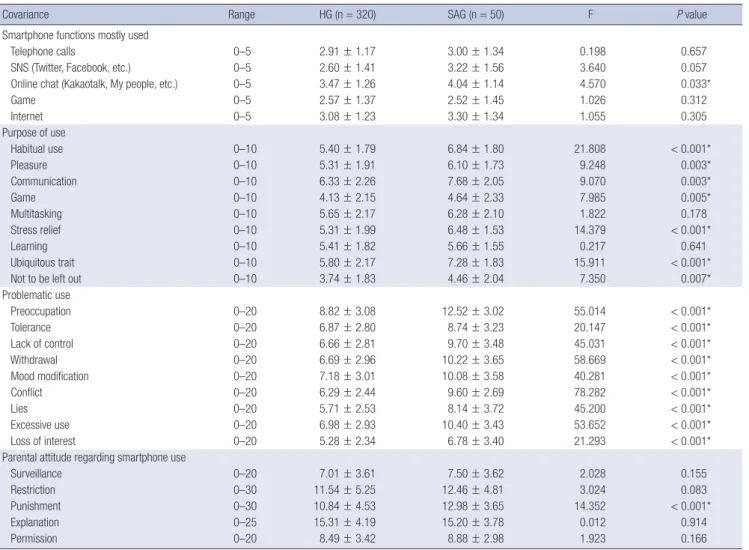
Although there were no differences between the two groups for
“phone call,” “SNS,” “games,” and “Internet,” the SAG used the
“online chat” function significantly more than the HG (F = 4.570;
P = 0.033) (Table 2).
Purpose of use
For purpose of use, the two groups did not show a difference in
“multitasking” and “learning,” but the SAG showed significantly higher “habitual use” (F = 21.808; P < 0.001), “pleasure” (F = 9.248;
P = 0.003), “communication” (F = 9.070; P = 0.003), “games”
(F = 7.985; P = 0.005), “stress relief” (F = 14.379; P < 0.001), “ubiq- uitous trait” (F = 15.911; P < 0.001), and “not to be left out” (F = 7.350; P = 0.007) (Table 2).
Problematic use
For problematic use patterns, all of the following sub-dimen- sions were significantly higher in the SAG compared to the HG:
“preoccupation” (F = 55.014; P < 0.001), “tolerance” (F = 20.147;
P < 0.001), “lack of control” (F = 45.031; P < 0.001), “withdraw- al” (F = 58.669; P < 0.001), “mood modification” (F = 40.281;
P < 0.001), “conflict” (F = 78.282; P < 0.001), “lies” (F = 45.200;
P < 0.001), “excessive use” (F = 53.652; P < 0.001), and “loss of interest” (F = 21.293; P < 0.001) (Table 2).
Parental attitude regarding smartphone use
Although there were no significant differences between the two groups in “surveillance,” ‘restriction,” “explanation,” “permission’
attitudes of parents,” and “punishment” (F = 14.352; P < 0.001), attitude was significantly higher for the parents of SAG (Table 2).
Binary logistic regression analysis in accordance with sociodemographic background and smartphone use pattern
We performed a binary logistic regression analysis with the so- ciodemographic data and smartphone use patterns as the in- dependent variables to assess the factors that affect smartphone addiction. We found that “female” (odds ratio [OR], 2.720; P = 0.014) (sociodemographic features), “learning” (OR, 0.773; P = 0.042) and “ubiquitous trait” (OR, 1.315; P = 0.015) (purpose of use), and “preoccupation” (OR, 5.326; P = 0.021) and “conflict”
(OR, 1.466; P < 0.001) (problematic use) had significant effects Table 1. Sociodemographic characteristics of the study population
Parameters HG (n = 320) SAG (n = 50) t or χ2 P value
Age, yr 13.13 ± 0.81 13.28 ± 0.86 −1.222 0.223
Sex 10.385 0.001*
Male 168 (52.5) 14 (28.0)
Female 152 (47.5) 36 (72.0)
Duration of smartphone use, yr 3.947 0.267
< 1 46 (14.4) 4 (8.0)
> 1 to < 2 81 (25.3) 9 (18.0) > 2 to < 3 110 (34.4) 23 (46.0)
> 3 83 (25.9) 14 (28.0)
Time on smartphone use, hr/day
Weekday 2.65 ± 2.17 3.36 ± 2.03 −2.151 0.032*
Weekend 3.24 ± 2.20 4.53 ± 2.84 −3.674 < 0.001*
Total 2.82 ± 2.02 3.70 ± 2.12 −2.827 0.005*
Data are shown as mean ± SD or number (%).
HG = healthy group, SAG = smartphone addiction group, SD = standard deviation.
*A statistically significant difference between groups.
on smartphone addiction in adolescents. Negelkerke R2 was 0.393, which can be interpreted as the model explaining 39.3%
of all variables (Table 3).
DISCUSSION
In this study, we assessed the severity of students’ smartphone addiction and divided them into the SAG and the HG. Then, we examined the factors that affect smartphone addiction by com- Table 2. ANCOVA regarding the factors affecting smartphone addiction
Covariance Range HG (n = 320) SAG (n = 50) F P value
Smartphone functions mostly used
Telephone calls 0–5 2.91 ± 1.17 3.00 ± 1.34 0.198 0.657
SNS (Twitter, Facebook, etc.) 0–5 2.60 ± 1.41 3.22 ± 1.56 3.640 0.057
Online chat (Kakaotalk, My people, etc.) 0–5 3.47 ± 1.26 4.04 ± 1.14 4.570 0.033*
Game 0–5 2.57 ± 1.37 2.52 ± 1.45 1.026 0.312
Internet 0–5 3.08 ± 1.23 3.30 ± 1.34 1.055 0.305
Purpose of use
Habitual use 0–10 5.40 ± 1.79 6.84 ± 1.80 21.808 < 0.001*
Pleasure 0–10 5.31 ± 1.91 6.10 ± 1.73 9.248 0.003*
Communication 0–10 6.33 ± 2.26 7.68 ± 2.05 9.070 0.003*
Game 0–10 4.13 ± 2.15 4.64 ± 2.33 7.985 0.005*
Multitasking 0–10 5.65 ± 2.17 6.28 ± 2.10 1.822 0.178
Stress relief 0–10 5.31 ± 1.99 6.48 ± 1.53 14.379 < 0.001*
Learning 0–10 5.41 ± 1.82 5.66 ± 1.55 0.217 0.641
Ubiquitous trait 0–10 5.80 ± 2.17 7.28 ± 1.83 15.911 < 0.001*
Not to be left out 0–10 3.74 ± 1.83 4.46 ± 2.04 7.350 0.007*
Problematic use
Preoccupation 0–20 8.82 ± 3.08 12.52 ± 3.02 55.014 < 0.001*
Tolerance 0–20 6.87 ± 2.80 8.74 ± 3.23 20.147 < 0.001*
Lack of control 0–20 6.66 ± 2.81 9.70 ± 3.48 45.031 < 0.001*
Withdrawal 0–20 6.69 ± 2.96 10.22 ± 3.65 58.669 < 0.001*
Mood modification 0–20 7.18 ± 3.01 10.08 ± 3.58 40.281 < 0.001*
Conflict 0–20 6.29 ± 2.44 9.60 ± 2.69 78.282 < 0.001*
Lies 0–20 5.71 ± 2.53 8.14 ± 3.72 45.200 < 0.001*
Excessive use 0–20 6.98 ± 2.93 10.40 ± 3.43 53.652 < 0.001*
Loss of interest 0–20 5.28 ± 2.34 6.78 ± 3.40 21.293 < 0.001*
Parental attitude regarding smartphone use
Surveillance 0–20 7.01 ± 3.61 7.50 ± 3.62 2.028 0.155
Restriction 0–30 11.54 ± 5.25 12.46 ± 4.81 3.024 0.083
Punishment 0–30 10.84 ± 4.53 12.98 ± 3.65 14.352 < 0.001*
Explanation 0–25 15.31 ± 4.19 15.20 ± 3.78 0.012 0.914
Permission 0–20 8.49 ± 3.42 8.88 ± 2.98 1.923 0.166
Data are shown as mean ± SD. ANCOVA was performed.
ANCOVA = analysis of covariance, HG = healthy group, SAG = smartphone addiction group, SNS = Social Network Services, SD = standard deviation.
*A statistically significant difference between groups.
Table 3. Binary logistic regression analysis for the factors affecting smartphone addiction
Variables B SE Walds OR 95% CI
P value
Lower Higher
Sociodemographic characteristics
Sex (female) 1.001 0.408 6.027 2.720 1.224 6.047 0.014*
Purpose for use
Learning 0.258 0.127 4.136 0.773 0.603 0.991 0.042*
Ubiquitous trait 0.274 0.112 5.976 1.315 1.056 1.637 0.015*
Problematic use
Preoccupation 0.165 0.071 5.326 1.179 1.025 1.356 0.021*
Conflict 0.382 0.080 23.100 1.466 1.254 1.713 < 0.001*
Nagelkerke R2= 0.393.
B = regression coefficient, SE = standard error, OR = odds ratio, CI = confidence interval.
*A statistically significant difference between groups.
paring the smartphone use patterns and the parental attitudes regarding their children’s smartphone use. The results showed that being female (sociodemographic features), learning and ubiquitous trait (purpose of use), and preoccupation and con- flict (problematic use) were identified as the factors with signif- icant effects on smartphone addiction in the Korean adoles- cents. The present study is meaningful in that it was the first re- search that attempted to reveal a disease entity for smartphone addiction by analyzing adolescents’ smartphone use patterns.
The study findings showed that the proportions of female and using online chat were higher in the SAG than the HG. The re- sults of logistic regression analysis also showed that females had 2.7 times more risk for smartphone addiction than males. Fur- thermore, using SNS was relatively higher trend in the SAG, al- though the difference was not statistically significant (F = 3.640;
P = 0.057). These results are in line with prior studies that the proportions of females as well as using SNS and online chats were higher in the SAG (8,9). In fact, smartphones can be used for social interaction anywhere at any time because they are specialized in using mobile messengers and SNS. Moreover, women are known to have stronger desires for social relation- ships, which may have contributed to the significantly higher proportion of females with smartphone addictions (13). How- ever, from a different perspective, such use patterns could be changed as smartphone functions are rapidly evolving. Gener- ally, men are known to be more vulnerable to the internet gam- ing disorder than women (14). Therefore, if smartphones devel- op to be able to play high performance games, being male could become a risk factor for smartphone addiction (8).
Regarding purpose, using for habit, pleasure, communica- tion, game, stress relief, ubiquitous trait, and not to be left out were significantly higher in the SAG than the HG. Additionally, the logistic regression analysis results showed that risk for smart- phone addiction was reduced when smartphones were used for learning. However, risk for smartphone addiction was incre- ased when smartphones were used for ubiquitous trait. Smart- phone functions are based on the Internet and are similar to computers, but are more vulnerable to addiction because they can be used anywhere at any time (15). Actually, many problems associated with smartphone are not limited within households, but the influence on the person’s whole life, such as work and school. For these reasons, parents and teachers should keep in mind that if smartphones are used anywhere at any time with- out specific purposes, the risk for addiction could rise, and also encourage adolescents to use smartphones for specific purpos- es, such as searching for information or learning in order to over- come smartphone addiction.
Regarding problematic use of smartphones, preoccupation, tolerance, lack of control, withdrawal, mood modification, con- flict, lies, excessive use, and loss of interest were all significantly higher in the SAG compared to in the HG. These nine problem-
atic use patterns are the same diagnostic criteria for internet gaming disorder defined by the DSM-5 (4). However, the most important thing was that only preoccupation and conflict among the nine problematic use patterns had significant effects on smart- phone addiction according to the logistic regression analysis. It was known that the most common pathology of addiction is tolerance and withdrawal symptoms due to alternation of re- ward pathway (16,17). However, in this study, these factors were not verified as significant risk factors for smartphone addiction.
Based on these results, we could think that current problems associated with smartphone addiction are not actually associ- ated with the psychopathology of an addiction; rather, increas- ing the use of smartphones just has led to preoccupation and conflict. However, the pathology of smartphone addiction could not be defined simply based on the smartphone use patterns only. Thus, we think that further brain imaging and neurobio- logical studies would be required to reveal the definite psycho- pathology of smartphone addiction.
Regarding parental attitude toward children’s smartphone use, parents of the SAG showed significantly higher punishment attitudes than those of the HG. Although parental attitude to- ward children’s smartphone use was not found to have a signif- icant effect on smartphone addiction in the logistic regression analysis, it was known that family education is necessary to treat adolescents with addiction problems. Prior studies also support- ed the need for such a family education. For instance, Han et al.
(18) examined internet gaming addicted adolescents and found that three-week family therapy increased the activity of the cau- date nucleus, which was highly associated with parental attach- ment and also stabilized the dopamine addiction pathway, re- ducing the desire for internet games. Based on such findings, current treatment for internet gaming disorder comprises fami- ly therapy, cognitive behavior therapy and motivational inter- viewing for their parents and children (19). Therefore, we sug- gest that various psychosocial treatments involving participa- tion from both parents and children would be one of the treat- ment options for smartphone addiction, because a definite treat- ment guideline for smartphone addiction has not been estab- lished yet. Additional studies should be performed to confirm the treatment guideline for smartphone addiction.
There were several study limitations. First, there is currently no standardized scale to measure the purpose of smartphone use, problematic use, and parental attitude regarding smart- phone use. Therefore, in this study, we measured these based on the treatment manual for smartphone addiction in adoles- cents distributed by the Ministry of Gender Equality and Family (10). However, more meaningful results would be produced if standardized scales are developed in the future. Second, one limitation of self-reporting scales is that they are susceptible to recall bias. Third, this was a cross-sectional study that examined adolescents’ smartphone addiction and smartphone use pat-
terns; therefore, the result was limited to infer causative relation- ships regarding the factors that affect smartphone addiction.
Fourth, the study samples comprised middle school students from only one school in Daegu. In addition, adolescents with conduct problems could drop out due to insincere attitude. There- fore, the sample would not accurately represent the entire pop- ulation.
We identified a disease entity and risk factors for smartphone addiction by analyzing adolescents’ smartphone use patterns.
Our results revealed that the risk factors for smartphone addic- tion were female, preoccupation, conflict, and use for ubiqui- tous trait, while the protective factor was use for learning. As smart- phone use is rapidly increasing worldwide, we insist that more research, including brain imaging and neurobiological studies, should be performed to reveal clinical evidence of disease enti- ty about smartphone addiction.
DISCLOSURE
The authors have no potential conflicts of interest to disclose.
AUTHOR CONTRIBUTION
Conceptualization: Kim JW, Choi TY. Data curation: Lee H, Kim JW, Choi TY. Investigation: Lee H, Kim JW, Choi TY. Writing - original draft: Lee H. Writing - review & editing: Lee H, Kim JW, Choi TY.
ORCID
Hyuk Lee https://orcid.org/0000-0003-4716-3360 Jun Won Kim https://orcid.org/0000-0001-6793-3006 Tae Young Choi https://orcid.org/0000-0003-2677-9297
REFERENCES
1. Park MJ, Park GD, Lee YY, Oh JA. Smartphone use actual condition for re- search. Seoul, Kyung Hee Cyber University, 2012.
2. Ministry of Science, ICT and Future Planning (KR). The demographics of domestic subscribers to smartphones [Internet]. Available at www.msip.
go.kr/web/msipContents/contents.do?mId=MTQ2 [accessed on 23 May 2016].
3. National Information Society Agency (KR). 2013 survey on the side effect of Internet addiction [Internet]. Available at www.nia.or.kr/site/nia_kor/
ex/bbs/View.do?cbIdx=65914&bcIdx=13015&parentSeq=13015 [accessed
on 23 May 2016].
4. American Psychiatric Association. Diagnostic and Statistical Manual of Mental Disorders. 5th ed. Washington, D.C., American Psychiatric Asso- ciation, 2013.
5. Seo MJ, Choi TY, Woo J, Kim J, Lee J. A comparative study of smartphone and Internet addiction on adolescent psychopathology. J Korean Soc Biol Ther Psychiatry 2013; 19: 154-62.
6. Smetaniuk P. A preliminary investigation into the prevalence and predic- tion of problematic cell phone use. J Behav Addict 2014; 3: 41-53.
7. Seo CM, Lee JH, Choi TY, Kim J, Shin I, Woo J. Study for relations between smart-phone addiction level and Korea youth self report. J Korean Soc Biol Ther Psychiatry 2012; 18: 223-30.
8. Choi SW, Kim DJ, Choi JS, Ahn H, Choi EJ, Song WY, Kim S, Youn H. Com- parison of risk and protective factors associated with smartphone addic- tion and Internet addiction. J Behav Addict 2015; 4: 308-14.
9. Lee H, Seo MJ, Choi TY. The effect of home-based daily journal writing in Korean adolescents with smartphone addiction. J Korean Med Sci 2016;
31: 764-9.
10. Lee YS, Lee DH, Kim EY, Kang SY, Kim RS, Choi YH, Yoon MJ. Parent Edu- cation Program Manual for Smartphone Addiction. Seoul, Korea Youth Counseling & Welfare Institute, 2013.
11. Kim D, Lee Y, Lee J, Nam JK, Chung Y. Development of Korean smartphone addiction proneness scale for youth. PLoS One 2014; 9: e97920.
12. National Information Society Agency (KR). Development of Korean smart- phone addiction proneness scale for youth and adults [Internet]. Available at www.iapc.or.kr/info/mediaAddc/showInfoMediaAddcDetail.do?article _id=ICCART_0000000003777&board_type_cd=A1 [accessed on 23 May 2016].
13. Weiser EB. Gender differences in Internet use patterns and Internet ap- plication preferences: a two-sample comparison. Cyberpsychol Behav 2004; 3: 167-78.
14. Rees H, Noyes JM. Mobile telephones, computers, and the Internet: sex differences in adolescents’ use and attitudes. Cyberpsychol Behav 2007;
10: 482-4.
15. Lee YJ, Lee SI, Lee AR, Bahn GH, Choi TY, Kim JY, Kim JH, Park EJ, Park JS, Bhang SY, et al. Attitudes of psychiatrists towards smartphone usage of children and adolescents. J Korean Neuropsychiatr Assoc 2015; 54: 556- 63.
16. Kalivas PW, Volkow ND. The neural basis of addiction: a pathology of mo- tivation and choice. Am J Psychiatry 2005; 162: 1403-13.
17. Prochaska JO, DiClemente CC, Norcross JC. In search of how people change.
Applications to addictive behaviors. Am Psychol 1992; 47: 1102-14.
18. Han DH, Kim SM, Lee YS, Renshaw PF. The effect of family therapy on the changes in the severity of on-line game play and brain activity in ado- lescents with on-line game addiction. Psychiatry Res 2012; 202: 126-31.
19. Lee H, Choi TY. The psychosocial approaches of Internet/game addic- tion. J Korean Soc Biol Ther Psychiatry 2015; 21: 65-72.