Surgeon Custom-Made Iliac Branch Device to Salvage Hypogastric Artery during Endovascular Aneurysm Repair
Endovascular salvage of the hypogastric artery using iliac branch device (IBD) during endovascular aortic aneurysm repair (EVAR), offers less invasive alternative solution to surgery to prevent pelvic ischemia. We have performed the first Korean surgeon custom- made IBD for this purpose to overcome the limitation of unavailability of the devices in Korea. Four patients with abdominal aortic aneurysm with bilateral common iliac artery aneurysm (CIAA) were treated using custom-made IBDs from October 2013 to December 2013. IBD was created in back table before EVAR operation using TFLE Zenith iliac limb stent graft (Cook Inc.). Three V12 (Atrium, Inc.) one Viabahn (Gore, Inc.) were used for bridging between IBD and target hypogastric artery. With this modification of IBD procedure, exteriorize the guide wire without snare device is possible which offers another benefit in terms of reducing medical costs comparing to commercial IBD. All operations were successful without any device related complications or postoperative endoleaks.
During the mean follow up of 3 months, all IBD were patent without clinical
complications. Surgeon custom made IBD is feasible and useful to preserve pelvic perfusion especially in the situation of limited commercial IBD availability in many countries. Long- term follow-up is needed to evaluate stent graft patency and IBD-related complications.
Keywords: Iliac Branch Device; Custom-Made; Endovascular Aneurysm Repair Young Eun Park,1 Jae Hoon Lee,1
Woo-Sung Yun,2 and Ki Hyuk Park1
1Division of Vascular Surgery, Department of Surgery, Daegu Catholic University College of Medicine, Daegu; 2Department of Surgery, Yeungnam University, College of Medicine, Daegu, Korea
Received: 28 January 2014 Accepted: 12 August 2014 Address for Correspondence:
Ki Hyuk Park, MD
Division of Vascular Surgery, Department of Surgery, Daegu Catholic University College of Medicine, 33 Duryugongwon-ro 17-gil, Nam-gu, Daegu 705-718, Korea Tel: +82.53-650-4065, Fax: +82.53-624-7185
E-mail: [email protected]
http://dx.doi.org/10.3346/jkms.2014.29.12.1678 • J Korean Med Sci 2014; 29: 1678-1683
INTRODUCTION
Endovascular aneurysm repair (EVAR) for abdominal aortic aneurysm (AAA) now becomes widely accepted as primary choice for aortic aneurysm repair. Main obstacles for this less invasive procedure lies in proximal hostile neck anatomy which leads to aneurismal exclusion failure by causing type-I endole- ak (1, 2). Although distal iliac stenotic lesion causes access diffi- culty to deliver the system, smaller profile and lubricant sheath offers more chance to overcome this limitation (3). The other important iliac artery related issue is combined common iliac artery (CIA) aneurysm which occurred up to 20% with AAA (4).
In such cases, EVAR requires distal extension to external iliac artery with occlusion of hypogastric artery to prevent type II endoleak via patent hypogastric artery.
Unfortunately, sudden blockage of the hypogastric artery caused variable degree of pelvic ischemia. Predominantly this will cause buttock claudication and erectile dysfunction, but sometimes more serious consequences such as colon ischemia or spinal cord ischemia could happen (5-8). To prevent this com- plication, surgical bypass to hypogastric artery via retroperito- neal approach has been performed (9). However this hybrid procedure sometimes offsets the benefit of less invasiveness of EVAR by causing complication such as retroperitoneal hemato-
ma. The iliac branch device (IBD) (Cook Inc., Bloominton, IN, USA) introduced for pure endovascular approach. Technical success and clinical results showed feasibility with desirable outcome (10,11). However, in many countries including Korea, the commercialized IBD is not available yet. Hence we report four cases using surgeon custom made IBD which could be used for substitute technique of endovascular salvage for hypo- gastric artery. This is not an original concept, already many ex- periences have been reported in terms of branched stent graft (12). We also customized the IBD procedure to make it more cost effective.
MATERIALS AND METHODS Device customization
IBD is created making short cuff to TFLE Zenith iliac limb (Cook Inc.). Making branch portion is done with partial proximal de- ployed state. For this, peel-away the system of limb needed to be removed, but to keep it in stable status, the main keeping wire should not be removed. Although the diameter of TFLE limb is fixed as 12 mm, the length of limb used for IBD will be dependent on iliac artery anatomy. This would be another ben- efit of custom-made devices compared to fixed length of factory ready-made devices. We used 73 mm in three cases and 56 mm
Park YE, et al. • Surgeon Custom-made Iliac Branch Device
in one case. First step, deploy proximal two stent (Fig. 1A). Some- times second stent row is not fully expanded because of distal confined portion, we found that making a cuff was not hindered.
To make an accurate hole for cuff, electric coagulator is used (Fig. 1B). The hole should be made at the site of stent, not be- tween stents. We usually use a 7 mm thin walled PTFE (Gore Inc., Flagstaff, AZ, USA) graft for making cuff, but 8 mm graft also will work. The length of cuff is decided between 15 mm to 20 mm based on working distance between cuff and hypogas- tric artery orifice. The orientation of cuff can be decided in any direction using reference of knob at the handling portion. The configuration of cuff should be downward shaped usually 45 degree. Using 5-0 Prolene, running suture as vascular anasto- mosis is done (Fig. 1C). The cuff located under the stent, we put three sutures including top to fix stent with cuff. So this outside stent could offer supporting skeleton at the overlap zone. We put one gold marker at the outside of distal portion of cuff (Fig.
1D). For the proximal marker of cuff, second stent will be used as the reference. This whole “making device” procedure usually takes less than 10 min (Fig. 1E). In our first case, we made the
device before operation to avoid unnecessary anesthetic time, but after that we did during the operation. For the preload cath- eter, it could be decided by the configuration of aortic bifurca- tion (Fig. 1F). For the sharp angle, Cobra 2 or RIM catheter will be proper other than we usually choose KMP catheter with Teru- mo 035 inch 260 cm glide wire.
Deploy procedure (Fig. 2)
The first step is to insert a large diameter sheath enough to in- troduce cuffed IBD, into CIA. Since the sheath size for 12 mm diameter Zenith is 14 Fr, we often choose 20 Fr, 35 cm length sheath (Saint Jude, Inc., St. Paul, MN, USA) for this purpose.
Even though 5Fr angio catheter comes together for preload catheter, we found 20 Fr sheath is enough size for IBD proce- dure. After the tip of the sheath is located CIA orifice level, the custom-made IBD needs to be loaded. This step would be the bustle up without experiences, because of back bleeding via sheath. Variable techniques in terms of reloading procedure can be used according to operator’s experiences. We use um- bilical tape to confine the stent-graft to reload into sheath. This Fig. 1. Back table customization of IBD (liac branch device) with Cook Zenith TFLE 12-73 iliac stent graft limb. (A) Partial proximal deploy of limb. (B) Elliptical graftotomy is made round 2nd row of stent column using electric cautery. (C) 15 mm long cuff, using PTFE (polytetrafluoroethylene) graft is sutured with Prolene sutures. (D) For distal cuff orientation, gold marker is attached to cuff (black arrow). (E) Completed modification of IBD. (F) Proper shape of angio-catheter with guidewire preloaded through cuff to en- hance iliac artery cross-over. (G) Custom made IBD with PTFE cuff.
A
C
E F
G
D
B
is two person’s work and both should be familiar with loading procedure to avoid inadvertent injury to stent of cuff compo- nent. Since the hypogastric artery direction is always posterior, the cuff should be loaded with facing posterior, too. After intro-
ducing IBD at the level of CIA proximal site, contralateral selec- tion to make through-through guidewire needs to be started.
With proper shape of preload catheter, passing guidewire to op- posite iliac artery is simple without much difficulty. However if A
D
G H I
B
E
C
F
Fig. 2. Procedure of IBD (iliac branch device) during EVAR (endovascular aortic aneurysm repair). (A) Two operators work cooperatively to reload IBD into big sheath (20 Fr Saint Jude, Inc.) with preload angio catheter. (B) First step, big sheath is introduced to aortic bifurcation level at ipsilateral side. (C) After introducing IBD, guidewire is passed and ex- teriorized with proper type of angio-catheter. (D) Using guidewire as through-through guidewire, proper sized of sheath to introduce covered stent is advanced up to cuff of IBD.
(E) After cannulation of target hypogastric artery, the length between cuff and hypogastric artery needs to be measured with sizing catheter. (F) Balloon expandable stent-graft is used for aneurismal changed hypogastric artery to adjust distal sealing zone. (G) After deploying main body via contralateral side for EVAR, bridging between contralateral limb and IBD is proceeded. (H) In final aortogram, there is no endoleak. (I) In early post operative CT angiogram, the patency of IBD is confirmed.
Park YE, et al. • Surgeon Custom-made Iliac Branch Device
there is severe tortuosity in contralateral external iliac artery (EIA) with sharp aortic bifurcation angle, this step would be very hard without snare. Commercial IBD devices include snare device for this purpose. However sometimes snaring also can be diffi- cult with hairpin shape bended EIA anatomy. We do not use a snare device for this step. Instead of using preload catheter, we can do cross over guide wire first from any side of femoral ar- tery and using this preplaced guidewire as through-through guidewire during IBD loading procedure. By avoiding snare procedure, it offers huge medical costs saving effect. This is an- other merit of custom-made IBD. After using this technique we could overcome any difficulties related to this step. The proper diameter sheath to introduce bridging covered stent is inserted with holding through-through guidewire. The tip should be placed beyond cuff to prevent inadvertent fall off during insert- ing covered stent, especially sharp aortic bifurcation angled anatomy. Before this step, proximal IBD portion needs to be deployed to cuff level. If there is limited working distance be- tween cuff and hypogastric artery, bridging procedure would be failed or kinking could happen. So this must be kept in mind.
Cannulation for hypogastric artery can be easy with proper cath- eter. We change to stiff guidewire to introduce covered stent.
Measuring the distance between cuff and hypogastric artery is important to decide proper covered stent. Preplaced gold mark- er with stent row used as reference marker for this step. If there is some aneurismal change with hypogastric artery, we prefer balloon expandable stent-graft, V12 (Atrium, Inc., Hudson, NH, USA) because diameter adjustment with bigger balloon is ca- pable. After introducing covered stent to proper site, the through- through wire needs to be removed. It will offer natural configu- ration of cuff to direction of hypogastric artery. Careful balloon for covered stent with proper diameter is important to prevent distal type I endoleak. After completing this procedure, the rest of IBD part will be deployed without pressure to hypogastric ar- tery. The main body of Zenith stent graft will be introduced via contralateral side and deployed as regular EVAR procedure. To bridge the gap between contralateral limb and proximal stent
of IBD, also sizing catheter introduced after contralateral gate selection. Since only 22 mm length of stent in limb graft offers overlapping zone, operator should be careful during bridging procedure. It should not cover the orifice of IBD internal open- ing which could lead to hypogastric artery occlusion. For this step, proper oblique C-arm angle, with caudal-cranial view is recommended.
RESULTS
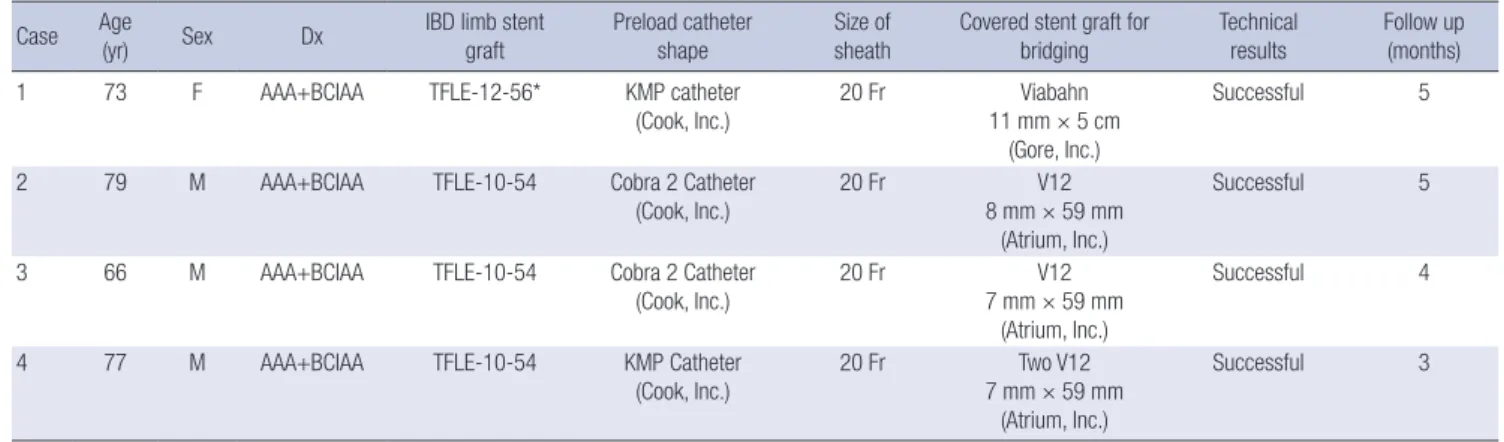
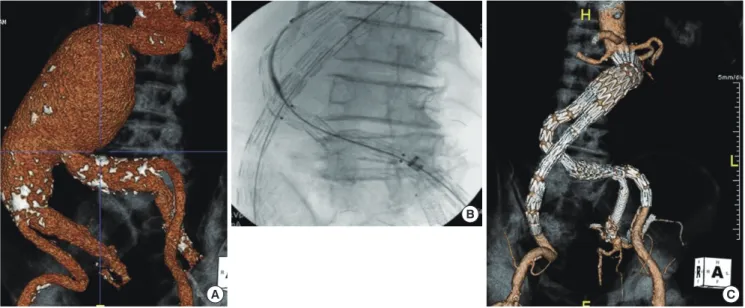
We have done four custom-made IBD cases. The technical suc- cess for all cases was 100%. Each step of procedure for IBD load- ing, hypogastric artery cannulation, bridging procedure with covered stent was done uneventfully. All iliac artery aneurysm was excluded without type I endoleak which was confirmed in early post operative CT scans. The indication of IBD were Bilat- eral CIAA combined with AAA in all patients (Table 1). For the bridging procedure, V12 (Atrium, Inc.) was used in three pa- tients and one Viabahn (Gore, Inc.) was used for the other pa- tient. In all three V12 using cases, flaring of distal V12 with big- ger balloon to adjust aneurismal portion of hypogastric artery was achieved. In three patients, opposite hypogastric artery was simultaneously occluded with coil. In the other forth patient, contralateral hypogastric artery was already occluded by dis- ease progression and single hypogastric artery was saved by IBD. The 4th patient (case 4 in Table 1) has severely angled aor- toiliac anatomy and the operation was relatively challenging (Fig. 3). The acute angle over aorta and left CIA hindered the advancing of limb stent graft which offered a bridge between contralateral limb and IBD. During the pushing up of the limb stent graft, pre-deployed IBD device was moved upward, too.
Since V12 was already deployed and fixed to hypogastric artery, the cuff portion of IBD could have been fallen off and lead to disconnection. To overcome this situation we have used 24 Fre- nch big sheath (Cook, Inc.) to offer paving. We have used Endu- rant (Medtronic, Inc., Minneapolis, MN, USA) limb stent graft for flexibility.
Table 1. Charateristics of four IBD (iliac branch device) patients. Procedure in case 2 and case 3 are illustrated in corresponding Fig 2, 3 Case Age
(yr) Sex Dx IBD limb stent
graft Preload catheter
shape Size of
sheath Covered stent graft for
bridging Technical
results Follow up (months)
1 73 F AAA+BCIAA TFLE-12-56* KMP catheter
(Cook, Inc.) 20 Fr Viabahn
11 mm × 5 cm (Gore, Inc.)
Successful 5
2 79 M AAA+BCIAA TFLE-10-54 Cobra 2 Catheter
(Cook, Inc.) 20 Fr V12
8 mm × 59 mm (Atrium, Inc.)
Successful 5
3 66 M AAA+BCIAA TFLE-10-54 Cobra 2 Catheter
(Cook, Inc.) 20 Fr V12
7 mm × 59 mm (Atrium, Inc.)
Successful 4
4 77 M AAA+BCIAA TFLE-10-54 KMP Catheter
(Cook, Inc.) 20 Fr Two V12
7 mm × 59 mm (Atrium, Inc.)
Successful 3
*IBD is created making short cuff to TFLE Zenith iliac limb. AAA, abdominal aortic aneurysm; Dx, diagnosis; BCIAA, Bilateral common iliac artery aneurysm.
Fig. 3. Procedure in case number 4. (A) Preoperative CT angiogram showed 8 cm abdominal aortic aneurysm with severe angle between common iliac artery. (B) The proce- dure was challenging by difficulties in advancing limb stent graft to avoid displacement of pre-deployed IBD, flexible limb stent graft with paving sheath is used. (C) In postoper- ative follow up CT angiogram, successful aneurysm exclusion is accomplished without endoleak.
A C
B
DISCUSSION
The risk of hypogastric artery embolization during EVAR is well known but sometimes it is inevitable when AAA is combined with CIA aneurysm. The most disastrous complication such as ischemic colon necrosis reported with bilateral embolization (13). This life threatening complication needs instant abdomi- nal exploration with bowel excision and colostomy. However even with unilateral hypogastric embolization, up to 50% of pa- tients suffer from buttock claudication (14). Although this is not a critical complication and expected spontaneous improve- ment with time, many of these patients turn out to be in a dis- abled walking life style. Since the elective aneurysm repair is preventive surgery even without any symptom, postoperative life quality is severely affected. Surgical bypass such as hypo- gastric artery transposition or interposition graft could offer pelvic perfusion for such cases, but still need general anesthesia with increasing peri-operative risk to comorbid patients. There is some noble endovascular technique so called “sandwich”
procedure. Separate covered stent insert to hypogastric artery in parallel configuration with main stent graft to salvage hypo- gastric perfusion (15). However still there is no constant con- sensus for this technique in terms of feasibility. Also there is high risk for endoleak through the gap between parallel cov- ered stents, especially hostile anatomy. Iliac branch device was designed to pursue more stable procedure which could offers natural anatomic configuration. Commercial available IBD de- vice becomes the solution for this circumstance without any more invasiveness. The clinical outcome of Cook Zenith IBD have showed prominent results with desirable longterm paten- cy results (10). With 100 consecutive cases, the procedural suc-
cess rate was 95% without mortality. The patency rate of hypo- gastric branch was 90% at 1 yr and 81.4% at 5 yr. There were no late ruptures. However, even with these highly acceptable re- sults, the device availability in some countries are very limited.
Because of health costs and reimbursement issues, many coun- tries including Korea, this situation motivates vascular surgeons to customize conventional stent graft (16-18). Because the vas- cular surgeons are already getting used to manipulating graft, they have some privileges for customization such as suture cuff to iliac limb stent graft. Other authors reported using Dacron graft for cuff. We used PTFE graft to favor IBD loading into big sheath by reducing profile. Through our four cases of experi- ences, we found that the loading procedure is the most demand- ing step because of back-bleeding. The benefit of our procedur- al customization is revising the order of procedures and capa- ble cross over guide wire without snare device. If the angle of aortic bifurcation is sharp with tortuous iliac arterial anatomy, crossing guide wire is not easy. Snaring is not directly related with IBD, but it is an expensive complement and another bur- den of medical cost. Even without snare, if the cross over guide- wire is done at first and using this wire to insert preload catheter of IBD during loading procedure, hostile iliac anatomy could be surmounted. The other benefit is choosing the most proper size of IBD graft in terms of length and diameter. The size could be decided according to external iliac artery diameter and config- uration. We chose the distal diameter 10 mm and the limb length 56 mm (TFLE-10-54) in three cases. This aspect offers more flexibility in case of tortuous anatomy as in our fourth case (Fig.
3). For bridging, we used balloon expandable covered stent, be- cause of dilatation could be possible to adjust aneurismal change of hypogastric artery. There is some anatomical limitation for
Park YE, et al. • Surgeon Custom-made Iliac Branch Device
application of IBD procedure. The CIA lumen should be enough to allow cuff with limb stent graft which is more than 20 mm. If the lumen is smaller than this, the cuff could be compressed by arterial wall. The length of CIA is also an important factor for cross over introducing bridging covered stent. Based on config- uration of limb stent graft and considering working distance for bridging, 50 mm length is the minimum requirement. Severe tortuosity of external iliac artery and acute angle between aorta and CIA could act as an obstacle for IBD, but it is not absolute contraindication. Careful planning based on CT workstation is a prerequisite with hostile anatomy as in our case. It is better to do IBD procedure in straight CIA side, because tortuous iliac artery may cause displacement of preplaced IBD during intro- duction of other components during EVAR.
In summary, we reported the first case of surgeon custom- made IBD in Korea. The procedure is feasible and useful to pre- serve pelvic perfusion especially in the situation of unavailabili- ty of device. Long-term follow-up is needed to evaluate stent graft patency and IBD-related complications.
DISCLOSURE
The authors have no conflicts of interest to disclose.
ORCID
Young Eun Park http://orcid.org/0000-0002-5211-9500 Jae Hoon Lee http://orcid.org/0000-0002-0906-5236 Woo-Sung Yun http://orcid.org/0000-0001-8956-8310 Kihyuk Park http://orcid.org/0000-0001-9679-2820 REFERENCES
1. Aburahma AF, Campbell JE, Mousa AY, Hass SM, Stone PA, Jain A, Nan- jundappa A, Dean LS, Keiffer T, Habib J. Clinical outcomes for hostile versus favorable aortic neck anatomy in endovascular aortic aneurysm repair using modular devices. J Vasc Surg 2011; 54: 13-21.
2. Stather PW, Sayers RD, Cheah A, Wild JB, Bown MJ, Choke E. Outcomes of endovascular aneurysm repair in patients with hostile neck anatomy.
Eur J Vasc Endovasc Surg 2012; 44: 556-61.
3. Early H, Atkins M. Technical tips for managing difficult iliac access. Se- min Vasc Surg 2012; 25: 138-43.
4. Armon MP, Wenham PW, Whitaker SC, Gregson RH, Hopkinson BR.
Common iliac artery aneurysms in patients with abdominal aortic an- eurysms. Eur J Vasc Endovasc Surg 1998; 15: 255-7.
5. Connolly JE, Ingegno M, Wilson SE. Preservation of the pelvic circula- tion during infrarenal aortic surgery. Cardiovasc Surg 1996; 4: 65-70.
6. Lee CW, Kaufman JA, Fan CM, Geller SC, Brewster DC, Cambria RP, Lamuraglia GM, Gertler JP, Abbott WM, Waltman AC. Clinical outcome of internal iliac artery occlusions during endovascular treatment of aor- toiliac aneurysmal diseases. J Vasc Interv Radiol 2000; 11: 567-71.
7. Lin PH, Bush RL, Chaikof EL, Chen C, Conklin B, Terramani TT, Brink- man WT, Lumsden AB. A prospective evaluation of hypogastric artery embolization in endovascular aortoiliac aneurysm repair. J Vasc Surg 2002; 36: 500-6.
8. Lin PH, Chen AY, Vij A. Hypogastric artery preservation during endo- vascular aortic aneurysm repair: is it important? Semin Vasc Surg 2009;
22: 193-200.
9. Arko FR, Lee WA, Hill BB, Fogarty TJ, Zarins CK. Hypogastric artery by- pass to preserve pelvic circulation: improved outcome after endovascu- lar abdominal aortic aneurysm repair. J Vasc Surg 2004; 39: 404-8.
10. Parlani G, Verzini F, De Rango P, Brambilla D, Coscarella C, Ferrer C, Cao P. Long-term results of iliac aneurysm repair with iliac branched endograft: a 5-year experience on 100 consecutive cases. Eur J Vasc En- dovasc Surg 2012; 43: 287-92.
11. Ferreira M, Monteiro M, Lanziotti L. Technical aspects and midterm patency of iliac branched devices. J Vasc Surg 2010; 51: 545-50; discus- sion 50.
12. Oderich GS, Ricotta JJ 2nd. Novel surgeon-modified hypogastric branch stent graft to preserve pelvic perfusion. Ann Vasc Surg 2010; 24: 278-86.
13. Parodi JC, Barone A, Piraino R, Schonholz C. Endovascular treatment of abdominal aortic aneurysms: lessons learned. J Endovasc Surg 1997;
4: 102-10.
14. Ghosh J, Murray D, Paravastu S, Farquharson F, Walker MG, Serracino- Inglott F. Contemporary management of aorto-iliac aneurysms in the endovascular era. Eur J Vasc Endovasc Surg 2009; 37: 182-8.
15. Friedman SG, Wun H. Hypogastric preservation with Viabahn stent graft during endovascular aneurysm repair. J Vasc Surg 2011; 54: 504-6.
16. Oderich GS, Ricotta JJ 2nd. Modified fenestrated stent grafts: device de- sign, modifications, implantation, and current applications. Perspect Vasc Surg Endovasc Ther 2009; 21: 157-67.
17. Ricotta JJ 2nd, Tsilimparis N. Surgeon-modified fenestrated-branched stent grafts to treat emergently ruptured and symptomatic complex aor- tic aneurysms in high-risk patients. J Vasc Surg 2012; 56: 1535-42.
18. Starnes BW. Physician-modified endovascular grafts for the treatment of elective, symptomatic, or ruptured juxtarenal aortic aneurysms. J Vasc Surg 2012; 56: 601-7.