INTRODUCTION
Peanut allergy patients have diverse clinical manifestations, depending on age, ethnicity, and sensitization profiles. In adults, sensitization and clinical patterns of peanut allergy are different from those in children.1,2 Peanut anaphylaxis (PA) is common in children; oral allergy syndrome (OAS) to peanut is common in adults. Cross-reactivity between Fagales tree (in- cluding birch and oak family trees) pollen and peanut can ex- plain the age difference observed in peanut allergy, as the Fag- ales pollen sensitization rate increases with age.3 As some pa- tients have both PA and OAS, accurate diagnosis of peanut al- lergy and prediction of prognosis are important for these pa- tients.
In Asian populations, peanut allergic patients are rare com- pared to those observed in Western countries.4 However, the in- cidence of peanut allergy among Asian populations also con- tinues to increase, though the precise cause of this phenome- non is currently unknown.5,6 The increasing incidence of pea-
nut allergy in Korea may be due to increased Fagales sensitiza- tion, which is cross-reactive to peanuts. The number of tree pollen-sensitized patients is increasing worldwide due to changes in atmospheric CO2, climate, and pollen counts;7 the incidence of Fagales pollen-related OAS is also increasing.8 In Korea, Fagales pollen sensitization is also increasing, which may be due to climate change and restoration of forests after the Korean War and the consecutive period of industrialization.
Differences in the sensitization to major peanut allergens have been reported in many previous studies. The Ara h 2 com- ponent allergen is a storage protein in peanuts and well known to be suitable for diagnosing PA.9 However, OAS patients can
Clinical Significance of Component Allergens in Fagales Pollen- Sensitized Peanut Allergy in Korea
Kyung Hee Park,
1,2Young Woong Son,
1Sang Chul Lee,
1Kyunguk Jeong,
3Da Woon Sim,
1,2Hye Jung Park,
1,2Sooyoung Lee,
3Jae-Hyun Lee,
1,2Jung-Won Park
1,2*
1Division of Allergy and Immunology, Department of Internal Medicine, Yonsei University College of Medicine, Seoul, Korea
2Institute of Allergy, Yonsei University College of Medicine, Seoul, Korea
3Department of Pediatrics, Ajou University School of Medicine, Suwon, Korea
This is an Open Access article distributed under the terms of the Creative Commons Attribution Non-Commercial License (http://creativecommons.org/licenses/by-nc/3.0/) which permits unrestricted non-commercial use, distribution, and reproduction in any medium, provided the original work is properly cited.
Purpose: Clinical features of peanut allergy can range from localized to systemic reactions. Because peanut and birch pollen have cross-reactivity, peanut can lead to localized allergic reaction in Fagales pollen-sensitized oral allergy syndrome (OAS) patients without peanut sensitization per se.
The purpose of this study was to discriminate true peanut food allergy from cross-reactive hypersensitivity in birch-sensitized peanut allergy. Meth- ods: Birch-sensitized (n=81) and peanut anaphylaxis patients (n=12) were enrolled. Peanut-related allergic reactions and sensitization profiles were examined. Specific IgE to Fagales tree pollens (birch, oak), peanut, and their component allergens (Bet v 1, Bet v 2, Ara h 1, Ara h 2, Ara h 3, Ara h 8, and Ara h 9) were evaluated. Based on these specific IgEs and clinical features, the patients were classified into 4 groups: group 1 (Fagales pollen allergy without OAS), group 2 (Fagales pollen allergy with OAS), group 3 (OAS with peanut anaphylaxis), and group 4 (peanut anaphylaxis).
Results: After peanut consumption, one-third of OAS patients experienced oral symptoms not associated with peanut sensitization. Ara h 1 or Ara h 2 was positive in peanut anaphylaxis patients, whereas Ara h 8 was positive in OAS patients. There were 4 patients with both peanut anaphylaxis and OAS (group 3). Both Ara h 2 and Ara h 8 were positive in these patients. Foods associated with OAS in Korea showed unique patterns com- pared to Westernized countries. Conclusions: Ara h 2 and Ara h 8 may be important component allergens for discriminating peanut allergy.
Key Words: Allergens; IgE; peanut hypersensitivity; pollen; trees
Correspondence to: Jung-Won Park, MD, PhD, Division of Allergy and Immunology, Department of Internal Medicine, Yonsei University College of Medicine, 50-1 Yonsei-ro, Seodaemun-gu, Seoul 03722, Korea.
Tel: +82-2-2228-1961; Fax: +82-2-393-6884; E-mail: [email protected]
Received: November 27, 2015; Revised: March 15, 2016; Accepted: April 25, 2016
•There are no financial or other issues that might lead to conflict of interest.
Allergy Asthma Immunol Res. 2016 November;8(6):505-511.
http://dx.doi.org/10.4168/aair.2016.8.6.505 pISSN 2092-7355 • eISSN 2092-7363
experience oral symptoms after peanut consumption; these cases are usually associated with Ara h 8, which belongs to the pathogenesis-related protein (PR)-10 family. The PR-10 family includes Bet v 1, Que a 1, Aln g 1, and Cor a 1. Furthermore, the sensitization patterns of peanut component allergens also dif- fer among countries.10
The aim of this study was to identify different sensitization patterns of birch and peanut component allergens associated with PA and OAS. These differences may enable physicians to accurately diagnose patients and to implement appropriate treatment plans for peanut allergy. In addition, diets and eating habits differ between Western and Eastern countries, and therefore, it is necessary to determine the patterns of OAS in East Asian countries.
MATERIALS AND METHODS Study population
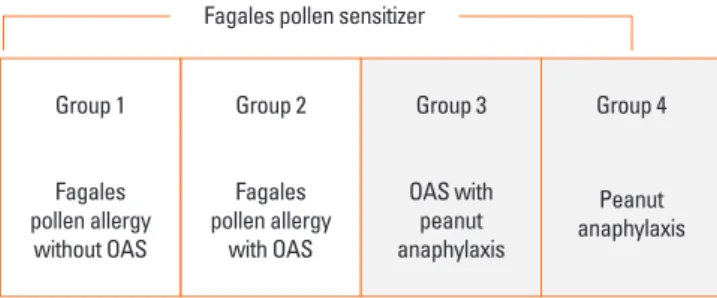
Birch pollen allergic patients (n=81) and PA patients (n=12) were retrospectively enrolled from January 2013 to June 2015 from the Severance Resource Allergy Data System (Seoul, Ko- rea), which includes clinical history, diagnosis, and sensitiza- tion profiles of patients’ allergic diseases with their sera. Sensiti- zation was determined using ImmunoCAP and skin prick test (SPT) results. Patients’ medical records were retrospectively re- viewed for detailed clinical symptoms of cross-reactivity of food allergens to sensitized tree pollens.11 If the exact symptoms were not recorded, we conducted telephone interviews with the patients to obtain a more detailed clinical history. Based on the sensitization profiles and clinical manifestations, the pa- tients were categorized into 4 groups. Group 1 included birch pollen allergic patients without OAS (patients with allergic rhi- nitis or asthma); group 2 included birch pollen-related OAS pa- tients; group 3 included patients with both OAS and PA; and group 4 included patients with PA but without OAS. Diagnosis of OAS and PA were determined by careful history taking, symptom reproducibility and sIgE titers. The classification of each group is shown schematically in Fig. 1. Sensitization pro- files for birch and peanut were analyzed including component allergens. This study was approved by the Institutional Review
Board of Yonsei University Health System (4-2013-0397). Par- ticipating patients provided written informed consent.
SPT
SPTs were performed on the patients’ backs using 55 kinds of allergens, including trees, grasses, weeds, molds, house dust mites, animal dander, white birch pollen, and white oak tree pollen (Allergopharma, Hamburg, Germany); a negative con- trol (normal saline with 0.3% phenol and 50% glycerol) and positive control (0.1% histamine; Allergy Therapeutics, Worth- ing, UK) were also tested. The SPT results were interpreted as positive if the wheal size of each allergen averaged ≥3 mm in diameter.
Serum allergen-specific immunoglobulin E measurement Sera of the enrolled subjects, which were stored at -70°C, were used for IgE measurement. The ImmunoCAP system (Thermo Fisher, Uppsala, Sweden) was used to measure specific IgE (sIgE) to peanut and tree pollens. The total allergen and 5 re- combinant component allergens (Ara h 1, Ara h 2, Ara h 3, Ara h 8, and Ara h 9) of peanuts were measured using the serum of each patient; sIgE titers ≥0.35 kU/L were considered positive.
Titers >100 kU/L were regarded as 101 kU/L for statistical anal- ysis. The levels of sIgE against the total birch and oak tree pol- lens and component allergens of birch (Bet v 1, Bet v 2) were measured.
Statistical analysis
The data were analyzed using SPSS 18.0 (SPSS Inc., Chicago, IL, USA). Patients’ baseline characteristics were analyzed using Fisher’s exact, Pearson’s χ2, and Kruskal–Wallis tests. The posi- tivity rate for each allergen was compared using Fisher’s exact or Pearson’s χ2 tests. The sIgE titers were compared with Mann- Whitney U and Kruskal-Wallis tests. Dunn’s test was used for subgroup comparisons after the Kruskal-Wallis test. Receiver operating characteristic (ROC) curve analysis was performed to determine the sIgE cut-off titers for OAS. A comparison of the ROC curve was performed using MedCalc software (MedCalc, Mariakerke, Belgium). A P value of <0.05 was considered sta- tistically significant.
RESULTS
Patients’ characteristics
The demographic characteristics of the enrolled patients are shown in Table 1. The mean age of the patients was 30.3 years.
In Korea, PA in adults is rare, so that the mean age of group 4 was 7.6 years. All the food allergy patients (groups 2, 3, and 4) re-experienced immediate allergic reactions by culprit food al- lergen. The sex ratio was not different between groups. Total birch- sIgE level was highest in the OAS group (P=0.004), which was 2 times higher than in the non-OAS group. Initially, we Group 1
Fagales pollen allergy
without OAS
Group 2
Fagales pollen allergy
with OAS
Group 3
OAS with peanut anaphylaxis
Group 4
Peanut anaphylaxis Fagales pollen sensitizer
Fig. 1. Classification of participating patients into 4 groups. OAS, oral allergy syndrome.
speculated that group 4 patients were not sensitized to birch.
However, there were birch-sensitized patients (n=5, 62.5%) in group 4 as determined by the ImmunoCAP test. The total pea- nut-sIgE level was highest in group 4 (P<0.001) and 3 times higher than in group 3. Clinical diagnosis and manifestations are also shown in Table 1.
Clinical symptoms of OAS
In the OAS group (groups 2 and 3), apple was the most com- mon cause of OAS, followed by peach, plum, and cherry in the Rosaceae family. Regarding the Fabaceae family, 18 patients (36.0%) experienced allergic reactions to peanuts, and 11 pa- tients (22.0%) had reactions to legumes. With peanuts, 4 pa- tients experienced anaphylaxis, while the others (n=14) experi- enced only localized reactions. Four patients with both OAS and PA (group 3) experienced anaphylaxis after peanut con- sumption, with localized oral symptoms after eating apples or peaches. The symptoms of OAS were limited to the mouth and oropharynx, and included an itching sensation, lip swelling, and erythematous changes. Patients commonly complained that the types of fruits that they were able to consume de- creased with time.
Interestingly, culprit foods associated with OAS in Korea are somewhat different from those in Westernized countries. We found a prevalence of OAS in patients with apple allergy that was similar to that reported in a previous study.12 However, none of the patients in our study had hazelnut allergy, which is not a popular food in Korea. Interestingly, 7 patients (14.0%) ex- perienced oral symptoms after eating fresh Korean ginseng, a popular herbal medicine in Asia. Cherry, kiwi, chestnut, and ginseng showed similar allergic frequencies in the OAS group.
The allergic response rate for different food types in OAS pa- tients is shown in Table 2.
Sensitization profiles of peanut
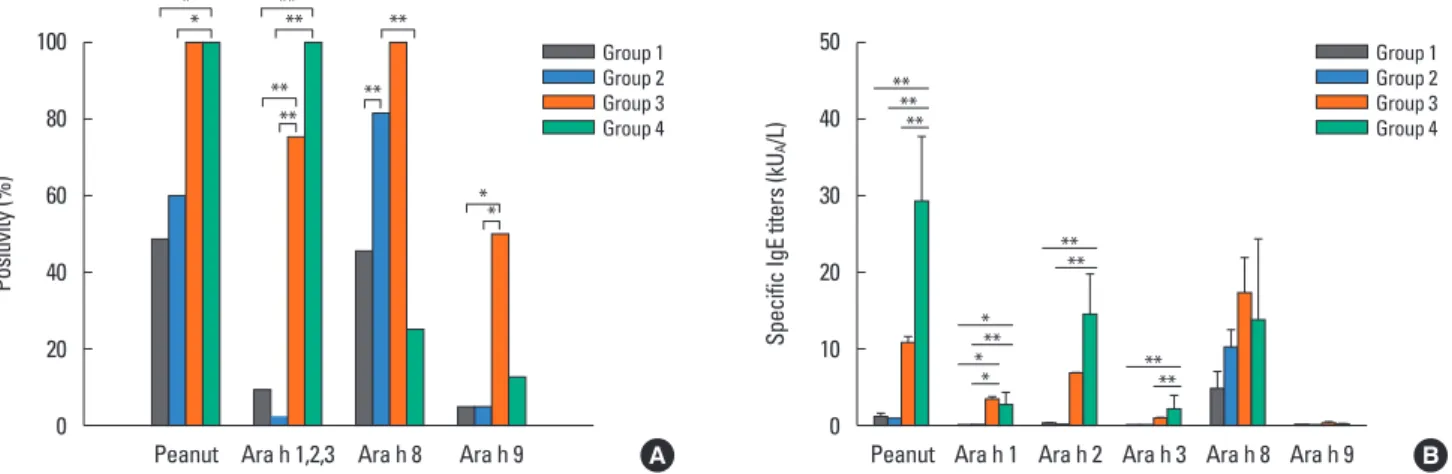
The positivity rates of peanut and its component allergens are shown in Fig. 2A. The positive rate of the allergens was signifi- cantly different between the groups. The positive rate of total peanut sIgE was 100% in the PA group (groups 3 and 4). In the OAS group, total peanut sIgE positivity was not correlated with symptoms. Interestingly, 19.2% of patients who had clinical symptoms to peanuts had a negative reaction to total peanut al- lergens.
The positivity rate to anaphylaxis-related component aller- Table 1. Baseline characteristics of the patients
Parameters Total (n=93) Group 1 (n=35) Group 2 (n=46) Group 3 (n=4) Group 4 (n=8) P value*
Age (yr), Mean±SD 30.3±15.3 34.4±15.2 31.3±13.0 27.8±20.8 7.6±2.4 <0.001
Sex (M:F) 50:43 22:13 22:24 2:2 4:4 0.565
Specific IgE (kU/L), Mean±SD
Birch 24.5±29.5 15.2±26.7 30.9±29.3 25.4±17.6 30.9±43.1 0.004
Oak 11.8±20.8 15.5±16.5 20.3±15.7 20.3±15.7 25.3±38.7 0.115
Peanut 3.9±11.2 1.2±2.0 0.9±1.2 10.9±17.6 29.5±24.8 <0.001
Diagnosis, N (%)
Allergic rhinitis 84 (90.3) 33 (94.3) 44 (95.7) 4 (100) 3 (37.5) <0.001
Asthma 25 (26.9) 13 (37.1) 10 (21.7) 0 (0) 2 (25) 0.303
Oral allergy syndrome 50 (53.8) 0 (0) 46 (100) 4 (100) 0 (0) <0.001
Food anaphylaxis 12 (12.9) 0 (0) 0 (0) 4 (100) 8 (100) <0.001
Reaction to peanut
Localized symptoms 14 (15.1) 0 (0) 14 (30.3) 0 (0) 0 (0) <0.001
Anaphylaxis 12 (12.9) 0 (0) 0 (0) 4 (100) 8 (100) <0.001
SD, standard deviation
*P values were calculated using the Kruskal-Wallis test (age, specific IgE) and Fisher’s exact test (sex, diagnosis, reaction to peanut).
Table 2. Allergic response rates for each food in patients with oral allergy syn- drome (n=50)
Culprit food Allergic response rate in OAS patients, N (%) Rosaceae
Apple 36 (72.0)
Peach 33 (66.0)
Plum 14 (28.0)
Cherry 6 (12.0)
Fabaceae
Peanut 18 (36.0)
Legumes 11 (22.0)
Others
Chestnut 8 (16.0)
Kiwi 7 (14.0)
Ginseng 7 (14.0)
OAS, oral allergy syndrome.
gens (Ara h 1, Ara h 2, or Ara h 3) was 100% in group 4. In group 4 patients, 7 out of 8 showed a positive response to Ara h 2. The remaining patient showed a positive response only to Ara h 1.
Only 1 patient (1/12, 8.3%) in the PA group (groups 3 and 4) had no reaction to anaphylaxis-related component peanut aller- gens. In the non-anaphylaxis group (group 1 and 2), there were 3 (3.7%) patients who showed a positive response to Ara h 1, Ara h 2, or Ara h 3. Ara h 8 was highly positive in the OAS group (groups 2 or 3). In group 3, Ara h 2 showed 75% (3/4) positivity, and Ara h 8 showed 100% positivity. However, Ara h 8 positivity did not correlate with symptoms to peanut.
The sIgE titers of the 4 subgroups were also compared, and the results are shown in Fig. 2B. The total peanut sIgE titers were higher in the PA group than in the non-PA group. Similar patterns were found for Ara h 1, 2, and 3. These differences in total peanut allergens, Ara h 1, Ara h 2, and Ara h 3 were statisti- cally significant. In contrast, Ara h 8-sIgE titers were highest in group 3, but there was no statistical significance. As mentioned earlier, 62.5% of group 4 patients were unexpectedly regarded
as birch sensitizer. Ara h 9 was highly positive in group 3, but the titers were not significantly different between the groups.
The mean titers of Ara h 9 in group 3 was 0.26±0.19 kU/L To demonstrate the sensitization profiles more clearly accord- ing to the clinical manifestation, patients were divided into 2 groups, depending on whether the symptom for peanut was OAS or PA. IgE positivity and titers are shown in Fig. 3A and B.
PA patients showed the highest response to Ara h 2 (83.3%).
Specific IgE titers to peanut, Ara h 1, Ara h 2, and Ara h 3 were higher in the anaphylaxis group than in the localized symptom group (P<0.001). Patients who had localized reactions to pea- nut showed high positivity to Ara h 8. However, 75.0% (9/12) of patients in the PA group (groups 3 and 4) were also sensitized to birch pollen and 50.0% (6/12) to Ara h 8. For this reason, mean sIgE titers of Ara h 8 showed subtle difference between the groups (P=0.231). The positive rates of Ara h 3 and Ara h 9 were not significantly different between the groups in the Kore- an population. The sIgE titers of Ara h 9 was statistically differ- ent ( Fig. 3B). However, the mean titers were 0.12 kU/L in the lo- Fig. 2. Sensitization profiles of peanut allergens. (A) Positive rates, (B) Specific (IgE titers to total and component peanut allergens.
*P value<0.05; **P value<0.005.
Positivity (%) Specific IgE titers (kUA/L)
Peanut Ara h 1,2,3 Ara h 8 Ara h 9 Peanut Ara h 1 Ara h 2 Ara h 3 Ara h 8 Ara h 9 100
80 60 40 20 0
50 40 30 20 10 0 Group 1
Group 2 Group 3 Group 4
Group 1 Group 2 Group 3 Group 4
A B
**
**
**
**
**
**
**
**
**
*
**
**
**
*
**
**
**
***
Fig. 3. Sensitization profiles of peanut allergens in peanut allergic patients. (A) Positive rates, (B) Specific IgE titers to total and component peanut allergens in pa- tients with peanut allergy.
*P value<0.05; **P value<0.005.
Positivity (%) Specific IgE titers (kUA/L)
Peanut Ara h 1 Ara h 2 Ara h 3 Ara h 8 Ara h 9 Peanut Ara h 1 Ara h 2 Ara h 3 Ara h 8 Ara h 9 100
80 60 40 20 0
100 80 60 40 20 0 Localized symptoms
Anaphylaxis Localized symptoms
Anaphylaxis
A B
*
**
*
**
**
**
*
**
*
calized symptom group and 0.21 kU/L in the PA group.
Sensitization profiles of birch and oak pollen
Among all the participants, 63 (67.7%) underwent SPT. Among these participants, 82.5% and 82.5% were sensitized to birch and oak pollens, respectively. Alder pollen sensitization (86.7%) was found to have a pattern similar to that of birch and oak, and is known to be cross-reactive to birch tree pollen.13 When sensiti- zation was based on ImmunoCAP results, which was performed iw n 90 patients (96.8%), 98.9% and 97.8% of the patients were sensitized to both birch and oak pollen, respectively. The per- centages of positive responses to birch component allergens were 82.0% and 19.7% for Bet v 1 and Bet v 2, respectively.
In order to show the sensitization patterns more specifically, birch-sensitized patients were divided into 2 groups: the non- OAS group (groups 1 and 4) and the OAS group (groups 2 and 3). Sensitization patterns are shown in Fig. 4. The sIgE titers of birch, oak, Bet v 1, and Ara h 8 were significantly higher in the OAS group than in the non-OAS group. Birch-sIgE titers of OAS patients were 1.7 times higher than thoseof non OAS patients.
The sIgE titer of Bet v 1 was 2.4 times higher in OAS patients compared to nonOAS patients. The 2 component allergens Bet v 1 and Ara h 8 are belonged to the PR-10 family, and agree- ment of the allergens was 93.8%. The sIgE titers of Bet v 2 were not different between the 2 groups, regardless of the presence of OAS symptoms.
To predict OAS using sIgE titers, the ROC curve and optimal cutoff sIgE titer are shown in Fig. 5. Predictive abilities of OAS were not different between the sIgE titers for birch pollen, Bet v 1, and Ara h 8.
DISCUSSION
In this study, the sensitization patterns and clinical symptoms of patients with peanut and birch allergy were evaluated. Since tree pollen counts have increased over the past 15 years in Ko-
rea, the oak and birch tree sensitization rates have increased from 4.4% to 14.4%, and from 7.1% to 13.6%, respectively.14 Al- though birch is not a dominant species in South Korea, there are many cross-reactive Fagaceae and Betulaceae family trees, including the Quercus and Alnus species.15 In Korea, Pinales (pine trees) and Fagales trees make up 80% of forests. Pine tree pollens are the most common in Korea, accounting for 70% of all tree pollens.16 Dominant Fagales trees in Korea include Quercus mongolica, Quercus serrata, Quercus aliena, and Quer- cus acutissima. Choi et al.17 reported that as the temperature ris- es, so does the proportion of Quercus species. Climate changes in Korea exceed the global climate change rate, especially with regard to temperature changes.18 Patients sensitized to tree pol- len and those with OAS in Korea will be increasing due to this climate trend.
Similar to Western countries, the incidence rates of peanut al- lergy and sensitization are increasing in Korea. In this study, 57.1% of patients in Korea with tree pollen allergy had total pea- nut sIgE, regardless of symptoms. It is difficult to confirm pea- nut allergy using the total peanut sIgE test. In this study, 19.2%
of patients who exhibited symptoms in response to peanuts had a negative reaction to total peanut allergens. Total peanut sIgE is not enough to diagnose cross-reactive peanut allergy in those sensitized to Fagales.
AUC 95% CI P value Cut-off
sIgE titer Sensitivity Specificity Birch 0.721 0.608 to 0.833 0.0001 >9.19 75.51 68.29 Oak 0.632 0.513 to 0.751 0.0292 >7.02 70.83 58.54 Bet v 1 0.768 0.645 to 0.892 <0.0001 >5.86 87.50 63.33 Ara h 8 0.698 0.570 to 0.825 0.0024 >0.33 82.98 60.00
Fig. 5. Receiver operating characteristic (ROC) curve of specific sIgE titers for prediction of oral allergy syndrome (OAS).
AUC, area under the curve; CI, confidence interval.
Sensitivity
0 20 40 60 80 100 100-Specificity
100
80
60
40
20
0
Birch sIgE Oak sIgE Bet v 1 sIgE Ara h 8 sIgE
Fig. 4. Specific IgE titers to total and component tree pollen allergens in pa- tients with and without oral allergy syndrome (OAS).
*P value<0.05; **P value<0.005.
Specific IgE titers (kUA/L)
Birch Oak Ara h 8 Bet v 1 Bet v 2 50
40 30 20 10 0
non-OAS (Group 1, 4) OAS (Group 2, 3)
**
*
**
**
Sensitization profiles of peanut component allergens can be used for precise risk assessments and prediction of symptom severity. There have been many previous studies regarding re- combinant peanut component allergens. When patients are co- sensitized to Ara h 1, 2, and/or 3, they tend to experience severe allergic reactions to peanuts.19,20 Similar to a previous peanut component study, this study showed that Ara h 2 was positive in patients with PA, and that Ara h 8 was positive in those with localized symptoms. In patients with both PA and OAS, both Ara h 2 and Ara h 8 were positive. Among 12 PA patients, there was 1 patient (8.3%) who was only sensitized to Ara h 8 without Ara h 1, Ara h 2, or Ara h 3. (The patient was included in group 3.) In a previous Korean study, Ara h 2 was less prevalent than in Western countries.21 Large-scale research is needed to un- derstand PA sensitization patterns in Korean patients. Based on our data, we were unable to clarify the order of sensitization be- tween birch and peanut. Ara h 9, which belongs to a lipid trans- fer protein, has limited clinical significance in Korea, but it is the most frequently sensitized peanut allergen in Mediterra- nean countries (i.e., Spain), which suggests the possibility of cross-reactivity between the group 3 peach major allergen (Pru p 3) and Ara h 9.22
Peanut component-resolved diagnosis can be used to dis- criminate the cross-reaction to birch pollen and predict the se- verity of peanut allergy.23 This precise diagnosis can lead to de- creased unnecessary food elimination and medical costs. It may also play a role in discriminating between OAS patients with peanut allergy that may be treated by pollen-specific im- munotherapy and patients with immunotherapy-intractable peanut allergies. According to our ROC evaluation, a cutoff val- ue for birch or Bet v 1 can be applied to determine appropriate initiation timing of allergen immunotherapy.
The sensitization patterns of Bet v 1 and 2 vary among coun- tries.24 According to a previous study in Korea, the sensitization rates for Bet v 1 and 2 confirmed by an immunoblot were 78.9%
and 75.8%, respectively.13 In this study, 82.0% and 19.7% of pa- tients sensitized to birch pollen were Bet v 1- and v 2-positive, respectively. This difference can be explained by the use of dif- ferent birch species and detection techniques. According to this study, Bet v 1 had more clinical implications compared to Bet v 2. A higher titer of Bet v 1 better correlates with OAS symptoms.
In addition, differences in the allergic response rate of various fruits in OAS patients should also be mentioned. Cross-reactive foods with tree pollen were somewhat different from that in Western countries. Apples or peaches were the most frequent causes of OAS in Korea. However, there were patients allergic to chestnuts and Korean ginseng. Ginseng is generally used as an herbal medicine in Asian countries. Currently, there is only 1 published study about the cross-reactivity between Korean gin- seng and birch pollens.25 Ginseng is available in fresh or dried forms and can be added to teas, alcoholic drinks, energy drinks, or skin cosmetics. Furthermore, it can be used for intravenous
injection and acupuncture as a type of alternative medicine.
When used as alternative medicine, patients can experience se- vere allergic reactions after ginseng treatment. There have been 2 case reports regarding ginseng-induced asthma and anaphy- laxis; both patients were sensitized to the pollen of birch and al- der trees.26,27 Clinicians should consider ginseng as a possible culprit for OAS. Chestnut allergy is common in latex-fruit aller- gy patients.28 The biochemical classification of typical OAS (usually PR-10 related birch apple syndrome) is different from latex-fruit allergy (usually PR-3 related).29 Sensitization to pro- filin (Bet v 2) has also been recognized to be important in the pathogenesis of OAS;22,30 however, Bet v 2 positivity was not cor- related with clinical symptoms in our study.
This study has certain limitations, namely its retrospective de- sign. We could not directly compare changes in pollen count, sensitization rate, and peanut allergy incidence. In addition, the number of patients with PA was small. Furthermore, this re- search was based on mainly adult patients. As the number of pediatric OAS patients is also increasing in Korea, additional re- search including pediatric patients is needed. Further studies are needed to evaluate the efficacy of allergen immunotherapy using tree pollens as a treatment for peanut-related OAS pa- tients. In some subgroups, patients with peanut allergy can be treated using immunotherapy.
In conclusion, the increase in Fagales pollen allergy can influ- ence the prevalence of peanut allergies. To discriminate be- tween OAS involving peanut from vignette peanut allergy in Korea, it is crucial to measure component peanut allergens, es- pecially Ara h 2 and Ara h 8.
ACKNOWLEDGMENTS
This research was supported by a grant of the Korea Health Technology R&D Project through the Korea Health Industry Development Institute (KHIDI), funded by the Ministry of Health and Welfare, Republic of Korea (grant number: HI 13C0010).
REFERENCES
1. Ballmer-Weber BK, Lidholm J, Fernández-Rivas M, Seneviratne S, Hanschmann KM, Vogel L, et al. IgE recognition patterns in peanut allergy are age dependent: perspectives of the EuroPrevall study.
Allergy 2015;70:391-407.
2. Garcia-Blanca A, Aranda A, Blanca-Lopez N, Perez D, Gomez F, Mayorga C, et al. Influence of age on IgE response in peanut-aller- gic children and adolescents from the Mediterranean area. Pediatr Allergy Immunol 2015;26:497-502.
3. Schmitz R, Ellert U, Kalcklösch M, Dahm S, Thamm M. Patterns of sensitization to inhalant and food allergens - findings from the German Health Interview and Examination Survey for Children and Adolescents. Int Arch Allergy Immunol 2013;162:263-70.
4. Lee AJ, Thalayasingam M, Lee BW. Food allergy in Asia: how does
it compare? Asia Pac Allergy 2013;3:3-14.
5. Sicherer SH, Sampson HA. Peanut allergy: emerging concepts and approaches for an apparent epidemic. J Allergy Clin Immunol 2007;120:491-503.
6. Chiang WC, Kidon MI, Liew WK, Goh A, Tang JP, Chay OM. The changing face of food hypersensitivity in an Asian community. Clin Exp Allergy 2007;37:1055-61.
7. Bajin MD, Cingi C, Oghan F, Gurbuz MK. Global warming and al- lergy in Asia Minor. Eur Arch Otorhinolaryngol 2013;270:27-31.
8. Kim SH, Park HS, Jang JY. Impact of meteorological variation on hospital visits of patients with tree pollen allergy. BMC Public Health 2011;11:890.
9. Codreanu F, Collignon O, Roitel O, Thouvenot B, Sauvage C, Vilain AC, et al. A novel immunoassay using recombinant allergens sim- plifies peanut allergy diagnosis. Int Arch Allergy Immunol 2011;
154:216-26.
10. Vereda A, van Hage M, Ahlstedt S, Ibañez MD, Cuesta-Herranz J, van Odijk J, et al. Peanut allergy: clinical and immunologic differ- ences among patients from 3 different geographic regions. J Allergy Clin Immunol 2011;127:603-7.
11. Sicherer SH. Clinical implications of cross-reactive food allergens. J Allergy Clin Immunol 2001;108:881-90.
12. Geroldinger-Simic M, Zelniker T, Aberer W, Ebner C, Egger C, Gre- iderer A, et al. Birch pollen-related food allergy: clinical aspects and the role of allergen-specific IgE and IgG4 antibodies. J Allergy Clin Immunol 2011;127:616-622.e1.
13. Yoon MG, Kim MA, Jin HJ, Shin YS, Park HS. Identification of im- munoglobulin E binding components of two major tree pollens, birch and alder. Allergy Asthma Respir Dis 2013;1:216-20.
14. Park HJ, Lim HS, Park KH, Lee JH, Park JW, Hong CS. Changes in allergen sensitization over the last 30 years in Korea respiratory al- lergic patients: a single-center. Allergy Asthma Immunol Res 2014;
6:434-43.
15. Weber RW. Patterns of pollen cross-allergenicity. J Allergy Clin Im- munol 2003;112:229-39.
16. Oh JW, Lee HB, Kang IJ, Kim SW, Park KS, Kook MH, et al. The re- vised edition of Korean calendar for allergenic pollens. Allergy Asthma Immunol Res 2012;4:5-11.
17. Choi K, Kim M, Lee WK, Gang HU, Chung DJ, Ko EJ, et al. Estimat- ing radial growth response of major tree species using climatic and topographic condition in South Korea. J Clim Chang Res 2014;5:
127-37.
18. Cho KT, Jeong HM, Han YS, Lee SH. Variation of ecological niche of quercus serrata under elevated CO2 concentration and temper-
ature. Korean J Environ Biol 2014;32:95-101.
19. Nicolaou N, Poorafshar M, Murray C, Simpson A, Winell H, Kerry G, et al. Allergy or tolerance in children sensitized to peanut: preva- lence and differentiation using component-resolved diagnostics. J Allergy Clin Immunol 2010;125:191-197.e1-13.
20. Astier C, Morisset M, Roitel O, Codreanu F, Jacquenet S, Franck P, et al. Predictive value of skin prick tests using recombinant aller- gens for diagnosis of peanut allergy. J Allergy Clin Immunol 2006;
118:250-6.
21. Kim J, Lee JY, Han Y, Ahn K. Significance of Ara h 2 in clinical reac- tivity and effect of cooking methods on allergenicity. Ann Allergy Asthma Immunol 2013;110:34-8.
22. Krause S, Reese G, Randow S, Zennaro D, Quaratino D, Palazzo P, et al. Lipid transfer protein (Ara h 9) as a new peanut allergen rele- vant for a Mediterranean allergic population. J Allergy Clin Immu- nol 2009;124:771-778.e5.
23. Ferreira F, Wolf M, Wallner M. Molecular approach to allergy diag- nosis and therapy. Yonsei Med J 2014;55:839-52.
24. Movérare R, Westritschnig K, Svensson M, Hayek B, Bende M, Pau- li G, et al. Different IgE reactivity profiles in birch pollen-sensitive patients from six European populations revealed by recombinant allergens: an imprint of local sensitization. Int Arch Allergy Immu- nol 2002;128:325-35.
25. Kim M, Choi E, Yoon T. Korean ginseng makes oral allergy syn- drome in birch-sensitized respiratory allergy patients. J Allergy Clin Immunol 2008;121 Suppl 1:S187.
26. Lee JY, Lee YD, Bahn JW, Park HS. A case of occupational asthma and rhinitis caused by Sanyak and Korean ginseng dusts. Allergy 2006;61:392-3.
27. Lee JY, Jin HJ, Park JW, Jung SK, Jang JY, Park HS. A case of Korean ginseng-induced anaphylaxis confirmed by open oral challenge and basophil activation test. Allergy Asthma Immunol Res 2012;4:
110-1.
28. Blanco C. Latex-fruit syndrome. Curr Allergy Asthma Rep 2003;3:
47-53.
29. Breiteneder H, Ebner C. Molecular and biochemical classification of plant-derived food allergens. J Allergy Clin Immunol 2000;106:
27-36.
30. Sekerková A, Poláčková M. Detection of Bet v1, Bet v2 and Bet v4 specific IgE antibodies in the sera of children and adult patients al- lergic to birch pollen: evaluation of different IgE reactivity profiles depending on age and local sensitization. Int Arch Allergy Immu- nol 2011;154:278-85.