INTRODUCTION
Due to the introduction of vaccination program and the ad- vance of public health, tetanus is now uncommon in the devel- oped countries. In Korea, a nationwide childhood vaccination with tetanus toxoid began in 1956 and the improved wound management have resulted in a decrease of tetanus (1). While major efforts have been made to increase immunization cov- erage among children, very little attention has been paid to immunization against tetanus among adults. Thus, the risk of tetanus may increase with age.
Recently, physicians might not have had a chance to take care of tetanus patients due to a decreasing number of tetanus cases in the developed countries, as well as in Korea. As a result, tetanus may not be diagnosed adequately during the early stage and therefore, proper treatment for tetanus can be delayed. To our knowledge, there have been no documented reports about spectrum of tetanus recently occurred in Korea. In this report, we describe the demographics, epidemiological and clinical findings, management, and outcome of 17 tetanus patients who presented to Chonnam National University Hospital dur- ing a 21-month period.
MATERIALS AND METHODS
During the periods of March 2000 and November 2001, 17
cases of tetanus were diagnosed at Chonnam National Uni- versity Hospital, a 900-bed university-affiliated teaching hospital in Korea.
All cases of tetanus were clinically diagnosed, based on the clinical case definition for public health surveillance for tetanus, because a laboratory test for definitive diagnosis of tetanus was not routinely available. Tetanus is defined as an acute onset of hypertonia and/or painful muscular contractions, usually of the muscles of the jaw and neck, and generalized muscle spasms without other apparent medical cause (2). A chart review of the demographic characteristics, epidemiology, occupational and immunization history, symptoms and signs, treatment, and outcome of 17 cases of tetanus were studied. In addition, we reviewed the provisional diagnosis in order to find out whether the first physicians were aware of tetanus in emer- gency room.
RESULTS Patient characteristics
During a 21-month period, we identified 17 adult tetanus.
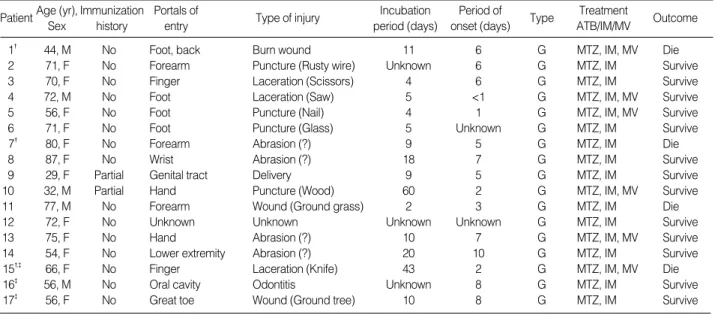
Demographic characteristics, epidemiologic and clinical fea- tures, and clinical outcome for all study subjects are summa- rized in Table 1 and 2. The mean age of the 17 patients was 63 yr (range, 29-87). There were 5 (30%) males and 12 (70%)
Dong Hyeon Shin, Ho Sung Yu, Jung Ho Park, Jong Hee Shin*, Sei Jong Kim
Departments of Internal Medicine, and Clinical Pathology*, Chonnam National University, Medical School, Gwangju, Korea
Address for correspondence Dong Hyeon Shin, M.D.
Department of Internal Medicine, Chonnam National University, Medical School, 8 Hak-dong, Dong-gu, Gwangju 501-757, Korea
Tel : +82-62-220-6978, Fax : +82-62-225-8578 E-mail : [email protected]
11
Recently Occurring Adult Tetanus in Korea: Emphasis on Immunization and Awareness of Tetanus
Since a nationwide childhood vaccination with tetanus toxoid, tetanus has become a rare disease in Korea. However, we recently experienced 17 cases of adult tetanus in a university hospital during a 21-month period. Seventy percent of the patients were female, and the mean age was 63 yr (range, 29-87). The majority (88.2%) of the patients did not get primary vaccinations for tetanus and decennial tetanus-diph- theria toxoid booster. Most patients (88.2%), who sustained acute injury, did not seek medical care for their wounds or did not receive the prophylaxis for tetanus. Te- tanus was found most frequently among farmers. Tetanus was diagnosed initially only in 53% of patients. The case-fatality ratio was 23.5%. These cases show that recent- ly occurring tetanus in Korea is a disease, affecting the elderly and the female who may have a lower immunity against tetanus, and the farmers who are likely to be ex- posed to Clostridium tetani. In addition, diagnosis of tetanus is often delayed in area where cases are seen infrequently. Therefore, improved education among patients and physicians, emphasis of anti-tetanus immunization and awareness of tetanus respectively, may be essential for the prevention of disease and the reduction of its mortality.
Key Words : Tetanus; Immunization
Received : 23 July 2002 Accepted : 11 September 2002
females. All the cases were non-neonatal, adult tetanus. Of these, all patients except one who was a 29-yr-old female who was a housewife, and also a puerperal tetanus patient, were farmers. We reported the case of puerperal tetanus patient pre- viously (3). Out of the 17 patients with tetanus, 15 (88.2%) patients did not get the primary vaccination for tetanus and de- cennial tetanus-diphtheria toxoid booster, but two (11.7%) patients had a primary vaccination series during the childhood except decennial tetanus-diphtheria toxoid booster thereafter.
All the patients in this study developed tetanus during the periods from March 2000 to November 2001, which usually coincided with the warm season and the time of their most intensive work in the fields.
Portals of entry and type of injury
An acute injury sustained before onset of tetanus was iden- tified among the 16 (94.1%) tetanus cases with known injury status. Portals of entry were an upper extremity in 8 (47.0%) patients, a lower extremity (one patient had a burn wound on back as well) in 6 (35.2%) and an oral cavity in 1 (5.8%). One puerperal tetanus patient did not have a sustained acute wound, but the disease occurred 9 days postpartum. In this case, the genital tract might be the portal of entry. Of 17 cases, 4 (23.5%) occurred after puncture wounds and abrasions, the most com- mon types of injuries, respectively. The types of puncture wo- unds were from cuts by rusty wire, or piece of wood, and from stepping on nail or glass. Other most frequently reported types of acute injuries were 3 (17.6%) lacerations, 3 (17.6%) wounds
including burn, and 1 (5.8%) patient had a toothache due to odontitis and had tooth extracted. Additionally, two (11.7%) patients applied home remedy, ground grass or tree to previ- ous operation wound or wound due to ingrowing nail.
Fifteen (88.2%) patients, excluding one with whom tetanus occurred after the delivery, and another one with odontitis, did not seek for medical care for their wounds and did not received prophylaxis for tetanus. They applied wound care for themselves at home, because the wounds were mild and small in size.
Clinical features
The incubation period, which is the time between the injury and the first clinical symptoms, varied from 2 to about 60 days.
In addition, the interval between first symptoms and gener- alized spasms, period of onset, also varied from 1 to 10 days.
The clinical type of tetanus was generalized in all patients.
The first symptoms and signs were lockjaw, the most common first symptom in 17 (100%) patients, swallowing difficulty in12 (70.5%), dysarthria in 6 (35.2%), and neck stiffness in 5 (29.4%) patients.
Autonomic nervous dysfunctions were common. Of cardio- vascular dysfunction, profound bradycardia or tachycardia were in 3 patients; 1 sinus tachycardia occurred 1 day, 1 atrial fib- rillation 2 days, and 1 ventricular tachycardia 5 days after onset of symptoms. The patients with ventricular tachycardia received cardiopulmonary resuscitation and antiarrhythmic drugs, but other patients were restored spontaneously to normal sinus rhythm without antiarrhythmic drugs. Also disordered blood
PatientAge (yr), Sex
Immunization history
Portals of
entry Type of injury Incubation
period (days)
Period of
onset (days) Type Treatment
ATB/IM/MV Outcome
1� 44, M No Foot, back Burn wound 11 6 G MTZ, IM, MV Die
2 71, F No Forearm Puncture (Rusty wire) Unknown 6 G MTZ, IM Survive
3 70, F No Finger Laceration (Scissors) 4 6 G MTZ, IM Survive
4 72, M No Foot Laceration (Saw) 5 <1 G MTZ, IM, MV Survive
5 56, F No Foot Puncture (Nail) 4 1 G MTZ, IM, MV Survive
6 71, F No Foot Puncture (Glass) 5 Unknown G MTZ, IM Survive
7� 80, F No Forearm Abrasion (?) 9 5 G MTZ, IM Die
8 87, F No Wrist Abrasion (?) 18 7 G MTZ, IM Survive
9 29, F Partial Genital tract Delivery 9 5 G MTZ, IM Survive
10 32, M Partial Hand Puncture (Wood) 60 2 G MTZ, IM, MV Survive
11 77, M No Forearm Wound (Ground grass) 2 3 G MTZ, IM Die
12 72, F No Unknown Unknown Unknown Unknown G MTZ, IM Survive
13 75, F No Hand Abrasion (?) 10 7 G MTZ, IM, MV Survive
14 54, F No Lower extremity Abrasion (?) 20 10 G MTZ, IM Survive
15�,� 66, F No Finger Laceration (Knife) 43 2 G MTZ, IM, MV Die
16� 56, M No Oral cavity Odontitis Unknown 8 G MTZ, IM Survive
17� 56, F No Great toe Wound (Ground tree) 10 8 G MTZ, IM Survive
Table 1.Descriptions of 17 patients with tetanus
No, no history of primary vaccination for tetanus and decennial tetanus-diphthera toxoid booster; Partial, only primary vaccination for tetanus during childhood; Incubation period, time between the injury and the first clinical symptoms; Period of onset, interval between first symptoms and general- ized spasms; ATB, antibiotics, IM, passive & active immunization; MV, mechanical ventilation, MTZ, metronidazole; G, generalized; *, type of tetanus;
�, these patients were discharged against medical advice, who were not cared over the whole period of treatment. �, these patients did not received DT because DT is not available in Korea since August 2002.
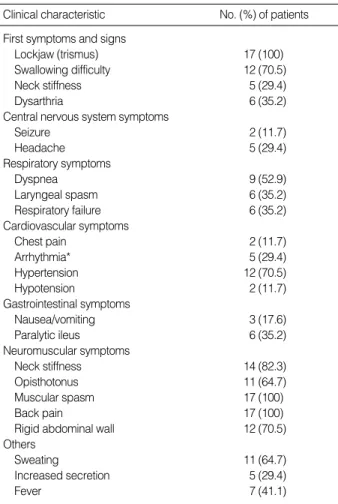
pressure was in 14 patients. Those cardiovascular dysfunctions were recurrent and labile. Six patients, who had a mean peri- od of onset 3.1 days (range, 1-7), developed laryngeal spasm of sudden onset, progressed to respiratory failure and received mechanical ventilation. In addition, sweating and increased secretion were common. Other clinical manifestations were presented in Table 2.
Complications were pneumonia in 5 patients, atelectasis in 4 patients, bacteremia (catheter-related) in 3 patients, joint contracture in 3 patients, urinary tract infection in 2 patients, and pressure sore in 2 patients.
Provisional diagnosis in emergency room
We reviewed the provisional diagnosis in order to find out whether the physicians were aware of tetanus in emergency room. Provisional diagnosis were tetanus in only 9 (53%) of the 17 patients. The actual erroneous diagnoses by clinicians included oromandibular dystonia, electrolyte imbalance, cer- vical dystonia, meningitis, meningoencephalitis, hypertensive encephalopathy, cerebral infarct, arthritis of temporomandibu-
lar joint, cerebral infarction and spinal cord injury.
Treatment and outcome
Of 17 patients, all patients received treatment such as TIG (tetanus immunoglobulin, Hypertet� 3000 IU, Green Cross, Korea) and intravenous metronidazole (500 mg thrice daily).
However three patients did not receive the whole period of treatment and was discharged or sent to other hospital. Since Td (tetanus-diphtheria toxoid) was not available, DT (diph- theria-tetanus toxoid, D.T. VAX� 0.5 mL, Green Cross, Korea) was subcutaneously administered for 14 patients on admission, and for 11 out of 14 patients who received the whole period of treatment on 1 month and 6 months after the first dose. They were monitored in the quiet and dark room at which environ- mental stimuli and unnecessary patient manipulation were minimized. Patients with unstable vital signs were cared in intensive care unit during the early stage. Benzodiazepines were used for sedation. In addition, vasopressors or antihyper- tensive agents were used for disordered blood pressure. In case of patients with severe muscular rigidity and pain, muscular blocking agent (vecuronium) was administered after the mech- anical ventilation was applied. Six patients with respiratory failure received ventilator therapy.
Four deaths occurred among 17 patients, including 3 patients who were not cared over the whole period of treatment in our hospital, representing a case-fatality ratio of 23.5%. Among 4 deaths, 3 result from patients who denied treatment in our hospital and were discharged or sent to other hospital and 1 results from patient with intractable hypotension.
DISCUSSION
Tetanus is a fatal infectious disease, usually of acute onset, which results from contamination of a wound with the tetanus bacillus, Clostridium tetani. The clinical manifestations result from a potent neurotoxin, tetanospasmin that produces painful spasm and muscular rigidity. Vaccination with a primary series of three doses of tetanus toxoid containing vaccine and boost- er doses of Td (tetanus-diphtheria toxoid) every 10 yr are high- ly effective in preventing tetanus (4).
During 1990-1999, a total of 8 tetanus cases have been re- ported in Korea: 1 case in 1992, 3 cases in 1998, and 4 cases in 1999 (5-7). A number which, due to passive reporting by physicians, may underestimate the true rate of incidence of the disease. In addition, the every 10-yr-booster of Td after the primary tetanus-toxoid containing vaccine series have been neglected in Korea because of unavailability of Td and lack of education of adult vaccination. Therefore, the rate of occurrence of tetanus may increase in Korea.
Our cases show that tetanus occurred more often among the elderly females and males. The frequent occurrence of tetanus among the elderly females and males may be due to the dif-
*, one patient had bradycardia and 5 tachycardia including atrial fibril- lation and ventricular tachycardia in one each.
Clinical characteristic No. (%) of patients First symptoms and signs
Lockjaw (trismus) 17 (100)
Swallowing difficulty 12 (70.5)
Neck stiffness 5 (29.4)
Dysarthria 6 (35.2)
Central nervous system symptoms
Seizure 2 (11.7)
Headache 5 (29.4)
Respiratory symptoms
Dyspnea 9 (52.9)
Laryngeal spasm 6 (35.2)
Respiratory failure 6 (35.2)
Cardiovascular symptoms
Chest pain 2 (11.7)
Arrhythmia* 5 (29.4)
Hypertension 12 (70.5)
Hypotension 2 (11.7)
Gastrointestinal symptoms
Nausea/vomiting 3 (17.6)
Paralytic ileus 6 (35.2)
Neuromuscular symptoms
Neck stiffness 14 (82.3)
Opisthotonus 11 (64.7)
Muscular spasm 17 (100)
Back pain 17 (100)
Rigid abdominal wall 12 (70.5)
Others
Sweating 11 (64.7)
Increased secretion 5 (29.4)
Fever 7 (41.1)
Table 2.Clinical presentations of 17 patients with tetanus
ference of tetanus immunity by age and sex. In the U.S. study, the prevalence of immunity declined rapidly at the age of 40 yr, and only 27.8% among those 70 yr of age or older had pro- tective levels of tetanus antibodies. It also states that men had significantly higher age-adjusted rates of immunity than wo- men had, and in particular, large differences in the rates between men and women at 40 yr of age or older accounted for most of this gap (8). Similarly, among the Australian population, 52% of adults 49 yr of age or older had protective levels of tetanus antitoxin. There also was a significant decline in the prevalence of immunity with increasing age, and women were less likely to be immune regardless of their age (9). A recent population-based serologic survey of immunity to tetanus in Korea may partially explain the frequent occurrence of tetanus among the elderly females and males: the immunity to tetanus remarkably decreased among the populations 30 yr of age or older, of whom over 75% needed maintenance of immunity to tetanus, and among populations greater than or equal to 60 yr, the immunity in male was significantly greater than in female (10). In addition, the majority of Korean male, who had records of military service, might have protective immu- nity to tetanus. Therefore, the differences in the rate between men and women were increasing with age, suggesting that women were less likely to be immune (8-10).
Most patients in our study had an acute trauma sustained before onset of tetanus. However they did not seek for med- ical care for their wound, because their wounds were not con- sidered severe. Thus, they did not have a chance to receive pro- phylaxis against tetanus. In addition, 16 patients were farm- ers who were likely to be exposed to the soils, a natural habi- tat of C. tetani, and one patient was a housewife who did not have an acute trauma except delivery occurred in the hospital that used standard hygienic practices. Because C. tetani are widely distributed in the environment, and are found in the intestinal flora of domestic animals, horses, chickens, and hu- mans, the genital tract may be a natural habitat for C. tetani.
The portals of entry described in our study are consistent with the previous studies (11-13). However, even minor trauma can lead to tetanus and in up to 30% of patients no portal of entry is apparent (11, 12). These findings illustrate that there are no safe wounds for tetanus. Therefore, the prevention for tetanus requires carefully reviewed tetanus immunization status and a full immunization for all visitors at health care centers.
The incubation period and period of onset are important in prognosis; shorter these periods, more severe the disease (14). In this study, six patients with period of onset 3.1 days developed respiratory failure and required mechanical venti- lation. Thus, a short period of onset may be associated with requirement of ventilation.
Tetanospasmin, which C. tetani produces, exerts its effects on the spinal cord, the brain stem, peripheral nerves, at neuro- muscular junctions, and directly on muscles, with antago- nizing inhibitory motor activity and also with stimulating the autonomic nervous system (14, 15). Of four types: localized,
cephalic, neonatal or generalized, generalized tetanus is the most common and presents with pain, headache, stiffness, rigid- ity, opisthotonus and spasms, which can lead to laryngeal ob- struction. Trismus (lockjaw)-the inability to open the mouth fully owing to rigidity of masseters is often the first symptom.
In this study, 100% of patients experienced lockjaw, 70.5%
difficulty in swallowing, 35.2% dysarthria, and 29.4% neck stiffness as the first symptoms and signs. As the disease pro- gresses, spasms extend into other muscular groups including back, abdomen, extremities or respiratory system, leading to respiratory arrest, the commonest direct cause of death when intubation and mechanical ventilation is not available. Six patients who developed laryngeal spasm in our study required prolonged mechanical ventilation, and two of six patients died;
one was discharged without complete treatment and another died of intractable hypotension. In addition, autonomic distur- bance with sustained labile hypertension, hypotension, tachy- cardia, bradycardia, dysrhythmia and increased secretion are recurrent, labile in severe cases (16). In particular, these cardio- vascular manifestations do not usually occur until later in the course of the disease and is associated with a poor prognosis (17, 18). In our study, a total of five patients developed arrhyth- mia within 5 days after onset of symptoms and one patient died of hypotension.
The common complications in our study, such as pneumo- nia, atelectasis, catheter-related bacteremia, joint contracture, urinary tract infection and pressure sores may be attributable to increased bronchial secretion, intensive care and prolonged periods of immobility. Much attention must be paid to pre- venting those complications and detail in basic care.
The diagnosis is based on clinical features. Because of the rarity of tetanus, as well as the similarity of its clinical man- ifestations to other more common medical conditions, the di- agnosis is difficult and is often a diagnosis of exclusion. The differential diagnosis of tetanus should be extensive; hypocal- cemia, hypoglycemia, strychnine poisoning, drug induced dys- tonic reactions, rabies, orofacial infection, meningitis, seizures and meningoencephalitis (14). In our study, only 53% of pa- tients were diagnosed with tetanus initially in emergency room.
Early diagnosis and aggressive management are to be imple- mented in order to reduce the mortality of tetanus patients.
Thus, increased awareness and education regarding tetanus among physicians should be emphasized.
There is no curative treatment for tetanus. If tetanus is sus- pected, aggressive management should be implemented as early as possible. All tetanus patients should be cared in a mon- itored room that is dark and quiet. Environmental stimuli, as well as unnecessary patient manipulation, should be minimized.
Tetanus patients may often require ventilatory support because of asphyxia from increased secretion and continual muscle spa- sms. In our study, six patients progressed to respiratory fail- ure and received mechanical ventilation. If the hypersympa- thetic state such as hypertension, and tachycardia happened, early attempts to control autonomic disturbance included
and -adrenoceptor blockers and combined block either with propranolol or labetolol (14). Large doses of sedatives such as benzodiazepines may be necessary to control muscular spasms and tetanic seizures. Tetanic spasms refractory to benzodia- zepines may be managed with nondepolarizing neuromus- cular blocking agents such as vecuronium.
Passive immunization with human tetanus immunoglob- ulin (HTIG) should be given intramuscularly as soon as pos- sible, proven that early administrations are associated with decreased mortality. Once the toxin is bound and internalized it will have no effect (19). When 3000 IU are administered intramuscularly, maximum concentrations reach in 24-48 hr and approximately 0.1 IU/mL. Adequate concentrations of passive antitoxin that protect a human against tetanus are main- tained for 10-15 days (14). Patients with tetanus also should actively be immunized through administration of adsorbed tetanus toxoid given intramuscularly at a site contralateral to the HTIG dosing. In our study, DT were administered to the patients instead of Td, which was not available in Korea. Vac- cination with lower dose of DT (0.25 mL) induced an excel- lent immune response (20, 21). All adults should be immune to tetanus and if not previously immunized they should be given a primary immunizing course (three doses of Td admin- istered at time zero, 4 to 8 weeks, and 6 to 12 months) with boosters administered every 10 yr thereafter (22).
In patients with a deep wound, thorough debridement and toilet, and antibiotic therapy are critical to remove the source of toxin production. Metronidazole is a safe alternative to peni- cillin because penicillin can cause CNS hyperexcitability and may be now considered as the first line therapy (23). The dose is 500 mg every 6 hr intravenously for 7-10 days.
There were four deaths with the case-fatality rate of 23.5%
in our study. In the U.S. studies, the case-fatality rate of 11- 25% was reported and increased with age (12, 24). In partic- ular, total of three patients who did not receive the whole peri- od of treatment in our study died. Thus all tetanus patients always require the intensive treatment.
Only 11.7% of tetanus patients in our study have received a primary series of tetanus-toxoid containing vaccine, and all patients did not have a booster within 10 yr before onset of tetanus. This finding is similar to that seen at the previous studies (12, 24). Therefore, to reduce the tetanus burden among older adults, the necessity for the every 10-yr-booster of Td after the primary tetanus-toxoid containing vaccine series should be emphasized.
Our study is limited because of the small number of patients, diagnosis only based on clinical features, and incomplete treat- ment for 3 patients who were discharged or sent to other hos- pital.
In summary, our cases show that tetanus has still become a disease of the elderly and inadequately immunized persons in Korea. Most tetanus patients had acute injury sustained before onset of tetanus, but did not receive tetanus prophylax- is such as anti-tetanus immunoglobulin and/or tetanus vac-
cination. Therefore, every contact with a potential patient at risk should prompt a careful review of tetanus immunization status and ensure full immunization for prevention of tetanus.
In addition, increased awareness and education regarding te- tanus among physicians are essential for recognizing tetanus along with aggressive management in the early stages.
REFERENCES
1. Lee DH. Past, present and future of the national immunization pro- gram. Korean J Infect Dis 1995; 27: 213-9.
2. Centers for Disease Control and Prevention. Case definitions for infec- tious conditions under public health surveillance. MMWR Recom Rep 1997; 46 (RR-10): 1-55.
3. Shin DH, Park JH, Jung PJ, Lee SR, Shin JH, Kim SJ. A case of mater- nal tetanus in Korea. J Korean Med Sci 2002; 17: 260-2.
4. Edsall G. Specific prophylaxis of tetanus. JAMA 1959; 171: 125-35.
5. National Institute of Health. National communicable disease report by month and area. Communicable Diseases Monthly Report 1993; 4: 21.
6. National Institute of Health. National communicable disease report by month and area. Communicable Diseases Monthly Report 1999;
10: 23.
7. National Institute of Health. National communicable disease report by month and area. Communicable Diseases Monthly Report 2000;
11: 23.
8. Gergen PJ, McQuillan GM, Kiely M, Ezzati-Rice TM, Sutter RW, Virella G. A population-based serologic survey of immunity to tetanus in the United States. N Engl J Med 1995; 332: 761-6.
9. Heath TC, Smith W, Capon AG, Hanlon M, Mitchell P. Tetanus immu- nity in an older Australian population. Med J Aust 1996; 164: 593-6.
10. Kang JH, Hur JK, Kim JH, Lee KI, Park SE, Ma SH, Lee MS, Ban SJ, Hong SH, Cho DH, Lee SH. Age related serosurvey of immunity to tetanus in Korean populations. Korean J Infect Dis 2001; 33: 104- 11.
11. Centers for Disease Control and Prevention. Tetanus-United States, 1985-1986. MMWR Morb Mortal Wkly Rep 1987; 36: 477-81.
12. Izurieta HS, Sutter RW, Strebel PM, Bardenheier B, Prevots DR, Wh- arton M, Hadler SC. Tetanus Surveillance-United States, 1991-1994.
MMWR CDC Surveill Summ 1997; 46(SS-2): 15-25.
13. Fauveau V, Mamdani M, Steinglass R, Koblinsky M. Maternal tetanus:
Magnitude, epidemiology and potential control measures. Int J Gynecol Obstet 1993; 40: 3-12.
14. Farrar JJ, Yen LM, Cook T, Fairweather N, Binh N, Parry J, Parry CM.
Tetanus. J Neurol Neurosurg Psychiatry 2000; 69: 292-301.
15. Alfery DD, Rauscher LA. Tetanus: a review. Crit Care Med 1979; 7:
176-81.
16. Wright DK, Lalloo UG, Nayiager S, Govender P. Autonomic nervous system dysfunction in severe tetanus: current perspectives. Crit Care Med 1989; 17: 371-5.
17. Trujillo MH, Castillo A, Espana J, Manzo A, Zerpa R. Impact of inten- sive care management on the prognosis of tetanus: analysis of 641 cases. Chest 1987; 92: 63-5.
18. Abrahamian FM, Pollack CV Jr, LoVecchio F, Nanda R, Carlson RW.
Fatal tetanus in a drug abuser with “protective”antitetanus antibod- ies. J Emerg Med 2000; 18: 189-93.
19. Kefer MP. Tetanus. Am J Emerg Med 1992; 10: 445-8.
20. Bjorkholm B, Wahl M, Granstrom M, Hagberg L. Immune status and booster effects of low doses of tetanus toxoid in Swedish medical per- sonnel. Scand J Infect Dis 1994; 26: 471-5.
21. Bjorkholm B, Hagberg L, Sundbeck G, Granstrom M. Booster effect of low doses of tetanus toxoid in elderly vaccines. Eur J Clin Micro- biol Infect Dis 2000; 19: 195-9.
22. Centers of Disease Control and Prevention. Recommendations of the Immunization Practices Advisory Committee (ACIP): Diphtheria, tetanus, and pertussis: recommendoctions for vaccine use and other preventive measures. MMWR Recom Rep 1991; 40(RR-10): 1-28.
23. Sanford JP. Tetanus-forgotten but not gone. N Engl J Med 1995; 332:
812-3.
24. Bardenheier B, Prevots R, Khetsuriani N, Wharton M. Tetanus surveil- lance-United States, 1995-1997. MMWR CDC Surveill Summ 1998;
47(SS-2): 1-13.
. . . .
. . . .