586
©The Korean Society of Food Science and Technology
조릿대 잎차의 영양성분 분석 및 기능성 평가
정창호·최성길·허호진*경상대학교 응용생명과학부, 농업생명과학연구원
Analysis of Nutritional Components and Evaluation of
Functional Activities of
Sasa borealis
Leaf Tea
Chang-Ho Jeong, Sung-Gil Choi, and Ho Jin Heo*
Division of Applied Life Science, Institute of Agriculture and Life Sciences, Gyeongsang National University Abstract In this study, the nutritional components and functional activities of Sasa borealis leaf tea were evaluated. The
proximate compositions were as follows; moisture 5.68%, crude protein 16.38%, crude fat 4.68%, nitrogen free extracts 32.37%, crude fiber 32.36%, and ash 8.53%, respectively. The mineral elements were as follows: K 2,133.83, Ca 1,144.09
and P 543.00 mg%, respectively. The amino acid contents of the Sasa borealis leaf tea were very rich in proline (1,275.26
mg/100 g) and deficient in cystine (71.49 mg/100 g). The major fatty acid components were linoleic acid (50.52%),
palmitic acid (18.52%), and oleic acid (14.16%). Finally, based on our sensory evaluations, the 80oC extracted Sasa
borealis leaf tea evidenced the best overall quality. The contents of total phenol and total flavonoids of the 80% methanol
and hot water extracts were 15.09, 7.69 mg/g and 12.03, 6.12 mg/g, respectively. The DPPH and ABTS·+ radical
scavenging activities of the 80% methanol extract from Sasa borealis leaf tea were 86.87% and 83.85% at a concentration
of 1.25 mg/mL. The 80% methanol and hot water extracts evidenced reducing power and inhibitory effects against acetylcholinesterase in a dose-dependent manner.
Key words: Sasa borealis leaf tea, nutritional components, functional activities, acetylcholinesterase.
서 론 최근식품관련산업및학계에서는자연계에존재하는다양한 동식물 및미생물로부터 얻어지는 각종유용성분을 식품소재로 활용하려는 연구및생리활성 작용에 대한검색이활발하게 이 루어지고있다. 특히인체의생리기능조절이나 항상성유지에 관여하여질병예방과노화억제등건강을유지하는데중요한역 할을하는 것으로밝혀진 각종식품소재를 찾는것이 식품산업 의새로운 연구목표로부각되고있다. 인간의질병및노화는대 사과정 중 발생하는 superoxide(O2−), nitric oxide(NO·), nitrogen
dioxide(NO2·), hydroxyl(OH·), peroxyl(ROO·), alkoxyl (RO·),
hydroperoxyl(HO·) radical 등의 산화반응에기인하며, 이러한
rad-ical들은 체내 지질, 단백질 그리고 핵산과 같은 물질의 손상을 유발한다(1,2). 따라서 체내에서는유해한 radical들을제거하기위 하여여러 효소적, 비효소적 반응이 진행된다. 여러연구결과들 에의하면과채류등과같은식물성식품을충분히섭취하는것 이노화지연및심혈관계질환, 동맥경화, 암, 당뇨등과 같은만 성질환의예방과치료에도움이된다고보고되고 있다(3-7). 대나무는 화본과식물로 세계적으로 약 280여종이알려져 있 으며, 우리나라에서는 5속, 10종, 4변종이분포되어있고, 대표적 인 품종은 조릿대(Sasamorpha purpurascens Nakai var. borealis Nakai), 참대(Phyllostachys reticulata Koch), 신의대(Sasa coreana Nakai) 및이대(Pseudosasa japonica Makino) 등이며, 주로중부 이남에서식하고있다(8,9). 성질은차고맛이달고, 독이 없으며, 잎은 번열, 소갈과악창등을낫게하고열내림, 피멎이약, 살균, 항진균등에효능이있으며, 고혈압, 중풍, 발한등의치료를위 한민간요법에활용되어 왔다(10,11).
대나무에관련된주요연구는조릿대잎추출물이고지방식이 유도 비만 마우스의 혈장 adiponectin, resistin C-reactive protein 및 homocysteine 농도에미치는영향(12), 한국산 왕대, 솜대, 맹 종죽, 조릿대 및오죽의 항산화효과(13), 추출방법에따른대나 무 추출물의 화학성분및 생리활성(14), in vitro에서 조릿대, 연 근과 연잎이인슐린 작용및 분비에미치는 영향(15), 대나무로 부터 terpene류와 폴리페놀화합물의분리(16,17), 대나무잎을 이 용한 천연건강음료의 가능성(18), 대나무 잎분말을 첨가한 쿠 키의품질특성(19) 등이보고되고있다. 그러나현재 국내에자생 및재배하고있는 대나무와대나무 잎을 이용한가공품 개발에관한 연구는매우 미비한실정이라 이에대한체계적인연구가절실한시점이라 판단된다. 따라서국내의 고유천연자원, 부산물및미이용 자원으로부터 기능성을갖는다양한물질을 탐색하여자원의효율적인이용 측 면에서특히 경남지역을포함한남부지방에서많이 자생하고있 는조릿대 잎과같은 미이용자원을 이용하여 볶음차를제조한 후그화학성분및관능검사를 실시하였으며, 또한새로운기능
*Corresponding author: Ho Jin Heo, Division of Applied Life Sci-ence, Institute of Agriculture and Life Sciences, Gyeongsang National University, Jinju, Gyeongnam 660-701, Korea
Tel: 82-55-751-5476 Fax: 82-55-753-4630 E-mail: [email protected]
Received September 8, 2008; revised September 16, 2008; accepted September 19, 2008
성소재를 탐색하기 위한일환으로 조릿대 잎차 80% 메탄올과 열수추출물을이용하여항산화 활성및 acetylcholinesterase 저해 활성에대하여조사하였다. 재료 및 방법 조릿대 잎차 및 추출물의 제조 본실험에사용된 조릿대잎은 2007년 10월에경남 진주시가 좌동에위치한 남부임업시험장에서분양을받아 사용하였다. 조 릿대잎차제조는분양받은조릿대잎을선별및세척하여열풍 건조기를이용하여 40oC의온도로 2-3시간건조하여수분을 10% 이하가되게 하였으며, 위와같이 건조한조릿대잎을 120-150oC 의온도로 30분정도볶아조릿대잎차를제조하여화학성분분 석시료로 이용하였다. 색도측정 및관능검사를위한 차추출물 은잎차 2 g에 40, 60, 80 및 100oC의온도로 조정한증류수 100 mL에서 2분간추출한후색도및관능검사실험을위한시료로 이용하였다. 80% 메탄올 추출물 및 열수추출물은 조릿대 잎차 20 g에 80% 메탄올및증류수를각각 200 mL씩첨가하여 2시간 동안환류냉각 추출을한 후그추출물을 동결건조하여 기능성 평가실험에사용하였다. 일반성분 분석 수분함량은 105oC 건조후항량을측정하여 산출하였고, 조단 백질은 Auto-kjeldahl법, 조지방은 Soxhlet 추출장치로추출하여측 정하였으며, 조섬유는 1.25% H2SO4 및 NaOH 분해법으로, 조회 분은 550oC 직접회화법으로측정하였고, 그외나머지성분들은 가용성무질소물(당)로나타내었다(20). 무기성분 분석 무기성분분석은각시료 0.1 g에분해용액(HClO4:H2SO4:H2O2 =9:2:5) 25 mL를가하여열판(hot plate)에서무색으로변할때까 지 분해한 후 100 mL로 정용하여 여과(Whatman No. 2)한 후
Inductively coupled plasma(Aton scan 25, Thermo Jarrell-Ash Co., Franklin, MA, USA)로 분석하였다. 분석조건 중 RF power 는 1,300 W이며, analysis pump flow rate는 1.5 mL/min으로 하 였고, gas flows는 plasma: 15, auxiliary: 0.2, nebulizer: 0.8 L/
min으로하여분석하였다(21). 아미노산 분석
시료를일정량취하여 6 N HCl 용액을가하고진공밀봉하여
heating block(110±1oC)에서 24시간 동안 가수분해시킨 후 glass
filter로여과한여액을회전진공농축기(N-N series, EYLYA, Tokyo,
Japan)를이용하여 HCl을제거하고증류수로 3회세척한다음감 압 농축하여 sodium citrate buffer(pH 2.2) 2 mL로 용해한 후
0.22µm membrane filter로 여과한 여액을 아미노산 자동분석기
(Biochrom 20, Pharmacia Biotech, Stockholm, Sweden)를 이용하 여 분석하였다. 분석에 이용한 column은 ultrapac 11 cation
exchange resin(11µm±2µm)를 사용하였고, flow rate와 buffer는 각각 ninhydrin 25 mL/hr와 pH 3.20-10.0으로 하였으며, column 온도와 reaction 온도는 각각 46oC와 88oC로하였고, 분석시간은
44분동안분석하였다(22). 지방산 분석
조지방추출은 분쇄된 시료 2 g을원통여지(Whatman cat No.
2800260)에 넣고 ethyl ether를가하여 soxhlet 추출법으로약 16
시간추출한 다음추출물을감압농축시켜중량법으로함량을측 정하였다. 지방산 분석은지방성분분석에서추출한 시료약 200
mg을취하여 Metcalf 등(23)의방법에준하여즉, 지방추출물에
0.5 N NaOH/MeOH을 각각 첨가한 후 85oC에서 10분간 methyl
ester화시킨 다음 n-heptan 4 mL를첨가하여 4-5분간 방치하고,
NaCl 포화용액 2 mL와 ether 20 mL을첨가한 후 ether층을감압 농축하여 GC(Hewlett packard GC 5890, Palo Alto, CA, USA) 로 분석하였으며, 분석조건은 column은 supelcowax 10(60 m×
0.32 mm I.D.)를 사용하였고, injector temperature와 column oven
temperature는각각 250oC와 260oC로하였으며, detector
tempera-ture와 carrier gas은 280oC와 N
2로하였고, split ratio은 30:1이었다.
색도측정
추출온도를달리하여추출한조릿대잎차의색도 측정은 Color
difference meter(CT-310, Konica, Minolta, Tokyo, Japan)를이용 하여 측정하였으며, 색도는 L(lightenss), a(redness) 및
b(yellow-ness) 값으로나타내었다. 관능 평가 추출온도(40, 60, 80 및 100oC)를달리하여 추출한 조릿대 잎 차추출물에대한관능평가는경상대학교농생명학부식품공학 전공 학생을 대상으로 실험의 취지를 충분히 이해시킨 후 색, 향, 단맛, 쓴맛, 구수한맛및전체적인기호도의평가항목에 대 하여 10명의 관능검사원이 실시하였다. 조릿대잎차 2 g에온도 를 40, 60, 80 및 100oC로조정한 물을첨가하여 2분간우려낸 후관능검사용시료로사용하였다. 평가는평점법으로 1(아주나 쁘다)에서 5(아주좋다)까지의 5점척도로 평가하였다. 총 페놀화합물 및 플라보노이드 화합물 함량 분석 총페놀화합물분석은추출물 0.1 mL에증류수 3 mL, 0.016 M 포타슘 페리시아나이드(K3Fe(CN)6) 1 mL, 0.01 M 삼염화철(FeCl3/ 0.1 N HCl)용액 1 mL를넣고 혼합한 후 15분간방치하고, 안정 제(H2O:1% gum arabic:85% phosphoric acid=3:1:1, v/v/v) 5
mL 첨가한후 700 nm에서흡광도를측정하였으며, 몰식자산(gallic acid)으로 작성한 검량곡선으로 함량을 환산하였다(24). 총플라 보노이드 화합물분석은추출물 1 mL에 diethylene glycol 10 mL, 1 N NaOH 1 mL를 넣고 진탕한 후 37oC에서 1시간 방치하여 420 nm에서흡광도를 측정하였으며, naringin으로 작성한검량곡 선에준하여함량을환산하였다(25). DPPH 라디칼 소거활성 여러농도의추출물 1 mL에에탄올로서 1.5×10⁻⁴ M 농도가되 게 한 DPPH(1,1-diphenyl-2-picryl-hydrazyl)용액 4 mL씩을 vortex 로균일하게 혼합한다음실온에서 30분간방치한후 517 nm에
서흡광도(optical density, OD)를측정하였다(26). ABTS+ 라디칼 소거활성 7 mM ABTS+ 5 mL와 140 mM K 2S2O2 88µL를 섞어 어두운 곳에 14-16시간방치시킨 후, 이를 absolute ethanol과약 1:88 비 율로 섞어 734 nm에서대조구의 흡광도 값이 0.7±0.002가되도 록 조절한 ABTS+ solution을 사용하였다. 시료용액 50µL와 ABTS+ solution 1 mL를 혼합하여 30초간진탕한 후 2.5분간 반 응시키고, 734 nm에서흡광도를 측정하여 아래의 식에 의해 라 디칼소거활성을 계산하였다(27).
ABTS radical scavenging acivity (%) = (1−시료첨가구의 흡광도)×100
대조구의흡광도 환원력
여러농도의추출물 2.5 mL에 sodium phosphate buffer(2.5 mL,
200 mM, pH 6.6)와 1% potassium ferricyanide(2.5 mL)를 혼합시 킨후혼합물을 50oC에서 20분동안반응시킨다음 trichloroacetic
acid(2.5 mL, 10%, w/v)를첨가하여 650×g에서 10분간 원심분리 하였다. 원심분리한 상징액(5 mL)에 탈이온수(5 mL)와 1% ferric
chloride 1 mL를 첨가시킨 후 UV-spectrophotometer(Shimadzu
UV-1601, Tokyo, Japan)를이용하여 700 nm에서흡광도를측정하 였다(28).
Acetylcholinesterase 저해활성
Acetylcholinesterase저해 활성측정은 acetylcholine iodide를기 질로사용하여 Ellman법으로측정하였다. 효소는 PC12 세포배양 액 1 mL에균질화를 위한 buffer(1 M NaCl, 50 mM MgCl2, 1% Triton X-100 혼합액에 10 mM Tris-HCl로 pH 7.2 조정) 5 mL를 첨가하여 Gllass-Col homogenizer로균질화한후균질화된세포배 양액을 10,000 rpm에서 30분동안 원심분리하였으며, 그 상징액 을효소실험을위하여사용하였다. 모든추출공정은 4oC에서수 행하였으며, 추출한효소액의단백질함량을측정하기위하여 BCA
kit(bicin-choninic acid; Sigma Co., St. Louis, MO, USA)를 이용 하였고, bovine serum albumin으로 작성한검량곡선에 준하여함 량을환산하였다. 정제효소(단백질함량: 2.38 mg/mL) 10µL에추 출물 10µL를넣어 37oC에서 15분간반응시켰으며, 반응혼합물
에 50 mM sodium phosphate buffer(pH 8.0)에용해시킨 Ellman’s
reaction mixture[0.5mM acetylthiocholine, 1mM 5,5'-dithio-bis(2-nitro benzoic acid)] 70µL를첨가한후 405 nm에서 10분 동안 2분간 격으로흡광도를측정하였다(29).
통계처리
통계처리는 Window 용 SAS 8.0 version을이용하여 분산분석
(analysis of variance)을실시하였으며, Duncan의다중범위검정법
(Duncan’s multiple range test)으로유의성을검정하였다(30).
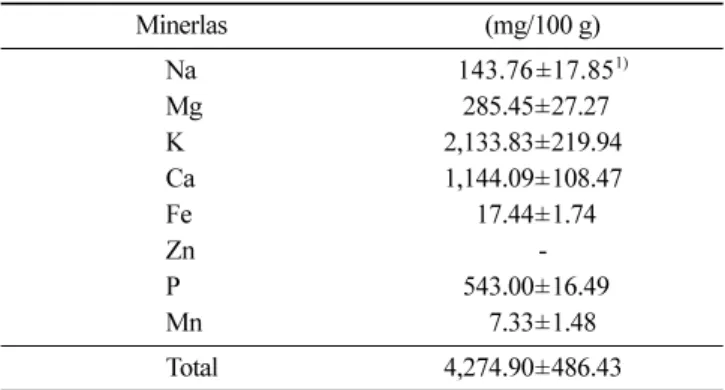
결과 및 고찰 일반성분 함량 조릿대잎차의 일반성분을 분석한 결과(Table 1) 가용성 무질 소물 32.37±4.28%, 조섬유 32.36±2.49%, 회분 8.53±0.18%, 조단 백 16.38±0.72%, 수분 5.68±0.40% 및조지방 4.68±0.84% 순으 로 나타났다. Ko(31)는 조릿대 잎에 함유되어 있는일반성분을 분석한결과수분 28.79±0.13%, 조단백 6.33±0.40%, 회분 3.76± 0.14% 및조지방 3.43±0.08%였다고 보고하여본실험의결과와 차이를보였는데 이는조릿대잎을 차로가공하는과정 즉, 볶음 과정에서수분증발에의한결과로생각되나함량의순서는유사 한결과를 보였다. 무기성분 함량 조릿대잎차에함유되어있는무기성분을분석한결과(Table 2) 총 7종이 분리, 동정되었으며, 그 중 K이 2,133.83±219.94 mg/ 100 g으로 가장 많이 함유되어 있었고, Ca 1,144.09±108.47 mg/ 100 g, P 543.00±16.49 mg/100 g, Mg 285.45±27.27 mg/100 g 및 Na 143.76±17.85 mg/100 g순으로나타났다. Ju 등(14)은왕대의추 출방법별추출물의무기성분의함량을측정한결과추출액의무 기물 함량은 K, Mg, Ca 및 Na 순으로 높았고, K의 함량이 235.2-517.1 mg%로다른무기성분에비하여높은함량을보였다 고보고하여본실험의결과와유사한결과를보였다.
Table 1. Proximate compositions of tea manufactured with Sasa borealis leaf (Unit: %)
Moisture Crude protein Crude fat Nitrogen free extracts Crude fiber Ash
Tea 5.68±0.401) 16.38±0.72 4.68±0.84 32.37±4.28 32.36±2.49 8.53±0.18
1)The values are mean±SD of three experimental data.
Table 2. Mineral contents of tea manufactured with Sasa borealis
leaf Minerlas (mg/100 g) Na 143.76±17.851) Mg 285.45±27.270 K 2,133.83±219.940, Ca 1,144.09±108.470, Fe 17.44±1.740 Zn -P 543.00±16.490 Mn 7.33±1.48 Total 4,274.90±486.430,
1)The values are mean±SD of three experimental data.
Table 3. Amino acid contents of tea manufactured with Sasa
borealis leaf Amino acids (mg/100 g) Aspartic acid 855.51±55.051) Threonine 502.56±36.72 Serine 474.07±42.21 Glutamic acid 1,157.24±87.58 Proline 1,275.26±84.22 Glycine 502.59±41.97 Alanine 576.66±30.11 Cystine 71.49±5.290 Valine 427.78±24.30 Methionine 151.15±8.290 Isoleucine 489.28±42.48 Leucine 642.48±49.14 Tyrosine 289.40±32.76 Phenylalanine 537.59±35.76 Histidine 244.37±19.34 Lysine 540.84±42.90 Arginine 593.69±38.50 Total E.A.A 3,536.05±294.82 Total A.A 9,331.96±842.17
아미노산 함량
조릿대잎차의 아미노산을 분석한 결과는 Table 3과 같이총
17종이 분리, 동정되었으며, 총아미노산 함량은 9,331.96 mg/100
g이었고, 필수아미노산 함량은 3,536.05 mg/100 g으로 나타났다. 분리, 동정된 17종의총아미노산중조릿대잎차의주요아미노 산으로는 proline(1,275.26±84.22 mg/100g), glutamic acid (1,157.24
±87.58 mg/100 g), aspartic acid(855.51±55.05 mg/100 g) 및 leucine
(642.48±49.14 mg/100 g)이었다. Kim 등(32)은맹종죽, 솜대및왕 대잎열수추출물의 아미노산을 분석한결과 glutamic acid,
ala-nine, aspartic acid 및 serine이주요 아미노산으로나타났으며, 품 종별에따른대나무열수추출물의아미노산조성과함량이차이 를보인다고보고하였다. 이는품종별 식물성식품에서흔히나 타나는연구결과로서기후, 온도및토양과같은여러 가지재배 환경에의한차이인것으로생각된다. 지방산 함량 조릿대잎차에함유되어있는 지방산조성을 GC를이용하여분 석한결과는 Table 4와 같다. 즉, 조릿대잎차의 주요 지방산으 로는 linoleic acid, palmitic acid 및 oleic acid였으며, 그 외에도 포화지방산으로는 lauric acid, myristic acid, stearidc acid 등이함 유되어있었고, 불포화지방산으로는 linolenic acid가소량함유되
어 있었다. Han 등(33)은 죽순의 지방산 조성을 분석한 결과
linoleic acid가 48.4%로 가장 많았고, palmitic acid 24.5%,
lino-lenic acid 23.0% 및 oleic acid 2.7% 순이었으며, stearic acid와
arachidonic acid는매우소량존재한다고보고하여본실험의결 과와매우유사한경향을보였다. 색도 추출온도를 달리하여 추출한 조릿대 잎차추출물을 이용하여 색도를측정한결과는 Table 5와같다. 추출온도가증가됨에따 라밝기를나타내는 L값이점차감소하는경향을보여추출온도 40oC에서는 L값이 99.29였으나추출온도 100oC에서는 97.68이었 다. 적녹도를 나타내는 a값은추출온도가 높아짐에따라점차적 으로낮아지는 경향을보였으며, 황청도를 나타내는 b값은반대 로증가하는경향을보였다. 관능검사 추출온도를달리하여추출한조릿대잎차추출물에대하여색, 향, 단맛, 쓴맛, 구수한맛및전체적인기호도를평가한결과는 Table 6과같다. 조릿대잎차 추출물의색은 60oC와 80oC에서 추 출하였을 때가 가장높은 기호도를 보였으며, 향기의 경우에는 추출온도에따른유의적인차이를보이지않았다. 또한단맛, 쓴 맛, 구수한맛에서는 80oC에서추출한조릿대잎차가 가장높은 기호도를 보였으며, 전체적인 기호도에서도 80oC에서추출한 시 료에서가장높은기호도를보였다. 총 페놀 화합물 및 플라보노이드 화합물 함량 총페놀 및플라보노이드화합물은천연물에많이함유되어있 는성분으로 이들의 주요역할은 자유라디칼을 소거하는것이 라는연구가많이보고되고 있으며, 또한이러한페놀성화합물 인플라보노이드나 페놀산및안토시아닌 등의 총량인총페놀 함량은 DPPH 라디칼 소거활성과같은항산화활성에 중요한 인 자로 작용을한다. 조릿대잎차 80% 메탄올 및열수추출물의 총 페놀화합물과플라보노이드화합물의함량을측정한결과각각 15.09±0.84와 7.69±0.42 mg/g, 12.03±0.67과 6.12±0.29 mg/g이 함 유되어있었다. Ju 등(14)은왕대추출물의폴리페놀성분을분석
Table 4. Fatty acid composition of tea manufactured with Sasa
borealis leaf
Fatty acids Peak area (%)
Lauric acid 00)0.93±0.021) Myristic acid 00.47±0.04 Palmitic acid 18.52±2.16 Stearic acid 02.63±0.11 Oleic acid 14.16±2.08 Linoleic acid 50.52±4.67 Linolenic acid 04.74±0.94 Arachidonic acid 02.26±0.23 Behenic acid 02.72±0.31
1)The values are mean±SD of three experimental data.
Table 5. Hunter’s value of Sasa borealis leaf tea according to extraction temperature
Temperature of extraction
(oC) L value a value b value ∆E value
40 0099.29±0.021)a2) -3.50±0.03a 09.06±0.05a 15.52
60 98.87±0.01b -4.70±0.02b 12.76±0.05b 18.63
80 98.73±0.08c -4.81±0.01c 13.17±0.02c 18.29
100 97.68±0.01d -5.20±0.03d 15.91±0.02d 20.59
1)The values are mean±SD of three experimental data.
2)Each value with different superscripts within the same row are significantly difference at p<0.05 by Duncan’s multiple test.
Table 6. Sensory evaluation of Sasa borealis leaf tea according to extraction temperature
Temperature of extraction
(oC) Color Flavor Sweettaste Bittertaste Delicatetaste acceptabilityOverall
40 3.50±0.551)c2) 4.03±0.32ab 2.83±0.38c 2.83±0.25d 2.67±0.13c 3.17±0.41c
60 4.12±0.41ab 4.24±0.29ab 3.33±0.21ab 3.33±0.46b 3.50±0.15a 3.33±0.18b
80 4.17±0.35a 4.33±0.28a 3.64±0.37a 3.83±0.38a 3.65±0.13a 3.79±0.22a
100 3.67±0.36c 4.00±0.10ab 2.67±0.47d 3.17±0.28c 3.13±0.17b 2.67±0.35d
1)The values are mean±SD of ten experimental data.
한 결과 catechin, chlorogenic acid, caffeic acid, 3-hydroxy
ben-zoic acid 및 ferulic acid 둥총 5종이확인되었으며, 이들 중
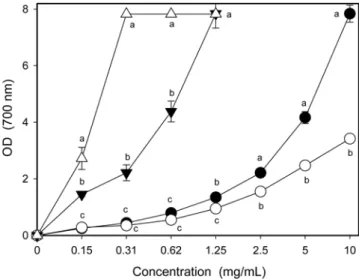
3-hydroxy benzoic acid와 catechin은추출방법에 관계없이가장높 은함량을 보였다고보고하였다. 항산화 활성 조릿대잎차의 80% 메탄올및열수추출물을 이용하여 DPPH 라디칼소거활성을 측정한결과는 Fig. 1과같이추출물의 첨가 농도가 증가함에 따라점차적으로 증가하는 경향을나타내었으 며, 농도 1.25 mg/mL의농도로첨가하였을때 80% 메탄올및열 수추출물에서 각각 90.34%와 86.73%의 소거활성을 보였다(Fig.
2). ABTS+라디칼소거활성을 측정한결과 positive control로사
용한α-tocopherol 및 ascorbic acid보다는낮은라디칼소거활성
을 보였지만 DPPH 라디칼 소거활성과 유사하게 농도의존적인 경향을 보였다(Fig. 3). Fe3+ 이온을 Fe2+이온으로 환원시키는 환 원력을측정한결과열수추출물에 비하여 80% 메탄올추출물에 서높은 환원력을보였으며, 특히농도 10 mg/mL의농도에서는 환원력이 각각 3.42와 7.84로 2배이상의 환원력차이를보였다 (Fig. 4). 이는 총페놀함량이 열수추출물보다 80% 메탄올 추 출물에서 높게나타났기 때문인것으로생각되며, 지금까지 발표 된여러가지연구결과와유사한결과를보였다. Kim 등(9)은신 의대잎 70% 에탄올추출물로부터 얻어진각용매별획분을이 용하여전자공여능을측정한결과 부탄올, 물, 에틸아세테이트및 다이에틸에테르 순으로일반적으로극성이높아질수록전자공여 능이 증가된다고 보고하였다. Lee 등(13)은다섯 종류의대나무 줄기와잎열수및 70% 에탄올추출물을 이용하여 TEAC 방법 으로항산화효과를측정한결과열수및 70% 에탄올추출물모 두강한항산화효과를 나타내었으며, 그중에서도왕대, 조릿대, 솜대, 맹종죽및오죽순으로 TE(Trolox equivalent)값이높게나
Fig. 1. Total phenol and flavonoid compounds of tea
manufactured using with Sasa borealis leaf. Different superscripts
indicate significant difference between groups at p<0.005.
Fig. 2. DPPH radical scavenging activities of 80% methanol and
hot water extracts from tea manufactured using with Sasa
borealis leaf. ●, 80% methanol ext.; ○, water ext.; ▼, α
-Tocopherol; △, ascorbic acid. Different superscripts indicate
significant difference among groups at p<0.005.
Fig. 3. ABTS+ radical scavenging activities of 80% methanol and
hot water extracts from tea manufactured using with Sasa
borealis leaf. ●, 80% methanol ext.; ○, water ext.; ▼, α
-Tocopherol; △, ascorbic acid. Different superscripts indicate
significant difference among groups at p<0.005.
Fig. 4. Reducing power of 80% methanol and hot water extracts
from tea manufactured using with Sasa borealis leaf. ●, 80%
methanol ext.; ○, water ext.; ▼, α-Tocopherol; △, ascorbic acid.
Different superscripts indicate significant difference among groups at p<0.005.
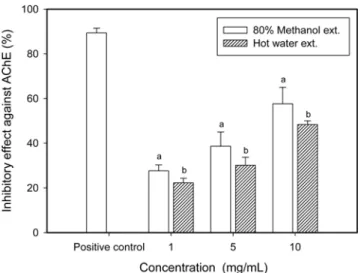
타났고, 부위별로는 잎보다 줄기의 항산화 효과가 높은 것으로 보고하였다. 또한 Park 등(17)은 조릿대 잎으로부터 4종류의 화 합물을 분리하였는데 그 중 luteolin 6-C-β-D-gluco-pyranoside가 가장높은 DPPH 라디칼소거활성을보였다고보고하였다. 따라 서대나무에는 품종및추출방법에 관계없이 많은종류의 항산 화및생리활성 물질이다량 존재하기 때문에기능성 식품소재 및기능성 식품으로활용가능성이 매우 높은천연자원이라 생 각된다. Acetylcholinesterase저해 활성 조릿대잎차 80% 메탄올및열수추출물들이 acetylcholinesterase 의저해활성에미치는영향을조사한결과는 Fig. 5와같다. 조 릿대잎차 80% 메탄올및열수추출물모두 1, 5 및 10 mg/mL의 농도범위에서 농도의존적으로 acetylcholinesterase에대한저해 활성을보였으며, 10 mg/mL의농도에서는각각 57.65%와 48.39% 로열수추출물에 비하여메탄올추출물에서높은저해활성을보 였다. 본 연구 결과를 바탕으로 조릿대 잎차에 함유되어 있는 acetylcholinesterase저해활성을나타내는구체적인화합물에대한 연구가필요할것으로생각된다. 요 약 조릿대잎을이용한가공품개발에대한기초자료로활용하기 위하여잎차의 영양성분및기능성을평가하였다. 일반성분은수 분 5.68%, 조단백 16.38%, 조지방 4.68%, 가용성 무질소물 32.37%, 조섬유 32.36% 및회분 8.53%로각각나타났다. 주요무 기성분으로는 K 2,133.83, Ca 1,144.09 및 P 543.00 mg/100 g이었 으며, 아미노산중 proline이 1,275.26 mg/100 g으로 가장높은 함 량을보였고, cystine이 71.49 mg/100 g으로가장 낮은함량을보 였다. 주요 지방산으로는 linoleic acid(50.52%), palmitic acid
(18.52%) 및 oleic acid(14.16%)였으며, 관능검사 결과 80oC에서 추출한조릿대잎차가 가장높은기호도를보였다. 80% 메탄올 및 열수추출물의 총 페놀과 플라보노이드 함량을 측정한 결과 15.09, 7.69 mg/g과 12.03±0.67, 6.12±0.29 mg/g으로 각각 나타났 다. DPPH와 ABTS+ 라디칼 소거활성을 측정한결과 80% 메탄 올추출물농도 1.25 mg/mL에서 각각 86.87%와 83.85%의소거활 성을 보였으며, 환원력및 acetylcholinesterase(퇴행성뇌신경질환의 일종인치매유발효소) 저해활성은농도의존적인경향을나타 내었다. 문 헌
1. Fang YZ, Yang S, Wu G. Free radical, antioxidant, and nutrition. Nutrition 18: 872-879 (2002)
2. Morrissey PA, O'Brien NM. Dietary antioxidant in health and dis-ease. Int. Dairy J. 8: 463-472 (1998)
3. Willet WC. Diet and health: what should we eat. Science 254: 532-537 (1994)
4. Slavin JL, Jacobs D, Marquart L. Whole-grain consumption and chronic disease: Protection mechanism. Nutr. Cancer 27: 14-21 (1997)
5. Temple NJ. Antioxidants and disease: More question than answers. Nutr. Res. 20: 449-459 (2000)
6. Feskanich D, Ziegler RG, Michaud DS, Giovannucci EL, Speizer FE, Willett WC, Colditz GA. Prospective study of fruit and vege-table consumption and risk of lung cancer among men and women. J. Natl. Cancer I. 92: 1812-1823 (2000)
7. Ames BN, Shigenaga MK, Hagwn TM. Oxidants, antioxidant, and the degenerative disease of aging. P. Natl. Acad. Sci. USA 90: 7915-7922 (1993)
8. Chung DK, Yu R. Antimicrobial activity of bamboo leaves extract on microorganisms related to kimchi fermentation. Korean J. Food Sci. Technol. 27: 1035-1038 (1995)
9. Kim MJ, Byun MW, Jang MS. Physiological and antibacterial activity of bamboo (Sasa coreana Nakai) leaves. J. Korean Food Sci. Nutr. 25: 135-142(1996)
10. Shin JH, Choi DJ, Sung NJ. Nutritional properties of yakju
brewed with natural plants. Korean J. Food Nutr. 17: 18-24 (2004)
11. Shin MK, Han SH. Effects of methanol extracts from bamboo (Pseudosasa japonica Makino) leaves extracts on lipid metabo-lism in rats fed high fat and high cholesterol diet. Korean J. Diet. Culture 17: 30-36 (2002)
12. Kim EY, J EY, Lim HS, Heo YR. The effects of the Sasa borea-lis leaves extract on plasma adiponectin, resistin, C-reactive pro-tein and homocyspro-teine levels in high fat diet-induced obses C57/ BL6J mice. Korean J. Nutr. 40: 303-311 (2007)
13. Lee MJ, Moon GS. Antioxidative effects of Korean bamboo trees, ‘Wang-dae’, ‘Som-dae’, ‘Maengjong-Juk’, ‘Jolit-dae’ and ‘O-juk’. Korean J. Food Sci. Technol. 35: 1226-1232 (2003) 14. Ju IO, Jung GT, Ryu J, Choi JS, Choi YG. Chemical components
and physiological activities of bamboo (Phyllostachys bambuso-ides Starf) extracts prepared with different methods. Korean J. Food Sci. Technol. 37: 542-548 (2005)
15. Ko BS, Jun DW, Jang JS, Kim JH, Park SM. Effect of Sasa Borealis and white lotue roots and leaves on insuline action and secretion in vitro. Korean J. Food Sci. Technol. 38 : 114-120 (2006)
16. Lee J, Jeong YH, Jang DS, Seo EK. Three terpenes and one phe-nolic compound from Sasa borealis. J Appl. Biol. Chem. 50: 13-16 (2007)
17. Park HS, Lim JH, KIm HJ, Choi HJ, Lee IS. Antioxidant flavone glycosides from the leaves of Sasa borealis. Arch. Pharm. Res. 30: 161-166 (2007)
18. Chung MJ, Lee SJ, Shin JH, Jo JS, Sung NJ. The components of the sap from birches, bamboos and darae. J. Korean Soc. Food Nutr. 24: 727-733 (1995)
19. Lee JY, Ju JC, Park HJ, Heu ES, Choi SY, Shin JH. Quality characteristics of cookies with bamboo leaves powder. Korean J. Food Nutr. 19: 1-7 (2006)
20. AOAC. Official Methods of Analysis of AOAC Intl. 13th ed.
920.39, 934.01, 942.05, 954.01 and 974.06, Association of Offi-cial Analytical Chemists, Washington DC, USA (1990).
21. Jeong CH, Shim KH. Quality characteristics of sponge cake with
Fig. 5. Inhibitory effect against AChE of 80% methanol and hot
water extracts from tea manufactured using with Sasa borealis
leaf. Positive control: 0.1 mM
1,5-bis(4-allyldimethylammonium-phenyl)-pentane-3-one dibromide. Inhibition rate (%)=[1-(test OD-test blank OD)/(control OD-control blank OD)]×100.
addition of Pleurotus eryngii mushroom powders. J. Korean Soc. Food Sci. Nutr. 33: 716-722 (2004)
22. Jeong CH, Shim KH. Chemical composition and antioxidative activities of Platycodon grandiflorum leaves and stems. J. Korean Soc. Food Sci. Nutr. 35: 511-515 (2006)
23. Metcalf LD, Schmits AA, Pelka JR. Rapid preparation of fatty acid esters from lipids for gas chromatographic analysis. Anal. Chem. 38: 514-515 (1966)
24. Graham HD. Modified prussian blue assay for total phenolic compound.J. Agr. Food Chem.40: 801-805 (1992)
25. Jeong CH, Bae YI, Lee HJ, Shim KH. Chemical components of propolis and its ethanolic extracts. J. Korean Soc. Food Sci. Nutr. 32: 501-505 (2003)
26. Blois MA. Antioxidant determination by the use of a stable free radical. Nature 181: 1199-200 (1958)
27. Pellegrin N, Re R, Yang M, Rice-Evans C. Screening of dietary carotenoids and carotenoid-rich fruit extracts for antioxidant activ-ities applying 2,2'-azinobis (3-ethylbenzothiazoline-6-sulfonic acid) radical cation decolorization assay. Method Enzymol. 299:
379-389 (1998)
28. Yen GH, Chen HY. Antioxidant activity of various tea extracts in relation to their antimutagenicity. J. Agr. Food Chem. 45: 27-32 (1995)
29. Ellman GL, Doutney KD, Andres V, Featherstone RM. A new and rapid colorimetric determination acetylcholinesterase activity. Biochem. Phamacol. 7 : 88-95 (1961)
30. Lee KH, Park HC, Her ES. Statistics and Date Analysis Method. Hyoil Press, Seoul, Korea. pp. 253-296 (1998)
31. Ko MS. Chemical components in stalks and leaves of Sasa bore-alis Makino and antioxidant and antimicrobial activities of extracts. Korean J. Food Preserv. 15: 125-132 (2008)
32. Kim NK, Cho SH, Lee SD, Ryu JS, Shim KH. Chemical proper-ties of hot water extracts from bamboos (Phyllostachys sp.). Korean J. Postharv. Sci. Technol. 8: 469-474 (2001)
33. Han SJ, Koo SJ. Study on the chemical composition in bamboo shoot, lotus root and burdock. Free sugar, fatty acid, amino acid, and dietary fiber contents. Korean J. Soc. Food Sci. 9: 82-87 (1993)