INTRODUCTION
Aberrant methylation patterns are one of the fundamental hallmarks of cancer cells. Tumor cells are generally hypomethy- lated relative to normal cells with regional hypermethylation.
CpG islands are GC-rich areas of the genome corresponding to the promoter regions of genes and are associated with transcrip- tional activity (1). The methylation status of these CpG islands has been shown to be involved with oncogene activation and tumor suppressor gene inactivation. A recent study on the profile of promoter hypermethylation for 12 genes (p16INK4A, p15INK4B, p14ARF, p73, APC, BRCA1, hMLH1, GSTP1, MGMT, CDMI, TIMP3, and DAPK) in 15 major tumor types revealed that one or more of the genes are hypermethylated in all tumor types (2). The profile of the promoter hypermethylation for the genes, however, differs in each cancer type, providing a tumor type- and gene-specific profile.
Aberrant methylation in tumor-related genes is frequently detected in gastric intestinal metaplasia with and without gastric cancer, suggesting their early involvement in the mul- tistep progression of gastric carcinogenesis (3). The identifi- cation of genes targeted by hypermethylation may provide insights into the mechanisms for the inactivation of tumor- suppressive pathways in gastric cancer cases. In addition, hypermethylated genes may serve as targets for the develop-
ment of new screening tests for cancer (4).
In the present study, we compared the hypermethylation of genes responsible for the cell repair system (hMLH1, MGMT, and GSTP1) in gastric cancer case and control study. We also analyzed MINT 25 (methylated in tumors 25) which showed a high frequency of methylation in gastric carcinomas (5, 6).
There are many reports that have shown frequent hyperme- thylation of these genes in gastric carcinoma, but its inter- action with histological characteristics is still unclear. Thus, we evaluated the association between the hypermethylation of these genes and gastric cancer according to the risk factors such as H. pylori infection, alcohol consumption, smoking, family history, and their histological characteristics by the methylation-specific PCR (MSP) method.
MATERIALS AND METHODS Subjects and genomic DNA purification
A case-control study of gastric cancer was performed in Daegu City. One hundred gastric cancer patients and two hundred thirty-eight healthy subjects participated in this study. Patients affected with gastric cancer were considered eligible if they had histologically diagnosed adenocarcinoma
Su Hyung Hong, Ho Gak Kim*, Woon Bok Chung, Eun Young Kim*, Jong Young Lee�, Sang Mo Yoon�, Joong Goo Kwon�, Yoon Kyung Sohn�, Eun Kyung Kwak‖, Jung Wan Kim
Department of Dental Microbiology, Pathology‖, Kyungpook National University School of Dentistry;
Department of Internal Medicine*, Catholic University of Daegu School of Medicine; Department of Preventive Medicine�, Pathology�, Kyungpook Nation- al University School of Medicine; Department of Therapeutic Radiology and Oncology�, Yeungnam University College of Medicine, Daegu, Korea
Address for correspondence Jung-Wan Kim, D.D.S.
Department of Dental Microbiology, Kyungpook National University School of Dentistry, 101 Dongin-dong, Jung-gu, Daegu 700-422, Korea Tel : +82.53-420-4991, Fax : +82.53-422-6596 E-mail : [email protected]
*The first two authors contributed equally to this work.
236
DNA Hypermethylation of Tumor-Related Genes in Gastric Carcinoma
The hypermethylation of the CpG islands is a common mechanism for the inacti- vation of tumor-related genes. In the present study, we analyzed the methylation status of genes for cell repair such as hMLH1, MGMT, and GSTP1, and a gastric cancer-specifically methylated DNA fragment, MINT 25 in gastric cancer cases and control groups. The study population consisted of 100 gastric cancer patients (50 distal and 50 proximal carcinomas), and 238 healthy controls. All genes showed more frequent hypermethylation in the cases than in the control group (p<0.0001).
We investigated the association between promoter hypermethylation and relevant parameters including age, gender, alcohol consumption, smoking, and family his- tory. There was a common hypermethylation of hMLH1 (p=0.008), MGMT (p=
0.0001), and GSTP1 (p=0.0003) in females. This study also demonstrates that hypermethylation was strongly associated with non-drinkers (MGMT, p=0.046 and MINT 25, p=0.049) and non-smokers (hMLH1, p=0.044; MGMT, p=0.0003; MINT 25, p=0.029). Moreover, the frequency of MINT 25 hypermethylation increased with age (p=0.037), and MGMT methylation was frequently detected in distal gas- tric cancer than in proximal type (p=0.038). Our study suggested that promoter hypermethylation of the genes involved in cell repair system and MINT 25 is asso- ciated strongly with some subgroups of primary gastric carcinoma.
Key Words : Stomach Neoplasms; DNA Methylation; MLH1 Protein, mammalian; O (6)-Methylguanine-DNA Methyltransferase; Glutathione S-transferase pi; MINT 25
Received : 8 September 2004 Accepted : 16 November 2004
of the stomach. The control group included subjects who had no current or previous diagnosis of cancer. Data includ- ed questionnaire data, and a review of medical records.
Whole blood samples of control group were used to iso- late genomic DNA by the phenol-chloroform method (7).
Tumor tissues were used to determine DNA methylation status of cancer patients. Frozen tumor tissues were ground and incubated at 50℃for 3 hr in a lysis buffer containing 0.5% of sodium dodecyl sulfate (SDS), followed by a phenol- chloroform method. The amount of DNA and their purity were determined by spectrophotometry.
Bisulfite modification
DNA methylation patterns in the CpG islands of the tar- get genes were determined by chemical modification of un- methylated, but not methylated, cytosines to uracils, and subsequent PCR amplification using primers specific for either methylated or modified unmethylated DNA (8). The bisulfite-modification was performed according to Olek et al. (9). One microgram of DNA was denatured by NaOH and modified by sodium bisulfite. DNA samples were then purified using Wizard DNA purification resin (Promega, Madison, WI, U.S.A.), treated with NaOH again, and pre- cipitated with ethanol. DNA was resuspended in water and used immediately or stored at -20℃.
Methylation-sensitive PCR and bisulfite-PCR RFLP
Two L of treated DNA were used for each PCR reaction.
MSP showed the presence or absence of methylated genes of hMLH1, MGMT, and GSTP1. The methylation status of MINT 25 was determined by bisulfite-PCR followed by res- triction digestion. Two L of DNA modified with bisulfite were amplified and 15 L of the PCR products were then
digested with RsaI, which is specific to the methylated alleles by virtue of having CpG sites in their recognition sequence.
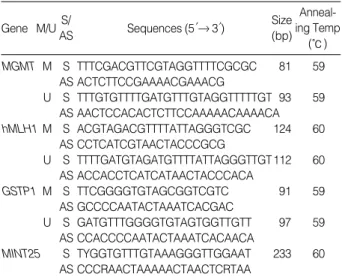
After digestion, 10 L of each product were directly loaded onto 2% agarose or 6% polyacrylamide gels and stained with ethidium bromide. Primer sequences and annealing temper- atures are shown in Table 1.
Statistical analysis
Cases and controls were described according to their basic sociodemographic, and clinicopathological factors. Patients who indicated that they had stopped smoking or drinking alcohol within the post 6 months were classified as current smokers or current alcohol drinkers. 2tests and Fisher’s exact tests were done using the software package SAS Release 8.01 for Windows to examine the differences in DNA methylation status. The corresponding tests on the cases and controls were carried out (p-values) to compare each factor.
RESULTS DNA methylation in gastric carcinoma
We determined aberrant DNA methylation of hMLH1,
Anneal- ing Temp
(℃) Size Gene M/US/ Sequences (5 � 3 ) (bp)
AS
MGMT M S TTTCGACGTTCGTAGGTTTTCGCGC 81 59 AS ACTCTTCCGAAAACGAAACG
U S TTTGTGTTTTGATGTTTGTAGGTTTTTGT 93 59 AS AACTCCACACTCTTCCAAAAACAAAACA hMLH1 M S ACGTAGACGTTTTATTAGGGTCGC 124 60
AS CCTCATCGTAACTACCCGCG
U S TTTTGATGTAGATGTTTTATTAGGGTTGT 112 60 AS ACCACCTCATCATAACTACCCACA
GSTP1 M S TTCGGGGTGTAGCGGTCGTC 91 59 AS GCCCCAATACTAAATCACGAC
U S GATGTTTGGGGTGTAGTGGTTGTT 97 59
AS CCACCCCAATACTAAATCACAACA
MINT25 S TYGGTGTTTGTAAAGGGTTGGAAT 233 60 AS CCCRAACTAAAAACTAACTCRTAA
Table 1.PCR primers used for MSP and bisulfite-PCR
′ ′
Fig. 1.Methylation analysis in gastric cancer. (A) hMLH1, (B) MGMT, and (C) GSTP1 methylation were analyzed by methylation-specific PCR. The presence of visible PCR products in those lanes marked U indicate the presence of unmethylated genes; the presence of products in those lanes marked M indicate the presence of methy- lated genes. Cases 9, 35, 59, and 92 show methylated and un- methylated bands because of the heterogeneously methylated genes, and cases 5 and 75 do not have methylated genes. (D) MINT 25 methylation analysis was performed by bisulfite-PCR and restriction digestion. Only methylated alleles will be digested by restriction enzymes, and they are indicated by arrows. Case 27 and 28 have homogeneously and, heterogeneously methylated MINT 25 DNA fragments, respectively.
Case 92
U M
Case 75
U M
Case 9
U M
Case 35
U M
Case 5
U M
Case 59
U M
Cases 25 26 27 28 A B
C D
M, methylated; U, unmethylated; S, sense; AS, antisense.
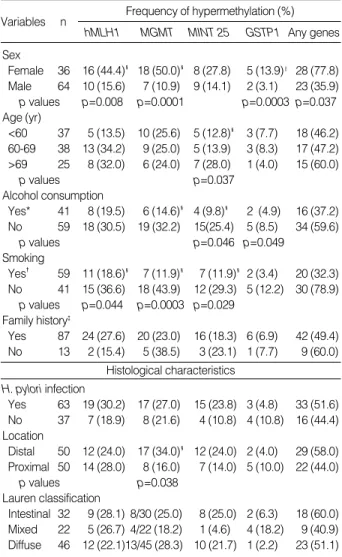
MGMT, MINT 25, and GSTP1 in 100 gastric cancer patients and 238 randomly chosen, healthy Koreans. The mean ages were 62 yr for cancer patients and 60.7 yr for controls. These genes were generally unmethylated in the control group, in particular, MINT 25 and GSTP1 showed no hypermethyla- tion. All these genes, however, were aberrantly methylated in the cancer group at the following frequencies: 26 (26%) for hMLH1, 25 (25%) for MGMT, 19 (19%) for MINT 25, and 7 (7%) for GSTP1. All the p values are <0.0001, and the overall results are shown in Fig. 1 and Table 2. When we com- pared the relationship of the DNA methylation of hMLH1 and other 3 genes, we found concurrent methylation of hMLH1 and any of other 3 genes (p=0.045) (Table 3).
Association between the characteristics of patients and DNA methylation
We analyzed the methylation changes in the tumors and the questionnaire data obtained from the patients. The pro- moter hypermethylation of hMLH1, MGMT, and GSTP1 were detected more frequently in women than in men and the frequencies are as follows: 44.4% vs. 15.6% for hMLH1 (p=0.008), 50.0% vs. 10.9% for MGMT (0.0001), and 13.9%
vs. 3.1% for GSTP1 (p=0.0003). To determine the relation- ship between DNA hypermethylation and aging, we ranked the 100 gastric carcinomas into three groups according to age. The proportion of MINT 25 methylation was increased with age (p=0.037). We compared the frequency of methy- lation after grouping the cases in two by tobacco smoking or never-smoking. It is interesting to note that the promot- er hypermethylation of MGMT and MINT 25 were detect- ed less frequently in the alcohol consumption subgroup and the frequencies are as follows: 14.6% vs. 32.2% for MGMT (p=0.046), and 9.8% vs. 25.4% for MINT 25 (p=0.049).
When we compared the methylation after grouping in two by smoking or never smoking, we observed similar results in alcohol consumption, which showed a lower proportion hMLH1 methylation (18.6% vs. 36.6%, p=0.044), MGMT (11.9% vs. 43.9%, p=0.0003), and MINT 25 (11.9% vs.
29.3%, p=0.029). There was no significant difference in the methylation frequency between subgroups with and with- out gastric cancer family history. The proportion of hMLH1 methylation in these two groups was 27.6% and 15.4%, res- pectively, but it is not statistically significant.
Another aim of this study was to investigate that the ins- tances of promoter hypermethylation in gastric carcinoma are associated with histological parameters such as H. pylori infection, tumor location, and Lauren classification. In our study, MGMT showed hypermethylation more frequently in distal gastric carcinomas than in the proximal type (34%
vs. 16%, p=0.038). These were summarized in Table 4.
DISCUSSION
Methylation of the CpG islands of tumor suppressor genes
Frequency of hypermethylation (%) hMLH1 MGMT MINT 25 GSTP1 Cases (n=100) 26 (26.0)* 25 (25.0)* 19 (19.0)* 7 (7.0)*
Controls (n=238) 2 (0.8) 4 (1.7) 0 (0) 0 (0)
*All the p values are <0.0001.
Table 2.The frequency of DNA hypermethylation in gastric can- cer and control groups
hMLH1 Concurrent methylation (any genes)
Methylated (n=26) 16 (61.6%)*
Unmethylated (n=74) 23 (31.1%)
*p=0.045.
Table 3.Concurrent hypermethylation of hMLH1 with other genes
*Current or ex-drinkers, �Current or ex- smokers, �One or more first-degree relatives with gastric cancer, �p values by chi square test, ‖p values by Fisher’s exact test.
Frequency of hypermethylation (%) hMLH1 MGMT MINT 25 GSTP1 Any genes Variables n
Sex
Female 36 16 (44.4)� 18 (50.0)� 8 (27.8) 5 (13.9)‖ 28 (77.8) Male 64 10 (15.6) 7 (10.9) 9 (14.1) 2 (3.1) 23 (35.9) p values p=0.008 p=0.0001 p=0.0003 p=0.037 Age (yr)
<60 37 5 (13.5) 10 (25.6) 5 (12.8)� 3 (7.7) 18 (46.2) 60-69 38 13 (34.2) 9 (25.0) 5 (13.9) 3 (8.3) 17 (47.2)
>69 25 8 (32.0) 6 (24.0) 7 (28.0) 1 (4.0) 15 (60.0)
p values p=0.037
Alcohol consumption
Yes* 41 8 (19.5) 6 (14.6)� 4 (9.8)� 2 (4.9) 16 (37.2) No 59 18 (30.5) 19 (32.2) 15(25.4) 5 (8.5) 34 (59.6)
p values p=0.046 p=0.049
Smoking
Yes� 59 11 (18.6)� 7 (11.9)� 7 (11.9)� 2 (3.4) 20 (32.3) No 41 15 (36.6) 18 (43.9) 12 (29.3) 5 (12.2) 30 (78.9)
p values p=0.044 p=0.0003 p=0.029 Family history�
Yes 87 24 (27.6) 20 (23.0) 16 (18.3) 6 (6.9) 42 (49.4) No 13 2 (15.4) 5 (38.5) 3 (23.1) 1 (7.7) 9 (60.0)
Histological characteristics H. pylori infection
Yes 63 19 (30.2) 17 (27.0) 15 (23.8) 3 (4.8) 33 (51.6) No 37 7 (18.9) 8 (21.6) 4 (10.8) 4 (10.8) 16 (44.4) Location
Distal 50 12 (24.0) 17 (34.0)� 12 (24.0) 2 (4.0) 29 (58.0) Proximal 50 14 (28.0) 8 (16.0) 7 (14.0) 5 (10.0) 22 (44.0)
p values p=0.038
Lauren classification
Intestinal 32 9 (28.1) 8/30 (25.0) 8 (25.0) 2 (6.3) 18 (60.0) Mixed 22 5 (26.7) 4/22 (18.2) 1 (4.6) 4 (18.2) 9 (40.9) Diffuse 46 12 (22.1)13/45 (28.3) 10 (21.7) 1 (2.2) 23 (51.1) Table 4.Association between the characteristics of the subjects and DNA hypermethylation
leading to their transcriptional inactivation is a highly con- sistent feature of tumorigenesis. In the present study, we demonstrated the distribution pattern of the aberrant methy- lation of hMLH1, MGMT, MINT 25 and GSTP1 in gastric cancer patients and controls. We also investigated the asso- ciation between promoter hypermethylation and relevant parameters including age, gender, alcohol consumption, smok- ing, and family history. Other histological characteristics were also taken into consideration.
The transcriptional inactivation of MGMT by DNA methy- lation occurs in a wide spectrum of human tumors (10), where- as that of hMLH1 is restricted to sporadic tumors with micro- satellite instability such as colon (11), endometrial (12, 13), and gastric tumors (14). MGMT plays a major role in the repair of O6-methylguanine DNA adducts. The loss of MGMT expression is rarely due to genetic mutation, but due to the methylation of discrete regions of the CpG island of the gene.
Recently reported data indicated that MGMT protein expres- sion levels were decreased by the promoter hypermethylation of MGMT in gastric carcinomas (15). Glutathione S-trans- ferases (GSTs) are a family of enzymes involved in the detoxi- cation of xenobiotics and oxygen radicals (16, 17). Recent studies have demonstrated that the expression of the GSTP1 gene, one of the GST isoenzymes, is controlled by DNA methy- lation (18). MINT 25 stands out as the specific methylation pattern in gastric tumors, and there was no methylation ob- served in either normal stomach or colon, or less than 10%
of colorectal tumors (19). This suggests that it may play a special role in stomach neoplasia.
In the present study, the methylation of hMLH1, MGMT, MINT 25, and GSTP1 in gastric cancer was detected more frequently than in the controls (p<0.0001). Previous report showed that concurrent hypermethylation of hMLH1, CDH1, MGMT and COX2 gene promoters was more frequently ob- served in MSI-H gastric tumors, and the significant associa- tion between the concurrent hypermethylation and MSI-H was lost when hMLH1 was excluded (20). We tried to com- pare the hypermethylation pattern between hMLH1 and other genes analyzed in this study. Our result indicates that concurrent hypermethylation of hMLH1 and the other three genes are a common event in gastric cancer (p=0.045). Further studies are necessary to determine the association between the inactivation of hMLH1 gene promoters by hypermethy- lation and the microsatellite instability status of gastric car- cinomas.
We investigated the association between promoter hyper- methylation and relevant parameters including age, gender, alcohol consumption, smoking, and family history. We found that the promoter hypermethylation of hMLH1, MGMT, and GSTP1 was detected more frequently in women than in men (p<0.05). A previous report showed that the methy- lation of TIMP-3 was seen more frequently in women with lung cancer, whereas methylation of DAPK and p16INK4awas more common in men. These data suggest that some genes
showed gender-specific methylation pattern, but the reason for this is unknown.
It has been described that aging is associated with the methy- lation of certain genes such as hMLH1 (21) and estrogen re- ceptor (22). In the present study the proportion of MINT 25 methylation increased with age (p=0.037), and hMLH1 also showed significant difference of methylation frequency between the two age groups of 69 yr apart. Previous studies showed that age-related methylation affects only a subset of genes, suggesting a gene-specific susceptibility in this pro- cess (23). Furthermore, there are significant tissue-specific differences in age-related methylation (23). MINT 25, which is strongly associated with gastric carcinoma, demonstrated for the first time in this report an age dependent methyla- tion pattern.
In the present study, there was a significant association bet- ween methylation and smoking/alcohol consumption. The proportion of promoter methylation of genes increased sig- nificantly in the never-smoking or never-drinking subgroups (p<0.05). It was also shown that the incidence of MGMT pro- moter hypermethylation was significantly higher in never- smokers in lung adenocarcinomas (24). These result are, how- ever, inconsistent with the previous study related with the promoter methylation pattern of tumor suppressor genes in head and neck squamous cell carcinoma (25). It could be suggested that hypermethylation is regulated differently by alcohol consumption and/or smoking in genes.
There was a difference in hMLH1 methylation between subgroups with and without family history of gastric carci- noma, but this is not statistically significant. Since the size of these two subgroups is significantly different, it needs fur- ther investigation with more subgroups without gastric can- cer family history.
A previous study showed that the p16 methylation in the distal stomach epithelium was higher than that in the proxi- mal stomach (26). There have been reports showing that the microsatellite instability phenotype is linked with promoter hypermethylation of hMLH1 and MGMT (27). Furthermore, many studies including with Korean patients showed that gastric cancer with microsatellite instability was associated with distal location (28-31). These reports suggest that hyper- methylation is more susceptible in distal gastric carcinoma.
The correlation mechanism between the microsatellite insta- bility and DNA methylation needs to be uncovered. In our study, MGMT hypermethylation was detected more fre- quently in distal gastric carcinoma than in the proximal type (p=0.038).
A previous report suggested that there was a significant association between hMLH1 promoter hypermethylation and intestinal type gastric carcinomas (32). Another study, how- ever, showed that the frequency of hMLH1 methylation was similar between intestinal and diffuse type gastric carcinomas (3). In our study, there was no association between hMLH1 hypermethylation and the Lauren classification of gastric
carcinomas.
In conclusion, our study regarding promoter hypermethy- lation of genes involved in the cell repair system and MINT 25 in primary gastric carcinomas shows the high frequency of methylation of hMLH1, MGMT, and MINT 25. This study also demonstrates that hypermethylation was strongly asso- ciated with females, and non-drinking/non-smoking sub- groups. Moreover, the frequency of MINT 25 hypermethy- lation increased with aging, and the methylation of MGMT was frequently detected in distal gastric cancer than in proxi- mal cancer. The exact nature of the methylation defect in can- cer cells should be defined by further studies.
ACKNOWLEDGEMENT
This research was supported by research grants from Catholic University of Daegu in 2002.
REFERENCES
1. Bird AP. CpG-rich islands and the function of DNA methylation.
Nature 1986; 321: 209-13.
2. Esteller M, Corn PG, Baylin SB, Herman JG. A gene hypermethyla- tion profile of human cancer. Cancer Res 2001; 61: 3225-9.
3. To KF, Leung WK, Lee TL, Yu J, Tong JH, Chan MW, Ng EK, Chung SC, Sung JJ. Promoter hypermethylation of tumor-related genes in gastric intestinal metaplasia of patients with and without gastric cancer. Int J Cancer 2002; 102: 623-8.
4. Belinsky SA, Nikula KJ, Palmisano WA, Michels R, Saccomanno G, Gabrielson E, Baylin SB, Herman JG. Aberrant methylation of p16(INK4a) is an early event in lung cancer and a potential biomark- er for early diagnosis. Proc Natl Acad Sci USA 1998; 95: 11891-6.
5. Toyota M, Ahuja N, Suzuki H, Itoh F, Ohe-Toyota M, Imai K, Baylin SB, Issa JP. Aberrant methylation in gastric cancer associated with the CpG island methylator phenotype. Cancer Res 1999; 59: 5438- 42.
6. Oue N, Oshimo Y, Nakayama H, Ito R, Yoshida K, Matsusaki K, Yasui W. DNA methylation of multiple genes in gastric carcinoma:
Association with histological type and CpG island methylator phe- notype. Cancer Sci 2003; 94: 901-5.
7. Sambrook J, Fritsch EF, Maniatis T. Isolation of high-molecular- weight DNA from mammalian cells. In: Sambrook J, Fritsch EF, Maniatis T (ed.), Molecular cloning: A laboratory manual, 2nd eds., Cold spring harbor, New York: Cold Spring Harbor Lab. Press, 1989;
9.16-9.22.
8. Wang RY, Gehrke CW, Ehrlich M. Comparison of bisulfite modifi- cation of 5-methyldeoxycytidine and deoxycytidine residues. Nucle- ic Acids Res 1980; 8: 4777-90.
9. Olek A, Oswald J, Walter J. A modified and improved method for bisulphite based cytosine methylation analysis. Nucleic Acids Res 1996; 24: 5064-6.
10. Esteller M, Hamilton SR, Burger PC, Baylin SB, Herman JG. Inac-
tivation of the DNA repair gene O6-methylguanine-DNA methyltrans- ferase by promoter hypermethylation is a common event in primary human neoplasia. Cancer Res 1999; 59: 793-7.
11. Wheeler JM, Beck NE, Kim HC, Tomlinson IP, Mortensen NJ, Bod- mer WF. Mechanisms of inactivation of mismatch repair genes in human colorectal cancer cell lines: the predominant role of hMLH1.
Proc Natl Acad Sci USA 1999; 96: 10296-301.
12. Esteller M, Levine R, Baylin SB, Ellenson LH, Herman JG. MLH1 promoter hypermethylation is associated with the microsatellite insta- bility phenotype in sporadic endometrial carcinomas. Oncogene 1998;
17: 2413-7.
13. Esteller M, Catasus L, Matias-Guiu X, Mutter GL, Prat J, Baylin SB, Herman JG. hMLH1 promoter hypermethylation is an early event in human endometrial tumorigenesis. Am J Pathol 1999; 155: 1767-72.
14. Fleisher AS, Esteller M, Wang S, Tamura G, Suzuki H, Yin J, Zou TT, Abraham JM, Kong D, Smolinski KN, Shi YQ, Rhyu MG, Pow- ell SM, James SP, Wilson KT, Herman JG, Meltzer SJ. Hypermethy- lation of the hMLH1 gene promoter in human gastric cancers with microsatellite instability. Cancer Res 1999; 59: 1090-5.
15. Oue N, Shigeishi H, Kuniyasu H, Yokozaki H, Kuraoka K, Ito R, Yasui W. Promoter hypermethylation of MGMT is associated with protein loss in gastric carcinoma. Int J Cancer 2001; 93: 805-9.
16. Pickett CB, Lu AY. Glutathione S-transferases: gene structure, regu- lation, and biological function. Annu Rev Biochem 1989; 58: 743-64.
17. Tsuchida S, Sato K. Glutathione transferases and cancer. Crit Rev Biochem Mol Biol 1992; 27: 337-84.
18. Lee WH, Morton RA, Epstein JI, Brooks JD, Campbell PA, Bova GS, Hsieh WS, Isaacs WB, Nelson WG. Cytidine methylation of regulatory sequences near the pi-class glutathione S-transferase gene accompanies human prostatic carcinogenesis. Proc Natl Acad Sci USA 1994; 91: 11733-7.
19. Toyota M, Ahuja N, Ohe-Toyota M, Herman JG, Baylin SB, Issa JP.
CpG island methylator phenotype in colorectal cancer. Proc Natl Acad Sci USA 1999; 96: 8681-6.
20. Carvalho B, Pinto M, Cirnes L, Oliveira C, Machado JC, Suriano G, Hamelin R, Carneiro F, Seruca R. Concurrent hypermethylation of gene promoters is associated with a MSI-H phenotype and diploidy in gastric carcinomas. Eur J Cancer 2003; 39: 1222-7.
21. Nakajima T, Akiyama Y, Shiraishi J, Arai T, Yanagisawa Y, Ara M, Fukuda Y, Sawabe M, Saitoh K, Kamiyama R, Hirokawa K, Yuasa Y. Age-related hypermethylation of the hMLH1 promoter in gastric cancers. Int J Cancer 2001; 94: 208-11.
22. Baylin SB, Herman JG, Graff JR, Vertino PM, Issa JP. Alterations in DNA methylation: a fundamental aspect of neoplasia. Adv Can- cer Res 1998; 72: 141-96.
23. Ahuja N, Li Q, Mohan AL, Baylin SB, Issa JP. Aging and DNA methylation in colorectal mucosa and cancer. Cancer Res 1998; 58:
5489-94.
24. Pulling LC, Divine KK, Klinge DM, Gilliland FD, Kang T, Schwartz AG, Bocklage TJ, Belinsky SA. Promoter hypermethylation of the O6-methylguanine-DNA methyltransferase gene: more common in lung adenocarcinomas from never-smokers than smokers and asso- ciated with tumor progression. Cancer Res 2003; 63: 4842-8.
25. Hasegawa M, Nelson HH, Peters E, Ringstrom E, Posner M, Kelsey
KT. Patterns of gene promoter methylation in squamous cell cancer of the head and neck. Oncogene 2002; 21: 4231-6.
26. Bai H, Gu L, Zhou J, Deng D. p16 hypermethylation during gastric carcinogenesis of Wistar rats by N-methyl-N -nitro-N-nitrosoguani- dine. Mutat Res 2003; 535: 73-8.
27. Musulen E, Moreno V, Reyes G, Sancho FJ, Peinado MA, Esteller M, Herman JG, Combalia N, Rey M, Capella G. Standardized approach for microsatellite instability detection in gastric carcinomas. Hum Pathol 2004; 35: 335-42.
28. Ottini L, Palli D, Falchetti M, D’Amico C, Amorosi A, Saieva C, Calzolari A, Cimoli F, Tatarelli C, De Marchis L, Masala G, Mari- ani-Costantini R, Cama A. Microsatellite instability in gastric can- cer is associated with tumor location and family history in a high- risk population from Tuscany. Cancer Res 1997; 57: 4523-9.
29. Wu MS, Lee CW, Shun CT, Wang HP, Lee WJ, Sheu JC, Lin JT.
Clinicopathological significance of altered loci of replication error and microsatellite instability-associated mutations in gastric can- cer. Cancer Res 1998; 58: 1494-7.
30. Yamamoto H, Perez-Piteira J, Yoshida T, Terada M, Itoh F, Imai K, Perucho M. Gastric cancers of the microsatellite mutator phenotype display characteristic genetic and clinical features. Gastroenterolo- gy 1999; 116: 1348-57.
31. Kim H, Kim YH, Kim SE, Kim NG, Noh SH, Kim H. Concerted promoter hypermethylation of hMLH1, p16INK4A, and E-cadherin in gastric carcinomas with microsatellite instability. J Pathol 2003;
200: 23-31.
32. Oue N, Sentani K, Yokozaki H, Kitadai Y, Ito R, Yasui W. Promot- er methylation status of the DNA repair genes hMLH1 and MGMT in gastric carcinoma and metaplastic mucosa. Pathobiology 2001;
69: 143-9.
′