INTRODUCTION
Gonadotropin-releasing hormone (GnRH) antagonists have been widely used for the prevention of premature luteiniz- ing hormone (LH) surges during controlled ovarian hyper- stimulation (COH) for in vitro fertilization and embryo trans- fer (IVF-ET) since the late 1990’s (1). Applying the GnRH antagonists for COH in assisted reproductive technology (ART) leads to a dramatic reduction in the duration of GnRH analogue treatment or the amount of gonadotropins needed for stimulation, decreases the risk of developing severe ovar- ian hyperstimulation syndrome (OHSS), and avoids estro- gen deprivation symptoms such as hot flushes and sleep dis- turbance (2).
However, the first meta-analysis including the five com- parative studies compared with long agonist protocols iden- tified 5% less clinical pregnancies in the antagonist groups (3). Thereafter, the role of LH in follicular development becomes again a matter of debate, because GnRH antago- nists can completely deprive serum LH at a critical stage of follicular development. In view of the decreased probability of pregnancy associated with low LH levels, it has been demon-
strated that there is a dose-related decline in the implanta- tion rates when high doses of ganirelix were used (4). Simi- lar effects were observed when human menopausal gonado- tropin (hMG) leads to a significantly higher clinical preg- nancy rate than recombinant follicle stimulating hormone (rFSH) alone in IVF cycles of patients with normogonadotrop- ic GnRH agonist down regulation (5). Moreover, in many studies, GnRH antagonist protocols have been associated with significantly lower serum estradiol levels on the day of hCG administration and a significantly lower number of retrieved oocytes than GnRH agonist protocols (6, 7).
The subsequent meta-analyses have been reported but the results are quite conflicting (8, 9). Such conflicting results might be the consequence of variable regimens of GnRH antagonist utilized (10) or different starting doses of FSH (6). The confusing data from several comparative studies made the GnRH antagonist to be a second choice for many clinicians. Almost all of the studies identified that GnRH antagonists were often used in cycles with an unfavorable previous prognosis, old age and higher number of previous- ly failed cycles (11). Until now, it is still controversial that GnRH antagonists have adverse effect on clinical pregnancy
262
Hye Jin Chang*,�, Jung Ryeol Lee*,�, Byung Chul Jee*, Chang Suk Suh*,�, Seok Hyun Kim�, and On behalf of the Seoul National University College of Medicine Assisted Reproductive Technology (SMART) Study Group
Department of Obstetrics and Gynecology*, Health Promotion Center�, Seoul National University Bundang Hospital, Seongnam; Department of Obstetrics and Gynecology�, College of Medicine, Seoul National University, Seoul, Korea
Address for correspondence Chang Suk Suh, M.D.
Department of Obstetrics and Gynecology, Seoul National University Bundang Hospital, 300 Gumi-dong, Bundang-gu, Seongnam 463-707, Korea Tel : +82.31-787-7251, Fax : +82.31-787-4054 E-mail : [email protected]
*Presented at the 63rd Annual Meeting of American Society for Reproductive Medicine, Washington DC, USA, October 13-17, 2007.
DOI: 10.3346/jkms.2009.24.2.262
Cessation of Gonadotropin-Releasing Hormone Antagonist on Triggering Day: An Alternative Method for Flexible Multiple-Dose Protocol
This study was performed to analyze retrospectively outcomes of stimulated in vitro fertilization (IVF) cycles where the gonadotropin-releasing hormone (GnRH) antagonist was omitted on ovulation triggering day. A total of 92 consecutive IVF cycles were included in 65 women who are undergoing ovarian stimulation with recombinant FSH. A GnRH antagonist, cetrorelix 0.25 mg/day, was started when lead- ing follicle reached 14 mm in diameter until the day of hCG administration (Group A, 66 cycles) or until the day before hCG administration (Group B, 26 cycles). The duration of ovarian stimulation, total dose of gonadotropins, serum estradiol levels on hCG administration day, and the number of oocytes retrieved were not signifi- cantly different between the two groups. The total dose of GnRH antagonist was significantly lower in Group B compared to Group A (2.7±±0.8 vs. 3.2±±0.9 ampou- les). There was no premature luteinization in the subjects. The proportion of mature oocytes (71.4% vs. 61.7%) and fertilization rate of mature (86.3±±19.7% vs. 71.8±± 31.7%) was significantly higher in Group B. There were no significant differences in embryo quality and clinical pregnancy rates. Our results suggest that cessation of the GnRH antagonist on the day of hCG administration during a flexible multiple- dose protocol could reduce the total dose of GnRH antagonist without compromis- ing IVF results.
Key Words : GnRH Antagonist; hCG Administration; Oocyte Maturation; Fertilization; Ovulation Induction;
Cetrorelix
Received : 6 May 2008 Accepted : 26 June 2008
rates, thus optimal regimens of GnRH antagonist have not been established.
On the basis of the negative impact of GnRH antagonist on COH outcome, many attempts to modify GnRH antag- onist protocols have been made to improve the COH out- comes. These include pretreatment with 17β-estradiol, inter- cycle administration of a GnRH antagonist, pretreatment with oral contraceptives (12), modifications of initiation timing (13), and administration of GnRH antagonist before ovarian stimulation in an attempt to lengthen the follicular phase in the poor responder (14). However, there is still no consensus on the optimal GnRH antagonist protocol. Thus, additional efforts are needed to identify the optimal stimu- lation protocols to achieve better follicular and embryonic development and to improve the pregnancy rates in COH using GnRH antagonist.
Inhibitory action of GnRH antagonists can be reversed immediately when GnRH antagonist discontinued. Due to the nature of its competitive blockade of GnRH action at the receptor level, the degree of gonadal suppression can be controlled by the dose of the GnRH antagonist. Pulsatile release of LH by the pituitary was significantly suppressed by the GnRH antagonist for 456 min (7.6 hr), followed by a period of secretory pulses with decreased amplitude and pulse mass (15). Therefore, discontinuing the administra- tion of a GnRH antagonist on hCG day would efficiently prevent premature LH surge. Moreover, given the assump- tion of a potential disadvantage of GnRH antagonist with current protocols on the pregnancy rate, we hypothesized that a shorter duration of GnRH antagonist administration might improve IVF outcome. Therefore, we investigated the outcomes of cycle in which GnRH antagonist was admin- istrated till the day before hCG administration in flexible multiple-dose protocols. This is the first study to demon- strate that GnRH antagonist can be safely omitted on the triggering day.
MATERIALS AND METHODS Patients
Ninety-two eligible IVF cycles in 65 women who under- went COH with recombinant FSH and GnRH antagonist flexible multiple-dose protocols between July 2004 and December 2006 were included in this retrospective study.
The following selection criteria were adopted: 1) the women of 40 yr old or less, 2) both ovaries present with no morpho- logical abnormalities, 3) normal ovulatory women with cycle lengths between 25 and 35 days, 4) a basal serum FSH (day 3) level of <15 mIU/mL, 5) no history of a poor ovari- an response, 6) body mass index (BMI) ranged between 18 and 27 kg/m2, and 7) no evidence of endocrine abnormali- ties, such as, hyperprolactinemia, thyroid dysfunction, or
polycystic ovary syndrome, as defined by the Rotterdam criteria (22). Patients with hydrosalpinx, severe endometrio- sis (stage III-IV), and frozen-thawing cycles were excluded from the study. All patients had a normal uterine cavity doc- umented either by hysterosalpingography or hysteroscopy performed within one year before entering into the study.
The Patients were divided into two groups according to the administration of the GnRH antagonist on hCG day:
the GnRH antagonist was administered daily until the day of hCG administration (Group A, 66 cycles) or the day before hCG administration (Group B, 26 cycles). This study was approved by the Institutional Review Board of Seoul Nation- al University Bundang Hospital.
Controlled ovarian hyperstimulation protocols
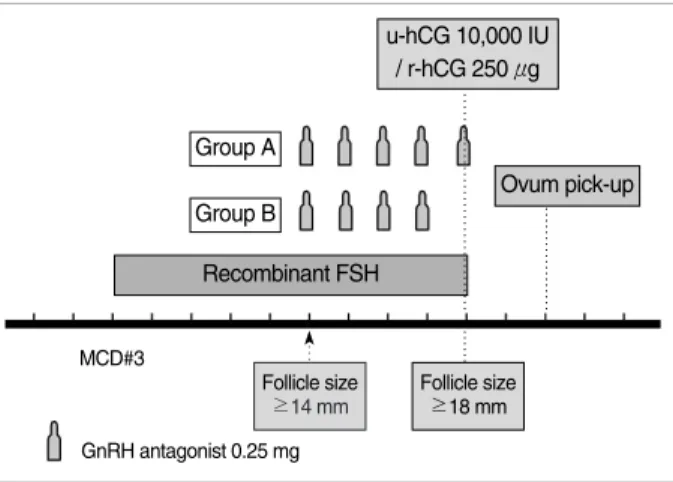
Recombinant FSH (Gonal-F; Serono, Geneva, Switzerland) was started on the second or third day of the menstrual cycle without previous oral contraceptive pretreatment. The GnRH antagonist, cetrorelix acetate (Cetrotide; Serono, Geneva, Switzerland) 0.25 mg was added daily, starting when the leading follicle reached 14 mm in diameter. When the lead- ing follicle reached a mean diameter of 18 mm or two follicles or more reached a diameter of 17 mm, 10,000 IU of urinary hCG (Pregnyl; Organon, Oss, Netherlands) IM or 250 μg of recombinant hCG (Ovidrel; Serono, Geneva, Switzerland) SQ was injected. In Group A, the GnRH antagonist con- tinued to be used until the day of hCG administration. In Group B, the GnRH antagonist was not administrated on the hCG day (Fig. 1). After the hCG injection, oocyte retrieval was performed 35 to 36 hr later.
Fig. 1. Schematic diagram of controlled ovarian hyperstimulation protocol. On the menstrual cycle day 3, recombinant FSH was started at adjusted dose individually. Once the largest follicle reached 14 mm in diameter, 0.25 mg of GnRH antagonist was started. 10,000 IU of urinary hCG (u-hCG) or 250 μg of recombi- nant hCG (r-hCG) was administrated when leading follicle reached 18 mm in diameter. GnRH antagonist was administered daily until the day of hCG administration (Group A) or the day before hCG administration (Group B).
Group A Group B
Recombinant FSH
Ovum pick-up u-hCG 10,000 IU
/ r-hCG 250 μg
Follicle size
≥14 mm Follicle size
≥18 mm MCD#3
GnRH antagonist 0.25 mg
At the time of oocyte retrieval, the maturity of the oocytes was assessed. They were classified as mature (MII), interme- diate, immature oocytes (including germinal vesicle) accord- ing to the cumulus/corona morphology, cytoplasmic clarity, zona thickness, and the extent of the perivitelline space.
Fertilization and embryo transfer
After oocyte maturation was achieved, the oocytes were inseminated with fresh pretreated sperm. If there was a failed fertilization in previous IVF cycles or the cause of infertility was due to a male factor, intracytoplasmic sperm injection (ICSI) was performed. Fertilization was assessed 16 to 18 hr after insemination or injection, where the presence of two pronuclei was recorded as a normal fertilization. Up to four embryos were transferred 2 or 3 days after the oocyte retrieval.
Embryonic development was assessed morphologically based on four grading system according to the regularity of blastomeres, the percentage of anucleate fragments, and the dysmorphic characteristic of the embryos: 1) grade I: 0% anu- cleate fragments, regularity of blastomeres and no apparent morphologic abnormalities, 2) grade II: <20% anucleate fragments, regularity of blastomeres and no apparent mor- phologic abnormalities, 3) grade III: 20-50% anucleate frag- ments, irregularity of blastomeres and no apparent morpho- logic abnormalities, 4) grade IV: >50% anucleate fragmen- tation, irregularity of blastomeres and apparent morpholog- ic abnormalities. Cumulative embryo score (CES) was calcu- lated as the number of blastomeres multiplied by the mor- phologic score of embryo (I=4, II=3, III=2, IV=1). The scores were summed to obtain the CES of all embryos transferred per patient. The mean CES was calculated as dividing CES by number of embryos and used as an indicator of embryo quality.
Pregnancy was initially assessed using serum β-hCG at 14 days after oocyte retrieval. Progesterone in oil (Progest;
Samil, Seoul, Korea) 50 mg/day IM was started from the day of oocyte retrieval until pregnancy testing, and continued until 8 weeks if pregnant. Clinical pregnancy was defined by the presence of an intrauterine gestational sac with visi- ble fetal heartbeats 3 to 4 weeks after embryo transfer.
Hormonal measurements
In the morning of triggering day, the patients’ sera were obtained and serum levels of LH, progesterone and estradiol (E2) were determined. Serum levels of LH were measured by immunoradiometric assay (IRMA) using a commercial kit (Biosource, Nivelles, Belgium). The detection limit, intra- and inter-assay coefficients of variation (CVs) were 0.2 mIU/
mL, 3.2% and 6.7%, respectively. Radioimmunoassay (RIA) was used to measure estradiol and progesterone concentra- tions using commercial kits (Biosourc). The detection lim- its and the intra- and interassay CVs were 10 pg/mL, 4.9%,
and 5.2% for E2, and 0.02 ng/mL, 3.3%, and 7.1% for pro- gesterone, respectively.
A premature LH rise was defined as LH ≥10 mIU/mL and a premature progesterone rise as progesterone ≥1.0 ng/
mL. The combination of the above-mentioned conditions (LH ≥10 mIU/mL and progesterone ≥1.0 ng/mL) was indicated as premature luteinization, as previously described (16).
Statistical analysis
The data were analyzed using the Student’s t-test for con- tinuous variables, and the chi-square or Fisher’s exact tests for categorical variables. The statistical software package SPSS, version 12.0 (SPSS Inc., Chicago, IL, U.S.A.), was used for statistical analysis, and a p<0.05 was considered to be statis- tically significant.
RESULTS
The patient characteristics are described in Table 1. There were no statistically significant differences in age, body mass index, duration of infertility, basal serum FSH levels, and distribution of the causes of infertility between the two groups.
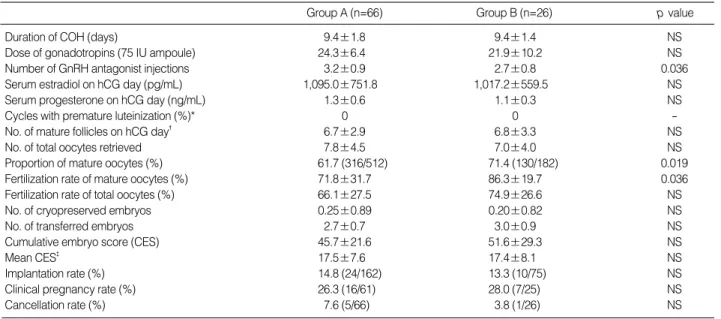
There was no case with premature ovulation in this study subjects. The duration of COH, total doses of gonadotropins used, serum E2levels on hCG day, and number of retrieved oocytes were not significantly different between the two groups (Table 2). As expected, total doses of GnRH antago- nist used were significantly lower in Group B compared to Group A.
Although the number of mature follicles (defined as mean diameter ≥15 mm) on hCG day and the retrieved oocytes were not significantly different between the two groups, the ratio of mature per total retrieved oocytes was higher in Group B. The fertilization rate of the mature and total oocytes was significantly higher in Group B. The number of embryos transferred and embryo quality did not differ between the
Values are mean±SD.
ICSI, intracytoplasmic sperm injection; NS, not significant.
Group A (n=66)
Group B (n=26)
p value Women’s age (yr) 34.7±4.8 32.9±5.5 NS Body mass index (kg/m2) 21.4±1.8 20.8±2.2 NS Duration of infertility (yr) 4.0±2.8 3.1±1.8 NS Basal serum FSH (mIU/mL) 6.9±5.6 7.1±3.2 NS
Cause of infertility (%) NS
Tubal factor 47.0 50.0
Male factor 28.8 26.9
Unexplained 24.2 23.1
Cases of underwent ICSI (%) 60.6 51.7 NS Table 1. Clinical characteristics of study subjects
two groups.
The mean endometrial thicknesses (9.8±2.3 mm vs. 10.5
±3.4 mm) and rates of a trilaminar endometrial pattern on hCG day (86.4% vs. 84.6%) were similar in both groups.
There was no case of premature luteinization in the two groups. No statistically significant difference was observed in implantation (14.8% vs. 13.3%) and the clinical preg- nancy rate (26.3% vs. 28.0%) when compared the two groups (Table 2). Six cases were cancelled in study subjects, because there were no fertilized egg in 5 cases and developmental arrest of embryo at two cell stage in remaining 1 case. The cancellation rate was not different (7.6% vs. 3.8%).
DISCUSSION
Our results indicate that administration of GnRH antag- onist till the day before hCG administration during flexible multiple-dose protocol could reduce total dose of GnRH antagonist without compromising IVF results. Interesting- ly, omitting GnRH antagonist on hCG day resulted in bet- ter oocyte maturity and significantly higher fertilization rate of mature oocytes, although the total number of retrieved oocytes was comparable between the two study groups. These findings suggest that omitting GnRH antagonist on ovula- tion triggering day might have a potential beneficial effect on the maturity and quality of oocyte. Nonetheless, there was no significant difference in embryo quality, implanta- tion and clinical pregnancy rates. Therefore, it is likely that the discontinuation of GnRH antagonist on the day of hCG
day seems not to affect overall IVF outcomes, at least. To the best of our knowledge, this is the first comparative study on the IVF outcomes whether or not the GnRH antagonist administration was omitted on hCG day.
The GnRH antagonists have emerged as an alternative for GnRH agonists to prevent premature LH surge during ART.
The GnRH antagonists are advantageous due to an imme- diate decrease of circulating gonadotropin levels and rapid reversal when discontinued (1, 2). Discontinuing the admin- istration of a GnRH antagonist can reverse the suppressive effect on pulsatile release of LH by pituitary after 456 min (7.6 hr) (15). The GnRH antagonists immediately act as a competitive blockade of the GnRH receptors, and do not induce an initial flare up effect, being frequently observed in GnRH agonist. However, a slightly lower clinical preg- nancy rate has been reported with IVF cycles using GnRH antagonists compared to GnRH agonists; this appears to be the main reason for a lower utilization of GnRH antagonists for ovarian stimulation during IVF (17). Ovarian follicles have development-related requirements for stimulation by LH, that is, there is a ‘‘threshold’’ for LH requirements dur- ing folliculogenesis. Beyond this level (high levels), LH sup- presses aromatase activity and inhibits cell growth. These findings were observed by different investigators as the ‘‘thresh- old’’ and ‘‘ceiling’’ levels for LH (framing the so-called LH window) during the follicular phase of the menstrual and induced cycles (18, 19). Considering the LH threshold/ceil- ing effect theory, the serum LH levels on hCG triggering day could be sustained between the threshold level and the ceiling level in omitted group. We could not get the patient’s
Duration of COH (days) 9.4±1.8 9.4±1.4 NS
Dose of gonadotropins (75 IU ampoule) 24.3±6.4 21.9±10.2 NS
Number of GnRH antagonist injections 3.2±0.9 2.7±0.8 0.036
Serum estradiol on hCG day (pg/mL) 1,095.0±751.8 1,017.2±559.5 NS
Serum progesterone on hCG day (ng/mL) 1.3±0.6 1.1±0.3 NS
Cycles with premature luteinization (%)* 0 0 -
No. of mature follicles on hCG day� 6.7±2.9 6.8±3.3 NS
No. of total oocytes retrieved 7.8±4.5 7.0±4.0 NS
Proportion of mature oocytes (%) 61.7 (316/512) 71.4 (130/182) 0.019
Fertilization rate of mature oocytes (%) 71.8±31.7 86.3±19.7 0.036
Fertilization rate of total oocytes (%) 66.1±27.5 74.9±26.6 NS
No. of cryopreserved embryos 0.25±0.89 0.20±0.82 NS
No. of transferred embryos 2.7±0.7 3.0±0.9 NS
Cumulative embryo score (CES) 45.7±21.6 51.6±29.3 NS
Mean CES� 17.5±7.6 17.4±8.1 NS
Implantation rate (%) 14.8 (24/162) 13.3 (10/75) NS
Clinical pregnancy rate (%) 26.3 (16/61) 28.0 (7/25) NS
Cancellation rate (%) 7.6 (5/66) 3.8 (1/26) NS
Group A (n=66) Group B (n=26) p value
Table 2. Outcomes of controlled ovarian hyperstimulation and IVF-ET between the two groups
Values are mean±SD.
*, premature luteinization: LH ≥10 mIU/mL and progesterone ≥1.0 ng/mL on hCG day; �, mature follicles: follicles ≥15 mm in diameter; �, Mean CES=
CES/ No. of embryos transferred.
IVF-ET, in vitro fertilization and embryo transfer; COH, controlled ovarian hyperstimulation.
sera at the day after hCG administration, thus we could not prove this hypothesis directly. This could be a limitation.
Concerns have been raised regarding the possible adverse effects of GnRH antagonists on the extra-pituitary repro- ductive organs, which have been claimed to be the cause of a lower pregnancy rate (20). The expression of GnRH recep- tor mRNA has been detected in a number of extra-pituitary tissues (i.e. ovary, testis, placenta, myometrium, and malig- nant cells of breast, endometrial, ovarian and prostate can- cers) (21, 22). In ovarian tissue, GnRH may have paracrine functions during follicular development and indeed induce transcription of several genes involved in follicular matura- tion and ovulation (23). In addition, it has been demonstrat- ed that GnRH and its receptor system could modulate cell growth in ovarian cancer. Although the regulation mecha- nisms of gonadal GnRH receptor expression are poorly under- stood, animal studies have shown that distinct signaling mechanisms are involved in the pituitary and ovarian GnRH systems (24). However, the potential adverse effects of GnRH antagonist on oocyte or endometrium are still controversial.
Several studies comparing the outcome of cryopreserved- thawed ET for GnRH agonist and GnRH antagonist proto- cols demonstrated that GnRH antagonist has no direct neg- ative effect on the quality of oocytes and embryos (25, 26).
With regards the effect of GnRH antagonists versus agonists on endometrial development, the results are quite conflict- ing (27, 28).
Although the impact of GnRH antagonists on the oocytes, embryos and endometrium remained to be elucidated (25- 28), a shorter duration of GnRH antagonists would be help- ful to the IVF patients. In other words, if the live birth rates were not affected, any protocols that use the least amount of GnRH antagonist would be less costly. Under the background of decreasing exposure to GnRH antagonist, Chen et al. show- ed that a daily dose of 0.2 mg cetrorelix acetate was effec- tive to prevent premature LH surge with comparable clini- cal pregnancies (29). Other researcher revealed that alter- nate-day administration of ganirelix was as effective as daily injections in preventing premature luteinization with simi- lar clinical pregnancy rate (30). Nonetheless, those modified protocols may have a possible adverse effect on IVF outcome.
There have been several reports demonstrating that the high- er LH and progesterone levels at the time of triggering are associated with lower pregnancy rates when the duration of GnRH antagonist was shortened. One previous study indi- cated that the stability of LH levels rather than absolute LH values is associated with clinical pregnancy; no pregnancies occurred if the LH and progesterone levels were changed too markedly during GnRH antagonist administration (31).
In the present study, we discontinued the GnRH antago- nist on hCG administration day in order to reduce the dura- tion of antagonist injections. Although premature elevation of progesterone was not detected in the morning sample of triggering day, our protocol might lead to premature LH
surge in the evening of triggering day. However, possible relief of pituitary suppression on triggering day appears not to affect IVF outcomes. First, the maturation of follicles are already achieved on hCG day, thus elevation of LH may have no adverse effect during several hours before hCG adminis- tration. Second, elevation of LH does not always result in luteinization of granulose cells or poor IVF outcome. It has been suggested that a gonadotrophin surge-attenuating fac- tor (GnSAF) is produced by the overstimulated ovaries in responsible for the attenuation of the LH surge. In general, luteinization process needs time, thus LH elevation does not induce instant progesterone elevation. Moreover, a recent meta-analysis does not support an association between pro- gesterone elevation on the day of hCG administration and the probability of clinical pregnancy in women undergoing ovarian stimulation with GnRH analogues and gonadotro- phins for IVF (32).
Interestingly, we found that omitting GnRH antagonist on hCG day resulted in better oocyte maturity and signifi- cantly higher fertilization rate of the mature oocytes. Dur- ing the second half of the follicular phase, as plasma FSH concentrations decline, the LH-dependent phase of pre-ovu- latory follicular development proceeds normally only if LH is present at concentrations over the threshold concentration and below the ceiling value. When the ceiling exceeds above the mid-cycle LH surge, further division of the granulosa cells stops as luteinization proceeds. From the hCG day, relief of GnRH antagonist suppression may lead to the change of microenvironment of follicles. Omitting GnRH antagonist on ovulation triggering day might have a beneficial effect on the maturity and quality of oocyte.
The present study demonstrated that omitting GnRH antagonist on triggering day have comparable IVF outcomes to standard protocol in women superovulated with recom- binant FSH using a flexible multiple-dose protocol. Most importantly and practically, dose of GnRH antagonist was significantly reduced thus lowering cost and not decreasing the IVF outcomes. We believe that this new approach is safe and economic alternative to conventional protocol without compromising IVF outcomes.
The main limitation of the present study was in its retro- spective design. However, we were able to show that the study groups were comparable with respect to several clini- cal parameters such as age, body mass index, basal serum FSH level, duration of infertility, and the causes of infertili- ty. In addition, the stimulation protocols were identical in both groups; rFSH with GnRH antagonists flexible multi- ple-dose protocol. Therefore, the possibility of selection bias appears to be minimal.
In conclusion, discontinuation of the GnRH antagonist on hCG administration day, during a flexible multiple-dose protocol, could reduce the total dose of the GnRH antago- nist and thus reduce the cost of the treatment without com- promising IVF results. Based on the present results, we are
currently conducting a prospective randomized trial to con- firm our findings.
REFERENCES
1. Diedrich K, Diedrich C, Santos E, Zoll C, al-Hasani S, Reissmann T, Krebs D, Klingmuller D. Suppression of the endogenous luteiniz- ing hormone surge by the gonadotrophin-releasing hormone antag- onist Cetrorelix during ovarian stimulation. Hum Reprod 1994; 9:
788-91.
2. Olivennes F. The use of gonadotropin-releasing hormone antago- nist in ovarian stimulation. Clin Obstet Gynecol 2006; 49: 12-22.
3. Al-Inany H, Aboulghar M. GnRH antagonist in assisted reproduc- tion: a Cochrane review. Hum Reprod 2002; 17: 874-85.
4. The ganirelix dose-finding study group. A double-blind, random- ized, dose-finding study to assess the efficacy of the gonadotrophin- releasing hormone antagonist ganirelix (Org 37462) to prevent pre- mature luteinizing hormone surges in women undergoing ovarian stimulation with recombinant follicle stimulating hormone (Pure- gon). The ganirelix dose-finding study group. Hum Reprod 1998;
13: 3023-31.
5. Al-Inany H, Aboulghar MA, Mansour RT, Serour GI. Ovulation induction in the new millennium: recombinant follicle-stimulating hormone versus human menopausal gonadotropin. Gynecol Endo- crinol 2005; 20: 161-9.
6. Olivennes F, Belaisch-Allart J, Emperaire JC, Dechaud H, Alvarez S, Moreau L, Nicollet B, Zorn JR, Bouchard P, Frydman R. Prospec- tive, randomized, controlled study of in vitro fertilization-embryo transfer with a single dose of a luteinizing hormone-releasing hor- mone (LH-RH) antagonist (cetrorelix) or a depot formula of an LH- RH agonist (triptorelin). Fertil Steril 2000; 73: 314-20.
7. Roulier R, Chabert-Orsini V, Sitri MC, Barry B, Terriou P. Depot GnRH agonist versus the single dose GnRH antagonist regimen (cetrorelix, 3 mg) in patients undergoing assisted reproduction treat- ment. Reprod Biomed Online 2003; 7: 185-9.
8. Al-Inany HG, Abou-Setta AM, Aboulghar M. Gonadotrophin-releas- ing hormone antagonists for assisted conception. Cochrane Database Syst Rev 2006; 3: CD001750.
9. Kolibianakis EM, Collins J, Tarlatzis BC, Devroey P, Diedrich K, Griesinger G. Among patients treated for IVF with gonadotrophins and GnRH analogues, is the probability of live birth dependent on the type of analogue used? A systematic review and meta-analysis.
Hum Reprod Update 2006; 12: 651-71.
10. Huirne JA, Homburg R, Lambalk CB. Are GnRH antagonists com- parable to agonists for use in IVF? Hum Reprod 2007; 22: 2805-13.
11. Griesinger G, Felberbaum R, Diedrich K. GnRH antagonists in ovar- ian stimulation: a treatment regimen of clinicians’ second choice?
Data from the German national IVF registry. Hum Reprod 2005;
20: 2373-5.
12. Kolibianakis EM, Papanikolaou EG, Camus M, Tournaye H, Van Steirteghem AC, Devroey P. Effect of oral contraceptive pill pre- treatment on ongoing pregnancy rates in patients stimulated with GnRH antagonists and recombinant FSH for IVF. A randomized
controlled trial. Hum Reprod 2006; 21: 352-7.
13. Kolibianakis EM, Albano C, Camus M, Tournaye H, Van Steirte- ghem AC, Devroey P. Initiation of gonadotropin-releasing hormone antagonist on day 1 as compared to day 6 of stimulation: effect on hormonal levels and follicular development in in vitro fertilization cycles. J Clin Endocrinol Metab 2003; 88: 5632-7.
14. Frankfurter D, Dayal M, Dubey A, Peak D, Gindoff P. Novel follic- ular-phase gonadotropin-releasing hormone antagonist stimulation protocol for in vitro fertilization in the poor responder. Fertil Steril 2007; 88: 1442-5.
15. Griesinger G, Dawson A, Schultze-Mosgau A, Finas D, Diedrich K, Felberbaum R. Assessment of luteinizing hormone level in the gona- dotropin-releasing hormone antagonist protocol. Fertil Steril 2006;
85: 791-3.
16. Allegra A, Marino A, Coffaro F, Scaglione P, Sammartano F, Rizza G, Volpes A. GnRH antagonist-induced inhibition of the premature LH surge increases pregnancy rates in IUI-stimulated cycles. A prospective randomized trial. Hum Reprod 2007; 22: 101-8.
17. Fauser BC, Devroey P. Why is the clinical acceptance of gonado- tropin-releasing hormone antagonist cotreatment during ovarian hyperstimulation for in vitro fertilization so slow? Fertil Steril 2005;
83: 1607-11.
18. Brown JB. Pituitary control of ovarian function-concepts derived from gonadotrophin therapy. Aust N Z J Obstet Gynaecol 1978; 18:
46-54.
19. Hillier SG. Current concepts of the roles of follicle stimulating hor- mone and luteinizing hormone in folliculogenesis. Hum Reprod 1994;
9: 188-91.
20. Hernandez ER. Embryo implantation and GnRH antagonists: embryo implantation: the Rubicon for GnRH antagonists. Hum Reprod 2000; 15: 1211-6.
21. Ortmann O, Diedrich K. Pituitary and extrapituitary actions of gonadotrophin-releasing hormone and its analogues. Hum Reprod 1999; 14 (Suppl 1): 194-206.
22. Grundker C, Gunthert AR, Millar RP, Emons G. Expression of gonadotropin-releasing hormone II (GnRH-II) receptor in human endometrial and ovarian cancer cells and effects of GnRH-II on tumor cell proliferation. J Clin Endocrinol Metab 2002; 87: 1427-30.
23. Peng C, Fan NC, Ligier M, Vaananen J, Leung PC. Expression and regulation of gonadotropin-releasing hormone (GnRH) and GnRH receptor messenger ribonucleic acids in human granulosa-luteal cells. Endocrinology 1994; 135: 1740-6.
24. Ikemoto T, Park MK. Comparative analysis of the pituitary and ovar- ian GnRH systems in the leopard gecko: signaling crosstalk between multiple receptor subtypes in ovarian follicles. J Mol Endocrinol 2007; 38: 289-304.
25. Kol S, Lightman A, Hillensjo T, Devroey P, Fauser B, Tarlatzis B, Mannaerts B, Itskovitz-Eldor J. High doses of gonadotrophin-releas- ing hormone antagonist in in-vitro fertilization cycles do not adverse- ly affect the outcome of subsequent freeze-thaw cycles. Hum Reprod 1999; 14: 2242-4.
26. Lee JR, Choi YS, Jee BC, Ku SY, Suh CS, Kim KC, Lee WD, Kim SH. Cryopreserved blastocyst transfer: impact of gonadotropin- releasing hormone agonist versus antagonist in the previous oocyte
retrieval cycles. Fertil Steril 2007; 88: 1344-9.
27. Simon C, Oberye J, Bellver J, Vidal C, Bosch E, Horcajadas JA, Murphy C, Adams S, Riesewijk A, Mannaerts B, Pellicer A. Simi- lar endometrial development in oocyte donors treated with either high- or standard-dose GnRH antagonist compared to treatment with a GnRH agonist or in natural cycles. Hum Reprod 2005; 20:
3318-27.
28. Saadat P, Boostanfar R, Slater CC, Tourgeman DE, Stanczyk FZ, Paulson RJ. Accelerated endometrial maturation in the luteal phase of cycles utilizing controlled ovarian hyperstimulation: impact of gonadotropin-releasing hormone agonists versus antagonists. Fertil Steril 2004; 82: 167-71.
29. Chen HJ, Lin YH, Hsieh BC, Seow KM, Hwang JL, Tzeng CR. Is a lower dose of cetrorelix acetate effective for prevention of LH surge during controlled ovarian hyperstimulation? J Assist Reprod Genet 2006; 23: 289-92.
30. Messinis IE, Loutradis D, Domali E, Kotsovassilis CP, Papaster- giopoulou L, Kallitsaris A, Drakakis P, Dafopoulos K, Milingos S.
Alternate day and daily administration of GnRH antagonist may prevent premature luteinization to a similar extent during FSH treat- ment. Hum Reprod 2005; 20: 3192-7.
31. Huirne JA, van Loenen AC, Schats R, McDonnell J, Hompes PG, Schoemaker J, Homburg R, Lambalk CB. Dose-finding study of daily GnRH antagonist for the prevention of premature LH surges in IVF/ICSI patients: optimal changes in LH and progesterone for clinical pregnancy. Hum Reprod 2005; 20: 359-67.
32. Venetis CA, Kolibianakis EM, Papanikolaou E, Bontis J, Devroey P, Tarlatzis BC. Is progesterone elevation on the day of human chori- onic gonadotrophin administration associated with the probability of pregnancy in in vitro fertilization? A systematic review and meta- analysis. Hum Reprod Update 2007; 13: 343-55.