http://dx.doi.org/10.9721/KJFST.2014.46.5.636
636
©The Korean Society of Food Science and Technology
도라지 뿌리의 건조방법에 따른 무기 성분 및 사포닌 함량의 변화
이병진
1,2·전승호
2·이신우
1·전현식
1·조영손
1,2,*
1경남과학기술대학교 농학·한약자원학부, 2경남과학기술대학교 종자실용화연구소
Effect of Drying Methods on the Saponin and Mineral Contents of
Platycodon grandiflorum Radix
Byung-Jin Lee1,2, Seung-Ho Jeon2, Shin-Woo Lee1, Hyun-Sik Chun1, and Young-Son Cho1,2,*
1Department of Agronomy & Medicinal Plant Resourses, Gyeongnam National University of Science and Technology 2Research Center for Seed Utilization of Gyeongnam National University of Science and Technology
Abstract This study was conducted to provide basic information about the drying methods (daylight, hot-air, and freeze drying) used for Platycodon grandiflorum radix. We investigated the mineral, free sugar, and saponin contents of dried P. grandiflorum. The potassium and calcium contents of hot-air-dried samples were the highest (22.6 and 9.2 mg%, respectively), when compared to those of daylight- or freeze-dried samples. Glucose and sucrose contents were the highest in freeze-dried samples (1,552 and 145.0 mg%, respectively), while fructose content was the highest in hot-air-dried samples (611.9 mg%). Platycodin D content was the highest in hot-air-dried samples (622.0 mg%); however platycodin D3, polygalacin D, and deapioplatycodin D contents were the highest in daylight-dried plant (113.5, 756.6, and 109.2 mg%, respectively). Glucose content was highly negatively correlated (p<0.01) with platycodin D, platycodin D3, and deapioplatycodin D (−0.924, −0.957, −0.861, p<0.01,respectively). These results suggest that the drying method affects the saponin content of P. grandiflorum and daylight and hot-air drying methods are more suitable and beneficial than freeze-drying.
Keywords: drying methods, free sugar, Platycodon grandiflorum, saponin
서
론
도라지(Platycodon grandiflorum A. DC)는 한국, 일본 및 중국 의 산간지방에 널리 자생하는 초롱꽃과 식물로(1) 약용 및 나물 용으로 이용되고 있다. 그 중 나물용으로 사용되는 도라지는 주 로 1-2년근을 사용하는데(2), 껍질 제거 후 물에 담가 쓴맛을 제 거한 뒤 말려서 식용으로 사용한다. 도라지는 섬유질이 풍부하고 칼슘과 철이 많이 함유된 알카리 식품이며(3), 생채, 전 및 나물 등의 식용으로 이용되고 있다. 약용도라지는 3년근 이상 도라지 를 이용하고 있다(4). 도라지의 뿌리는 길경(Platycodi radix)이라 하며 감기, 기침, 냉병, 복통, 부스럼, 설사, 산후병, 부인병, 불면 증 및 염증 등에 효과가 좋아 예로부터 민간처방 약재로 사용되 었을 뿐만 아니라 최근 식생활의 서구화, 운동부족과 누적되는 스트레스에서 기인하는 성인병과 비만으로 저칼로리 및 기능성 식품으로 도라지에 대한 관심이 증가하며 재배면적도 증가하고 있다(5,6). 도라지의 뿌리부분에는 다량의 사포닌이 함유되어 있는데, 이 러한 사포닌에는 platycodin A, C, D와 polygalacin D 등의 성분 이 알려져 있다(7, 8). 특히 platycodin D는 동물실험에서 진해 거 담작용, 중추신경억제작용(9), 혈당강화작용 및 콜레스테롤 대사 개선작용(10), 항암활성 효과(11) 항염증 효과(12), 항비만 효과 (13), 간손상억제(14,15) 등이 있는 것으로 밝혀졌다. 현재 도라지는 분말, 청, 즙 및 환 등의 가공형태로 시중에 유 통 판매되고 있으며 분말 형태가 활용도가 높다(16). 이런 도라 지 뿌리를 분말형태로 만들기 위해서는 반드시 건조 과정을 거 쳐야 한다. 식품에 이용되는 인공건조 방법으로는 일광건조, 열 풍건조(18), 냉풍건조(18), 감압건조(19) 및 동결건조(20) 등의 방 법이 있다. 일광건조는 건조시간이 많이 걸려 건조과정 중 부패 가 일어날 수 있으며, 열풍건조는 일반 농가에서 가장 흔하게 사 용하는 방법으로 주로 곡물류를 건조할 때 많이 사용되며, 동결 건조는 −50oC 이하의 낮은 온도로 동결 시킨 후 건조기의 내부 를 진공 상태로 만들어 수분을 승화시키는 방법으로 타 건조방 법에 비해 고품질의 최종제품을 생산할 수 있다. 본 연구에서는 일광, 열풍 및 동결건조법을 이용하여 도라지를 건조하고 이들 건조방법이 건조 도라지의 약리적 성분에 미치는 영향을 분석하여 도라지의 약리적 소재 활용에 필요한 실험적 기 초자료를 제공하고자 하였다.재료 및 방법
실험재료 경남과학기술대학교 종합농장에서 재배한 3년근 도라지를 2013 년 3월에 수확한 도라지로 형태학적 특성으로 뿌리 길이는 18.3 cm, 직경은 뇌두에서 1 cm 아래지점을 조사하여 17.2 mm, 생체 *Corresponding author: Young-Son Cho, Department of Agronomy& Medicinal Plant Resourses, Gyeongnam National University of Science and Technology, Jinju, Gyeongnam 660-758, Korea Tel: 82-55-751-3221
Fax: 82-55-751-3229
E-mail: [email protected]
Received May 16, 2014; revised July 15, 2014; accepted August 5, 2014
중은 14.3 g, 경도는 뇌두에서 1 cm 아래지점을 물성분석기(Texture analyzer, Model TA-XT2, London, England)를 이용 조사하였다. 실험재료로 사용한 도라지의 특성은 Table 1에 정리하였다. 건조방법 도라지 건조는 70oC의 건조기에서 48시간 동안 열풍건조와 자 연상태에서 3주간 일광건조와 그리고 −50oC 동결건조기에서 72 시간 동안 동결건조 방법으로 수행하였다. 건조 시 도라지는 원 형을 유지하면서 건조하였으며 건조된 시료는 분쇄기(Super grinder JL-1000, Hibell, Hwaseong, Korea)로 분쇄하여 0.5 mm 체망을 통 과시켜 수분측정기(MB45, OHAUS, Pine Brook, NJ, USA)로 수 분 함량을 측정하였다. 무기물 함량 무기물 함량은 습식분해법으로 분석하였다. 건조한 시료 0.1 g 을 취하여 테프론 산순환포집 분해 용기에 넣고 질산 2.5 mL와 과염소산 4 mL을 주입하여 흑연블럭분해기(OD-98-001, ODLAB, Seoul, Korea)로 서서히 온도를 올려 140oC가 유지된 후 2시간 가 열하여 분해(21)하였다. 분해 용액을 Whatman No. 42 (Pore size 2.5µm, Whatman plc, Maidston, UK) 여과지로 거른 후 용액 중 치환성 양이온(Ca+2, Mg+2, K+, Na+)의 함량을 ICP-OES (8300DV,
Perkin Elmer, Boston, MA, USA)로 정량하였다. 유리당 함량
당 추출방법은 분쇄한 도라지 가루 1 g을 80% 에탄올 10 mL 에 혼합하여 50oC 항온수조에서 1시간 진탕한 후 4,000 rpm에서
15분 원심분리하여 상등액을 회수하였다. 이 추출 조작은 총 2회 반복하였다. 유리당 분석에 사용된 high performance liquid Chro-matography (HPLC)는 Agilent 1260 Series HPLC system (Agi-lent Technologies, Delaware, DE, USA)을 이용하였고 column은 Hi-Plex Pb (300×7.7 mm, Agilent Technologies)를 사용하였다. 이 동상은 HPLC-grade water와 acetonitrile를 3:7 (V:V)로 혼합하여 사용하였다. 당 표준 시료는 sucrose, glucose, fructose (Sigma co., St, Louis, MO, USA)의 표준품을 각각 20, 10, 5, 0 mg/mL로 조 절하여 표준액을 만들었다. 각 당 표준액 10 µL를 취하여 HPLC 로 검량하고 작성한 검량선으로부터 환산하였다. 사포닌함량 사포닌 추출방법은 Park 등(22)이 제안한 방법으로 분쇄한 도 라지 가루 1 g을 70% 에탄올 50 mL에 혼합하여 45oC 항온수조 에서 2시간 동안 진탕한 후 4,000 rpm에서 15분 원심분리하여 상 등액을 회수하였다. 이 추출 조작은 총 2회 반복하였다. 도라지 추출물은 회전농축기(Rotavapor R-210, Buchi, Switzerland)를 이 용하여 감압 농축하여 HPLC-grade water 10 mL에 녹였다. 사포 닌 함량 분석에 사용된 HPLC는 Agilent 1260 Series HPLC sys-tem (Agilent Technologies)을 이용하여 측정하였다. HPLC 분석은 C18 column (4.6×250 mm, 5µm, Shiseido, Tokyo, Japan)을 사용
하였다. 이동상은 water, acetonitrile를 사용하였으며, acetonitrile 비 율을 0 min (18%)-22 min (18%)-32 min (30%)-60 min (50%)로 순차적으로 조절하였다. Column 온도는 35oC로 유지 하였고,
injection volume은 10 µL, 유속은 1 mL/min로 하였다. 검출파장은 203 nm에서 측정하였다.
사포닌 표준시료는 천연물 물질은행으로부터 분양 받은 platy-codin D, platyplaty-codin D3, deapioplatyplaty-codin D, polygalacin D를 각 각 1 mg씩 취하여 증류수 10 mL에 녹여 HPLC용 표준 사포닌 용액을 조제하여, 표준품을 각각 100, 50, 25 µm/mL로 조절하여 표준액을 만들었다. 각 사포닌 표준액 10 µL를 취하여 HPLC로 검량하고 작성한 검량선으로부터 환산하였다. 색차계 색도 색도의 측정은 건조 도라지를 분쇄하여 0.5 mm 체망을 통과시 켜 색채색차계(Chroma meter CR-200, Minolta Co., Tokyo, Japan)의 측정대에 고르게 담은 후 L (lightness), a (redness) 및 b (yellowness) 값을 각각 5회 반복하여 측정하였다.
통계분석
모든 실험은 3회 반복하여 평균과 표준 편차로 나타내었고, 유 의성검정은 SAS (Statistical Analysis System, SAS Institute Inc., Cary, NC, USA) Software를 이용하여 Duncan’s multiple range test에 의한 유의성 검증을 하였다. 사포닌함량과 환원당과의 상 관관계는 Pearson’s correlation으로 95%와 99% 신뢰수준에서 분 석하였다.
결과 및 고찰
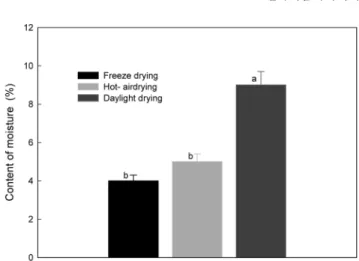
수분함량 건조방법에 따른 도라지의 수분 함량은 일광건조 9%, 열풍건 조 5%, 동결건조 4%로 나타났다(Fig. 1). 열풍건조와 동결건조에 서는 수분함량에 통계적 유의성이 인정되지 않았지만 자연건조 에서는 통계적 유의성이 인정되었다. 모든 건조방법에서 수분함 량이 10% 이하로 분말 가공에는 문제가 되지 않을 것으로 판단 된다. 무기질 성분 건조방법에 따른 도라지의 무기질 함량을 분석한 결과는 Table 2와 같다. 도라지의 무기질 성분 중에서 고혈압 예방과 치료에 효과적인(23) 칼륨은 일광건조, 열풍건조, 그리고 동결건조에서 각각 21.7, 22.6, 16.4 mg%로 다른 무기 성분에 비해 가장 많이 함유되어 있다. 칼슘은 열풍건조에서 9.2 mg%와 일광건조 8.6 mg%로 동결건조에 7.9 mg%에 비해 높게 나타났다. 건조방법에 따른 마그네슘 함량은 통계적 유의성이 인정되었으며 열풍 건조 도라지에서 높은 경향을 보였는데, 이는 건조과정에서 열이 가해 져 세포벽과 분자구조가 파괴되고 조직이 연화되어 여러 무기성 분의 용해능이 증가하였음을 알 수 있다(24). 따라서 도라지를 약 용 또는 가공 식품으로 사용하기 위해서는 열을 가하는 건조방 법이 무기성분 함량을 증가시키는 것으로 사료된다. 유리당 함량 건조방법에 따른 유리당의 함량은 Table 3과 같다. 동결건조와 일광건조 도라지는 glucose, fructose, sucrose가 검출되었지만 열 풍건조에서는 glucose가 검출되지 않았다. Glucose함량은 동결건 조 1,552 mg%, 일광건조 183.3 mg%로 동결건조에서 가장 많이 Table 1. Root length, diameter and fresh weight of Platycodongrandiflorum radix before experiment Root length (cm) Diameter (mm) Fresh weight (g) Hardness (g) 18.3±1.61) 17.2±2.7 14.3±0.6 1,823±83.5
검출되었다. Fructose함량은 동결건조는 242.8 mg%, 열풍건조 611.9 mg%, 일광건조 50.2 mg%로 열풍건조에서 가장 많이 검출되었다. Sucrose함량은 동결건조 145.0 mg%, 열풍건조 119.2 mg%, 일광건 조 117.2 mg%로 동결건조가 가장 많이 검출되었다. 건조방법에 따라 유리당의 함량이 다른 것으로 나타났는데 이는 건조과정에 가해진 열에 의해 당 분해의 차이에서 비롯된 것으로 사료된다 (25,26). 사포닌 함량 도라지를 생체로 사용하는 것 이외 약용 또는 가공을 위해 건 조과정을 거치는데 이때 건조방법에 따른 도라지의 주요 약리성 인 4가지 사포닌 함량을 분석하여 결과를 Fig. 2로 나타내었다. 동결건조에서 platycodin D, platycodin D3, polygalacin D, 그리고 deapioplatycodin D의 함량은 각각 271.9, 48.5, 3.4 그리고 54.8 mg%, 열풍건조에서는 platycodin D, platycodin D3, polygalacin D, 그리고 deapioplatycodin의 함량은 각각 622.0, 96.1, 10.9 그리 고 82.7 mg%로 동결건조와 열풍건조에서 platycodin D의 함량이 가장 높게 나타났다. 일광건조에서는 platycodin D, platycodin D3, polygalacin D, 그리고 deapioplatycodin D, 각각 494.3, 113.5, 756.6 그리고 109.2 mg%로 platycodin D의 함량이 가장 높게 나 타났다. 위 결과로 건조방법에 따라 사포닌 종류별 함량이 다르 게 나타남을 확인하였으며, 유리당의 함량이 가장 많이 검출된 동결건조방법(Table 3)이 사포닌 함량에서는 가장 적게 검출되었 으며, 도라지와 성상이 비슷한 더덕에서 건조한 더덕의 사포닌 함량이 채취 직후 함량보다 약 2배정도 높다고 보고 하였다(27). 따라서 사포닌 함량은 일광건조와 열풍건조가 동결건조 보다 많 은 결과를 확인하였다. 도라지의 주요 약리성분으로 분류되는 platycoside는 현재 많은 동물 실험에서 진해, 거담작용, 혈당강하 작용의 효능이 있는 것으로 밝혀졌으며(9-15), 이들의 함량을 높 이기 위해서는 도라지를 일광건조 또는 열풍건조하는 것이 좋을 것으로 사료된다. 또한 도라지의 무기성분과 사포닌 함량을 향상 시키기 위한 건조 온도 및 조건설정에 관한 연구가 이루어져야 할 것으로 판단된다. 상관관계 도라지의 건조방법에 따라 유리당과 사포닌 함량의 변화를 확 인하여 유리당과 사포닌과의 상관관계를 조사하여 Table 4로 나 타내었다. 유리당 함량과 사포닌 함량과의 상관관계에서 fructose 와 platycodin D의 함량과 상관관계는 정의 상관을 보였고, 나머 지는 부의 상관을 보였다. Fructose는 polygalacin D의 함량과는 음의 상관관계(−0.759)를 보였으며(p<0.05), glucose는 platycodin D, platycodin D3, peapioplatycodin D의 함량간의 상관계수는 각 각 −0.924, −0.957, −0.861로 고도의 음의 상관을 보였다(p<0.01). Sucrose와 platycodin D3 함량과의 상관계수는 −0.874 고도의 음 의 상관을 보였으며(p<0.01), platycodin D와 deapioplatycodin D Fig. 1. Contents of moisture of platycodon grandiflorum radix by
drying methods. Values are means±standard deviation of triplicate determination. Bars/mean values with different letters are significant differences (p<0.05).
Table 2. Mineral contents of playcodon grandiflorum radix by drying methods
Dry Methods K (mg%) Ca (mg%) Mg (mg%) Na (mg%)
Freeze drying 0016.4±3.71),a2) 7.9±0.2b 4.5±0.1c 1.0±0.0b0
Hot-air drying 22.6±4.2a 9.2±0.8a 6.1±0.5a 1.3±0.13a
Daylight drying 21.7±1.6a 8.6±0.5b 5.3±0.3b 1.3±0.10a 1)Values are means±standard deviation of triplicate determination
2)Different superscripts within a column (a-b) indicate significant differences (p<0.05).
Table 3. Free sugar contents of playcodon grandiflorum radix by drying methods
Dry Methods Glucose (mg%) Fructose (mg%) Sucrose (mg%) Freeze drying 1,552±145.91),a2) 242.8±18.2b 145.0±11.4a Hot-air drying - 611.9±16.4a 117.2±10.3b Daylight drying 183.3±11.5b0---- 50.2±1.4c 119.9±10.4b 1)Values are means±standard deviation of triplicate determination 2)Different superscripts within a column (a-c) indicate significant
differences (p<0.05).
Fig. 2. Contents of saponin of platycodon grandiflorum radix by drying methods.Values are means±standard deviation of triplicate determination. Bars/mean values with different letters are significant differences (p<0.05).
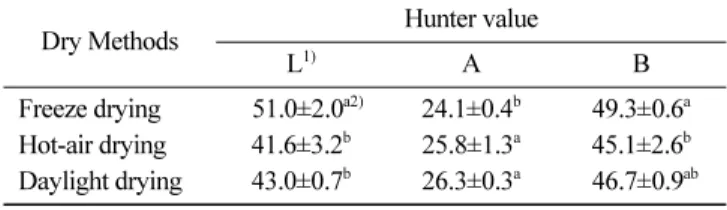
함량과의 상관계수는 각각 −0.759와 −0.787로 음의 상관을 보였 다(p<0.05). 도라지의 유리당 함량과 사포닌 함량과의 관계에서 서로 역의 상관관계를 보였다. Choi 등(28)의 연구에 따르면 배 당체 형태의 사포닌에 결합되어 있는 일부 당류가 팽화에 의해 분해되어 분자량이 작은 형태가 되어 조사포닌의 함량이 증가하 고, 본 연구를 통하여 도라지의 건조 방법에 따른 유리당 함량의 감소는 도라지 사포닌 함량의 증가로 이어진다는 것을 확인하였 다. 이는 당과 사포닌을 주성분으로 하는 도라지를 이용하고자 하는 목적에 따라 건조 방법을 달리 할 필요가 있을 것으로 보 여진다. 색도 도라지 건조과정 중 가해지는 열에 의한 건조 도라지의 갈변 정도를 분쇄기로 분쇄하여 색도를 측정하였다(Table 5). 동결건조 도라지의 명도는 51.0로 적색도와 황색도를 나타내는 a값과 b값 은 24.1와 49.3로, 열풍건조와 일광건조의 명도는 각각 41.6와 43.0 으로 a값과 b값은 25.8과 45.1 그리고 26.3과 46.7로 동결건조가 다른 건조 조건에 비해 색이 밝게 나타났다. 도라지를 약재로 쓰 는 경우 지나치게 밝은 색을 우선시하는 경우가 많은데(29), 도 라지의 주요 약리성분인 사포닌 함량을 고려한다면 건조과정에 도라지가 갈변되는 것을 선택하는 것이 좋을 것으로 사료된다.
요
약
도라지 건조방법에 대한 기본 정보를 제공하고자 일광건조, 열 풍건조 그리고 동결건조를 실시하여 무기성분과 환원당 그리고 사포닌 함량을 조사한 결과를 요약하면 아래와 같다. 칼륨과 칼 슘은 각각 22.6과 9.2 mg%로 열풍건조에서 높게 나타났다. Platy-codin D 는 열풍건조에서 622.0 mg%로 가장 높게 나타났으며, platycodin D3, Polygalacin D, deapioplatycodin D는 일광건조에서 각각 113.5, 756.6, 109.2 mg%로 나타났다. Glucose와 platycodin D, platycodin D3, deapioplatycodin D의 함량간의 상관계수는 각각 −0.924, −0.957, −0.861로 고도의 음의 상관을 보였다(p<0.01). 동결건조가 다른 건조조건에 비해 색이 밝게 나타났다. 이상의 결과로 도라지의 건조 방법은 일광건조와 열풍건조가 동결건조보다 좋은 것으로 평가 되었지만 일광건조는 건조기간 이 길어 많은 노동력이 소요된다. 따라서 열을 가하여 건조하면 서 건조기간도 줄이고 도라지 약리성도 높이기 위한 적정 건조 온도에 관한 연구도 수행 되어야 할 것으로 사료된다.감사의 글
본 연구는 농촌진흥청지원 경남도라지산학협력단 연구비지원 (과제번호 pj 008801) 의해 수행된 결과로 이에 감사를 드립니다.References
1. Lim KH. A Medicinal Phytology (The details) Dong Myoung Sa, Seoul, Korea. p 281. (1971)
2. Sung NJ, Seo JK. Medical action of perennial Platycodi Radix proceeding Inst. Agr. Res. Utill. Symposium for 50th Anniversary GSNU. 35-47 (1998)
3. Ahn KS, Noh EJ, Zhao HL, Jung SH, Kang SS, Kim YS. Inhibi-tion of inducible nitric oxide synthase and cyclooxygenase II by Platycodon grandiflorum saponins via suppression of nuclear fac-tor-kB activation in RAW 264.7 cells. Life Sci. 76: 2315-2328 (2005)
4. Kim HK, Choi JS, Yoo DS, Choi YH, Yon GH, Hong KS, Lee BH, Kim HJ, Kim EH, Park BK, Jeong YC, Kim YS, Ryu SY. HPLC analysis of saponins in platycodi radix. Korean J. Pharma-cogn. 38:192-196 (2007)
5. Kim HJ, Cho YS. Characteristics of rhizome rot incidence of Platycodon grandiflorus by ridge width and depth and cultivation period in the seeding place. Korean J. Medicinal Crop Sci. 19: 246-250 (2011)
6. Moon SG, Jeong SH, Choi CM. Classification of the edible plants on the market in Busan. Korean. J. Life Sci. 13: 764-774 (2003)
7. Konishi T, Tada A, Shoji J, Tanaka O. The structures of platyco-din A and C, monoacetylated saponins of the roots of Platycodon grandiflorum. Chem. Pharm. Bull. 26: 668-670 (1976)
8. Tada T, Kaneiwa Y, Shoji J, Shibat S. Saponins of the root of P. grandiflorum isolation and the structure of platycodin D. Chem. Pharm. Bull. 23: 2965-2969 (1975)
9. Choi CY, Kim JY, Kim YS, Chung YC, Seo JK, Jeong HG. Aqueous extract isolated from Platycodon grandiflorum elicits the release of nitric oxide and tumor necrosis factor-alpha from murine macrophages. Int. Immunopharmacol. 1: 1141-1151 (2001)
10. Zhao HL, Cho KH, Ha YW, Jeong TS, Lee WS, Kim YS. Cho-lesterol-lowering effect of platycodin D in hypercholesterolemic ICR mice. Eur. J. Pharmacol. 537: 166-173 (2006)
11. Kim YS, Kim JS, Choi SU, Kim JS, Lee HS, Roh SH, Jeong YC, Kim YK, Ryu SY. Isolation of a new saponin and cytotoxic effect of saponins from the root of Platycodon grandiflorum on human tumor cell lines. Planta Med. 71: 566-568 (2005)
12. Kim YP, Lee EB, Kim SY, Li D, Ban HS, Lim SS, Shin KH, Ohuchi K. Inhibition of prostaglandin E2 production by platyco-din D isolated from the root of platycodon grandiflorum. Planta Med. 67: 362-364 (2001)
13. Lee HY, Kang RH, Kim YS, Chung SI, Yoon YS. Platycodin D inhibits adipogenesis of 3T3 L1 cells by modulating krüppel like factor 2 and peroxisome proliferator activated receptor Y. Phy-tother. Res. 24:161-167 (2010)
14. Lee KJ, Jeong HG. Protective effect of Platycodin Radix on car-bon tetrachloride-induced hepatotoxicity. Food Chem. Toxicol. 40: 517-525 (2002)
15. Lee KJ, You HJ, Park SJ, Kim YS, Chung YC, Jeong TC, Jeong HG. Hepatoprotective effects of Platycodon grandiflorum on
ace-Table 4. Correlation coefficient between free sugar contents and contents of saponin of playcodon grandiflorum radix by drying methods
Fructose Glucose Sucrose Platycodin D -0.429ns1) -0.924** -0.759* Platycodin D3 -0.115ns -0.957** -0.874** Deapioplatycodin D -0.360ns -0.861** -0.787* Polygalacin D -0.759* -0.504ns -0.496ns 1)ns, *, **No significance or significance at 0.05 and 0.01 probabilities,
respectively.
Table 5. Hunter color values of playcodon grandiflorum radix by drying methods
Dry Methods Hunter value
L1) A B
Freeze drying 051.0±2.0a2) 24.1±0.4b 49.3±0.6a Hot-air drying 41.6±3.2b 25.8±1.3a 45.1±2.6b Daylight drying 43.0±0.7b 26.3±0.3a 046.7±0.9ab 1)L: Lightness; a: redness (+ red, - green); b: yellowness (+ yellow,
- blue)
2)Mean±SD within the same column followed by different superscript
taminophen induced liver damage in mice. Cancer Lett. 174: 73-81 (2001)
16. Hwang SY, Choi HM, Lim SY. Total phenolics of dried platyc-odon grandiflorum and its effect on growth of human cancer cell lines. Korean J. Food Sci. Technol. 45: 84-89 (2013)
17. Swami SB, Das SK, Maiti B. Convective hot air drying and quality characteristics of bori: A traditional Indian nugget pre-pared black gran pulse batter. J. Food Eng. 79: 225-233 (2007) 18. Kwon GM, Kim JW, Youn KS. Effect of different pre-treatments
on the physicochemical and antioxidant activities of cold-vacuum dried peaches. Korean J. Food Sci. Technol. 45: 466-472 (2013) 19. Lee JH, Kim HJ. Vacuum drying kinetics of Asian white radish
(Raphanus sativus L.) slices. Korean J. Food Sci. Technol. 42: 180-186 (2008)
20. Krokida MK, Maroulis ZB. Quality change druing drying of food materials. In: Drying technology in agriculture and food sciences, Mujumdar AS. Science Publishers Inc., Enfield, NH, USA. pp. 61-106 (2000)
21. NAAS. Analysis methods for soil chemical properties. Publication No. 11-1390802-000282-01. NAAS, Suwon, Korea. (2010) 22. Park IS, Kang EM, Kim NS. High-performance liquid
chromato-graphic analysis of saponin compounds in Bupleurum falcatum. J. Chromatographic Sci. 38: 229-233 (2000)
23. Lee SJ, SHin SR, Yoon KY. Physicochemical properties of black doraji (Platycodon grandiflorum). Korean J. Food Sci. Technol. 45: 422-427 (2013)
24. Arslan D, Ozcan MM. Evaluation of drying methods with respect to drying kinetics, mineral content and colour characteristics of rosemary leaves. Energ. Convers. Manage. 49:1258-1264 (2008) 25. Lee KS, Kim GH, Kim HH, Seong BJ, Lee HC, Lee YG.
Physi-cochemical characteristics on main and fine root of ginseng dried by various temperature with far-infrared drier. Korean J. Medici-nal Crop Sci. 16: 211-217 (2008)
26. Nam KY. The comparative understanding between red ginseng and white ginsengs processed ginsengs (Panax ginseng C.A. Meyer). J. Ginseng Res. 29:1-18 (2005)
27. Park Sj, Lee AY, Lee HS, Kim BY, Baik MY. Effect of puffing process on the saponin components in Platycodon grandiflorus (jacqin) A. Decandle. Food Eng.Progress. 16: 164-171 (2012) 28. Choi MY, Oh HS, Kim JH. Changes of physicochemical
proper-ties of cultivated codonopsis lanceolata stored at various storage conditions. Korean J. Plant Res. 19: 59-67 (2006)
29. Seong JD, Kim GS, Kim HT, Park CB, Kim SM. Effect of split application of nitrogen fertilizer on growth and yield in Platyc-odon grandiflorum A.DC. Korea J. Medicinal Crop Sci. 12: 437-441 (2004)