Toxkits에 의한 물벼룩 급성독성시험방법의 제도적용 적합성 평가
김종민†․신기식․이정서․이택준
국립환경과학원 물환경공학연구과
Evaluation of Alternative Acute Toxicity Test Method with Daphnia magna
Jongmin Kim†․Kisik Shin․Jungseo Lee․Taekjune Lee
National Institute of Environmental Research Water Environmental Engineering Research Division (Received 20 October 2016, Revised 3 March 2017, Accepted 20 March 2017)
Abstract
This paper aimed to evaluate the results of alternative acute toxicity test on 83 wastewater samples. Each sample was tested by traditional method (using laboratory cultured D. magna as a test organism) and alternative method (using Toxikit which can be purchased from a specialized company). The relationship between Lab. culture toxicity and Toxkits toxicity indicated good relation (r2= 0.84, p<0.01, n = 83). Number of samples which showed a small difference of lower than 0.5 between two test methods were 52 and they account for 63 percent of collected samples. In addition, these 52 samples had a lower average toxicity of TU 0.5 (Lab. culture method) and TU 0.45 (Toxkits method). Whereas samples which indicated big difference of test results between two methods, had a tendency to show higher toxicity. From these results, alternative toxicity test method could be applied to the official test method, if samples would have a lower toxicity less than TU 2. Also, Toxikit standard toxicant test results indicated EC50 values between 0.93 and 1.68 mg/L and these results were considered as valid for quality control standard.
Key words : Alternative test method, D. magna, Toxkits, Wastewater
1. Introduction1)
국내 폐・하수 처리수에 대한 생태독성시험방법은 물벼룩 을 시험종으로 급성독성을 측정토록 되어있다(NIER, 2014).
2011년 생태독성제도가 도입되어 시행된 지 5년이 지난 현 재 생태독성 배출허용기준 초과율은 당초 약 30 % 정도에 서 10% 내외로 감소하였고(NIER, 2014), 생태독성측정기관 의 표준독성시험에 의한 정도관리 결과도 대부분 기준(0.9
~ 2.1 mg/L)을 충족시키고 있어(NIER, 2015a) 물벼룩에 의 한 생태독성시험은 어느 정도 안정적인 단계에 도달된 것 으로 판단된다. 그러나 다른 수질오염물질에 비해 완화된 기준을 적용하고 있어 배출허용기준을 초과한 경우에도 일 부 개선이 부진한 경우도 있고, 살아있는 생물체를 이용하 여 시험하는데 동반되는 배양의 어려움, 그리고 시료 1건 에 약 120마리의 물벼룩 어린개체가 필요함에 따라 시험 수요에 바로 대응하기 어려운 점 등 여러 문제점들이 지적 되고 있다. 게다가 지도단속 등으로 시료가 많아지면 이를
†To whom correspondence should be addressed.
This is an Open-Access article distributed under the terms of the Creative Commons Attribution Non-Commercial License (http://creativecommons.org/
licenses/by-nc/3.0) which permits unrestricted non-commercial use, distribution, and reproduction in any medium, provided the original work is properly cited.
소화할 수 있는 물벼룩 어린개체를 바로 공급하기 어려운 점 때문에 하루에 생태독성시험을 할 수 있는 건수가 최대 4건을 넘기기 어려운 것으로 알려져 있다.
유럽 등 생태독성분석에 ISO시험법을 적용하고 있는 나 라에서는 물벼룩의 알을 이용하여 급성독성시험이 가능하 도록 상용화된 제품을 사용할 수 있는데(ISO, 2012), 이 방 법은 높은 균일성, 재현성 및 민감성이 높고 환경시료 적 용에 적합하며 계속적인 유지보수가 필요 없는 등 장점이 있어 독성실험의 건수가 많지 않고, 시료가 비정기적으로 들어올 경우 또는 설비 신설 및 배양의 유지관리가 어려울 때 기존 배양에 의한 방법보다 유리한 것으로 알려져 있다 (MicroBioTests Inc., 2016). 그러나 ISO 시험법에 대한 활 용도가 높은 유럽에 반해 미국에서는 활용도가 낮은 것으 로 알려져 있어(NIER, 2015b; U. S. EPA., 2002), 국내 대 체시험법으로 도입하기에는 보다 신중한 접근이 요구된다.
본 논문에서는 Toxkits 라는 이름으로 알려져 있는 상용 화된 시험방법을 국내 폐수 배출수 시료에 대한 급성독성 시험방법으로 적용이 적절한지에 대한 타당성을 검토하기 위해 수행되었다. 이를 위해 기존 계대 배양된 물벼룩을 이용하여 시험하는 방법과 상용화된 방법을 동일 시료에 대하여 적용하고 비교, 분석하여 기존 생태독성시험을 대체 할 수 있는지 여부 등을 검토하였다.
Table 1. Experimental conditions of acute toxicity test performed with D. magna from laboratory cultures and hatched from dormant eggs (Toxkits)
Laboratory culture (D. magna) Hatched from dormant eggs (Toxkits) (D. magna)
Exposure period 24 hour 24 hour
Test temperature 20 ± 2 (°C) 20 ± 2 (°C)
No. of test organism per each
concentration 20 20
No. of repeatability per each
concentration 4 4
Age of test organism
(hatching of the dormant eggs) less than 24 hour
Incubation for 72 hr at 20~22 °C under continuous illumination of 6000 lux (collected at the latest 90 hr after the start of the incubation)
End point EC50 EC50
Photo period (exposure) 16hr : 8hr (light : dark) 24 hr (dark)
Dilution ratio of sample 100 %, 50 %, 25 %, 12.5 %, 6.25 %, control 100 %, 50 %, 25 %, 12.5 %, 6.25 %, control
Dilution medium
NaHCO3 : 192 mg/L CaSO4・2H2O : 120 mg/L MgSO4 : 120 mg/L KCl : 192 mg/L
<US EPA>
NaHCO3 : 2.59 g/L CaCl2・2H2O : 11.76 g/L MgSO4・7H2O : 4.93 g/L KCl : 0.23 g/L
(Mix 25 mL of each of the four solution and make up 1 L with pure water)
<ISO 6341>
2. Materials and Methods
시료채취는 업종별 특성 또는 폐수처리수가 방류되는 수 역 등을 감안하여 개별 폐수배출시설 21개 업종과 공공폐 수처리장 및 공공하수처리시설 등 총 23개 업종의 사업장 에서 배출되는 유입수 및 방류수 83건을 대상으로 수행되 었다.
시료에 대한 생태독성수준 평가를 위해 수질오염공정시 험기준에 따라 물벼룩(D. magna)을 이용한 급성독성시험 (NIER, 2014)과 상용화된 제품(Toxkits : Daphtokit F magna, Belgium)을 이용한 급성독성시험을 수행하고 도출된 각 시 험방법별 독성값을 비교, 분석하였다. Toxkit를 이용한 독 성시험은 ISO 시험방법(KATS, 2014) 및 해당 제조사 매뉴 얼에 따라 수행하였고(Table 1), EC50값을 산출하여 TU값 으로 평가하였다. 또한 정도관리를 위해 다이크롬산포타슘 (potassium dicromate, K2Cr2O7)을 이용하여 배양 물벼룩과 Toxkits 물벼룩의 표준독성시험을 수행하고 비교하였다.
시료중 독성물질외 다른 환경인자에 의한 영향을 검토하 고자 염분농도, 전기전도도, pH, 용존산소 농도는 다항목 측정기(Yellow Springs Instrument model 556, OH, USA), 경도는 경도계(HI 93735, HANNA Instruments), 잔류염소 는 잔류염소측정기(HI 93734, HANNA Instruments)를 이용 하여 측정하였다. 암모니아는 수질오염공정시험방법의 암모 니아성 질소 분석법에 따라 수행하였다(NIER, 2014).
3. Results and Discussion
3.1. 업종별 시료에 대한 배양 물벼룩과 Toxkits 물벼 룩의 급성독성값 비교
업종 구분은 ‘수질 및 수생태계 보전에 관한 법률’ 시행
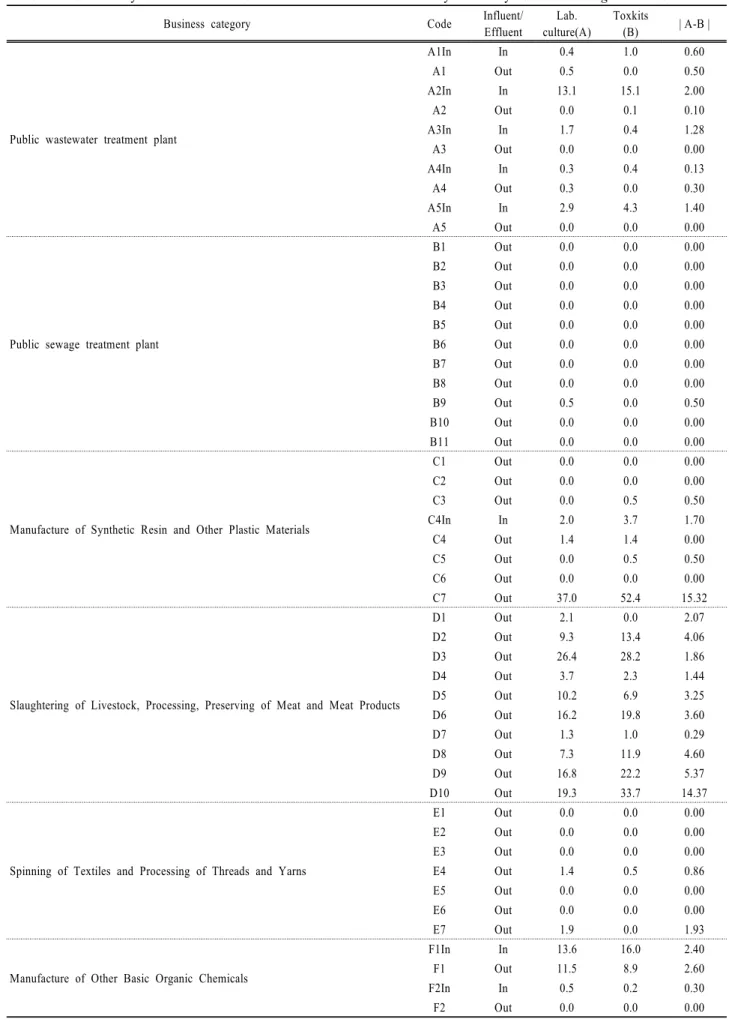
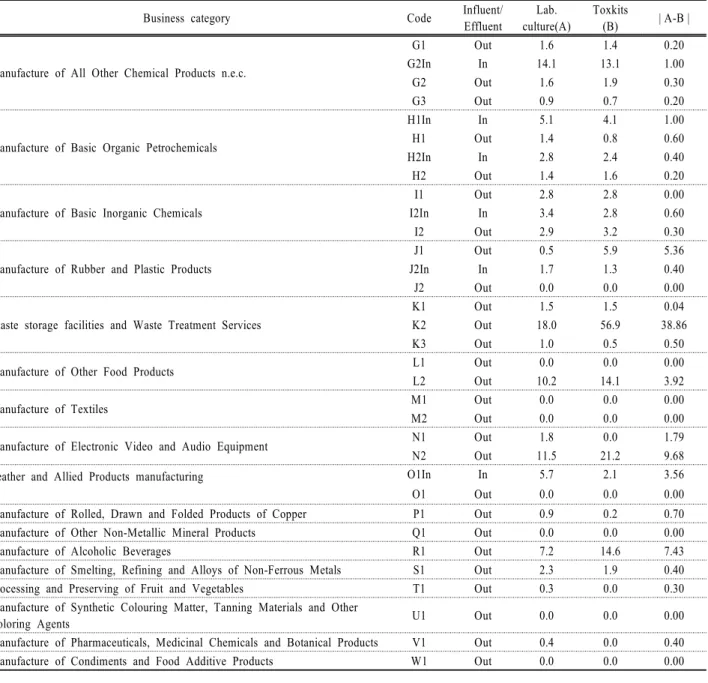
규칙 별표 4에 규정된 폐수배출시설의 분류 기준에 따라 구분하였고, 채취된 83건의 시료는 높은 생태독성값을 나 타내는 일부 유입수 시료를 포함하고 있다. 시료의 업종별, 사업장(시설)별 배양 물벼룩에 의한 시험결과와 Toxkits에 의한 시험결과 등은 Table 2와 같다.
전체 시료를 대상으로 실험실 배양 물벼룩을 시험생물로 하여 수행한 급성독성값과 Toxkits으로부터 부화한 물벼룩 어린개체(neonate)로 수행한 급성 독성값 간의 관련정도를 보면 Toxkits 를 이용한 독성값은 실험실 배양 물벼룩에 의한 독성값을 84 %정도 설명할 수 있었으며 유의수준은 0.01 이하였다(r2= 0.84, p<0.01, n = 83). (Fig. 1) 이 결과로 배양물벼룩에 의한 독성시험값과 Toxkits 물벼룩에 의한 독 성시험값 사이에 존재하는 유의한 연관관계를 추정할 수 있었다(Jeon, 1998).
Fig. 1. Relationship between Lab. culture acute toxicity and Toxkits acute toxicity.
Table 2. Acute toxicity test results and their differences which were tested by laboratory cultured D. magna and Toxikits
Business category Code Influent/
Effluent
Lab.
culture(A)
Toxkits
(B) | A-B |
Public wastewater treatment plant
A1In In 0.4 1.0 0.60
A1 Out 0.5 0.0 0.50
A2In In 13.1 15.1 2.00
A2 Out 0.0 0.1 0.10
A3In In 1.7 0.4 1.28
A3 Out 0.0 0.0 0.00
A4In In 0.3 0.4 0.13
A4 Out 0.3 0.0 0.30
A5In In 2.9 4.3 1.40
A5 Out 0.0 0.0 0.00
Public sewage treatment plant
B1 Out 0.0 0.0 0.00
B2 Out 0.0 0.0 0.00
B3 Out 0.0 0.0 0.00
B4 Out 0.0 0.0 0.00
B5 Out 0.0 0.0 0.00
B6 Out 0.0 0.0 0.00
B7 Out 0.0 0.0 0.00
B8 Out 0.0 0.0 0.00
B9 Out 0.5 0.0 0.50
B10 Out 0.0 0.0 0.00
B11 Out 0.0 0.0 0.00
Manufacture of Synthetic Resin and Other Plastic Materials
C1 Out 0.0 0.0 0.00
C2 Out 0.0 0.0 0.00
C3 Out 0.0 0.5 0.50
C4In In 2.0 3.7 1.70
C4 Out 1.4 1.4 0.00
C5 Out 0.0 0.5 0.50
C6 Out 0.0 0.0 0.00
C7 Out 37.0 52.4 15.32
Slaughtering of Livestock, Processing, Preserving of Meat and Meat Products
D1 Out 2.1 0.0 2.07
D2 Out 9.3 13.4 4.06
D3 Out 26.4 28.2 1.86
D4 Out 3.7 2.3 1.44
D5 Out 10.2 6.9 3.25
D6 Out 16.2 19.8 3.60
D7 Out 1.3 1.0 0.29
D8 Out 7.3 11.9 4.60
D9 Out 16.8 22.2 5.37
D10 Out 19.3 33.7 14.37
Spinning of Textiles and Processing of Threads and Yarns
E1 Out 0.0 0.0 0.00
E2 Out 0.0 0.0 0.00
E3 Out 0.0 0.0 0.00
E4 Out 1.4 0.5 0.86
E5 Out 0.0 0.0 0.00
E6 Out 0.0 0.0 0.00
E7 Out 1.9 0.0 1.93
Manufacture of Other Basic Organic Chemicals
F1In In 13.6 16.0 2.40
F1 Out 11.5 8.9 2.60
F2In In 0.5 0.2 0.30
F2 Out 0.0 0.0 0.00
Table 2. Acute toxicity test results and their differences which were tested by laboratory cultured D. magna and Toxikits
Business category Code Influent/
Effluent
Lab.
culture(A)
Toxkits
(B) | A-B |
Manufacture of All Other Chemical Products n.e.c.
G1 Out 1.6 1.4 0.20
G2In In 14.1 13.1 1.00
G2 Out 1.6 1.9 0.30
G3 Out 0.9 0.7 0.20
Manufacture of Basic Organic Petrochemicals
H1In In 5.1 4.1 1.00
H1 Out 1.4 0.8 0.60
H2In In 2.8 2.4 0.40
H2 Out 1.4 1.6 0.20
Manufacture of Basic Inorganic Chemicals
I1 Out 2.8 2.8 0.00
I2In In 3.4 2.8 0.60
I2 Out 2.9 3.2 0.30
Manufacture of Rubber and Plastic Products
J1 Out 0.5 5.9 5.36
J2In In 1.7 1.3 0.40
J2 Out 0.0 0.0 0.00
Waste storage facilities and Waste Treatment Services
K1 Out 1.5 1.5 0.04
K2 Out 18.0 56.9 38.86
K3 Out 1.0 0.5 0.50
Manufacture of Other Food Products L1 Out 0.0 0.0 0.00
L2 Out 10.2 14.1 3.92
Manufacture of Textiles M1 Out 0.0 0.0 0.00
M2 Out 0.0 0.0 0.00
Manufacture of Electronic Video and Audio Equipment N1 Out 1.8 0.0 1.79
N2 Out 11.5 21.2 9.68
Leather and Allied Products manufacturing O1In In 5.7 2.1 3.56
O1 Out 0.0 0.0 0.00
Manufacture of Rolled, Drawn and Folded Products of Copper P1 Out 0.9 0.2 0.70 Manufacture of Other Non-Metallic Mineral Products Q1 Out 0.0 0.0 0.00
Manufacture of Alcoholic Beverages R1 Out 7.2 14.6 7.43
Manufacture of Smelting, Refining and Alloys of Non-Ferrous Metals S1 Out 2.3 1.9 0.40 Processing and Preserving of Fruit and Vegetables T1 Out 0.3 0.0 0.30 Manufacture of Synthetic Colouring Matter, Tanning Materials and Other
Coloring Agents U1 Out 0.0 0.0 0.00
Manufacture of Pharmaceuticals, Medicinal Chemicals and Botanical Products V1 Out 0.4 0.0 0.40 Manufacture of Condiments and Food Additive Products W1 Out 0.0 0.0 0.00
또한 동일 시료에 대하여 시험된 배양 물벼룩 독성값과 Toxkits 물벼룩 독성값 간의 차이를 TU 0.5 간격으로 구분 하여 각 구간별로 해당되는 시료수와 이들 시료들의 평균 독성값을 산정하였는데, 두 방법 간의 측정값 차이가 TU 0.5 미만인 시료수는 52건으로 전체시료(83건)의 약 63 %를 차지하였고, 평균 독성값은 배양물벼룩이 TU 0.5, Toxkits 가 TU 0.45 정도로 낮은 수준을 보였다. 아울러 두 방법 간의 측정값 차이가 0.5 < TU ≤ 1.5 구간에 해당하는 시 료는 약 12 %를 차지하는 10건으로 독성값은 배양물벼룩 TU 2.78 ~ 3.81, Toxkits TU 2.34 ~ 3.21 수준이었다. 이후 각 순차적으로 두 시험법에 의한 측정값 차이별로 보았을 때 건수(1 ~ 5건 이내)는 적었으나 높은 독성값을 보였고 Toxkits로 측정된 값이 배양 물벼룩에 의한 측정값보다 높 은 수준을 나타냈다(Fig. 2).
위 결과로 판단할 때, 시료의 생태독성값이 낮은 수준에
Fig. 2. Number of samples and their average toxicity at TU 0.5 intervals between Lab. culture and Toxkits.
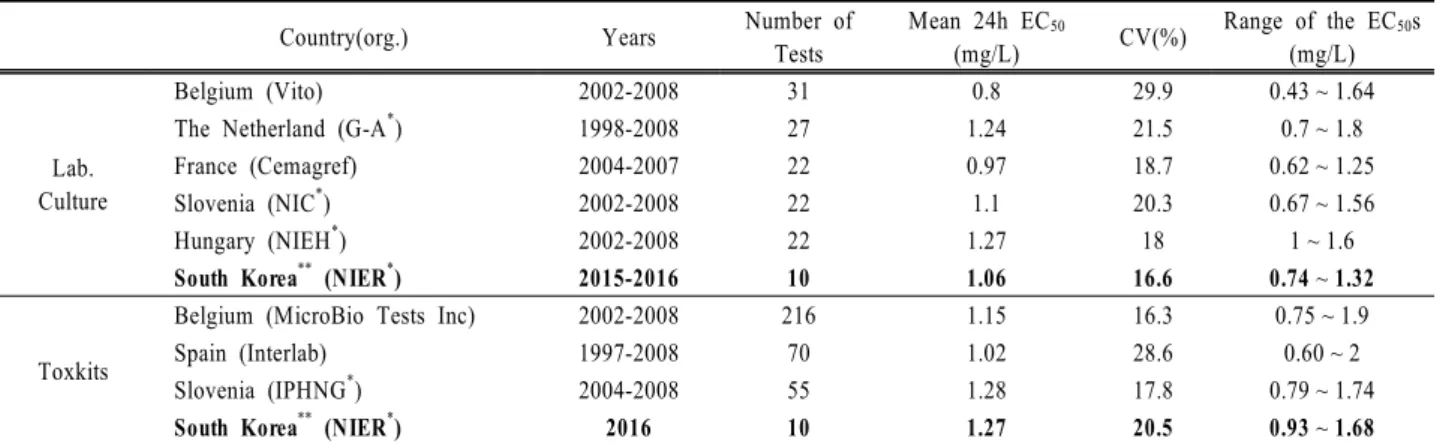
Table 3. Comparison of QC tests on potassium dicromate(K2Cr2O7, 24h EC50) with D. magna from Lab. culture and Toxkits (Persoone et al., 2009)
Country(org.) Years Number of Tests
Mean 24h EC50
(mg/L) CV(%) Range of the EC50s (mg/L)
Lab.
Culture
Belgium (Vito) 2002-2008 31 0.8 29.9 0.43 ~ 1.64
The Netherland (G-A*) 1998-2008 27 1.24 21.5 0.7 ~ 1.8
France (Cemagref) 2004-2007 22 0.97 18.7 0.62 ~ 1.25
Slovenia (NIC*) 2002-2008 22 1.1 20.3 0.67 ~ 1.56
Hungary (NIEH*) 2002-2008 22 1.27 18 1 ~ 1.6
South Korea** (NIER*) 2015-2016 10 1.06 16.6 0.74 ~ 1.32
Toxkits
Belgium (MicroBio Tests Inc) 2002-2008 216 1.15 16.3 0.75 ~ 1.9
Spain (Interlab) 1997-2008 70 1.02 28.6 0.60 ~ 2
Slovenia (IPHNG*) 2004-2008 55 1.28 17.8 0.79 ~ 1.74
South Korea** (NIER*) 2016 10 1.27 20.5 0.93 ~ 1.68
*G-A: Grontmij-Aquasense, NIC: National Institute of Chemistry, NIEH: National Institute of Envir. Health, NIER: National Institute of Envir. Research, IPHNG: Institute of Public Health Nova Gorica
**Data from author’s results
서는 두 방법간 시험결과값의 차이가 크지 않은 것으로 나 타나 현 생태독성 배출허용기준인 TU 2를 기준으로 지도 단속시료 등의 배출허용기준 초과여부를 확인하는 경우에 한정한다면 Toxkits 를 이용한 방법은 전통적인 물벼룩 시 험방법(실험실 배양)을 대체할 수 있을 것으로 판단되었다.
그러나 독성값이 높은 시료의 경우 각 시헙법에 의한 결과 값은 큰 차이를 보이므로 시험 목적에 따라 별도의 검토가 필요할 것으로 생각된다.
3.2. 표준독성시험
배양 물벼룩과 Toxkits 물벼룩 간의 표준독성시험은 각각 10회씩 수행하였다. 배양 물벼룩의 EC50 값은 0.94 ~ 1.32 mg/L 범위를 보였고, Toxkits 물벼룩의 EC50 값은 0.93 ~ 1.68 mg/L 범위를 보였다(Fig. 3). 수질오염공정시험기준(NIER, 2014) 에서 제시한 물벼룩을 이용한 생태독성시험에서 정도관리 를 위한 적정 범위는 다이크롬산포타슘을 이용한 EC50 값이 0.9 ~ 2.1 mg/L 이내로 관리하도록 규정되어있는데 Toxkits 물벼룩 시험에서도 규정된 표준독성시험 적정범위를 모두 만족하였다. 시험값의 변동계수(coefficient of variation; CV) 는 배양물벼룩이 Toxkits 물벼룩 시험결과보다 상대적으로 적었다(배양물벼룩 11.5 %, Toxkits 20.5 %). 결과적으로 Toxkits 물벼룩 시험방법의 표준독성시험결과는 적합한 것 으로 판단되었다.
Table 3은 물벼룩 급성독성시험 정도관리를 위해 시행한 외국의 배양물벼룩 및 Toxkits 시험결과(Persoone et al., 2009)와 본 논문의 결과를 비교한 것이다. 평균치로 보았을 때 Toxkits 시험방법의 EC50 값 (1.27 mg/L)은 국내 정도관리 기준인 0.9 ~ 2.1 mg/L 이내였으며 외국의 1.02 ~ 1.28 mg/L 수준과도 유사하였다. CV (%)값 (20.5 %)도 외국의 16.3 ~ 28.6 % 범위 이내로 두 시험방법 모두 외국의 결과와 큰 차이를 보이지 않았다.
Toxkits 시험방법에서 적용하는 배양액은 수질오염공정시 험기준에서 규정되어 현재 적용하고 있는 배양액과 다른 조성을 가진다. 현재 수년간 사용하여 익숙한 기존 배양액
Fig. 3. Comparison of reference toxicant test results between Lab. culture test method and Toxkits test method (n=10, reference toxicant : potassium dicromate (K2Cr2O7), 24h EC50)
으로 Toxkits 적용가능성을 검토하기 위해 Toxkits 제품을 대상으로 제품에서 규정한 배양액과 기존 배양 물벼룩 시 험에서 사용하고 있는 배양액을 이용하여 표준독성시험을 수행하였다(Table 4). 기존 배양액을 이용하여 수행한 표준 독성시험 결과 EC50 범위는 0.66 ~ 0.83 mg/L (평균 0.75 mg/L) 로서 국내 정도관리기준(0.9 ~ 2.1 mg/L) 범위를 만족시키지 못하였으나, Toxkits 제품설명서에서 제시한 배양액을 사용 하여 시험한 결과는 0.93 ~ 1.68 mg/L (평균 1.27 mg/L)로 국내 정도관리기준을 만족하였다. 따라서 물벼룩 배양에 적 용해온 기존배양액은 Toxkits 시험방법에는 적용할 수 없는 것으로 판단되었다.
4. conclusion
본 논문에서는 국내 폐수 시료에 대한 급성독성 시험방 법으로 현재 적용하고 있는 배양물벼룩에 의한 방법을 간 소화시킨 시험방법이 기존방법을 대체할 수 있는지에 대한 타당성을 평가해보고자 수행되었다. 국내 폐수시료 83건에
Table 4. Comparison of QC results between traditional Lab. culture testing media and Toxkits testing media Lab. Culture testing media Toxkits testing media Composition KCl, MgSO4, CaSO4, NaHCO3 NaHCO3, CaCl2, MgSO4, KCl
Number of tests 8 10
Range of the EC50 (mg/L) 0.66 ~ 0.88 0.93 ~ 1.68
Mean 24h EC50 (mg/L) 0.75 1.27
CV (%) 8.1 20.5
대하여 기존 배양물벼룩과 Toxikit 물벼룩을 이용한 급성독 성시험을 수행하여 그 결과를 비교하였다.
83건 전체시료에 대하여 Toxikit 를 이용한 독성값은 실 험실 배양 물벼룩에 의한 독성값을 84 %정도 설명할 수 있었으며 유의수준은 0.01 이하였다(r2= 0.84, p<0.01, n = 83).
이들 시료에서 배양 물벼룩 독성값과 Toxikit 물벼룩 독성 값 측정결과의 차이가 TU 0.5 이하인 건수는 52건으로 전 체(83건)의 약 63 %를 차지하였다. 또한 이 구간에 포함된 시료의 독성값 평균은 배양물벼룩 TU 0.5 및 Toxkits TU 0.45 정도로 낮은 수준을 보였고 시료들의 평균 독성값이 높은 경우 두 시험법에 의한 측정값 차이가 큰 것으로 나 타났다. 따라서 시료의 생태독성값이 낮은 수준에서는 두 방법간 시험결과값의 차이가 크지 않은 것으로 나타나 현 생태독성 배출허용기준인 TU 2를 기준으로 지도단속시료 등의 배출허용기준 초과여부를 확인하는 경우에 한정한다 면 Toxkits를 이용한 방법은 전통적인 물벼룩 시험방법(실 험실 배양)을 대체할 수 있을 것으로 판단되었다.
배양 물벼룩과 Toxikit 물벼룩 간의 표준독성시험결과 두 시험방법 간 시험결과의 차이는 크지 않고 결과 값의 범위 도 수질오염 공정시험기준에서 제시한 범의를 대부분 만족 하고 있어 Toxikit 물벼룩 시험의 표준독성시험결과는 적합 한 것으로 판단되었다.
References
Jeon, H. S., Lee, J. J., and Go, G. B. (1998). Statistics for Envi- ronmental Engineers. Dong Hwa Technology Publishing Co pp. 344 (Translation version) [Berthouex, P. M. and Brown, L. C. (1994). Statistics for Environmental Engineers. Lewis Publishers]. [Korean Literature]
Korean Agency for Technology and Standards (KATS). (2014).
Water Quality - Determination of the Inhibition of the mobi-
lity of Daphnia magna Struss (Cladocera Crustacea) - Acute Toxicity Test, KS_ISO 6341:2014. [Korean Literature]
MicroBioTests Inc. (2016). DAPHTOXKIT F magna, http://www.
microbiotests.be/ information/ toxkit-advantagesassets (accessed Mar. 2016)
Ministry of Environment (MOE). (2014). Water Quality and Aqu- atic Ecosystem Conservation Act, Ministry of Environment.
[Korean Literature]
National Institute of Environmental Research (NIER). (2014).
Standard Method for Water Pollutants ES 04704.1, -Acute Toxicity Testing with Daphnia magna-, National Institute of Environmental Research. [Korean Literature]
National Institute of Environmental Research (NIER). (2015a).
Collected data from Water Environmental Engineering Research Division, National Institute of Environmental Research. [Korean Literature]
National Institute of Environmental Research (NIER). (2015b).
Business Trip Report on USEPA Whole Effluent Toxicity Tes- ting System, National Institute of Environmental Research.
[Korean Literature]
Persoone. G., Baudo, R., Cotman, M., Blaise, C., Thompson, K.
Cl., Moreira-Snatos, M., Vpllat, B., Torokne, A., and Han, T.
(2009). Review on the Acute Daphnia magna Toxicity Test - Evaluation of the Sensitivity and the Precision of Assays Performed with Organisms from Laboratory Cultures or Hatched from Dormant Eggs, Knowledge and Management of Aquatic Ecosystems, 393.01, 01p12 - 01p14.
The International Organization for Standardization (ISO). (2012).
Water Quality - Determination of the Inhibition of the Mobi- lity of Daphnia magna Straus (Cladocera, Crustacea)- Acute Toxicity Test, ISO 6341 : 2012(E)
United States Environmental Protection Agency (U. S. EPA).
(2002). Methods for Measuring the Acute Toxicity of Effluents and Receiving Waters to Freshwater and Marine Organisms.
Fifth Edition. U.S. Environmental Protection Agency, Office of Water, Washington, D.C. EPA 821-R-02-012.