생태독성 숙련도 시료의 적절성 평가
신기식*ᆞ박우상ᆞ이정서ᆞ유순주ᆞ박태진ᆞ김종민†
국립환경과학원 물환경연구부 물환경공학연구과
*인천대학교 생명과학과
Validation of Suitability on Proficiency Testing Samples for Acute Toxicity Test with Daphnia magna
Kisik Shin․Woosang Park․Jungseo Lee․Soonju Yu․Taejin Park․Jongmin Kim†
Water Environmental Engineering Research Division, National Institute of Environmental Research
*Division of Life Science, Incheon National University, Incheon, Korea (Received 23 September 2014, Revised 16 January 2015, Accepted 19 January 2015)
Abstract
Acute toxicity test with Daphnia magna has a variety of factors such as incubation condition of test species, food quality and proficiency of laboratory workers. Therefore, proper proficiency testing samples were required for evaluating the competence of laboratory workers. This study aims to propose some appropriate proficiency testing samples for laboratory workers of acute toxicity test with Daphnia magna. Proposed four kinds of standard samples (Sample A, B, C, and D) for proficiency testing were selected from reference materials which were recommended from Canada and USA WET(Whole Effluent Toxicity) authorities. Proposed standard samples were tested by trial application of proficiency testing, homogeneity and stability checks using repeatability test. Sample A, C and D were estimated ad the suitable candidates for proficiency test standard samples except for Sample B. In addition, Sample A was proved to be the most suitable sample.
Key words : Acute toxicity, Daphnia magna, Proficiency testing, Reference materials
1. Introduction1)
물벼룩을 이용한 생태독성평가방법은 폐수에 혼합된 오 염물질의 화학적 조성 및 오염 부하량을 고려할 필요 없이 물벼룩의 상태를 통하여 유해 오염물질의 영향 여부에 대 한 확인이 가능하므로 효율적으로 수질을 관리할 수 있는 대체 수단으로 활용될 수 있다. 현재 시행중에 있는 「생태 독성 통합관리제도」는 개별폐수배출시설, 공공하수 및 폐수 종말처리시설 등을 대상으로 지도・점검 결과에 따라 시설 개선명령, 과태료 부과 등의 행정처분을 받게 되는 법적규 제의 성격을 가지므로(MOE, 2010), 다른 유해화학물질 분 석 결과와 마찬가지로 생태독성 분석결과에 대한 신뢰성 확보가 중요한 요소가 된다.
생태독성 분석은 법정 및 민간기관에서 수행하고 있으나, 그동안의 이들 기관에 대한 숙련도 평가는 평가용 표준시료 의 안정성 문제, 생물실험의 난이성 등으로 아직까지 예비 항목으로 정하여 평가가 수행되고 있다. 결과적으로 보다 신뢰성 있고 안정적인 생태독성 숙련도 시험용 표준시료의 마련이 시급한 실정이다. 숙련도 시험용 표준시료는 전 세
†To whom correspondence should be addressed.
계적으로 일관된 측정 시스템과 유효성 평가를 위하여 제조 및 균질성 등에 대한 가이드를 제시하고 있다(KATS, 2005).
그러나, 물벼룩을 이용한 생태독성실험은 살아있는 생물종 으로 시험을 실시하기 때문에 시험생물종의 배양조건, 공급 되는 먹이의 질, 시험자의 숙련도 등과 같은 다양한 인자들 에 따라 시험결과가 달라질 수 있으며, 특히, 시험생물종의 건강상태에 따라 다른 결과를 나타내는 가능성이 매우 크 다. 따라서 시험생물종에 대한 관리가 중요하나 실제 일부 생태독성분석기관에서는 전문 인력의 부족 또는 배양 시설 의 미흡 등으로 시험생물종에 대한 관리가 적절하게 이루어 지지 않은 사례가 보고된 바 있다(KECO, 2014).
2012년 및 2013년 기 시행된 예비 숙련도 시험 결과 (Shin et al., 2013)에서 각 시험실간 결과치의 큰 편차를 보이는 이유 중의 하나가 실험 과정뿐만 아니라 시험생물 종에 대한 부적절한 관리인 것으로 생각된다. 또한 수질오 염공정시험기준의 “물벼룩을 이용한 급성독성 시험 방법 (ES 04751.1)”에 규정된 표준독성물질은 다이크롬산포타슘 (K2Cr2O7)으로 정하고 있는데(NIER, 2011), 이 물질의 경우 고유색상(황색)을 띄고 있어 숙련도 시험을 위한 표준시료 로 사용 시 Blind test 효과는 기대하기 어렵다.
생태독성 숙련도 시험에 관한 국내 연구는 Park and Kim (2013), Shin et al. (2013)이 일부 수행한 사례가 있고, 외국 의 경우 실험실간 비교 숙련도 시험에 관한 연구 사례가 다 This is an Open-Access article distributed under the terms of the Creative
Commons Attribution Non-Commercial License (http://creativecommons.org/
Table 1. Characteristics of proficiency testing samples (2012, 2013)
2012 2013
Sample A Sample B Sample C Sample A Sample B_1 Sample C_1
Type liquid liquid solid liquid liquid solid
Purity (%) 99 > 99 > 99.5 99 > 99 > 99.5
Distribution conc. (mg/L, mg) 500 2,000 1,000 500 1,000 1,000
Test conc. (mg/L) 5 20 1,000 5 5 2,000
수 관찰된다(Cotman et al., 2009; Farre et al., 2004; Farre et al., 2006; Farre et al., 2007; Hernando et al., 2006).
본 연구는 그간 수행된 숙련도 시험용 표준시료의 문제점 등을 종합 검토하여 보다 안정된 숙련도 시험용 표준시료를 제시함으로써 국립환경과학원에서 향후 시행예정인 생태독성 분야 숙련도 시험의 원활한 수행을 도모하기 위하여 수행되었다.
2. Materials and Methods
2.1. 시험용 표준시료의 적절성 평가
숙련도 시험용 시료의 적절성을 평가하기 위해 2012년 이후 3년간 매년 선정한 시험용 시료의 타당성을 평가하고 적절하지 않다고 판단된 시험용 표준시료는 대체 혹은 농 도를 달리하여 재평가하였다. 시험용 표준시료의 적절성 여 부는 2012년 및 2013년 국립환경과학원에서 수행된 생태독 성분야 숙련도 시험결과(정규항목이 아닌 예비항목으로 평 가)를 KS A ISO에 제시된 방법으로 검토하였다(KATS, 2009). 이 2012년 및 2013년 시험용 표준시료 평가결과와 관련 문헌 등을 참고하여 최종적으로 4종을 선정하고 시험 용 표준시료로서의 적합성을 검토하였다.
2012년도 숙련도시험에 사용된 시험용 표준시료는 수질 오염공정시험법 상에 규정되어 있는 표준독성물질인 다이크 롬산포타슘(K2Cr2O7)과 U.S.EPA의 Ecotox database (Daphnia magna EC50) 값을 참고하여 2종을 추가 선정하였다. 2013 년에는 다이크롬산포타슘과 2012년 숙련도시험 당시 문제를 나타낸 Sample B를 U.S.EPA의 Ecotox database (Daphnia magna EC50) 값을 참고하여 다른 물질로 대체하고(Sample B_1), Sample C의 경우 2012년에 사용된 물질을 그대로 사용하되 시험농도를 2배로 하였다(Sample C_1). 선정된 3 종의 시험용 표준시료의 특성은 Table 1과 같다.
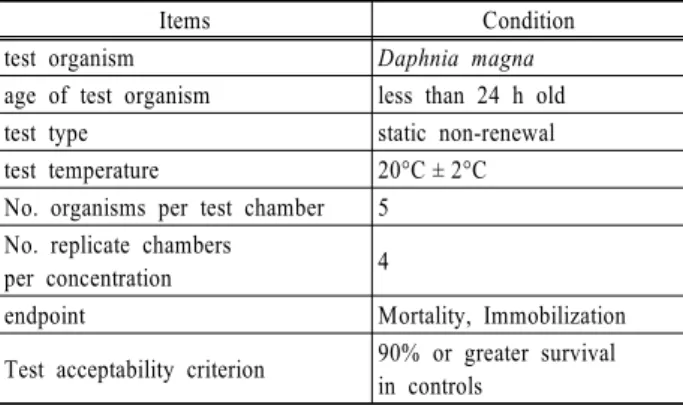
2012년에는 총 49개 생태독성 분석실험실을 대상으로 하 였고, 2013년에는 총 58개 실험실을 대상으로 숙련도 평가 를 시행하였다. 시료의 분석은 수질오염공정시험기준에 명 시된 ‘물벼룩을 이용한 급성독성 시험 방법(ES 04751.1)’에 따라 각각 5 mg/L, 20 mg/L, 1,000 mg/L 가 되도록 희석 하여 분석하고 probit, trimmed spearman-karber 통계기법을 이용하여 결과를 산출토록 하였다. 희석액의 조성과 시험조 건은 Table 2 및 Table 3과 같다.
2.2. 숙련도 시험용 표준시료 제시
2012년 및 2013년 조사결과를 반영하여 일부 색상의 문 제점을 제외하곤 숙련도 시료로 활용하기에 적합한 것으로
Table 2. Composition of dilution water for acute toxicity test with Daphnia magna
Items Final dilution water quality
pH 7.6 ~ 8.0
Hardness(as CaCO3 mg/L) 160 ~ 180 Alkalinity(as CaCO3 mg/L) 110 ~ 120
Dissolved Oxygen(mg/L) above 3.0 (20°C ± 2°C)
Table 3. Proficiency testing conditions
Items Condition
test organism Daphnia magna
age of test organism less than 24 h old
test type static non-renewal
test temperature 20°C ± 2°C
No. organisms per test chamber 5 No. replicate chambers
per concentration 4
endpoint Mortality, Immobilization
Test acceptability criterion 90% or greater survival in controls
판단된 Sample A를 포함하여 우리나라 보다 앞서 「생태독성 통합관리제도」를 운영하고 있는 미국과 캐나다에서 권고하 는 시험용 표준물질을 검토하여 총 4종을 대상으로 20회 반복시험을 실시하여 시험농도와 균질성을 평가하였다.
3. Results and Discussion
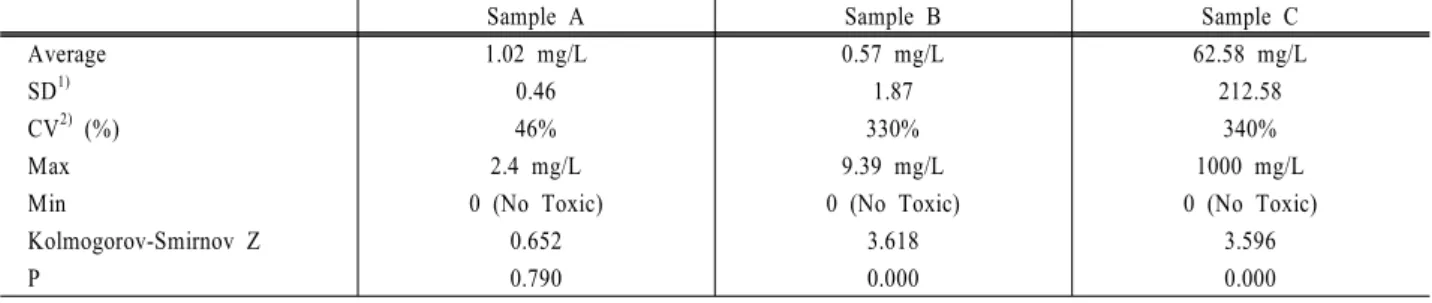
3.1. 2012년 예비 숙련도시험용 시료의 적합성 평가 Sample A, B, C 총 3종의 시험용 표준시료에 대한 49개 생태독성분석기관의 EC50 (mg/L)산출 결과 통계치는 Table 4 와 같다.
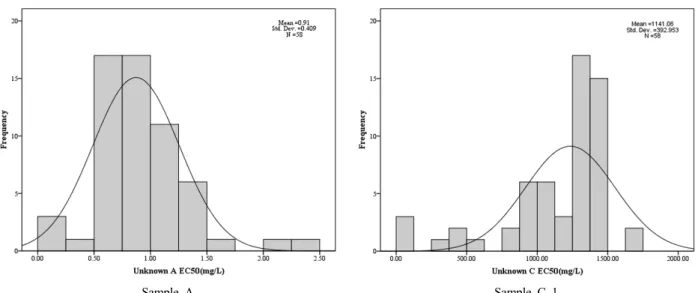
Sample A는 변동계수(CV : Coefficient of Variation) 값이 46% 정도였고 Fig. 1과 같이 정규분포(Kolmogorov-Smirnov p value 가 0.790, K-S p > 0.05 일 때 정규분포)를 보이고 있 어 숙련도 시험용 시료로 적합한 것으로 평가되었다. 그러 나 Sample B 및 Sample C는 숙련도 시험에 사용된 100%
원수시료 농도가 EPA ecotox에서 제시된 Daphnia magna 24h_EC50 값인 5.1 mg/L ~ 10.1 mg/L, 343 mg/L ~ 740 mg/L (Table 5)보다 높은 값임에도 불구하고(Sample B 20 mg/L, Sample C 1,000 mg/L) 숙련도 시험대상 49개 실험실의 약 90%인 44개 실험실에서 독성이 나타나지 않았으며, 결과 적으로 변동계수(CV)값도 330% ~ 340% 로 나타나 숙련도 시험용 표준물질로 적합하지 않은 것으로 판단되었다.
Table 4. Proficiency testing results of 3 PT samples in 2012 (EC50, mg/L)
Sample A Sample B Sample C
Average 1.02 mg/L 0.57 mg/L 62.58 mg/L
SD1) 0.46 1.87 212.58
CV2) (%) 46% 330% 340%
Max 2.4 mg/L 9.39 mg/L 1000 mg/L
Min 0 (No Toxic) 0 (No Toxic) 0 (No Toxic)
Kolmogorov-Smirnov Z 0.652 3.618 3.596
P 0.790 0.000 0.000
Kolmogorov-Smirnov test : P > 0.05 : normal distribution
1) SD : standard deviation, 2) CV : coefficient of variation
Table 6. Proficiency testing results of 3 PT samples in 2013 (EC50, mg/L)
Sample A Sample B_1 Sample C_1
Average 0.91 mg/L 0.77 mg/L 1141.06 mg/L
SD1) 0.41 1.28 392.95
CV2) (%) 45% 166% 34%
Max 2.33 mg/L 5.00 mg/L 1640.67 mg/L
Min 0 (No Toxic) 0 (No Toxic) 0 (No Toxic)
Kolmogorov-Smirnov Z 0.994 2.777 1.000
P 0.276 0.000 0.270
Kolmogorov-Smirnov test : P > 0.05 : normal distribution
1) SD : standard deviation, 2) CV : coefficient of variation Fig. 1. Histogram of Sample A (EC50 mg/L, 2012).
Table 5. Reference value of Sample B and Sample C (US EPA ecotox)
Reference value Source Sample B 5.1 mg/L ~ 10.1 mg/L ◦ LeBlanc (1982)
◦ Lewis and Weber (1985) Sample C 343 mg/L ~ 740 mg/L ◦ Dowden and Bennett (1965)
◦ Mount et al. (1997)
3.2. 2013년 예비 숙련도시험용 시료의 적합성 평가 시험용 시료(Sample A, Sample B_1, Sample C_1) 3종에 대한 58개 생태독성분석기관의 EC50 (mg/L)산출 결과 통계 치는 Table 6과 같다.
Sample A 및 Sample C_1는 CV값이 각각 45%, 34% 정도를 나타냈고 Fig. 2와 같이 정규분포(K-S p value : 0.276, 0.270)
를 보이고 있어 숙련도시험용 시료로 적합한 것으로 평가 되었다. 그러나 Sample B_1의 경우 숙련도시험에 사용된 100% 원수 시료 농도가 EPA ecotox에서 제시된 Daphnia magna EC50 (24h) 값인 0.07 mg/L ~ 3.58 mg/L (Table 7) 보다 높은 값임에도 불구하고(5 mg/L) 숙련도 시험대상 58 개 대상기관 중 37개(63.8%) 기관에서 독성이 나타나지 않 았으며, CV값도 166%로 나타나 숙련도 시험용 표준물질로 적합하지 않은 것으로 판단되었다.
Sample B_1은 영국 DTA (Direct Toxicity Assessment) 숙련도시험 평가 시 이용되고 있는 시험용 표준물질임에도 불구하고(EA, 2007), 이번 숙련도 시험결과에서 대상실험실 의 63.8%에서 독성이 나타나지 않은 이유는 국내와 영국 시험기준상에 규정되어 있는 시험시간의 차이(국내 24시간, 영국 48시간)에 의한 것으로 사료된다. 실제로 동일 농도의 Sample B_1 24시간, 48시간 후의 분석 결과를 비교한 결 과를 보면 48시간 분석결과가 24시간 분석결과에 비해 약 406% (약 4배) 정도 높은 독성값을 나타냈다(Table 8).
3.3. 숙련도시험용 표준시료 제안
이미 기술한 것과 같이 2012년, 2013년 예비 숙련도시험 평가에 사용된 일부 시험용 시료는 산출결과의 비정규분포, 24시간내 독성이 발현되지 않는 등 국내 숙련도 시험에 적 용하기 어려운 것으로 평가된 바 있다. 그러나 시험용 시 료로 적합한 것으로 평가된 Sample A 1종만을 사용하여 숙련도를 평가하기에는 충분한 평가가 어렵다고 판단되어 국외에서 권고하고 있는 숙련도 시험용 물질의 도입을 검 토하였다. 캐나다는 11종의 화학물질을 선정하여 시험생물 종에 대한 비정상적인 반응(치사 및 유영저해) 출현 여부,
Sample A Sample C_1 Fig. 2. Histogram of Sample A and Sample C_1 (EC50 mg/L, 2013).
Table 7. Reference value of Sample B_1 (US EPA ecotox)
Reference value Source
Sample B_1 0.07 mg/L ~ 3.58 mg/L ◦ Mount and Norberg (1984)
◦ Fisher et al. (1990)
Table 8. Comparison of 24 and 48 hour immobilization test using sample B_1
Round EC50 (mg/L)
Increase ratio of toxicity 24 hr 48 hr
1 4.91 1.32 371.97 (%)
2 6.21 1.41 440.43 (%)
average 406.2 (%)
독성자료확립 여부, 수용액의 안정성, 저장기간의 안정성 등을 고려하여 NaPCP (Sodium Pentachlorophenate), K2Cr2O7, NaCl, ZnSO4 등을 추천하고 있으며(Environment of Canada, 1990), 미국에서는 NaCl, KCl, CdCl2, CuSO4, SDS (Sodium dodecyl sulfate, K2Cr2O7을 표준물질로 권고하고 있다(U.S.EPA, 2002). 이들 중 3종을 선정하고 기존 Sample A를 포함하여 총 4종을 대상으로 EC50 (mg/L)값을 20회 반복 측정하여 시험용 표준물질로서의 적합성 등을 평가하였다(Table 9).
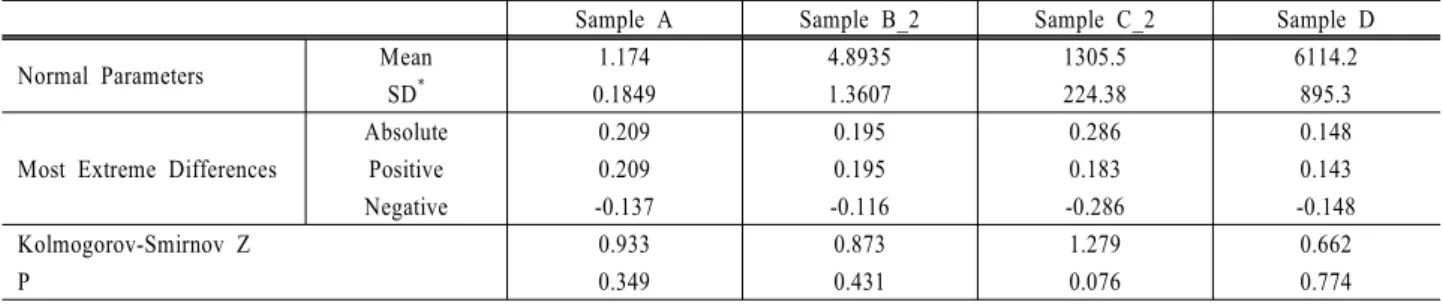
각 물질별 시험농도는 산출된 평균값과 시료 제조의 편 의성을 고려해 볼 때 Sample A는 3 mg/L ~ 5 mg/L, Sample B_2는 10 mg/L ~ 20 mg/L, Sample C_2는 3,000 mg/L ~ 4,000 mg/L, Sample D는 12,000 mg/L ~ 15,000 mg/L로 판 단된다. 시험용 시료들의 반복성 평가결과 4종의 시료는 변동계수(CV) 15% ~ 28% 정도였고, 정규분포여부 확인을 위해 Kolmogorov-Smirnov test를 수행한 결과 p value 가 0.05보다 큰 것으로 나타나, 시험용 시료들은 모두 정규분 포를 갖는 것으로 판단되었다(Table 10). 각 시료별 균질 성은 KS A ISO Guide 35에 명시된 방법에 따라 실시하였 으며, 병간 균질성이 목표 표준편차보다 작을 경우 균질하 다고 판정한다. 균질성 평가 결과 Table 11과 같이 Sample B_2 를 제외한 모든 물질이 균일하게 평가되어 Sample B_2를
Table 9. Repeatability test of procficiency testing samples (EC50, mg/L)
Replicate EC50 (mg/L)
Sample A Sample B_2 Sample C_2 Sample D
1 1.29 4.73 1060.66 5045.38
2 0.93 7.94 1060.66 4242.62
3 0.96 4.60 1783.81 7071.07
4 0.99 4.45 1468.82 7071.07
5 1.07 4.82 1414.21 7071.07
6 1.07 4.91 1440.25 6830.20
7 1.10 6.21 1231.14 6597.54
8 1.11 5.66 1414.21 6578.41
9 1.12 4.24 1414.21 6308.18
10 1.12 3.58 1231.14 6155.72
11 1.12 6.06 1414.21 5882.17
12 1.13 2.97 1414.21 5724.68
13 1.16 4.24 1440.25 5547.85
14 1.16 6.06 1414.21 5454.55
15 1.17 4.90 1414.21 6615.43
16 1.22 4.73 1309.38 6430.64
17 1.23 4.69 1414.21 7071.07
18 1.27 2.77 955.92 7071.07
19 1.52 2.97 923.36 4829.68
20 1.74 7.34 891.91 4685.00
Average (mg/L) 1.17 4.89 1305.55 6114.17
SD1) 0.18 1.36 224.38 895.3
CV2) (%) 15 28 17 15
Max (mg/L) 1.74 7.94 1783.81 7071.07
Min (mg/L) 0.93 2.77 1060.66 4242.62
1) SD : standard deviation, 2) CV : coefficient of variation
제외하고는 숙련도시험용 표준물질로 사용이 가능할 것으 로 평가된다.
4. Conclusion
물벼룩을 이용한 생태독성시험은 살아있는 생물종으로
Table 10. Normal distribution verification of testing samples using Kolmogorov- Smirnov test
Sample A Sample B_2 Sample C_2 Sample D
Normal Parameters Mean 1.174 4.8935 1305.5 6114.2
SD* 0.1849 1.3607 224.38 895.3
Most Extreme Differences
Absolute 0.209 0.195 0.286 0.148
Positive 0.209 0.195 0.183 0.143
Negative -0.137 -0.116 -0.286 -0.148
Kolmogorov-Smirnov Z 0.933 0.873 1.279 0.662
P 0.349 0.431 0.076 0.774
Kolmogorov-Smirnov test : P > 0.05 : normal distribution
* SD : standard deviation
Table 11. Homogeneity results of testing samples
Sample A Sample B_2 Sample C_2 Sample D
Between bottle Homogeneity 0 1.286 31.85 399.1
SD* (0.3×) 0.106 0.44 117.5 550.3
Results Homogeneity Heterogeneity Homogeneity Homogeneity
* SD : standard deviation
시험을 실시하기 때문에 시험생물종의 배양조건, 공급되는 먹이의 질, 시험자의 숙련도 등과 같은 다양한 인자들에 따라 시험결과가 달라질 수 있다. 따라서 분석자의 숙련도 평가가 적절하게 수행되기 위해서는 평가에 적합한 숙련도 시험용 표준시료의 개발이 필요하다. 본 연구는 물벼룩을 이용한 생태독성 시험을 수행하는 분석요원들의 숙련도 시 험 평가에 적합한 표준시료 개발을 위해 수행되었다. 숙련 도시험용 표준시료 후보물질은 우리나라 보다 앞서 「생태 독성 통합관리제도」를 운영하고 있는 미국과 캐나다에서 권고하는 시험용 표준물질 중에서 가장 적합하다고 평가된 물질 4종 (Sample A, B, C, D로 구분)을 선정하였다. 선정 된 각 후보물질은 총 2회에 걸쳐 실제 생태독성분석기관별 로 예비 숙련도 평가에 시범 적용하였고, 각 물질별로 20 회 반복시험을 거쳐 시험농도와 균질성을 평가하였다. 평가 결과 Sample B를 제외한 Sample A, Sample C, Sample D는 예비숙련도시험 결과나 반복성 및 균질성 시험결과 등으로 판단할 때 안정성이 높은 것으로 나타나 국내 숙련도시험 용 시료로 활용에 적합할 것으로 판단되었고 이중 가장 적 합한 것으로 평가된 표준물질은 Sample A로 평가되었다.
References
Cotman, M., Drolc, A., and Tisler, T. (2009). Interlaboratory Studies on Wastewater Toxicity using Daphnia magna, Accreditation and Quality Assurance, 14, pp. 319-327.
Dowden, B. F. and Bennett, H. J. (1965). Toxicity of Selected Chemicals to Certain Animals, Journal of Water Pollution Control Federation, 37(9), pp. 1308-1316.
Environment Agency (EA). (2007). Assessment of Aqueous Environmental Samples Using the Juvenile Daphnia magna Immobilisation Test, Environment Agency.
Environment of Canada. (1990). Guidance Document on Control of Toxicity Test Precision Using Reference Toxicants, Envi- ronment of Canada.
Farre, M., Arranz, F., Ribo, J., and Barcelo, D. (2004). Inter- laboratory Study of the Bioluminescence Inhibition Tests for Rapid Wastewater Toxicity Assessment, Talanta, 62, pp. 549- 558.
Farre, M., Martinez, E., Hernando, M. D., Fernandez-Alba, A., Fritz, J., Unruh, E., Mihail, O., Sakkas, V., Morbey, A., Albanis, T., Brito, F., Hansen, P. D., and Barcelo, D. (2006).
European Ring Exercise on Water Toxicity using Different Bioluminescence Inhibition Tests Based on Vibrio fischeri, in support to the Implementation of the Water Framework Directive, Talanta, 69, pp. 323-333.
Farre, M., Martinez, E., and Barcelo, D. (2007). Validation of Interlaboratory Studies on Toxicity in Water Samples, Trends in Analytical Chemistry, 26(4), pp. 283-292.
Fisher, D. J., Burton, D. T., and Paulson, R. L. (1990). Acute Toxicity of a Complex Mixture of Synthetic Hexachloro- ethane (HC) Smoke Combustion Products: II. Determination of Component Toxicity, Environmental Toxicology and Che- mistry, 9(6), pp. 755-760.
Hernando, M. D., Malato, O., Farre, M., Fernandez-Alba, A. R., and Barcelo, D. (2006). Application of Ring Study: Water Toxicity Determinations by Bioluminescence Assay with Vibrio fischeri, Talanta, 69, pp. 370-376.
Korean Agency for Technology and Standards (KATS). (2005).
Certification of Reference Materials-General and Statistical Principles, KS A ISO Guide 35:2005, Republic of Korea.
[Korean Literature]
Korean Agency for Technology and Standards (KATS). (2009).
Statistical Methods for Use in Proficiency Testing by Inter- laboratory Comparisons, KS Q ISO 13528:2009, Republic of Korea. [Korean Literature]
Korea Environment Corporation (KECO). (2014). Survey Scheme on the Status of WET(Whole Effluent Toxicity) Management [Draft]. [Korean Literature]
LeBlanc, G. A. (1982). Laboratory Investigation into the Development of Resistance of Daphnia magna (Straus) to Environmental Pollutants, Environmental Pollution, A.27(4), pp. 309-322.
Lewis, P. A. and Weber, C. I. (1985). A Study of the Reliability of Daphnia Acute Toxicity Tests, Aquatic Toxicology and Hazard Assessment, 7th Symposium, ASTM STP 854, Phila- delphia, pp. 73-86.
Ministry of Environment (MOE). (2010). Water Quality and Aquatic Ecosystem Conservation Act, Ministry of Environ- ment. [Korean Literature]
Mount, D. I. and Norberg, T. I. (1984). A Seven-Day Life-Cycle Cladoceran Toxicity Test, Environmental Toxicology and Chemistry, 3(3), pp. 425-434.
Mount, D. R., Gulley, D. D, Hockett, R., Garrison, T. D., and Evans, J. M. (1997). Statistical Models to Predict the Toxicity of Major Ions to Ceriodaphnia dubia, Daphnia magna and Pimephales promelas (Fathead Minnows), Environmental Toxicology and Chemistry, 16(10), pp. 2009-2019.
National Institute of Environmental Research (NIER). (2011).
Standard Method for Water Pollutants ES 04704.1, -Acute Toxicity Test with Daphnia magna-, Ministry of Environ- ment. [Korean Literature]
Park, W. S. and Kim, S. H. (2013). Evaluation of Whole Effluent Toxicity (WET) Proficiency Testing for Water Quality Measurement Agencies in Korea, Journal of Korean Society on Water Environment, 29(4), pp. 568-573. [Korean Literature]
Shin, K., Lee, Y. J., Huh I., Kim, J., Jeong, D. H., Park, C., Park, W., Lee, J., Yu, S., and Rhew, D. (2013). A study of QA/QC Method for WET(Whole Effluent Toxicity) - Prepa- ration of QA/QC and Operation Manual for WET -, National Institute of Environmental Research, pp. 11-24. [Korean Literature]
United States Environmental Protection Agency (U.S.EPA).
(2013). Ecotox Database, http://cfpub.epa.gov/ecotox/ (accessed Nov. 2013)
United States Environmental Protection Agency (U.S.EPA).
(2002). Methods for Measuring the Acute Toxicity of Eff- luents and Receiving Waters to Freshwater and Marine Organisms, Fifth Edition, pp. 21.