203
JOURNAL OF KOREAN FOREST SOCIETY ISSN 0445-4650(Print), ISSN 2289-0904(Online) http://e-journal.kfs21.or.kr
적외선등을 이용한 실외 실험적 온난화 처리에 따른 소나무와 전나무의 종자 발아 및 유묘 생존율
조민석1·황재홍1*·양아람1·한새롬2·손요환2
1국립산림과학원 산림생산기술연구소, 2고려대학교 환경생태공학과
Seed Germination and Seedling Survival Rate of Pinus densiflora and Abies holophylla in Open-field Experimental Warming
Using the Infrared Lamp
Min Seok Cho
1, Jaehong Hwang
1*, A-Ram Yang
1, Saerom Han
2and Yowhan Son
21Forest Practice Research Center, Korea Forest Research Institute, Pocheon 487-821, Korea
2Department of Environmental Science and Ecological Engineering, Korea University, Seoul 136-713, Korea
요 약: 본 연구는 지구 온난화와 관련한 대응 대책 마련을 위해서 대기 온도 상승에 따른 주요 침엽수의 종자 발아 및 발아 후 유묘의 생존율 변화를 알아보고자 수행하였다. 소나무와 전나무를 대상으로 적외선등을 이용하여 대조구 보다 온난화 처리구의 대기 온도를 3oC 높게 유지하는 실외 실험적 온난화 처리를 실시하였다. 온난화 처리에 따른 대기 온도 상승으로 두 수종 모두 발아율이 높아지는 경향을 보였지만, 전나무에서만 유의적 차이가 나타났다. 소나 무와 전나무 두 수종 모두 온난화 처리구가 대조구보다 평균발아일수는 유의적으로 감소하였으며, 온난화 처리구에 서 높은 발아속도와 발아세를 보였다. 온도 상승과 토양 수분 감소에 따라 전나무 유묘의 고사율은 증가하였지만, 소 나무는 온난화 처리에 따른 차이를 보이지 않았다. 향후, 지구 온난화에 따른 대기와 토양 온도 상승 및 토양 수분 감소로 양묘과정에서 종자 발아 및 유묘 생존율의 변화가 예상되기 때문에 지구 온난화에 대응할 수 있는 양묘기술 개선이 필요할 것으로 판단된다.
Abstract: The purpose of this study was to investigate the effect of experimental warming using infrared lamps on seed germination and seedling survival rate of Pinus densiflora and Abies holophylla. The air temperature of warmed plots had been automatically maintained 3 higher than control plots. The percent germinations (%) of the two coniferous species were higher in warmed plots than in control plots, however a significant difference appeared only in A. holophylla. In addition, P. densiflora and A. holophylla showed the shorter mean germination time (days), higher germination rate (seed·day−1) and germination energy (%) in warmed plots than in control plots.
A. holophylla showed a higher seedling mortality rate in the warmed plots than in control plots because of increased air and soil temperatures and decreased soil moisture. However, seedling survival rate of P. densiflora showed no significant difference by experimental warming. In the future, changed air and soil temperatures and soil moisture due to global warming will induce a variety of changes in seed germination and survival rate of tree species in nursery culture. Therefore, it is necessary to establish adaptation strategies that improve techniques in nursery culture against global warming.
Key words: Abies holophylla, experimental warming, global warming, Pinus densiflora, seed germination, seedling sur- vival rate
서 론
최근 대기 중 이산화탄소 농도 증가로 인한 대기 온도 상승은 생태계 내 식물의 생장과 탄소 순환에 많은 영향
을 미치며(IPCC, 2007; Luomala et al., 2003), 이러한 지 구 온난화에 따른 종자 발아, 묘목의 생장과 쇠퇴, 식생대 및 수종의 구성과 분포 등의 변화는 산림생태계 구조와 기능에 광범위한 영향을 줄 것으로 예측된다(Saxe et al., 1998; Thuiller et al., 2008).
지구 온난화에 따른 대기 또는 토양 온도 상승은 묘목
*Corresponding author E-mail: [email protected]
률, 기공전도도, 수분이용효율 등의 광합성 기구에 변화를 가져와 다양한 생장 특성 결과가 나타난다(Lewis et al., 2001). 온도 증가가 식물과 생태계에 어떤 영향을 주는지 에 대한 연구는 실내·외 실험을 통해 지속적으로 이루어 져 왔다. 온도 상승은 식물의 광합성 활동과 생장을 촉진 하는 것으로 보고되거나(Danby and Hik, 2007; Morison and Lawlor, 1999), 생장이 오히려 감소된다는 반대의 연 구 결과도 있다(Barber et al., 2000; Teskey, 1997).
온도는 종자 발아 및 발아 후 초기 생존에 영향을 미치 는 주요 인자로서(Walck et al., 2011), 온도 범위 및 변 화에 따라 발아율이 상승 또는 감소된다(Kozlowski et al., 1991). 또한 발아 후 유묘 단계에서는 뿌리와 줄기 발달 이 미약하기 때문에 온도 상승에 따른 변화가 민감하게 나타나서(Houle, 1994), 온도 상승에 따른 지구 온난화 영 향 예측이 성묘보다 용이하다(Lloret et al., 2009). 즉, 산 림생태계의 가장 기초가 되는 종자 발아 또는 유묘와 온 도의 관계 구명을 위한 실외 실험적 온난화 처리 연구는 지구 온난화 대응 대책 마련을 위한 기초 자료로 이용될 수 있다. 그러나 우리나라 주요 수종을 대상으로 실외 온 난화 처리에 따른 기후변화 연구는 초기 단계로 소나무 (Lee et al., 2013)와 굴참나무(Jo et al., 2011; Lee et al., 2012)를 대상으로 적외선등을 이용한 유묘의 생장과 생리적 특성 변화 연구가 이루어졌지만, 종자 발아 및 생 존율에 관한 연구는 부족한 실정이다. 그러므로 이러한 산림생태계의 변화에 선제적으로 대응하기 위해서 지구 온난화가 종자 발아부터 묘목과 임분의 생장 등에 미치 는 영향에 이르기까지 다양한 연구가 수행될 필요가 있 다(Matias and Jump, 2014; Rustad et al., 2001). 따라 서 양묘과정에서의 우량 묘목 생산을 위한 수종별 온난 화에 따른 발아 특성 및 생존율에 대한 기초 연구가 필요 할 것으로 판단된다.
지구 온난화에 대한 연구는 실험적 연구와 모델 또는 메타분석을 이용한 연구가 주로 이루어지고 있으며, 그 중 실험적 연구는 크게 실내와 실외 두 가지 방식으로 나 눌 수 있다(Chung et al., 2013). 실외 실험의 경우 실제 기후 환경에 맞춰 상승한 온도 환경을 조성할 수 있으며 (Lee et al., 2013), 다양한 기후대에 대한 온도 변화 조절 및 장기 모니터링이 가능하기 때문에 산림생태계에 대한 온난화 반응을 보다 정확하게 예측할 수 있는 장점이 있 다(Aronson and McNulty, 2009). 실외 실험에는 상부 개 방형 챔버(open-top champer), 열선(토양 또는 줄기 가열), 적외선등(infrared lamp) 등을 이용한 온난화 방법이 있는
한 장점이 있는 것으로 알려져 있다(Kimball et al., 2008).
이에 본 연구는 전 지구적으로 문제가 되고 있는 지구 온난화와 관련하여, 대기 온도 상승에 따른 종자 발아 및 발아 후 유묘의 생존율 변화를 알아보기 위해서 온난화에 의해 우선적으로 영향을 받을 것으로 예측되는 침엽수종 중 소나무(Pinus densiflora)와 전나무(Abies holophylla)를 대상으로 실외 실험적 온난화 처리에 따른 종자 발아 특 성 및 유묘의 생존율 변화를 조사하였다.
재료 및 방법
1. 공시 수종 및 시험지
실외 실험적 온난화 시험지는 경기도 포천에 위치한 국립산림과학원 산림생산기술연구소 묘포장(N 37° 45', E 127° 10')이며, 파종은 국립산림품종관리센터에서 분 양 받은 소나무와 전나무 채종원산 종자를 이용하여 2012 년 4월 실시하였다. 수종별 파종량 및 생립본수 등 양묘 사업은 종묘사업실시요령(KFS, 2012)을 기준으로 실시 하였다.
2. 온난화 처리
우리나라 대기 온도가 50년 후 약 3oC상승한다는 IPCC SRES A1B 시나리오(CCIC, 2014)에 기초하여, 적외선등 (FTE-1000, Mor Electric Heating Association Inc., USA, 1,000 Watt, 240 Volt, L 245 mm × W 60 mm)을 이용한 실외 실험적 온난화 처리를 하였다.
2012년 3월 수종별 대조구와 온난화 처리구 묘상(1 m
× 1 m)을 각각 3 plot씩 총 12 plot을 조성하였다. 온난화 처리를 위해 묘상 주변에 스테인리스 파이프를 이용한 구 조물을 설치하였다. 묘상 중앙부에 묘상 당 1개의 적외선 등을 하우징(L 254 mm × W 100 mm × H 90 mm) 안에 설치하였으며, 가열부인 적외선등은 묘상 지면으로부터 80 cm 높이에 위치하도록 하였다. 대조구 또한 온난화 처 리구와 동일한 조건이 되도록 적외선등 없이 같은 구조물 을 설치하였다(Kimball et al., 2008).
온난화 처리를 위해 각 plot에 적외선 온도계(SI-111, Campbell Scientific Inc., USA)를 설치하고, 데이터 로거 (CR3000, Campbell Scientific Inc., USA)에 프로그램을 설정하여, 온난화 처리구의 대기 온도가 대조구보다 항시 3oC 높게 유지되도록 적외선등의 전원 공급을 자동으로 조절하였다. 또한, 토양 온도 및 수분 센서(5TM, Decagon,
USA)를 설치하여 대기 및 토양 온도와 토양 수분 함량 자 료를 측정 후 수집하였다.
온난화 처리구의 월평균 대기 및 토양 온도는 대조구보 다 약 2-3oC 높게 유지되었으며, 월평균 토양 수분 함량은 측정 시기에 따라 약 2-5% 차이를 보이면서 온난화 처리 구가 대조구보다 낮은 경향을 나타냈다(Figure 1).
3. 발아 특성 및 생존율 조사
온난화 처리에 따른 발아 특성 및 유묘의 생존율을 조 사하기 위해서 묘상(1 m × 1 m) 당 발아 조사구(0.2 m × 0.2 m)를 묘상 중앙에 3개씩 구획하였다. 발아 특성은 2012년 4월 파종 후 매일 종자 발아 개수를 기록하여, 발아율(percent germination, %), 평균발아일수(mean germination time, days), 발아속도(germination rate, seeds·
day−1), 평균발아속도(mean daily germination, seeds·day−1) 및 발아세(germination energy, %)를 계산하였다(Scott et al., 1984). 또한 모든 실험이 끝난 후 10월 남아있는 묘목 을 조사하여, 파종립 당 생존율과 발아된 종자립 당 생 존율을 계산하였다.
4. 통계분석
온난화 처리에 따른 발아 특성 및 생존율 측정결과를 비 교·분석하기 위해서 대조구와 온난화 처리구간 t-test를 실시하였으며, 통계분석은 PC SAS program Version 8.2(SAS, 2000)를 이용하였다.
결과 및 고찰
1. 발아 특성
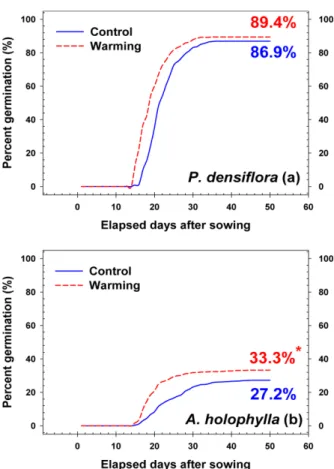
온난화 처리에 따른 대기 온도 상승으로 소나무 발아율 은 약 2.5% 높아졌지만, 유의적 차이는 없었다(P=0.41) (Figure 2a). 이러한 결과는 Pinus sylvestris가 대조구와 대 기 온도 5oC 상승 온난화 처리구간 유의적 차이 없이 두 처리구 모두 85% 이상 높은 발아율을 보였다는 결과 (Matias and Jump, 2014)와 일치한 것이다. 소나무속 (Pinus)은 수종에 따라 차이는 있지만 대부분 약 25oC 온 도까지는 발아율이 증가하다가 그 이상의 온도가 되면 오 히려 감소한다고 보고(Escudero et al., 2002; Skordilis and Thanos, 1995)되고 있으며, 본 시험에서도 대조구와 온난화 처리구 모두 파종부터 발아가 지속되는 5월까지 25oC 이하의 대기 온도 환경이었기 때문에 온난화에 따라 발아가 촉진된 것으로 판단된다.
전나무 발아율은 온난화 처리구가 대조구보다 유의적 차이를 보이면서 약 5% 높은 값을 나타냈다(P<0.05) (Figure 2b). 이는 Abies lasiocarpa가 10oC와 15oC 온도 처리구보다 20oC와 25oC 처리구에서 유의적으로 발아율 이 높아졌다는 결과와 같은 것이다(Knapp and Smith, 1982). 또한 북극 툰드라 지역 고산 수종을 대상으로 상부 개방형 챔버를 이용한 온난화 실험 결과에서도 온난화 처 리구가 대조구보다 약 10-30% 높은 발아율을 보였다고 보 고되고 있다(Klady et al., 2011). 한대성 수종인 전나무속 Figure 1. Monthly mean air (a) and soil (b) temperatures and soil water contents (c) in control and warmed plots in 2012.
(Abies)은 대기 온도 상승에 따라 발아율이 소나무보다 민 감하게 반응했음을 알 수 있으며, 휴면이 타파된 종자는 발아 임계온도 이하에서는 온도 상승으로 인해 발아가 촉 진된 것으로 판단된다(Bonner et al., 2008).
온대 산림(Thompson and Naeem, 1996), 한대 습지 (Hogenbirk and Wein, 1992), 아고산 초지(Harte and Shaw, 1995) 등 다양한 지역에서 토양 온도 상승에 따라 초본 및 수목의 발아율이 높아진다는 보고가 있으며, 이 는 발아 생리 촉진, 종자 휴면 타파 등의 영향으로 알려져 있다(Hoyle et al., 2013). 본 연구에서도 적외선등에 의한 토양 온도 상승으로 발아가 촉진된 것으로, 3-5월까지 온 난화 처리구 토양 온도가 15oC 이하이기 때문에 온도 스 트레스 없이 대조구보다 발아 촉진이 이루진 것으로 판단
인한 토양 수분 부족이 발아율 감소의 주된 요인이라 밝 혔다. 또한, 이러한 결과는 지중해지역 참나무류에서도 나 타났는데(Galiano et al., 2010) 이는 향후 지구 온난화에 따른 대기 및 토양 온도 상승이 건조지역 또는 강우량이 적은 지역에는 부정적 영향이 더욱 클 수 있음을 시사하 는 것이다.
종자가 발아하기 위해서는 종자가 건전하고, 종자 자체 의 물리적, 화학적, 생리적 발달장애 요인이 제거되어야 하며, 온도, 수분, 광선, 공기 등의 외부 환경요인이 적합 해야 한다(Kozlowski et al., 1991). 특히, 토양 수분함량 부족에 의한 수분 스트레스는 종자 발아 및 유묘의 생존 율에 부정적 영향을 미친다(Little et al., 1994; Germino et al., 2002; Legras et al., 2010). 그러나 본 연구에서는 발아 기간 중 온난화 처리에 따른 온도 상승으로 대조구 와 온난화 처리구 간의 토양 수분함량 차이가 크게 나타 나지 않았으며, 수종별 발아 임계온도 이상으로 온도가 상 승하지 않았기 때문에 두 수종 모두 발아율이 감소하는 현상은 없었으며, 오히려 발아 조건에 영향을 미치는 온 도의 상승으로 발아 촉진에 의해 실외의 실질적인 양묘과 정에서 전나무의 발아율은 높아진 것이다. 소나무(Pinus brutia)가 동일 수분 조건에서는 15oC 온도 처리구보다 20oC 온도 처리구에서 높은 발아율이 보인 결과와 같은 경향을 나타낸 것이다(Tilki and Dirik, 2007) 그러나 온난 화에 의한 양적인 발아율 증가가 궁극적인 묘목 생장에 반드시 긍정적인 영향을 주는 것은 아니기 때문에 발아율 과 함께 생존율, 생장 및 생리 특성에 대한 다각적인 추가 조사가 필요하다.
평균발아일수는 소나무(P<0.01)와 전나무(P<0.05) 모두 유의적 차이를 보이면서 온난화 처리구가 대조구보다 감 소하였다. 또한 두 수종 모두 온난화 처리구에서 유의적 으로 높은 발아속도를 보였으며(P<0.001), 평균발아속도 는 전나무(P<0.01)에서만 유의적 차이를 보이면서 같은 결과가 나타났다. 발아세 역시 소나무(P<0.01)와 전나무 Figure 2. Effects of experimental warming on percent
germination of P. densiflora (a) and A. holophylla (b).
Table 1. Seed germination characteristics of two coniferous species in control and warmed plots.
Species Treatment Mean germination time (days)
Germination rate (seeds·day−1)
Mean daily germination (seeds·day−1)
Germination energy (%)
P. densiflora Control 22.0±1.5** 1.63±0.09 0.97±0.07 47.8±14.40.
Warming 19.5±1.30. 001.91±0.15*** 0.99±0.07 66.7±10.7**
A. holophylla Control 24.6±2.3*. 2.37±0.06 1.21±0.22 15.7±7.70..
Warming 20.5±1.30. 003.40±0.51*** 0.1.48±0.20** 27.2±4.8***. Values are means±SD (n=9). The t-test was used to compare the results of control and warmed plots. *, **, and ***indicate significant differences at p<0.05, p<0.01 and p<0.001, respectively.
(P<0.001) 모두 온난화 처리구가 대조구보다 높았다(Table 1). 소나무와 전나무 모두 온난화 처리에 따라 발아기간이 짧아지고, 발아속도는 빨라지는 것을 알 수 있었으며, 이 는 온도 상승으로 발아 촉진이 이루어지면서 짧은 기간 동안 많은 양의 종자가 발아된 것으로 판단된다. Milbau et al.(2009)은 아북극대(subarctic) 수종을 대상으로 2.5oC 온난화 처리에 따른 종자 발아 특성 연구를 실시하였는데, 대부분의 수종에서 온도 상승에 따라 발아율은 유의적 차 이가 없었지만, 평균발아일수는 온난화 처리에 따라 6-18 일까지 감소한다고 보고하였다. 또한 초본류에서도 온도 상승에 따라 평균발아일수가 감소하는 결과도 있다(Pérez- García et al., 2008). 반면, 온난화에 의한 건조 스트레스로 토양 수분 함량이 감소하여 소나무는 평균발아일수가 증 가하였고, 발아속도는 감소하는 반대의 결과도 보고되고 있다(Zhu et al., 2006). 그러나 온난화와 관련하여 본 연구 의 토양 수분 함량 결과(Figure 1)와 같이 발아 기간 중 수 분 스트레스가 없는 조건에서는 대기 및 토양 온도 상승 에 따라 발아기간이 짧아지고, 발아속도가 증가하는 결과 를 보인 것이다.
2. 생존율
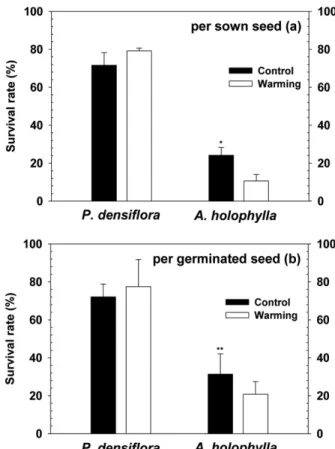
온난화 처리 후 파종립 당 유묘의 생존율은 전나무에서 유의적 차이를 보이면서 온난화 처리구보다 대조구가 높 게 나타났지만(P<0.05), 소나무는 온도 상승에 따른 차이 는 보이지 않았다(P=0.46)(Figure 3a). 또한 발아된 종자립 기준으로도 전나무에서 유의적 차이를 보이면서 온난화 처리구가 낮은 생존율을 나타냈다(P<0.01)(Figure 3b). 한
편, 소나무는 생존율이 온난화 처리에 따라 차이가 없었 으며, 전나무는 온난화에 따른 대기 및 토양 온도 상승으 로 종자 발아가 많이 이루어졌지만, 양묘기간 동안 지속 Figure 3. Effects of experimental warming on survival rate per sown seed (a) and per germinated seed (b) of two coniferous species.
Figure 4. The photograph of experimental sites on 27 September 2012: control (a) and warmed (b) plot of P. densiflora, control (c) and warmed (d) plot of A. holophylla.
문인 것으로 판단되며, Kullman(2007)은 온도 상승에 따 라 임분 내 치수 발생량은 많아지지만 종자 활력과 유묘 생장이 감소하여 고사율이 증가할 수 있다고 보고하였다.
또한 온대지역(Spain) 3월 온도 기준으로 온난화 처리구 (23oC)와 대조구(18oC)의 P. sylvestris 종자 발아율은 차이 가 없었지만, 발아 후 생존율은 약 50% 이상 감소한 결과 (Matias and Jump, 2014)와도 같은 경향으로 전나무는 묘 목의 생산적 측면에서 온난화에 따라 부정적인 피해를 많 이 받을 가능성이 높은 것으로 예상된다.
일반적으로 온도 상승에 따른 상호작용으로 토양 수분 감소가 나타나며, 이로 인한 결과로 묘목의 생장 및 생존 율이 감소한다고 보고되고 있다(Castro et al., 2005). 즉, 온난화에 따른 온도 상승은 동시에 수분 부족 현상을 초 래하며, 식물은 내부의 수분 손실을 막기 위한 방어기작 으로 기공을 닫아 증산율을 낮추어 광합성을 통해 CO2를 얻는 것보다 수분 손실을 감소 시켜 수분이용효율을 증대 시킨다(Cho et al., 2012). 그러나 식물이 기공을 닫게 되 면 엽육 세포내 CO2농도는 낮아지게 되고, 이에 따라 광 합성 능력 이 떨어지는 현상과 생육 저하를 동반하며 생존 율이 감소되는 것이다(Hernandez et al., 1995; Takemura et al., 2000). 온난화에 따른 온도의 상승은 식물체 엽육 온 도의 상승, 토양 내 증기압 결핍, 식물체 호흡 증가로 나 타난다(Chen et al., 1995). 즉, 온도 상승에 의해 수분 스 트레스가 발생되며 수분 조건과 온도 조건은 밀접한 연관 이 있는 것으로, 향후 한대수종 또는 내건성이 약한 수종 일수록 온난화에 따른 부정적 영향이 많이 나타날 것으로 예상된다(Galiano et al., 2010; Matias et al., 2012).
결 론
본 연구는 전 지구적으로 문제가 되고 있는 지구 온난 화와 관련하여, 대기 온도 상승에 따른 종자 발아 및 발아 후 생존율 변화를 알아보고자 실시하였다. 이를 위해서 온 난화에 의해 우선적으로 영향을 받을 것으로 예측되는 침 엽수종 중 소나무와 전나무를 대상으로 실외 실험적 온난 화 처리에 따른 종자 발아 특성 및 유묘의 생존율 변화를 조사하였다.
온난화 처리에 따른 대기 온도 상승으로 소나무 발아율 은 약 2.5% 높아졌지만, 유의적 차이는 없었다. 전나무 발 아율은 온난화 처리구가 대조구보다 유의적 차이를 보이 면서 약 5% 높은 값은 나타냈다. 평균발아일수는 소나무 와 전나무 모두 유의적 차이를 보이면서 온난화 처리구가
보다 높은 발아세를 나타냈다. 온난화 처리에 따른 파종 립 기준의 생존율은 전나무에서 유의적 차이를 보이면서 대조구가 높게 나타났지만, 소나무는 온도 상승에 따른 차 이를 보이지 않았다. 또한 발아된 종자립 기준으로는 전 나무에서 유의적으로 온난화 처리구가 낮은 생존율을 나 타냈다.
실험적 온난화에 따른 대기 온도 상승으로 소나무와 전 나무 모두 현재 발아율 기준을 유지하거나 높은 결과를 보였다. 또한 두 수종 모두 대기 온도 상승으로 발아기간 이 단축되고 발아속도가 높아지는 경향을 보였다. 그러나 전나무의 경우 온난화에 따라 발아된 묘목은 많아질 수 있지만, 고온 스트레스에 의해 고사율이 높아져서 묘목 생 산은 적어지는 현상이 나타났다. 또한 대기 온도 상승에 따라 소나무보다 전나무가 민감한 반응을 보였으며, 향후 전나무는 지구 온난화에 의해 양묘 과정에서 어려움이 있 을 것으로 예상된다. 이에 지구 온난화 대응 양묘기술 개 선과 함께 온난화에 적응 가능한 다양한 유전자원 확보 및 수종별 품종 개발 등의 대책 수립이 필요할 것으로 판 단된다.
감사의 글
본 연구는 산림청 ‘임업기술연구개발사업(과제번호 : S111114L030110)’의 지원을 받아 이루어진 것입니다.
References
Aronson, E.L. and McNulty, S.G. 2009. Appropriate experi- mental ecosystem warming methods by ecosystem, objec- tive, and practicality. Agricultural and Forest Meteorology 149(11): 1791-1799.
Bale, J.S., Masters, G.J., Hodkinson, I.D., Awmack, C., Beze- mer, T.M., Brown, V.K., Butterfield, J., Buse, A., Coulson, J.C., Farrar, J., Good, J.E.G., Harrington, R., Hartley, S., Jones, T.H., Lindroth, R.L., Press, M.C., Symrnioudis, I., Watt, A.D., and Whittaker, J.B. 2002. Herbivory in glo- bal climate change research: direct effects of rising tem- perature on insect herbivores. Global Change Biology 8(1):
1-16.
Barber, V.A., Juday, G.P., and Finney, B.P. 2000. Reduced growth of Alaskan white spruce in the twentieth century from temperature-induced drought stress. Nature 405: 668-673.
Bonner, F.T., Karrfalt, R.P. and Nisley, R.G. 2008. The Woody plant seed manual. USDA Forest Service. Washington.
pp. 1223.
Castro, J., Zamora, R., Hodar, J.A., and Gomez, J.M. 2005. Alle- viation of summer drought boosts establishment success of Pinus sylvestris in a Mediterranean mountain: an experimental approach. Plant Ecology 181: 191-202.
Chen, J., Franklin, J.F., and Spies, T.A. 1995. Growing sea- son microclimatic gradients from clearcut edges into old- growth Douglas-fir forests. Ecological Applications 5: 74- 86.
Cho, M.S., Lee, S.W., Hwang, J., and Kim, J.W. 2012. Growth performance and photosynthesis of two deciduous hard- wood species under different irrigation period treatments in a container nursery system. Korean Journal of Agricul- tural and Forest Meteorology 14(1): 28-38 (in Korean with English abstract).
Chung, H., Muraoka, H., Nakamura, M., Han, S., Muller, O., and Son, Y. 2013. Experimental warming studies on tree species and forest ecosystems: a literature review. Jour- nal of Plant Research 126: 447-460.
Climate Change Information Center. 2014. IPCC SRES A1B scenario. https://www.climate.go.kr:8005/index.html (2014.
2. 24).
Danby, R.K. and Hik, D.S. 2007. Responses of white spruce (Picea glauca) to experimental warming at a subarctic alpine treeline. Global Change Biology 13(2): 437-451.
Escudero, A., Pérez-García, F., and Luzuriaga, A.L. 2002.
Effects of light, temperature and population variability on the germination of seven Spanish pines. Seed Science Research 12(4): 261-271.
Farnsworth, E.J., Nunez-Farfan, J., Careaga, S.A., and Baz- zaz, F.A. 1995. Phenology and growth of three temperate forest life forms in response to artificial soil warming.
Journal of Ecology 83: 967-977.
Galiano, L., Martinez-Vilalta, J., and Lloret, F. 2010. Drought- induced multifactor decline of Scots pine in the Pyrenees and potential vegetation change by the expansion of co- occurring oak species. Ecosystems 13: 978-991.
Germino, M.J., Smith, W.K., and Resor, A.C. 2002. Conifer seedling distribution and survival in an alpine-treeline ecotone. Plant Ecology 162: 157-168.
Gunderson, C.A., Edwards, N.T., Walker, A.V., O'Hara, K.H., Campion, C.M., and Hanson, P.J. 2012. Forest phenology and a warmer climate-growing season extension in relation to climatic provenance. Global Change Biology 18(6): 2008- 2025.
Harte, J. and Shaw, R. 1995. Shifting dominance within a mon- tane vegetation community: results of a climate-warming experiment. Science 267: 876-880.
Hernandez, J., Olmos, A.E., Corpas, F.J., Sevilla, F., and Rio, A. 1995. Salt-induced oxidative stress in chloroplasts of pea plant. Plant Science 105(2): 151-167.
Hillier, S.H., Sutton, F., and Grime, J.P. 1994. A new tech- nique for the experimental manipulation of temperature in
plant communities. Functional Ecology 8: 755-762.
Hogenbirk, J.C. and Wein, R.W. 1992. Temperature effects on seedling emergence from boreal wetland soils: implica- tions for climate change. Aquatic Botany 42: 361-373.
Houle, G. 1994. Spatiotemporal patterns in the components of regeneration of four sympatric tree species-Acer rubrum, A. saccharum, Betula alleghaniensis and Fagus grandifo- lia. Journal of Ecology 82: 39-53.
Hoyle, G.L., Venn, S.E., Steadman, K.J., Good, R.B., McAu- liffe, E.J., Williams, E.R., and Nicotra1, A.B. 2013. Soil warming increases plant species richness but decreases germination from the alpine soil seed bank. Global Change Biology 19(5): 1549-1561.
Ineson, P., Coward, P.A., and Hartwig, U.A. 1998. Soil gas fluxes of N2O, CH4 and CO2 beneath Lolium perenne under ele- vated CO2: The Swiss free air carbon dioxide enrichment experiment. Plant and Soil 198: 89-95.
IPCC. 2007. Climate change (2007): The physical science basis. Working Group I Contribution to the Fourth Assess- ment Report of the IPCC. Cambridge University Press, Cambridge.
Jo, W., Son, Y., Chung, H., Noh, N.J., Yoon, T.K., Han, S., Lee, S.J., Lee, S.K., Yi, K., and Jin, L. 2011. Effect of artifi- cial warming on chlorophyll contents and net photosyn- thetic rate of Quercus variabilis seedlings in an open-field experiment. Journal of Korean Forest Society 100(4): 733- 737 (in Korean with English abstract).
Kimball, B.A., Conley, M.M., Wang, S., Lin, X., Lou, C., Morgan, J., and Smith, D. 2008. Infrared heater arrays for warming ecosystem field plots. Global Change Biology 14(2): 309-320.
Klady, R.A., Henry, G.H.R., and Lemay, V. 2011. Changes in high arctic tundra plant reproduction in response to long term experimental warming. Global Change Biology 17:
1611-1624.
Knapp, A.K. and Smith, W.K. 1982. Factors influencing under- story seedling establishment of Engelmann spruce (Picea engelmannii) and subalpine fir (Abies lasiocarpa) in south- east Wyoming. Canadian Journal of Botany 60(12): 2753- 2761.
Korea Forest Service. 2012. The guidelines for seed and nursery practices. KFS. p. 58 (in Korean).
Kozlowski, T.T., Kramer, P.J., and Pallardy, S.G. 1991. The physiology of woody plants. A.P. New York. pp. 811.
Kullman, L. 2007. Tree line population monitoring of Pinus sylvestris in the Swedish Scandes, 1973-2005: implications for tree line theory and climate change ecology. Journal of Ecology 95(1): 41-52.
Lee, S.J., Han, S., Yoon, T.K., Chung, H., Noh, N.J., Jo, W., Park, C. Ko, S., Han, S.H., and Son, Y. 2012. Effects of experimental warming on growth of Quercus variabilis seedlings. Journal of Korean Forest Society 101(4): 722- 728 (in Korean with English abstract).
with English abstract).
Legras, E.C., Vander Wall, S.B., and Board, D.I. 2010. The role of germination microsite in the establishment of sugar pine and Jeffrey pine seedlings. Forest Ecology and Man- agement 260: 806-813.
Lewis, J.D., Lucash, M., Olszyk, D., and Tingey, D.T. 2001.
Seasonal patterns of photosynthesis in Douglas fir seed- lings during the third and fourth year of exposure to ele- vated CO2 and temperature. Plant Cell & Environment 24: 539-548.
Little, R.L., Peterson, D.L., and Conquest, L.L. 1994. Regen- eration of subalpine fir (Abies lasiocarpa) following fire- effects of climate and other factors. Canadian Journal of Forest Science 24: 934-944.
Lloret, F., Peñuelas, J., Prieto, P., Llorens, L., and Estiarte, M. 2009. Plant community changes induced by experi- mental climate change: Seedling and adult species com- position. Perspectives in Plant Ecology, Evolution and Systematics 11(1): 53-63.
Luomala, E.M., Laitinen, K., Kellomaki, S., and Vapaavuori, E. 2003. Variable photosynthetic acclimation in consecu- tive cohorts of Scots pine needles during 3 years of growth at elevated CO2 and elevated temperature. Plant Cell & Environment 26: 645-660.
Matias, L. and Jump, A.S. 2014. Impacts of predicted climate change on recruitment at the geographical limits of Scots pine. Journal of Experimental Botany 65(1): 299-310.
Matias, L., Zamora, R., and Castro, J. 2012. Rare rainy events are more critical than drought intensification for woody recruitment in Mediterranean mountains: a field experi- ment simulating climate change. Oecologia 169: 833-844.
Milbau, A., Graae, B.J., Shevtsova, A., and Nijs, I. 2009. Effects of a warmer climate on seed germination in the subarc- tic. Annals of Botany 104(2): 287-296.
Morin, X., Roy, J., Sonié, L., and Chuine, I. 2010. Changes in leaf phenology of three European oak species in response to experimental climate change. New Phytologist 186(4):
900-910.
Morison, J.I.L. and Lawlor, D.W. 1999. Interactions between increasing CO2 concentration and temperature on plant growth. Plant Cell & Environment 22: 659-682.
Nakamura, M., Muller, O., Tayanagi, S., Nakaji, T., and Hiura, T.
2010. Experimental branch warming alters tall tree leaf phenology and acorn production. Agricultural and Forest Meteorology 150(7-8): 1026-1029.
Pérez-García, F., González-Benito, M.E., and Gómez-Campo, C. 2008. Germination of fourteen endemic species from the Iberian Peninsula, Canary and Balearic Islands after
gas fluxes and N availability to experimentally elevated temperatures. Ecological Applications 4(3): 617-625.
Rustad, L.E., Campbell, J.L., Marion, G.M., Norby, R.J., Mitch- ell, M.J., Hartley, A.E., Cornelissen, J.H.C., Gurevitch, J., and GCTE-NEWS. 2001. A meta-analysis of the response of soil respiration, net nitrogen mineralization, and above- ground plant growth to experimental ecosystem warm- ing. Oecologia 126(4): 543-562.
SAS Institute Inc. 2000. SAS/STAT TM guide for personal com- puter. Version 8 edition. SAS Institute Inc., N.C. pp. 1026.
Saxe, H., Ellsworth, D.S., and Heath, J. 1998. Tree and for- est functioning in an enriched CO2 atmosphere. New Phy- tologist 139: 395-436.
Scott, S.J., Jones, R.A., and Williams, W.A. 1984. Review of data analysis methods for seed germination. Crop Science 24:
1192-1199.
Skordilis, A. and Thanos, C.A. 1995. Seed stratification and germination strategy in the Mediterranean pines Pinus brutia and P. halepensis. Seed Science Research 5(3): 151-160.
Takemura, T., Hanagata, N., Sugihara, K., Baba, S., Karube, I., and Dubinsky, Z. 2000. Physiological and biochemical responses to salt stress in the mangrove, Bruguiera gymn- orrhiza. Aquatic Botany 68(1): 15-28.
Teskey, R.O. 1997. Combined effects of elevated CO2 and air temperature on carbon assimilation of Pinus taeda trees.
Plant Cell & Environment 20: 373-380.
Thompson, L.J. and Naeem, S. 1996. The effects of soil warm- ing on plant recruitment. Plant and Soil 182: 339-343.
Thuiller, W., Albert, C., Araújo, M.B., Berry, P.M., Guisan, A., Hickler, T., Midgley, G.F., Paterson, J., Schurr, F.M., Sykes, M.T., and Zimmermann, N.E. 2008. Predicting global change impacts on plant species’ distributions: Future challenges. Perspectives in Plant Ecology, Evolution and Systematics 9: 137-152.
Tilki, F. and Dirik, H. 2007. Seed germination of three prove- nances of Pinus brutia (Ten.) as influenced by stratifica- tion, temperature and water stress. Journal of Environmental Biology 28(1): 133-136.
Walck, J.L., Hidayati, S.N., Dixon, K.W., Thompson, K., and Poschilod, P. 2011. Climate change and plant regenera- tion from seed. Global Change Biology 17(6): 2145-2161.
Zhu, J., Kang, H., Tan, H., and Xu, M. 2006. Effects of drought stresses induced by polyethylene glycol on germination of Pinus sylvestris var. mongolica seeds from natural and plantation forests on sandy land. Journal of Forest Research 11(5): 319-328.
(2014년 3월 10일 접수; 2014년 5월 29일 채택)