A Study on the Effect of Conversing Action Learning in a Collaborative EFL Classroom
Myeong-Hee Shin
Professor, Talmage Liberal Arts College, Hannam University
협력형 EFL 교실에서 실천학습 융합 효과에 관한 연구
신명희
한남대학교 탈메이지 교양교육대학 교수
Abstract The purpose of this study is to investigate the effect of action learning methods and practices, which have a research focus on learner-centered teaching after training students to use collaborative learning practices from the viewpoint that the learners acquire English skills through peer correction activities based on sociocultural learning theory[1]. From March 1, 2018 to June 15, 2018, one control class and one experimental group were selected from the general freshman English courses. The experimental group attended classes centered on collaborative writing activities using action learning and cooperation techniques, and the control group attended classes lecture style and rote learning methods to teach writing. The result of study has shown that, for the experimental group, there have been statistically significant results in the production of writing, such as the number of words, the number of sentences, and sentence length. Learners could share the knowledge or ideas of others in their learning relationships with more regular basis.
Key Words : Action learning, Communication skills, Learner-centered, Collaborative writing, Cooperate techniques
요 약 본 연구의 목적은 교양영어 학습자들을 대상으로 실천학습(Action learning) 기법을 활용한 영어 수업 사례 연구를 통하여 그 효과를 알아보고자 했다. 본 연구는 학습자 중심 수업을 기본으로 하여 학습자 간의 상호수정 활동을 통해 영어 기술을 익힐 수 있다는 것에 연구의 가치를 두고 실천학습(Action learning)을 수업에 활용함으로써 그 효과 를 알아보고자 했다. 2018년 3월 1일부터 2018년 6월15일까지 교양 영어 두개 반(실험반, 통제반) 학생을 대상으로 하였으며 실험 집단은 실천학습(Action learning) 협력기법을 활용한 협력쓰기 수업을 진행하고, 통제 반은 교수자가 기존에 하던 방식의 쓰기 수업을 진행하여 비교하였다. 본 연구의 연구문제는 실천학습(Action learning) 기법을 적용한 협력 쓰기 활동이 학생들의 쓰기 유창성에 어떠한 영향을 미치는가를 알아보고자했다. 연구결과, 실험집단의 경우 단어 의 수, 문장의 수와 문장 길이 등의 쓰기의 유창성 부분에서 통계적으로 유의미한 결과를 가져왔다. 학습자들은 학습 관계에서 더 깊이 있게 다른 사람들이 지닌 지식이나 생각을 공유하고 보다 규칙적인 근거를 가지고 근접발달영역 들어 갈 수 있었다.
주제어 : 실천학습, 의사소통 기술, 학습자 중심, 협력 쓰기, 근접발달영역
*This paper has been supported by 2019 Hannam University Research Fund.
*Corresponding Author : Myeong-Hee Shin([email protected]) Received May 2, 2019
Accepted July 20, 2019
Revised June 28, 2019 Published July 28, 2019
1. Introduction
It has become painfully obvious that education professional's methods and practices need to evolve to take advantage of the continuously changing social and professional paradigm. The current paradigm of education is the student-centered teaching with a hyper sensitivity to students’
moods, but the new opportunity emerging for effective learning is self-directly study and problem solving[1]. The purpose of this study is to verify the effectiveness of English learning by using the action learning and collaborative teaching methods supported by sociocultural learning theory in the EFL (English as a Foreign Language) classroom. The goal of general English education is to encourage learners to communicate in context using the target language, thereby enhancing their communication skills through meaningful language activities. In the course of collaboration, the importance of the cooperative atmosphere was paramount to enable students to acquire communication skills with the ability to effectively express concepts, such as respect, consideration and empathy[2].
As the importance of English fluency is emphasized and the frequency of exposure to meaningful input and output naturally increases, the ability to receive meaningful input through reading and listening to English is acquired relatively well, while the ability to create meaningful output through writing and speaking English is not acquired relatively well[3]. Nevertheless, as the ability to communicate thoughts and opinions fluently is demanded through out professional and social settings, expressive abilities such as writing clearly becomes detrimental to successful social and professional relationships. Carrying out writing activities suitable for the learner's developmental stage and cognitive level can give learners a sense of accomplishment and confidence because they can show others their abilities or degree of development[4].
Therefore, it is important for teachers to provide students with a chance to produce meaningful output in writing a writing activity where they can actually use the English vocabulary that they have learned. However, according to a recent study that analyzed an EFL writing activity, the activity is often more focused on the level of teacher driven writing than on free writing, more over the practice of writing consist of more than 80% of individual writing activities[5]. This mechanical learning of writing can be devastating to the motivation of learners because what they learn cannot be utilized in a practical context[6]. Most of the research was obtained from classes using tools and processes such as mind map and brainstorming, and after individual writing was completed, cooperation was utilized in error correction[7].
Even in English writing classes, it is necessary to enhance the role of teachers to help learners express idea clearly, communicate fluently with others and cooperate in an efficient and meaningful way. This study aims to apply the 'Action Learning' collaborative technique among the various collaborative techniques to the learning of English writing which can be an effective tool to better understand the impact of the role of the teacher in the acquiring writing skills.
Collaborative Learning has similar concepts and characteristics to Cooperative Learning, but it is not the same concept. Collaboration is based on the principle of interaction, and cooperation is said to be close to the structure of the interaction made to reach the objective[8]. Therefore, the wording described in this study can be defined as the continuing exchange of opinions required for teaching comprehensive writing skills, not just the completion and integration of individual parts, for a single composition.
Collaborative writing helps learners play a role as members of a sociocultural process by providing opportunities to help and scaffold
each other into the ZEP (Zone of Proximal Development) during the writing process[9].
Action Learning (AL) is the concept first applied to improve productivity in collective consulting conducted on miners in the UK, and was gradually proposed to solve intra-organizational problems in enterprises[10]. Since then, action learning has been defined as a series of processes and programs that enable a small group to benefit not only the members of each group but also the entire organization[11, 12]. In this paper, the meaning of action learning is defined as 'the process in which learning is realized by interacting with learners to solve a task or to explore a solution using a strategy guided by a teacher to solve a common practical task in a class.' Also the MASA program, which focuses on strengthening decision making capabilities, among the action learning stage models was used. The MASA refers to task management (M), analysis of causes (A), problem solving (S), and action (A)[13, 14].
In the management step, it is the process of selecting tasks, understanding tasks, and clarifying them. Learners will be able to identify the topic of the article and decide what topic to select based on their experience. In the analysis step, identify the factors involved in the final selected task and the underlying causes of those factors in various respects. The next step called problem solving is to present solutions and alternatives to the problem identified earlier.
Finally, the Action step is evaluated by the execution of the problem solution and the return.
Interest in the definition of fluency began with oral language. The concept of fluency is not explicitly emphasized because it is evaluated without considering the context at the time of writing[15]. In writing situations, the emphasis on fluency over grammatical accuracy is less on the mind of learners in EFL situations, resulting in more scholars who argue that they can generate
various ideas and produce a larger amount of writing[16].
The purpose of this study is to investigate the effect of action learning methods and practices, which have a research focus on a learner-centered teaching viewpoint that the learners acquire English skills through peer correction activities based on sociocultural learning theory. The research question in this study was to find out how collaborative speaking classes applied with action learning techniques affect students' fluency in writing. That is, how collaborative writing classes applied with action learning techniques affected the number of words students used in English sentences, the number of sentences, and the length of sentences.
2. Materials and Method
2.1 Subjects
The study examined 62 bachelor degree candidates taking their required general freshman English course. From March 1, 2018 to June 15, 2018, the experimental group (32 students) participated in a collaborative writing classes using action-learning cooperative techniques, while the control group (30 students).
2.2 Research Period and Procedures
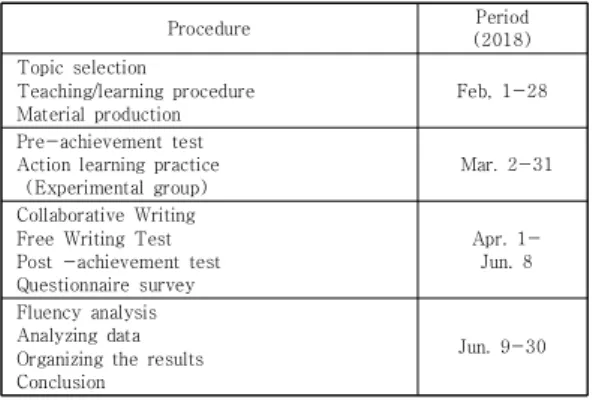
The specific steps and procedures of planning, preparation, data collection, data analysis and organization of this study are as follows. The research period was between February and June 0f 2018.
For the research on collaborative writing, we investigated previous research and related literature and devised a different research action plan in February, 2018. In March, 2018, A pre-test was conducted for comparison with the experimental post-test results. Because the experimental group was not accustomed to the
action learning, a pre-training was conducted for 20 minutes during the initial class time. The experimental group consisted of 10 lessons for a total of 10 weeks from April 1 to June 8, 2018.
Lastly, the scores of the final results were compared to measure the fluency of writing between the experimental and control groups by analyzing the completed writing from June 9 to June 30, 2018.
Procedure Period
(2018) Topic selection
Teaching/learning procedure Material production
Feb, 1-28
Pre-achievement test Action learning practice
(Experimental group)
Mar. 2-31
Collaborative Writing Free Writing Test Post -achievement test Questionnaire survey
Apr. 1- Jun. 8
Fluency analysis Analyzing data Organizing the results Conclusion
Jun. 9-30 Table 1. Research period and procedures
2.3 Instrument and Data Analysis
In order to confirm the homogeneity between the experimental group and the control group, the writing achievement test was performed and the significance of the group score was examined by t-test of the SPSS (Ver. 20) program.
In order to select the experimental group and the control group with similar writing achievement levels, an English writing achievement level test was conducted. A total of 25 questions and 4 points for each, and the p-value was 0.05 or more as a result of the t-test, indicating that there was no statistically significant difference between two classes.
Group M SD t p
Experimental 69.32 23.44
.132 .873
Control 69.01 24.97
Table 2. Analysis of achievement significance
3. Results
3.1 The Number of Words
Comparing the average of the total number of words in the final writing output over three times for each topic, the number of effective words in the experimental group was more than that of the control group. This can be statistically confirmed to be significant at p<0.05.
Group
Topic
M t p
turning point
describe people
favorite activity
Experimental 58.87 48.42 52.50 53.3
4.23 .014*
Control 52.02 37.21 48.98 46.1
Table 3. The number of words (* 0.01≦p<0.05)
3.2 The Number of Sentences
Comparing the total number of sentences of the final three drafts of each subject, we can see that the experimental group can produce one to two more sentences than the control group. The result of studies have shown that, for the experimental group, there has been statistically significant improvement of p<0.05.
Item Group
Topic
M t p
turning point
describe people
favorite activity
Number of sentences
Experimental 7.02 8.42 9.50 8.31
5.6 .012*
Control 6.97 7.21 8.98 7.72
Table 4. The number of English sentences and the length of sentences (* 0.01≦p<0.05)
3.3 The Length of Sentence
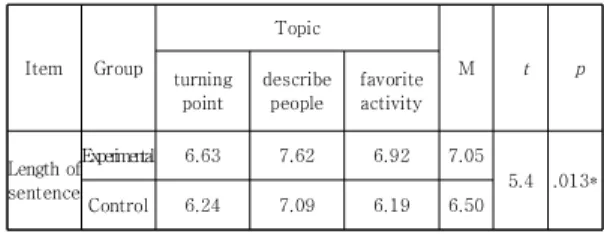
The length of sentences in experimental group was longer. Table 5 shows that the differences between the entries of the writing outcomes produced by the experimental and control groups are statistically significant at p<0.05
Item Group
Topic
M t p
turning point
describe people
favorite activity
Length of sentence
Experimental 6.63 7.62 6.92 7.05
5.4 .013*
Control 6.24 7.09 6.19 6.50
Table 5. The length of sentences (* 0.01≦p<0.05)
4. CONCLUSION AND DISCUSSION
The purpose of this study was to investigate the effect of applying action learning teaching methods and practices, which have a research focus from the learner-centered teaching viewpoint that the learners acquire English skills through peer correction activities by providing scaffolding as defined in a sociocultural learning theory.
The result of the study has shown that, for the experimental group, there have been statistically significant results in the production of writing, such as the number of words, the number of sentences, and sentence length. The number of effective words in the experimental group was greater than that of the control group. Regarding the number of the sentences, the experimental group can produce one to two more sentences than the control group. Also, the average length of the sentences in the experimental group was longer.
In conclusion, collaborative writing activities applied through action learning methods and practices guided by sociocultural learning theory can improve writing production compared to general process-oriented writing activities. The learners collaborate and scaffold each other into their ZPDs (Zones of Proximal Development) to effectively expand and efficiently screen how to create meaningful written output through action learning methods and practices. The result is students will be able to create papers with higher number of sentences with more words using English compared to students writing individually
in a lecture based class when converting their words into English and only receiving peer feedback at the end of the writing process.
However, it is somewhat difficult to generalize these results. Through a process-based collaborative writing activity using action learning methods and practices, thus the learners' writing fluency was measured using basic outputs such as number of words, number of sentences, and average sentence length, but the standards were not prepared and measured separately for grammatical accuracy. Also because of the limited amount research subjects, it is difficult to generalize this result of the study.
As a follow-up study, studies related to improving accuracy should be carried out in learners' free writing. In addition, process-oriented collaborative writing activities need to be studied as a class model.
REFERENCES
[1] R. Mitchell, F. Myles & E. Marsden. (2014). Second language learning Theories,3rd Ed. New York, USA.
Doi.org/10.4324/9780203770658
[2] Seoul Metropolitan Office of Education. (2016). Major business plans. Seoul: Seoul Metropolitan Office of Education
[3] Y. J. Jeon. (2010). Improvement of English Writing Ability for Pre-service English Teachers. English Language Education, 9(3), 251-273.
[4] D. Byrne. (1993). Teaching Writing ability.New York:
Longman Group Ltd.
doi.org/10.1080/0729436890080102
[5] D. K. Kim & E. Noh. (2016). Analysis of elementary school English textbook writing activities for effective writing guidance. Research in Humanities and Social Sciences, 17(1),435-465.
[6] H. R. Kim. (2011). Elementary English literacy instruction. Seoul: Education Science.
[7] E. J. Won. (2013). A Study on Improvement Method of English Writing by Elementary School Students through Collaborative Learning. Master Thesis.
Kookmin University, Seoul.
[8] L. Rebecca (2011). Cooperative Learning, Collaborative Learning, and Interaction: Three Communicative Strands in the Language Classroom. The Modern
language Journal. 81(4), 443-456.
Doi.org/10.1111/j.1540-4781.1997.tb05510.x
[9] N. Storch. (2005). Collaborative writing: Product, process, and students’ reflections. Journal of Second Language Writing, 14(3),153–173.
Doi.org/10.1016/j.jslw.2005.05.002
[10] R. Revans. (1980). Action learning: New techniques for management.London: Blond & Briggs, Ltd.
[11] M. J. Marquardt. (2004). Optimizing the power of action learning.Palo Alto: Davies-Black Publishing.
Doi.org/10.1177/1523422310367883
[12] S. H. Park, Y. S. Ahn & J. Y. Chung. (2010). Systematic Action Learning.Seoul: Academic Governor
[13] Y. S. Jung. (2013). A new approach to consulting crafts, building MASA capabilities. Seoul: History of Education and Science.
[14] D. Florence (2018). Guidelines for using behavioral skills training to provide teacher support. SAGeE Journal, 50(6),373-380
Doi.org/10.1177/0040059918777241
[15] M. K. Jeon. (2015). Analysis of Intergenerational Relationships among Middle School English Textbooks Using Automated Language Analysis Program.
Contemporary English Education, 16(1),195-218 [16] J. A. Hwang. (2010). Case study of the influence of
free writing on writing fluency on writing fluency &
confidence of EFL college-level students. Second Language Studies, 28(2), 97-134.
신 명 희(Myeong-Hee Shin) [정회원]
․ 2001년 2월 : Vancouver College TESOL
․ 2008년 8월 : 한국외국어대학교 영어 과(문학박사)
․ 2010년 9월 ~ 현재 : 한남대학교 탈 메이지교양교육대학 교수
․ 관심분야 : 언어와 문화, 교수법, 학습 자 중심 수업 전략
․ E-Mail : [email protected]