ISSN 2288-1069 (Online)
http://dx.doi.org/10.12925/jkocs.2020.37.4.848
우울증 예방을 위한 노인 운동프로그램 문헌 고찰
김대훈1,*
․서동녘
2,✝1숭실대학교 스포츠학부, 교수
2숭실대학교 일반대학원 생활체육학과, 대학원생
(2020년 8월 9일 접수: 2020년 8월 23일 수정: 2020년 8월 25일 채택)
The Analysis of Literature : Prevention of Depression through Exercise Program for the Elderly
Dae-Hoon Kim
1,*․Dong-Nyeuck Seo2,✝1,*
School of Sports, Soongsil University
2,✝
Department of Sports for All, Graduate School, Soongsil University (Received August 9, 2020; Revised August 23, 2020; Accepted August 25, 2020)
요 약 : 본 연구는 2010년부터 2020년 상반기까지 지난 10년간 노인들에게 우울증과 관련하여 운동프
로그램을 적용한 국내 선행문헌 42편을 연구대상으로 선정하여 선행연구 특성, 운동프로그램 적용기간, 운 동프로그램 구성, 노인 우울증에 대한 운동프로그램 효과에 대해 분석하였고 결론은 다음과 같다. 첫째, 선 행문헌에서 대부분 여성 노인과 혼성을 대상으로 한 연구가 대부분을 차지하였고 남성 노인을 대상으로 한 연구는 나타나지 않았다. 연령은 65세 이상이 대부분을 차지하였고, 피험자 수는 50명 이하가 가장 많이 차지하였다. 그룹에서는 운동군/통제군이 있는 선행연구가 대부분이었고 참여기관 및 지역은 거주지역/공 공기관 및 요양시설이 대부분을 차지하였다. 둘째, 운동프로그램 적용기간은 기간은 12주 이상 적용한 선 행연구가 대부분이었고, 주당 운동 빈도는 1-2회와 3-4회가 대부분을 차지하였다. 1회 운동시간에서 60분 의 운동프로그램을 적용한 선행문헌이 대부분을 차지하였다. 셋째, 운동프로그램 구성 내용은 유산소 운동 과 유·무산소가 복합된 복합운동으로 구성한 선행문헌이 대부분을 차지하였다. 넷째, 운동프로그램 효과에 대해서는 체력요소에 효과가 나타났으며 우울증과 인지기능에서 운동의 효과가 있음을 확인하였다.주제어 : 노인, 우울증, 예방, 운동, 프로그램
Abstract : This study selected 42 domestic preceded literatures that applied exercise programs to the
elderly for the past 10 years from 2010 to the first half of 2020 to analyze the characteristics of preceded research, applied period of exercise programs, configuration of exercise programs, and effectiveness of exercise programs on elderly depression, and the conclusion is as follows. First, the majority of the subjects were female and male/female elderly people in the preceding literature, and it appeared that there were no male subjects alone for any of the studies showed. The majority of the
✝
Corresponding author
(E-mail: [email protected])
ages were over 65 years old, and the number of subjects was 50 or less. In the group, preceded research with exercise/control groups was mostly predominant, and the participated institutions and regions accounted for the majority of the residential area/public institutions and sanatorium. Second, the period of the exercise program was mostly applied for more than 12 weeks, and the frequency of exercise per week was 1-2 times and 3-4 times. Most of the preceding literature was applied with a 60-minute exercise program during the one-time exercise period. Third, most of the contents of the exercise program consisted of a aerobic exercise alone and combination of aerobic·anaerobic exercise.
Fourth, it was confirmed that the effects of exercise programs were effective in physical fitness factors as well as in depression and cognitive function.
Keywords : Elderly, Depression, Prevention, Exercise, Program
1. 서 론
고령화 사회는 각 나라별 사회적 이슈(issue)라 할 수 있다. 우리나라도 예외는 아니며 2018년 고령자 통계에 따르면, 65세 이상 노인 인구가 전체인구 중 차지하는 비율이 14.3%로 2000년 초반에 진입한 고령화 사회(전체인구 중 노인 인 구 비율이 7%)에서 불과 17년 만에 고령사회에 들어왔다[1]. 이러한 고령화 현상으로 인해 노인 의 건강문제가 대두되고 있으며 최근 세계보건기 구[2]에 따르면 세계적으로 3억 명 이상이 우울 증을 앓고 있고 이 증상은 노인 자살의 원인이기 도 하고 사회적 비용 또한 만만치 않은 점 등 우 울증 치료의 중요성에 공감하여 ‘2017년 세계 보 건의 날’을 맞아 우울증(depression)을 중점과제 로 선정 각국의 관심을 촉구한 바 있다[3]. 이와 관련하여 노인실태조사에 의하면 전국 975개 구 의 거주 노인 10,451을 대상으로 조사한 결과 고 연령, 배우자의 부재 등에서 인지기능 저하자의 비율이 높게 나타났으며, 이 중 33.1%가 우울증 상이 높은 것으로 나타나므로[4,5] 노인들에게서 인지기능과 우울증상이 높게 나타남을 알 수 있 다. 노년기에는 노화로 인해 신체기능의 저하와 인지기능 저하 등으로 노인 대부분이 우울감을 가지고 있으며[6] 우울은 노인들의 정신건강에 중요한 요소이며, 경증 우울군을 포함하여 66%
에 달하여 노인의 우울증은 결코 간과해서는 안 될 심리 문제[7]이며, 방치할 시 궁극적으로 노인 의 삶의 질을 떨어뜨리는 결과를 초래할 수 있 다. 따라서 노인과 관련된 건강문제는 신체적 문
제뿐만 아니라 심리적 접근 또한 필요할 것이다.
한편, 지난 20년간 선행연구에서 연구된 우울 증과 운동과의 관계에 대한 자료를 수집하여 검 토한 결과 임상 노인 환자들의 우울증 치료에 운 동이 효과적임으로 밝혀졌다[8]. 선행연구를 보 면, 무릎 관절염을 앓고 있는 노인들이 지속적으 로 걷기 프로그램에 참여하면 우울증 감소에 도 움이 된다고 보고[9]하였고, 유산소 운동은 노인 우울증 완화에 효과가 있는 것으로 보고[10]함으 로 운동이 우울증을 앓고 있는 노인들에게 효과 가 있음을 보고하였다. 또한, 규칙적인 운동과 신 체활동이 노인의 정신건강에 긍정적 영향을 주며, 근력운동 시 노인의 운동에 대한 흥미도와 집중 도는 증가하고 우울도는 감소한다고 보고[11]한 연구, 또 48주간 복합운동 프로그램 실시 후 우 울요인의 변화량을 측정한 결과 거의 모든 요인 에서 우울 증세가 호전되었다고 보고[12]한 연구 들로 보아 운동은 노인들의 건강개선에 긍정적 영향을 주는 것을 알 수 있다.
따라서, 노인 우울증과 관련하여 여러 가지 운 동프로그램을 적용하여 우울증 예방 및 감소를 보고하였던 기존 선행문헌을 분석하고 나아가 새 로운 운동프로그램을 개발하는 데 있어 기존 선 행문헌을 분석하는 것은 매우 의미가 있는 것으 로 판단된다. 따라서 최근 10년간 국내 학회지에 발행된 노인 우울증과 관련된 운동프로그램의 연 구 동향을 조사하고 노인의 우울증 감소 및 예방 할 수 있는 다양한 운동프로그램을 개발하는데 기초자료를 제시하는데 본 연구의 목적이 있다.
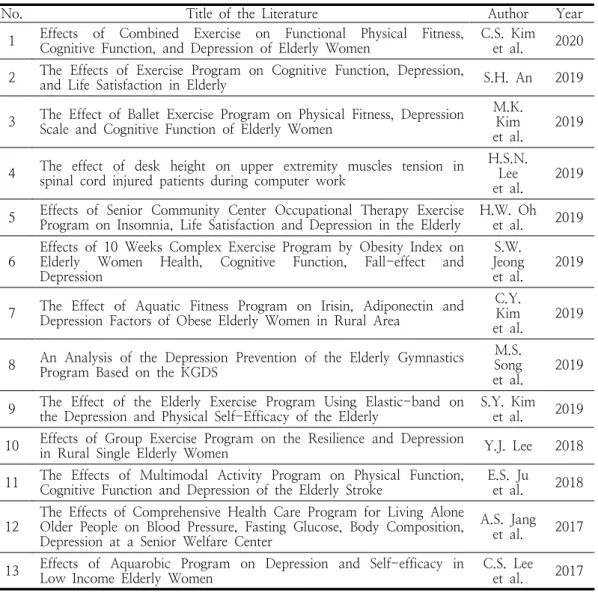
Table 1. List of Literature Review
No. Title of the Literature Author Year
1 Effects of Combined Exercise on Functional Physical Fitness, Cognitive Function, and Depression of Elderly Women
C.S. Kim et al. 2020 2 The Effects of Exercise Program on Cognitive Function, Depression,
and Life Satisfaction in Elderly S.H. An 2019
3 The Effect of Ballet Exercise Program on Physical Fitness, Depression Scale and Cognitive Function of Elderly Women
M.K.
Kim et al.
2019
4 The effect of desk height on upper extremity muscles tension in spinal cord injured patients during computer work
H.S.N.
Lee et al.
2019
5 Effects of Senior Community Center Occupational Therapy Exercise Program on Insomnia, Life Satisfaction and Depression in the Elderly
H.W. Oh et al. 2019 6
Effects of 10 Weeks Complex Exercise Program by Obesity Index on Elderly Women Health, Cognitive Function, Fall-effect and Depression
S.W.
Jeong et al.
2019
7 The Effect of Aquatic Fitness Program on Irisin, Adiponectin and Depression Factors of Obese Elderly Women in Rural Area
C.Y.
Kim et al.
2019
8 An Analysis of the Depression Prevention of the Elderly Gymnastics Program Based on the KGDS
M.S.
Song et al.
2019
9 The Effect of the Elderly Exercise Program Using Elastic-band on the Depression and Physical Self-Efficacy of the Elderly
S.Y. Kim et al. 2019 10 Effects of Group Exercise Program on the Resilience and Depression
in Rural Single Elderly Women Y.J. Lee 2018
11 The Effects of Multimodal Activity Program on Physical Function, Cognitive Function and Depression of the Elderly Stroke
E.S. Ju
et al. 2018 12
The Effects of Comprehensive Health Care Program for Living Alone Older People on Blood Pressure, Fasting Glucose, Body Composition, Depression at a Senior Welfare Center
A.S. Jang et al. 2017 13 Effects of Aquarobic Program on Depression and Self-efficacy in
Low Income Elderly Women
C.S. Lee et al. 2017
2. 연구방법
2.1. 연구대상
본 연구의 대상은 2010년부터 2020년 현재까 지 10년간 국내에서 발행된 노인을 대상으로 우 울증관련 운동프로그램을 적용한 선행문헌으로 자료 수집은 한국교육학술정보원 검색 사이트에 서 검색어로 노인, 우울증, 운동, 프로그램으로 검색하여 총 58편의 선행문헌을 수집하였다. 총 58편 중 KCI등재지와 등재후보지에 출판되지 않 은 논문 8편, 우울관련 메타분석을 활용한 논문, 이론검증 논문, 그리고 고찰 논문 등 8편은 제외
시켰는데 그 이유는 처치집단과 비교집단이 있어 야 하며 종속변수가 우울과 동일하지 않았기 때 문에 제외되었다. 이와 같은 기준으로 최종 42편 의 선행문헌을 연구대상으로 분석하였다. 선행연 구 분석대상은 <표 1>과 같다.
2.2. 선행 문헌 분석 내용
본 연구에서 우울관련 운동프로그램을 분석하 기 위해 항목을 정하였고 다음과 같다.
2.2.1. 선행문헌의 특성
본 연구에서는 선행문헌의 연구대상 특성을 알
No. Title of the Literature Author Year 14 The Effect of a 12 Week-Yoga Exercise on Body Composition,
Flexibility and Gloom in the visually impaired Elderly
H.C. Kim et al. 2017 15 Effects of Circuit Exercise on Functional Fitness, Estradiol, Serotonin,
Depression and Cognitive Function in Elderly Women
S.M. Ha et al. 2017 16
The Effects of Kouksundo Program on Functional Fitness, Musculoskeletal Pain, Quality of Life and Depression in Elderly Women
Y.A. Choi et al. 2017
17
The Effects of Physical Functions and Depression on Quality of Life According to Fall Prevention Exercise -Applying Otago Exercise Program with Music-
B.Y. Son et al. 2016 18 The Effect of Exercise program with Singing on the Depression and
Life Satisfaction in Single Elderly Women Y.J. Lee 2016 19 The Effects of a Regular Walking Program on Body Composition,
Functional Fitness, and Anxiety and Depression in Elderly Women S.C. Lee 2016 20
The Effects of Activity in Rhythem Movement on Depressive Mood, Behavioral and Psychological Symptoms in Elderly with Mild Alzheimer’s Disease
H.J.
Hong 2016 21 The Effect of Line Dance Program on Depression and Life
Satisfaction among Single Elderly Women Y.J. Lee 2016 22
The Effects of Exercise-Cognitive Combined Dual-Task Program on Cognitive Function and Depression in Elderly with Mild Cognitive Impairment
K.A. Kim et al. 2015
23 The Effects of the Cognitive Enhancement Program on Memory, Depression and Quality of Life in Elderly
H.W.
Shin et al.
2015
24 Effects of a 13-week outdoor group walking exercise on depression and its related variables in elderly women
Y.G. Huh et al. 2014 25 Effect of a 12 Week-Aerobic Exercise Program on Physical Fitness,
Depression, and Cognitive Function in the Elderly
J.H. Han et al. 2014 26 The Effect of Exercise on Senior' Depression in Local Area J.J. Bae
et al. 2014 27 The Effects of Taekwondo Training Program on Self-esteem and
Depression of the Elder
B.H. Kim et al. 2014 28 The Effort of Will Dance Program being based on Pure based on
Depression of the Elderly
K.H. Lee et al. 2013 29
The Effects of an Exercise Program using a Resident Volunteer as a Lay Health Leader for Elders’ Physical Fitness, Cognitive Function, Depression, and Quality of Life
Y.H.
Choi et al.
2013
30 The Effects of Qi-gong Exercise and Elastic Band Exercise on Fitness, ADL and Depression in Elderly Women
Y.S. Kim et al. 2013 31
Effects of a Muscle Strengthening Exercise Program on Muscle Strength, Activities of Daily Living, Health Perception, and Depression in Post-stroke Elders
G.Y. Kim et al. 2012 32 Effect of Combined Exercise Program for 16 Weeks on
Health-Related Physical Fitness and Depression in Elderly Women
Y.K. Chu et al. 2012
No. Title of the Literature Author Year 33 Effects of the BeHaS Exercise Program on Hand Strength, Depression
and Life Satisfaction in Institutionalized Elders with CVA
E.H. Seo et al. 2012 34 The Effects of 12-week Combined Exercise training on Body
Composition, Cognition and Depression in Elderly women
J.H. Kang et al. 2011 35 Effects of Rhythmic Exercise Program on the Perceived Health
Status, Depression, Life Satisfaction and Physical Strength in Elderly
S.M. Kim et al. 2011 36 Effects of the Aquatic Exercise Program on Body Fat, Skeletal
Muscle Mass, Physical Fitness and Depression in Elderly Women
M.S.
Song et al.
2011
37 The Effect of Danjeon Breathing and Walking Exercise on Activities
of Daily Living, Life Stress and Depression in the Elderly Women N.I. Kim 2011 38 The Effects of Worship Dance Program on Health-related Factor
and Psychological Health in the Elderly Women
S.J. Lee
et al. 2011 39 Effects of Folk Dance Program on Health Physical Fitness, Pain and
Depression in Older Female
S.B. Kim et al. 2010 40 Effect of Resistance Exercise Training on Metabolic Syndrome and
Depression in Elderly Women
H.J. Son et al. 2010 41 Effects of Recreation Combined Exercise Program in Body
Composition, Physical Fitness and Depression in Elderly
M.S.
Song 2010 42
The Effects of Regular Walking Exercise on Metabolic Syndrome, Cardiovascular Risk Factors, and Depressive Symptoms in the Elderly with Diabetic Mellitus
K.W.
Sung et al.
2010
아보기 위해 성별, 연령, 피험자 수, 건강상태, 그 룹, 참여기관 및 지역으로 나눠 분석하였다.
2). 우울증과 관련된 운동프로그램 적용기간 우울 관련 운동프로그램 적용기간에 대해 기 간, 주당 횟수, 1회 운동시간으로 나눠 분석하였 다.
3). 우울증과 관련된 운동프로그램 구성 우울 관련 운동프로그램 구성에 대하여 각각 분석하였다.
4). 노인대상 우울증관련 운동프로그램 적용 효 과
노인에게 우울증 관련 운동프로그램 적용 후 효과 여부에 대해 분석하였다.
3. 연구결과 및 논의
3.1. 선행문헌 대상 특성
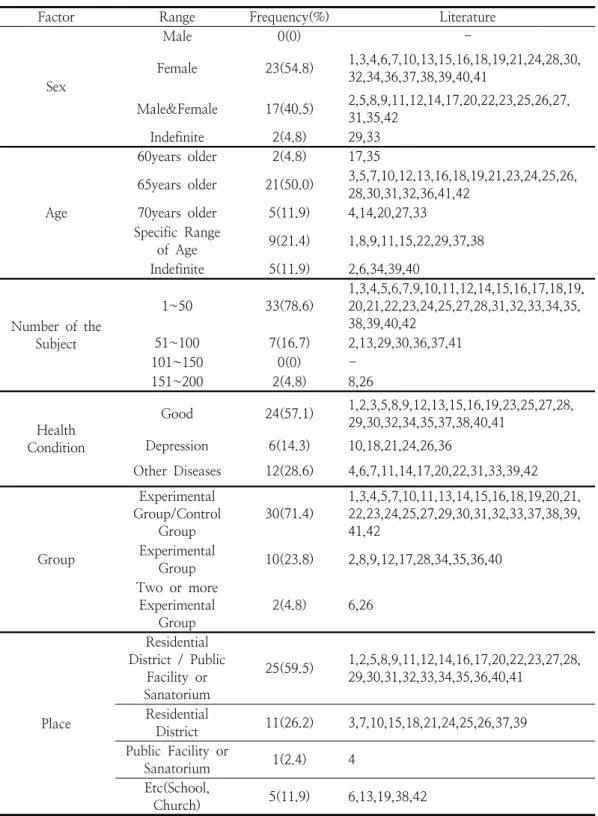
선행문헌 대상의 특성을 분석하기 위해 성별, 연령, 피험자 수, 건강상태, 그룹군, 참여기관 및 지역에 대한 분석은 <표 2>와 같다.
<표 2>에 따르면 성별에서는 여성 노인을 대상
으로 한 연구가 23편(54.8%), 혼성 17편(40.5%), 따로 성별을 밝히지 않은 논문 2편(4.8%), 남성 노인은 0편으로 조사되었다. 연령은 60세 이상 2 편(4.8%), 65세 이상 21편(50.0%), 70세 이상 5 편(11.9%), 특정 나이대는 9편(21.4%), 불명은 5 편(11.9%)을 차지하였다. 연구 피험자 수는 50명 이하 33편(78.6%), 51명-100명 7편(16.7%), 101 명-150명 0편, 151명-200명 2편(4.8%)을 차지 하였다. 건강상태는 양호하다 24편(57.1%), 우울 증상 6편(14.3%), 기타 질환 12편(28.6%)를 차 지하였으며, 그룹군에서는 운동군/통제군 30편 (71.4%), 운동군만 있는 군 10편(23.8%), 2개 이 상의 운동군 그룹 2편(4.8%)을 차지하였다. 마지 막으로 운동 참여기관 및 지역은 거주지역/공공 기관 및 요양시설 25편(59.5%), 거주지역 11편 (26.2%), 공공기관 및 요양시설 1편(2.4%), 기타 대학교 및 스포츠센터 등 5편(11.9%)으로 분석되 었다. 이와 관련하여 연구대상을 한번 살펴보면, 선행연구에서 여성 노인과 혼성노인들을 대상으 로 한 논문들이 대부분이고 남성 노인을 대상으 로 한 논문은 없었다. 그 이유는 표집 시 남성 노인보다는 여성 노인들이 공공기관이나 복지관
Table 2. Characteristics of the Subject
Factor Range Frequency(%) Literature
Sex
Male 0(0) -
Female 23(54.8) 1,3,4,6,7,10,13,15,16,18,19,21,24,28,30, 32,34,36,37,38,39,40,41
Male&Female 17(40.5) 2,5,8,9,11,12,14,17,20,22,23,25,26,27, 31,35,42
Indefinite 2(4.8) 29,33
Age
60years older 2(4.8) 17,35
65years older 21(50.0) 3,5,7,10,12,13,16,18,19,21,23,24,25,26, 28,30,31,32,36,41,42
70years older 5(11.9) 4,14,20,27,33 Specific Range
of Age 9(21.4) 1,8,9,11,15,22,29,37,38 Indefinite 5(11.9) 2,6,34,39,40
Number of the Subject
1~50 33(78.6)
1,3,4,5,6,7,9,10,11,12,14,15,16,17,18,19, 20,21,22,23,24,25,27,28,31,32,33,34,35, 38,39,40,42
51~100 7(16.7) 2,13,29,30,36,37,41
101~150 0(0) -
151~200 2(4.8) 8,26
Health Condition
Good 24(57.1) 1,2,3,5,8,9,12,13,15,16,19,23,25,27,28, 29,30,32,34,35,37,38,40,41
Depression 6(14.3) 10,18,21,24,26,36
Other Diseases 12(28.6) 4,6,7,11,14,17,20,22,31,33,39,42
Group
Experimental Group/Control
Group
30(71.4)
1,3,4,5,7,10,11,13,14,15,16,18,19,20,21, 22,23,24,25,27,29,30,31,32,33,37,38,39, 41,42
Experimental
Group 10(23.8) 2,8,9,12,17,28,34,35,36,40 Two or more
Experimental Group
2(4.8) 6,26
Place
Residential District / Public
Facility or Sanatorium
25(59.5) 1,2,5,8,9,11,12,14,16,17,20,22,23,27,28, 29,30,31,32,33,34,35,36,40,41
Residential
District 11(26.2) 3,7,10,15,18,21,24,25,26,37,39 Public Facility or
Sanatorium 1(2.4) 4
Etc(School,
Church) 5(11.9) 6,13,19,38,42
Table 3. Applied Period of Time
Factor Range Frequency(%) Literature
Period
Under 8 Weeks 1(2.4) 19 8 to Under
12 Weeks 12(28.6) 4,6,10,13,18,21,22,23,30,33,35,39 More than
12 Weeks 29(69.0)
1,2,3,5,7,8,9,11,12,14,15,16,17,20, 24,25,26,27,28,29,31,32,34,36,37, 38,40,41,42
Time of Exercise per Week
1~2 Times 18(42.9) 3,6,8,9,11,12,14,17,20,22,23,26,27, 28,33,37,39,41
3~4 Times 23(54.8) 1,2,4,5,7,10,13,15,16,18,19,21,24, 25,29,30,31,32,34,36,38,40,42
5 Times 1(2.4) 35
Exercise Hour per Time
Under 60 Minutes 13(31.0) 2,3,4,10,17,18,19,21,24,27,30,31,42 60 Minutes 22(52.4) 1,5,7,8,9,12,13,14,15,16,20,22,25,
26,28,29,32,33,35,36,40,41 Over 60 Minutes 7(16.7) 6,11,23,34,37,38,39 에서 시행하는 운동프로그램에 더 많은 기대와
관심을 가지고 있기 때문에 표집이 용이하였을 것이라 생각된다. 또는 선행연구에서 우울증 발생 비율이 남성 노인보다 여성 노인들에게서 우울증 발생 비율이 높다고 보고[13]함으로 선행연구에 서 여성 노인을 중점으로 연구를 시행했을 수도 있다고 생각된다. 따라서 앞으로 남자 노인들을 대상으로 진행하는 연구가 필요하다고 생각된다.
피험자 수와 관련해서는 운동프로그램 적용과 관 련된 선행연구이다 보니 다수 노인을 대상으로는 한계가 있을 것이며 표집 또한 쉽지가 않기 때문 에 50명 이하가 가장 많은 것으로 생각된다. 또 한, 노인의 특성상 타 지역으로의 이동이 원활하 지 않은 관계로 대부분 거주지역의 공공기관이나 요양시설에서 운동프로그램을 실시한 것으로 생 각된다.
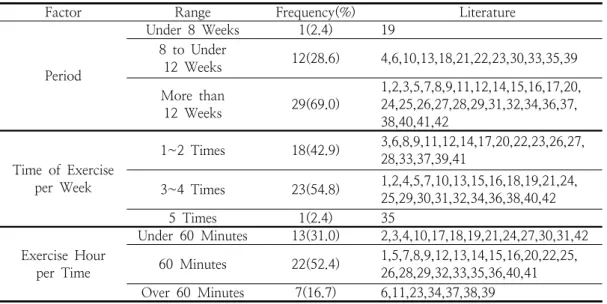
3.2. 노인 우울증관련 운동프로그램 적용 기간 우울증관련 운동프로그램 적용 기간, 빈도, 1회 운동시간은 <표 3>과 같다.
<표 3>에 따르면 기간은 8주 미만 1편(2.4%), 8주-12주 미만 12편(28.6%), 12주 이상 29편 (69.0%)으로 나타났다. 주당운동 빈도는 1-2회 18편(42.9%), 3-4회 23편(54.8%), 5회 가 1편 (2.4%)을 차지하였고, 1회 운동시간은 60분 미만 13편(31.0%), 60분 22편(52.4%), 60분 초과 7편 (16.7%)으로 분석되었다.
세부적으로 살펴보면, 운동 기간은 1편을 제외하 고 8주 이상 12주 미만을 적용한 선행연구 12편, 12주 이상 진행한 논문이 29편으로 8주 이상 운 동프로그램을 진행한 선행연구들이 대부분을 차 지하였으며, 주당운동 빈도는 1-4회가 진행되었 던 논문들이 대부분을 차지하였다. 또한, 1회 운 동시간에서 준비운동 포함하여 대다수 논문이 60 분 정도로 진행되었음을 알 수 있었다. 이와 관 련하여 연구주제는 조금 다르지만, 노인에게 적용 된 낙상 예방 프로그램 기간에서 노인 운동프로 그램은 10주 이상 진행되어야 한다는 미국 노인 사회(American Geriatric Society)의 지침이 있고 [14], 노인에게는 기초체력과 신체기능이 기타 다 른 연령대보다 상대적으로 낮으므로 주 2-3회 이상의 운동을 권장하며, 1회 운동시간도 60분 이내의 운동시간을 권장하는 미국스포츠의학회의 운동 처방 권고를 보고[15]함에 따라 본 연구결 과도 비슷한 결과가 나타난 것으로 생각된다.
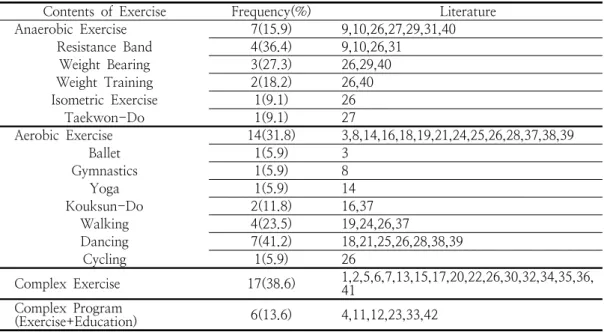
3.3. 노인 우울증관련 운동프로그램 구성 내용 노인 우울증관련 운동프로그램 구성 내용은
<표 4>와 같다. <표 4>에 따르면 무산소 운동 7 편(15.9%), 유산소 운동 14편(31.8%), 유·무산소 가 복합된 복합운동 17편(38.6%), 운동프로그램 과 교육을 병행한 복합프로그램 6편(13.6%)으로 분석되었다. 연구결과 무산소 운동보다는 유산소 운동과 유·무산소가 복합된 복합운동 프로그램이
Table 4. Configuration of the Exercise Program
Contents of Exercise Frequency(%) Literature Anaerobic Exercise 7(15.9) 9,10,26,27,29,31,40
Resistance Band 4(36.4) 9,10,26,31 Weight Bearing 3(27.3) 26,29,40 Weight Training 2(18.2) 26,40 Isometric Exercise 1(9.1) 26
Taekwon-Do 1(9.1) 27
Aerobic Exercise 14(31.8) 3,8,14,16,18,19,21,24,25,26,28,37,38,39
Ballet 1(5.9) 3
Gymnastics 1(5.9) 8
Yoga 1(5.9) 14
Kouksun-Do 2(11.8) 16,37
Walking 4(23.5) 19,24,26,37
Dancing 7(41.2) 18,21,25,26,28,38,39
Cycling 1(5.9) 26
Complex Exercise 17(38.6) 1,2,5,6,7,13,15,17,20,22,26,30,32,34,35,36, 41
Complex Program
(Exercise+Education) 6(13.6) 4,11,12,23,33,42 대부분을 차지하였는데 이와 관련하여 선행연구
를 살펴보면, 유산소 운동과 저항성 운동을 복합 적으로 실시하는 것이 단독적으로 실시하는 것보 다 더 효과적이라고 보고[16]한 연구, 65세 이상 75세 이하의 여성 노인을 대상으로 12주간 복합 운동을 실시한 결과 운동 후에 우울 정도가 유의 한 감소를 나타내었다고 보고한 연구[17]들이 복 합운동 프로그램이 우울 정도를 낮춰주는 긍정적 효과가 있음을 시사한다. 김종원[18]은 요양시설 에 있는 노인들을 대상으로 구조화된 운동프로그 램 실시 후 우울 증상이 감소한다고 하였고 노인 들을 대상으로 12주간 저 강도 운동을 실시하였 을 때 우울의 감소가 나타나며 운동종목보다 운 동프로그램의 구성형태가 많은 영향을 미친다고 보고[19]함으로써 다양한 운동프로그램 종목도 중요하지만, 운동프로그램의 구성형태 또한 중요 함을 시사하고 있다. 따라서 노인의 복합운동프로 그램 참가는 신체적 기능향상과 심리적 요소 모 두 긍정적 향상을 도모할 수 있는 효과적 운동프 로그램임을 확인할 수 있었고 이에 따라 다양한 유산소 및 복합 운동프로그램 개발이 필요하다고 생각된다.
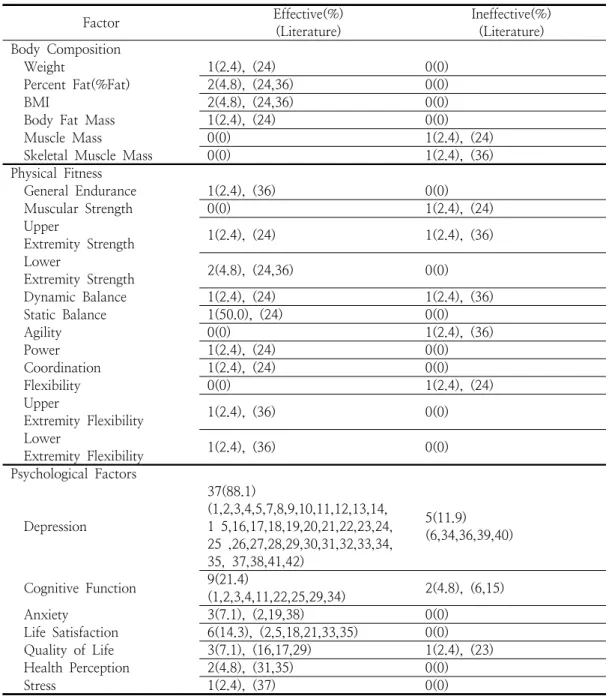
3.4. 노인 우울증관련 운동프로그램 효과 여부 노인 우울증관련 운동프로그램 적용 효과는
<표 5>와 같다. <표 5>에 따르면 신체조성에서 체지방률 2편(4.8%), BMI 2편(4.8%), 체력요소 에서는 신체지구력 1편(2.4%), 하지근력 2편 (4.8%), 상지근력 1편(2.4%), 평형성 1편(2.4%) 에서 효과가 나타났으며, 민첩성과 유연성에서는 노인대상 운동프로그램의 효과가 나타나지 않았 다. 그리고 심리요인인 우울증은 총 42편의 선행 문헌에서 운동의 효과가 나타난 논문은 37편 (88.1%)으로 나타났으며, 인지기능에서는 11편 중 9편(21.4%)이 나타나 노인에게 운동프로그램 적용 시 우울증과 인지기능에서 긍정적인 효과가 나타남을 확인할 수 있었다. 이와 관련하여 선행 연구를 살펴보면, 지속적 운동이 몸무게와 신체조 성에 있어서 긍정적 변화에 영향을 미친다고 보 고[20]한 연구, 12주간 순환 운동프로그램이 근 력, 근지구력, 민첩성 및 유연성을 증가시켰다고 보고[21]한 연구, 10주간의 복합운동 프로그램에 참여한 노인의 상지근력, 하지근력, 유연성, 심폐 체력, 동적 평형성이 유의하게 향상되었다고 보고 [22]한 연구, 34주간 복합 운동프로그램을 실시 한 결과 우울증을 나타내고 있는 여성 노인들이 30%의 우울증 감소를 가져왔다고 보고[23]한 연 구결과와 일치함을 알 수 있었다. 또한, 본 연구 에서 운동프로그램 적용 후 우울증과 인지기능의 긍정적 향상을 가져온 선행논문이 대부분이었는
Table 5. Effects of the Exercise Program
Factor Effective(%)
(Literature)
Ineffective(%) (Literature) Body Composition
Weight 1(2.4), (24) 0(0)
Percent Fat(%Fat) 2(4.8), (24,36) 0(0)
BMI 2(4.8), (24,36) 0(0)
Body Fat Mass 1(2.4), (24) 0(0)
Muscle Mass 0(0) 1(2.4), (24)
Skeletal Muscle Mass 0(0) 1(2.4), (36) Physical Fitness
General Endurance 1(2.4), (36) 0(0)
Muscular Strength 0(0) 1(2.4), (24)
Upper
Extremity Strength 1(2.4), (24) 1(2.4), (36) Lower
Extremity Strength 2(4.8), (24,36) 0(0) Dynamic Balance 1(2.4), (24) 1(2.4), (36)
Static Balance 1(50.0), (24) 0(0)
Agility 0(0) 1(2.4), (36)
Power 1(2.4), (24) 0(0)
Coordination 1(2.4), (24) 0(0)
Flexibility 0(0) 1(2.4), (24)
Upper
Extremity Flexibility 1(2.4), (36) 0(0) Lower
Extremity Flexibility 1(2.4), (36) 0(0) Psychological Factors
Depression
37(88.1)
(1,2,3,4,5,7,8,9,10,11,12,13,14, 1 5,16,17,18,19,20,21,22,23,24, 25 ,26,27,28,29,30,31,32,33,34, 35, 37,38,41,42)
5(11.9) (6,34,36,39,40)
Cognitive Function 9(21.4)
(1,2,3,4,11,22,25,29,34) 2(4.8), (6,15)
Anxiety 3(7.1), (2,19,38) 0(0)
Life Satisfaction 6(14.3), (2,5,18,21,33,35) 0(0) Quality of Life 3(7.1), (16,17,29) 1(2.4), (23) Health Perception 2(4.8), (31,35) 0(0)
Stress 1(2.4), (37) 0(0)
데 이것은 노화 과정에서 인지기능이 감퇴함에 따라 우울의 정도가 증가하고[24], 우울은 노인들 의 삶의 질을 떨어트림으로써 노인의 인지기능과 우울 및 삶의 질은 서로 연관성이 높다고 할 수 있으며[25], 노인의 낮은 신체활동과 떨어진 체력 관련 기능은 우울증 발병의 잠재적 위험이 되는
것으로 보고[26]한 연구, 노인의 규칙적 운동프로 그램 참가가 신체적 건강을 증진시키고 우울증과 같은 심리적 건강에도 긍정적인 영향을 미친다고 보고[27]한 연구결과와도 일치함을 알 수 있었다.
따라서 운동프로그램 적용이 노인의 신체조성, 체 력 및 우울과 인지기능 향상에 긍정적 영향을 미
치는 것을 확인할 수 있었으며 규칙적 운동참여 는 노인의 인지, 정서 및 신체적 기능의 감소를 예방하고 적극적 삶에 대한 기대를 증가시킴으로 써 궁극적으로 삶의 질 또한 높아질 것으로 생각 된다.
4. 결론 및 제언
본 연구는 2010년부터 2020년 상반기까지 지 난 10년간 노인들에게 우울증과 관련하여 운동프 로그램을 적용한 국내 선행문헌 42편을 연구대상 으로 선정하여 선행연구 특성, 운동프로그램 적용 기간, 운동프로그램 구성, 노인 우울증에 대한 운 동프로그램 효과에 대해 분석하였고 결과는 다음 과 같다. 첫째, 선행문헌에서 여성 노인과 혼성을 대상으로 한 연구가 대부분을 차지하였고 남성 노인을 대상으로 한 연구는 진행되지 않았다. 연 령은 65세 이상이 대부분을 차지하였고, 피험자 수는 50명 이하가 가장 많이 차지하였다. 그룹에 서는 운동군/통제군이 있는 선행연구가 대부분이 었고 참여기관 및 지역은 거주지역의 공공기관 및 요양시설이 대부분을 차지하였다. 둘째, 운동 프로그램 적용기간은 12주 이상의 기간을 적용한 선행연구가 대부분이었고, 주당 운동 빈도는 1-2 회와 3-4회가 대부분을 차지하였다. 1회 운동시 간에서 60분의 운동프로그램을 적용한 선행문헌 이 대부분을 차지하였다. 셋째, 운동프로그램 구 성 내용은 유산소 운동과 유·무산소가 복합된 복 합운동프로그램으로 구성한 문헌이 대부분을 차 지하였다. 넷째, 운동프로그램 효과에 대해서는 신체조성 및 체력에 효과가 나타났으며 우울증과 인지기능에서 운동의 효과가 있음을 확인할 수 있었다.
본 연구를 살펴보며 다음과 같이 제언한다. 첫 째, 우울증 관련하여 남성 노인만을 대상으로 한 연구는 진행되지 않았기에 이와 관련한 연구도 필요하다고 생각되며 해외에서는 남성 노인을 대 상으로 한 연구들이 활발히 이루어지고 있다[28, 29,30]. 둘째, 본 연구에서 표본의 수가 50명 이 하의 연구가 대부분이었지만 후속 연구에서는 좀 더 광범위하게 노인들을 대상으로 한 연구가 필 요하다고 생각된다. 셋째, 운동프로그램과 관련하 여 유산소, 무산소, 복합운동 프로그램과 노인에 게 적합한 비운동적 교육 및 치료 등이 병행된 운동프로그램까지를 포함한 연구들이 진행된다면
향후 노인들의 우울증 예방에 도움을 줄 것이라 생각되며 해외 선행연구에서도 다양한 프로그램 을 적용하여 활발히 진행되고 있다[31,32,33].
References
1. Statistics Korea. 2018 The Elderly Statistics [Internet]. Seoul: Statistics Korea, c2018 [cited 2018 Sep27], Available From:
http://kostat.go.kr/portal/korea/kor_nw/1/1 /index.board?bmode=read&aSeq=370779 (accessed Aug., 04, 2020)
2. World Health Organization. 2017 World Health Day [Internet]. Seoul: World Health Organization, c2017[cited 2017 Apr 11], Available From: http://www.queen.
co.kr/news/articleView.html?idxno=204011 (accessed Aug., 04, 2020)
3. M. K. Kim, D. J. Oh, 2018 “The Effect of Ballet Exercise Program on Physical Fitness, Depression Scale and Cognitive Function of Elderly Women”,
The Korean Journal of Dance
, Vol.77, No.3 pp. 23-38, (2019).4. Korea Ministry of Health and Welfare.
Health Statistics: Survey of the State of the Elderly [Internet]. Seoul: Korea Ministry of Welfare, c2015[cited 2015 Mar 31] AvailableFrom:http://www.mohw.go.
kr/react/al/sal0301vw.jsp?PAR_MENU_ID=
04&MENU_ID=0403&CONT_SEQ=318359 (accessed Aug., 04, 2020)
5. C. S. Kim, H. T. Kim, “Effects of Combined Exercise on Functional Physical Fitness, Cognitive Function, and Depression of Elderly Women”,
Sport Science
, Vol.38, No.1 pp. 169-179, (2020).6. J. Y. Bae, W. H. Kim, K. A. Yoon,
“Depression, suicidal thoughts and the buffering effect of social support among the elderly”,
Journal of the Korean Gerontological Society
, Vol.25, No.3 pp.59-73, (2005).
7. J. S. Won, K. H. Kim, “Evaluation of Cognitive Functions, Depression, Life Satisfaction among the Elderly Receiving
Visiting Nursing Services”,
Journal of Korean Academy of Nursing
, Vol.38, No.1 pp. 1-10, (2008).8. K. R. Fox, “The influence of physical activity on mental well-being”,
Public Health and Nutrition
, Vol.2, Supplement.3a pp. 411-418, (1999).9. B. W. J. H. Penninx, W. J. Rejeski, J.
Pandya, M. E. Miller, M. D. Bari, W. B.
Applegate, M. Pahor, “Exercise and depressive symptoms: A comparison of aerobic and resistance exercise effects on emotional and physical function in older persons with high and low depressive symptomatology”,
The Journals of Gerontology: Series B
, Vol.57, No.2 pp.124-132, (2002).
10. J. A. Blumenthal, M. A. Babyak, K. A.
Moore, E. Craighead, S. Herman, P.
Khatri, R. Waugh, M. A. Napolitano, L.
M. Forman, M. Appelbaum, M.
Doraiswamy, K. R. Krishnan, “Effect of exercise training on older patients with major depression”,
Archives of Internal Medicine
, Vol.159, No.19 pp. 2349-2356, (1999).11. S. W. Jeong, T. K. Han, “Effects of 10 Weeks Complex Exercise Program by Obesity Index on Elderly Women Health, Cognitive Function, Fall-effect and Depression”,
The Korean Journal of Sport
, Vol.17, No.1 pp. 475-485, (2019).12. J. J. Bae, H. C. Park, “The Effect of Exercise on Senior' Depression in Local Area”,
The Korean Journal of Physical Education
, Vol.53, No.3 pp. 549-557, (2014).13. Korea Ministry of Health and Welfare.
2010 White Paper of Health and Welfare [Internet]. Seoul: Korea Ministry of Welfare, c2011[cited 2011 Oct 28], Available From:http://www.mohw.go.kr/
react/jb/sjb030301vw.jsp?PAR_MENU_ID=
03&MENU_ID=032901&CONT_SEQ=3369 08 (accessed Aug., 07, 2020)
14. A. G. Society, B. G. Society, & A. A. O.
S. P. F. Prevention, “Guideline for prevention of falls in older person”,
Journal of the American Geriatrics Society
, Vol.49, No.5 pp. 664-672, (2001).15. ACSM.
ACSM’s resource manual for guidelines for exercise testing and prescription
. 4th ed, Lippincott Williams &Wilkins. (2006).
16. S. Colcombe, A. F. Kramer, “Fitness effects on the cognitive function of older adults”,
Psychological Science
, Vol.14, No.2 pp. 125-130, (2003).17. Y. S. Ko,
Effects of 12 weeks of Combined Exercise Training on physical function, Depression index and Serotonin in Elderly women
, Unpublished Master’s Dissertation, Chonnam National University Graduate School of Education, (2017).18. J. W. Kim,
The effect of constructed exercise program on quality of life and depression for elderly in a care facility
, Unpublished Master’s Dissertation, Hanseo University, (2010).19. S. A. Sung,
The effects of exercise program on health related fitness and depression of low-income elderly women
, Unpublished Master’s Dissertation, Ewha Womans University, (2003).20. S. C. Lee, “The Effects of a Regular Walking Program on Body Composition, Functional Fitness, and Anxiety and Depression in Elderly Women”,
Journal of The Korean Society of Integrative Medicine
, Vol.4, No.2 pp. 67-76, (2016).21. Y. H. Son, A. Y. Jeon, J. S. Roh, Y. H.
Seo, “Impact on Basic Strength and Blood Composition of the Elderly in the Circuit Training Program”,
Korean Journal of Sports Science
, Vol.25, No.5 pp.1041-1049, (2016).
22. S. W. Jeong, T. K. Han, “Effects of 10 Weeks Complex Exercise Program by obesity Index on Elderly Women Health, Cognitive Function, Fall-effect and Depression”,
The Korean Journal of Sport
, Vol.17, No.1 pp. 475-485, (2019).23. A. S. Mather, C. Rodriquez, M. F.
Guthrie, A. M. McHarg, I. C. Reid, M. E.
T. McMurdo, “Effects of exercise on depressive symptoms in older adults with poorly responsive depressive disorder:
Randomized controlled trial”,
British Journal of Psychology
, Vol.180, No.5 pp.411-415, (2002).
24. S. C. Kim, H. K. Kim, “Cognitive Deficits in Depressed Patients: Evidence from a Paired-task Analysis”,
Journal of Rehabilitation Psychology
, Vo.21, No.2 pp.151-169, (2014).
25. R. I. Hwang, J. Y. Lim, Y. W. Lee, “A Comparison of the Factors Influencing the Life Satisfaction of the Elderly According to their Cognitive Impairment Level”,
Journal of Korean Academy of Nursing
, Vol.39, No.5 pp. 622-631, (2009).26. S. Holmquist, S. Mattsson, I. Schele, P.
Nordstrom, A. Nordstrom, “Low physical activity as a key differentiating factor in the potential high-risk profile for depressive symptoms in older adults”,
Depression and Anxiety
, Vol.34, No.9 pp.817-825, (2017).
27. C. S. Kim,
The correlation analysis of functional fitness and depression, life-satisfaction and self-esteem of elderly woman
, Unpublished Master’s Dissertation, Kyung Hee University Graduate School of Education, (2013).28. R. C. Cassilhas, H. K. M. Antunes, S.
Tufik, M. T. Mello, “Mood, Anxiety, and Serum IGF-1 in Elderly Men Given 24 Weeks of High Resistance Exercise”,
Perceptual and Motor Skills
, Vol.110, No.1 pp. 265-276, (2010).29. D. Amir, D. Ali, M. M. Reza, M. Rasoul,
“Effect of Anaquatic Exercise on Depression Level in Male Elderly”,
Journal of Research in Rehabilitation Sciences
, Vol.8, No.6 pp. 1095-1102, (2013).30. Y. H. Chang, M. E. Liu, C. C. Huang, Y.
C. Ku, S. Y. Lee, S. L. Chen, W. C. Liu, R. B. Lu, “Cognitive performance in older elderly men with late-life depression and cardiovascular comorbidities: symptomato- logical correlation”,
Annals of General Psychiatry
, Vol.12, No.1 pp. 36-43, (2013).31. I. Salehi, S. M. Hosseini, M. Haghighi, L.
Jahangard, H. Bajoghil, M. Gerber, U.
Pühse, E. H. Trachsler, S. Brand,
“Electroconvulsive therapy (ECT) and aerobic exercise training (AET) increased plasma BDNF and ameliorated depressive symptoms in patients suffering from major depressive disorder”,
Journal of Psychiatric Research
, Vol.76, pp. 1-8, (2016).32. A. O’rourke, B. Lewin, S. Whitecross, W.
Pacey, “The effects of physical exercise training and cardiac education on levels of anxiety and depression in the rehabilitation of coronary artery bypass graft patients”,
International Disability Studies
, Vol.12, No.3 pp. 104-106, (2009).33. P. Tekur, R. Nagarathna, S. Chametcha, A. Hankey, H. R. Nagendra, “A comprehensive yoga programs improves pain, anxiety and depression in chronic low back pain patients more than exercise:
An RCT”,