39(2) : 150 154 (2008)
150
Butein의 Jurkat T 림포마 세포에서 발현되는 세포괴사 효과
김나영
*
Children’s Hospital Boston, Department of Medicine, and Harvard Medical School, Department of Pediatrics, Boston, MA
Butein-Induced Apoptosis in Human T Lymphoma Jurkat Cells Nayoung Kim*
Children’s Hospital Boston, Department of Medicine, and Harvard Medical School, Department of Pediatrics, Boston MA, 02115
Abstract –
Butein is a one of polyphenolic compound widely available in numerous plants. It has broad biological activities including antioxidant and anti-inflammatory activities, which contributed to its protective effects against cancer. Evidences that butein influence proliferation of tumor cells make it important to determine how butein affects cell death of various cancers.
In this study, we show that butein, a phenolic compound, induces apoptosis in human T lymphoma jurkat cells. We found that treatment of cells with butein increased apoptosis in a dose- and time- dependent manner as determined by staining cells with Annexin V and 7AAD. There was no significant apoptotic cell death when normal lymphocytes and monocytes from healthy donor were treated with butein. We also found caspase-3 activity was increased during butein-induced apoptosis. The butein- induced apoptotic cell death was blocked by the treatment of cells with caspase-3 inhibitor. These results indicate that butein has the potential to provide an effective strategy against cancer with the advantage of being widely avalible.
Key words −
Butein, Apoptosis, Anti-oxidant, Polyphenol
천연물로부터분리된생리활성물질은항암치료제개발을 위한목적으로상당한과학계의관심과집중을받아왔다
.
그중에서폴리페놀계성분은항산화작용을발휘하기때문 에염증반응치료나항암작용의목적으로이용하려는많 은시도가이루어져왔다
.
천연물에존재하는폴리페놀성분은주로
60%
가풀라보노이드계열이고 약30%
가페놀산형태로존재한다
.
1,2)이들 화합물의우수한항산화작용기전은실험적증명을통해과학적으로그생리활성작용 이입증되어져있다
.
3) 지난수십년간많은증거자료들은이들폴리페놀계성분들은 세포증식을억제하고세포괴사
(apoptosis)
작용을유도함으로써다양한종류의암세포를괴사시킬수있다는사실을입증하고있다
.
4-13)세포괴사
(apoptosis)
작용은생물학에서세포가적절한신호자극을받았을때스스로를파괴하는작용을말한다
.
이는신체에그세포가더필요없거나
,
그세포의존재가유기체전체의건강을위협하는등여러가지경우에시작
된다
.
필요한세포괴사작용이억제될경우암등여러질병이발생할수있다
.
아포토시스를일으킨세포들은형태적으로세포가쭈그러들어다른세포로부터떨어져나가며
,
세포표면에거품같은형태가나타나고
,
핵에있는염색사(
염색체DNA
와핵단백질)
가응축하는등의변화를나타낸다
.
이렇게된세포는다른세포에의해분해되거나,
작은조각으로부서져다른포식세포에게둘러싸인다
.
14-17)본연구진은폴리페놀계성분에속하는
butein
을이용한실험에서이화합물이
HL-60
세포에서apoptosis
를일으켜항 암효과를 발휘할 수 있음을 증명하였다
.
18)Butein (3,4,2',4'-tetrahydroxychalcone)
은폴리페놀계화합물에속하며 주로
stem-bark of cashews ( Semecarpus anacardium ), the heartwood of Dalbergia odorifera ,
그리고전통적인중국과 티벳의 천연물
Caragana jubata , Rhus verniciflua
Stokes
에존재한다.
이들천연물로부터분리된성분은주로항산화작용과항염증효과를발휘할수있다고보고되어
왔다
.
19-22)이들보고들은실험적증명을바탕으로butein
이세포괴사를유도하므로써다양한종류의암세포들
,
예를들어
breast carcinoma, colon carcinoma, osteosarcoma,
*교신저자(E-mail): [email protected] (FAX):+1-617-730-0255
lymphoma, melanoma,
그리고hepatic stellate cells
에대한항암효과를입증하고있다
.
23-29)본연구진은실험적자료를바탕으로폴리페놀계열성분 의항암효과와관련된작용기전을구체적으로규명함으로 써새로운항암치료약물의개발을시도하고있다
.
본논문에서는이러한연구중
butein
에의해유도되는Jurkat T
림포아세포에서의세포괴사효과를나타내는기전을연구하 였으며세포괴사에관련된다양한단백질과
,
효소활성을측정하였다
.
재료 및 방법
재료 –
Butein
은Calbiochem-Novabiochem (La Jolla, CA, USA)
에서 구입하였으며, 4', 6-diamidino-2- phenylindole, 3'-(4,5-dimethylthiazol-2-yl)-2,5-diphenyl tetrazoliumbromide
는Sigma Chemical Co. (St. Louis, MO, USA)
에서 구입하였고, CaspACE assay kit
는Promega (Madison, WI, USA)
에서 구입하였다. RPMI 1640 medium, fetal bovine serum (FBS), penicillin, streptomycin
은Life Technologies Inc. (Grand Island, NY)
에서구입하였다
. Human leukemia HL-60, lymphoma cell MOLT-4 cell
과CCRF-CEM
세포는American Type Culture Collection (Rockville, Maryland, USA)
에서구입하였다.
세포의 배양 –
HL-60 (myeloblastic), MOLT-4 (lymphoblastic), Jurkat (lymphoblastic)
과T cell acute lymphoblastic leukemia cell line
인CCRF-CEM
세포는10% FBS
및penicillin (100 µg/ml), streptomycin (100 U/
ml)
이 포함된RPMI 1640
배지에서37
oC, 5% CO
2incubator
에서배양하였다. Jurkat
세포에시료용액의여러농도
(10, 20, 40 µg/ml)
또는양성대조군을처리하고실험조건에따라서
48
시간동안배양하였다.
세포독성 시험
– 24 well plate
에1×10
6cells/well
로세포를동일하게분주하고
24
시간동안배양한후여러농도의시료용액을두군으로나누어배지에희석하여첨가하였 다
. 24
시간이지난후MTT
시약을넣고4
시간동안방치한후상등액을제거하고형성된
formazan
을DMSO 100 µl
를첨가하여용해시키고
30
분후540 nm
에서흡광도를측정하였다
.
Apoptosis 측정 –
Jurkat
세포(1×10
6cells/ml)
를동일하게분주하고 일정시간동안배양한후
1×10
5에서1×10
6cells
을10/5
혈청을 함유하는phosphate-buffered saline (PBS)
에 희석한 후Annexin V-FITC
와7AAD staining (BD Biosciences, San Diego, California, USA)
를사용하여제조회사의지침에따라서세포를염색하였다세포괴사는
Annexin V-FITC
와7AAD
에양성을나타내는세포의%
로측정하였다
.
Caspase-3 활성 측정 –
Caspase-3
활성은단백질50 µg
과
50 mM fluorescent substrate Ac-DEVD-AMC
을사용하여측정하여방출된
AMC
양을spectrofluorometer
를이용하여
360 nm
와460 nm
파장에서측정하였다.
통계학적 분석 – 실험치의값은
mean±S.D.
로나타냈으며분석은
Student’s t -test
로그유의성을나타내었다. 결과 및 고찰
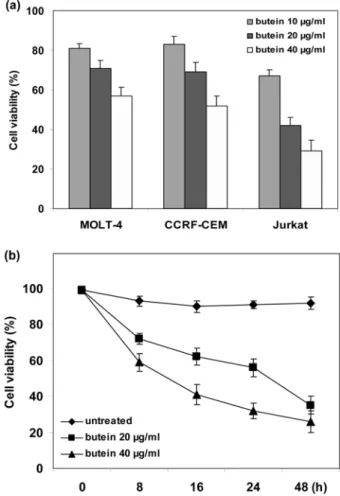
Butein의 세포독성에 대한 효과 –
Butein
의다양한종양세포들에대한세포독성을측정하기위해
MTT assay
를수행하였다
(Fig. 1a).
이들세포들중, jurkat
세포에대한독성작용이가장높다는사실을확인하였다
. Butein
은농도의존적으로
jurkat
세포의생존능력을감소시켰다. Butein
의IC
50는18.2
µg/ml
로확인되었으며20
그리고40
µg/ml
농Fig. 1.
Effects of butein treatment on the cell viability in various cancer cells. (a) Each type of cancer cells or (b) jurkat cells (1×10
6cells/ml) were treated with butein at indicated concentration for 24 h. Cell viability was determined by using 3'-(4,5-dimethylthiazol-2-yl)-2,5-diphenyl tetrazoliumbromide.
Data are represented as means±S.E. of three independent
experiments.
도에서세포생존율은각각
56%, 32%
로감소됨을확인하였다
(Fig. 1b). Butein
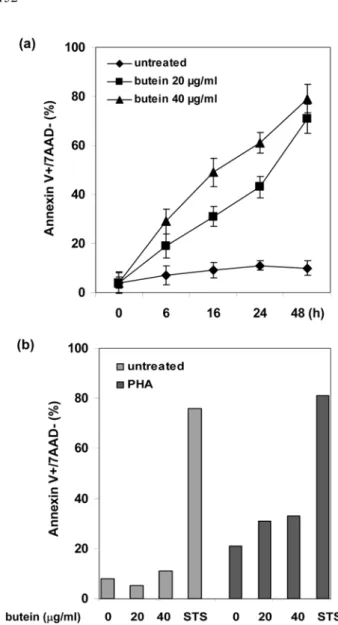
에의한세포괴사효과를구체적으로증명하기위하여
, Annexin V
과7AAD
를사용하여세포염색을한후에
flow cytometry analysis
를통한세포괴사율을측정하였다
(Fig. 2). Butein
은20
µg/ml
와40
µg/ml
의농도에서
24
시간동안각각43%
와61%
의세포괴사를유도하였다
. Butein
에의한세포괴사효과는농도및시간의존적임을확인하였다
(Fig. 2a).
정상세포에대한butein
의작용을확인하기위해서건강한사람의혈액으로부터
PBMC
를분리하여같은실험을실시하였고
butein
의세포독성작용은정상적인세포에서는발생하지않았음을확인하였다
(Fig. 2b). Butein
에의한세포괴사효과는caspase-3
효소의활성화를유발시켰으며
(Fig. 3a)
효소저해제를처리했을때butein
에의한세포괴사작용은현저히감소됨을확인하였다
(Fig. 3b).
이와같은사실은caspase-3
효소활성이butein
에의한세포괴사에중요한인자로작용함을입증하고있다
.
본연구진은폴리페놀계화합물을다량함유하는여러천 Fig. 2.
Levels of apoptosis in butein-treated jurkat cells and
human PBMC. (a) Jurkat cells or (b) human PBMC from healthy donor were treated with butein. Human PBMC were stimulated with or without phytohemagglutinin (PHA) for 48 h and then incubated butein for 24 h. 1 mM of staurosporin (STS) was used as a positive control. The percentage of Annexin V+and 7AAD- is reported as level of apoptosis. The results are represented as mean±S.E of three independent experiments.
Fig. 3.
Activation of caspase-3 in the butein-induced apoptosis.
(a) Caspase-3 activity in the butein-treated jurkat cells. Cells
were treated with butein (20 and 40
µg/ml) at indicated time
periods, and then caspase-3 activity was measured as described
in Materials and Methods. Results are means±S.E. of three
independent experiments. (b) Inhibition of butein-induced
apoptosis by caspase-3 inhibitor. Cells were pretreated with
caspase-3 inhibitor, Ac-DEVD-CHO (50
µM) for 1 h and
further incubated with 40 mg/ml of butein for 16 h. Apoptosis
was measured using flow cytometry by staining the cells with
Annexin V-FITC and 7AAD. The results are represented as
mean±S.E of three independent experiments.
연물의성분중에서새로운항암작용을지닌약물을검색 할 하는 과정에서
Dalbergia odorifera
에주로 존재하는butein
의jurkat T lymphoma
세포에대한항암효과를발견하였다
.
지난수십년간의실험적입증을통해제시된이들폴리페놀계 성분들의 탁월한 세포증식 억제와 세포괴사
(apoptosis)
작용을유도함으로써다양한종류의암세포를괴사시킬수있는항암효과들은앞으로더많은
in vivo
실험과임상실험을토대로입증되어져야할것이며
,
이들중butein
은탁월한후보물질의하나로서평가될수있을것이다.
인용문헌
1. Bravo, L. (1998) Polyphenols: chemistry, dietary sources, metabolism, and nutritional significance. Nutr. Rev.
56: 317-333.
2. Manach, C., Scalbert, A., Morand, C., Rémésy, C. and Jiménez, L. (2004) Polyphenols: food sources and bioavail- ability. Am. J Clin. Nutr .
79: 727-747.
3. Rice-Evans, C. A., Miller, N. J., Bolwell, P. G., Bramley, P.
M. and Pridham, J. B. (1995) The relative antioxidant activ- ities of plant-derived polyphenolic flavonoids. Free Radic Res.
22: 375-383.
4. Bergamaschi, G. V., Rosti, M., Danova, L., Ponchio, C. and Lucotti, M. (1993) Cazzola: Inhibitors of tyrosine phos- phorylation induce apoptosis in human leukaemic cell lines.
Leukemia
7: 2012-2018.
5. Constantinou, A. I., Kamath, N. and Murley, J. S. (1998) Genistein inactivates bcl-2, delays the G2/M phase of the cell cycle, and induces apoptosis of human breast adenocarci- noma MCF-7 cells. Eur. J. Cancer.
34: 1927-1934.
6. Csokay, B., Prajda, N., Weber, G. and Olah, E. (1997) Molec- ular mechanisms in the antiproliferative action of quercetin.
Life Sci.
60: 2157-2163.
7. Fioravanti, L., Cappelletti, V., Miodini, P., Ronchi, E., Brivio, M. and Di Fronzo, D. (1998) Geninstein in the control of breast cancer cell growth: insights into the mechanism of action in vitro. Cancer Lett.
130: 143-152.
8. Pagliacci, M. C., Smacchia, M., Migliorati, G., Grignani, F., Riccardi, C. and Nicoletti, I. (1994) Growth-inhibitory effects of the natural phyto-genistein in MCF-7 human breast cancer cells. Eur. J. Cancer
11: 1675-1682.
9. Shao, Z. M., Wu, J., Shen, Z.Z. and Barsky, S. H. (1998) Genistein inhibits both constitutive and EGF-stimulated inva- sion in ER-negative human breast carcinoma cell lines Anti- cancer Res. 18: 1435-1439.
10. Kang, T. B. and Liang, N. C. (1997) Studies on the inhibitory effects of quercetin on the growth of HL-60 leukemia cells.
Biochem. Pharmacol. 54: 1013-1018.
11. Lepley, D. M. and Pelling, J. C. (1997) Induction of p21/
WAF1 and G1 cell cycle arrest by the chemopreventive agent apigenin. Mol. Carcinogen 19: 74-82.
12. Bellosillo, B., Pique, M., Barragan, M., Castano, E., Vil-
lamor, N., Colomer, D., Montserrat, E., Pons, G. and Gil, J.
(1998) Aspirin and salicylate induce apoptosis and activation of caspase in B-cell chronic lymphocytic leukaemia cells.
Blood 92: 1406-1414.
13. Samaha, H. S., Kelloff, G. J., Steele, V., Rao, C. V. and Reddy, B. S. (1997) Modulation of apoptosis by sulindac, curcumin, phenyl-3-methylcaffeate, and 6-phenylhexyl isothiocyanate:
apoptotic index as a biomarker in colon cancer chemopre- vention and promotion. Cancer Res. 57: 1301-1305.
14. Budihardjo, I., H., Oliver, M., Lutter, X. and Wang, X.
(1999) Biochemical pathways of caspase activation during apoptosis. Annu. Rev. Cell Dev. Biol .
15: 269-290.
15. Danial, N. N. and Korsmeyer, S. J. (2004) Cell death: critical control points. Cell
116: 205-219.
16. Earnshaw, W. C., Martins, L. M. and Kaufmann, S. H.
(1999) Mammalian caspases: structure, activation, substrates, and functions during apoptosis. Annu. Rev. Biochem.
68: 383-424.
17. Strasser, A., O'Connor, L. and Dixit, V. M. (2000) Apoptosis signaling. Annu. Rev. Biochem.
69: 217-245.
18. Kim, N. Y., Pae, H. O., Oh, G. S., Kang, T. H., Kim, Y. C., Rhew, H. Y. and Chung, H. T. (2001) Pharmacol. Toxicol.
88
: 261–266
19. Ramanathan, R., Tan, C. H. and Das, N .P. (1992) Cytotoxic effects of plant polyphenols and fat-soluble vitamins on malignant human cultured cells. Cancer Lett.
62: 217-214.
20. Yit, C. C. and Das, N. P. (1994) Cytotoxic effects of butein on human colon adenocarcinoma cell proliferation. Cancer Lett.
82: 65-72.
21. Chan, S. C., Chang, Y. S., Wang, J. P., Chen, S. C. and Kuo, S. C. (1998) Three new flavonoids and antiallergic, anti- inflammatory constituents from heartwood of Dalbergia odorifera . Planta Med.
64: 153-158.
22. Cheng, Z. Y., Kuo, S. C., Chan, S. C., Ko, F. N. and Teng, C. M. (1998) Antioxidant properties of butein isolated from Dalbergia odorifera . Biochim. Biophys. Acta.
1392: 291-299.
23. Wang, Y., Chan, F. L., Chen, S. and Leung, L. K. (2005) The plant polyphenol butein inhibits testosterone-induced pro- liferation in breast cancer cells expressing aromatase. Life Sci.
77: 39–51.
24. Samoszuk, M., Tan, J. and Chorn, G. (2005) The chalcone butein from Rhus verniciflua Stokes inhibits clonogenic growth of human breast cancer cells co-cultured with fibro- blasts. BMC Complement Altern. Med. 5: 1–5.
25. Kang, H. M., Kim, J. H., Lee, M. Y., Son, K. H., Yang, D.
C., Baek, N. I. and Kwon, B. M. (2004) Relationship between flavonoid structure and inhibition of farnesyl protein transferase. Nat. Prod. Res.
18: 349–356.
26. Jang, H. S., Kook, S. H., Son, Y. O., Kim, J. G., Jeon, Y. M.,
Jang, Y. S., Choi, K. C., Kim, J., Han, S. K., Lee, K. Y., Park,
B. K., Cho, N. P. and Lee, J. C. (2005) Flavonoids purified
from Rhus verniciflua Stokes actively inhibit cell growth and
induce apoptosis in human osteosarcoma cells. Biochim. Bio- phys. Acta.
1726: 309–316.
27. Lee, J. C., Lee, K. Y., Kim, J., Na, C. S., Jung, N. C., Chung, G. H. and Jang, Y. S. (2004) Extract from Rhus verniciflua Stokes is capable of inhibiting the growth of human lym- phoma cells. Food Chem. Toxicol.
42: 1383–1388.
28. Iwashita, K., Kobori, M., Yamaki, K. and Tsushida, T. (2000)
Flavonoids inhibit cell growth and induce apoptosis in B16 mel- anoma 4A5 cells. Biosci. Biotechnol. Biochem.
64: 1813–1820.
29. Lee, S. H., Seo, G. S., Kim, H. S., Woo, S. W., Ko, G. and Sohn, D. H. (2006) 2',4',6'-Tris(methoxymethoxy) chalcone attenuates hepatic stellate cell proliferation by a heme oxyge- nase-dependent pathway. Biochem. Pharmacol.
72: 1322–1333.
(2008년 5월 27일 접수)