Demonstration of Propulsion System for Microsatellite Based on Hydrogen Peroxide in SOHLA-2L Project
Hironori Sahara
Department of Aeronautics and Astronautics, University of Tokyo 7-3-1, Hongo, Bunkyo, Tokyo 113-8656, Japan
Keywords: SOHLA-2L, Hydrogen Peroxide, Mono-Propellant, Bi-Propellant Abstract
An innovative Panel ExTension SATellite (PETSAT) and propulsion system for PETSAT, are presented in this paper. First, we outline what PETSAT is. Next, based on PETSAT ethos, design policy of the propulsion system is provided. According to the policy, we designed propulsion system and concretely estimated and assembled mono-propellant and bi- propellant systems, and it indicated that mono- propellant propulsion with 50-60 seconds of specific impulse and 1 N of thrust is probable. In the case of bi-propellant, 120-150 seconds of specific impulse is valid even based on the design policy. We conducted captive tests of mono-propellant and bi-propellant propulsions with a breadboard model of propulsion system for PETSAT, and obtained good operations and performances. Based on the test results, we designed and manufactured flight model propulsion system for PETSAT. We are planning to demonstrate it in SOHLA-2L project progressed by the Space Oriented Higashiosaka Leading Association (SOHLA).
SOHLA-2L will be the first on-orbit demonstrator of PETSAT in 2008.
Introduction
Microsatellites developed by university groups or non- governmental associations are now in vogue not only in Japan1-2) but also in all over the world. We, University of Tokyo, launched the world’s first CubeSat XI-IV in 2003 and XI-V in 2005, and they are in good running order even now whereas their designed lifetime was 3 months. The two XIs photograph the Earth with their on-board cameras and we are delivering the images with their status by e- mail on PC or cellular phone to people who want them after free registration at the XI-MAIL STATION (http://www.space.t.u-tokyo.ac.jp/ximail/en/top.html).
Now we are ongoing 3 satellite projects, that is, PRISM, Nano-JASMINE, and Panel ExTension SATellite (PETSAT). PETSAT was first proposed by us, the Nakasuka Laboratory of University of Tokyo and consists of standardized subsystem panels3) as shown in Fig. 1. You can launch your own satellite with lower cost and shorter development period by selecting PETSAT subsystem panels and assembling them as you like as shown in Fig. 2. In addition, PETSAT is folded in a launcher and extended in orbit so that required volume for a launcher and its launch
cost become smaller. Thus, PETSAT will contribute to activating space utilization and development.
Fig. 1. Concept of PETSAT. You can assemble your own satellite as you like in shorter period just by selecting standardized subsystem panels to install you want.
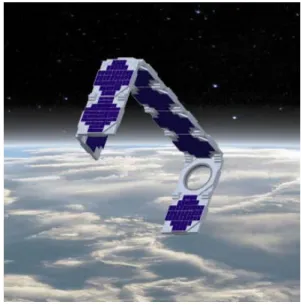
Fig. 2. An application of PETSAT. An Extended PETSAT in orbit is engaged in an optical earth observation (Imaginary Picture).
Now we are collaborating with the Space Oriented Higashiosaka Leading Association (SOHLA) in the SOHLA-2L microsatellite project. SOHLA-2L is the first on-orbit demonstrator of PETSAT, consists of 4 subsystem panels of main bus (BUSF) based on the XI, attitude control system (ACS), propulsion (PROP) and a gravity-gradient boom (GG), shown in Fig. 3. It weighs 25 kg, and we position demonstration of each panel including PROP and their coordinated operation as its main missions to establish PETSAT technology.
We have been developing the SOHLA-2L in its flight model (FM) manufacturing and fabrication stage, and are planning to launch the SOHLA-2L in 2008.
Fig. 3. SOHLA-2L, consisting of subsystem panels of BUSF, ACS, PROP and GG, is being developed by SOHLA.
Propulsion System for PETSAT
We have been developing propulsion system for microsatellite with moderate price and higher safety for several years. One of their results is a cold gasjet propulsion system installed in 4 kg small satellites in ISAS/JAXA S-310-36 sounding rocket project (Figs.
4) launched in 2006. The propulsion system was manufactured under active and effective Commercial- Off-The-Shelf (COTS, Fig. 5), and it worked very well in orbit.
Figs. 4. The 4 kg small satellite and telemetry video in ISAS/JAXA S-310-36 sounding rocket project. 3 small satellites were separated from the rocket.
Based on the result, we designed propulsion system for PETSAT in SOHLA-2L project and selected COTS elements for it.
Before then, we discussed which propulsion is the most suitable for PETSAT4-6, 15-16)
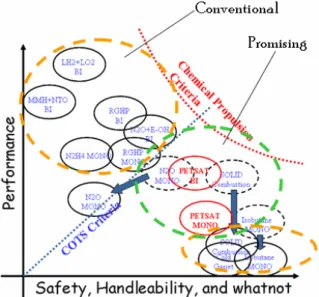
, and resulted in that mono-propellant and bi-propellant chemical propulsion (CP) were the strongest candidates because of its large thrust density, low power consumption, and its multiple operation capability, by fair judgment as shown in Fig. 5, based on PETSAT ethos, that is, open-modular architecture. Indeed various propulsions are developed in the world by now7-14), but little convenient for microsatellites with respect to performance, volume, weight and cost. We proposed the following 6 policies for the propulsion system for PETSAT.
Fig. 5. Cast of chemical propulsion, and position of mono-propellant and bi-propellant propulsion for PETSAT. Various propulsions are developed but little convenient for microsatellite.
SAFETY FIRST
It is not necessarily the case that a satellite called
‘Our-Town Satellite’ or other microsatellites are projected, manufactured, and tested by proper specialists as a whole, it means that a non-specialist may retouch or be close to the propulsion system on the satellite. It indicates that propulsion on such a satellite must have the highest safety first of all, and SAFETY FIRST is the first priority during all the phases concerning all parts of the satellite. A concrete way to realize SAFETY FIRST is to reduce the risk of propellant management, especially oxidizer.
Propellant generally shows at least one of toxicity, causticity, explosibility: Ethanol is less toxic than methanol, less caustic than hydrazine, and less explosive than acetone or HAN, and lower concentration of Hydrogen Peroxide (HP) solution is less dangerous than the higher one or H2O4, N2O.
Less risk means lower performance of propulsion but higher safety and lower optional cost in the project.
Therefore, we permit the performance decrement due to SAFETY FIRST to some extent.
MODERATE PRICE
One of the main reasons for distance of the conventional microsatellites from propulsion, is the fact that the conventional propulsion is awfully expensive. The cost that proper specialists produce an identifiable propulsion system with the highest reliability and performance, may be higher than that of manufacturing a satellite in some cases. A way to reduce the cost is not to optimize propulsion and its elements but to accept aggressive COTS. COTS product is indeed not for space application but has enormous number of uses on ground not only with the highest reliability and quality but also with very moderate price.
DECENT PERFORMANCE
The above two policies generally decrease propulsion performance, but good trade-off can achieve a good balance even between the antithetic policies and attain decent performance.
GOOD HANDLEABILITY
Suppose that propellant cannot be drained from a satellite once it was filled. When the satellite is transported to launch site after all the tests at test facilities, legal regulations concerning propellant are imposed on the satellite. In addition, it must be more careful with respect to vibration, shock, and thermal environments. It indicates that Fill and Drain port is necessary for good handleability. Otherwise, Care for propellant causes extra expense and dangerous risk. It suggests that good handleability is favorable, and handleability is concerned to all the work operations from the initial assembly to the final satellite launch through propellant filling. For example, Rocket Grade Hydrogen Peroxide (RGHP) is good propellant but is difficult to be handled because its decomposition heat exceeds its own latent heat. So we chose middle concentration of HP as propellant for the propulsion system of PETSAT.
STANDARDIZATION
The propulsion for PETSAT should be available to various missions via minimum adjustment. In an extreme instance, no adjustment is needed and we only combine it to a PETSAT and fill propellant.
Furthermore, users may select either mono-propellant or bi-propellant, and sort of propellant. Such a standardization and common architecture are targeted, that is, open-modular propulsion system is our goal because PETSAT is based on open-modular architecture.
REDUNDANCY
Even if the above policies are satisfied, all-or-nothing system is never acceptable and it should have some redundancy. When in trouble, propulsion should attain even some performance. Typically complete propulsion diagram is shown in the upper of Figs. 6, which consists of fuel line (F-line), oxidizer line (O- line), and gas line (G-line). G-line is regulation type and pressures F-line and O-line at constant pressure
through bladders in tanks, and pressured propellant are injected to thruster. However, this is too gorgeous to install all the elements into a PETSAT panel, so some of them should be omitted if possible. Here, the proposed propulsion diagram for PETSAT is shown in the lower of Figs. 6, based on the above design policies. It abbreviates some overlap elements but possesses fill and drain gates and latch valves in all lines. It is quite common system in the both cases of mono-propellant and bi-propellant propulsions due to the standardization, so that both of F-line and O-line are filled with a single propellant such as HP of 60 % concentration when using as mono-propellant system and one line is to be redundancy of another line. When using as bi-propellant system, O-line can work as mono-propellant by itself, and F-line can also work as Registojet by itself, to produce thrust even in trouble.
This is not all-or-nothing system and ensures some redundancy.
Figs. 6. Propulsion diagrams. The upper is typical configuration and the lower is the diagram for PETSAT after abbreviation of overlap elements.
Propellants
According to the above 6 policies, we decided propellants for the propulsion system for PETSAT as HP solution of middle concentration and ethanol. The highest concentration of the HP solution which is available as COTS product is 60 %. HP indicates decomposition heat by its decomposition to oxygen and water, but it does not exceed its own latent heat when under 65 % concentration and generates wet steam having low sonic velocity because mixture of gas and liquid or minuscule droplet of water has the sonic velocity depending on their void ratio as shown in Fig. 7. It suggests that such a HP solution of middle
concentration under 65 % produce only wet steam and attain 40-50 seconds of specific impulse at the highest.
The specific impulse of 50 seconds seems a barrier in the case of low risk mono-propellant. For examples, Isobutane mono-propellant propulsion, being developed at Surrey Satellite Technology LTD.
(SSTL) and ISAS/JAXA, has 40-50 seconds of specific impulse at the highest. Therefore, we targeted 50 seconds of specific impulse in the case of mono- propellant in propulsion system for PETSAT.
In the case of bi-propellant, oxygen and liquid water droplet generated by HP decomposition are mixed with ethanol, and the mixture is ignited in combustion chamber of a thruster. Its combustion heat completely exceeds latent heat of the mixture propellant and generates high temperature gas before nozzle throat.
Fig. 7. Sonic velocity of gas and liquid water mixture, depending on their void ratio.
Catalysts
In order to improve the performance of propulsion system applying the propellants related above, HP decomposition with high efficiency is necessary. It is realized with high efficiency catalyst. We chose many candidates of metals, oxides, alloys, some of them are supported by another materials such as ceramics, and conducted HP decomposition test with the candidates.
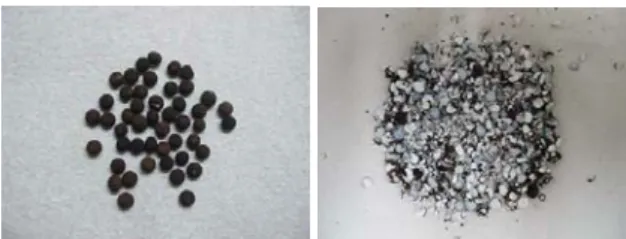
As the result, 5 strong candidates remained, but 4 of them have a fatal weak point as shown in Fig. 8. For example, the NS-1A is platinum catalyst supported with highly-porous ceramic which has 200-300 m2/g of specific surface area and decomposes HP very strongly, but highly-porous ceramic is very weak against thermal shock so that it breaks into fragments after several times of HP decomposition as shown in Figs. 9. Foamed metal catalyst has very high strength against thermal shock but its efficiency is not as high as NS-1A, in addition, its efficiency decreased for a while after several operations due to water film formed on its surface.
The remaining candidate, TANAKA-I, is platinum catalyst supported with metal honeycomb structure, and provides high efficiency comparable to NS-1A and high strength comparable to the foamed metal catalyst, so that we finally decided to use TANAKA-I
for HP decomposition. As for ethanol combustion, palladium catalyst supported with metal honeycomb, TANAKA-II, was selected. TANAKA-I and TANAKA-II is shown in Fig. 10.
Fig. 8. Strong candidates of catalysts for HP decomposition with high efficiency.
Figs. 9. Appearance of a catalyst before (left) and after (right) several times of HP decomposition.
Fig. 10. Metal honeycomb catalysts for HP decomposition (TANAKA-I) and ethanol combustion (TANAKA-II).
Performances Estimation
We estimated performances in the cases of mono- propellant and bi-propellant with Chemical Equilibrium with Applications (CEA).
Mono-propellant, initially set that propellant was HP of 60 % concentration, temperature of the propellant was 300 K, thruster chamber pressure was 0.4 MPa, nozzle aperture ratio was 50, resulted in that shown in Fig. 11. Its specific impulse was calculated as about 120 seconds, where c-star efficiency, nozzle efficiency, and so on was not taken in to consideration.
Here, we supposed their efficiencies based on our preliminary experimental results, and it indicated that 50-60 seconds of specific impulse with 1 N of thrust was practically valid.
We also estimated performance of bi-propellant with CEA as shown in Fig. 12. It was initially set that oxidizer was HP of 60 % concentration, fuel was ethanol, initial propellants temperature was 300K, combustion pressure in the thruster was 0.4 MPa, nozzle aperture ratio was 50. It resulted in the higher temperature in combustion chamber than melting point of its material. Also in this calculation, no efficiencies were taken into consideration, and we
supposed their values, and it indicated that 120- 150seconds of specific impulse was practically valid and attainable.
Fig. 11. Calculation result with CEA in the case of mono-propellant.
Fig. 12. Calculation result with CEA in the case of bi- propellant.
Captive Tests with PROP-BBM
We have been conducting captive tests of propulsion system for PETSAT with a breadboard model (BBM) as shown in Fig. 13. In this time, we applied the new catalyst TANAKA-I and TANAKA-II into a thruster installed on the BBM. Inner structure of the thruster is shown in Fig. 14, consisted of impinging injector and void for atomization, catalysts, ejector, chamber, igniter, and nozzle.
Fig. 13. PROP-BBM combined with O-line and F-line.
Fig. 14. Inner structure of the thruster. Catalyst-I and –II mean TANAKA-I and –II, respectively.
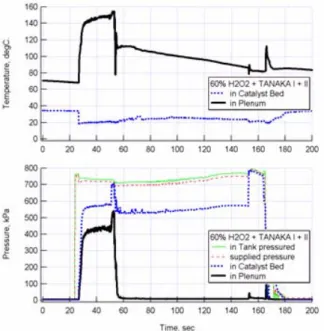
The result in the case of mono-propellant using HP solution of 60 % concentration as propellant, are shown in Fig. 15 for plume in operation and Fig. 16 for pressure and temperature histories in the chamber.
It indicates that its temperature reached at boiling point of the propellant at the pressure and wet steam was attained in the chamber. Propellant mass flow rate was 1.59 g/sec, throat area is 1.57 mm2, and specific exhaust velocity was obtained as 415 m/sec.
suppose that practical nozzle coefficient is 1.5, its specific impulse and thrust is estimated as 63 seconds and 989 mN, respectively.
Fig. 15. Plume in operation in the case of mono- propellant.
Fig. 16. Pressure and temperature histories in the camber.
We also conducted captive test of bi-propellant. The most suitable mix ratio of 60 % HP with ethanol is about 4.7 or 7.4 with respect to volume or mass,
respectively. Even if the ratio is out of order and ignition fails, this propulsion system works as mono- propellant and its performance decrease is not large because large part of the mixed propellants is HP. In the captive test, high voltage pulse discharge was put in the chamber and succeeded in good ignition. Plume shape shown in Fig. 17 was regarded as supersonic exhaust. After the test, we overhauled the thruster and found that an element made of aluminum in the chamber was melted, which suggested that over 660 degrees centigrade had been attained there. Catalytic combustion can be formed without the pulse discharge under such a temperature, in fact we confirmed it.
Therefore, target performance estimated in the previous section, 120-150 seconds of specific impulse, is very practical.
Fig. 17. Plume in operation in the case of bi- propellant.
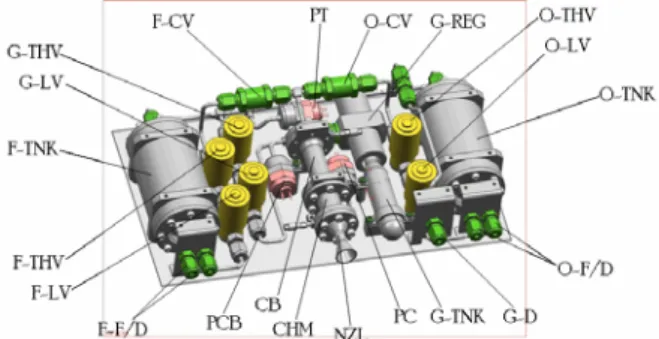
Design and Fabrication of Flight Model Based on all the test results, we designed and manufactured a proto-flight model (PFM) of the propulsion system for PETSAT (PROP-PFM) as shown in Fig. 18 and Fig. 19 as mentioned above, the system can be operated as both mono-propellant and bi-propellant. An igniter is not drawn in the figure.
The material where HP can touch is selected to be SUS316L and the other pars are made of A5055.
Bladders in the tanks are made of fluorine series polymer. As for COTS electromagnetic valves, wetted materials is SUS430 which is not so good as SUS316L but has good compatibility with HP. Check valves are installed in both of O-line and F-line near the thruster.
Fill and drain gates are prepared on the tanks and vent gate of G-line is also quipped. The tank of G-line has to exchange after each use. The total dry weight of PROP-PFM is 2.9kg actually.
Thrust vector is adjusted to center of gravity of each PETSAT. It means that only nozzle should be optimized to each PETSAT. In fact, PROP-PFM directly turned to a flight model (FM) just by replacing the nozzle part to an off-axis nozzle. We designed a nozzle for SOHLA-2L as shown in Fig. 20 and have manufactured it in January, 2008. We are on going to conduct the final test of PROP-FM.
Fig. 18. PROOP-PFM designed.
Fig. 19. PROP-PFM manufactured. PROP- PFMdirectly turned to PROP-FM just by replacing the nozzle part to an off-axis nozzle.
Fig. 20. Optimized nozzle for SOHLA-2L.
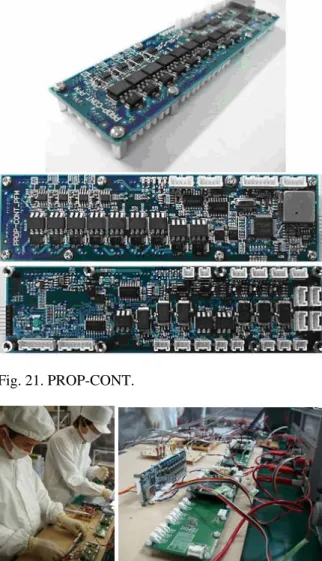
Controller of Propulsion System for PETSAT We designed and manufactured a controller of propulsion system for PETSAT, called PROP-CONT.
PROP-CONT is an one-board, compact type controller as shown in Fig. 21, requires power supplying of 5V for electronic circuit and 12V for electromagnetic valves and igniter operations, and has 4 terminals for pressure gauges, 6 terminals for semiconductor temperature sensors and 2 thermocouples, each 3 terminals for latch valves and thruster valves, and equips a 3-axis accelerometer, and 2 switching terminals for igniter and heater. CPU is Renesas H8/3694F, operation frequency is 10 MHz.
Communications via I2C and SCI3 is available. 5V
power is necessary for operation of CPU and other electronic circuit and 12V power for valves, igniter and heater if necessary.
We have tested PROP-CONT and obtained its perfect operation. Also, inner-panel and inter-panels communication tests were conducted as shown in Fig.
22, it resulted in success that uplink from pseudo- ground station controlled PROP-CONT perfectly.
Now a flight model of PROP-CONT has already been prepared.
We can provide the controller for propulsion system or for other purposes if you would like and please contact us.
Fig. 21. PROP-CONT.
Fig. 22. Inner-panel and inter-panels communication tests. Inner-panel and inter-panels communications are using I2C bus and CAN bus, respectively.
Conclusion
Propulsion is to be installed in the SOHLA-2L and demonstrated in orbit, we completed mono-propellant and bi-propellant propulsion system for SOHLA-2L.
Its estimated performances are 50-60 seconds and 120-150 seconds of specific impulses in the case of mono-propellant and bi-propellant, respectively.
SOHLA-2L project is now positioned on its final flight model manufacturing and testing stage, and progressed energetically for its launch in 2008.
Acknowledgments
This research is financially supported by the New Energy and Industrial Technology Development Organization (NEDO) project of “Research and development of a general-purpose micro satellite by the fusion of advanced manufacturing technologies and innovative design.”
References
1) Nakamura, Y., “University of Tokyo’s Ongoing Student-Lead Pico-Satellite Projects – CubeSat XI and PRISM,” Proceedings of 55th International Astronautical Congress, IAF, IAC- 04-IAA.4.11.4.06, 2004.
2) Kuwahara, T., “Kyushu University Micro- Satellite QTEX Project,” Proceedings of 55th International Astronautical Congress, IAF, IAC- 04-IAA.4.11.5.06, 2004.
3) Nakasuka, S., “Panel Extension Satellite (PETSAT) – Low Cost Multi-Purpose Microsatellite Consisting of Modular, Functional and Plug-in Panels,” Proceedings of 55th International Astronautical Congress, IAF, IAC- 04-U.1.08, 2004.
4) Sahara, H., et al., “Propulsion System for Panel ExTension SATellite (PETSAT),” Proceedings of 41st AIAA/ASME/SAE/ASEE Joint Propulsion Conference and Exhibit, AIAA, AIAA-2005- 3956, 2005.
5) Sahara, H., et al., “Propulsion System for Panel ExTension SATellite (PETSAT),” Proceedings of 8th International Hydrogen Peroxide Propulsion Conference, 2005.
6) Sahara, H., et al., “Propulsion System for Panel ExTension SATellite (PETSAT),” Proceedings of 56th International Astronautical Congress, IAF, IAC-05-C4.1.09, 2005.
7) Gibbon, D., and Underwood, C., “Low cost butane propulsion systems for small spacecraft,”
Proceedings of 15th AIAA/USU Conference on Small Satellites, SSC01-XI-1, 2001.
8) Jason, W. S., et al., “Microthrusters for Nanosatellites,” Proceedings of 2nd International Conference on Integrated Micro Nano technology for Space Applications (MNT99), 1999.
9) Surrey Satellite Technology LTD. (SSTL), URL:http://www.sstl.co.uk/ [cited 15 June 2006].
10) Yamamoto, T., et al., “Kogata-Eisei yo Kieki- Heikou Thruster no Kaihatsu,” Proceedings of 49th Space Sciences and Technology Conference, JSASS, 2005.
11) Gronland, T. A., et al, “Green Propulsion for Spacecraft – Towards The First Flight of AND- Based Propulsion on PRISMA in 2008,”
Proceedings of 57th International Astronautical Congress, IAF, IAC-06-C4.1.08, 2006.
12) Gronland, T. A., et al, “Miniaturization of Components and Systems for Space Using MEMS Technology,” Proceedings of 57th
International Astronautical Congress, IAF, IAC- 06-B5.5.12, 2006.
13) Yamamoto, T., et al., “Development and Mission Status Report of Gas-Liquid Equilibrium Thruster for The Small Satellite,” Proceedings of 57th International Astronautical Congress, IAF, IAC-06-B5.5.06, 2006.
14) Rackmann, N., et al., “Design and Development of A Propulsion System for A CUBESAT,” Proceedings of 57th International Astronautical Congress, IAF, IAC- 06-B5.5.13, 2006.
15) Sahara, H., et al., “Propulsion System on Hydrogen Peroxide Mono-Propellant for Panel ExTension SATellite (PETSAT),” Proceedings of 42nd AIAA/ASME/SAE/ASEE Joint Propulsion Conference and Exhibit, AIAA, AIAA-2006-4552, 2006.
16) Sahara, H., et al., “Demonstration of Propulsion System for Microsatellite Based on Hydrogen Peroxide in SOHLA-2 Project,” Proceedings of 43rd AIAA/ASME/SAE/ASEE Joint Propulsion Conference and Exhibit, AIAA, AIAA-2007-5575, 2007.