Effect of Buan Mulberry on Metabolic Improvement in Streptozotocin-Induced Diabetic Rats
Ju Taek Lee, Jae-Sung Ryu, Dong Hoon Kwak, Yun Jum Park
1, Seong Sun Kang
2, Pyoung Jun Kim
2, Kyung-A Hwang
3and Young-Kug Choo*
Department of Biological Science, College of Natural Sciences, Wonkwang University, Iksan 570-749, Korea
1
Division of Horticulture and Pet Animal-Plant Science, Wonkwang University, Iksan 570-749, Korea
2
Buan Agricultural Development & Technology Center, Buan 579-833, Korea
3
Department of Agrofood Resources, National Academy of Agricultural Science, RDA, Suwon 441-853, Korea
Received August 31, 2010 /Accepted November 17, 2010This study was designed to evaluate the anti-diabetic effects of Buan mulberries by using an in- sulin-dependent diabetes mellitus animal model. Several studies have shown that mulberries have me- tabolism-improving, antioxidant, and lipid-lowering properties in rats with streptozotocin (STZ)-in- duced diabetes. In this study, Sprague-Dawley male rats were randomly assigned to 1 normal control group and 5 STZ-induced diabetes groups: rats that had STZ-induced diabetes and did not receive any agents (diabetic group; negative control), rats that had STZ-induced diabetes and received insulin (insulin group; positive control), rats that had STZ-induced diabetes and received 0.5% mulberry ex- tract (0.5% mulberry group), rats that had STZ-induced diabetes and received 1.0% mulberry extract (1.0% mulberry group), and rats that had STZ-induced diabetes and received 2.0% mulberry extract (2.0% mulberry group). Mulberry extracts were administered to the diabetic animals for 4 weeks. The rats that received mulberry extracts showed lower body weights and insulin levels, as well as higher kidney weights, blood glucose levels, urine quantities, and water intake in comparison with the nor- mal controls. Further, the insulin concentrations in the mulberry-fed animals were higher than those in the diabetic group, and the kidney weights, blood glucose levels, urine quantities, and water intake in the mulberry-fed animals were lower than the corresponding values in the diabetic controls. These results suggest that mulberry may be an effective functional food to prevent diabetes-related complications.
Key words : Buan mulberry, diabetes mellitus, streptozotocin (STZ), oral administration, insulin
*Corresponding author
*Tel:+82-63-850-6087, Fax:+82-63-857-8837
*E-mail : [email protected]
Introduction
Diabetes mellitus is one of the most serious metabolic dis- eases; it is characterized by hyperglycemia resulting from defects in insulin secretion, insulin action, or both, and is associated with long-term damage, dysfunction, and failure of various organs, especially the eyes, kidneys, nerves, heart, and blood vessels [6]. Type I diabetes results from a cel- lular-mediated autoimmune destruction of the β-cells of the pancreas, which leads to absolute insulin deficiency [2].
Other studies have shown that Lycium chinense Miller (Lycii) fructus chloroform extract, polygoni radix (Pleuropterus mul- tiflorus) ethanol extract, Angelica gigas Naki 50% ethanol ex- tract, and Ecklonia cava water extract have anti-diabetic and antioxidative effects in rats with streptozotocin (STZ)-induced diabetes [15,16,28].
Old medical textbooks have described mulberry (Morus spp.) as sweet and cold without toxicity. Further, it has been described as a treatment for diabetes and has been shown to provide vitality via its benefits to the 5 viscera and the liver. Long-term use of mulberries relieved hunger, turned faded hair black, and prevented aging [12,18]. Additionally, mulberry extract has been known to have anti-hyper- glycemic, anti-oxidative, anti-inflammatory, and anti-hyper- tensive physiological effects [17,31]. In another study, mul- berry leaves, a traditional medicine, were shown to cure and prevent diabetes [1]. In particular, 1-deoxynojirimycin (DNJ) is believed to be a typical naturally occurring imino sugar with potent biological activity [1,19]. Mulberry is a perennial crop that grows throughout the year in the tropics. The con- tinuous production of mulberries over a long period results in the gradual reduction of leaf yield and quality. The growth and quality of mulberry leaves is influenced by sev- eral abiotic and biotic factors, including variety, agronomic practices, method of leaf harvest, and environment [20,27].
The various effects of mulberries differ according to the
region of mulberry growth. Therefore, in the present study, we evaluated the metabolic improvement caused by Buan mulberry in rats with STZ-induced diabetes.
Materials and Methods Preparation of mulberry material
Mulberries were cultivated and harvested in Buan, Jeonbuk, South Korea. Dried and powdered mulberries (1.2 kg) were extracted by repeated refluxing with methanol (MeOH) (2×6 l) for 4 hr at 80°C. The combined MeOH ex- tract (12 l) was clarified by filtration and evaporated to ob- tain a dark purple syrup (200 g).
Breeding conditions for the rats and diabetes induction by using STZ
Male Sprague-Dawley rats (weight, 235±9.87 g) (Samtaco Co. Ltd, Osan, South Korea) were obtained and adapted by feeding them maintenance feed (Samtaco) for 7 days. After adaptation, 0.2 ml [0.1 M sodium citrate buffer (pH 4.5)] of STZ, which induces hyperglycemia by causing insulin defi- ciency in pancreatic cells without influencing other organs, was subcutaneously administered to the rats to induce dia- betes mellitus (STZ dose, 70 mg/kg body weight).
Induction of diabetes mellitus in rats was confirmed by elevated glucose concentration (above 350 mg/dl) in the tail vein blood on day 3 after STZ treatment. The rats were div- ided into 6 groups of 10 rats each by using a randomized complete block design. Among the 6 groups, 5 contained rats with STZ-induced diabetes and 1 did not (normal con- trol). Rats of 1 STZ-induced diabetes group (diabetic group;
negative control) and the normal control were fed only dis- tilled water. Rats of the remaining 4 STZ-induced diabetes groups received the following agents: insulin (insulin group;
positive control, 10 unit/0.1 ml), 0.5% mulberry extract (0.5%
mulberry group, 15 mg/3 ml), 1.0% mulberry extract (1.0%
mulberry group, 30 mg/3 ml), or 2.0% mulberry extract (2.0% mulberry group, 60 mg/3 ml). Rats were maintained in a controlled environment at a temperature of 23±1°C, hu- midity of 55±5%, and noise levels below 70 dB with a 14-h photoperiod (lights were switched on at 6 AM and switched off at 8 PM). Three milliliters of 0.5%, 1%, and 2% mulberry extracts in distilled water were orally administered to the rats on day 8 after STZ administration, and the admin- istration of the mulberry extract was continued once a day for 4 weeks.
Food intake and food efficiency ratio (FER)
Food intake was measured every 3 days. The daily food intake was calculated by determining the mean food intake.
Body weight was measured using a weighing machine (Scaltec Instruments, Sartorius, AG) in the same order at a fixed time every day. Food efficiency ratio (FER) was calcu- lated by determining the ratio of the body weight gain (g) to the food intake (g).
Water intake and urine quantity
To determine the levels of polydipsia, the amount of wa- ter that the rats drank over a period of 24 hr was measured in a metabolic cage twice a week during both the adaptation (1 week) and experimental (4 weeks) periods. To determine the levels of polyuria, the same procedure was employed to assess the amount of urine excreted by the rats.
Collection of blood and organs
One drop of blood was collected from the tail vein of each rat every 3 days, and the glucose levels were measured using a testing machine (ACCU-CHEK Co., Ltd.) according to the manufacturer’s recommendations. After oral administration of mulberry extracts for 4 weeks, rat liver and kidney were extracted and washed with cold 0.9% normal saline. The weights of the washed liver and kidney were measured. To compare the organ weights among rats, the obtained values were converted to a ratio of organ weight to body weight.
Insulin measurements
Blood samples were centrifuged at 4°C, and plasma was separated and frozen at -20°C until use. Plasma insulin levels were determined using a rat insulin enzyme-linked im- munosorbent assay (ELISA) kit according to the manu- facturer’s instructions (Shibayagi Co., Japan).
Histochemical analysis of the changes in the kidney, liver and spleen
Kidneys were dissected and fixed using phosphate-buf- fered saline (PBS) containing 4% paraformaldehyde. After fixation, the kidneys were frozen overnight in 30% sucrose prepared in PBS. Serial coronal sections of kidney were cut with a microtome, after which the sections were fixed to slides and stained with hematoxylin and eosin.
Statistical analysis
All data are presented as mean±SD. Comparisons of mul-
tiple groups were performed by one-way analysis of var- iance (ANOVA) and two-way ANOVA, followed by pair-wise comparisons with a Bonferroni post-hoc test.
Differences were considered statistically significant at p<0.001. All data were analyzed using the GraphPad Prism software, version 4.00 (GraphPad software).
Results
Effect of mulberry extracts on the body weight of the rats
The effect of various mulberry extracts on the body weight was analyzed over a period of 4 weeks (Fig. 1). The mean body weight of the normal controls increased to 332.30 g by week 4 (Fig. 1). The mean body weight of the diabetic group remained steady (178.93 g). The mean body weights of most of the mulberry-extract groups tended to be lower than that of the insulin group. The mean body weight of the 0.5% mulberry, 1.0% mulberry, and 2.0% mulberry groups were deceased respectively 38.1%, 21.0%, and 32.2%
lower than that of the insulin group. However, the mean body weight of the 1.0% mulberry group was increased
Fig. 1. Body weight changes in normal and diabetic rats that were fed mulberry extracts of various concentrations.
Normal: normal control rats that were fed water;
Diabetic: diabetic control rats that were fed water;
Insulin: rats that received insulin injections; 0.5%
Mulberry: rats that received oral administration of 0.5%
mulberry extract; 1.0% Mulberry: rats that received oral administration of 1.0% mulberry extract; 2.0% Mulberry:
rats that received oral administration of 2.0% mulberry extract. The columns represent the mean values of body weight (n=10)**
p
<0.01 vs. Diabetic control rats that were fed water (Diabetic),***p
<0.001 vs. Diabetic control rats that were fed water (Diabetic)131.62% of the mean body weight of the diabetic group.
Effect of mulberry on blood glucose level and kidney weight
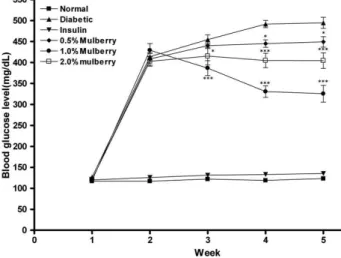
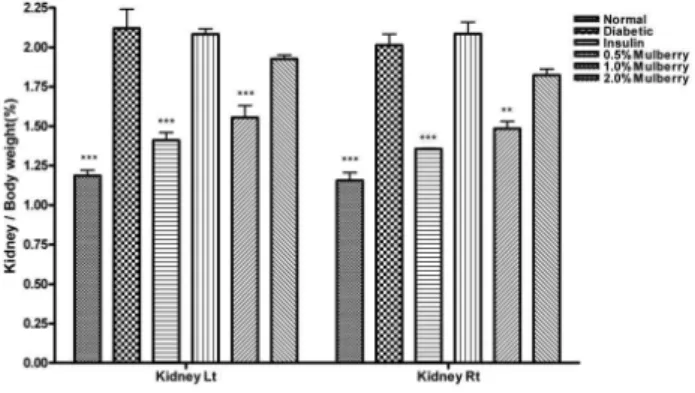
We measured the blood glucose levels to investigate the effect of mulberry extracts on blood glucose levels in rats (Fig. 2). In all the STZ-induced diabetes groups, blood glu- cose levels increased, which resulted in hyperglycemia (>500 mg/dl) in the diabetic group within 4 weeks. In the diabetic group and the mulberry treatment groups, the glucose level rapidly increased in 1 week. After 1 week, the rate of in- crease reduced. At week 4, the blood glucose levels in the 0.5%, 1.0%, and 2.0% mulberry groups were 449 mg/dl, 326 mg/dl, and 405 mg/dl, respectively (Fig. 2). The blood glu- cose level in the 1.0% mulberry group (326 mg/dl) was sig- nificantly lower (34.2% reduction) than that in the diabetic group (495 mg/dl). Kidney weight after mulberry admin- istration was measured in each experimental group and con- verted to the weight of organs per body weight (Fig. 3). The kidney weight in the 1.0% mulberry group was significantly lower than that in the diabetic group (p<0.001 and 0.01).
Fig. 2. Fasting blood glucose level in STZ-induced diabetic rats that received mulberry extracts of various concentrations. Normal: normal control rats that were fed water; Diabetic: diabetic control rats that were fed water; Insulin: rats that received insulin injections; 0.5%
Mulberry: rats that received oral administration of 0.5%
mulberry extract; 1.0% Mulberry: rats that received oral administration of 1.0% mulberry extract; 2.0% Mulberry:
rats that received oral administration of 2.0% mulberry extract. The columns represent the mean value of blood glucose level (n=10).*
p
<0.05 vs. Diabetic control rats that were fed water (Diabetic),***p
<0.001 vs. Diabetic control rats that were fed water (Diabetic)Fig. 3. Water intake level and urine quantity in STZ-induced diabetic rats that were fed mulberry extracts of various mulberry concentrations for 4 weeks. Normal: normal control rats that were fed water; Diabetic: diabetic con- trol rats that were fed water; Insulin: rats that received insulin injections; 0.5% Mulberry: rats that received oral administration of 0.5% mulberry extract; 1.0% Mulberry:
rats that received oral administration of 1.0% mulberry extract; 2.0% Mulberry: rats that received oral admin- istration of 2.0% mulberry extract. The columns repre- sent the mean values of water intake level and urine quantity (n=10). **
p
<0.01 vs. Diabetic control rats that were fed water (Diabetic),***p
<0.001 vs. Diabetic control rats that were fed water (Diabetic)Water intake and urine quantity
After STZ administration, the polyuria and polydipsia, which are distinctive symptoms of diabetes mellitus, gradu- ally increased in the rats. Water intake and urine quantity were measured twice a week for 4 weeks after STZ admin- istration (Fig. 4). Water intake and urine quantity in the STZ-induced diabetes groups that received mulberry ex- tracts of different concentrations were significantly higher than the values in the normal control group. The urine quan- tity in the 1.0% mulberry group was 28.4% lower than that in the diabetic group. Additionally, the water intake in all the diabetes groups was significantly higher than that in the normal control group. The water intake in the 1.0% mulberry group was significantly (53.6%) lower than that in the dia- betic group.
Food intake quantity and food efficiency ratio (FER) Food intake, food efficiency ratio (FER), and alterations in body weight in STZ-induced diabetic rats that received various concentrations of mulberry extract were observed for 4 weeks (Table 1). Food intake in all diabetes groups was significantly higher than that in the diabetic group (p<0.001). Thus, FER in most diabetes groups was sig-
Fig. 4. The kidney weights of STZ-induced diabetic rats that were fed mulberry extracts of various concentrations for 4 weeks. Normal: normal control rats that were fed wa- ter; Diabetic: diabetic control rats that were fed water;
Insulin: rats that received insulin injections; 0.5%
Mulberry: rats that received oral administration of 0.5%
mulberry extract; 1.0% Mulberry: rats that received oral administration of 1.0% mulberry extract; 2.0% Mulberry:
rats that received oral administration of 2.0% mulberry extract. The columns represent the mean values of kid- ney weight (n=10).**
p
<0.01 vs. Diabetic control rats that were fed water (Diabetic),***p
<0.001 vs. Diabetic control rats that were fed water (Diabetic)nificantly lower than that in the normal group (p<0.001). The FER in the 1.0% mulberry group was significantly higher than that in the diabetic group (p<0.001). These results sug- gest that administration of a 1.0% mulberry extract is effec- tive in increase FER.
Histological changes in diabetic rat kidneys
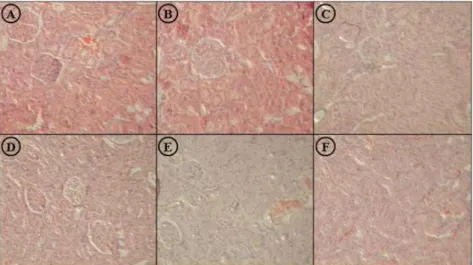
The morphology of the diabetic kidneys was observed us- ing hematoxylin and eosin at 4 weeks after diabetes in- duction (Fig. 5). Diabetic rats showed marked glomerular hypertrophy and an increase in the mesangial matrix in com- parison with the control. Minimal changes in the glomerular morphology were observed in the rats administered 1.0%
mulberry extract.
Effect of mulberry on insulin concentration in diabetic rats
Insulin concentration assays were performed after mul- berry administration in each experimental group (Fig. 6).
The insulin concentrations decreased in STZ-induced dia- betic groups. On week 4, the insulin concentrations in the 0.5%, 1.0%, and 2.0% mulberry treatment groups were 1.63 ng/ml, 3.3 ng/ml, and 1.83 ng/ml, respectively (Fig. 6). The value for the 1.0% mulberry group (3.3 ng/ml) was 260.52%
of that for the diabetic group (1.27 ng/ml).
Table. 1 The food intake and food efficiency ratio (FER) in STZ-induced diabetic rats fed various mulberry concentrations for 4 weeks
Group1) Food in take
Ave. FER2)
1 week 2 week 3 week 4 week
Normal (n=10) 12.5±2.1 13.0± 1.5 13.0±2.5 14.5±1.5 13.3±0.9 164.5±11.9
Diabetic (n=10) 27.0±12.0 33.5±0.7***3) 30.0±10.4** 27.5±7.7 29.5±3.0 56.9±6.5***
Insulin (n=10) 26.0±6.0 30.9±1.9*** 21.8±2.5 16.2±0.0 23.7±6.2 54.1±7.0***
0.5% Mulberry (n=10) 17.0±6.0 32.0±2.4*** 24.5±6.3 14.5±1.5 22.0±7.9 69.9±6.9***
1.0% Mulberry (n=10) 10.9±3.0 31.5±5.6*** 30.5±2.5** 29.5±15.3 25.6±9.8 9.3±8.8***†
2.0% Mulberry (n=10) 20.5±5.5 31.0±1.9*** 28.5±3.9 26.0±9.2 26.5±4.5 40.2±10.2***
1)Normal: normal control fed water, Diabetic: diabetic control fed water, Insulin: injected insulin, 0.5% Mulberry: 0.5% oral admin- istration of mulberry, 1.0% Mulberry: 1.0% oral administration of mulberry, 2.0% Mulberry: 2.0% oral administration of mulberry
2)FER: [Body weight gain (g/4 weeks)/ Food intake (g/4 weeks)]×100
3)Each column represents mean value±S.D. (n=10).
**
p
<0.01 vs. normal control fed water group (Normal),***p
<0.001 vs. normal control fed water group (Normal),†p
<0.001 vs. diabetic control fed water group (Diabetic)Fig. 5. Morphological changes in the kidneys of STZ-induced diabetic rats that were fed mulberry extracts of various concentrations for 4 weeks. Representative renal sections from normal control (A), STZ-induced diabetic rats (B), diabetic rats treated with insulin (C), diabetic rats that received oral administration of 0.5% mulberry extract (D), diabetic rats that received oral admin- istration of 1.0% mulberry extract (E), and diabetic rats that received oral administration of 2.0% mulberry extract (F) are shown. Diabetic rats showed significant glomerular hypertrophy and a marked increase in the mesangial matrix.
Fig. 6. Insulin concentration in STZ-induced diabetic rats that were fed mulberry extracts of various concentrations for 4 weeks.
Normal: normal control rats that were fed water; Diabetic:
diabetic control rats that were fed water; Insulin: rats that received insulin injections; 0.5% Mulberry: rats that received oral administration of 0.5% mulberry extract; 1.0%
Mulberry: rats that received oral administration of 1.0%
mulberry extract; 2.0% Mulberry: rats that received oral ad- ministration of 2.0% mulberry extract. The columns repre- sent the mean value of insulin concentration (n=10).
***
p
<0.001 vs. Diabetic control rats that were fed water (Diabetic).Discussion
Several studies demonstrated that the effect of mulberris on the metabolic improvement in rats with STZ-induced dia- betes in vitro [18,21,22]. Moreover, this study was conducted to investigate the effect of Buan mulberries on the metabolic improvement in rats with STZ-induced diabetes in vivo.
Specifically, we analyzed weight and histological change of kidney, and insulin concentration in blood.
Methanol extract from mulberries demonstrated improve- ment of lipid metabolism, liver function, glutamic oxalo- acetic transaminase (GOT), glutamic pyruvic transaminase (GPT) and lactate dehydrogenase (LDH) in cholesterol-in- duced hyperlipidemia rats [10,11]. Therefore, we extracted Buan mulberries and administrated various concentration of methanol extraction to STZ-induced diabetic rats.
STZ (70 mg/kg, rat body weight) was subcutaneously ad- ministered to the rats. The induction of diabetes mellitus in rats was confirmed by determining the blood glucose level (>400 mg/dl).The rats were divided into 6 experimental groups of 10 rats each: normal control, diabetic group (negative control), insulin group (positive control), 0.5%
mulberry group, 1.0% mulberry group, and 2.0% mulberry group. The results showed that the body weight of the con- trol rats (87.2±6.3 g) increased in the 4 weeks following mul- berry oral administration. However, the body weight in the negative control group significantly decreased within 4 weeks after STZ administration. The mean body weights of the mulberry-treated diabetic groups were significantly low- er than that of the negative control group after 4 weeks.
Another study reported that the body weight of the rats with STZ-induced diabetes decreased due to insulin deficiency and dysfunction of energy metabolism [9].
Blood glucose in the negative control group was sig- nificantly higher than that in the normal control group.
However, the blood glucose in the 1.0% mulberry group was significantly lower than that in the negative control. This result was similar to the findings of Kim et al., who showed that ingestion of mulberry fruit resulted in a hypoglycemic effect in rats with STZ-induced diabetes [18].
A previous study reported that food intake in the diabetes group was significantly higher than that in the normal con- trol [23]. Additionally, our results showed that the food in- take in the diabetes groups was significantly higher than that in the normal control. The FER values of all diabetes groups were significantly lower than that of the normal control
(p<0.001). The FER value of the 1.0% mulberry group was significantly higher than that of the negative control (p<0.001). Although the food intake in the diabetes groups was much higher than that in the normal control, the weight loss and decreased FER phenomena resulted from dia- betes-induced degenerative changes in in vivo metabolism [24].
Glucose accumulates in the blood (hyperglycemia), and when its concentration exceeds the renal tubular transport threshold, it is excreted into the urine (glucosuria) [4].
Glucosuria causes osmotic diuresis, thereby causing polyuria and obligatory polydipsia [3,4,26]. Diabetic nephropathy (DN) caused by the osmotic diuresis is a major complication of diabetic mellitus and is one of the main causes of death in humans, dogs, and cats [3,4,5,30]. Our study showed that kidney weight of rats with STZ-induced diabetes was higher than that of the normal control. In addition, we observed that the mean kidney weight of the 1.0% mulberry group was lower than that of the negative control.
Our results showed that the insulin concentration in rats with STZ-induced diabetes decreased. However, the serum insulin level of the 1.0% mulberry group was significantly higher than that of the negative control. Several studies showed that rats with STZ-induced diabetes had decreased insulin concentration in serum [13,17,29]. Therefore, our study results indicate that administration of a 1.0% mulberry extract has an anti-diabetes effect.
Thus, we have shown that administration of 1.0% mul- berry extract significantly inhibited the blood glucose level and urine quantity and increased kidney weight, food intake and insulin concentration. These results suggest that culti- vated in Buan mulberry could serve as a functional food for the treatment of diabetes mellitus and is highly effective for the recovery from STZ-induced diabetes in rats.
Acknowledgment
This study was supported by a grant (Code
#PJ0074922010) and (20100101-054-013-001-03-00) from the Korea Rural Development Administration.
References
1. Asano, N., T. Yamashita, K. Yasuda, K. Ikeda, Y. Kameda, A. Kato, R. J. Nash, H. S. Lee, and K. S. Ryu. 2001.
Polyhydroxy alkaloids islated from mulberry trees (Morus alba L.) and silkworms (Bombyx mori L.).
J. Agric. Food
Chem.
49, 4208-4213.2. Atkinson, M. A. and N. K. Maclaren. 1994. The pathogenesis of insulin dependent diabetes.
N. Engl. J. Med.
331, 1428-1436.3. Birchard, S. J. and R. G. Sherding. 2000.
Diabetes mellitus.
Saunders manual of small animal practice.
pp. 274-287, 2nd eds., WB Saunders Company. Philadelphia.4. Chandler, E. A., J. M. Evans, W. B. Singleton, F. G. Startup, J. B. Sutton, and W. D. Tavernor. 1979.
Diabetes mellitus (hypoinsulinism). Canine medicine and therapeutics.
pp.182-186, Oxford: Blackwell Scientific Publications. Oxford.
5. Ettinger, S. J. 1983.
Hypoinsulinism (Diabetes mellitus).
Textbook of veterinary internal medicine, Diseases of the dog and cat.
pp. 1619-1633, 2nd eds., WB Saunders Company.Philadelphia.
6. Gavin, J. R., K. G. M. M. Alberti, M. B. Davidson, R. A.
Defronzo, A. Drash, S. G. Gabbe, S. Genuth, M. I. Harris, R. Kahn, H. Keen, W. C. Knowler, H. Lebovitz, N. K.
Maclaren, J. P. Palmer, P. Raskin, R. Rizza, and M. P. Stern.
2002. Report of the expert committee on the diagnosis and classification of diabetes mellitus.
Diabetes Care
25, S5-S20.7. Ghosh, S. and S. A. Suryawanshi. 2001. Effect of vinca rosea extracts in treatment of alloxan diabetes in male albino rats.
J. Exp. Biol.
39, 748-759.8. Holthofer, H., J. Reivinen, M. L. Solin, A. Haltia, and A.
Miettinen. 1996. Decrease of glomerular disialogangliosides in puromycin nephrosis of the rat.
American J. Pathol.
149, 1009-1015.9. Kim, C. S., Y. S. Lee, J. S. Kim, and Y. H. Hahn. 2000. High performance liquid chromatographic analysis of isoflavones in soybean food.
J. Korean Food Sci. Technol.
32, 23-30.10. Kim, H. B., S. Y. Kim, K. S. Ryu, W. C. Lee, and J. Y. Moon.
2001. Effect of methanol extract from mulberry fruit on the lipid metabolism and liver function in cholesterol-induced hyperlipidemia rats.
Korean J. Seric. Sci.
43, 104-108.11. Kim, H. B., K. J. Park, Y. S. Seuk, S. L. Kim, G. B. Sung, H. W. Nam, and J. Y. Moon. 2002. Mophological character- istics and physiological effects of mulberry leaves and fruits with wild varieties.
Korean J. Seric. Sci.
44, 4-8.12. Kim, H. B., A. J. Kim, and S. Y. Kim. 2003. The analysis of functional materials in mulberry fruit and food product development trends.
Food Science and Industry
36, 49-60.13. Kim, M. W. 2000. Effects of H2O fraction of dioscorea japon- ica thumb with vitamin E on glucose and lipid metabolism in streptozotocin indued diabetic rats.
Korean J. Soc. Food Sci.
13, 500-506.14. Kim, M. W. 2000. The antidiabetic properties of fractions of Lycopus Lucidic Turcz in streptozotocin diabetic rats
. Korean J. Soc. Food Sci.
16, 644-651.15. Kim, O. K. 2009. Antidiabetic and antioxidative effect of Lycii fructus in streptozotocin-induced diabetic rats.
Korean J. Pharmacogn.
40, 128-136.16. Kim, O. K. 2009. Antioxidative effect of polygoni radix in streptozotocin-induced diabetic rats.
Korean J. Pharmacogn.
40, 213-217.
17. Kim, S. Y., K. J. Park, and W. C. Lee. 1998. Antiinflamatory and antioxidative effect of Morus spp. Fruit extract.
Korean J. Medical Crop. Sci.
6, 204-209.18. Kim, T. W., Y. B. Kwon, J. H. Lee, I. S. Yang, J. K. Youm, H. S. Lee, and J. Y. Moon. 1996. A study on the antidiabetic effect of mulberry fruit.
Korean J. Seric. Sci
. 38, 100-107.19.. Kimura, T., K. Nakagawa, Y. Saito, K. Yamagishi, M.
Suzuki, K. Yamaki, H. Shinmoto, and T. Miyazawa. 2004.
Determination of 1-deox-ynojirimycin in mulberry leaves using hydrophilic interaction chromatography with evapo- rative light scattering detection.
J. Agric. Food Chem.
52, 1415-1418.20. Krishnaswami, S., M. K. R. Naomani, and M. M. Ahsan.
1970. Studies on the quality of mulberry leaves and silk- worm cocoon crop production. Part1: Quality differences due to varieties.
Indian J. Seric.
9, 1-10.21. Kwon, E. H., M. A. Jung, S. J. Rhee, S. W. Choi, and S.
H. Cho. 2006. Antioxidant effects and improvement of lipid metabolism of mulberry fruit, mulberry leaves and silk- worm powder with different mixing ratios in streptozoto- cin-induced diabetic rats.
Korean J. Nutr.
39, 91-99.22. Kwon, E. H., H. S. Jang, S. W. Kim, S, W. Choi, S. J. Rhee, and S. H. Cho. 2007. Effects of mulberry juice and cake pow- ders on blood glucose and lipid lowering and erythrocytic antioxidative enzye activities in streptozotocin-induced dia- betic rats.
Korean J. Nutr.
40, 199-210.23. Lau, A. L., and M. L. Failla. 1984. Urinary excretion of zinc, copper and iron in the streptozoticin-diabetic rat.
J. Nutr.
114, 223-224.
24. Lee, J. S., H. S. Son, Y. S. Maeng, Y. K. Chang, and J. S.
Ju. 1994. Effect of buck wheat on organ weight. Glucose and lipid metabolism in stereptozotocin induced diabetic rats.
J. Korean Nutr.
27, 819-827.25. Mohos, S. C. and L. Skoza. 1969. Glomerular sialoprotein.
Science
164, 1519-1521.26. Mogensen, C. E., W. F. Keane, P. H. Bennett, G. Jerums, H. H. Parving, P. Passa, M. W. Steffes, G. E. Striker, and G. C. Viberti. 1995. Prevention of diabetic renal disease with special reference to microalbuminuria.
Lancet
346, 1080-1084.27. Narayan, E. S., K. Kasiviswanathan, and I. M. N. Sitaram.
1967. Effect of varietal feeding, irrigation levels and nitrogen fertillization on larvae of Bombyx mori L.
Indian J. Seric.
1, 109-117.
28. Park, M. J., S. J. Kang, and A. J. Kim. 2009. Hypoglycemic effect of angelica gigas naki extract in streptozotocin-in- duced diabetic rats.
Korean J. Food Nutr.
22, 246-251.29. Qiu, L., C. Zhang, J. Zhang, J. Liang, J. Liu, C. Ji, and J.
Y. Yang. 2009. Intraperitoneal co-administration of thymosin α-1 ameliorates streptozotocin-induced pancreatic lesions and diabetes in C57BL/6 mice.
Int. J. Mol. Med.
23, 597-602.30. Ritz, E. and S. R. Orth. 1999. Nephropathy in patients with type 2 diabetes mellitus.
N. Engl. J. Med.
341, 1127-1133.31. Shin, D. H. 1998. Antioxidative substance in mulberry leaves.