HSV 컬러 모델에서의 도플러 효과와 영상 차분 기반의 실시간 움직임 물체 검출
누완*, 김원호* 종신회원
Real Time Moving Object Detection Based on Frame Difference and Doppler Effects in HSV color model
Nuwan Sanjeewa*, Won-Ho Kim* Lifelong Member
요 약
본 논문은 영상에서 실시간으로 움직임 물체와 물체의 위치를 검출하는 방법을 제안한다. 첫째로 영상으로부터 2개의 연속된 프레임 차분을 통해 움직이는 물체를 추출하는 방법을 제안한다. 만약 두 프레임이 캡쳐되는 사이의 간격이 길다면, 실제 움직이는 물체의 꼬리 같은 거짓 움직임 물체를 생성한다. 두번째로 본 논문은 도플러 효과와 HSV 색상 모델을 사용하여 이 문제들을 해결하는 방법 을 제안한다. 마지막으로 물체의 분할과 위치 설정은 상기의 단계에서 얻은 결과가 조합되어 완료된다. 제안된 방법은 99.2%의 검출 율을 갖고, 과거에 제안된 다른 비슷한 방법들 보다는 비교적 빠른 속도를 갖는다. 알고리즘의 복잡성은 시스템의 속도에 직접적인 영향을 끼치기 때문에, 제안된 방법은 낮은 복잡성을 가져 실시간 움직임 검출을 위해 사용 될 수 있다.
Key Words : Video Surveillance, object detection, Color Analysis, Image Processing, Doppler Effects, HSV color model
ABSTRACT
This paper propose a method to detect moving object and locating in real time from video sequence. first the proposed method extract moving object by differencing two consecutive frames from the video sequence. If the interval between captured two frames is long, it cause to generate fake moving object as tail of the real moving object. secondly this paper proposed method to overcome this problem by using doppler effects and HSV color model. finally the object segmentation and locating is done by combining the result that obtained from steps above. The proposed method has 99.2% of detection rate in practical and also this method is comparatively speed than other similar methods those proposed in past. Since the complexity of the algorithm is directly affects to the speed of the system, the proposed method can be used as low complexity algorithm for real time moving object detection.
※ 본 연구는 2014년도 지식경제부의 재원으로 한국에너지 기술평가원(KETEP)의 지원을 받아 수행한 연구 과제입니다.
*공주대학교 전기전자제어공학부, 교신저자 : 김원호 ([email protected])
접수일자 : 2014년 10월 27일, 수정완료일자 : 2014년 11월 18일, 최종게재확정일자 : 2014년 11월 24일
I. Introduction
Moving object detection is one of the basic and important scheme in video surveillance system with the purpose of extracting interesting target area and locating the moving objects from a video sequence. It is a very essential task to segment motion areas clearly for object recognition, tracking as well as behavior understanding.
However, due to the variation of application in the reality, such as light changes, camera vibration, mutual-occlusion
of moving objects, the accuracy and rapidity of the moving object detection is challenged with a variety of complication. So far, the most of the moving object detection algorithms have been based on certain direction, therefore moving object detection is still a huge field to research in computer vision application. There are three major ways for moving object detection in present applications: Background subtraction, inter frame differencing, optical flow method. Background subtraction uses difference image between current frame and
referenced background image to threshold and extract moving objects[1][2]. The frame differencing method is used in many application and it the most famous method for moving object detection since it is fast and easy to implement[3][4]. But this method is very sensitive to noise such as sudden illumination, light changes etc. This method simply takes the difference of two or three inter frame and obtains the moving objects by thresholding.
This method can not be used for object recognition since it does not give the real shape of the object, Therefore it needs further process to detect exact moving object.
Optical Flow reflects the light changing tendency of every pixel in scene. Without any priori information, it can detect an independent moving-object[5][6]. The method, however, can’'t meet the need of real-time because the heavy computation load and need relevant hardware support.
What is worse, it’'s easily affected by noise.
Since there are some shortcomings in traditional method, the combination of frame difference method and doppler effects in HSV color model is proposed in this paper and it can overcome the setbacks and flaws in single method effectively and makes full advantages.
firstly it takes difference of a two consecutive frame and extract candidate moving areas. In the next step it extract brightness areas in the H channel of the current frame that generated due to the moving object. Finally match the candidate moving regions those resulted from the two method above and get the final result by extracting overlapped areas. This result gives the complete reliable moving objects, which is convenient for the recognition and tracking.
Ⅱ. Moving Object Extraction
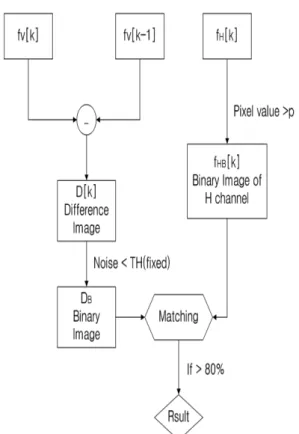
The proposed algorithm in this paper has three basic steps and each step is explained bellow. The block diagram of the proposed algorithm is shown in figure 1 and all process are done using HSV color model. V channel is used for frame difference since this channel similar to the gray scale image. Thus the H channel used to detect the brightness of the moving object since the moving objects are brighter then background. Then those two result is match (AND process) to get the final moving object and its real time exact position.
Fig 1. Block diagram of the moving object detection algorithm
A. Moving Object Extraction by Using Frame Difference
To detect the moving object in the surveillance, two consecutive frames from the video sequence must be subtracted. The frame difference process eliminates the static area that common for both considered frame while the temporally changed area over time is remained. Let
be the current frame of the video sequence and
is the consecution previous frame of the sequence. Then the frame difference image can be written as follow
(1)Differs from theory, the frame difference image
does not contain all, but only the areas that introduced by moving objects but also the areas that generated due to the noise and shadow in practical. Furthermore the resulted image from equation (1) can be represent as combination of shadow portion, noise portion and moving portion as bellow.
∆ ∆ ∆
(2)∆ represents the covered area from the moving object in previous image and current image while ∆
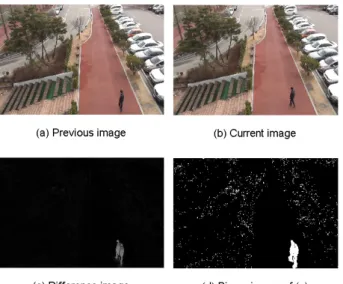
and ∆ represent respectively the fluctuated noise and shadow areas. Figure 2 illustrate the phenomena explained and it needs a further process to eliminate the noise area and shadow area from the resulted image in above. (a) and (b) are the two successive frame from a video sequence and image (c) shows the difference image of the two frame and image (b) shows the binary image of the image (c).
First this paper deal with the noise pixels and shadow pixels and later with object pixels to extract real moving object and its real position.
Fig 2. Frame difference and its results
B. Noise & Shadow Elimination Based on Frame Difference
The noise pixels and shadow pixels in the frame difference image always exist numerically small gray values while object pixels contains high gray values.
Based on this concept, the frame different image is separated into two parts by the threshold . Pixels those have smaller gray values than are set down to zero and the other pixels those have grater gray values than are set up to one and then the image that contains the object pixels can be obtained.
≥
(3)In this paper the is fixed in certain value that obtained from experiment and the resulted binary image after removing noise and shadow is shown in figure (3).
Fig 3. Binary image after thresholding noise and shadow
The figure 3 show the covered area from the moving object ∆ currently and previously. It can be seen that the object appears as two objects which are partly overlap each other. This happen due to the frame difference value that given by the previously covered area from the moving object at the previous frame. Therefore it needs to extract the real moving object from the candidate areas and next step introduce a method for that based on H channel of the HSV color model.
C. Extracting real moving object and its real position
It needs to understand some physical characteristics of real color images which are influenced by typical CCD cameras. The CCD sensors linearly transforms infinite-dimensional spectral color space to a three-dimensional RGB color space via red, green, and blue color filters. Those filters filter the reflected light waves based on wave length. As we already know the reflected waves from moving objects have effects of Doppler effects.
When the moving object is moving outward from camera, the reflected waves have smaller wave lengths than its original. When the moving object is moving inward to camera the reflected waves have greater wave lengths than its original. This Phenomenon cause to change brightness of the moving objects over its movements. This Phenomenon cause to have greater pixels values in H channel of HSV color model. Thus H value can be greater than others due to the system noise or light reflection from metal surfaces and it shows in figure 4.
Fig 4. H channel image in HSV color model
Therefor H channel can be used to extract real moving object by thresholding its pixel's values based on concept above as follow.
≥
(4)Where is binary image resulted from H channel image after threshold and it contains real time moving object and some illuminated pixels as well. The threshold
is decided by experimental process and it is in range of 0 to 1. The resulted binary image from this step is shown in figure 5.
Fig 5. The resulted binary image in H channel
Now the real moving object and its real position can be obtained by applying AND logic to those two resulted binary images resulted from frame difference and secondly proposed method in this paper. The result is shown in figure 6 bellow.
Fig 6. The resulted image from AND process
The resulted image from after AND process gives the real time moving object and its current position. In this paper, the candidate are is introduces as real moving objects if the objects pixels are matched more than 80%
and number of object pixels are counted by connected component labeling[7]. The resulted object included some scatters and a sharp shape can be obtained by applying mathematical morphology erosion or dilation. The final
result is shown in next section.
III. Simulation Result
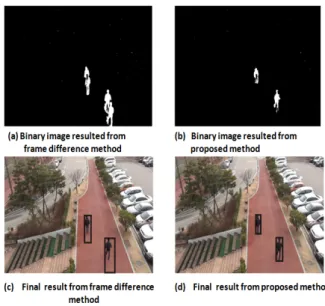
The moving object detection is done by previous steps and not it is time to be done the object segmentation. In this paper, it uses eight connected component labeling for object segmentation and finally it gets rectangle that contains the real moving object in its real location. Some of the simulation result is shown in figure 7. Simulation result shows 99.2% of moving object detection rate.
Fig 7. Simulation result
It can be seen that the proposed method gives real moving object and its real location at the moment while the traditional frame difference method gives over headed result. The simulation result shows that the proposed method is able to extract the real moving object and its real location by removing unnecessary part of the candidate moving area.
IV. Conclusion
This paper propose a method to detect moving object and locating in real time from video sequence. first the proposed method extract moving object by differencing two consecutive frames from the video sequence and then extract the real moving object from the candidate moving areas based on doppler effects in the HSV color model.
The proposed method shows comparatively higher detection rate which is 99.2% and the computational load of this algorithm is comparatively lower then other traditional algorithms. Whole process of the proposed
algorithm are done in a single color model that is HSV.
However the proposed method has some shortcomings since this method unable to perform well since moving object move very fast across the camera Also this algorithm is unable to track moving objects since the object is not moving and if real shape of the object needed, then it has to be done a further process such as dilation or erosion as mentioned before. The simulation result shows the proposed algorithm in this paper can be applied for real time moving object detection and locating.
REFERENCES
[1] Cucchiara, R. ; Grana, C. ; Piccardi, M. ; Prati, A, "Detecting moving objects, ghosts, and shadows in video streams", IEEE Transactions on Pattern Analysis and Machine Intelligence, Vol. 25, pp. 1337-1342, 2003.
[2] Heikkila, M. ; Pietikainen, M, "A texture-based method for modeling the background and detecting moving objects", IEEE Transactions on Pattern Analysis and Machine Intelligence, Vol. 28, pp. 657-662.
[3] Yongquan Xia ; Weili Li ; Shaohui Ning, "Moving Object Detection Algorithm Based on Variance Analysis", Second International Workshop on Computer Science and Engineering, Vol. 1, pp. 347-350, 2009.
[4] Zhan Chaohui ; Duan Xiaohui ; Xu Shuoyu ; Song Zheng,
"An Improved Moving Object Detection Algorithm Based on Frame Difference and Edge Detection", Fourth International Conference on Image and Graphics, pp. 519-523, 2007.
[5] Diansheng Chen ; Yuxin Chen ; Tianmiao Wang, "Moving object detection by multi-view geometric constraints and flow vector classification", IEEE International Conference on Robotics and Biomimetics (ROBIO), pp. 1630-1634, 2010.
[6] Ping Gao ; Xiangju Sun ; Wei Wang, "Moving object detection based on kirsch operator combined with Optical Flow", International Conference on Image Analysis and Signal Processing (IASP), pp. 620-624, 2010.
[7] Klaiber, M. ; Rockstroh, L. ; Zhe Wang ; Baroud, Y, "A memory-efficient parallel single pass architecture for connected component labeling of streamed images", International Conference on Field-Programmable Technology (FPT), pp. 159-165 2012.
[8] Jabid, T. ; Mohammad, T. ; Ahsan, T. ; Abdullah-Al-Wadud, M, "An edge-texture based moving object detection for video content based application", 14th International Conference on Computer and Information Technology (ICCIT), pp. 112-116, 2011.
[9] Bo-Hao Chen ; Shih-Chia Huang, "An Advanced Moving Object Detection Algorithm for Automatic Traffic Monitoring in Real-World Limited Bandwidth Networks", IEEE Transactions on Multimedia, Vol. 16, pp. 837-847,
2014.
[10] Jiman Kim ; Guensu Ye ; Daijin Kim, "Moving object detection under free-moving camera", 17th IEEE International Conference on Image Processing (ICIP), pp.
4669-4672, 2010.
저자
누 완(Nuwan Sanjeewa) 정회원
․2013년 2월:공주대 전기전자제어공학 부 (공학사)
․2013년 3월 ∼ 현재:공주대 대학원 전 기전자제어공학과 석사과정
<관심분야> : 영상신호처리, DSP응용
김 원 호(Won-Ho Kim) 종신회원
․1987년 2월:경북대 전자공학 석사
․1999년 2월:충남대 전자공학 박사
․1989년 2월 ∼ 1999년 8월:한국전자 통신연구원(ETRI) 선임연구원
․1999년 8월 ∼ 현재:공주대학교 전기 전자제어공학부 교수
<관심분야> : 영상 및 통신 신호처리, 위성멀티미디어통신, 지능형 영상감시 및 비젼센서