색상지도와 멀티 레이어 HOG-SVM 기반의 실시간 신호등 검출 알고리즘
김 상 기
a)
, 한 동 석b)‡
Real Time Traffic Light Detection Algorithm Based on Color Map and Multilayer HOG-SVM
Sanggi Kim
a)
and Dong Seog Hanb)‡
요 약
신호등 검출은 첨단운전자보조시스템에서 매우 중요하며 최근 신호등 검출 알고리즘의 연구가 활발히 진행 중이다. 그러나 기존의 영상처리 기반의 신호등검출 알고리즘은 조명의 변화에 민감하다는 문제점이 있다. 이러한 문제점을 해결하기 위하여 본 논문에서는 다음과 같은 신호등 검출 알고리즘을 제안한다. 먼저 제안하는 컬러맵과 HSV(hue-saturation-value)를 이용하여 신호등의 후보영역을 검출한다. 이후 검출된 신호등 후보영역으로부터 HOG(histogram of oriented gradient) 서술자와 SVM(support vector machine)을 이 용하여 신호등을 검출한다. 검출된 신호등 영상을 이용하여 제안하는 Multilayer HOG 서술자를 이용하여 신호등의 방향 정보를 결정 한다. 실험결과에서 확인할 수 있듯이 제안하는 알고리즘은 높은 검출성능과 실시간 처리가 가능하다.
Abstract
Accurate detection of traffic lights is very important for the advanced driver assistance system (ADAS). There have been many research developments in this area. However, conventional of image processing methods are usually sensitive to varying illumination conditions. This paper proposes a traffic light detection algorithm to overcome this situation. The proposed algorithm first detects the candidates of traffic light using the proposed color map and hue-saturation-value (HSV) Traffic lights are then detected using the conventional histogram of oriented gradients (HOG) descriptor and support vector machine (SVM). Finally, the proposed Multilayer HOG descriptor is used to determine the direction information indicated by traffic lights. The proposed algorithm shows a high detection rate in real-time.
Keyword : traffic light detection (TLD), support vector machine (SVM), histogram of oriented gradient (HOG), advanced driver assistance system (ADAS)
Copyright Ⓒ 2017 Korean Institute of Broadcast and Media Engineers. All rights reserved.
“This is an Open-Access article distributed under the terms of the Creative Commons BY-NC-ND (http://creativecommons.org/licenses/by-nc-nd/3.0) which permits unrestricted non-commercial use, distribution, and reproduction in any medium, provided the original work is properly cited and not altered.”
a)
경북대학교 대학원 전자공학부(Kyungpook National University, Graduate School of Electronics Engineering)
b)
경북대학교IT
대학 전자공학부(Kyungpook National University, School of Electronics Engineering, College of IT Engineering)
‡
Corresponding Author :
한동석(Dong Seog Han) E-mail: [email protected] Tel: +82-53-950-8669
ORCID: http://orcid.org/0000-0002-7769-0236
※ 이 논문은
2016
년도 정부(
미래창조과학부)
의 재원으로 한국연구재단의 지원을 받아 수행된 지역신산업선도인력양성사업 성과임(No.
한국연구재단에서 부여한 과제번호:
연구사업 통합시스템에서 확인)(NRF-2016H1D5A1909920).
・Manuscript received September 30, 2016; Revised December 19, 2016; Accepted December 21, 2016.
일반논문(Regular Paper)
방송공학회논문지 제22권 제1호, 2017년 1월 (JBE Vol. 22, No. 1, January 2017) https://doi.org/10.5909/JBE.2017.22.1.62
ISSN 2287-9137 (Online) ISSN 1226-7953 (Print)
Ⅰ. Introduction
Recently, advanced driver assistance system (ADAS) is widely used in autonomous vehicle system. Among the ADAS techniques, traffic light detection is one of the im- portant issues of which there have been many research de- velopments to get more accurate detection of traffic lights.
Vision-based systems can be integrated with sensors such as global positioning system (GPS) to discover the potential presence of traffic light regions. Research works [2] and [3]
used GPS to acquire traffic light regions robustly and reduce noise such as varying illumination conditions and background noise. However, these systems require additional cost and ac- curate equipment such as sensors and GPS. To reduce the additional cost, many researchers have focused on purely vi- sion based systems and they used the features on traffic lights such as color, shape and illumination.
De Charette et al [5], [6] used the white-top-hat-filter and morphological filter to obtain candidates for traffic lights. Then an adaptive template matching is applied to the result of candidate regions to detect traffic lights.
Masako et al. [7] used the normalized (red-green-blue) RGB color space to detect candidates of traffic lights. Then they detect edges for traffic lights to compare the shape.
However, these methods would be affected by varying illumination. A lot of research has been carried out in the hue-saturation-value (HSV) color space for the detection of traffic lights. The HSV color space is less sensitive to vary- ing illumination. Hwang et al. [8] used the HSV color space by adopting an appropriate threshold and the center finding with a Gaussian mask to detect candidates of traffic lights. Then traffic lights are detected by using a suggested existence-weight map. Shen et al. [9] used hue and satu- ration to obtain traffic lights. Chen et al. [10] used the nor- malized RGB and HSV which are called a joint color space to obtain candidates of traffic lights. Then the proposed histogram of oriented gradient (HOG) feature is used to de- tect traffic lights. John et al. [4] used GPS information to
discover potential traffic light regions robustly. Then traffic lights are detected based on the convolutional neural net- work by training various datasets for traffic lights.
However, this method has high complexity so that the processing time is too long to be implemented in real-time.
This proposed algorithm uses a color map in the saliency map [1] and the HSV color space. One of the advantages using both color map and HSV is reduced noise compared to other color spaces. The noise in non-traffic light regions is reduced from the result of the color map. Then the con- ventional HOG feature is used to detect traffic lights and the support vector machine (SVM) classifier finally decides the existence of the traffic lights in the test images. The direction information in the traffic light is detected by us- ing the proposed M-HOG with linear SVM. The proposed vision-based algorithm can detect both traffic lights and di- rection information. This paper is organized as follows.
Section II presents a detailed review of the proposed traffic light detection algorithm. Comparative analysis and per- formance of the proposed algorithm are given in Section III and conclusions are drawn in Section IV.
Ⅱ. System Model for Proposed Traffic Light Detection Algorithm
The proposed algorithm is a purely vision-based algo-
rithm to detect traffic lights and extract the directional
information. Fig.1 shows the proposed algorithm. The op-
eration of the proposed algorithm is as follows: At first,
the input image is converted to a color map to detect candi-
dates of traffic lights, then the red or green color is
detected. If the color of a candidate is not red or green,
the candidate should be removed. The color is decided
from the HSV color space. At the second step, the conven-
tional HOG descriptor with linear SVM is used to detect
traffic lights from the candidates. At the third step, the
M-HOG feature is extracted to determine the direction in
formation in the detected traffic lights. Finally, the trained- linear SVM classifier is used to decide the direction in the traffic lights. When the direction information is decided the linear SVM classifier utilizes the fact that traffic light lamps are consisted with the shape of a circle or arrow.
The detailed process is described in the next section.
1. Color Map with HSV
Traffic lights are defined by fixed colors and shapes which are easily noticeable to human eyes. Candidates of traffic lights are normally detected in the color space.
Among the color spaces, RGB and HSV are widely used
to obtain such candidates. When the candidates for traffic lights using the color space are detected, the appropriate spectrum threshold value defining red and green colors is applied to the detected candidates. Adopting the threshold value of color space in road environments does not yield a good performance because of color distortion and varying illumination conditions.
In this paper, the color map is used to detect noticeable parts of images and then detect the candidates using HSV to solve the problem. The color map is one of the features on the saliency map proposed by Itti et al [1]. The saliency map is composed of a linear combination of the color map, intensity map, and orientation map of the divided Gaussian
Direction Information Determination Traffic Light
Detection Traffic Light
Candidates Detection Input Image
그림
1.
제안하는 알고리듬의 개요Fig. 1. Block diagram of the proposed algorithm
(a) (b)
(c) (d)
그림
2.
신호등 후보군 선택 절차: (a)
입력 영상, (b)
입력영상으로부터 색상지도 결과영상, (c)
색상지도와HSV
적용 영상(d) (c)
결과영상으로부터 노이즈필터 적용 결과영상Fig. 2. The procedure of traffic light candidate selection: (a) An input image, (b) Result of color map from the input image, (c) Result of color
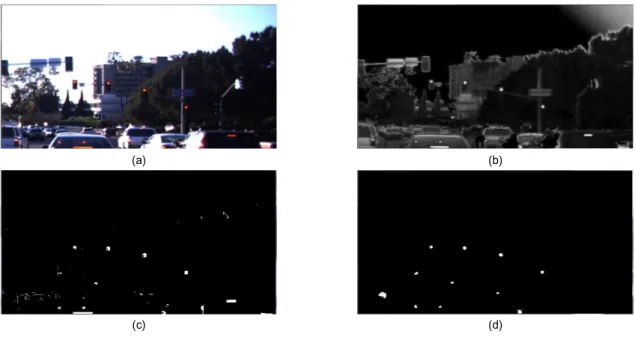
map with HSV color space to obtain candidates of traffic light, (d) Result of Noise filter from the previous result in (c)
pyramid to obtain noticeable parts in the image. However, it is hard to apply the saliency map to road environments because of the high complexity. The proposed color map has the same architecture of the color map in the saliency map. However, it does not use a pyramid structure, but just subtracts the blur image from the input image to obtain no- ticeable parts. The result of the proposed color map is shown in Fig. 2(b). As seen in Fig. 2(b), it is obvious that the proposed color map can detect noticeable parts with traffic lights in the image. However, the colors both red and green are not considered in this part. In order to re- move candidates in the color space which define neither red nor green, the image is converted to HSV from the re- sult of the color map as
arctan
min
(1)
Where , and are hue, saturation and value in the HSV color apace.
From the HSV using (1), H and S are used to detect colors of red and green and the candidates with other col- ors are deleted from the candidates by adopting threshold values as shown in Fig. 2(c). The threshold value was em- pirically set using red and green traffic light dataset ob- tained from experimental environment. The candidate traffic lights are detected if pixel range satisfies the threshold.
2. Noise filter
As shown in the previous result of Fig. 2(c), there is still much noise in the image. This noise occurs due to varying illumination conditions, background noise and taillights. To reduce the noise, we propose a noise filter. Traffic light emit-
ting units have fixed shapes. Their average size can be known from the training datasets. We find the connected component and calculate the area for each candidate to remove noise.
The condition to remain as a candidate is as follows:
≤
≤
(2)Where is the size of an object in the image,
and
are minimum and maximum areas, respectively.
However, the filter for average size of traffic light cannot remove noise when the size is within the minimum and maximum range defined by
and
respectively. In or- der to remove these noise, we consider aspect ratio regard- ing all blobs as follows:
min
max
(3)
Where is the aspect ratio, and rep- resent the width and height of the bounding box. If
is larger than the threshold
, the object is registered as a candidate for traffic light. The range of the aspect ratio may be change due to dynamic road environments causing the varying illumination condition. Therefore, the threshold for aspect ratio was set at 1.5 empirically in this paper. The results of noise filter is shown in Fig. 2(d).
3. Traffic Light Detection
In the previous section, we detected traffic light candi- dates and color attributes of red or green. Traffic lights consist of three emitting units with different positions.
The traffic light can be detected from the result of emit-
ting unit detection by using traffic light architecture as ex-
plained in Section III. Then candidate regions are divided
into two images of red and green. Each image in Fig. 3
is used to extract the HOG feature. The process to obtain
the HOG feature is as follows: Candidate regions are esti-
mated from the body size of traffic lights using color attributes. The size of candidate regions are normalized as
× ×
Then the detection window size of HOG-descriptor is normalized as
× and block and cell size are
× and
× respectively to extract a conventional HOG feature. Then extract the con- ventional HOG feature for each color.
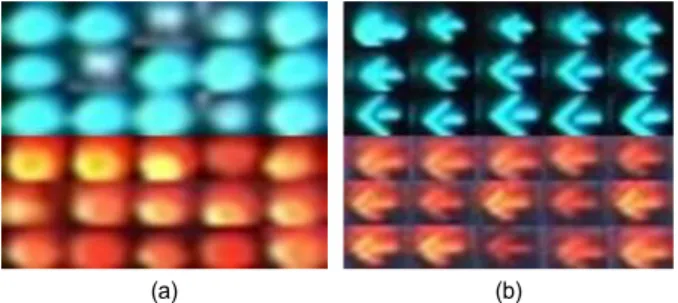
The training dataset shown in Fig. 3 is used to extract the HOG feature by applying the above steps. Linear SVM classifier is used to train HOG feature for training dataset.
Then trained linear SVM classifier for traffic lights is used to detect traffic lights.
(a) (b)
그림
3.
신호등 검출을 위한 훈련영상: (a)
적색 신호등 훈련영상(b)
녹색 신호등 훈련영상Fig. 3. Training samples to detect traffic lights: (a) training samples for the red traffic light (b) training samples for green traffic light
4. Direction Information Determination
In the previous section, we detected traffic light with color. Therefore, we don’t consider color when the direc- tion of traffic light is determined. The orientations of the gradient are normally calculated for circle and arrow im- ages to determine the direction information for the traffic light. Another way to identify the direction of the traffic light is to use the conventional HOG with linear SVM classifier. However, those methods cannot achieve a good performance because of changing illumination and color distortion. Thus, we determine the direction of the traffic light by using the multilayer HOG method. The multilayer HOG descriptor can be obtained as follows: First, we di-
vide emitting unit regions into R, G, B and grayscale from the result of traffic light. Then the image size for each layer is normalized as × × The de- tection window size of mltilayer HOG is normalized as
× The block and cell size are × and × respectively for purposes of extracting the multilayer HOG feature. For each cell, we accumulate gradient magnitude weighted votes for gradient orientation into 9 bins. Then, the multilayer HOG descriptor decides the maximum gra- dient magnitude for each layer. The whole process for mul- tilayer HOG descriptor is shown Fig. 4
그림
4. multilayer HOG descriptor
처리 절차Fig. 4. The process of for multilayer HOG descriptor
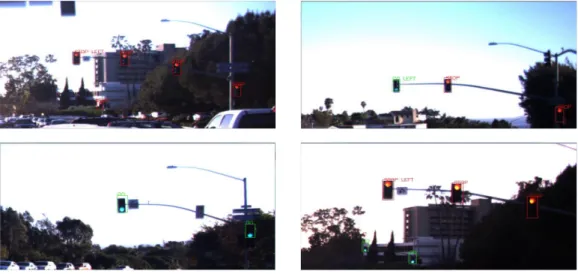
The training dataset shown in Fig. 5 is used to determine the direction of traffic lights by using the multilayer HOG feature described in (4). Then the linear SVM classifier is trained using the multilayer HOG feature in order to classi- fy the direction information which is used to decide the di- rection in the traffic lights. The result of traffic light de- tection and result of directional information is shown in Fig. 6.
(a) (b)
그림
5.
신호등 방향정보 추출을 위한 훈련영상: (a)
원 영상(b)
화살표 영상Fig. 5. Training sample to extract direction information: (a) training sam-
ple to extract circle (b) training sample for the arrow
Ⅲ. Experiment Result
1. Dataset
In this paper, the USA dataset [14] and french dataset [13] are used to train the proposed algorithm. To train the dataset of the proposed algorithm, 5,000 and 8,000 traffic light images for positive dataset and negative dataset were used for the traffic light detection, respectively. The neg- ative images from the test dataset were collected randomly.
For the direction identification, 8,000 circle images and 8,000 arrow images for positive dataset, and 13,000 back- ground images for negative dataset were used. Table 1 shows our training dataset.
Dataset Traffic Light Circle Arrow
RED 5,000 5,123 6,371
GREEN 5,000 2,877 1,629
NEGATIVE 8,000 13,000 13,000
표
1.
훈련 영상Table 1. Training Dataset
2. Performance Evaluation
In order to verify the performance of the proposed algo-
rithm, we utilize French dataset for traffic light detection and USA dataset to detect direction information. The meth- ods of measurement for the proposed algorithm are pre- sented as
Precision TruePositives FalsePositives TruePositives
Recall TruePositives FalseNegatives
TruePositives (5)
The performance evaluation of traffic light detection methods are shown in Table 2. [6],[7] are based on image processing algorithm. As shown in Table 2, image process- ing methods are relatively of low performance compared to the proposed method because of appearance variations and illumination variations. Image processing methods can’t classify similar objects to traffic light such as tail light because of multiple threshold problems. However, The proposed algorithm is relatively robust to illumination variations and the losses of the traffic lights by setting mul- tiple threshold are less than [6],[7].
Table 3 and 4 shows the result of extracting direction information of the traffic lights using Multilayer HOG de- scriptor and conventional HOG descriptor. The conven-
그림
6.
신호등 및 신호등의 방향 정보 검출 결과영상Fig. 6. The result of the proposed algorithm for both traffic light detection and extract direction information
tional HOG descriptor detects the edge using difference of the brightness value from the grayscale. However, this method cannot distinguish between an arrow and a circle due to illumination variations. To solve this problem, Multilayer HOG descriptor is applied to four channel such as R, G, B and grayscale to extract robust features. As shown table 3 and 4, the proposed Multilayer HOG fea- tures show better performance compared to the conven- tional HOG descriptor. The advantage of the Multilayer HOG descriptor is that it is less sensitive to change the illu- mination and represents the shape for the object compared to the conventional HOG descriptor.
Method Precision Recall
proposed 92.16% 93.84%
[6] 84.5% 53.5%
[7] 61.22% 93.75%
표
2.
제안 알고리즘의 성능Table 2. Performance of Proposed algorithm
Class Go Go Left Stop Stop Left
Go 97.2% 7.3% 0% 0%
Go Left 2.8% 92.3% 0% 0%
Stop 0% 0% 96.4% 6.4%
Stop Left 0% 0% 3.6% 93.6%
표
3. Multilayer HOG
서술자를 이용하여 도출된 방향정보 인식성능에 대한 혼동행렬Table 3. Confusion Matrix for Performance of Direction Information us- ing Multilayer HOG descriptor
Class Go Go Left Stop Stop Left
Go 94.6% 10.7% 0% 0%
Go Left 5.4% 89.3% 0% 0%
Stop 0% 0% 93.1% 9.6%
Stop Left 0% 0% 6.9% 90.4%
표
4. HOG
서술자를 이용하여 도출된 방향정보 인식성능에 대한 혼동행렬Table 4. Confusion Matrix for Performance of Direction Information us- ing HOG descriptor
3. Computation Time
To evaluate the computation time of the proposed algo-
rithm, computer simulations have been conducted in a computer having the Intel core CPU i7-4790 processor with the frequency of 3.60 GHz and with 8GB RAM. The algorithm is implemented in C++ and the proposed algo- rithm is a non-optimized C++ code using a single thread.
The image size of the dataset is × However, to reduce computation time, image is resized as × .
The computation time for the proposed algorithm is a near- ly real time algorithm (≈13.7 fps) and the computation time for each part is present in Table 4. As shown in Table 4, the proposed algorithm can perform in nearly real time and it might be applied in practice.
Algorithm Computation Time
Color Map 30ms
Noise Filter 12ms
Traffic Light Detection 31ms
Total 73ms
표
4.
제안하는 알고리즘의 처리시간Table 4. Computation Time For Proposed algorithm
Ⅳ. Conclusion