Introduction
Dextran is a generic term for a bacterial exopolysaccharide synthesized from sucrose and composed of chains of D-glu- cose units connected by α-1,6 glycosidic linkages. Dextran can be branched by α-1,2, α-1,3, or α-1,4-linkages with various de- grees, depending on the strains of Leuconostocs [2,16]. Dextrans have been used for more than 50 years as plasma volume expanders. Recently, dextrans have been investigated for de- livery of drugs and proteins, primary to increase the longevity of therapeutic agents in the circulation [14]. The size of most dextrans that could be applied for medical use ranges from 5 to 100 kDa. The dextran, however, usually synthesized by Leuconostocs has much higher molecular weight of 5×10
7to 10
9and different types of branch were formed dependant on species [1,3,8,9]. Therefore, special techniques must be used to producel the lower molecular weight dextrans.
Lipomyces starkeyi, ascosporogeneous yeast, produces dex- tranase which selectively hydrolyzes the α-(1 6) glycosidic →
bond present in dextrans to produce oligodextrans [10,11].
Mostly the commercial dextranases have been produced from fungi, either Penicillium sp. or Chaetomium sp [5,13]. However, the dextranases of fungi are non-food grade because they con- tain various antibiotics and toxic metabolites that are not re- moved completely. Under circumstance like this, L. starkeyi dex- tranase has been studied for food related application because it is not known to produce antibiotics or toxic metabolites.
L. starkeyi dextranase hydrolyzed high molecular weight of dex- tran to a controlled-size [9]. And also, the dextranase can block formation of dental plaque which is composed of salivary gly- coproteins and sticky glucose polymers [15].
In this paper, we optimized the dextranase production with another strain L. starkeyi KCTC 17343 in the fermenta- tion process. W ith partially purified enzyme, the pattern of dextran hydrolyzates was examined and compared with the previous reports.
Materials and Methods Organism and culture conditions
The ascosporogenic yeast Lipomyces starkeyi KCTC 17343
Optimization of an Extracellular Dextranase Production from Lipomyces starkeyi KCTC 17343 and Analysis of Its Dextran Hydrolysates
Yoon-Hyuck Chang, Joong-Hyun Yeom
1, Kyung-Hwan Jung
2, Byung Chul Chang
3Jung Hee Shin
4and Sun-Kyun Yoo
1Food Research Program, Agriculture and Agri-Food Canada, 93 Stone Road West, Guelph, Ont., Canada N1G 5C9
1
Department of Oriental Medicine and Food Biotechnology, Joongbu University, Choobu-myun, Geumsan-gun, Chungnam, 312-702, Korea
2
Department of Food and Biotechnology, Chungju University, 123 Geodan-ri, Iryu-myun, Chungju, Chungbuk, 380-702, Korea
3
Department of Medical Genetic Engineering, Keimyung University School of Medicine and Institute for Medical Science, 194 Dongsan-dong, Jung-gu, Daegu 700-712, Korea
4
Department of Food and Nutrition, Joongbu University, Choobu-myun, Geumsan-gun, Chungnam, 312-702, Korea Received March 3, 2009 /Accepted April 20, 2009
W e optimized dextranase culture conditions by batch fermentation using Lipomyces starkeyi KCTC 17343. Furthermore, dextranase was purified by an ultra-membrane, and then dextran hydrolyzates were characterized. Cell growth and dextranase production varied depending on the initial culture pH and temperature. The conditions of optimal dextranase production were met in a pH range of 4-5 and temperature between 25-30
oC. At optimal fermentation conditions, total enzyme activity and specific enzyme activity were about 4.85 IU/ml and 0.79 IU/g cells, respectively. The specific growth rate was examined to be 0.076 hr-
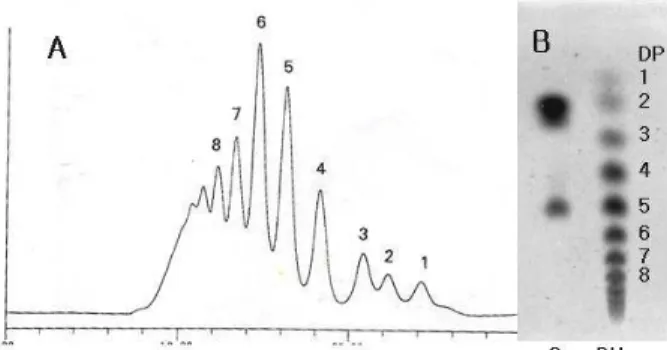
1. The production of dextranase in culture broth was very stably maintained after mid-log phase of growth. The enzyme hydrolyzed dextran into DP (degree of polymerization) 2 to 8 oligodextran series. Analysis of the composition of hydrolysates suggested that the enzyme pro- duced is an endo-dextranase.
Key w ords : Lipomyces starkeyi, dextranase, dextran, fermentation, oligodextran
*Corresponding author
*Tel +82-41-750-6206, Fax +82-41-750-6422 : :
*E-mail : [email protected]
was purchased from a Biological Resources Center (Daejeon, Korea). L. starkeyi was maintained on agar slants containing mineral medium (MM) with 0.5% yeast extracts (Y) and 2%
(w/v) soluble starch as a carbon source. Mineral medium (MM) consisted of 3.0 g KH
2PO
4,0.01 g FeSO
4․ H
2O, 0.01 g MnSO
4․ 4H
2O, 0.2 g MgSO
4․ 7H
2O, 0.01 g NaCl, 0.05 g CaCl
2per 1 liter deionized water. The medium pH was ad- justed to 4.5 prior to sterilization. W orking cultures were prepared by incubating the culture in 50 ml of pH 4.5 MMY (pH4.5) containing 1% (w/v) sucrose or soluble starch in 250 ml-shake flasks. Cultures were incubated on a shaker at 30
oC and 200 rpm. The organism was sub-cultured biweekly.
Optimization of dextranase production
The effects of culture pH and temperature on dextanase production by L. starkeyi KCTC 17343 were determined by incubating the strain at different pH values and at various temperature conditions, respectively. All cultures were in- cubated in MMY medium containing 2% (w/v) soluble starch with a working volume of 50 ml in a shaking in- cubator (SI-300R, Jeio Tech, Daejeon, Korea). The strain was inoculated with 2.0% (v/v) of working volume and the growth was monitored at absorbance of 660 nm by a spectrophotometer. The biomass (g/l) was obtained by the standard curve plotted by comparing the absorbance and dry cell weight. Dextranase activity was measured as de- scribed in the method of Konig and Day [10]. And then, the culture supernatant was reacted with 5% (w/v) T-500 dextran (Sigma, MO, USA) for 20 min in 100 mM sodium acetate, pH 5.2. Activities were determined from increase rate of reducing sugar measured by DNS method [10]. One unit (IU) of dextranase was defined as the amount of enzyme which liberates 1 mole of isomaltose equivalents in one μ minute. Specific enzyme production was expressed as IU/g dry weight cells.
Mass production of dextranase
At optima culture conditions, L. starkeyi dextranase was produced by batch fermentation in a 10 L fermenter (Semitel, BioTechnology Innovation, Dae-jeon, Korea). The medium with working volume 6 L was composed of MMY containing 2% (w/v) gelatinized soluble starch. The strain was in- oculated with 10% (v/v) of the working volume. The pH was adjusted to 5.0 prior to sterilization. The aeration rate was set at 1.0 vvm and temperature was maintained at 30
oC.
Analysis of dextran hydrolyzates
T-500 Dextran hydrolyzates were separated using an ion-exchange column, Aminex HPX-42A (Bio-Rad, Hercules, CA). Samples, 0.1% (w/v), were dissolved in deionized water and the pH was adjusted to 6.5. Fifty ul of sample was used for injection and column temperature was main- tained at 85
oC. The deionized water was used to elute hy- drolysates and elution rate was fixed to 0.4 ml per min.
And also, a 410 Differential Refractometer (Millipore Corporation, MA, USA) was used for detection of hydrolysates. Dextrans hydrolyzates were also analyzed by thin layer chromatography on E. Merck plates 0.25 mm of silica gel 60-Kieselguhr. The solvents as two ascents were used as follows : methylacetate, ethylacetate, propanol, and water in proportions of 85:20:50:85, respectively. The plates were air dried and spraied with the reagent, 5% (v/v) H
2SO
4in ethanol containing 0.3% (w/v) alpha-naphthol.
And then, the plates were heated to 100
oC for 10 to 20 min for development. The oligodextrans were analyzed by comparing their chromatographic behavior with those of the standards.
Results and Discussion
The growth rate and dextranase production of L. starkeyi KCTC 17343 varied depending on the initial culture pH.
As can be seen in Table 1, the dextranase production was directly in proportion to bacterial growth. As the culture pH increased from 2 to 5, the growth also increased. At pH 5, specific growth rate was highest and then dramati- cally decreased at pH 6. Total dextranase production fol- lowed the same pattern. Dextranase yields and specific productions at pH 3 were over 3 times lower than those at pH 4 to 5. At previous research, Lipomyces strains have been reported to have optimal growth at around 5.0 [11].
Interestingly, the optimum pH of dextranase fermentation is similar to that of recombinant dextranase that is ex- pressed in Pichia pastoris [11,12]. And also, the growth rate and dextranase production of L. starkeyi KCTC 17343 var- ied depending on the initial culture temperature (Table 2).
As culture temperature increased from 15 to 30
oC, cell
mass and specific growth rate also increased. At 30
oC of
culture temperature, the specific growth rate was highest
and then decreased at 35
oC. Dextranase yields at culture
temperature 20 to 30
oC were over 7 times higher than that
at 15
oC. It is consistent that Lipomyces strains have shown
optimal dextranase production around at 25 to 30
oC as re- ported in previous study [10,11]. As mentioned above, the optimum pH of dextranase fermentation is similar to that of enzyme activity.
At the optimal fermentation conditions, kinetics of dex- tranase production by L. starkeyi KCTC 17343 was exam- ined as can be seen in Fig. 1. Bacterial growth and dex- tranase production were investigated until the growth reached to a stationery phase. The maximal dextranase production was achieved at the early stage of growth. At this point, the specific growth rate and specific enzyme ac- tivity were 0.047 hr
-1and 0.18 IU/g cells, respectively.
Interestingly, the total activity of dextranase in culture broth maintained very stable after mid-log phase of growth. After fermentation, crude dextranase was obtained after removing sugar and medium residues by ultra-mem- brane system. Typical chromatograms of HPLC and TLC of dextran hydrolyzates by HPLC and TLC were illus- trated in Fig. 2. Enzymes which hydrolyze α-D-(1 6) gly → - cosidic linkages are classified in two types: endodextranase (E.C. 3.2.1.68) and pullulanase (E.C. 3.2.1. 41). However, an extracellular endodextranase was observed from Lipomyces starkeyi [18]. Generally, Endo-dextranases act randomly on the internal part of dextran linkage (α, 1 6) and produce → the isomaltooligosaccharides [15]. This enzyme do not cleave the α-(1 4) and → β-(1 4) linkage. Until now, endo → - dextranase produced from Lipomyces starkeyi ATCC 20825 has been extensively studied. It hydrolyzes the dextran to
Fermentation time (hr)
l) m/ UI
(