Copyright@2014 by The Korean Society of Safety (pISSN 1738-3803) All right reserved. http://dx.doi.org/10.14346/JKOSOS.2014.29.3.079
휴먼에러를 중심으로 한 위험요인 도출 방법론에 관한 연구
정상교․장성록 †
부경대학교 안전공학과 (2013. 9 9. 접수 / 2014. 4. 25. 채택)A Study on the Risk Assessment System for Human Factors
Sang Kyo Jung․Seong Rok Chang †
Department of Safety Engineering, Pukyong National University (Received September 9, 2013 /Accepted April 25, 2014)
Abstract : Human error is one of the major contributors to the accidents. A lot of risk assessment techniques have been developed for
prevention of accidents. Nevertheless, most of them were interested in physical factors, because quantitative evaluation of human errors was difficult quantitatively. According to lack of risk assessment techniques about human errors, most of industrial risk assessment for human errors were based on data of accident analysis. In order to develop an effective countermeasure to reduce the risk caused by human errors, a systematic analysis is needed. Generally, risk assessment system is composed of 5 step(classification of work activity, identification of hazards, risk estimation, evaluation and improvement). This study aimed to develop a risk identification technique for human errors that could mainly be applied to industrial fields. In this study, Ergo-HAZOP and Comprehensive Human Error Analysis Technique were used for developing the risk identification technique. In the proposed risk identification technique, Ergo-HAZOP was used for broad-brush risk identification. More critical risks were analysed by Comprehensive Human Error Analysis Technique. In order to verify applicability, the proposed risk identification technique was applied to the work of pile head cutting. As a consequence, extensive hazards were identified and fundamental countermeasures were established. It is expected that much attention would be paid to prevent accidents by human error in industrial fields since safety personnel can easily fint out hazards of human factors if utilizing the proposed risk identification technique.Key Words : human error, Ergo-HAZOP, comprehensive human error analysis technique, risk assessment system
†
Corresponding Author : Seong Rok Chang, Tel : +82-51-629-6468, E-mail : [email protected]
Department of Safety Engineering, Pukyong National University, 365, Sinseon-ro, Nam-Gu, Busan 608-739, Korea
1.
서 론Heinrich는 불안전한 행동의 원인으로 지식의 부족 (Lack of Knowledge), 기능의 미흡(Insufficient Skill), 태 도의 불량(Improper Attitude), 휴먼에러(Human Error)등 4가지를 들었다 1) . 하지만 최근에 와서는 지식의 부족 이나 기능의 미흡도 관리 활동의 부적절에 기인하는 것이므로 휴먼에러의 범주에 포함시켜야 한다고 주장 하는 학자들도 있다. 반면 태도의 불량은 고의적인 규 정위반 (Intentional Violation)으로 파악되어야 한다는 주 장이 높다 2) . 본 연구에서 말하는 휴먼에러의 범위는 이 와 같이 고의적인 규정위반에 의한 에러를 제외한 휴 먼에러를 모두 포함하는 범위로 설정하였다.
이러한 휴먼에러가 고장이나 사고에 얼마나 많은 영 향을 미치는지에 대한 연구는 오래전부터 이루어져 왔 다. Meister는 장비고장의 약 20%~30%가 직·간접적으
로 휴먼에러에 의해 기인한다고 하였다 3) . Dhillon은 시 스템 고장의 상당비율이 휴먼에러에 기인하는데 , 전자 장비에서 고장의 약 50%~70%가 인간에 의해 휴발되 고, 항공기 시스템에서는 고장의 50%~60%가 휴먼에러 에 의하여 발생한다고 연구하였다 4) . 또한 Rouse &
Rouse는 항공, 전력생산 및 공정작업에서 주요한 사고
의 60%~90%가 휴먼에러에 의해 발생한다고 하였다 5) .
하지만 이러한 휴먼에러에 대한 정량적인 측정이나
평가가 쉽지 않다 . 이로 인해 현재 산업현장에서는 주
로 물적 요인에 치중해서 위험성 평가가 이루어지다
보니 인적요인과 물적 요인간의 긴밀한 인과관계가 소
홀히 취급되었다. 실제로 현재 화학플랜트나 해양플랜
트 산업에서 가장 널리 쓰이는 위험성 평가 기법은 주
로 물적 요인에 대해 평가하는 HAZOP(Hazard and
Operability study)이나 FMEA(Failure Mode and Effects
Analysis)등이 주로 사용되고 있다 6) .
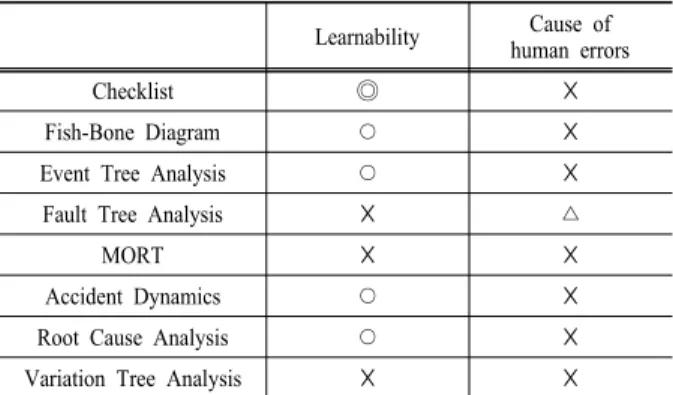
Table 1. Comparison of accident analysis techniques
2) Learnability Cause ofhuman errors
Checklist
◎
☓Fish-Bone Diagram
○
☓Event Tree Analysis
○
☓Fault Tree Analysis ☓
△
MORT ☓ ☓
Accident Dynamics
○
☓Root Cause Analysis
○
☓Variation Tree Analysis ☓ ☓