*1 Received on September 4, 2007; accepted on October 10, 2007.
*2 Div. of Wood Engineering, Dept. of Forest Products, Korea Forest Research Institute, Seoul 130-712, Korea.
*3 Dept. of Forest Sciences, College of Agriculture & Life Sciences, Seoul National University, Seoul 151-921, Korea.
† Corresponding author : Joo-Saeng Park ([email protected])
Ignition and Heat Release Rate of Wood-based Materials in Cone Calorimeter Tests*
1Joo-Saeng Park*
2†and Jun-Jae Lee*
3ABSTRACT
This study was performed to evaluate the burning characteristics of wood-based materials and the effect of surface treatment of fire retardant using cone calorimeter. Four types of wood-based materials, such as Plywood, Oriented Strand Board (OSB), Particle Board (PB) and Medium Density Fiberboard (MDF), were tested at a constant heat flux of 50 kW/m2 to investigate the time to ignition, mass loss rate, heat release rate, effective heat of combustion, etc. In addition, each type of wood-based material was tested at the same heat flux after fire retardant treatment on the surface to evaluate the effect of this treatment on the burning characteristics. The surface treatment of fire retardant, by the amount of 110 g/m2, delayed the time to ignition almost twice. However, it was indicated that heat release rate, mass loss rate, and effective heat of combustion were not significantly affected by fire retardants treatment for all types of wood-based materials.
Keywords : heat release rate, ignition, cone calorimeter, wood-based materials, fire retardant
1. INTRODUCTION
Wood-based materials, such as plywood, ori- ented strand board (OSB), medium density fi- berboard (MDF) and particleboard (PB) have been used commonly as the interior lining mate- rials in residential or commercial buildings. Due to the combustibility of these materials, how- ever, there have been some strict limitations in actual use of those. To overcome this situation, many researches have been performed in both field of fire engineering and timber engineering.
There are two important options in improving
the utilization of these wood-based materials.
The first one is to improve their own fire per- formance by fire retardant treatment, and the second one is to establish the standard test method for evaluating the fire performance of building materials.
Fire is one of the most unpredictable and hence dangerous accidents that occur in our sur- roundings, especially in residential buildings. Its occurrence, development, behavior and effects are very complex. In the point of building mate- rial, ignition and heat release are the essential fire properties, which must or always be consid-
ered in any assessment of fire hazard.
The ignition of cellulosic materials, such as wood and wood-based materials, has been of in- terest for a long time due to its direct relation to fire hazard and fire safety issues. Generally, ignition refers to the appearance of flame at the surface of a material which has been exposed to some type of external heating. Typically, in building fires, the thermal radiation from the flame, the ceiling layer, and hot walls is the pri- mary source of external heating. The initiation of flaming may be spontaneous or piloted. The latter occurs in the presence of an ignition source, such as a flame or an electrical spark.
The phenomenon of piloted ignition is of great importance in fire safety research since it occurs at low critical surface temperatures and is asso- ciated with the initiation and subsequent growth and development of fire from a small ignition source.
Ignition depends on various interrelated fac- tors (Babrauskas, 2003). As the surface is ex- posed to heat flux, initially most of heat is transferred into the inside of the specimen. The rate of this heat transfer is dependent on the thermal properties of the material including ig- nition temperature, material thermal conducti- vity, material specific heat, and the density of the material. The ignition of wood or wood- based material is more complex than other ma- terials, especially when a layer of char is formed. The time to ignition is generally used to evaluate the ignition property (Drysdale, 1985).
Calculations of fire behavior in buildings are not possible unless the heat release rate of fire is known. And the heat release rate of the fire can be obtained from the heat release rate data of building materials, which include interior lin- ing materials. In this point, evaluation of the heat release rate of wood-based materials is an essential and basic step for the fire behavior
prediction.
One of the key burning characteristics is heat release rate during burning. Heat release rate is generally considered one of the most dominant material properties affecting the growth of fire.
Its measurement in a simulated fire environment was made possible by the introduction of the oxygen consumption method. Likewise, the cone calorimeter is becoming the most useful standard tool used to evaluate the heat release rate of building materials. The cone calorimeter is capable of measuring not only time-depend- ent heat release rate but also many other burn- ing characteristics. Using such a device, trends of heat release rate, total heat evolved, and ef- fective heat of combustion for wood-based pan- els were evaluated.
To measure the burning characteristics such as the time to ignition, mass loss rate and heat release rate in a bench-scale test is nowadays an easy because cone calorimeter is becoming the most standard tool used to evaluate the heat re- lease rate of building materials.
In this study, the cone calorimeter tests for four types of wood-based materials, such as plywood, OSB, MDF and PB, were conducted to evaluate the burning characteristics of those materials. And the same tests for the fire re- tardant treaded materials were carried out to evaluate the effect of those treatments
2. MATERIALS and METHODS
2.1. Materials
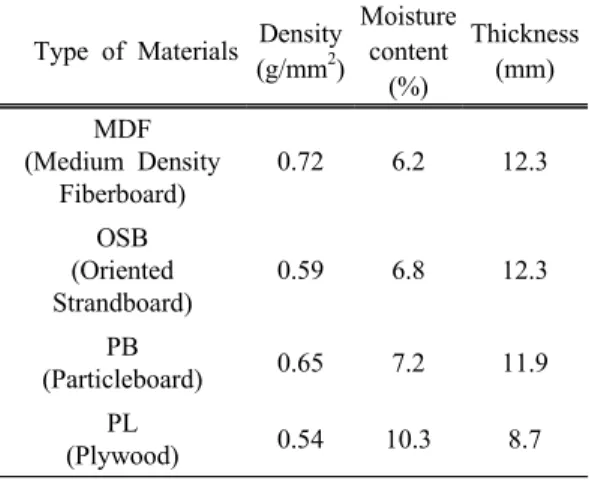
Four types of wood-based materials were tested; MDF (Medium Density Fiberboard), PB (Particle Board), OSB (Oriented Strand Board), and plywood. The specimens were cut into 100 mm square for the cone calorimeter tests. Prior to testing, all specimens were conditioned in a humidity chamber at 50% relative humidity and
Table 1. Density, moisture content and thickness of tested materials Type of Materials Density
(g/mm2)
Moisture content
(%)
Thickness (mm) MDF
(Medium Density Fiberboard)
0.72 6.2 12.3
OSB (Oriented Strandboard)
0.59 6.8 12.3
PB
(Particleboard) 0.65 7.2 11.9 PL
(Plywood) 0.54 10.3 8.7
Fig. 1. Schematic diagram for the principal compo- nents of the cone calorimeter.
20oC for 14 days or more, and density, moisture contents, and thickness of each specimen were measured (Table 1).
The same procedures were applied to the fire retardants treated materials except that the com- mercial fire retardants were treated on the sur- face of materials using the manual sprayer. The fire retardant, which was composed of 50% and more (NH4)2HPO4, was used in this study and the solid content of that was 23%. The amount of fire retardants treated is 110 g/m2.
2.2. Cone Calorimeter
The cone calorimeter is a widely available standard instrument used primarily to measure the heat release rate of small samples when subjected to a uniform radiative heat flux. Heat release rate is measured using the oxygen deple- tion approach. The cone calorimeter has been adopted as a standard method by Korean Stan- dards (KS FISO 5660-1, 2003), ASTM Interna- tional (ASTM E-1354, 2005), the International Organization for Standardization (ISO 5660-1, 2002), and the National Fire Protection Associa- tion (NFPA 264A, 2004).
While primarily designed for heat release rate measurements, the cone calorimeter can be used to study radiative ignition since it provides a nearly uniform and easily varied source of radi- ative heat flux at the sample surface. Babrauskas and Parker (1987) describe the use of the cone calorimeter for ignition studies.
Fig. 1 shows a schematic diagram of a cone calorimeter. The principal components are a conical heater wound in the form of a truncated cone with temperature control achieved using 3 type K thermocouples as input for a controller that automatically adjusts the current supply, cooled shutter to protect the sample before the start of a test, a specimen holder placed on top of a load cell for mass measurement, a spark ig- niter used for piloted ignition of fuel vapors, a hood and exhaust system equipped with an or- ifice plate for velocity measurements, a gas sampling port used to extract gases for oxygen and other molecular species concentration meas- urement, and a laser system for monitoring smoke obscuration.
2.3. Experimental Procedure
The cone calorimeter test is a bench-scale test
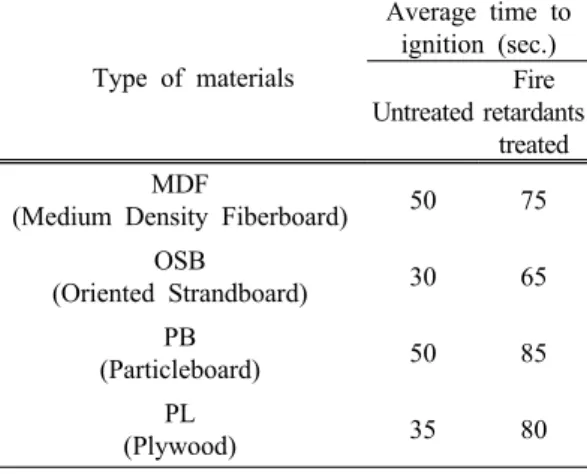
Table 2. Ignition time of wood based materials measured by cone calorimeter
Type of materials
Average time to ignition (sec.) Untreated
Fire retardants
treated MDF
(Medium Density Fiberboard) 50 75 OSB
(Oriented Strandboard) 30 65 PB
(Particleboard) 50 85
PL
(Plywood) 35 80
used to determine the reaction to fire of surface lining materials used in buildings. The test ap- paratus consist basically of an electric heater, an ignition source, and a gas collection system (Fig. 1).
All specimens tested in the cone calorimeter were in a horizontal orientation. Specimens were wrapped in a single layer of aluminum foil and placed into a 50 mm high specimen holder. After mounting and placing them in the right position, specimens were exposed to a ra- diant heat flux of 50 kW/m2 from an electric heater. All procedures for testing were con- formed to KS F ISO 5660-1:2003 [Reaction to fire test-Heat release, smoke production and mass loss rate- Part 1 : Heat release rate (Cone calorimeter method)].
3. RESULTS and DISCUSSION
3.1. Ignition
In this study, ignitions by a radiant heat flux of 50 kW/m2 were evaluated for the treated and non-treated wood-based materials using the
cone calorimeter. The onset of ignition in the cone calorimeter tests could be easily detected by the rapid increase of heat release rate.
In Table 2, ignition time of each material, measured by the cone calorimeter tests, was shown. Ignition times of MDF and PB, of which density were relatively higher, were lon- ger than those of OSB and Plywood. It was considered that higher density (especially sur- face density) of the specimen delayed the time to reach ignition temperature at surface and re- duced the amount of volatile gas for ignition.
For more accurate analysis, it was thought that surface temperature at ignition time should be measured.
The effect of fire retardants was also shown in Table 2. The ignition time of fire retardants treated plywood was delayed longer than other materials. This was estimated that surface treat- ment of fire retardants for lower density materi- al was more effective than others in the point of the reduction of the amount of volatile gas for surface ignition as mentioned above. It was in- dicated that the surface treatment of fire re- tardant, by the amount of 110 g/m2, delayed the time to ignition almost 1.5 to 2.3 times for all wood based materials tested.
3.2. Mass Loss Rate
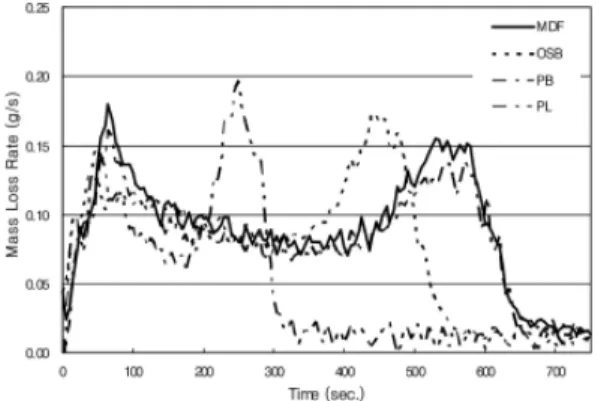
Mass loss rate of material exposed to a radi- ant heat flux was closely related to the burning rate of tested materials. Mass loss data measured in this study were shown in Fig. 2 to Fig. 5.
Results from cone calorimeter tests indicated that mass loss rate after ignition was nearly constant, about 0.1 g/sec., regardless of material types and fire retardants treatment. This fact means that the burning rates of tested materials were almost same in this study. This value of mass loss rate was limited to 50 kW/m2 heat flux. So, additional tests under various heat
Fig. 2. Mass change of untreated materials in cone calorimeter tests.
Fig. 3. Mass change of fire retardants treated materi- als in cone calorimeter tests.
Fig. 4. Mass loss rate of untreated materials in cone calorimeter tests.
Fig. 5. Mass loss rate of fire retardants treated mate- rials in cone calorimeter tests.
fluxes are needed in the future.
3.3. Heat Release Rate
In Fig. 6 and Fig. 7, the time histories of the heat release rate were compared between four types of materials and fire retardants treated materials.
As shown in Fig. 6 and Fig. 7, there were two peaks in heat release rate for all specimens.
One appeared shortly after ignition, then the heat release rate decreased rapidly with time due to the formation of a heat insulating char layer near the sample surface. Since the back
side of the sample was insulated, after heat reached there, the sample was heated more and subsequently the thermal degradation was accel- erated and the heat release rate started to in- crease again until the sample was significantly consumed. From Fig. 6 and Fig. 7, time to igni- tion was easily determined as time to rapid in- crease of the heat release rate. First peak values of heat release rate for plywood and OSB were somewhat smaller than those for PB and MDF.
Since the time to ignition of MDF and PB was longer than that of plywood and OSB, more heat flux was transferred to the surface of MDF and PB. It was indicated that there was no sig-
Fig. 6. Heat realease rate of untreated materials in cone calorimeter tests.
Fig. 7. Heat realease rate of fire retardnats treated materials in cone calorimeter tests.
Fig. 8. Total heat evolved for untreated materials in cone calorimeter tests.
Fig. 9. Total heat evolved for fire retardnats treated materials in cone calorimeter tests.
nificant difference between untreated and treat- ed materials except that ignition time was delayed.
In Fig. 8 and Fig. 9, total heat changes evolved during the cone calorimeter tests were presented. It was observed that there was little difference between the total heat evolved in all specimens except for thinner plywoods.
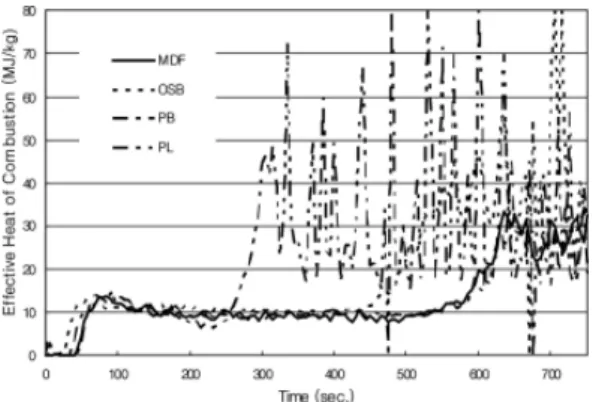
In Fig. 10 and Fig. 11, effective heat of com- bustion (EHC) calculated by dividing heat re- lease rate by mass loss rate were shown. It was concluded that EHC values were nearly constant at a value of 10 MJ/kg, independent of material types and fire retardants treatment after ignition.
This value will be useful as input for fire growth models.
4. CONCLUSIONS
In this study, burning characteristics such as time to ignition, mass loss rate, heat release rate, total heat evolved, and effective heat of combustion for four types of wood-based mate- rials were evaluated using the cone calorimeter.
And the effect of fire retardants treatment was also evaluated. From the results of this study, conclusions were summarized as follows : 1) Time to ignition was affected by density
Fig. 10. Effective heat of combustion of untreated materials in cone calorimeter tests.
Fig. 11. Effective heat of combustion of fire re- tardants treated materials in cone calo- rimeter tests.
of tested materials. And, the surface treatment of fire retardant, by the amount of 110 g/m2, delayed the time to ignition almost twice for all types of wood-based materials.
2) Under constant and severe external heat flux of 50 kW/m2, there was little difference in mass loss rate, heat release rate, total heat evolved and effective heat of combustion be- tween four types of wood-based panels.
3) For fire retardants treated materials, more applied heat flux caused by longer ignition time resulted in a higher initial peak value of heat release rate.
4) Burning characteristics data measured in this study will be useful as input for fire growth models for predicting fire behavior of the mate- rials in specific fire scenarios.
REFERENCES
1. American Society for Testing of Materials. 1997.
Standard test method for heat and visible smoke release rate for materials and products using an oxygen consumption calorimeter, ASTM E 1354, USA.
2. Babrauskas, V. 2003. Ignition Handbook, Fire Science Publishers, Issaquah, WA, pp. 315∼320, 833∼847.
3. Babrauskas V. and W. J. Parker. 1987. Ignitabil- ity measurements with the cone calorimeter, Fire and Materials, 11(1): 21∼43.
4. Bock, H. M. and E. Klement. 1999. Ignitability test for building materials: Influence of fuel gas- es and the design of the burner’s flame stabilizer on test results. Fire and Materials, 23: 201∼207.
5. Drysdale, D. 1985. An introduction to fire dynamics. John Wiley and Sons, USA, pp. 265
∼277.
6. Fangrat, J., Y. Hasemi, M. Yoshida, and T.
Hirata. 1996. Surface temperature at ignition of wooden based slabs. Fire Safety Journal, 27: 249
∼259.
7. Gallina, G., E. Bravin, C. Badalucco, G. Audisio, M. Armanini, A. De Chirico, and F. Provasoli.
1998. Application of cone calorimeter for the as- sessment of class of flame retardants for polypropylene. Fire and Materials, 22: 15∼18.
8. International Organization for Standardization.
2002. Reaction to fire tests-Heat release, smoke production and mass loss rate- Part 1 : Heat re- lease rate (Cone calorimeter method), ISO 560.
Switzerland.
9. KSA. 2000. Testing method for incombustibility of thin materials for buildings. KS F 2819.
10. Lattimer, B. Y. and J. J. Beitel. 1998. Evaluation of heat release rate equations used in standard test methods. Fire and Materials, 22: 167∼173.
11. National Fire Protection Association. 2004.
Standard method of test for heat and visible
smoke release rates for materials and products using an oxygen consumption calorimeter, NFPA 271. USA.
12. Rhodes, B. T. and J. G. Quintiere. 1996. Burning rate and flame heat flux for PMMA in a cone
calorimeter. Fire Safety Journal, 26: 221∼240.
13. Silcock, G. W. H. and T. J. Shields. 1995. A protocol for analysis of time-to-ignition data from bench scale tests. Fire Safety Journal, 24:
75∼95.