• 검색 결과가 없습니다.

Comparison of Costochondral Graft and Customized Total Joint Reconstruction for Treatments of Temporomandibular Joint Replacement

N/A
N/A
Protected

Academic year: 2021

Share "Comparison of Costochondral Graft and Customized Total Joint Reconstruction for Treatments of Temporomandibular Joint Replacement"

Copied!
5
0
0

로드 중.... (전체 텍스트 보기)

전체 글

(1)

ISSN 2288-8101(Print) ISSN 2288-8586(Online)

Review Article

RECEIVED June 16, 2014, REVISED June 30, 2014, ACCEPTED July 21, 2014 Correspondence to Woo-Young Lee

Department of Oral and Maxillofacial Surgery, College of Dentistry, Gangneung-Wonju National University 7 Jukheon-gil, Gangneung 210-702, Korea

Tel: 82-33-640-3139, Fax: 82-33-640-3113, E-mail: [email protected]

Copyright © 2014 by The Korean Association of Maxillofacial Plastic and Reconstructive Surgeons. All rights reserved.

CC
This is an open access article distributed under the terms of the Creative Commons Attribution Non-Commercial License (http://creativecommons.org/licenses/

by-nc/3.0) which permits unrestricted non-commercial use, distribution, and reproduction in any medium, provided the original work is properly cited.

Comparison of Costochondral Graft and Customized Total Joint Reconstruction for Treatments of

Temporomandibular Joint Replacement

Woo-Young Lee, Young-Wook Park, Seong-Gon Kim

Department of Oral and Maxillofacial Surgery, College of Dentistry, Gangneung-Wonju National University

Abstract

Purpose: We review published research on temporomandibular joint (TMJ) total replacement that compares costochondral graft and customized total joint reconstruction (especially TMJ concepts), focusing on effectiveness.

Methods: We searched PubMed databases, including prospective, retrospective, case-control or longitudinal studies and sig- nificant statistical analysis. In data analysis, we divided outcomes into ‘Acceptable’ or ‘Non-acceptable’.

Results: There were seven articles found dealing with costochondral graft and 180 patients. The majority of patients had satisfactory treatment outcomes (n=109, 61%). There were six articles including 275 patients using the alloplastic material TMJ concepts. Almost all patients had satisfactory treatment outcomes (n=261, 95%).

Conclusion: Comparing customized total joint reconstruction with costochondral graft, use of TMJ concepts resulted in increased quality of life and fewer complications. In conclusion, we judged that alloplastic material such as TMJ concepts is more effective device in total joint replacement than costochondral graft.

Key words: Temporomandibular joint disorders, Joint prosthesis, Autograft

Introduction

End-stage temporomandibular joint (TMJ) pathology re- sults in anatomic changes and restricted jaw function, re- quiring total joint replacement. The complexity of TMJ’s functional relationship with the local anatomy and mastica- tory muscles and the technical requirements of implanting a replacement mean that it is incorrect to expect the re- placed joint to return to its pre-morbid, fully functional condition[1].

The indications for TMJ replacement include joint anky- losis, rheumatoid arthritis, neoplastic disease, severe osteo- arthritis, post-traumatic disorders and congenital disease or syndromes[2]. The purposes of the procedure include the restoration of mandibular function and form, decreased patient disability and the prevention of disease pro- gression[3]. Reconstruction methods include a multitude of techniques, with both autogenous graft and alloplastic techniques as options[4].

The most widely accepted autogenous technique in-

(2)

volves the costochondral graft, which offers biological com- patibility, workability, functional adaptability, and minimal additional detriment to the patient. The growth potential of the costochondral graft makes it the ideal choice in children. Potential complications with the costochondral graft include fracture, further ankylosis, donor site morbid- ity, and the unpredictable growth tendency of the graft[5].

Customized alloplastic material has many advantages over costochondral graft. Of alloplastic materials, TMJ con- cepts (TMJ Concepts Inc., Ventura, CA, USA) has reliable and predictable results. Unlike costochondral grafts, TMJ concepts does not risk donor site morbidity. As the TMJ concepts can be manufactured individually, there is no need for bending or modification during surgery. Therefore, sur- gical time is reduced compared to costochondral graft.

However, TMJ concepts does not have growth capability, so applications are limited in growing patients[6].

The costochondral graft and customized total joint re- construction are the most useful techniques in TMJ replace- ment, but there is no research comparing them. We review published research on TMJ total replacement that compares costochondral graft and customized total joint reconstruction (especially, TMJ concepts), focusing on effectiveness.

Material and Methods

We searched PubMed, in English, for research published between 2000 and 2013, using the following keywords:

TMJ replacement, costochondral graft, TMJ concepts.

Article like editorials, letters to the editor, experimental studies with animals and short communications were ex- cluded from this review. We included prospective, retro- spective, case-control or longitudinal studies and significant statistical analysis. The inclusion criteria are TMJ ankylosis, condylar resorption, and articular changes resulting from previous surgical procedures or trauma. Studies that dealt with deformities and craniofacial syndromes or treatment by means of orthognathic surgery were excluded. Pre-pros- thetic reconstruction cases were also excluded.

In data analysis, we divided outcomes into ‘Acceptable’

or ‘Non-acceptable’. ‘Acceptable’ is a satisfactory outcome in TMJ replacement technique. ‘Non-acceptable’ is a regret- table result in reconstruction technique. We dealt with the numbers of patients who underwent joint graft or

replacement. We judged the effectiveness of both costo- chondral graft and TMJ concepts statistically.

To compare both techniques, above all, we evaluated the quality of life (QOL). ‘Much better’ and ‘better’ were judged ‘Acceptable’ outcomes, and ‘no change’, ‘worse’

and ‘much worse’ were judged ‘Non-acceptable’ results.

However, some articles did not mention the QOL. In those articles, we evaluated maximum mouth opening (MMO) or pain score. After total TMJ replacement procedure, an MMO increase to 35 mm was judged an acceptable outcome. Released pain score was also acceptable results Recurrence in follow-up period and occurrence of any complications were designated ‘Non-acceptable’ outcome.

Finally, we extracted the data of only costochondral graft and TMJ concepts, and compared results.

Results

1. Costochondral graft

We found seven articles dealing with costochondral graft according to the inclusion criteria. If the article dealt with other techniques (eg. gap arthroplasty, flap surgery), we included only costochondral graft data (Table 1)[4,7-12].

There were 180 patients meeting inclusion criteria. The majority of the patients had satisfactory treatment outcomes (n=109, 61%).

2. TMJ concepts

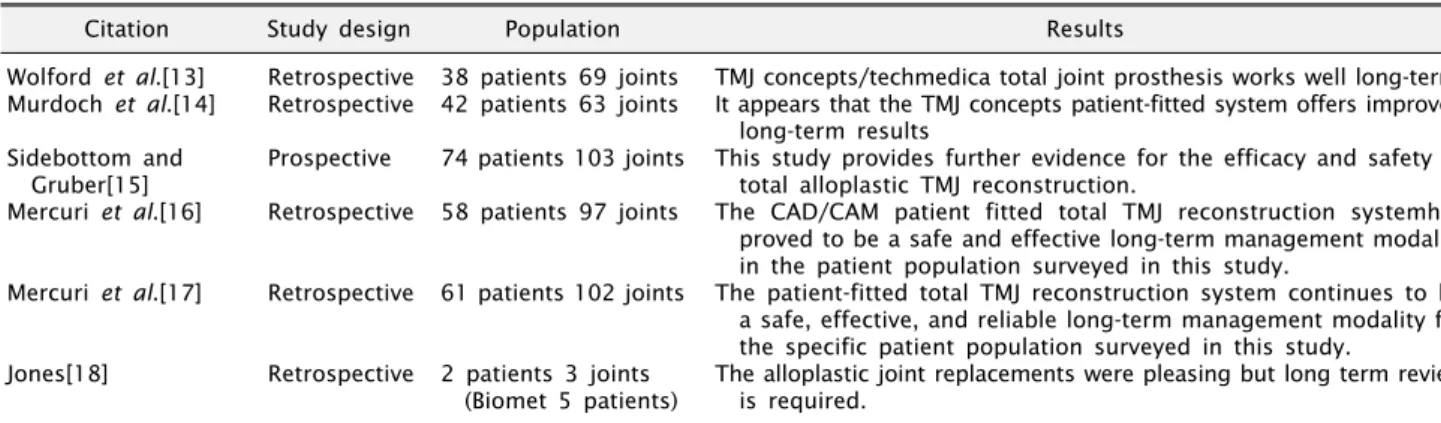
We found six articles dealing with TMJ concepts accord- ing to the inclusion criteria. If the article presented other materials (eg. Biomet System; Lorenz Microfixation, Jacksonville, FL, USA), we used only TMJ concepts data (Table 2)[13-18]. There were 275 patients meeting inclusion criteria. Almost all patients had satisfactory treatment out- comes (n=261, 95%).

The effectiveness of both techniques was evaluated by percentage score. The comparing results were summarized in Table 3.

Discussion

There are many techniques, developed over the years,

for TMJ replacement with both autogenous and alloplastic

(3)

Table 1. Studies of costochondral graft

Citation Study design Population Results

Saeed and Kent[4]

Villanueva-Alcojol et al.[7]

Medra[8]

Vasconcelos et al.[9]

El-Sayed[10]

Tanrikulu et al.[11]

He et al.[12]

Retrospective Retrospective

Retrospective

Retrospective

Retrospective Retrospective

Retrospective

57 patients 76 grafts 13 patients 17 grafts

55 patients 85 grafts

3 patients 4 grafts (arthroplasty 10 patients Alloplastic recon 2 patients) 12 patients 14 grafts 7 patients 9 grafts (gap

arthroplasty 8 patients, soft tissue interpositional arthroplasty 9 patient) 33 graft

20 CCG only, 11 CCG with TMF, 2 CCG with MMF

There is no doubt that CCG reconstruction of the TMJ can produce excellent results.

Use of CCG for the reconstruction of the mandibular condyle using the green-stick fracture technique provides optimal results in the surgical treatment of temporomandibular pathology.

Good remodeling in 50 (59%), reankylosis in 8 (9%), resorption of the graft in 21 (25%) and overgrowth of the graft in 3 (4%). Mouth opening was satisfactory (more than 25 mm) in 32 of the 55 patients (58%), unsatisfactory (between 5 and 25 mm) in 10 (18%), and the operation was a failure in 13 (24%).

The articular reconstruction with alloplastic or autogenous grafts, or gap arthroplasty for the treatment of ankylosis is efficient in relation to the postoperative maximal incisal opening, recurrence and articular function.

The author recommends routine use of modified approach for costochondral grafting in TMJ reconstruction.

Effect of interpositional arthroplasty on postoperative maximal interincisal mouth opening was greater than that achieved using the other methods.

CCG with TMF has good results for ankylosis.

CCG, costochondral graft; TMF, temporalis myofascial flap; MMF: masetter muscle flap; TMJ, temporomandibular joint.

Table 2. Studies of TMJ concepts

Citation Study design Population Results

Wolford et al.[13]

Murdoch et al.[14]

Sidebottom and Gruber[15]

Mercuri et al.[16]

Mercuri et al.[17]

Jones[18]

Retrospective Retrospective Prospective Retrospective

Retrospective

Retrospective

38 patients 69 joints 42 patients 63 joints 74 patients 103 joints 58 patients 97 joints

61 patients 102 joints

2 patients 3 joints (Biomet 5 patients)

TMJ concepts/techmedica total joint prosthesis works well long-term.

It appears that the TMJ concepts patient-fitted system offers improved long-term results

This study provides further evidence for the efficacy and safety of total alloplastic TMJ reconstruction.

The CAD/CAM patient fitted total TMJ reconstruction systemhas proved to be a safe and effective long-term management modality in the patient population surveyed in this study.

The patient-fitted total TMJ reconstruction system continues to be a safe, effective, and reliable long-term management modality for the specific patient population surveyed in this study.

The alloplastic joint replacements were pleasing but long term review is required.

CAD/CAM, computer aided design/computer aided manufacturing; TMJ, temporomandibular joint.

Table 3. Comparing percentage of costochondral graft and TMJ concepts

Acceptable Non-acceptable Total Costochondral graft

TMJ concepts

109 (61) 261 (95)

71 (39) 14 (5)

180 (100) 275 (100) TMJ, temporomandibular joint.

Values are presented as number (%).

materials, offering varying success. In particular, the costo- chondral graft has been used as an autogenous joint re- placement for many years and many authors advocate its use[19]. Because of anatomical and biological character-

istics similar to the mandibular condyle, the costochondral graft has become the most versatile autogenous tissue to replace the TMJ. The costochondral graft consists of an autogenous material with an articular cartilage surface that can resemble the mandibular condyle, and it has the ability to adapt and remold in response to joint function[7].

The TMJ concepts system is custom-made and has the

merit of appropriate fit in each patient. This allows max-

imum contact between the device and the patient’s bone,

which increases stability, reduces micromovement, and im-

proves its long-term success. It is particularly applicable

(4)

for patients who demand replacement of the joint and whose anatomy is often distorted as a result of disease or previous operations. The TMJ concepts prosthesis was particularly designed for these patients[15,17].

Almost all studies cited in this review reported that costo- chondral graft in TMJ replacement has acceptable outcome and safety. El-Sayed[10] reported 14 costochondral grafts in 12 patients. The mean preoperative mouth opening was 6 mm, improving to a mean 40 mm by six months postoperatively. The author used a modified approach sim- ilar to conventional technique. There were no complications.

However, other researchers note complications. Saeed and Kent[4] reported 76 costochondral grafts in 57 patients.

In that study, there was improvement in both diet and pain, and the mean mouth opening improved. However, 33 grafts developed complications, mostly ankylosis. The authors concluded that costochondral graft reconstruction of the TMJ can produce excellent results, but there is a risk of pain and ankylosis for patients who have undergone multiple surgeries.

Another major concern with the costochondral graft is unpredictable growth, usually excessive[20]. Clinical and radiographic evaluation showed no growth in some cases and excessive growth in other cases. Medra[8] reported 85 costochondral grafts in 55 patients. In those patients, three (4%) grafts developed overgrowth. The risk appears small, but many cases of overgrowth after TMJ replacement by costochondral graft are reported. It is unclear whether the costochondral graft exhibits a primary growth potential or a secondary growth potential in response to a functional matrix[21]. To explain this phenomenon, more research is required.

Costochondral grafts entail risk of donor site morbidity.

Villanueva-Alcojol et al .[7] noted one patient with right pneumothorax in a series of 13 patients. Costochondral graft has a low rate of complications at the donor site compared to other sites, but complications can always occur. Surgeons should consider precise anatomic struc- tures and have skillful surgical techniques.

Research concludes that replacements via TMJ concepts offer acceptable outcomes and increase QOL of patients.

Wolford et al .[13] reported 69 joint replacements in 38 patients. After joint replacement, patients’ mouth opening increased, pain level decreased, and jaw function improved.

The study concluded that the TMJ concepts total joint pros- thesis works well over long term, and is a viable technique for TMJ reconstruction. Sidebottom and Gruber[15] re- ported 103 joint replacements in 74 patients. In that study, all patients achieved excellent outcomes in pain, mouth opening and dietary score. Reaching the same conclusions, Mercuri et al .[16] found that patients who underwent TMJ replacement surgery via TMJ concepts developed improved jaw function and diet, and a diminished pain score. The study had a long follow-up period (range, 60 to 120 months), and showed symptoms improving over time.

Murdoch et al .[14] reported 63 joint replacement in 42 pa- tients via TMJ concepts in New Zealand. Nearly all patients (40 patients, 91%) reported improved QOL. The author concluded that TMJ concept system offers improved long-term results, and found total joint replacement using the TMJ concepts to be a reliable treatment option for man- agement of end-stage TMJ disease.

However, TMJ concepts is not free from complications.

These can include anatomic injury to blood vessels, nerves, or salivary glands. Therefore, surgeons should be very at- tentive during procedures and need knowledge of anatom- ic structure of TMJ area. Mercuri[1] noted that as the number of prior TMJ surgeries increases, the lower the subjective outcomes improvement measure. Pain can develop with worsening of TMJ symptoms. Another main complication is heterotropic bone formation. Sometimes, bone surround- ing a joint replacement is discovered, leading to restricted jaw movement and pain. Heterotropic bone formation tends to recur and can grow excessively. This complication can be prevented by autogenous fat graft packing[6,22].

Infection is rare, and can be resolved by appropriate antibiotic and proper surgical management protocols. Dislocation can arise from time to time. Murdoch et al .[14] found coronoidec- tomy to be a risk factor for dislocation. The author noted at least two weeks delay for active postoperative physical therapy. Temporary pain and swelling can occur, although these are sequelae, not complications.

In this study, we evaluated the effectiveness of costo- chondral graft and TMJ concepts for joint replacement.

Both techniques have proven efficacy, and are used in

many diverse patient populations. Comparing TMJ con-

cepts with costochondral graft, TMJ concepts offers in-

creased QOL and fewer complications. In conclusion, we

(5)

judged that TMJ concepts is more effective in total joint replacement than costochondral graft. Although some ar- ticles noted complications of TMJ concepts in total joint replacement, outcomes are gratifying when accompanied skilled surgical technique and proper patient management.

Acknowledgements

This study was supported by a grant from the Next- Generation BioGreen21 Program (Center for Nutraceutical

& Pharmaceutical Materials no. PJ009013), Rural Development Administration, Republic of Korea.

References

1. Mercuri LG. Alloplastic temporomandibular joint replace- ment: rationale for the use of custom devices. Int J Oral Maxillofac Surg 2012;41:1033-40.

2. Lindqvist C, Jokinen J, Paukku P, Tasanen A. Adaptation of autogenous costochondral grafts used for temporomandibular joint reconstruction: a long-term clinical and radiologic fol- low-up. J Oral Maxillofac Surg 1988;46:465-70.

3. Obeid G, Guttenberg SA, Connole PW. Costochondral graft- ing in condylar replacement and mandibular reconstruction.

J Oral Maxillofac Surg 1988;46:177-82.

4. Saeed NR, Kent JN. A retrospective study of the costochon- dral graft in TMJ reconstruction. Int J Oral Maxillofac Surg 2003;32:606-9.

5. MacIntosh RB. The case for autogenous reconstruction of the adult temporomandibular joint. In: Worthington P, Evans JR, editors. Controversies in oral and maxillofacial surgery. Philadelphia: WB Saunders; 1994. p.356-80.

6. Mercuri LG, Ali FA, Woolson R. Outcomes of total allo- plastic replacement with periarticular autogenous fat grafting for management of reankylosis of the temporomandibular joint. J Oral Maxillofac Surg 2008;66:1794-803.

7. Villanueva-Alcojol L, Monje-Gil F, Gonzalez-Garcia R, et al . Costochondral graft with green-stick fracture used in re- construction of the mandibular condyle: experience in 13 clinical cases. Med Oral Patol Oral Cir Bucal 2009;14:e663-7.

8. Medra AM. Follow up of mandibular costochondral grafts after release of ankylosis of the temporomandibular joints.

Br J Oral Maxillofac Surg 2005;43:118-22.

9. Vasconcelos BC, Porto GG, Bessa-Nogueira RV, Nascimento MM. Surgical treatment of temporomandibular joint anky- losis: follow-up of 15 cases and literature review. Med Oral Patol Oral Cir Bucal 2009;14:E34-8.

10. El-Sayed KM. Temporomandibular joint reconstruction with costochondral graft using modified approach. Int J Oral Maxillofac Surg 2008;37:897-902.

11. Tanrikulu R, Erol B, Görgün B, Söker M. The contribution to success of various methods of treatment of tempor- omandibular joint ankylosis (a statistical study containing 24 cases). Turk J Pediatr 2005;47:261-5.

12. He D, Yang C, Chen M, et al . Traumatic temporomandibular joint ankylosis: our classification and treatment experience. J Oral Maxillofac Surg 2011;69:1600-7.

13. Wolford LM, Pitta MC, Reiche-Fischel O, Franco PF. TMJ Concepts/Techmedica custom-made TMJ total joint prosthe- sis: 5-year follow-up study. Int J Oral Maxillofac Surg 2003;

32:268-74.

14. Murdoch B, Buchanan J, Cliff J. Temporomandibular joint replacement: a New Zealand perspective. Int J Oral Maxillofac Surg 2014;43:595-9.

15. Sidebottom AJ, Gruber E. One-year prospective outcome analysis and complications following total replacement of the temporomandibular joint with the TMJ Concepts system.

Br J Oral Maxillofac Surg 2013;51:620-4.

16. Mercuri LG, Wolford LM, Sanders B, White RD, Giobbie- Hurder A. Long-term follow-up of the CAD/CAM patient fit- ted total temporomandibular joint reconstruction system. J Oral Maxillofac Surg 2002;60:1440-8.

17. Mercuri LG, Edibam NR, Giobbie-Hurder A. Fourteen-year follow-up of a patient-fitted total temporomandibular joint reconstruction system. J Oral Maxillofac Surg 2007;65:1140-8.

18. Jones RH. Temporomandibular joint reconstruction with total alloplastic joint replacement. Aust Dent J 2011;56:85-91.

19. MacIntosh RB. The use of autogenous tissues for tempor- omandibular joint reconstruction. J Oral Maxillofac Surg 2000;58:63-9.

20. Khadka A, Hu J. Autogenous grafts for condylar re- construction in treatment of TMJ ankylosis: current concepts and considerations for the future. Int J Oral Maxillofac Surg 2012;41:94-102.

21. Lata J, Kapila BK. Overgrowth of a costochondral graft in temporomandibular joint reconstructive surgery: an un- common complication. Quintessence Int 2000;31:412-4.

22. Wolford LM. Temporomandibular joint devices: treatment

factors and outcomes. Oral Surg Oral Med Oral Pathol Oral

Radiol Endod 1997;83:143-9.

수치

Table 2. Studies of TMJ concepts

참조

관련 문서