surgery field1,2.
II. Method
A retrospective observational study was conducted for the articles published in a leading international journal, Journal of Oral and Maxillofacial Surgery, between January 2014 and December 2015.
All of the articles were hand selected and were assessed and analyzed.
III. Results
A total of 28 articles related to TMJ were retrieved from the Journal for 2014 and 2015 for analysis and review.
The number of issues was the same for both of the years (10 each).
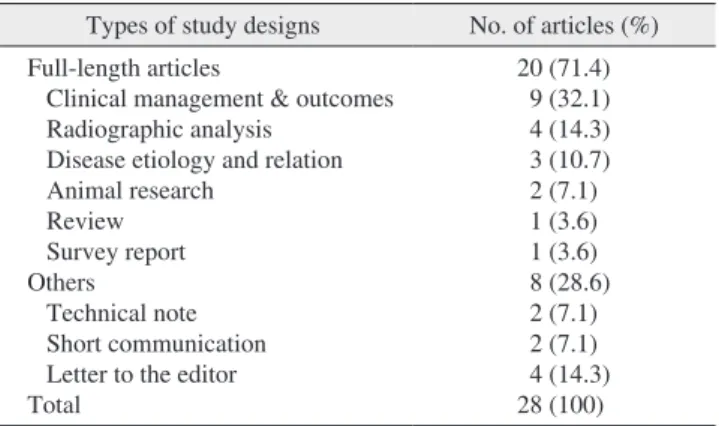
The majority of the study designs from full-length publica- tions in both of the years were clinical management and out- comes related to TMJ (9 articles in 2014 and 2015), followed by articles on radiographic diagnosis and disease etiology and relation, with 4 and 3 articles, respectively.(Table 1)
Most of the full-length articles were prospective stud- ies, amounting to 60% of the articles, while the numbers of retrospective studies and randomized control trials (RCTs) were three.(Table 2) Other surveys and reviews accounted for
I. Introduction
We conducted a retrospective analysis and reviewed the temporomandibular joint (TMJ)-related papers published in a leading international journal, Journal of Oral and Maxillofa- cial Surgery, between January 2014 and December 2015. The review and analysis were conducted to ascertain the trends of articles being published and to reflect on the scientific features of TMJ that the journal is covering and providing its readers. In this period of two years, a total of 28 articles were published related to TMJ, of which 20 (71.4%) were full- length, 2 (7.1%) were technical notes or short communica- tions, and 4 (14.3%) were letters to the editors. The number of full-length articles increased considerably compared to previous reviews of articles from 2011 to 2012 (16 full-length articles) and 2008 to 2009, showing that there has been a moderate rise in interest in improvement in the maxillofacial
Vaibhav Singh
Department of Oral and Maxillofacial Surgery, Kalinga Institute of Dental Sciences, KIIT University, Campus 6, Patia, Bhubaneswar 751024, India TEL: +91-7064267124 FAX: +91-0674-2725092
E-mail: [email protected]
ORCID: http://orcid.org/0000-0002-7791-9168
This is an open-access article distributed under the terms of the Creative Commons Attribution Non-Commercial License (http://creativecommons.org/
licenses/by-nc/4.0/), which permits unrestricted non-commercial use, distribution, and reproduction in any medium, provided the original work is properly cited.
CC
A review of temporomandibular joint-related papers published between 2014-2015
Vaibhav Singh, K.N.V. Sudhakar, Kiran Kumar Mallela, Rajat Mohanty
Department of Oral and Maxillofacial Surgery, Kalinga Institute of Dental Sciences, KIIT University, Bhubaneswar, India
Abstract(J Korean Assoc Oral Maxillofac Surg 2017;43:368-372)
We conducted a retrospective study and reviewed the temporomandibular joint (TMJ)-related papers published in a leading international journal, Journal of Oral and Maxillofacial Surgery, between January 2014 and December 2015. The study was conducted to ascertain and compare the trends of articles being published in the years 2014 and 2015. A total of 28 articles were reviewed, of which most of the full-length articles were on clinical management and outcomes and the role of radiology. The bulk of the studies were prospective, and less interest was shown in experimental research. A thorough review and analysis thus gives the impression that there is a great need for well-designed clinical studies on TMJ.
Key words: Temporomandibular joint, Temporomandibular joint disorders, Ankylosis
[paper submitted 2017. 2. 22 / revised 1st 2017. 4. 4, 2nd 2017. 4. 14 / accepted 2017. 5. 7]
Copyright © 2017 The Korean Association of Oral and Maxillofacial Surgeons. All rights reserved.
episodes of TMJ dislocation, suggesting no pain or difficulty associated with any nerve. Ninety-one percent of the patients had no recurrence, indicating that it is a simple, economical, and very effective line of treatment. In the 41 rehabilitated patients, 26 patients (63.4%) required a single injection, 11 patients (26.8%) had two treatments, and 4 patients (9.8%) needed a third injection. Abel et al.6 compared the conven- tional TMJ prosthesis to a customized condylar support prosthesis and found the latter to have a better physiologic form along with a better capacity to transfer load and reduce strain on the bone and screws. A retrospective comparison by Zhang et al.7 of the use of autogenous coronoid process grafts and costochondral grafts for the management of unilateral TMJ ankylosis patients yielded satisfactory results for both of the modalities on jaw deviation, mouth opening, and jaw movement parameters. Thus, they state that coronoid grafts can be a good treatment option.
The effectiveness of a management protocol is based on its outcome. It is very important to ascertain the potency of the treatment method, be it surgical or conservative, for its proper use and improved application. A total of four articles regarding the outcomes of different treatment techniques vis- à-vis TMJ were retrieved from these two years. Sipahi et al.8 carried out a placebo-controlled, double-blind study of 30 patients with symptomatic internal derangements of TMJ in order to ascertain the efficacy of intra-articular analgesics post arthrocentesis. Injections of 1 mL of 5% Ringer’s lactate were given to one group, the second group received 1 mg morphine, and the third group was given 50 mg Tramadol intra-articularly immediately after the procedure. Pain relief was sustained for six months using morphine, while Tra- madol, though equally effective, had a shorter duration. In a study on the outcome of joint replacement, Hussain et al.9 compared the outcomes of patients allergic to metals, using a titanium prosthesis in patients with a normal cobalt-chromi- um replacement. Based on mouth opening, diet, and disease and pain parameters, they found that there was no significant approximately 10% of the articles. There was a considerable
increase in the number of prospective studies compared to the review of 2011 to 2012, which contained 50% prospective stud- ies.
IV. Full-Length Articles
1. Clinical management and outcomes
The TMJ has a very strategic location and prime function in the head and neck region. It is a very circuitous system with an assemblage of complex structures such as muscles, tendons, and bones. Generally, TMJ disorders fade and im- prove gradually with time, but serious difficulties demand proper interventions. We came across five articles dealing with the topic of management of TMJ disorders. Haq et al.3 tried a single stage instead of the usual two-stage approach for reconstruction of the joint following ankylosis in five patients. A virtual resection and reconstruction was carried out by a surgeon and an engineer via teleconference, and prosthetic implants were manufactured using computer aided design/computer aided manufacturing (CAD-CAM) technol- ogy in a period of six weeks, after which the surgeries were carried out. It was found that this approach is economical both in the sense of time and money. Jose et al.4 in their study of 62 gap arthroplasty cases in 35 patients over a period of six months demonstrate that using piezoelectric technology is superior to conventional drilling in terms of bleeding, postop- erative complications, and amount of mouth opening, but is more time consuming. A one-year follow-up study by Zhou et al.5 of a modified prolotherapy of injecting lignocaine with 50% dextrose in the posterior pre-articular tissues, showed great results in 45 patients having non-neurogenic recurrent
Table 1. Comparison of types of study designs from 2014 to 2015 Types of study designs No. of articles (%) Full-length articles
Clinical management & outcomes Radiographic analysis
Disease etiology and relation Animal research
Review Survey report Others
Technical note Short communication Letter to the editor Total
20 (71.4) 9 (32.1) 4 (14.3) 3 (10.7) 2 (7.1) 1 (3.6) 1 (3.6) 8 (28.6) 2 (7.1) 2 (7.1) 4 (14.3) 28 (100)
Vaibhav Singh et al: A review of temporomandibular joint-related papers published between 2014-2015. J Korean Assoc Oral Maxillofac Surg 2017
Table 2. Comparison of article trends in full-length publications from 2014 to 2015
Type No. of articles (%)
Retrospective Prospective
Randomized control trial Review
Survey
3 (15.0) 12 (60.0) 3 (15.0) 1 (5.0) 1 (5.0)
Vaibhav Singh et al: A review of temporomandibular joint-related papers published between 2014-2015. J Korean Assoc Oral Maxillofac Surg 2017
and closed-lock in disorders of TMJ. Verifying the efficacy of the buccal fat pad in the gap arthroplasty procedure, Bansal et al.14 performed a volumetric analysis with ultrasonography at 15 days and 6 months following operation and found the shrinkage percentage of the fat pad to be 28%. With little or no heterotrophic calcification in the 6 month postoperative CT scan, it was deduced that the buccal fat pad is a viable, stable, and easily harvested option for management of TMJ ankylosis. The efficaciousness of cone-beam CT in the diag- nosis and management of TMJ disorders was examined by de Boer et al.15. Patients were given a provisional diagnosis after obtaining their history, and following a clinical examination and orthopantomogram study. The patients then underwent CT scan, after which the degree of certainty was ascertained.
In more than half of the cases of TMJ disorders, the diagnosis had to be changed following CT scans, indicating that they are an important component of proper identification of the disorder.
3. Disease etiology and relation
TMJ disorders very commonly are either associated with or a sequelae of some other condition. It is important to cor- rectly diagnose the proper etiology of the disorder and to plan the treatment options, keeping in mind the postoperative complications and their impact on the TMJ. Xiang et al.16 in- vestigated 492 cases of treated mandibular condylar fracture and found 16 cases of ankylosis recurrence during a follow- up period of 6 months to 10 years. Condylar head fractures are more likely to lead to ankylosis compared to condylar neck and subcondylar fractures. In addition, miniplates, wires, or removal of a fractured segment are more highly associated with ankylosis compared to fixation using long screws (bicortical screw). All of the postoperative ankylosed cases were associated with damaged articular discs. Matrix metalloproteins (MMPs) are supposedly a contributing fac- tor to the loss of matrix and fibrocartilage inflammation of the TMJ. Taking this hypothesis into account and the fact that MMPs have increased activity in the serum of patients with polycystic ovary syndrome (PCOS), Soydan et al.17 tried to ascertain the prevalence of TMJ disorder in such patients. Comparing PCOS patients with a normal control group showed that, based on the symptoms of pain through VAS, the severity of TMJ disorders was greater in the former group, confirming the association between PCOS and TMJ disorder. Lund et al.18, by performing an extensive bacterial culture and serological tests on venous blood and synovial difference in the results of the groups. Based on similar pa-
rameters, Gruber et al.10 conducted an analysis of 84 patients and found that three and five years after TMJ replacement, patients in the United Kingdom had fewer complaints of pain and better functional morbidity, with very few patients show- ing complications such as weakness in the temporal branch of the facial nerve and prosthesis infections due to a localized head and neck infection. Enlightened by the holistic approach of multispecialty clinics, Ahmed et al.11 scrutinized the out- comes of patients visiting a multidisciplinary team for TMJ- related issues, consisting of specialists from the fields of maxillofacial surgery and prosthesis, oral medicine and psy- chiatry, and advocated that such types of clinics have a high impact on improving the overall quality of life of patients.
They concluded that a multi-layer system and approach for dealing with a patient’s complaint using all available resourc- es should be inculcated into the system.
2. Radiographic analysis
In this modern era, technology plays a major role in all aspects of life. Technological advancements in the field of radiology and radiodiagnosis have made a huge impact and have a large role to play in planning, executing and determin- ing the success of treatment regimens of different diseases.
Four articles were discovered that comment on the diagnosis and treatment of TMJ with the aid of various radiological options. Li et al.12 executed a magnetic resonance imaging (MRI)-based study of 247 patients undergoing arthroscopic repositioning of anterior disc displacement. The patients were divided into two groups based on disc rupture, probable disc rupture and no rupture after repositioning. Analysis was conducted on the parameters of age, sex, symptom duration, mouth opening, unilateral or bilateral disc displacement, and Wilkes stage and concluded that teenagers and young adults have a high tendency for disc rupture. Furthermore, the Wil- kes stage was more significant in the ruptured disc group compared to the other two groups. Describing the association between the anti-oxidant capacity of synovial fluid and intra- articular structures, Ishimaru et al.13 conducted diagnostic arthrograms, computed tomography (CT) scans, and chemi- luminescence on the synovial fluid of 21 patients having TMJ disorders and measured them based on the constants of age, sex, and mouth opening visual analogue scale (VAS). Obtain- ing results for 11 patients with closed lock and 10 with no closed lock radiologically, they commented that there seems to be an association between synovial fluid oxidative stress
V. Other Articles
1. Short communications, technical notes, and letters to the editor
Two short communications were published during this period. Mustafa and Sidebottom22 assessed the risk of intra- operative dislocation of TMJ replacement as well as its man- agement. Amongst 138 cases, 8% were identified as having a risk of intraoperative dislocation, which is associated primari- ly with coronoidectomy (30%) and inflammatory arthropathy (24%) and is mainly managed with intermaxillary elastics.
Sidebottom and Mistry23 determined the incidences of metal allergies in prospective patients of total TMJ replacements and the efficacy of patch tests. It was observed that 39% of 101 patients had an allergy to one or more metals and were thus given a titanium prosthesis. No signs of allergy were seen six months following the operation; thus, it is advocated that all patients who are to undergo total joint replacement should be given patch tests to determine the need for a tita- nium prosthesis.
Two technical notes were published. Machon et al.24 sug- gested the use of mini instruments made from pre-tensioned stainless steel wire during visually guided arthroscopy of the TMJ. These instruments help with irrigation and permit the grading of chondromalacia and removal of adhesions. Ryba et al.25 wrote about the use of Arthrex Corkscrew for TMJ meniscopexy. In the publication, the strength, efficacy, and ease of use of the Arthrex system are discussed and compared to the Mitek system.
Four letters to the editor were published from 2014 to 2015.
Kain et al.26 described the misdiagnosis of TMJ synostosis as ankylosis and it being treated as such. Bonte27 tried to cover the omitted part of the article by de Boer et al.15, in which the analysis of the axial view of the CT scan was not carried out.
The other two letters were responses to previously published articles26-28.
VI. Discussion
Table 2 indicates that there was a predominance of pro- spective studies. Experimental research contributed to a very minor portion of the publications. Hence, there seems to be a requirement to diversify the resources and workflow as well as to test the strength of imagination with the appropriate knowledge and cutting-edge technology of the field to revo- lutionize the work culture.
tissues from patients with reciprocal clicking and chronic closed lock, tried to determine the relation of reactive arthritis and internal derangements of TMJ. With no significant dif- ference observed between the number of bacterial antibodies and the absence of antibodies for Chlamydia trachomatis and Campylobacter jejuni, it was confirmed that reactive arthritis does not play a role in the internal derangement of TMJ.
4. Animal research
A lot of research and experiments have been carried out on animals to determine the efficacy, limitations, and feasibility of application to humans. In a similar approach for visual- izing the role of psychological stress on the TMJ, Huang et al.19 divided rats into three groups of 12, based on the dura- tion of stress—3 weeks, 6 weeks, and more than 6 weeks.
They compared them to a fourth control group. Based on the presence of MMP-3, a tissue inhibitor of metalloproteinase 3 (TIMP-3), thinning of articular cartilage, shedding of col- lagen fibers, cracks in articular discs, and other structural changes in the stained tissues of TMJ, it was concluded that psychological stress does have an impact on rats; however, further research is required for confirmation. On the other hand, to evaluate the effect of diazepam on TMJ, Figueroba et al.20, using iOVD, saline, and diazepam, studied approxi- mately 40 male rats. A thorough examination was conducted on the thickness of the articular cartilage, articular area, and number of collagen fibers from the bilateral TMJs of the rats.
Pro-inflammatory cytokines and tumor necrosis factor were also measured, and it was observed and confirmed that both iOVD and diazepam induced significant changes in the ar- ticular cartilages.
5. Review articles and survey
A single review article was published in these two years and reviewed all of the TMJ-related papers published be- tween 2011 and 2012. It was written by Tahim et al.1 and found a total of 24 articles published in the given time frame.
A report on baseline data was published by Idle et al.21. It was prepared to establish the long-term collection of data on TMJ replacement from all centers in the United Kingdom.
Data was collected and analyzed through Snap Survey, which accounted for 402 patients who had undergone replacements between 2011-2012. The main reasons for replacement were osteoarthritis, failed operation, ankylosis, and seronegative arthritis.
mandibular joint. Prospective outcome analysis after 3 and 5 years.
Br J Oral Maxillofac Surg 2015;53:412-5.
11. Ahmed N, Poate T, Nacher-Garcia C, Pugh N, Cowgill H, Page L, et al. Temporomandibular joint multidisciplinary team clinic. Br J Oral Maxillofac Surg 2014;52:827-30.
12. Li H, Cai X, Yang C, Wang S, Huang L. Ruptured disc after ar- throscopic repositioning in the temporomandibular joint: a retro- spective magnetic resonance imaging study. Br J Oral Maxillofac Surg 2014;52:545-50.
13. Ishimaru K, Ohba S, Yoshimura H, Matsuda S, Ishimaru J, Sano K.
Antioxidant capacity of synovial fluid in the temporomandibular joint correlated with radiological morphology of temporomandibu- lar disorders. Br J Oral Maxillofac Surg 2015;53:114-20.
14. Bansal V, Bansal A, Mowar A, Gupta S. Ultrasonography for the volumetric analysis of the buccal fat pad as an interposition materi- al for the management of ankylosis of the temporomandibular joint in adolescent patients. Br J Oral Maxillofac Surg 2015;53:820-5.
15. de Boer EW, Dijkstra PU, Stegenga B, de Bont LG, Spijkervet FK. Value of cone-beam computed tomography in the process of diagnosis and management of disorders of the temporomandibular joint. Br J Oral Maxillofac Surg 2014;52:241-6.
16. Xiang GL, Long X, Deng MH, Han QC, Meng QG, Li B. A ret- rospective study of temporomandibular joint ankylosis secondary to surgical treatment of mandibular condylar fractures. Br J Oral Maxillofac Surg 2014;52:270-4.
17. Soydan SS, Deniz K, Uckan S, Unal AD, Tutuncu NB. Is the inci- dence of temporomandibular disorder increased in polycystic ovary syndrome? Br J Oral Maxillofac Surg 2014;52:822-6.
18. Lund B, Holmlund A, Wretlind B, Jalal S, Rosén A. Reactive arthritis in relation to internal derangements of the temporoman- dibular joint: a case control study. Br J Oral Maxillofac Surg 2015;53:627-32.
19. Huang X, Liu H, Xiao P, Wang Y, Zhang H. Effect of psychologi- cal stress on the structure of the temporomandibular joint and the expression of MMP-3 and TIMP-3 in the cartilage in rats. Br J Oral Maxillofac Surg 2014;52:709-14.
20. Figueroba SR, Desjardins MP, Nani BD, Ferreira LE, Rossi AC, Santos FA, et al. Effect of diazepam on temporomandibular joints in rats with increased occlusal vertical dimension. Br J Oral Maxil- lofac Surg 2014;52:438-44.
21. Idle MR, Lowe D, Rogers SN, Sidebottom AJ, Speculand B, Wor- rall SF. UK temporomandibular joint replacement database: report on baseline data. Br J Oral Maxillofac Surg 2014;52:203-7.
22. Mustafa el M, Sidebottom A. Risk factors for intraoperative dis- location of the total temporomandibular joint replacement and its management. Br J Oral Maxillofac Surg 2014;52:190-2.
23. Sidebottom AJ, Mistry K. Prospective analysis of the incidence of metal allergy in patients listed for total replacement of the temporo- mandibular joint. Br J Oral Maxillofac Surg 2014;52:85-6.
24. Machon V, Levorova J, Foltan R, Hirjak D, Sidebottom A. Mini- instruments for minimally invasive arthroscopy of the temporo- mandibular joint: a technical note. Br J Oral Maxillofac Surg 2015;53:662-3.
25. Ryba FM, Ali A, Matthews NS. Temporomandibular joint menisco- pexy using the Arthrex Corkscrew® mini anchor system: technical note. Br J Oral Maxillofac Surg 2015;53:299-300.
26. Kain R, Arya S, Sharma U. Maxillomandibular synostosis misdiag- nosed and treated as ankylosis of the temporomandibular joint. Br J Oral Maxillofac Surg 2014;52:674.
27. Bonte B. RE: De Boer EWJ, Dijkstra PU, Stegenga B, et al. Value of cone-beam computed tomography in the process of diagnosis and management of disorders of the temporomandibular joint. Br J Oral Maxillofac Surg 52;2014:241-46. Br J Oral Maxillofac Surg 2014;52:870-1.
28. González-García R. "Improvement" or "success" in arthroscopy for internal derangement of the temporomandibular joint? Br J Oral Maxillofac Surg 2014;52:288-9.
Though the number of full-length articles has increased compared to previous years, it is still low compared to other areas of the field such as oncology and salivary gland dis- eases. We need to give more attention to this field of spe- cialty and focus on proper channeling of the knowledge and resources for expansion.
Conflict of Interest
No potential conflict of interest relevant to this article was reported.
ORCID
Vaibhav Singh, http://orcid.org/0000-0002-7791-9168 K.N.V. Sudhakar, http://orcid.org/0000-0002-4169-7807 Kiran Kumar Mallela, http://orcid.org/0000-0003-4587-9496 Rajat Mohanty, http://orcid.org/0000-0002-7391-8037
References
1. Tahim AS, Goodson AM, Payne KF, Brennan PA. A review of TMJ-related papers published in the British Journal of Oral and Maxillofacial Surgery in 2011 and 2012. Br J Oral Maxillofac Surg 2015;53:e9-12.
2. Spencer HR, Morrison A, Braga A, Brennan PA. Review article:
oral surgery and TMJ-related papers published in BJOMS in 2008 and 2009. Br J Oral Maxillofac Surg 2010;48:544-8.
3. Haq J, Patel N, Weimer K, Matthews NS. Single stage treatment of ankylosis of the temporomandibular joint using patient-specific to- tal joint replacement and virtual surgical planning. Br J Oral Maxil- lofac Surg 2014;52:350-5.
4. Jose A, Nagori SA, Virkhare A, Bhatt K, Bhutia O, Roychoudhury A. Piezoelectric osteoarthrectomy for management of ankylo- sis of the temporomandibular joint. Br J Oral Maxillofac Surg 2014;52:624-8.
5. Zhou H, Hu K, Ding Y. Modified dextrose prolotherapy for recur- rent temporomandibular joint dislocation. Br J Oral Maxillofac Surg 2014;52:63-6.
6. Abel EW, Hilgers A, McLoughlin PM. Finite element analysis of a condylar support prosthesis to replace the temporomandibular joint. Br J Oral Maxillofac Surg 2015;53:352-7.
7. Zhang W, Gu B, Hu J, Guo B, Feng G, Zhu S. Retrospective com- parison of autogenous cosotochondral graft and coronoid process graft in the management of unilateral ankylosis of the temporoman- dibular joint in adults. Br J Oral Maxillofac Surg 2014;52:928-33.
8. Sipahi A, Satilmis T, Basa S. Comparative study in patients with symptomatic internal derangements of the temporomandibular joint: analgesic outcomes of arthrocentesis with or without intra- articular morphine and tramadol. Br J Oral Maxillofac Surg 2015;53:316-20.
9. Hussain OT, Sah S, Sidebottom AJ. Prospective comparison study of one-year outcomes for all titanium total temporomandibular joint replacements in patients allergic to metal and cobalt-chromi- um replacement joints in patients not allergic to metal. Br J Oral Maxillofac Surg 2014;52:34-7.
10. Gruber EA, McCullough J, Sidebottom AJ. Medium-term out- comes and complications after total replacement of the temporo-