• 검색 결과가 없습니다.

Transfer of SOD2 or NDP kinase 2 genes into purebred lines of petunia

N/A
N/A
Protected

Academic year: 2021

Share "Transfer of SOD2 or NDP kinase 2 genes into purebred lines of petunia"

Copied!
5
0
0

로드 중.... (전체 텍스트 보기)

전체 글

(1)

Transfer of SOD2 or NDP kinase 2 genes into purebred lines of petunia

Su Young Lee

1*

・ Bong Hee Han

1

・ Eun Woon Noh

2

・ Sang-Soo Kwak

3

1

Floricultural Research Division, National Institute of Horticultural & Herbal Science, Rural Development Administration, Suwon 441-310, Korea

2

Department of Forest Genetic Resources, Korea Forest Research Institute, Suwon 441-350, Korea

3
Environmental Biotechnology Research Center, Korea Research Institute of Bioscience and Biotechnology (KRIBB), Daejeon 305-806, Korea

Abstract The transfer of Mn-Superoxide Dismutase (SOD2) gene, complex gene (SA) of CuZnSOD and ascorbate peroxidase (APX), and NDP kinase 2 (NDPK2) gene into Korean 4 cultivars (cvs. Millenium White, Glory Blue, Glory Red, and Glory Purple) and 15 purebred lines of petunia was conducted using Agrobaterium-mediated technique. Two (Wongyo A2-16 and A2-36) of 15 purebred lines and one (cv. Glory Red) of 4 cultivars were effective for the transfer of SOD2 gene.

The putative transgenic plants survived on the 2nd selection medium were 124. From PCR analysis, 118 (derived from 4 cultivars and 2 purebred lines) of 124 plants were confirmed to contain marker ( npt II ) gene, while 58 of 118 plants did not have target genes. There were no plants with both npt II and SA genes. Twenty seven of 28 SOD2 transgenic plants were re-confirmed as transformants by Sothern analysis. SOD2 and NDPK2 genes were expressed in the transgenic petunias as the ratio of 77.8 to 100.0 % and 23.5%, respectively. T

1

seeds were obtained from 36 acclimated transgenic plants (SOD2 34 plus NDPK2) in a glasshouse by self-pollination.

*Corresponding author Tel 82-31-290-6198 Fax 82-31-290-6219 E-mail: [email protected]

Introduction

Petunia is one of major bedding plants over the world, and it mainly used to be planted on the side of road in company with pansy in Korea from spring to late in summer. A research project for breeding new cultivar of petunia was started in National Horticultural Research Institute (NHRI) (past name of National Institute of Horticultural & Herbal Science, NIHHS), rural development administration (RDA) of Korea, in 1992. After then, 26 cultivars had been developed by conventional breeding program of NHRI until 2002 (National Horticultural Research Institute 2006). One of characteristics, which should be improved in petunia, is resistance to abiotic stresses such as rainfall, humidity, and air pollution. Recently, there have been many reports to develop plants resistant to abiotic stresses through introduction of SOD or APX or NDPK genes (Fang et al. 2002; Haejeong et al. 2003; Tang et al. 2004a; Tang et al. 2004b;

Tang et al. 2007; Kim et al. 2005). Successful transformation in most crops relies on genotypes (Shibata 2008), so, it will be necessary to use many genotypes for getting transgenic plant in petunia. By the way, considering patent, if possible, it will be desirable to use Korean

domestic purebred lines or cultivars as materials for genetic transformation of petunia. Therefore, this study was executed to obtain transgenic petunia resistant to abiotic stresses through transfer of SOD2 and NDPK2 genes into Korean domestic purebred lines or cultivars of petunia by Agrobacterium-mediated transformation technique.

Materials and methods Plant materials

Four cultivars and 15 purebred lines of Petunia hybrida were used as materials. Their seeds, which had been harvested at the plastic house of NHRI on 1999 or 2000, were sterilized and sown on MS medium, which was supplemented with 30 g·L

-1

sucrose, adjusted to pH 5.8, and solidified with 8.0 g·L

-1

plant agar. After one month, the youngest leaves (2 to 3 leaves per donor shoot) were cut into 5 mm × 5 mm and used as explants for co-cultivation with Agrobacterium tumefaciens.

Co-cultivation and selection

Leaf explants were cultured on MS selection medium (MSM)

Vol. 36, No. 2, 144-148(2009)

(2)

supplemented with 1.0 mg·L

-1

BAP, 2 mg·L

-1

IAA, 400 mg·L

-1

cefotaxime, and 50 mg·L

-1

kanamycin after being co-cultured with Agrobacterium tumefaciens including SOD2 gene (Genebank accession No. X03951), complex gene of CuZnSOD (Genebank accession No. AF170297) and APX (Genebank accession No.

X62077) (SA), and NDPK2 gene (Genebank accession no.

AF017640), respectively. SOD2 was cloned, inserted into pBI121 vector, and introduced into Agrobacterium tumefaciens GV3101 by Young Im Choi in Korea Foresty Research Institute. Both SA and NDPK2 were cloned, inserted into pCAMBIA 2300, and introduced into Agrobacterium tumefaciens EHA105 by Dr. Suk-Yoon Kwon of Korea Research Institute of Bioscience and Biotechnology. Because both SA and NDPK2 were controlled independently by oxidative stress-inducible SWPA2 promoter (Kim et al. 2003), after this, they were described as SSA and SN, respectively. The shoots, which were survived on the MSM, were transferred to the 2

nd

MS selection medium (SMSM) containing 100 mg·L

-1

kanamycin and 400 mg·L

-1

cefotaxime. Each medium was adjusted to pH 5.7. Cultures were maintained at 25±2℃ in 16h photoperiod with fluorescent lamp at 60 μmol m

-1

s

-1

.

PCR and Sothern analysis

The putative transgenic plants, which were survived at SMSM, were subjected to PCR and Southern analyses according to Lee and Han (2008). Genomic DNA for both PCR and Southern analyses was extracted by DNeasy plant mini kit (QIAGEN Co.) and quantified by using NanoDrop (Nano Co.). PCR was conducted using both the neomycin phosphotransferase II (npt II) specific primers (forward; 5' GAG GCT ATT CGG CTA TGA CTG 3', reverse; 5' ATC GGG AGC GGC GAT ACC GTA 3') and target genes specific primers(forward; 5'-TAC TGG AGA TGA ATA TGA GC-3', reverse; 5'-CAG CAG GCG GCA AAT GAT TA-3'), respectively.

Southern analysis was performed using 10 μg of DNA digested with EcoRΙ and target gene specific probe.

RT-PCR analysis

Total RNA of transgenic plants was isolated by TRI-reagent procedure (MRC, Inc.) and quantified by using NanoDrop. RT-PCR analysis was conducted using the same primers as that used for PCR analysis, because the intron region of target gene was included.

Generations progress of transgenic plants

Transgenic plants, which were confirmed by PCR and Sothern analyses, were transferred to MS medium containing 200 mg·L

-1

cefotaxime for rooting for 3 week. Then, they were acclimated at 25℃

for 20 days and self-polinated for the production of T

1

seed inside a glasshouse.

Examination of tolerance to salt stress

Transgenic seeds (T

1

), which were harvested from SOD2 transgenic ‘Glory Red’ plant (T

0

), were sown in MS medium, which was supplemented with 150 mM NaCl and adjusted to pH 5.8. After 10 days, the number of germinated seeds was counted.

Results and discussion

The transfer of three genes (SOD2, SSA, and SN), which had been universally applicable for many crops as genes resistant to abiotic stresses (Kim et al. 2003; Tang et al. 2004a, Tang et al. 2004b), into leaf explants of 19 genotypes of Petunia hybrid was tried to develop new petunia plant resistant to abiotic stresses by Agrobacterium- mediated transformation technique. After the explants were co- cultivated with SOD2 gene, while those of all used cultivars showed shoot regeneration in the 1

st

selection medium supplemented with kanamycin 50 mg·L

-1

, only six of 15 purebred lines did. The selection rate of one (cvs. Millenium White, Glory Blue, Glory Red, and Glory Purple) was from 12.0 to18.5%, while that of the others (Wongyo A2-19, Wongyo A2-16, Wongyo A2-18, Wongyo A2-3, Wongyo A2-36, and Wongyo A2-29) was from 2.0 to 72.0%. When the selected shoots were transferred into the 2

nd

selection medium supplemented with kanamycin 100 mg·L

-1

, most of shoots stopped growing (Table 1). On the basis of selection efficiency after the introduction of SOD2 gene, cultivars were more effective than the purebred line. However, considering the fact that the one will take a longer period to be registered than the other, two (Wongyo A2-19 and Wongyo A2-36) of 15 purebred lines were selected and used for following experiment. Also, as a result of SOD2 gene transfer, selection efficiency of white or blue colored genotypes was better compared to that of red or pink or purple color genotypes.

Meanwhile, as a result of the transfer of SSA and SN genes into the

Wongyo A2-19 and Wongyo A2-36 lines by co-cultivation, shoots

(3)

Table 1 Explants (%) regenerated and survived on MS medium supplemented with kanamycin after co-cultivation with Agrobacterium tumefaciens GV3101 inserted with both SOD2 and NPTII genes within pBI121 vector in Petunia hybrida

Flower color Genotypes No. of explant Explant (%) regenerated on MS medium with kanamycin 50 mg・L

-1

Explant (%) survived on MS medium with kanamycin 100 mg・L

-1

White Millennium White 72 13.8 9.7

Wongyo A2-2 72 0.0 0.0

Wongyo A2-19 92 72.0 10.0

Wongyo A2-26 81 0.0 0.0

Wongyo A2-27 81 0.0 0.0

Pink Wongyo A2-5 172 0.0 0.0

Wongyo A2-14 81 0.0 0.0

Wongyo A2-16 48 2.0 0.0

Wongyo A2-18 99 9.1 2.0

Wongyo A2-42 99 0.0 0.0

Red Glory Red 90 12.0 5.5

Wongyo A2-3 81 4.9 1.2

Wongyo A2-13 68 0.0 0.0

Wongyo A2-36 53 3.7 3.7

Blue Glory Blue 81 14.0 11.0

Wongyo A2-29 72 9.7 0.0

Purple Glory Purple 54 18.5 3.7

Wongyo A2-9 54 0.0 0.0

Wongyo A2-12 54 0.0 0.0

5 19 1,504

Table 2 Explants (%) regenerated and survived on MS medium supplemented with kanamycin after co-cultivation with Agrobacterium tumefaciens EHA105 inserted with SSA or SN genes within pCAMBIA2301 vector in Petunia hybrida

Gene Flower color Genotypes No. of explant Explant (%) regenerated on MS medium with kanamycin 50 mg・L

-1

Explant (%) survived on MS medium with kanamycin 100 mg・L

-1

SSA White Wongyo A2-19 267 18.0 16.4

Red Wongyo A2-36 313 2.2 0.0

SN White Wongyo A2-19 298 2.0 1.7

Red Wongyo A2-36 338 3.6 0.0

Total 1,216

Table 3 PCR and Southern analyses of putative transgenic petunia plants survived on MS medium supplemented with kanamycin 100 mg・L

-1

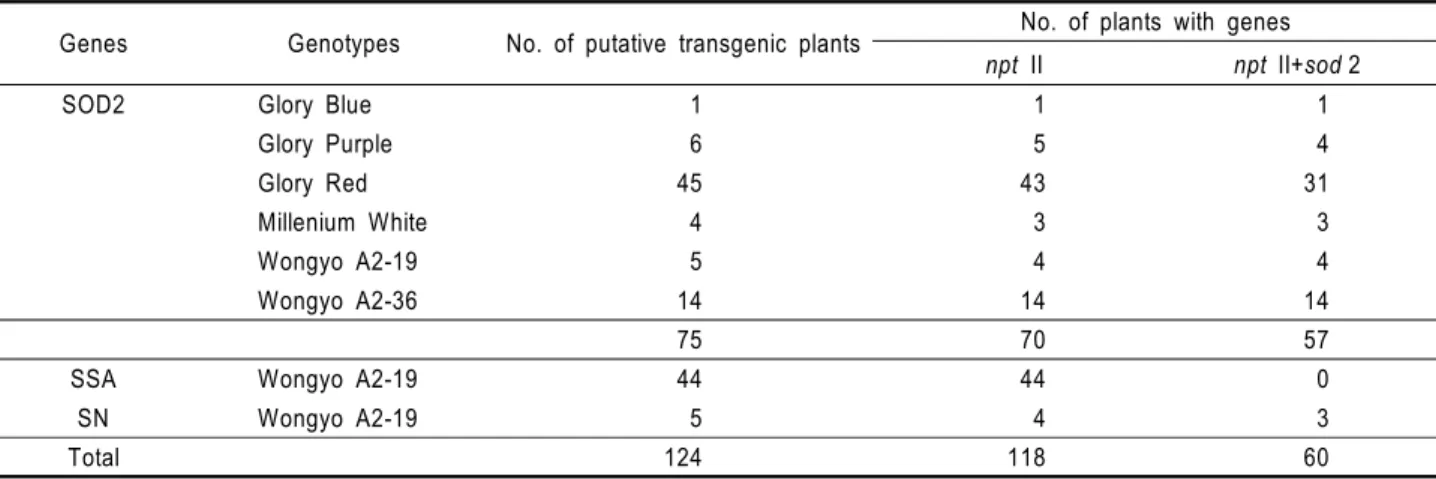
Genes Genotypes No. of putative transgenic plants No. of plants with genes

npt II npt II+sod 2

SOD2 Glory Blue 1 1 1

Glory Purple 6 5 4

Glory Red 45 43 31

Millenium White 4 3 3

Wongyo A2-19 5 4 4

Wongyo A2-36 14 14 14

75 70 57

SSA Wongyo A2-19 44 44 0

SN Wongyo A2-19 5 4 3

Total 124 118 60

(4)

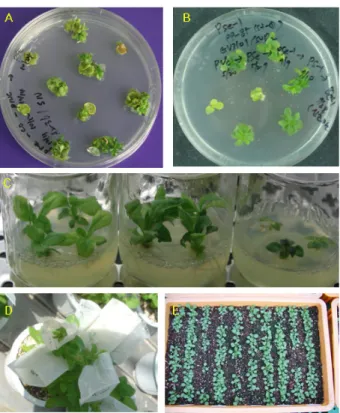
Figure 1. Shoot regeneration in the selection medium supplemented with kanamycin 50 (A) and 100 (B and C) mg・L

-1

after co-cultivation with SOD2 and SN genes and getting of transgenic progeny (D and E) in petunia

Figure 2. PCR analysis of SOD2 transgenic plants regenerated in the 2

nd

selection medium supplemented with kanamycin 100 mg・L

‐1

Figure 3. Southern analysis of SOD2 transgenic plants confirmed by PCR analysis

Figure 4. Expression of SOD2 gene in SOD2 transgenic petunia plants by RT‐PCR analysis

were regenerated from some of explants of both Wongyo A2-19 and Wongyo A2-36 in the 1

st

selection medium, too. However, when the selected shoots were transferred to the 2

nd

selection medium, while those of Wongyo A2-19 kept growing, those of Wongyo A2-36 did not (Table 2). The number of putative transgenic plants survived on the 2

nd

selection medium after co-cultivation with three genes (SOD2, SSA, and SN) was 124 (75, 44, and 5, respectively). From PCR analysis, 118 (derived from 4 cultivars and 2 purebred lines) of 124 plants were confirmed to contain marker (npt II) gene, while 58 of 118 did not have target genes (SOD2, SSA, and SN, respectively).

There were no plants with npt II and SSA genes, together. A total of 27 out of 28 SOD2 transgenic plants were re-confirmed as transformants by Southern analysis (Table 3, Fig. 1A to 1C, 2 & 3). Results obtained from RT-PCR analysis also indicated that SOD2 and SN genes were expressed in the transgenic petunia in the ratio of 77.8 to 100.0 % and 23.5%, respectively (Table 4, Fig. 4). T

1

seeds were obtained from 36 acclimated transgenic plants (SOD2 34 plus SN 2) in a glasshouse by self-pollination (Table 4, Fig. 1D and 1E).

The resistance to abiotic stress in SOD or NDPK gene-transgenic

pants was reported by many researchers (Lee et al. 2007; Kim et al.

2003; Tang et al. 2004a, Tang et al. 2004b). Through following

simple tests to measure and determine resistance to abiotic stress, this

study also identified that SOD2 transgenic progeny seeds have

resistance to cold or salt stress. SOD2 T

1

seeds of cv. Glory Red were

germinated in MS medium supplemented with NaCl 150 mM, while

non-transgenic seeds were not (Fig. 5). Also, the T

1

seeds showed

resistance to cold stress (no data). There were few reports about

transformation to develop new cultivar of petunia, but not to examine

function of genes cloned. However, according to Chandler and Lu

(2005), field testing of transgenic petunias was done in several

companies or university as follows: disease resistance (by Sanford

Scientific Co.), extended flower life (by Monsanto Co.), glyphosate

resistance and altered flower color (by Scott Co.), and cold, drought,

and increased salt tolerance (by the University of Florida). However,

we have yet to determine where the transgenic petunias are found

(5)

Table 4 Expression of target genes and production of progeny in transgenic petunia plants which were in vitro -rooted and acclimated at glass house

Genes Genotypes No. of acclimated transgenic lines Lines expressing target gene (%) Lines with progeny (%)

SOD2 Glory Purple 2 80.0 1

Glory Red 28 87.1 25

Millenium White 4 100.0 3

Wongyo A2-19 5 100.0 3

Wongyo A2-36 6 77.8 2

Subtotal 45

SN Wongyo A2-19 2 23.5 2

Total Total 47

Figure 5. SOD2 transgenic petunias (T

1

) obtained from ‘Glory Red’

germinated on MS medium supplemented with 150 mM NaCl. NT was non‐transgenic seed

because of lack of information. And moreover, this study was the first report about transgenic petunia using purebred lines. Therefore, the transgenic petunia seeds obtained in this study will be key fundamental genetic materials for breeding petunia new cultivar resistant to abiotic stress.

References

Chandler SF and Lu CY (2005) Biotechnology in ornamental horticulture. In Vitro Cell. Biol._Plant 41:591-601

Fang GC, Hanau RM, Vaillancourt LJ (2002) The SOD2 gene, encoding a manganese-type superoxide dismutase, is up- regulated during conidiogenesis in the plant pathogenic fungus Colletotrichum graminicola . Fungal Genetics, and Biology 36:155-165

Haejeong M, Lee B, Choi G, Shin D, Prasad DT, Lee O, Kwak SS, Kim DH, Nam J, Bahk J, Hong JC, Lee SY, Cho MJ, Lim CO, Yun DJ (2003) NDP kinase 2 interacts with two oxidative stress-activated MARKs to regulate cellular redox state and enhances multiple stress tolerance in transgenic plants. PNAS. 100:358-363

Kim KY, Kwon SY, Lee HS, Hur Y, Bang JW, Kwak SS (2003) A novel oxidative stress-inducible peroxidase promoter from

sweetpotato: molecular cloning and characterization in trans- genic tobacco plants and cultured cells. Plant Mol. Biol. 51:

831-838

Kim JS, Lee BH, Kwon SY, Kim YH, Kim SH, Cho KY (2005) Antioxidative responses of transgenic tobacco plants expressing both superoxide dismutase and ascorbate peroxidase in chlo- roplasts to several herbicides. Kor. J. Plant Biotech. 32:97-103 Lee SY, Han BH (2008) Development of petunia resistant to

environmental stress. In: National Horticultural Research Ins- titute (eds) Report of horticultural experimental studies in 2007 pp: 333-342 (in Korean)

Lee SY, Woo JG, Han BH, Bang CS, Oh DG, Huh KY (2005) Superoxide dismutase(SOD) gene transferred into cultivars and breeding lines of Petunia hybrid. In: The Korean Society of Plant Biotechnology (eds). Platform technology for plant bioproduct. p 217

Lee SH, Ahsan N, Lee KW, Lim DH, Lee DG, Kwak SS, Kwon SY, Kim TH, Lee BH (2007) Simultaneous overexpression of both CuZn superoxide dismutase and ascorbate peroxidase in transgenic tall fescue plants confers increased tolerance to a wide range of abiotic stresses. J. Plant Physiology 164:

1626-1638

National Horticultural Research Institute (2006) New cultivars of ornamental crops. pp 47-51

Shibata M (2008) Importance of genetic transformation in orna- mental plant breeding. Plant Biotech. 25:3-8

Tang L, Kwon SY, Kim MD, Kim JS, Kwak SS, Lee HS (2007) Enhanced tolerance to oxidative stress of transgenic potato (cv. Superior) plants expressing SOD and APX in chloroplasts.

Kor. J. Plant Biotech. 34:299-305

Tang L, Kwon SY, Yun DJ, Kwak SS, Lee HS (2004a) Selection of transgenic potato plants expressing NDP Kinase 2 gene with enhanced tolerance to oxidative stress. Kor. J. Plant Biotech. 31:19-195

Tang L, Kwon SY, Kwak SS, Sung CK, Lee HS (2004b) Selection of transgenic potato plants expressing both CUZNSOD and APX in chloroplastswith Enhanced tolerance to oxidative stress.

Kor. J. Plant Biotech. 31:109-113

(Received April 16, 2009; Accepted April 30, 2009)

수치

Table 3 PCR and Southern analyses of putative transgenic petunia plants survived on MS medium supplemented with kanamycin 100 mg・L -1 Genes Genotypes No
Figure 2. PCR analysis of SOD2 transgenic plants regenerated in the 2 nd  selection medium supplemented with kanamycin 100 mg・L ‐1

참조

관련 문서