Implications of Emphysema and Lung Function for the Development of Pneumonia in Patients with Chronic Obstructive Pulmonary Disease
Yoonki Hong, M.D. 1 , Jae Seung Lee, M.D. 2 , Kwang Ha Yoo, M.D. 3 , Ji-Hyun Lee, M.D. 4 , Woo Jin Kim, M.D. 1 , Seong Yong Lim, M.D. 5 , Chin Kook Rhee, M.D. 6 , Sang-Do Lee, M.D. 2 and Yeon-Mok Oh, M.D. 2
1
Department of Internal Medicine, Kangwon National University Hospital, Kangwon National University College of Medicine, Chuncheon,
2Department of Pulmonary and Critical Care Medicine and Clinical Research Center for Chronic Obstructive Airway Diseases, Asan Medical Center, University of Ulsan College of Medicine, Seoul,
3Department of Internal Medicine, Konkuk University School of Medicine, Seoul,
4Department of Internal Medicine, CHA Bundang Medical Center, CHA University, Seongnam,
5Division of Pulmonary and Critical Care Medicine, Department of Medicine, Kangbuk Samsung Hospital, Sungkyunkwan University School of Medicine, Seoul,
6Department of Internal Medicine, Seoul St. Mary’s Hospital, College of Medicine, The Catholic University of Korea, Seoul, Korea
Background: Chronic obstructive pulmonary disease (COPD) is sometimes complicated with pneumonia, but little is known about the risk factors that promote the development of pneumonia in COPD. These risk factors were evaluated in the present study.
Methods: The data of 324 patients with COPD from a prospective multi-center observational cohort with obstructive lung disease were evaluated retrospectively. To identify risk factors for the development of pneumonia in COPD, the clinical and radiological data at enrollment and the time to the first episode of pneumonia were analyzed by Cox proportional hazard analysis.
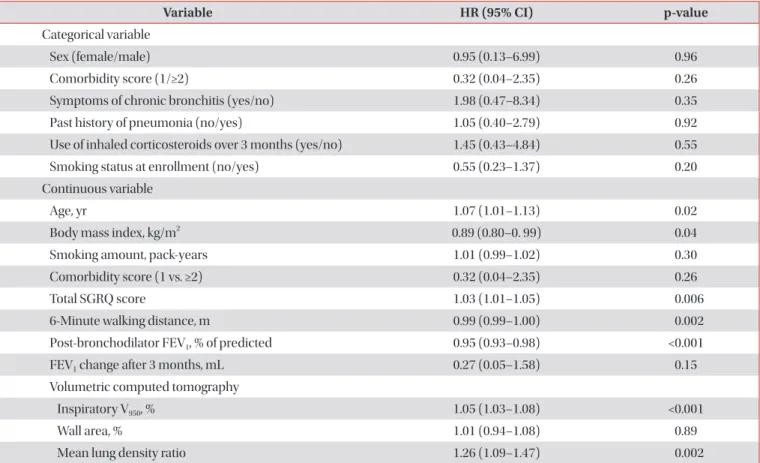
Results: The median follow-up time was 1,099 days and 28 patients (8.6%) developed pneumonia. The Cox analysis showed that post-bronchodilator forced expiratory volume in one second (FEV
1, % of predicted) and the computed tomography (CT) emphysema extent (inspiratory V950) were independent risk factors for the development of pneumonia (post-bronchodilator FEV
1: hazard ratio [HR], 0.97; 95% confidence interval [CI], 0.94–1.00; p=0.048 and inspiratory V950: HR, 1.04; 95% CI, 1.01–1.07; p=0.01).
Conclusion: Emphysema severity measured by CT and post-bronchodilator FEV
1are important risk factors for the development of pneumonia in COPD.
Keywords: Pulmonary Disease, Chronic Obstructive; Emphysema; Pneumonia; Tomography, X-Ray Computed; Risk Factors
Copyright © 2016
The Korean Academy of Tuberculosis and Respiratory Diseases. All rights reserved.
Address for correspondence: Yeon-Mok Oh, M.D.
Department of Pulmonary and Critical Care Medicine and Clinical Research Center for Chronic Obstructive Airway Diseases, Asan Medical Center, University of Ulsan College of Medicine, 88 Olympic-ro 43-gil, Songpa-gu, Seoul 05505, Korea
Phone: 82-2-3010-3136, Fax: 82-2-3010-6968, E-mail: [email protected]
*The abstract was submitted and presented at the 17th Congress of the Asian Pacific Society of Respirology which was held on 14–16 Dec 2012 at the Hong Kong Convention and Exhibition Centre.
Received: Nov. 4, 2015, Revised: Dec. 7, 2015, Accepted: Dec. 28, 2015
cc
It is identical to the Creative Commons Attribution Non-Commercial License (http://creativecommons.org/licenses/by-nc/4.0/).
Introduction
Chronic obstructive pulmonary disease (COPD) is a com- plex syndrome with significant heterogeneity, having differ- ent clinical presentation, imaging, and response to therapy
1. COPD is a major cause of chronic morbidity and mortality throughout the world and its incidence is expected to increase over the coming decades
2. Pneumonia is also a major cause of hospitalization and a common cause of death
3. Epidemio- logical studies show that COPD is the most common disease associated with pneumonia
4.
COPD as a risk factor for the development of pneumonia was primarily identified by studies on population-based co- horts
5or cohorts of patients with pneumonia
6,7. It has been suggested that COPD severity is an important predictor of pneumonia hospitalization in the Unites States
5. Elevations in baseline C-reactive protein levels and dyspnea index have also been suggested to be markers of pneumonia risk
8. More- over, common comorbid conditions, such as advanced age, diabetes mellitus, and cardiovascular disease, in patients with COPD may also associate with an increased risk of pneumo- nia. Recently, concerns is raised on that inhaled corticoste- roids (ICS) use may associate with an increased incidence of pneumonia
9-11. Despite these reports, it is still unknown which components of COPD associate with the development of pneumonia.
Given recent advances in computed tomography (CT) tech- nology, it may be a useful tool for evaluating the severity, ex- tension, and distribution of the disease components of COPD at both a qualitative and a quantitative level. Indeed, recent studies have reported that particular radiological characteris- tics of COPD are associated with various clinical, genetic, and physiological features, such as greater lung emphysema as- sociated with COPD exacerbations or Gly16 variant in ADRB2 gene associated with airway wall changes
12-14. However, it is not clear about the role of CT for predicting the development of pneumonia in patients with COPD.
It would be of interest to know which types or components of COPD are associated with the development of pneumonia because being able to predict which patients with COPD are at greatest risk of developing pneumonia may improve the un- derstanding of the heterogeneity in COPD and facilitate better health care for these individuals. Therefore, the present ret- rospective study analyzed clinical features, exercise capacity, lung function, and CT measurements to identify risk factors for the development of pneumonia in patients with COPD on a prospective observational cohort.
Materials and Methods
1. Subjects
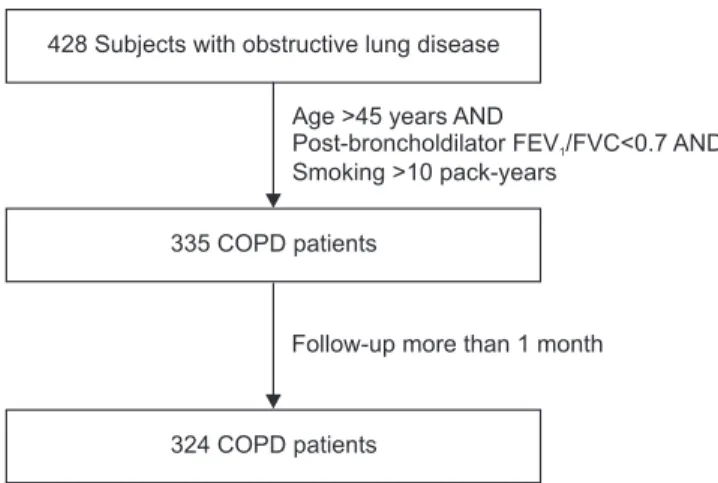
The data of 324 patients diagnosed with COPD were ana- lyzed retrospectively. These patients were selected from the Korean obstructive lung disease (Korean OLD, KOLD) Cohort (Figure 1), which consisted of 428 stable patients with OLD who had been prospectively recruited from the pulmonary clinics of 16 hospitals in South Korea between June 2005, and February 2012. The inclusion criteria for patients with OLD have been described previously
15. The patients were diag- nosed with COPD if they were aged >45 years, had >10 pack- years of cigarette smoking, and had a post-bronchodilator forced expiratory volume in one second (FEV
1)/forced vital capacity <0.7, but did not have bronchiectasis or sequelae of pulmonary tuberculosis. Patients who had exacerbation of COPD within the past 2 months were excluded. Patients who had been enrolled for less than 1 month were excluded be- cause adverse events were evaluated on a monthly basis.
At the enrollment visit, all patients were evaluated with medical interviews, physical examinations, spirometry, bron- chodilator reversibility tests, and lung volume, and 6-minute walk tests. Health-related quality of life was evaluated by calculating the total score of St. George’s Respiratory Ques- tionnaire (SGRQ). Comorbidity scores were calculated by using an updated Charlson comorbidity index
16. Chronic bronchitis was defined by a questionnaire that identified the patients who had a chronic cough and phlegm production for 3 months per year for at least 2 consecutive years. In addition, volumetric CT was performed to evaluate airway wall thick- ness, emphysema severity, and mean lung density (MLD) ratio at full expiration and inspiration at the enrollment visit.
Our Institutional Review Board approved the analyses of
Figure 1. Selection of study subjects from the initial cohort with ob- structive lung disease. FEV
1: forced expiratory volume in 1 second;
FVC: forced vital capacity; COPD: chronic obstructive pulmonary disease.
428 Subjects with obstructive lung disease
335 COPD patients
Age >45 years AND
Post-broncholdilator FEV /FVC<0.7 AND Smoking >10 pack-years
1