• 검색 결과가 없습니다.

Treatment of Drug Susceptible Pulmonary Tuberculosis

N/A
N/A
Protected

Academic year: 2021

Share "Treatment of Drug Susceptible Pulmonary Tuberculosis"

Copied!
7
0
0

로드 중.... (전체 텍스트 보기)

전체 글

(1)

Treatment of Drug Susceptible Pulmonary Tuberculosis

Hong-Joon Shin, M.D. and Yong-Soo Kwon, M.D.

Department of Internal Medicine, Chonnam National University Hospital, Gwangju, Korea

Tuberculosis (TB) remains a major global health problem, and the incidence of TB cases has not significantly decreased over the past decade in Korea. The standard short course regimen is highly effective against TB, but requires multiple TB-specific drugs and a long treatment duration. Recent studies using late-generation fluoroquinolones and/or high- dose rifapentine-containing regimens to shorten the duration of TB treatment showed negative results. Extending the treatment duration may be considered in patients with cavitation on the initial chest radiograph and positivity in sputum culture at 2 months of treatment for preventing TB relapse. Current evidence does not support the use of fixed-dose combinations compared to separate drugs for the purpose of improving treatment outcomes. All patients receiving TB treatment should be monitored regularly for response to therapy, facilitation of treatment completion, and management of adverse drug reactions. Mild adverse effects can be managed with symptomatic therapy and changing the timing of the drug administration, but severe adverse effects require a discontinuation of the offending drugs.

Keywords: Tuberculosis; Antitubercular Agents; Fluoroquinolones; Combination Therapy; Drug-Related Side Effects and Adverse Reactions

in Korea, since new cases have plateaued at approximately 100/100,000 persons over the past decade

3

. One possible explanation for the steady rate of new TB cases in Korea is an increasing proportion of the elderly, who may be at a higher risk for TB development

3

. TB also has the highest mortality rate among the infectious diseases; it was 4.9/100,000 persons in 2012

3-7

. In pulmonary TB patients, the mortality rate during TB treatment reached 3.4% in a recent multicenter study

8

.

Current TB drugs were developed 40 years ago and have a high treatment success rate if patients take TB drugs through- out the course of treatment

9

. However, current regimens include many TB drugs and require lengthy treatment dura- tions. Therefore, there are challenges in the current TB treat- ment such as shortening the treatment duration, increasing adherence, and managing adverse drug effects. This article covers current TB treatment in patients with newly diagnosed drug-susceptible pulmonary TB based on the Korean Guide- lines for Tuberculosis, second edition, 2014

10

and recent clini- cal studies for TB treatment

8,11-20

.

Principles of TB Chemotherapy

The overall goals for treatment of TB are (1) to cure the dis- Copyright © 2015

The Korean Academy of Tuberculosis and Respiratory Diseases.

All rights reserved.

Introduction

Tuberculosis (TB) remains a major global health problem, with an estimated 9 million incident cases and 1.5 million deaths in 2013 according to the World Health Organization (WHO)

1

. In Korea, the prevalence of bacteriologically or radio- logically active TB (>5 years old) decreased dramatically from 5,168/100,000 persons in 1965 to 767/100,000 persons in 1995

2

. However, TB remains a current major health concern

Address for correspondence: Yong-Soo Kwon, M.D.

Department of Internal Medicine, Chonnam National University Hospital, 42 Jebong-ro, Dong-gu, Gwangju 501-757, Korea Phone: 82-62-220-6575, Fax: 82-62-225-8578

E-mail: [email protected] Received: Mar. 3, 2015 Revised: Mar. 30, 2015 Accepted: Mar. 31, 2015

cc It is identical to the Creative Commons Attribution Non-Commercial License (http://creativecommons.org/licenses/by-nc/4.0/).
(2)

ease that could improve quality of life for individual patients, (2) to minimize transmission of Mycobacterium tuberculosis to other persons, and (3) to prevent a relapse of this disease and spread of drug-resistant TB

10,21

.

M. tuberculosis has characteristics distinct from other bac- teria, including slow growth, with generation times of 15 to 20 hours and a capacity for dormancy that requires prolonged treatment to confirm successful eradication

22

. Moreover, this organism can actively multiply in the liquid caseous debris of pulmonary cavities, which may contain up to 10

8

organ- isms

22

. Drug resistance could be achieved by random genetic point mutation; it is also possible that the large population of organisms in such cavities could have the potential for drug resistance

22

. Therefore, a combination of highly active agents against M. tuberculosis is needed for the successful eradica- tion of these organisms in their various states, and for prevent- ing drug resistance. However, the most important cause of TB therapy treatment failure is the development of drug re- sistance, which can be developed by irregular drug-taking, in- adequate dosage, and single-drug treatment. Sufficiently long periods of TB treatment are also needed to eradicate the slow growing mycobacteria. Therefore, to achieve the overall TB treatment goal, the following principles should be followed: (1) combination therapy of more than three TB drugs for preven- tion of drug resistance, (2) once-daily administration of TB drugs and exact dosage for optimizing efficacy, and (3) taking TB drugs regularly for at least 6 months.

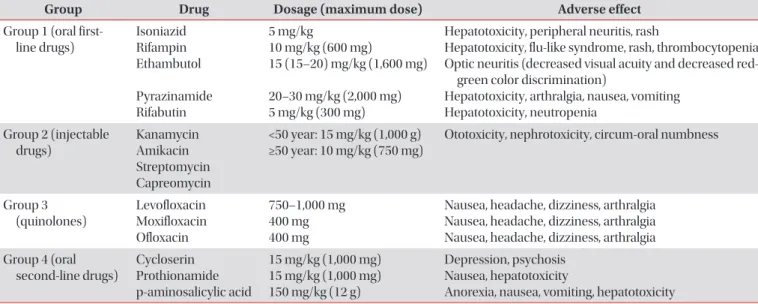
TB drugs are classified into five groups according to efficacy, potency, and drug class (Table 1)

23

. First-line TB drugs com- prising group 1—except streptomycin, which is classified with the other injectable agents in group 2—are the most potent, have the best tolerance of all TB drugs, and are currently rec- ommended in a four-drug combination for the treatment of

drug-susceptible TB. A lower degree of efficacy and a higher degree of intolerability and toxicity have limited the use of second-line TB drugs for patients with drug-resistant TB or intolerance with first-line drugs.

The standard short course regimen is a 2-month period of isoniazid (INH), rifampin (RIF), ethambutol (EMB), and pyrazinamide (PZA), followed by a 4-month period of INH, RIF, and EMB (2HREZ/4HR[E]). If the organism is susceptible to INH and RIF upon drug susceptibility testing, EMB can be discontinued. If PZA cannot be included in the initial phase of treatment, a combination of INH, RIF, and PZA should be administered for 9 months (9HRE).

The standard four-drug (2HREZ/4HR) regimen has shown high efficacy in achieving cure rates around 90%–95%, both in treatment under oversight of TB control programs and trial conditions

24

. A recent multicenter retrospective cohort study was conducted in Korea, including a total of 2,481 patients with pulmonary TB and excluding patients with treatment default, those who were transferred to another hospital, had unknown treatment outcome, and had positive human immunodeficien- cy virus antibodies; successful treatment was achieved for 2,333 patients (94%), who comprised those being cured (45.5%) and completing treatment (48.5%)

8

. However, the treatment suc- cess fate of all reported TB patients in Korea is still low, that is, less than 70%; this low success rate is mainly caused by patients with treatment default and for whom there is an unknown treatment outcome

5

. Therefore, to improve the treatment suc- cess rate in Korea, more efforts are necessary to reduce the number of patients with default and to improve the collection of accurate data regarding treatment outcomes in TB patients.

Table 1. Groups, recommended dosage for daily administration, and adverse effects of tuberculosis drugs for adults

23

Group Drug Dosage (maximum dose) Adverse effect

Group 1 (oral first- line drugs)

Isoniazid Rifampin Ethambutol Pyrazinamide Rifabutin

5 mg/kg

10 mg/kg (600 mg)

15 (15–20) mg/kg (1,600 mg) 20–30 mg/kg (2,000 mg) 5 mg/kg (300 mg)

Hepatotoxicity, peripheral neuritis, rash

Hepatotoxicity, flu-like syndrome, rash, thrombocytopenia Optic neuritis (decreased visual acuity and decreased red-

green color discrimination)

Hepatotoxicity, arthralgia, nausea, vomiting Hepatotoxicity, neutropenia

Group 2 (injectable drugs)

Kanamycin Amikacin Streptomycin Capreomycin

<50 year: 15 mg/kg (1,000 g)

≥50 year: 10 mg/kg (750 mg)

Ototoxicity, nephrotoxicity, circum-oral numbness

Group 3 (quinolones)

Levofloxacin Moxifloxacin Ofloxacin

750–1,000 mg 400 mg 400 mg

Nausea, headache, dizziness, arthralgia Nausea, headache, dizziness, arthralgia Nausea, headache, dizziness, arthralgia Group 4 (oral

second-line drugs)

Cycloserin Prothionamide p-aminosalicylic acid

15 mg/kg (1,000 mg) 15 mg/kg (1,000 mg) 150 mg/kg (12 g)

Depression, psychosis Nausea, hepatotoxicity

Anorexia, nausea, vomiting, hepatotoxicity

(3)

Optimal Duration of TB Treatment

The relapse rates for standard 6-month treatment of pulmo- nary TB were 1%–2% at 24 months after treatment, although the current TB regimen showed high efficacy

25

. It has been recommended that patients with risk factors for relapse in- cluding cavitation on chest radiography, extensive disease, im- munosuppression, and positive sputum culture at 2 months of treatment may need a treatment extension of up to 9 months

9

. However, the evidence regarding efficacy of treatment exten- sion is weak and there are no defined criteria for prolonging treatment to prevent relapse of TB. In a recent study per- formed in Korea, the combination of cavitation on initial chest radiography and positive culture after 2 months was associ- ated with an increased risk of 1-year relapse, with the authors suggesting a treatment extension in these patients

17

. However, this was a single center retrospective study that included only 6 patients with TB relapse, and there was no proven efficacy of prolonged TB treatment for preventing relapse of TB in these patients. Further studies are needed to evaluate the efficacy of extending standard treatments. In the Korean Guidelines for Tuberculosis, based on the previous study, in cases with cavi- tations on the chest radiograph at the start of treatment and a positive culture after 2 months of treatment, extending stan- dard treatment may be considered, but the total duration of treatment should be individualized according to the patient’s condition

10

.

Shortening the treatment duration could be a big advance- ment in TB control. It could enhance adherence to TB treat- ment, decrease side effect rates, and reduce costs. A random- ized, open-label equivalence trial evaluating the shortening

of a standard treatment continuation period for 2 months (2 months of HREZ+2 months of HR) in patients with non-cavi- tary TB and negative sputum culture after 2 months showed significantly higher rates of relapse in a 4-month arm than a standard 6-month arm (7.0% vs. 1.6%; risk difference, 0.054;

95% confidence interval with Hauck-Anderson correction, 0.01–0.10)

26

. Failure to eradicate dormant bacilli in the use of current standard regimens might result in a higher relapse rate. Therefore, regimens successfully used to shorten the treatment duration need to focus on the introduction of new drugs with novel mechanisms of action

11

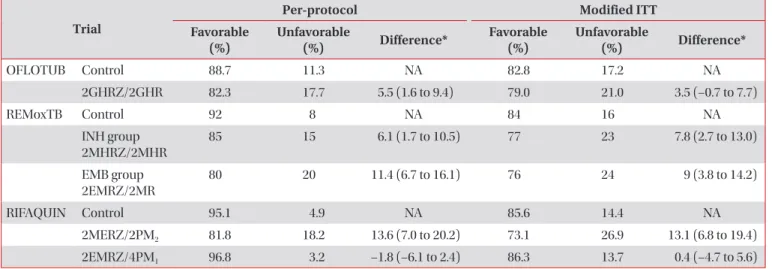
. Recently, three non- inferiority trials were performed to shorten standard therapy to 4 months using fluoroquinolones or higher doses of rifa- pentine (Table 2)

11-14

.

OFLOTUB, a randomized, open-label, controlled trial, com- pared the standard 6-month regimen (2HREZ/4HR) with a regimen in which gatifloxacin (400 mg once daily) was sub- stituted for EMB during 4 months of treatment comprised of a 2-month intensive phase of gatifloxacin, INH, RIF, and PZA, followed by a 2-month maintenance phase of gatifloxacin, INH, and RIF (2GHRZ/2GHR)

14

. The primary endpoints at 24 months after the end of treatment were unfavorable outcomes including treatment failure, recurrence, and death or dropout during treatment, which did not meet the non-inferiority of the 4-month regimen compared to the standard regimen.

REMoxTB (a randomized, double-blind, placebo-controlled trial) is comparing standard 6-month therapy (control group) with two study groups: the INH group, in which EMB was replaced with moxifloxacin for 17 weeks, and the EMB group, in which INH was replaced with moxifloxacin for 17 weeks

12

. The primary outcome that included treatment failure or re-

Table 2. Comparisons of current trials which aimed to shorten duration of TB treatment Trial

Per-protocol Modified ITT

Favorable (%)

Unfavorable

(%) Difference* Favorable (%)

Unfavorable

(%) Difference*

OFLOTUB Control 88.7 11.3 NA 82.8 17.2 NA

2GHRZ/2GHR 82.3 17.7 5.5 (1.6 to 9.4) 79.0 21.0 3.5 (–0.7 to 7.7)

REMoxTB Control 92 8 NA 84 16 NA

INH group 2MHRZ/2MHR

85 15 6.1 (1.7 to 10.5) 77 23 7.8 (2.7 to 13.0)

EMB group 2EMRZ/2MR

80 20 11.4 (6.7 to 16.1) 76 24 9 (3.8 to 14.2)

RIFAQUIN Control 95.1 4.9 NA 85.6 14.4 NA

2MERZ/2PM

2

81.8 18.2 13.6 (7.0 to 20.2) 73.1 26.9 13.1 (6.8 to 19.4)

2EMRZ/4PM

1

96.8 3.2 –1.8 (–6.1 to 2.4) 86.3 13.7 0.4 (–4.7 to 5.6)

*Adjusted difference, experimental group-control group, percentage points (OFLOTUB, 95% CI; REMoxTB, 97.5% CI; RIFAQAUIN, 90% CI).

TB: tuberculosis; ITT: intention-to-treat; Control: 2HREZ/4HR; G: gatifloxacin; H: isoniazid; R: rifampin; Z: pyrazinamide; NA: not applicable;

INH: isoniazid; EMB: ethambutol; M: moxifloxacin; E: ethambutol; P: rifapentine; PM

2

: twice weekly moxifloxacin and rifapentine; PM

1

: once-

weekly moxifloxacin and rifapentine; CI: confidence interval.

(4)

lapse within 18 months after randomization of this study also did not meet the non-inferiority of the 4-month trial regimens compared to the standard regimen. However, trial regimens showed a more rapid sputum-negative conversion in both solid and liquid culture media. There was no significant dif- ference in the incidence of grade 3 or 4 adverse events, as reported in 127 patients (19%) in the INH group, 111 patients (17%) in the EMB group, and 123 patients (19%) in the control group.

RIFAQUIN (a randomized, controlled trial) compared the standard 6-month regimen with two other study regimens (4-month regimen: 2 months of daily EMB, moxifloxacin, RIF, and PZA followed by 2 months of twice-weekly moxifloxacin and rifapentine [900 mg]; 6-month regimen: 2 months of daily EMB, moxifloxacin, RIF, and PZA followed by 4 months of once-weekly moxifloxacin and rifapentine [1,200 mg])

13

. The 6-month regimen was as effective as the standard 6-month regimen, but the 4-month regimen was inferior to the stan- dard.

Based on these three clinical trials, recommendations could not be made related to the use of fluoroquinolone and/or high-dose rifapentine-containing regimens in shortening the TB treatment duration by 2 months.

Fixed Dose Combination

One of the most important causes for TB treatment fail- ure or development of drug resistance is non-adherence to TB drugs. It is reported that 20% to 50% of patients with TB treatment fail to complete treatment, and the consequences contribute to prolonged therapy, drug resistance, and death

27

. To improve adherence for TB treatment, direct observed treatment (DOT) is recommended

21

. DOT includes provision of anti-TB drugs directly to the patient and observation for patient intake. When DOT is not available, fixed dose combi- nations (FDCs) might be expected to improve a compliance of TB treatment and reduce a risk of drug resistance by pre- venting inappropriate drug selection and treatment of a single regimen

23

. The WHO and the International Union against Tu- berculosis and Lung Disease (IUATLD) have recommended the use of these drugs since 1994

28,29

. In a randomized study comparing FDCs and separate drugs, the use of FDCs is pre- ferred because of the potential advantages associated with FDC administration compared with separate-drug formula- tions

15,18

. However, these results do not fully demonstrate the non-inferiority of the FDCs compared with separate drugs us- ing strict pre-trial definitions at both 18 months post-random- ization and 30 months after treatment initiation. Moreover, the efficacy of FDCs is still controversial owing to the decreased bioavailability of rifampicin in FDCs

30

. A recent meta-analysis showed a trend toward higher risk of treatment failure or re- lapse with FDCs (pooled relative risk, 1.28; 95% confidence in-

terval, 0.99–1.7) compared with separate drugs; there was no evidence that FDCs could improve patient compliance for TB drugs

16

. Given the possible risks, additional studies evaluating the efficacy of FDCs are warranted.

Monitoring of Treatment Response and Definition of Treatment Outcome

All patients who received TB treatment are recommend- ed to undergo regular monitoring, not only for observing the response to therapy but also for facilitating treatment completion, and identifying and managing adverse drug reactions

10,21,23

. Monthly monitoring of patient weight and ac- cordingly adjusting TB drug dosage upon weight change is also recommended

10,23

. To monitor pulmonary TB patients, sputum smears and culture examinations are recommended at monthly intervals until two consecutive culture specimens are negative at the end of treatment

10,21

. However, the re- sponse using sputum studies has its limitations, particularly in patients with smear- and culture-negative pulmonary TB. In these patients, chest radiography can provide information on the treatment response, but this alone is not recommended for monitoring the treatment response in pulmonary TB pa- tients due to non-responsive fibrotic lesions to TB treatment and possible other causes of lung infiltration such as lung cancer, pneumonia, bronchiectasis, and hemorrhage

10

. Chest computed tomography (CT) has been acknowledged to be a more sensitive and specific tool for pulmonary TB compared to chest radiography; it is suggested as an appropriate tool for evaluating treatment responses and complications during treatment

31-36

. However, in a recent study including 66 pulmo- nary TB patients who had chest CT scans before and after TB treatment, 50% of all patients had significant residual lesions in chest CT scans after TB treatment, although these lesions had no evidence of persistent activity or the possibility of early relapse during the median 15 months of follow-up

19

.

The treatment outcome definitions were revised recently by WHO: “default” and “transfer out” were removed, and “lost to follow-up” and “not evaluated” were inserted

37

. Lost to follow- up included cases with no start of TB treatment in addition to cases with interrupting TB treatment for 2 consecutive months or more, and not evaluated included cases with un- known outcome in addition to cases where the patient was transferred to another treatment unit (Table 3)

37

.

Management of Common Adverse Effects

Current combination chemotherapy for curing TB requires

a lengthy treatment duration, and many TB drugs are associ-

ated with a high incidence of adverse effects. Mild adverse

effects such as minor rash with itch, non-gouty polyarthralgia,

(5)

and mild gastrointestinal upset including nausea, vomiting, poor appetite, and abdominal pain can generally be managed with symptomatic therapy and changing the timing of the drug administration. However, in severe adverse effects such as drug-induced hepatitis, RIF induced severe immunologic reactions including thrombocytopenia, hemolytic anemia, acute renal failure, and thrombotic thrombocytopenic purpu- ra, EMB-induced optic toxicity, and PZA-induced acute gouty arthritis, offending drugs should be discontinued

10,21

.

Drug-induced hepatotoxicity is the most frequent adverse effect limiting the use of effective first-line TB drugs and in- ducing transfer to other TB drugs

38

. Alanine aminotransferase (ALT) level has been revised as more specific for drug-induced hepatotoxicity than aspartate aminotransferase, which can be also increased in abnormal conditions in muscle, heart, or kid- ney

38

. If the ALT level is more than three times the upper limit of normal with symptoms, or more than five times the upper limit of normal without symptoms, three of the first-line anti- TB drugs, INH, RIF, and PZA should be discontinued; other causes of hepatitis such as viral hepatitis A, B, and C should be evaluated, in addition to intake of drugs other than those for TB, herbal medications, and alcohol. After the ALT has de- creased to less than two times the upper limit of normal, first- line drugs can be reinitiated one at a time. Underlying chronic liver diseases have been contributing risk factors for TB drug- induced hepatitis, and patients with this disease might re- ceive less effective non-hepatotoxic second-line TB drugs

38,39

. However, the relative risks according to various etiologies of chronic liver disease such as hepatitis A, B, and C infections, and degree of liver cirrhosis on the development of drug- induced hepatitis have not been well studied. Research con- ducted in Korea to address these issues revealed that patients with hepatitis B or C seropositivity, or without advanced liver

cirrhosis (Child-Pugh score less than B), could be used for standard short course regimens including INH and RIF

20,40,41

.

Conclusion

Since the distinctive characteristics of M. tuberculosis include acquired drug resistance, slow growth rates, and dormancy, TB treatment requires a combination of many TB drugs and a lengthy treatment duration. However, most pa- tients with drug-sensitive TB could be cured by a highly effec- tive standard short course regimen if patients received a full course of TB therapy. Therefore, a clinician’s efforts regarding appropriate management of adverse drug effects and treat- ment response monitoring are needed to prevent drug inter- ruption. Recently, new regimens such as late-generation qui- nolones and high-dose rifapentine-containing regimens have been administered to reduce the duration of TB treatment, but the results of these studies were not successful. Further studies using new drugs with novel mechanisms of action are critical for shortening the treatment duration.

Conflicts of Interest

No potential conflict of interest relevant to this article was reported.

References

1. World Health Organization. Global tuberculosis report 2014 [Internet]. Geneva: World Health Organization; 2014 [cited Table 3. Revised definitions of treatment outcomes for drug-susceptible tuberculosis patients

37

Outcome Definition

Cured A pulmonary TB patient with bacteriologically confirmed TB at the beginning of treatment who was culture- negative in the last month of treatment and on at least one previous occasion

Treatment completed A TB patient who completed treatment without evidence of failure but with no record to show that sputum smear or culture results in the last month of treatment and on at least one previous occasion were negative, either because tests were not done or because results are unavailable

Treatment failed A TB patient whose sputum culture is positive at month 4 or later during treatment Died A TB patient who dies for any reason before starting or during the course of treatment

Lost to follow-up A TB patient who did not start treatment or whose treatment was interrupted for 2 consecutive months or more Not evaluated A TB patient for whom no treatment outcome is assigned. This includes cases “transferred out” to another

treatment unit as well as cases for whom the treatment outcome is unknown to the reporting unit Treatment success The sum of cured and treatment completed

Adopted from World Health Organization (2013). Definitions and reporting frame work for tuberculosis, 2013 revision: WHO/HTM/

TB/2013.2 (available from: http://apps.who.int/iris/bit stream/10665/79199/1/9789241505345_eng.pdf), with permission of World Health Organization

37

.

TB: tuberculosis.

(6)

2014 Mar 1]. Available from: http://apps.who.int/iris/bitstre am/10665/137094/1/9789241564809_eng.pdf.

2. Hong YP, Kim SJ, Lew WJ, Lee EK, Han YC. The seventh na- tionwide tuberculosis prevalence survey in Korea, 1995. Int J Tuberc Lung Dis 1998;2:27-36.

3. Park YK, Park YS, Na KI, Cho EH, Shin SS, Kim HJ. Increased tuberculosis burden due to demographic transition in Korea from 2001 to 2010. Tuberc Respir Dis 2013;74:104-10.

4. Korea Centers for Disease Control and Prevention. An- nual report on the notified tuberculosis patients in Korea 2012 [Internet]. Cheongwon: Korea Centers for Disease Control and Prevention; 2013 [cited 2014 Mar 1]. Avail- able from: http://tbfree.cdc.go.kr/tbfree/cmm/BoardList.

do?boardType=REPORT&id=4500.

5. Park YS, Hong SJ, Boo YK, Hwang ES, Kim HJ, Cho SH, et al.

The national status of tuberculosis using nationwide medical records survey of patients with tuberculosis in Korea. Tuberc Respir Dis 2012;73:48-55.

6. Kim HJ. Current status of tuberculosis in Korea. Korean J Med 2012;82:257-62.

7. Statistics Korea. Annual report of deaths by cause 2012 [In- ternet]. Daejeon: Statistics Korea; 2013 [cited 2014 Mar 1].

Available from: http://kosis.kr/ups/ups_01List01.jsp?grp_

no=1005&pubcode=YD&type=F.

8. Kwon YS, Kim YH, Song JU, Jeon K, Song J, Ryu YJ, et al. Risk factors for death during pulmonary tuberculosis treatment in Korea: a multicenter retrospective cohort study. J Korean Med Sci 2014;29:1226-31.

9. Zumla A, Raviglione M, Hafner R, von Reyn CF. Tuberculosis.

N Engl J Med 2013;368:745-55.

10. Joint Committee for the Revision of Korean Guidelines for Tuberculosis, Korea Centers for Disease Control and Preven- tion. Korean guidelines for tuberculosis. 2nd ed. Seoul and Cheongwon: Joint Committee for the Revision of Korean Guidelines for Tuberculosis, Korean Centers for Disease Con- trol and Prevention; 2014.

11. Kwon YS, Jeong BH, Koh WJ. Tuberculosis: clinical trials and new drug regimens. Curr Opin Pulm Med 2014;20:280-6.

12. Gillespie SH, Crook AM, McHugh TD, Mendel CM, Meredith SK, Murray SR, et al. Four-month moxifloxacin-based regi- mens for drug-sensitive tuberculosis. N Engl J Med 2014;371:

1577-87.

13. Jindani A, Harrison TS, Nunn AJ, Phillips PP, Churchyard GJ, Charalambous S, et al. High-dose rifapentine with moxifloxa- cin for pulmonary tuberculosis. N Engl J Med 2014;371:1599- 608.

14. Merle CS, Fielding K, Sow OB, Gninafon M, Lo MB, Mthiyane T, et al. A four-month gatifloxacin-containing regimen for treating tuberculosis. N Engl J Med 2014;371:1588-98.

15. Lienhardt C, Cook SV, Burgos M, Yorke-Edwards V, Rigouts L, Anyo G, et al. Efficacy and safety of a 4-drug fixed-dose com- bination regimen compared with separate drugs for treat- ment of pulmonary tuberculosis: the Study C randomized

controlled trial. JAMA 2011;305:1415-23.

16. Albanna AS, Smith BM, Cowan D, Menzies D. Fixed-dose combination antituberculosis therapy: a systematic review and meta-analysis. Eur Respir J 2013;42:721-32.

17. Jo KW, Yoo JW, Hong Y, Lee JS, Lee SD, Kim WS, et al. Risk fac- tors for 1-year relapse of pulmonary tuberculosis treated with a 6-month daily regimen. Respir Med 2014;108:654-9.

18. Nunn AJ, Cook SV, Burgos M, Rigouts L, Yorke-Edwards V, Anyo G, et al. Results at 30 months of a randomised trial of FDCs and separate drugs for the treatment of tuberculosis.

Int J Tuberc Lung Dis 2014;18:1252-4.

19. Seon HJ, Kim YI, Lim SC, Kim YH, Kwon YS. Clinical signifi- cance of residual lesions in chest computed tomography after anti-tuberculosis treatment. Int J Tuberc Lung Dis 2014;18:

341-6.

20. Shin HJ, Lee HS, Kim YI, Lim SC, Jung JP, Ko YC, et al. Hepa- totoxicity of anti-tuberculosis chemotherapy in patients with liver cirrhosis. Int J Tuberc Lung Dis 2014;18:347-51.

21. Blumberg HM, Burman WJ, Chaisson RE, Daley CL, Etkind SC, Friedman LN, et al. American Thoracic Society/Centers for Disease Control and Prevention/Infectious Diseases So- ciety of America: treatment of tuberculosis. Am J Respir Crit Care Med 2003;167:603-62.

22. Schlossberg D. Tuberculosis and nontuberculosis mycobac- terial infections. Washington, DC: ASM Press; 2011.

23. World Health Organization. Treatment of tuberculosis:

guidelines for national programmes. 4th ed. WHO/HTM/

TB/2009.420. Geneva: World Health Organization; 2009.

24. Combs DL, O’Brien RJ, Geiter LJ. USPHS Tuberculosis Short- Course Chemotherapy Trial 21: effectiveness, toxicity, and ac- ceptability. The report of final results. Ann Intern Med 1990;

112:397-406.

25. Chang KC, Leung CC, Yew WW, Ho SC, Tam CM. A nested case-control study on treatment-related risk factors for early relapse of tuberculosis. Am J Respir Crit Care Med 2004;170:

1124-30.

26. Johnson JL, Hadad DJ, Dietze R, Maciel EL, Sewali B, Gitta P, et al. Shortening treatment in adults with noncavitary tu- berculosis and 2-month culture conversion. Am J Respir Crit Care Med 2009;180:558-63.

27. Cuneo WD, Snider DE Jr. Enhancing patient compliance with tuberculosis therapy. Clin Chest Med 1989;10:375-80.

28. The promise and reality of fixed-dose combinations with rifampicin. A joint statement of the International Union Against Tuberculosis and Lung Disease and the Tuberculosis Programme of the World Health Organization. Tuber Lung Dis 1994;75:180-1.

29. Blomberg B, Spinaci S, Fourie B, Laing R. The rationale for recommending fixed-dose combination tablets for treatment of tuberculosis. Bull World Health Organ 2001;79:61-8.

30. Milan-Segovia RC, Dominguez-Ramirez AM, Jung-Cook H,

Magana-Aquino M, Romero-Mendez MC, Medellin-Garibay

SE, et al. Relative bioavailability of rifampicin in a three-drug

(7)

fixed-dose combination formulation. Int J Tuberc Lung Dis 2010;14:1454-60.

31. Im JG, Itoh H, Shim YS, Lee JH, Ahn J, Han MC, et al. Pul- monary tuberculosis: CT findings--early active disease and sequential change with antituberculous therapy. Radiology 1993;186:653-60.

32. Kim WS, Moon WK, Kim IO, Lee HJ, Im JG, Yeon KM, et al.

Pulmonary tuberculosis in children: evaluation with CT. AJR Am J Roentgenol 1997;168:1005-9.

33. McGuinness G, Naidich DP, Jagirdar J, Leitman B, McCauley DI. High resolution CT findings in miliary lung disease. J Comput Assist Tomogr 1992;16:384-90.

34. Pastores SM, Naidich DP, Aranda CP, McGuinnes G, Rom WN. Intrathoracic adenopathy associated with pulmonary tuberculosis in patients with human immunodeficiency virus infection. Chest 1993;103:1433-7.

35. Hulnick DH, Naidich DP, McCauley DI. Pleural tuberculosis evaluated by computed tomography. Radiology 1983;149:

759-65.

36. Lee JJ, Chong PY, Lin CB, Hsu AH, Lee CC. High resolution chest CT in patients with pulmonary tuberculosis: character-

istic findings before and after antituberculous therapy. Eur J Radiol 2008;67:100-4.

37. World Health Organization. Definitions and reporting frame- work for tuberculosis, 2013 revision: WHO/HTM/TB/2013.2 [Internet]. Geneva: World Health Organization; 2013 [cited 2015 Mar 3]. Available from: http://apps.who.int/iris/bitstre am/10665/79199/1/9789241505345_eng.pdf.

38. Saukkonen JJ, Cohn DL, Jasmer RM, Schenker S, Jereb JA, No- lan CM, et al. An official ATS statement: hepatotoxicity of an- tituberculosis therapy. Am J Respir Crit Care Med 2006;174:

935-52.

39. Kang YA. Tuberculosis treatment in patients with comorbidi- ties. Tuberc Respir Dis 2014;76:257-60.

40. Lee BH, Koh WJ, Choi MS, Suh GY, Chung MP, Kim H, et al. In- active hepatitis B surface antigen carrier state and hepatotox- icity during antituberculosis chemotherapy. Chest 2005;127:

1304-11.

41. Kwon YS, Koh WJ, Suh GY, Chung MP, Kim H, Kwon OJ. Hepa-

titis C virus infection and hepatotoxicity during antitubercu-

losis chemotherapy. Chest 2007;131:803-8.

수치

Table 1. Groups, recommended dosage for daily administration, and adverse effects of tuberculosis drugs for adults 23
Table 2. Comparisons of current trials which aimed to shorten duration of TB treatment Trial

참조

관련 문서

In cases with a history of adequate treatment for TB, TB infection tests are not considered to be clinically meaningful and treatment of LTBI is not performed unless

Delay in the diagnosis and treatment of pulmonary tuberculosis in patients att- ending a university teaching hospital.. Venkatarama KR, Iademarco EP, Fraser

Mongolia’s Guidelines on Tuberculosis Care and Services recommend DST for patients with newly diagnosed TB when they remain sputum smear-positive after 3 months of TB treatment,

Extrapulmonary organ involvement (10) in human immun- odeficiency virus (HIV)-infected patients with pulmonary TB is reported to be 26%, however, the clinical characteris- tics

This study was conducted to evaluate treatment outcome, mortality, and predictors of both in patients with multidrug-resistant tuberculosis (MDR-TB) at 3 TB referral hospitals in

The aim of our study was to estimate the diagnostic accuracy in pulmonary TB patients notified from private sectors of Korea by analyzing the randomly sampled notified cases with

We compared the cause of death of TB patients who died during the early intensive and late continuation phase of treatment.. This finding suggests that TB-related early deaths

Our results revealed that drug resistance of MDR-TB patients appears to have been amplified especially for second-line oral drugs be- cause the likelihood of previous MDR-TB