Diagnostic Accuracy of Notified Cases as Pulmonary Tuberculosis in Private Sectors of Korea
The diagnostic accuracy of the data reported in the Korean tuberculosis surveillance system (KTBS) has not been adequately investigated. We reviewed the clinical data of pulmonary tuberculosis (PTB) cases notified from private medical facilities through KTBS between January and June, 2004. PTB cases were classified into definite (culture-proven), probable (based on smear, polymerase chain reaction, histology, bronchoscopic finding, computed tomography, or both chest radiograph and symptoms) or possible (based only on chest radiograph) tuberculosis. Of the 1126 PTB cases, sputum AFB smear and culture were requested in 79% and 51% of the cases, respectively. Positive results of sputum smear and culture were obtained in 43% and 29% of all the patients, respectively. A total of 73.2%
of the notified PTB cases could be classified as definite or probable and 81.7% as definite, probable, or possible. However, where infection was not confirmed bacteriologically or histologically, only 60.1% of the patients were definite, probable, or possible cases. More than 70% of PTB notified from private sectors in Korea can be regarded as real TB. The results may also suggest the possibility of over-estimation of TB burden in the use of the notification-based TB data.
Key Words: Tuberculosis; Diagnosis; Electronic Notification; Private Sector; Korea Ina Jeong1, Hee-Jin Kim2, Juyong Kim3,
Soo-Yeon Oh2, Jin-Beom Lee2, Jeong Ym Bai2, and Chang-Hoon Lee4
1Department of Internal Medicine, National Medical Center, Seoul; 2Korean Institute of Tuberculosis, Seoul; 3Department of Rehabilitation Medicine, Seoul National University College of Medicine, Seoul; 4Department of Internal Medicine, Seoul Metropolitan Government Seoul National University Boramae Medical Center, Seoul, Korea
Received: 6 August 2011 Accepted: 23 February 2012 Address for Correspondence:
Chang-Hoon Lee, MD
Department of Internal Medicine, Seoul National University Hospital, 101 Daehak-ro, Jongno-gu, Seoul 110-744, Korea Tel: +82.2-2072-4743, Fax: +82.2-762-9662 E-mail: [email protected]
http://dx.doi.org/10.3346/jkms.2012.27.5.525 • J Korean Med Sci 2012; 27: 525-531 Respiratory Diseases
INTRODUCTION
Tuberculosis (TB) still remains a huge health burden worldwide.
The World Health Organization (WHO) estimated that 9.3 mil- lion new cases and 1.7 million deaths by TB occurred in 2007 globally, based on data provided by individual countries includ- ing Korea (1, 2). Korea has evaluated the burden of TB using several methods. From 1965 to 1995, the Korean National Tuber- culosis Association conducted seven nationwide TB prevalence surveys at five-year intervals (3, 4) which provided useful infor- mation identifying the status and trends of TB in Korea. How- ever, the nationwide surveys had limitations: for example, as TB prevalence rate decreased, the sample size required for a survey increased, which led to a higher cost. Thus, a web-based sur- veillance system named as the Korean TB surveillance system (KTBS) based on notification launched in 2000 and has been implemented across the country in place of additional nation- wide surveys (5).
By Korean TB Prevention Law, physicians in both public and private sector making or suspecting the diagnosis of TB are legal- ly responsible for notification, and these notified data are col- lected in KTBS. The Korean government reported the incidence rate based on the KTBS data. As a result, the number of TB cases reported from the private sector were included in the national figure for the first time (6). Although KTBS is a simple way to col-
lect and analyze massive data on the TB burden in Korea, eval- uating the accuracy of data from KTB S is essential (7). However, there have been concerns on the completeness and the accuracy of the data especially from private sectors. First, there are possi- bilities of missed notifications, which can result in an underes- timation of TB burden (7-13). On the contrary, a question whether a ‘notified TB’ case is a ‘real TB’ can also be raised. Some noti- fied cases as TB might not be real TB cases, which can lead to overestimating the TB burden. In fact, a study reported that the concordance rate between notified TB reports and medical re- cords of ‘sputum culture examination’ was lower than expected (23%) in one private general hospital in Korea (14). However, there have been no comprehensive analyses on the diagnostic accuracy of the notified cases as pulmonary tuberculosis (PTB) of private sectors in Korea.
The aim of our study was to estimate the diagnostic accuracy in pulmonary TB patients notified from private sectors of Korea by analyzing the randomly sampled notified cases with a sensi- tive analysis.
MATERIALS AND METHODS
Case definitions for surveillance and notification
For disease surveillance, the diagnosis of TB was standardized on the basis of laboratory and/or clinical evidence of active dis-
ease due to the Mycobacterium tuberculosis complex. The WHO/
IUATLD case definitions were used in both the public and pri- vate sectors. A definite tuberculosis case is culture positive case for M. tuberculosis complex (15). Notification was conducted by the standard nationwide surveillance systems (KTBS) which was supervised by the Korea Centers for Disease Control and Prevention. The TB notification form included case character- istics, history of previous treatment, history of BCG vaccination, examinations for diagnosis (such as sputum smear or culture, histologic and radiological examinations, tuberculin skin test), site of tuberculosis by International Classification of Disease-10 (ICD-10) code and treatment information (16).
Data collection and Study population selection
A total of 20,652 patients were reported as ‘new’ TB cases from private sectors of Korea in 2004. Among the 10,160 notified new tuberculosis cases during the first half of 2004, 1,530 cases from 488 private medical facilities were randomly selected by strati- fied proportional to size sampling by region and classification (general hospital, hospital, clinic). After the selection, medical records of TB patients treated at private sector during that peri- od were collected by requesting the selected medical facilities to send copies of medical records and to complete a question- naire between December 2005 and January 2006. The question- naire included demographics, types of TB by site, history of treat- ment, ICD-10 code, results of initial and follow up chest radio- graphs, results of sputum smear and culture examinations for diagnosis, the date of diagnosis or treatment, and the initial treat- ment regimen. After collecting requested medical records and additional questionnaire from each relevant private sector, re- inforcement work has been performed by health workers in the public health centers or co-workers of this study. All of the col- lected data were transferred to and organized at the Korea Insti- tute of Tuberculosis (KIT). The cases that were notified as PTB were included in the study. Of the 1,530 randomly selected pa- tients, the cases without the ICD-10 code at notification (cases lacking clinical information or cases other than TB), the cases with A17-A18 (extrapulmonary TB only), the cases with A19 (mil- iary TB), the cases with A15.4 or A16.3 (mediastinal TB lymph- adenitis only), and the cases with A15.6 or A16.5 (TB pleurisy only) were excluded. A total of 1,126 PTB cases remained for further analysis. To assess the completeness of notifications, laboratory data including initial chest radiographs and follow- up chest radiographs after the initiation of anti-TB treatment as well as clinical symptoms at diagnosis were also examined.
Proposed classification of TB
All the cases were reclassified into nine categories using clini- cal, laboratory, or radiologic data: ‘definite TB’ cases (category 1, acid-fast bacilli [AFB] culture positive); ‘probable TB’ cases (category 2, smear positive; category 3, TB PCR positive; cate-
gory 4, histopathologically diagnosed; category 5, bronchoscop- ically positive, i.e. compatible with endobronchial tuberculosis;
category 6, radiographically active TB on chest CT examination;
category 7, active TB on initial simple chest radiographs with symptoms for more than two weeks [1, 14]) or ‘possible TB’ cases for more sensitive inclusion (category 8, active TB on initial sim- ple chest radiograph other than category 7; category 9, radio- graphical improvement with anti-TB treatment). ‘Radiographi- cally active TB’ was defined as cases with multinodular lesions, miliary nodules, cavity or airspace consolidation. Calcified or fibrotic lesions were excluded. The reports provided by the radi- ologist at each applicable hospital were used. Lastly ‘improve- ment of follow-up chest radiograph’ was defined as reduction of lesions after at least one month of anti-TB medication.
Statistical analysis
The 95% confidence intervals of each class of the notified cases were estimated by calculating the ratio (p), the total number of cases (n) divided by the number of each case, ± 1.96 × √{p (1- p)/n}. Statistical analyses were performed using the SPSS ver- sion 12.0 (SPSS Inc, Chicago, IL, USA) and STATA Version 11.1 (StataCorp., College Station, TX, USA).
Ethics statement
The study was approved by the institutional review board of Korean Institute of Tuberculosis (IRB No. KIT-2006-05). Written informed consents were exempted by the board due to the ret- rospective nature of the study.
RESULTS
Of the 1,530 randomly selected cases, 404 cases were excluded:
219 cases were missing the ICD-10 code at notification (cases lacking of clinical information or cases other than TB), 86 cases were A17-A18 (extrapulmonary TB only), 7 cases were A19 (mil- iary TB), 9 cases were A15.4 or A16.3 (mediastinal TB lymphad- enitis only), 83 cases were A15.6 or A16.5 (TB pleurisy only).
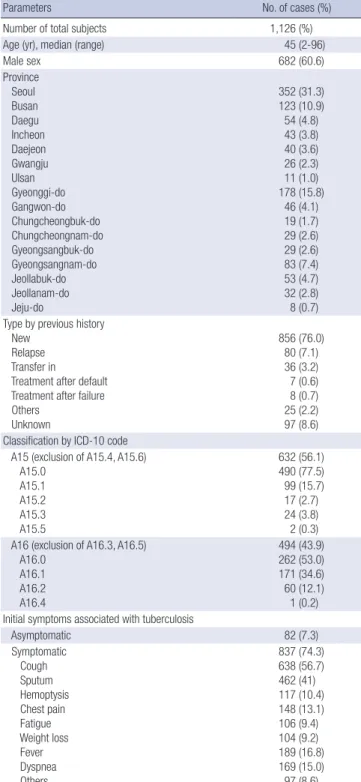
A total of 1,126 PTB patients from private sectors was includ- ed in the analysis as described above. The median age was 45 yr (range 2-96) and 60.6% of the patients were male. Baseline char- acteristics including type of cases, type of tuberculosis, ICD-10 code, clinical symptoms are summarized in Table 1. Six hun- dred and thirty-two (56.1%) patients were notified as laboratory diagnosed TB cases (A15), and 74.3% of them were symptom- atic with cough and sputum being the most common symp- toms.
Laboratory tests for the diagnosis of PTB performed in private sector are listed in Table 2. Sputum AFB smear was performed in approximately 80% of the patients and 42.5% of the notified PTB cases were smear positive. Sputum M. tuberculosis culture was verified in approximately half of the patients (51%) and 29%
of the total patients were M. tuberculosis culture positive. PCR (14.3%) or biopsy (3.6%) were performed in a relatively small number of PTB patients. Fifty-seven patients (5.1%) were exam- ined bronchoscopically and 49% (28 cases) showed positive re- sults (e.g. active caseating inflammation). Chest CT was performed in about a quarter of patients and a high positive result (83.5%) was reported. A simple chest radiograph was performed in the majority of the patients (71.1%) and ‘radiographically active PTB’
lesions were reported in 77%. The most commonly involved site of the lung was right upper lung field (31.7%). The left upper lung field was the next most commonly involved site (27.7%). A fol- low-up radiologic examination at least one month after the ini- tiation of anti-TB medication was assessed in 454 patients and 77.5% showed radiologic improvement. When the utilization of the diagnostic modalities by private sector scale was analyzed, the performance rates of all the diagnostic methods including AFB smear and culture, TB PCR, bronchoscopy, chest radiogra- phy and chest CT were lower in primary clinic compared to those of secondary and tertiary hospitals (Table 2). Definite TB, cate- gorized as a M. tuberculosis complex culture positive case, was observed in 28.9% (95% CI, 26.3%-31.5%) of the total patients.
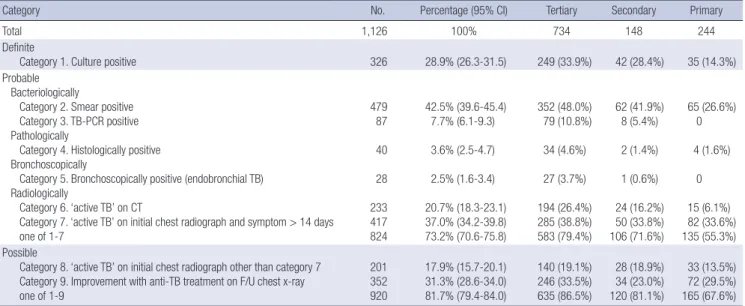
When the diagnostic criteria of TB was extended according to the proposed classification, definite and probable TB combined was 73.2% (95% CI, 70.6%-75.8%); and definite, probable, and possible TB combined was 81.7% (95% CI, 79.4%-84.0%) (Table 3). A detailed microbiological information of categories 5, 6, 7 is summarized in Table 4. When the analyses were limited to the patients who were notified as presumptive TB patients (PTB not confirmed bacteriologically or histologically; A16), definite case was observed in only one patient. Definite and probable TB cases were observed in 41.7% (95% CI, 37.4%-46.0%); and definite, probable, and possible TB cases were 60.1% (95% CI, 55.8%- 64.4%) of the total patients, respectively (Table 5).
A total of 206 cases did not meet the criteria of the proposed categories 1-9. Of these, 143 cases were treated with anti-TB medication for less than 30 days, 21 cases for 30 to 90 days, and 42 cases for longer than 90 days (34 patients were treated for longer than six months).
DISCUSSION
In this study, definite TB cases confirmed by culture of M. tuber- culosis complex (category 1, the current gold standard of diag- nosis of TB) were only 28.9% (95% CI, 26.3%-31.5%) of the total cases. The percentage of definite cases or bacteriologically, patho- logically or bronchoscopically probable TB cases (category 2-5) were 55.7% (95% CI, 52.8%-58.6%) of the total cases, and if radio- graphically positive TB cases (category 6-7) are also included, the percentage of the “definite or probable TB” cases became 73.2% of the total cases.
When possible cases were regarded as real TB (category 1-9), still the percentage of real TB was 81.7% (95% CI, 79.4%-84.0%), not 100%. Due to the nature of a retrospective study, the limita- tions concerning a lack of sufficient information despite an ex- tensive review of the medical records is encountered. The defi- nite number of cases that were not real TB among cases not in- cluded in Category 1-9 could not be determined. Therefore, the results should not be interpreted directly as ‘only 81.7% of the notified new PTB patients had real PTB’ or ‘approximately 20%
Table 1. Baseline characteristics
Parameters No. of cases (%)
Number of total subjects 1,126 (%)
Age (yr), median (range) 45 (2-96)
Male sex 682 (60.6)
Province Seoul Busan Daegu Incheon Daejeon Gwangju Ulsan Gyeonggi-do Gangwon-do Chungcheongbuk-do Chungcheongnam-do Gyeongsangbuk-do Gyeongsangnam-do Jeollabuk-do Jeollanam-do Jeju-do
352 (31.3) 123 (10.9) 54 (4.8) 43 (3.8) 40 (3.6) 26 (2.3) 11 (1.0) 178 (15.8)
46 (4.1) 19 (1.7) 29 (2.6) 29 (2.6) 83 (7.4) 53 (4.7) 32 (2.8) 8 (0.7) Type by previous history
New Relapse Transfer in
Treatment after default Treatment after failure Others
Unknown
856 (76.0)
80 (7.1) 36 (3.2) 7 (0.6) 8 (0.7) 25 (2.2) 97 (8.6) Classification by ICD-10 code
A15 (exclusion of A15.4, A15.6) A15.0
A15.1 A15.2 A15.3 A15.5
632 (56.1) 490 (77.5) 99 (15.7) 17 (2.7) 24 (3.8) 2 (0.3) A16 (exclusion of A16.3, A16.5)
A16.0 A16.1 A16.2 A16.4
494 (43.9) 262 (53.0) 171 (34.6) 60 (12.1) 1 (0.2) Initial symptoms associated with tuberculosis
Asymptomatic 82 (7.3)
Symptomatic Cough Sputum Hemoptysis Chest pain Fatigue Weight loss Fever Dyspnea Others
837 (74.3) 638 (56.7) 462 (41) 117 (10.4) 148 (13.1) 106 (9.4) 104 (9.2) 189 (16.8) 169 (15.0) 97 (8.6)
of the notified new PTB patients did not have TB’. However, the study suggests that some cases notified as PTB might not be real TB. In fact, 69% of 206 cases that were not included in categories 1-9 were treated with anti-TB medication for less than one month, which suggests that some may be cases with other than PTB, such as pneumonia. So far, most reports focused on underesti-
mation of TB by the notification system and emphasized the im- portance of notification (10, 17, 18). On the contrary, this study may suggests the possibility of overestimation of tuberculosis.
It is possible that the microbiological tests are not performed sufficiently when physicians diagnose a case as PTB in Korea, which could lead to overdiagnosis. Although WHO recommends Table 2. The test modality and yield for diagnosis of tuberculosis that performed in private sector of Korea classified by scale of private hospital (n = 1,126)
Diagnosis by Total No. (%) Tertiary (n = 734) Secondary (n = 148) Primary (n = 244)
Sputum AFB smear
Uncertain 98 (8.7) 53 (7.2%) 12 (8.1%) 33 (13.5%)
Not done 137 (12.2) 56 (7.6%) 17 (11.5%) 64 (26.2%)
Done One time More than two times Unknown times
891 (79.1) 135 (12.0) 398 (35.3) 358 (31.8)
625 (85.1%) 99 (13.5%) 298 (40.6%) 228 (31.1%)
119 (80.4%) 17 (11.5%) 49 (33.1%) 53 (35.8%)
147 (60.2%) 19 (7.8%) 51 (20.9%) 77 (31.6%)
Positive results 479 (42.5) 352 (48.0%) 62 (41.9%) 65 (26.6%)
Sputum M. tuberculosis culture Uncertain
Not done Done Positive results
203 (18.0) 349 (31.9) 574 (51.0) 326 (29.0)
131 (17.8%) 171 (23.3%) 432 (58.9%) 249 (33.9%)
23 (15.5%) 46 (31.1%) 79 (53.4%) 42 (28.4%)
49 (20.1%) 132 (54.1%) 63 (25.8%) 35 (14.3%) PCR
Uncertain or not done Done
Positive results
965 (85.7) 161 (14.3) 87 (7.7)
594 (80.9%) 140 (19.1%) 79 (10.8%)
131 (88.5%) 17 (11.5%) 8 (5.7%)
240 (98.4%) 4 (1.6%)
0 Biopsy
Unknown or not done Done
Positive results
1,063 (94.4) 63 (5.6) 40 (3.6)
680 (92.6%) 54 (7.4%) 34 (4.6%)
145 (98.0%) 3 (2.0%) 2 (1.4%)
238 (97.5%) 6 (2.5%) 4 (1.6%) Bronchoscopy
Unknown or not done Done
Positive results
1,069 (94.9) 57 (5.1) 28 (2.5)
680 (92.6%) 54 (7.4%) 27 (3.7%)
146 (98.6%)
2 (1.4%) 1 (0.7%)
243 (99.6%) 1 (0.4%)
0 Chest CT
Uncertain or not done 850 (75.5) 502 (68.4%) 123 (83.1%) 225 (92.2%)
Done Active TB
Indeterminate activity Old TB
Other disease Normal chest CT
276 (24.5) 233 (84.4) 29 (10.5) 9 (3.2) 3 (1.1) 2 (0.7)
232 (31.6%) 194 (83.6%) 26 (11.2%) 9 (3.9%) 3 (1.3%)
0
25 (16.9%) 24 (96.0%) 1 (4.0%)
0 0 0
19 (7.8%) 15 (78.9%)
2 (10.5%) 0 0 2 (10.5%) Chest radiography
Uncertain Not done Done
266 (23.6) 59 (5.2) 801 (71.1)
139 (18.9%) 39 (5.3%) 556 (75.7%)
45 (30.4%) 7 (4.7%) 96 (64.9%)
82 (33.6%) 13 (5.3%) 149 (61.1%) Location
Right upper lung Right middle lung Right lower lung Left upper lung Left lower lung Multilobar involvement
357 (31.7) 122 (10.8) 125 (11.1) 312 (27.7) 103 (9.1) 224 (19.9)
247 (33.7%) 93 (12.7%) 101 (13.8%) 216 (29.4%) 76 (10.4%) 165 (18.4%)
41 (27.7%) 11 (7.4%) 15 (10.1%) 34 (23.0%) 12 (8.1%) 23 (15.5%)
69 (28.3%) 18 (7.4%)
9 (3.7%) 62 (25.4%) 15 (6.1%) 36 (14.8%) Pattern (n = 801)
Compatible with active pulmonary TB*
Indeterminate activity:Consolidation without nodule Old TB
Pleural effusion without lung lesion Other disease
Normal chest radiograph
618 (54.9) 109 (9.7)
25 (2.2) 22 (2.6) 16 (1.4) 11 (1.0)
425 (57.9%) 69 (9.4%) 21 (2.9%) 20 (2.7%) 13 (1.8%) 8 (1.1%)
78 (52.7%) 13 (8.8%)
3 (2.0%) 0 2 (1.4%)
0
115 (47.1%) 27 (11.1%) 1 (0.4%) 2 (0.8%) 1 (0.4%) 3 (1.2%) Radiological improvement after anti-TB treatment† (n = 454) 352 (31.3) 246 (33.5%) 34 (23.0%) 72 (29.5%)
*Cases with a cavity, multiple nodules, or consolidation; †Assessed at least one month after anti-TB treatment. AFB, acid fast bacilli; PCR, polymerase chain reaction; CT, com- puterized tomography; TB, tuberculosis.
that patients suspected of having TB should have appropriate specimens collected for smear and culture for M. tuberculosis (19), smear-positive patients were 42.5% among the new PTB cases in our study, which is lower to some degree than that of global epidemiology data that showed smear-positive rate of ap- proximately 57% in 2008 (1). It may be due to the fact that spu- tum test is less requested in Korea than in other countries in sub- stantial number of patients with suspected TB. Sputum smear and culture test results for M. tuberculosis could be verified only in 79% and 51% of cases, respectively, in our study. It is possible that the physicians did not request sputum tests or have request- ed sputum smears only without culture. According to a Korean study performed at a tertiary hospital, the initial sputum exami- nations were not performed at the time of diagnosis of PTB in 20% of patients which was similar to our results (Table 2) (20).
The guidelines for TB management in Korea published in 2004 recommended doctors to collect two sputum specimens for AFB smear and at least one for culture from cases that are sus-
pected to have PTB (suspicious findings on chest radiographs or suspicious symptoms of PTB) in the diagnosis of PTB (21). In our study, we verified sputum culture results in 51% and requests of two or more sputum AFB smear tests in 35.3% of total patients.
The rates are obviously lower than those of public sectors. In 2004 (the same year of our study), the request rate of AFB smear ( = [total count of requested AFB smear tests] ÷ [total number of registered PTB cases× 2]) was 95% and that of culture in pub- lic health care centers was 98%.
One of the possible explanations for the lack of adherence to the national guideline in the diagnosis of PTB is the capacity
Table 3. Diagnosis of pulmonary TB by categories classified by scale of private hospitals
Category No. Percentage (95% CI) Tertiary Secondary Primary
Total 1,126 100% 734 148 244
Definite
Category 1. Culture positive 326 28.9% (26.3-31.5) 249 (33.9%) 42 (28.4%) 35 (14.3%)
Probable Bacteriologically
Category 2. Smear positive Category 3. TB-PCR positive Pathologically
Category 4. Histologically positive Bronchoscopically
Category 5. Bronchoscopically positive (endobronchial TB) Radiologically
Category 6. ‘active TB’ on CT
Category 7. ‘active TB’ on initial chest radiograph and symptom > 14 days one of 1-7
479 87 40 28 233 417 824
42.5% (39.6-45.4) 7.7% (6.1-9.3) 3.6% (2.5-4.7) 2.5% (1.6-3.4) 20.7% (18.3-23.1) 37.0% (34.2-39.8) 73.2% (70.6-75.8)
352 (48.0%) 79 (10.8%) 34 (4.6%) 27 (3.7%) 194 (26.4%) 285 (38.8%) 583 (79.4%)
62 (41.9%) 8 (5.4%) 2 (1.4%) 1 (0.6%) 24 (16.2%) 50 (33.8%) 106 (71.6%)
65 (26.6%) 0 4 (1.6%)
0 15 (6.1%) 82 (33.6%) 135 (55.3%) Possible
Category 8. ‘active TB’ on initial chest radiograph other than category 7 Category 9. Improvement with anti-TB treatment on F/U chest x-ray one of 1-9
201 352 920
17.9% (15.7-20.1) 31.3% (28.6-34.0) 81.7% (79.4-84.0)
140 (19.1%) 246 (33.5%) 635 (86.5%)
28 (18.9%) 34 (23.0%) 120 (81.1%)
33 (13.5%) 72 (29.5%) 165 (67.6%) Table 4. Smear requests and positivity of bronchoscopically and radiographically diag- nosed pulmonary tuberculosis
Category Smear positive Culture positive
Category 5 (n = 28) 16/23 (69.6%) 13/18 (72.2%) Category 6 (n = 233) 95/188 (50.5%) 67/127 (52.8%) Category 7 (n = 417) 237/347 (68.3%) 165/238 (69.3%)
Table 5. Diagnosis of laboratory undiagnosed pulmonary TB (A16.0-2,4)
Category No. Percentage (95% CI)
Total 494 100%
Definite
Category 1. Culture positive
1/151
0.2% (0-0.6) Probable
Category 2. Smear positive Category 3. TB-PCR positive Category 4. Histologically positive Category 5. Bronchoscopically positive Category 6. ‘active TB’ on CT
Category 7. ‘active TB’ on chest radiograph AND symptom > 14 days one of 1-7
1/241
7/53 2/16 3/19 100/119 128/318
206
0.2% (0-0.6) 1.4% (0.4-2.5) 0.4% (0-1.0) 0.6% (0-1.3) 20.2% (16.7-23.8) 25.9% (22.0-29.8) 41.7% (37.4-46.0) Possible
Category 8. ‘active TB’ on initial chest radiograph other than category 7 Category 9. Improvement with anti-TB treatment on F/U chest radiograph one of 1-9
94 131 297
19.0% (15.6-22.5) 26.5% (22.6-30.4) 60.1% (55.8-64.4)
for sputum tests. Secondary and tertiary hospitals of Korea are equipped with laboratories where mycobacterial tests can be performed, while the majority of primary clinics are not. There- fore private physicians in the primary clinics must send the spec- imen to commercial or public health laboratories (e.g. public health care center or laboratories of Korean National Tubercu- losis Association) for microbiological tests (specifically, the cul- ture) which is cumbersome and requires a relatively longer pe- riod for acquiring the results. Our data suggest that primary clinics rather than secondary or tertiary hospitals are less likely to perform sufficient microbiological tests (Tables 2, 3). Howev- er, the exact percentage or number of physicians using the hos- pital, commercial and public labs are unknown.
The low adherence to the national guideline in the diagnosis of TB in Korea calls for a continuing medical education and a greater role of the public health organization. In Korea, PPM- DOTS (public-private mix for directly observed therapy, short course) have been introduced to large scale private sectors re- cently, which could encourage physicians to adhere to the na- tional guideline as public sectors. Such national services pro- vided and organized in primary clinics may prove beneficial to primary physicians. If the accessibility to public laboratories improves, the diagnosis based on microbiology in private sec- tors will also become more reliable.
The lack of proper microbiological tests may lead to overdiag- nosis of TB. In the absence of positive sputum AFB smears, most cases of PTB are diagnosed on the basis of clinical findings which depend heavily on the findings of chest radiographs (22). How- ever, some limitations exist: 1) inter-observer variability in in- terpretation of chest radiographs (23); 2) difficulty in differenti- ation of pneumonia from PTB (24) since it shows clinical and radiological response with rifampicin (25, 26); 3) an inexperi- enced physician in TB contributing to lower TB prevalence rate and lower diagnostic accuracy of chest radiographs (27-30); 4) Difficulty in differentiation from non-tuberculous mycobacteria (NTM) lung diseases which have been increasing in Korea (31).
In this study, the assessment of the diagnostic validity of PTB using chest radiograph at diagnosis and follow-up chest radio- graph after at least one month of anti-tuberculosis treatment was performed. The diagnosis of TB can be strongly inferred by the clinical and radiographic response to anti-TB treatment (19).
The cases with a cavity, multiple nodules or consolidation in ini- tial chest radiograph were regarded as ‘compatible with active PTB (category 8)’ in our study, and comprised only 54.9% (95%
CI, 52.0%-57.8%) (33-36). However, 77.5% of the 454 cases with follow-up chest radiographs showed radiographic response (cat- egory 9). This suggests that a large number of cases whose initial chest radiographs revealed atypical findings of TB and showed improvement spontaneously or with a rifampicin-including anti- TB regimen may be of other lung diseases such as pneumonia.
A variety of diagnostic modalities are utilized to diagnose TB
in private sectors of Korea where medical resources and labora- tory services are more advanced and easily accessible than those of other developing countries. The advanced diagnostic modal- ities contribute to more accurate diagnosis of TB. For example, chest CT is more sensitive than chest radiography in the detec- tion of PTB. According to a study that compared chest CT with chest radiograph, the radiographic diagnosis of TB was initially correct in only 49% of all tuberculosis cases, while CT diagnosis of PTB was correct in 91% (36). Because the definitive diagnosis still requires an isolation and identification of M. tuberculosis complex in a clinical specimen, invasive procedures such as bronchoscopy with washing or biopsy may help in the diagno- sis of TB. In addition, use of polymerase chain reaction (PCR) detection of bacterial DNA is increasing recently in the diagno- sis of TB. Although performance frequency of PCR was relative- ly low (14.3%), half of the patients showed positive PCR results in the present study.
Some limitations exist due to the retrospective nature of the study as mentioned above. The missing data may affect the re- sult. Chest radiography reports were found only in 71.1% of the patients, and chest radiograph was not performed in 5.2% of the notified PTB patients. Although the cases with an unknown sta- tus of chest radiograph were 23.6%, the imaging was probably performed in most of those cases and assessed by clinicians with- out the official reports of the radiologists. Patients who showed active TB in initial chest radiographs or improvement in the fol- low-up chest radiographs were approximately 62% of the total cases (n = 695). Of the 247 cases in which whether chest radio- graphs were performed or not is ‘uncertain’, 130 cases were clas- sified into categories 1-9. Assuming that 62% of the remaining 117 cases also meet the criteria for radiological TB, then addi- tional 72 possible cases (6.4% of the total of 1,126 cases) may be added. Since the records of other diagnostic tests such as PCR, histology, or bronchoscopy mostly remained unknown, most of the tests of unknown status may have been categorized as ‘not performed’ examination. Although the TB data from the year 2004 were analyzed in this study, it is difficult to conclude that it directly reflects the present clinical situation.
In conclusion, in 2004, the private sectors in Korea utilized various laboratory tests in diagnosis of PTB and more than 70%
of the notified PTB cases were ‘real TB’. The results may suggest the possibility of over-estimation of TB burden with the use of the notification-based TB data.
REFERENCES
1. World Health Organization. Global tuberculosis control: a short update to the 2009 report. Geneva: World Health Organization, 2009.
2. Dye C, Scheele S, Dolin P, Pathania V, Raviglione MC. Consensus state- ment. Global burden of tuberculosis: estimated incidence, prevalence, and mortality by country. WHO Global Surveillance and Monitoring
Project. JAMA 1999; 282: 677-86.
3. Ministry of Health and Welfare and Korean National Tuberculosis Asso- ciation. Report on the 7th tuberculosis prevalence survey in Korea. Seoul:
Ministry of Health and Welfare and Korean National Tuberculosis Asso- ciation, 1995.
4. Hong YP, Kim SJ, Lew WJ, Lee EK, Han YC. The seventh nationwide tu- berculosis prevalence survey in Korea, 1995. Int J Tuberc Lung Dis 1998;
2: 27-36.
5. Lew WJ, Lee EG, Bai JY, Kim HJ, Bai GH, Ahn DI, Lee JK, Kim SJ. An in- ternet-based surveillance system for tuberculosis in Korea. Int J Tuberc Lung Dis 2006; 10: 1241-7.
6. World Health Organization. Global tuberculosis control: surveillance, planning, financing. Geneva: World Health Organization, 2003.
7. Pillaye J, Clarke A. An evaluation of completeness of tuberculosis notifi- cation in the United Kingdom. BMC Public Health 2003; 3: 31.
8. EuroTB and the National Coordinators for Tuberculosis Surveillance in the WHO. European Region. Surveillance of tuberculosis in Europe. Re- port on tuberculosis cases notified in 2006. Saint-Maurice: Institut de Veille Sanitaire, 2006.
9. Heo E, Oh SY, Jeong I, Lee JS, Lim HJ, Park YS, Lee JW, Han SK, Lee CH.
The diagnostic accuracy of notified new culture-negative pulmonary tuber- culosis patients in public healthcare centers. Korean J Med 2009; 76: 44-51.
10. Jelastopulu E, Alexopoulos EC, Venieri D, Tsiros G, Komninou G, Con- stantinidis TC, Chrysanthopoulos K. Substantial underreporting of tu- berculosis in West Greece: implications for local and national surveillance.
Euro Surveill 2009; 14: 19152.
11. Baussano I, Bugiani M, Gregori D, van Hest R, Borraccino A, Raso R, Merletti F. Undetected burden of tuberculosis in a low-prevalence area.
Int J Tuberc Lung Dis 2006; 10: 415-21.
12. Cojocaru C, van Hest NA, Mihaescu T, Davies PD. Completeness of noti- fication of adult tuberculosis in Iasi County, Romania: a capture-recap- ture analysis. Int J Tuberc Lung Dis 2009; 13: 1094-9.
13. Sheldon CD, King K, Cock H, Wilkinson P, Barnes NC. Notification of tu- berculosis: how many cases are never reported? Thorax 1992; 47: 1015-8.
14. Kim CH, Koh WJ, Kwon OJ, Ahn YM, Lim SY, An CH, Youn JW, Hwang JH, Suh GY, Chung MP, et al. The accuracy of tuberculosis notification reports at a private general hospital after enforcement of new Korean tu- berculosis surveillance system. Tuberc Respir Dis 2003; 54: 178-90.
15. World Health Organization; International Union Against Tuberculosis and Lung Disease; Royal Netherlands Tuberculosis Association. Revised international definitions in tuberculosis control. Int J Tuberc Lung Dis 2001; 5: 213-5.
16. World Health Organization. International statistical classification of dis- eases and related health problems: 10th revision. Geneva: World Health Organization, 2008.
17. Migliori GB, Spanevello A, Ballardini L, Neri M, Gambarini C, Moro ML, Trnka L, Raviglione MC. Validation of the surveillance system for new cases of tuberculosis in a province of northern Italy. Varese Tuberculosis Study Group. Eur Respir J 1995; 8: 1252-8.
18. Rieder HL, Watson JM, Raviglione MC, Forssbohm M, Migliori GB, Schwoebel V, Leitch AG, Zellweger JP. Surveillance of tuberculosis in Europe. Working Group of the World Health Organization (WHO) and the European Region of the International Union Against Tuberculosis and Lung Disease (IUATLD) for uniform reporting on tuberculosis cases.
Eur Respir J 1996; 9: 1097-104.
19. American Thoracic Society; CDC; Infectious Diseases Society of Amer- ica. Treatment of tuberculosis. MMWR Recomm Rep 2003; 52: 1-77.
20. Koh WJ, Kwon OJ, Kim CH, Ahn YM, Lim SY, Yun JW, Hwang JH, Suh GY, Chung MP, Kim H, et al. Clinical characteristics and treatments out- comes of patients of pulmonary tuberculosis at a private general hospi- tal. Tuberc Respir Dis 2003; 55: 154-64.
21. Korea Center for Disease Control and Prevention. The guideline of TB management. 2004.
22. Siddiqi K, Lambert ML, Walley J. Clinical diagnosis of smear-negative pulmonary tuberculosis in low-income countries: the current evidence.
Lancet Infect Dis 2003; 3: 288-96.
23. Balabanova Y, Coker R, Fedorin I, Zakharova S, Plavinskij S, Krukov N, Atun R, Drobniewski F. Variability in interpretation of chest radiographs among Russian clinicians and implications for screening programmes:
observational study. BMJ 2005; 331: 379-82.
24. Schlossberg D. Acute tuberculosis. Infect Dis Clin North Am 2010; 24:
139-46.
25. Korvick JA, Peacock JE Jr, Muder RR, Wheeler RR, Yu VL. Addition of rifampin to combination antibiotic therapy for Pseudomonas aeruginosa bacteremia: prospective trial using the Zelen protocol. Antimicrob Agents Chemother 1992; 36: 620-5.
26. Sharma A, Shariff M, Thukral SS, Shah A. Chronic community-acquired Acinetobacter pneumonia that responded slowly to rifampicin in the anti- tuberculous regime. J Infect 2005; 51: e149-52.
27. Catanzaro A, Perry S, Clarridge JE, Dunbar S, Goodnight-White S, LoBue PA, Peter C, Pfyffer GE, Sierra MF, et al. The role of clinical suspicion in evaluating a new diagnostic test for active tuberculosis: results of a mul- ticenter prospective trial. JAMA 2000; 283: 639-45.
28. Llewellyn H. The effect of disease prevalence on positive predictive value:
a simple model. Cytopathology 2006; 17: 101-3.
29. Schulman KA, Escarce JJ, Eisenberg JM, Hershey JC, Young MJ, McCar- thy DM, Williams SV. Assessing physicians’ estimates of the probability of coronary artery disease: the influence of patient characteristics. Med Decis Making 1992; 12: 109-14.
30. Lee S. Clinical epidemiology. In: Yoo S, editor. Seoul: Gyechook Publisher, 2004, p 141-59.
31. Jeon K, Koh WJ, Kwon OJ, Suh GY, Chung MP, Kim H, Lee NY, Park YK, Bai GH. Recovery rate of NTM from AFB smear-positive sputum speci- mens at a medical centre in South Korea. Int J Tuberc Lung Dis 2005; 9:
1046-51.
32. Scott B, Schmid M, Nettleman MD. Early identification and isolation of inpatients at high risk for tuberculosis. Arch Intern Med 1994; 154: 326-30.
33. Tattevin P, Casalino E, Fleury L, Egmann G, Ruel M, Bouvet E. The valid- ity of medical history, classic symptoms, and chest radiographs in pre- dicting pulmonary tuberculosis: derivation of a pulmonary tuberculosis prediction model. Chest 1999; 115: 1248-53.
34. Kanaya AM, Glidden DV, Chambers HF. Identifying pulmonary tuber- culosis in patients with negative sputum smear results. Chest 2001; 120:
349-55.
35. Bah B, Massari V, Sow O, Siriwardana M, Camara LM, Larouzé B, Murray JF. Useful clues to the presence of smear-negative pulmonary tuberculosis in a West African city. Int J Tuberc Lung Dis 2002; 6: 592-8.
36. Lee KS, Hwang JW, Chung MP, Kim H, Kwon OJ. Utility of CT in the eval- uation of pulmonary tuberculosis in patients without AIDS. Chest 1996;
110: 977-84.