Bayes tests of independence for contingency tables from small areas
Aejung Jo 1 · Dal Ho Kim 2
12 Department of Statistics, Kyungpook National University
Received 9 October 2016, revised 30 October 2016, accepted 1 November 2016
Abstract
In this paper we study pooling effects in Bayesian testing procedures of indepen- dence for contingency tables from small areas. In small area estimation setup, we typi- cally use a hierarchical Bayesian model for borrowing strength across small areas. This techniques of borrowing strength in small area estimation is used to construct a Bayes test of independence for contingency tables from small areas. In specific, we consider the methods of direct or indirect pooling in multinomial models through Dirichlet pri- ors. We use the Bayes factor (or equivalently the ratio of the marginal likelihoods) to construct the Bayes test, and the marginal density is obtained by integrating the joint density function over all parameters. The Bayes test is computed by performing a Monte Carlo integration based on the method proposed by Nandram and Kim (2002).
Keywords: Bayes factor, Dirichlet priors, Gibbs sampler, pooling, small areas.
1. Introduction
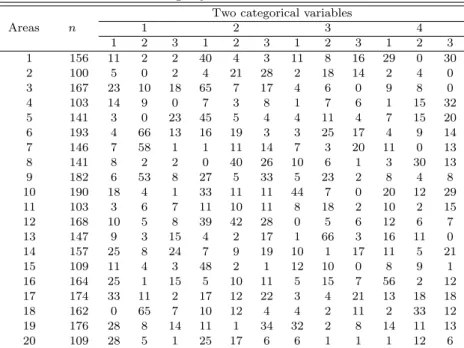
In many surveys, there are several small areas and a contingency table is constructed for each area. We consider a hierarchical Dirichlet-multinomial model to analyze the counts from these small areas. Our concern is to perform a test of independence which is competitive to the chi-square test for a single table. We follow a Bayesian inferential procedure so that appropriate priors are needed.
Statistical inference for small areas requires considerable care because the sample sizes for small areas are usually very small. To solve this problem, we use a hierarchical model which is to borrow strength some information from the neighboring areas. In this paper, we use the hierarchical Bayesian model to study the pooling effects in Bayesian tests of independence for contingency tables from small areas.
There are several literatures on methods for pooling of data. Malec and Sedransk (1992) developed a Bayesian procedure for estimation of the means for the specified experiments among a set of seemingly similar experiments. The proposed flexible prior distribution allows the intensity and nature of the pooling to be influenced by the sample data. Evans and Sedransk (1999) proposed an alternative Bayesian model with covariates that is more flexible.
1
Ph.D. candidate, Department of Statistics, Kyungpook National University, Daegu 702-701, Korea
2
Corresponding author: Professor, Department of Statistics, Kyungpook National University, Daegu
702-701, Korea. E-mail: [email protected]
Evans and Sedransk (2003) provided a fully Bayesian justification for the results in Malec and Sedransk.
There is a wide literature on Bayesian methods for analyzing data with contingency ta- bles. Agresti and Hitchcock (2005) surveyed Bayesian methods for categorical data analysis, with emphasis on contingency table analysis. The general concern with hierarchical Bayesian approach to contingency table analysis is how to handle the hyperparameters. In Dirichlet- multinomial model, Leonard (1977) made approximations when deriving the posterior to account for hyperparameter uncertainty. By contrast, Nandram (1998) used the Metropolis- Hastings algorithm to sample from the posterior distribution, rendering Leonard’s approx- imation unnecessary. Recently hierarchical Bayesian models in the contingency tables from small areas with nonresponses have been studied in Woo and Kim (2015, 2016).
In this paper, we will construct Bayesian tests of independence using a hierarchical multi- nomial model with Dirichlet priors. We will investigate the pooling effects in Bayes factors through the three different types of pooling strategies for Dirichlet priors; no pooling, com- plete pooling and adaptive pooling. In Section 2, we introduce the hierarchical Bayesian models under the three different types of pooling strategies for the test of independence.
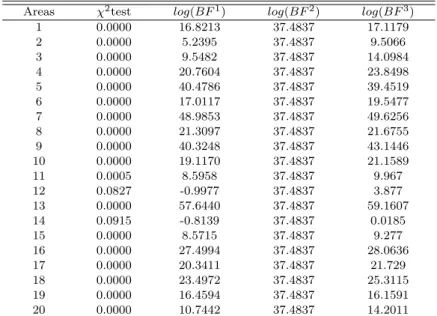
Then we obtain the corresponding three Bayes factors using the marginal likelihoods. In Section 3, we present the results of numerical study with some simulated data. Finally, we provide some discussion and concluding remarks in Section 4.
2. Hierarchical Bayesian models
2.1. General models
For the sth area of S small areas, we consider the r × c contingency tables with cell counts, n sjk , which are the responses for the kth column and jth row in the sth area. Let π sjk denote the corresponding probabilities of each unit cell in the sth area. When p sj and q sk are marginal probabilities for each column and each row in the sth area, the independence models have π sjk = p sj q sk , j = 1, · · · , r, k = 1, · · · , c, where P r
j=1 p sj = 1 and P c
k=1 p sk = 1 for s = 1, · · · , S. Let n si , i = 1, · · · , I (= rc) denote the cell counts for the sth area and π si denote the corresponding probabilities of each area. We assume that
n s |π s ind ∼ Multinimial(n s , π s ), s = 1, · · · , S (2.1) where n s = (n s1 , · · · , n sI ) for s = 1, · · · , S is the vector of responses with n s = P I
i=1 n si , total sum of responses, and π s = (π s1 , · · · , π sI ) is the corresponding probability vector of each area with P I
i=1 π si = 1. Here I is denoted by the number of cells for the table corresponding to each area.
Now we consider three types of pooling strategies for the general model (2.1).
1) No pooling, π s
iid ∼ Dirichlet(1), s = 1, · · · , S;
2) Complete pooling, ˜ π ∼ Dirichlet(1) with π 1 = · · · = π S = ˜ π;
3) Adaptive pooling, π s
iid ∼ Dirichlet(µτ ), where µ = (µ 1 , · · · , µ K ), 0 ≤ µ k ≤ 1, P K
k=1 µ k = 1 and τ > 0 are hyperparameters
for Dirichlet distribution and are assumed to have the noninformative and proper prior
π(µ, τ ) = (K − 1)!/(1 + τ ) 2 . This prior is very similar to a half-Cauchy prior and can pre- vent overestimation of scale parameters from our models. Recall that x|µ, τ ∼ Dirichlet(µτ ) has the density f (x|µ, τ ) = Q k
i=1 x µ i
iτ −1 /D(µτ ), 0 < x i < 1, P k
i=1 x i = 1 where D(µτ ) = Q k
i=1 Γ(µ i τ )/Γ(τ ), 0 < µ i < 1, τ > 0, is the Dirichlet function, also known as the multivari- ate Beta function.
Under no pooling, the joint density function for all variables is
π(n, π) =
S
Y
s=1
{f (n s |π s )π(π s )} =
S
Y
s=1
n n s ! Q I
i=1 n si !
I
Y
i=1
π si n
si(I − 1)! o ,
where n = (n 1 , · · · , n S ) and π = (π 1 , · · · , π S ). In no pooling, we could not obtain any information from prior distribution. For the marginal likelihood, we can use the posterior density of π s given n s ,
π s | n s
ind ∼ Dirichlet(n s + 1), s = 1, · · · , S.
So we obtain the marginal likelihood for the sth area,
f (n s ) = n s !(I − 1)!
Q I i=1 n si !
Q I
i=1 Γ(n si + 1) Γ( P I
i=1 n si + I) . Under complete pooling, the joint density function is
π(n, ˜ π) =
S
Y
s=1
{f (n s | ˜ π)}π( ˜ π) =
S
Y
s=1
n n s ! Q I
i=1 n si !
I
Y
i=1
˜ π n i
sio
(I − 1)!
where ˜ π = (˜ π 1 , · · · , ˜ π I ). The parameter ˜ π is shared by the data in entire areas. Then we can calculate the marginal likelihood using the posterior density of ˜ π which is the Dirichlet distribution with parameter P S
s=1 n s + 1. Our marginal likelihood under complete-pooling is
f (n) = Q S
s=1 n s !(I − 1)!
Q S s=1
Q I i=1 n si !
Q S s=1
Q I
i=1 Γ(n si + 1) Γ( P S
s=1
P I
i=1 n si + I) where Γ(t) = R ∞
0 x t−1 e −x dx is the gamma function. In complete pooling, the data are tied by interested parameter ˜ π, so our marginal likelihood for entire areas is expressed in just one equation. The idea of complete-pooling can be a contrast to no-pooling case.
Under adaptive pooling, the joint density function for all variables is
π(n, π, µ, τ ) =
S
Y
s=1
n n s ! Q I
i=1 n si !
I
Y
i=1
π si n
si1 D(µτ )
I
Y
i=1
π si µ
iτ −1 o (I − 1)!
(1 + τ ) 2 .
Here we need to know the posteriors for all parameters to be integrated out in the joint density function. The posterior density of π s , s = 1 · · · , S under adaptive-pooling is
π s | n s , µ, τ ind ∼ Dirichlet(n s + µτ ), s = 1, · · · , S;
π(µ, τ | n) ∝
S
Y
s=1
n Y I
i=1
D(n s + µτ ) D(µτ )
o 1
(1 + τ ) 2 .
Each area has separate parameter vector π s for s = 1, · · · , S. However, the data in all areas is indirectly pooled by hyper-parameters µ and τ . Using these posteriors, we obtain the marginal likelihood
f (n s ) = (I − 1)!n s ! Q I
i=1 n si ! Z
µ Z
τ
D(µτ + n s )
D(µτ )(1 + τ ) 2 dµdτ, s = 1 · · · , S.
For the computation of this marginal likelihood, we can use the method developed by Nan- dram and Kim (2002). They use an importance function which exploits the multiplication rule of probability, and is appropriate for any hierarchical model.
2.2. Independence models
Let n sjk , j = 1, · · · , r, k = 1, · · · , c, be the cell counts for jth row and kth column in sth area, s = 1, · · · , S with corresponding cell probability π sjk = p sj q sk where p sj = P c
k=1 π sjk
and q sk = P r
j=1 π sjk . We assume that
n s |p s , q s ind ∼ Multinomial(n s , vec(p s q 0 s )), s = 1, . . . , S (2.2) where n s = (n s11 , · · · , n s1c , · · · , n sr1 , · · · , n src ), n s = P r
j=1
P c
k=1 n sjk , p s = (p s1 , · · · , p sr ), q s = (q s1 , · · · , q sc ), P r
j=1 p sj = 1, and P c
k=1 q sk = 1.
For the independence model (2.2), we consider no pooling p s iid ∼ Dirichlet(1 p );
q s iid ∼ Dirichlet(1 q ).
Under no pooling, the joint density function for all variables is π(n s , p s , q s ) = n s !
Q r j=1
Q c
k=1 n sjk !
r
Y
j=1 c
Y
k=1
(p sj q sk ) n
sjk(r − 1)!(c − 1)!, s = 1, . . . , S.
Then the marginal likelihood for the sth area is f (n s ) = (r − 1)!(c − 1)! n s !
Q r j=1
Q c
k=1 n sjk ! Z
p
sr
Y
j=1
p n sj
sjkdp s Z
q
sc
Y
k=1
q sk n
sjkdq s .
Using the posterior distributions,
p s | n (1) s ind ∼ Dirichlet(n (1) s + 1) and q s | n (2) s ind ∼ Dirichlet(n (2) s + 1), where n (1) s = (n (1) s1 , · · · , n (1) sr ), n (1) sj = P c
k=1 n sjk , j = 1, · · · , r, n (2) s = (n (2) s1 , · · · , n (2) sc ), n (2) sk = P r
j=1 n sjk , k = 1, · · · , c, we obtain the marginal likelihood f (n s ) = (r − 1)!(c − 1)! n s !
Q r j=1
Q c
k=1 n sjk ! Q r
j=1 Γ(n (1) sj + 1) Q c
k=1 Γ(n (2) sk + 1) Γ( P r
j=1 n (1) sj + r)Γ( P c
k=1 n (2) sk + c)
.
Under no pooling, the Bayes factor (BF) of the general model versus the independence model for the sth area is
BF s 1 = (rc − 1)! Q r j=1
Q c
k=1 Γ(n sjk + 1)Γ( P r
j=1 n (1) sj + r)Γ( P c
k=1 n (2) sk + c) (r − 1)!(c − 1)!Γ( P r
j=1
P c
k=1 n sjk + I) Q r
j=1 Γ(n (1) sj + 1) Q c
k=1 Γ(n (2) sk + 1) .
Next, we consider complete pooling for the independence model, p 1 = · · · = p S = p ∼ Dirichlet(1 p );
q 1 = · · · = q S = q ∼ Dirichlet(1 q ),
where p = (p 1 , · · · , p r ), q = (q 1 , · · · , q c ). Under complete pooling, the joint density function for all variables is
π(n, p, q) =
S
Y
s=1
n s ! Q r
j=1
Q c
k=1 n sjk !
r
Y
j=1 c
Y
k=1
(p j q k ) n
sjk(r − 1)!(c − 1)!, s = 1, . . . , S.
Then the marginal likelihood is
f (n) = Z
p Z
q
S
Y
s=1
n s ! Q r
j=1
Q c
k=1 n sjk !
r
Y
j=1 c
Y
k=1
(p j q k ) n
sjk(r − 1)!(c − 1)!dpdq.
Using the posterior distributions,
p | n (1) ∼ Dirichlet(
S
X
s=1
n (1) s + 1) and q | n (2) ∼ Dirichlet(
S
X
s=1
n (2) s + 1),
where n (1) = (n (1) 1 , · · · , n (1) S ), n (1) s = P c
k=1 n sjk , n (2) = (n (2) 1 , · · · , n (2) S ), n (2) s = P r
j=1 n sjk , we have the marginal density as follows.
f (n) = (r − 1)!(c − 1)! Q S s=1 s s ! Q S
s=1
Q r j=1
Q c
k=1 n sjk ! Q r
j=1 Γ( P S
s=1 n (1) sj + 1) Q c
k=1 Γ( P S
s=1 n (2) sk + 1) Γ( P r
j=1
P S
s=1 n (1) sj + r)Γ( P c k=1
P S
s=1 n (2) sk + c) .
Under complete-pooling, we obtain the Bayes factor of the general model versus the inde- pendence model for all areas,
BF 2 = (rc − 1)! Q S s=1
Q I
i=1 Γ(n si + 1)Γ( P r j=1
P S
s=1 n (1) sj + r)Γ( P c k=1
P S
s=1 n (2) sk + c) (r −1)!(c −1)!Γ( P S
s=1
P I
i=1 n si +I) Q r
j=1 Γ( P S
s=1 n (1) sj +1) Q c
k=1 Γ( P S
s=1 n (2) sk +1) ,
where n (1) sj = P c
k=1 n sjk , n (2) sk = P r
j=1 n sjk . This Bayes factor is the same for all areas. It means that the all areas are regarded as strata with same characteristics in one grand area.
Under two pooling strategies, the Bayes factors are too much influenced by observed sample
data because the priors are noninformative. To complement this concern, we consider the
hierarchical Bayesian model under adaptive-pooling. In specific, adaptive pooling for the
independence model is given by
p s iid ∼ Dirichlet(µ 1 , τ 1 );
q s iid ∼ Dirichlet(µ 2 , τ 2 );
π(µ 1 , τ 1 ) = (r − 1)!
(τ 1 + 1) 2 , π(µ 2 , τ 2 ) = (c − 1)!
(τ 2 + 1) 2 , where µ 1 = (µ 11 , · · · , µ 1r ), P r
j=1 µ 1j = 1, 0 < µ 1j < 1, j = 1, · · · , r, µ 2 = (µ 21 , · · · , µ 2c ), P c
k=1 µ 2k = 1, 0 < µ 2k < 1, k = 1, · · · , c, τ 1 > 0, and τ 2 > 0. Under adaptive pooling, the joint density function for the sth area is
π(n s , p s , q s , µ 1 , µ 2 , τ 1 , τ 2 ) = n s ! Q r
j=1
Q c
k=1 n sjk !
r
Y
j=1 c
Y
k=1
(p sj q sk ) n
sjk1 D(µ 1 τ 1 )
r
Y
j=1
p µ sj
1jτ
1−1
× 1
D(µ 2 τ 2 )
c
Y
k=1
q µ sk
2kτ
2−1 (r − 1)!
(1 + τ 1 ) 2
(c − 1)!
(1 + τ 2 ) 2 . In the joint density function, f (n s | p s , q s ) is also rewritten as
f (n s |p s q s ) = Q r
j=1 n (1) sj Q c k=1 n (2) sk n s ! Q r
j=1
Q c
k=1 n sjk ! f (n (1) s |p s )f (n (2) s |q 2 ) where f (n (1) s |p s ) = Q
rn
s!
j=1
n
(1)sjQ r
j=1 p n sj
sjkand f (n (2) s |q 2 ) = Q
cn
s!
k=1