223 This is an Open-Access article distributed under the terms of the Creative Commons Attribution Non-Commercial License (http://
creativecommons.org/licenses/by-nc/3.0) which permits unrestricted non-commercial use, distribution, and reproduction in any medium, provided the original work is properly cited.
# These authors contributed equally to this work.
J. Mushrooms 2017 December, 15(4):223-228 http://dx.doi.org/10.14480/JM.2017.15.4.223 Print ISSN 1738-0294, Online ISSN 2288-8853
© The Korean Society of Mushroom Science
*Corresponding author E-mail : [email protected] Tel : +82-55-751-3397 Received November 24, 2017 Revised December 20, 2017 Accepted December 22, 2017
발효 팽이버섯 수확후배지의 급여 수준이 한우 거세우의 비육과 도체성적 및 경제성 분석에 미치는 영향
문여황
1,*
,#· 조웅기
2,#· 김현정
1· 김지은
1· 김보람
1· 김혜수
3· 조수정
3,*
1경남과학기술대학교 동물생명과학과
2경상대학교 응용생명과학부(BK21 plus)
3경남과학기술대학교 제약공학과
Effects of dietary supplementation with fermented spent mushroom substrates of the winter mushroom ( Flammulina velutipes) on growth performance, carcass traits, and economic characteristics of Hanwoo steers
Yea-Hwang Moon
1,*
,#, Woong-Ki Cho
2,#, Hyun-Jung Kim
1, Ji-Eun Kim
1, Bo-Ram Kim
1, Hye-Soo Kim
3, and Soo-Jeong Cho
3,*
1Department of Animal Science & Biotechnology, Gyeongnam National University of Science and Technology, 33 Dongjin-ro, Jinju, Korea
2Division of Applied Life Science(Institute of Agriculture & Life Science), BK21 plus, Gyeongsang National University, 501 Jinju-daero, Jinju, Korea
3Department of Pharmaceutical Engineering, Gyeongnam National University of Science and Technology, 33 Dongjin-ro, Jinju, Korea
ABSTRACT: This study was conducted to investigate the effects of fermented spent mushroom substrates (F-SMS) of Flammulina velutipes on growth performance, carcass traits, and economic characteristics of Hanwoo steers. A yeast strain (Saccharomyces sp. UJ14) and Bacillus strain (Bacillus sp. UJ03) isolated from fresh spent mushroom substrates of Flammulina velutipes were used as probiotics to prepare F-SMS.
Twenty-four Hanwoo steers (14 months old) were allocated to three dietary treatments via a randomized block design and were slaughtered at 30 months of age. These treatment groups included Control (TMR), T1 (TMR containing 10% of F-SMS) group, and T2 (TMR containing 30% of F-SMS). Body weight gain was not influenced by the experimental diets. DM and TDN intakes in the finishing period were significantly (p < 0.05) greater in group T1 than in other groups. CP intake was significantly (p < 0.05) greater in group T2 than in other groups during the whole experimental period. Among carcass traits, rib-eye area and back fat thickness tended to increase with F-SMS supplementation. The appearance rate (%) of a meat yield more than grade A was the highest in group T1. The net profits increased by 1.2% and 13.3% in groups T1 and T2, respectively. In conclusion, if a proper feeding program (including feed safety) can be ensured, spent mushroom substrates of Flammulina velutipes can prove to be a highly profitable feed source for Hanwoo steers.
KEYWORDS: Carcass trait, Flammulina velutipes, Hanwoo, Spent mushroom substrate, Winter mushroom
서 론
최근 중국과 아시아 신흥국가들의 곡물 수요가 증가하 고, 지구 온난화에 따른 기상이변으로 생산량이 감소하여 원료사료의 해외의존도가 높은 우리나라 축산업은 사료가 격 상승으로 인한 생산비 부담이 더욱 가중되고 있다. 사 료비 절감은 각종 부산물이나 폐자원을 최대한 활용하는 것이 가장 적극적인 방법인데, 사료적 가치가 우수한 농 산 부산물로는 버섯 수확후배지를 들 수 있다. 일반적으
로 버섯배지 중 영양소의 약 20%만 재배과정에서 버섯이 이용하고, 나머지 80%는 버섯 수확후배지에 그대로 남아 있다(Bae et al, 2006). 또한, 버섯 수확후배지에 남아있는 균사체에 의해 단백질과 lignin이나 cellulose결합이 어느 정도 분해됨으로써 반추위 미생물에 의한 이용성도 증가 되어 축우용 사료 공급원으로서 가치가 높다(Caswell, 1990; Adamovic et al, 1998). 그러나 가축의 사료로 사 용할 경우, 병 재배법으로 버섯을 생산하는 농가가 많으 므로(Cheong et al, 2010) 탈병 시에 파병으로 인한 플라 스틱 조각이 혼입되지 않도록 세심한 주의가 필요하다.
우리나라에서는 팽이버섯과 큰느타리(새송이버섯) 그리고 느타리버섯이 주로 생산되고 있는데, 팽이버섯 (Flammulina velutipes) 수확후배지는 연간 약 33.5만 톤 (MAFRA, 2013)이상 발생되고 농가당 생산규모도 크다.
버섯배지의 원료는 주로 콘코브, 볏짚, 톱밥과 미강, 밀기 울, 비트펄프, 건비지 등으로 구성되어 있어서 톱밥을 제 외하면 모두 축우사료로 이용되고 있는 원료들이다(Moon et al, 2012). 팽이버섯 배지에는 톱밥은 거의 사용되지 않 거나 비율이 낮지만, 특유의 향으로 인한 기호성 문제와 수분함량이 높고(54% 이상) 부패가 쉬운 미강이 다량으 로 함유되어 있어서 대량으로 사료화하기 위해서는 가축 의 안전이 가장 중요하므로 발효과정이 반드시 필요하다 (Moon et al, 2014). 또한, 발효과정에서 작용하는 미생물 은 단백질 함량이 높아서 반추동물의 우수한 미생물 단백 질원으로 이용되며, 발효취는 기호성을 증진시킬 수도 있 다(Kwak et al, 2008). 그동안 버섯 수확후배지를 원료로 하여 사료화를 위한 저장성이나 가축의 영양소 이용성 및 생산성에 대한 연구는 수행되어져 왔지만, 팽이버섯 수확 후배지를 대량으로 발효시켜서 반추가축용 TMR의 원료 로 사용하였을 때, 가축의 생산성과 경제성을 분석한 연 구는 수행되지 않았다.
따라서, 본 연구는 팽이버섯 수확후배지를 발효시켜서 첨가비율을 달리하여 제조한 완전혼합사료(TMR)를 한우 비육우에게 급여하였을 때, 사양성적, 도체특성 및 경제성 에 미치는 영향을 조사하기 위하여 수행되었다.
재료 및 방법
공시동물 및 시험설계
한우 거세우 24두(14개월령, 평균체중 278kg)를 이용하 여 ㈜부산사료 생축장(경남 의령)에서 출하 시(30개월령) 까지 총 16개월 동안 사양시험을 실시하였다. 처리구는 시판되는 한우용 TMR을 급여한 대조구(Control)와 팽이 버섯 수확후배지 첨가비율에 따라 10% 첨가구(T1)와 30%첨가구(T2)로 나누어 총 3처리구를 두었다. 공시축은 각 처리구당 8두씩 난괴법으로 우사(4.5×8 m)당 4두씩 분리 배치하였다.
팽이버섯 수확후배지 발효사료 제조 및 공시사료 팽이버섯 수확후배지(Flammuliua velutipes spent mushroom substrates; SMS)는 탈병 후 24시간 이내에 수 거한 다음, 체를 이용해 이물질을 제거하였다. 팽이버섯 수확후배지와 부형재인 소맥피를 혼합하여 수분함량을 40% 이하로 조절하였으며, Moon et al(2015)의 방법에 따라 혼합 배양액(Bacillus sp. UJ03+Saccharomyces sp.
UJ14)을 5%수준으로 접종하고, 상온에서 14일 동안 혐기 발효시켜서 팽이버섯 수확후배지 발효사료 (Fermented spent mushroom substrates; F-SMS)를 제조하였다. 공시 사료는 성장단계별(비육전기, 14–18개월령; 비육후기, 19–23개월령; 비육마무리기, 24–30개월령)로 TMR을 각 각 제조하여 물과 미네랄 블록과 함께 자유섭취토록 하였 다. 공시사료의 배합비율과 조성분 함량은 Table 1에 나 타내었다.
조사항목 및 조사방법
사료섭취량은 급여량에서 잔량을 공제하여 매일 측정하 였고, 체중은 시험기간 동안 매월 1회씩 오전 11시에 측 정하였다. 시험에 사용된 사료의 일반성분 분석은 AOAC (1995) 방법에 따라 실시하였고, NDF(Neutral detergent fiber) 및 ADF(Acid detergent fiber)는 Van Soest et al (1991)의 방법에 따라 분석하였다. 가소화 영양소총량 (TDN)은 사료회사에서 제시한 수치를 사용하였다. 도체 성적은 사양시험 종료 후, 부경축산물공판장(경남 김해시) 내 도축장에서 공시축을 도축하여 축산물등급판정사가 육 량형질(도체중, 등지방두께, 등심단면적, 육량지수)과 육 질형질(근내지방도, 육색, 지방색, 조직감, 성숙도)을 평가 하였다. 시험축의 경제성 분석을 위해 사료비는 팽이버섯 수확후배지 발효사료의 제조경비를 포함하여 산출하였으 며, 송아지 구입가격 및 지육판매 대금은 당일 경매가격 으로 산출하였다.
통계처리
본 시험의 시험결과는 SAS(2000) 통계 package를 이용 하여 분산분석 및 Duncan의 다중검정법으로 처리구간 유 의성(p<0.05)을 검증하였다.
결과 및 고찰
체중변화 및 영양소 섭취량
한우 거세우의 성장단계별 체중변화는 Table 2와 같다.
성장단계별 처리간 체중변화는 유의적인 차이가 없었으나 발효 팽이버섯 수확후배지의 첨가비율이 높은 구에서 증 체량이 많은 편이었으며, 성장단계별 일일증체량은 처리 구 모두 비육후기로 갈수록 떨어지는 경향이었다.
Shinekhuu et al(2009)은 한우 거세우에게 발효 팽이버 섯 수확후배지를 볏짚 30-60%와 대체 급여하였을 때, 총
증체량 및 일일증체량에서 차이가 없었다고 하여 본 시험 의 결과와 일치하였다.
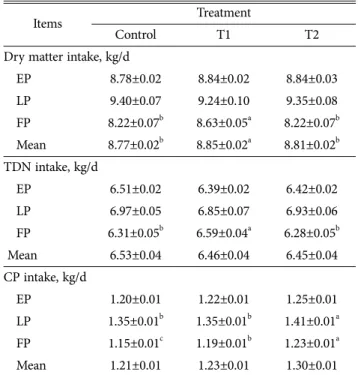
한우 거세우의 성장단계별 건물, TDN 및 조단백질 섭 취량은 Table 3과 같다. 한우 거세우의 건물섭취량은 시 험 전 기간 동안 일일 약 8.2–9.4 kg 수준이었으며, 비육 마무리기에 T1구가 다른 처리구에 비해 많았다(p<0.05).
본 시험의 건물섭취량을 한국가축사양표준(NIAS, 2012) 과 비교해보면, 체중 400–650 kg대 건물요구량(일일 0.8 kg 증체시, 평균 8.55 kg/일)보다 약 2.6–3.5% 높은 수준이었 다. Lee et al(2008)은 육성기 한우에게 농후사료를 제한 급여하고 조사료로서 버섯 수확후배지와 볏짚을 각각 자 유채식 시킨 결과, 버섯 수확후배지구가 볏짚구에 비하여 사료섭취량이 많았는데, 이러한 결과는 볏짚과 버섯 수확 후배지의 물리적 특성 차이 때문(Lee et al, 2004; Okine
et al, 1991)이라고 하였다. TDN 섭취량은 일일 6.28–
6.97 kg 수준이었으며, 비육전기에 Control구가 다른 처리 구에 비해 많았으나(p<0.05), 비육후기에는 비슷하였고, 비육마무리기의 TDN섭취량은 T1구가 다른 처리구에 비 해 많은 것으로 나타났다(p<0.05). 본 시험의 TDN섭취 량을 한국가축사양표준(NIAS, 2012)과 비교해 보면, 체 중 400–650 kg대 TDN요구량(일일 0.6 kg 증체시, 평균 6.53 kg/일)과 비슷한 수준이었다.
조단백질 섭취량은 일일 1.15–1.41kg 수준이었으며, 전 시험기간 동안 T2구가 다른 처리구에 비해 많았다 (p<0.05). 본 시험의 조단백질 섭취량을 한국가축사양표준 (NIAS, 2012)과 비교해보면, 체중 400–650 kg대 TDN요 구량(일일 0.6 kg 증체시, 평균 1.04kg/일)에 비해 약 14.1–17.5% 높은 수준이었다. 한편, 일일증체량 평균 Table 1. Ingredient and chemical compositions of experimental diets
Items
Treatment1)
Control T1 T2
EP2) LP2) FP2) EP LP FP EP LP FP
Ingredient composition, %
Corn 9.0 12.0 12.0 9.0 13.0 10.0 3.0 10.0 10.0
Barley 5.0 2.0 7.0 - 2.0 5.0 - - 5.0
Whole cotton seed 4.0 2.0 2.0 4.0 2.0 4.0 - 4.0 5.0
Prunus mume byproduct 0.7 0.7 0.7 0.7 0.7 0.7 0.7 0.7 0.7
Alfalfa hay 8.0 5.0 4.0 8.0 5.0 4.0 8.0 5.0 4.0
Italian rye grass 8.0 9.0 8.0 8.0 9.0 8.0 8.0 9.0 8.0
Tall fescue 3.5 - - 3.5 - - 3.5 - -
F-SMS3) - - - 15.0 15.0 15.0 43.0 43.0 43.0
Base-feed 26.0 31.1 28.3 26.8 31.9 32.3 19.8 17.9 14.3
Liquid yeast 25.8 26.0 26.0 25.0 21.0 21.0 14.0 10.0 10.0
Fermentation mix 10.0 12.0 12.0 - - - -
Micro elements4) - 0.2 - - 0.4 - - 0.4 -
Chemical composition, %DM
Dry matter 61.46 64.96 60.23 62.95 65.55 60.96 63.99 64.79 60.57
Crude protein 13.65 15.01 14.03 13.78 14.65 14.23 14.10 15.09 14.52
Crude ash 8.98 9.53 8.68 9.15 9.42 8.78 12.66 7.48 8.21
NDF 57.84 46.8 46.62 59.00 46.18 49.54 60.22 41.74 51.02
ADF 42.53 26.28 26.17 43.38 25.65 27.68 44.28 25.16 28.82
Ca5) 0.82 0.80 0.81 0.80 0.80 0.87 0.81 0.45 0.72
P5) 0.46 0.50 0.44 0.47 0.49 0.45 0.40 0.42 0.44
TDN5) 72.70 74.19 76.84 72.31 74.15 76.32 72.6 74.09 76.38
1)Control, TMR; T1, TMR including 10% F-SMS; T2, TMR including 30% F-SMS.
2)EP, early-fattening period (14 to 18 month age); LP, late-fattening period (19 to 23 month age); FP, Finishing period (24 to 30 month age).
3)Fermented spent mushroom (Flammuliua velutipes) substrates (70% SMS + 30% wheat bran).
4)Contained per kg diet: Vitamin A, 18,000 IU; Vitamin D3, 3,600 IU; Vitamin E, 1,500 IU; Fe, 120mg; Mn, 135mg; Zn, 135mg; Cu, 30mg;
Co, 0.3 mg.
5)Calculated value from the formula of feed company.
0.67 kg (Table 2)이었던 T2구의 영양소 섭취량(Table 3) 을 NIAS(2012)의 한국가축사양표준 한우 거세우 육성에 필요한 영양소 요구량(체중 450 kg, 일일증체량 0.8 kg 기 준일 때, TDN 6.09 kg, 조단백질 0.99 kg; 체중 600 kg 일일증체량 0.6 kg 기준일 때, TDN 6.35 kg, 조단백질 1.01 kg)과 비교하였을 때, 본 시험 T2구의 비육전기(14–
18개월령, 평균 체중 443 kg)동안 TDN 및 조단백질 섭취 량은 많았지만 일일증체량은 비슷한 수준이었고, 비육후 기(19–23개월령, 평균 체중 575 kg)에서도 영양소 섭취량 은 많았으나 일일증체량은 비슷한 수준이었다. 또한, 본 시험 전 기간 동안 일일증체량이 평균 0.39 kg이었던 T1 구에서 비육 마무리기(평균 체중 653 kg)의 TDN 및 조단 백질 일일 섭취량이 각각 6.59 kg 및 1.23 kg 이었으나, NIAS(2012)의 한우 거세우 체중 650 kg대 일일증체량 0.4 kg 기준에서 TDN 및 조단백질의 일일 요구량은 각각 5.91 kg 및 0.99 kg로 설정되어있어, 한국가축사양표준의 요구량이 실제 측정치 보다 낮게 책정되어 있다는 것을 알 수 있었다. 즉, 본 시험결과에서는 한우거세우의 증체 를 위한 TDN 및 조단백질 섭취량이 한국가축사양표준 (2012)에서 설정된 값보다 많이 섭취해야 하는 것으로 나 타났다.
도체성적
한우 거세우의 도체성적 결과는 Table 4와 같다. 육량부 분에 있어서 한우 거세우의 도체중은 406–414 kg 수준이 었으며, T2, T1, 대조구순으로 무거운 경향이었다. 등지방 두께는 10.57–12.25 mm 수준이었으며, T2, T1, 대조구순 으로 두꺼운 경향이었다. 이는 T2구에서 시험 전 기간동 안 조단백질 섭취수준이 높았는데, 한우 거세우의 비육후 기 조단백질 섭취 수준이 높을수록 등지방 두께는 두꺼워 진다는 Ryu(2017)의 2001에서 2016년까지 한우 사양에 관련된 논문의 메타분석 결과와 일치하였다. 또한, 도체중 이 증가하면 등지방 두께가 두꺼워 진다는 Dikeman et al (1998)의 결과와도 유사하였다.
배최장근단면적은 105.86–113.43㎠ 수준으로, 처리구 의 모든 개체가 100 cm2 이상이었는데, 다른 연구결과 (KAPE, 2016; Kim et al, 2012; Lee et al, 2016)와 비교 하면, 한우 거세우의 평균 배최장근단면적은 86.8–
96.9 cm2 수준이라고 하여 본 연구의 결과보다 현저히 낮 았다.
육량지수는 68.52–69.33로 나타나 처리구간에 비슷한 수 준이었으며, 육량 A등급 비율은 대조구 57%, T1구에서 71% 그리고 T2구에서 38%로 나타났다. T1구에서 육량 A 등급 출현율이 월등히 높은 것은 도체중에 비해 등심단면 적이 넓었으며 특히, 등지방 두께가 얇았기 때문이다. 또한 Gal et al(2011)은 큰느타버섯리 수확후배지 발효사료를 급 여한 한우 사양시험에서 수확후배지 30% 첨가구에서 A등 급 출현율이 높았다고 하여 본 시험의 결과와 유사하였다.
Table 2. Effect of dietary supplementation of the fermented spent mushroom(Flammulina velutipes) substrate on growth performance of Hanwoo steers
Items Treatment
Control T1 T2
Body weight, kg
Initial body wt. 371.63±11.82 383.63±11.82 376.63±11.82 EP1) 427.85±8.21 435.75±8.21 443.38±8.21 LP2) 550.89±10.60 563.55±10.19 574.93±10.19 FP3) 652.76±10.44 652.57±9.87 677.30±9.76 Final body wt. 683.86±26.68 682.86±26.68 704.38±24.96 Body gain, kg
EP 109.13±8.42 108.63±8.42 128.13±8.42 LP 100.88±8.63 111.50±8.63 115.50±8.63 FP 92.00±8.11 78.86±8.11 84.16±7.60 Total body gain 313.71±17.07 302.71±17.07 327.75±15.96 Average daily gain, kg/d
EP 0.70±0.09 0.71±0.06 0.83±0.06
LP 0.68±0.05 0.70±0.05 0.72±0.05
FP 0.50±0.05 0.39±0.06 0.47±0.04
Mean 0.63±0.04 0.60±0.04 0.67±0.04
Mean±SE.
1)Early-fattening period (14 to 18 month age).
2)Late-fattening period (19 to 23 month age).
3)Finishing period (24 to 30 month age).
Table 3. Effect of dietary supplementation of the fermented spent mushroom(Flammulina velutipes) substrate on nutrients intakes of Hanwoo steers
Items Treatment
Control T1 T2
Dry matter intake, kg/d
EP 8.78±0.02 8.84±0.02 8.84±0.03
LP 9.40±0.07 9.24±0.10 9.35±0.08
FP 8.22±0.07b 8.63±0.05a 8.22±0.07b Mean 8.77±0.02b 8.85±0.02a 8.81±0.02b TDN intake, kg/d
EP 6.51±0.02 6.39±0.02 6.42±0.02
LP 6.97±0.05 6.85±0.07 6.93±0.06
FP 6.31±0.05b 6.59±0.04a 6.28±0.05b
Mean 6.53±0.04 6.46±0.04 6.45±0.04
CP intake, kg/d
EP 1.20±0.01 1.22±0.01 1.25±0.01
LP 1.35±0.01b 1.35±0.01b 1.41±0.01a FP 1.15±0.01c 1.19±0.01b 1.23±0.01a
Mean 1.21±0.01 1.23±0.01 1.30±0.01
Mean±SE.
a,b,c Means in the same row with different superscripts differ signifi-
cantly (p<0.05).
육질부분에서 근내지방도(1–9범위)는 처리구 모두, 평 균 8.4–8.7의 범위로서 매우 높았으며, 육색, 지방색, 조직 감 및 성숙도에서는 처리구 간에 통계적 유의차는 없었다.
T2구에서 1두를 제외한 모든 공시축이 육질 1++등급을 기 록하였는데, 큰느타리버섯 수확후배지 발효사료를 한우 거세우에게 급여한 Moon et al(2015)의 시험에서도 육질 이 향상되었다고 보고한 바 있다. 이러한 결과들을 축산 물품질평가원(KAPE, 2012)의 한우거세우 도체중 400kg 이상의 등급판정 결과와 비교해 보면, 도체중 445kg, 등 지방두께 14.4 mm, 등심단면적 93.0 cm2, 육량지수 63.8, 근내지방도 5.7수준이라고 하여 본 시험과 비교하였을 때, 도체중은 낮았으나, 등지방두께, 배최장단면적, 육량지수 및 근내지방도는 본 시험의 결과가 월등히 우수한 것으로 나타났다.
따라서, 본 시험의 도체평가에서 대조구와 F-SMS첨가 구간 성적은 비슷하였지만, 팽이버섯 수확후배지 발효사 료가 도체등급 향상에 효과적이었다고 판단된다.
경제성분석
팽이버섯 수확후배지 발효사료를 한우 거세우에게 급여 하였을 때, 경제성 분석은 Table 5에 나타내었다. 지육판 매 수익에서 대조구에 비해 T1구 및 T2구의 수익이 각각 1.1% 및 3.1% 적었는데, 이러한 결과는 도체성적에서 처
리구간의 도체중 차이는 없었지만 대조구의 등지방 두께 가 다른 처리구에 비해 상대적으로 얇아 경매단가에 영향 을 미친 것으로 판단된다.
사료비용을 분석해 보면, 대조구에 비해 T1 및 T2구가 각각 7.6% 및 23.9% 적게 소요되었는데, 이러한 결과는 팽이버섯 수확후배지의 원료가격이 kg당 50원 수준으로 저렴하였고, 제조단가도 높지 않았기 때문이다. TMR 제 조비용을 포함한 사료비는 대조구, T1 및 T2구가 kg당 각각 319원, 309원 및 264원으로 평가되어 팽이버섯 수 확후배지 발효사료의 첨가비율이 많은 T2구가 대조구의 82% 수준이었다. 소득비율은 대조구에 비해 T1과 T2구 가 각각 1.2% 및 13.3% 증가한 것으로 나타났다. 육량과 육질이 다른 처리구에 비해 낮았던 T2구에서 순수익이 높게 나타난 것은, 도체중이 상대적으로 많았고 버섯 수 확후배지의 첨가비율이 높아 사료단가가 낮았기 때문이다.
이상의 결과들을 종합해 볼 때, 한우 거세우에게 팽이버 섯 수확후배지 발효사료를 급여함으로써 증체량과 육질등 급은 대조구와 비슷하였으나, 육량등급은 T1구에서 우수 하였으며, 사료비가 절감되었다. 따라서 팽이버섯 수확후 배지 원료비와 발효사료 제조비용의 변동이 없고, 사료로 서 안전성과 적절한 사양프로그램만 확보된다면, 팽이버 섯 수확후배지는 한우 비육에 있어서 우수한 대체사료 자 원으로서 농가소득에 크게 기여할 것으로 판단된다.
적 요
Table 4. Effect of dietary supplementation of the fermented spent mushroom(Flammulina velutipes) substrate on carcass traits of Hanwoo steers slaughtered at 30 month of age
Items Treatment
Control T1 T2
Yield traits
Carcass weight, kg 405.71±14.85 407.14±12.53 414.25±17.79 Back fat thickness,
mm 10.57±1.34 11.29±1.25 12.25±1.42 Rib-eye area, cm2 105.86±3.70 113.43±3.59 113.13±5.65 Yield index 68.83±1.23 69.33±0.89 68.52±1.00 Yield grade(A:B:C), % 57:43:0 71:29:0 38:62:0 Quality traits
Marbling score 8.71±0.18 8.57±0.20 8.38±0.26 Meat color 4.57±0.20 4.29±0.18 4.5±0.19 Fat color 2.57±0.20 2.43±0.20 2.75±0.16 Texture 1.00±0.00 1.00±0.00 1.00±0.00 Maturity 2.14±0.14 2.14±0.14 2.25±0.16 Quality
grade(1++:1+:1), % 100:0:0 100:0:0 88:12:0 Mean±SE.
Table 5. Effect of dietary supplementation of the fermented spent mushroom(Flammulina velutipes) substrate on economical analysis in feeding of Hanwoo steers
Items Treatment
Control T1 T2
Gross income(A) 7,856,485 7,775,596 7,626,763 Carcass sale1), won/head 7,653,610 7,571,846 7,419,638 By-products sale2), won/head 202,875 203,750 207,125 Operating cost(B) 5,471,426 5,362,680 4,924,437
Calves3), won/head 2,261,429 2,261,429 2,261,429 Feed4), won/head 3,034,397 2,925,651 2,487,408 Dismissal cost5), won/head 175,600 175,600 175,600 Profit(A-B) 2,385,060 2,412,916 2,702,326
Income ratio 100.0 101.2 113.3
1)Cold carcass auction price: 1++A=18,596 won, 1++B=18,462 won, 1+B=15,791 won.
2)By-products price: head, internal organ, the feet of a cow skin.
3)Buying price.
4)Feed price(won/kg): TMR=319, 10% F-SMS TMR=309, 30% F- SMS TMR=264.
5)Dismissal cost: slaughter cost, stamp cost, sales cost, transportation and other miscellaneous expenses/total number of marketed animal.
본 연구는 팽이버섯 수확후배지를 이용한 발효 TMR 급여가 한우 거세우의 사양성적과 도체특성 및 경제성 분 석에 미치는 영향을 조사하기 위해 수행되었다. 팽이버섯 수확후배지 발효사료(F-SMS) 제조를 위하여 자체 개발된 혼합배양액(Bacillus sp. UJ03+Saccharomyces sp. UJ14) 을 사용하였다. 한우 거세우 14개월령 24두를 공시하여 성장단계(비육전기, 비육후기, 비육마무리기)에 따라 배합 비를 조절하면서 사육한 후, 30개월령에 도축하였다. 처 리구는 자체 TMR을 급여한 대조구(Control), F-SMS 10% 첨가구(T1) 및 30% 첨가구(T2)로 나누어 난괴법으 로 배치하였다. 증체량은 처리구간에 유의적인 차이가 없 었으나. 건물과 TDN 섭취량은 비육 마무리기에 T1구에 서 다른 처리구보다 높았고, 조단백질 섭취량은 전 시험 기간 동안 T2구가 다른 처리구에 비해 많았다(p<0.05). 배 최장근 단면적과 등지방두께는 팽이버섯 수확후배지 발효 사료 급여 시 증가되는 경향이었으며, T1구에서 육량 A등 급 출현율이 가장 높았다. 순수익은 대조구에 비해 T1과 T2구가 각각 1.2% 및 13.3%가 증가한 것으로 나타났다.
이상의 결과들을 종합해 볼 때, 팽이버섯 수확후배지의 원료비와 발효사료 제조비용의 변동이 없고, 사료로서 안 전성이 확보된다면, 팽이버섯 수확후배지는 한우 비육에 있어서 우수한 대체사료자원으로서 농가소득에 크게 기여 할 것으로 판단된다.
감사의 글
본 연구는 2016년 경남과학기술대학교 대학회계 연구비 지원에 의해 수행된 결과의 일부이며 이에 감사드립니다.
References
AOAC. 1995. Official methods of analytical chemists, Washington DC, USA.
Adamovic M, Grubi G, Milenkovic I, Jovanovi R, Proti R, Sretenovi L, Stoievi L. 1998. The biodegradation of wheat straw by pleurotus ostreatus mushrooms and its use in cattle feeding. Anim Feed Sci Technol. 71:357-362.
Bae JS, Kim YI, Jung SH, Oh YG, Kwak WS. 2006. Evaluation on feed-nutritional value of spent mushroom(Pleurotus osteratus, Pleurotus eryngii, Flammulina velutupes) substrates as a roughage source for ruminants. J Anim Sci & Technol. 48:237- 246.
Caswell LE. 1990. Fungal additives. Feed manage. 41:9-13.
Cheng JC, Jhune CS, Lee CJ, Oh JA. 2010. Physico-chemical characteristics and utilization of raw materials for Mushroom Substrates. Kor J Mycol. 38:136-141
Dikeman ME, Cundiff LV, Gregory KE, Kemp KE, Koch RM.
1998. Relative contributions of subcutaneous and intermuscular fat to yields and predictability of retail product, fat trim, and bone in beef carcasses. J Anim Sci. 76:1604-1612.
Gal SW, Moon Yh, Cho SJ. 2011. Effect of the dietary supplemention of fermented spent mushroom(Pleuroutus
eryngii) substrates on the growth performance and carcass characteistics in Hanwoo steers. J Mushrooms. 21:1705-1709.
KAPE(Korea institute for animal products quality evaluation).
2012. Animal products grading statistical yearbook. Korea.
pp. 24.
KAPE(Korea institute for animal products quality evaluation).
2016. Animal products grading statistics. http://www.
ekapepia.com/194.su(2017.07.29).
Kim YI, Lee YH, Kim KH, Oh YK, Moon YH. 2012. Effects of Supplementing Microbially-fermented Spent Mushroom Substrates on Growth Performance and Carcass Characteristics of Hanwoo Steers (a Field Study). Asian-Aust J Anim Sci. 25:1575-1581
Kwak WS, Jung SH, Kim YI. 2008. Broiler litter supplementation improves storage and feed-nutritional value of sawdust-based spent mushroom substrate. Bioresour technol. 99:2947-2955.
Lee JY, Lee JK, Kim JB. 2016. Relation ship of major carcass grading traits with the related retail cut productivity traits in Hanwoo steers. J Agri Life Sci. 50:99-111.
Lee SM, Hwang JH, Yoon YB, Kwak WS, Kim YI, Moon SH, Jeon BT. 2008. Effect of spent mushroom substrates addition on eating behavior of growing Hanwoo. J Kor Grassl Forage Sci.
28:107-118.
Lee WS, Lee BS, Oh YG, Kim GH, Kang SW, Lee SS, Ha JG.
2004. Effects of concentrate to roughage ratio on duration and frequencies of rumination and chewing in Hanwoo Steers. J Anim Sci. 46:55-60.
MAFRA(Ministry of Agriculture, Food and Rural Affairs). 2013.
Production of special crops. p. 62.
Moon YH, Shin PG, Cho SJ. 2012. Feeding value of spent mushroom(Pleurotus eryngii) substrate. J Mushrooms.
10:236-243.
Moon YH, Kim HS, Kim CH, Cho WG, Yoo YB, Shin PG, Cho SJ. 2015. Effect of dietary supplementation of fermented spent mushroom substrates from pleurotus eryngii on Hanwoo steers. J Mushrooms. 13:108-113.
Moon YH, Kim SC, Cho WG, Lee SS, Cho SJ. 2014. Effects of supplementation of spent mushroom(Flammulina velutipes) substrates on the fermentative quality of rye silage. J mushrooms. 12:138-143
NIAS(National institute of animal science). 2012. Korean feeding standard for Hanwoo. RDA. pp. 21-22.
Okine EK, Mathison GW. 1991. Effects of feed intake on particle distribution, passage of digesta and extent of digestion in the gastrointestinal of cattle. J Anim Sci. 69:34-35.
Ryu CH. 2017. Investigation of relationship dietary crude protein and energy levels, and growth performance and carcass characteristics of Hanwoo using statistical Meta-analysis. Ph.
D. Thesis. Chonbuk.
SAS. 2000. SAS Users Guide: Statistics, SAS Inst. Inc., Cary, NC.
USA.
Shinekhuu J, Ji BJ, Jin GL, Choi SH, Song MK. 2009. Effects of dietary replacement of rice straw with fermented spent mushroom(Flammuliua velutipes) compost on availability of feeds in sheep, and growth performance of Hanwoo steers. J Anim Sci Technol. 51:241-248.
Van Soest PJ, Robertson JB, Lewis BA. 1991. Methods of dietary fiber, neutral detergent fiber, and nonstarch polysaccharides in relation to animal nutrition. J Dairy Sci. 74:3583-3597.