Effects of Applying Microbial Additive Inoculants to Spent Mushroom Substrate (Flammulina velutipes) on
Rumen Fermentation and Total-tract Nutrient Digestibility in Hanwoo Steers
7)
Baek, Youl-Chang*․Jeong, Jin-Young*․Oh, Young-Kyoon*․ Kim, Min-Seok*․Lee, Sung-Dae*․Lee, Hyun-Jeong*․
Do, Yoon-Jung**․Ahmadi, Farhad***․Choi, Hyuck****
팽이버섯 부산물 발효에 따른
한우 거세우 반추위 성상 및 소화율에 미치는 영향
백열창․정진영․오영균․김민석․이성대․이현정․도윤정․Farhad Ahmadi․최혁
We inoculated a spent mushroom substrate from Flammulina velutipes (SMSF) with a microbial additive and assessed the effects on chemical composition, ruminal fermentation parameters, and total-tract nutrient digestibility. In Exp. 1, three cannulated Hanwoo steers were used in an in situ trial to determine the degradation kinetics of dry matter (DM) and crude protein (CP). In Exp. 2, three Hanwoo steers were randomly assigned to experimental diets according to a 3 × 3 Latin square for a 3-week period (2 weeks for adaptation and 1 week for sample collection). Experimental diets included the control diet (3.75 kg/d formulated concentrate mixture + 1.25 kg/d rice straw), SMSF diet (3.19 kg/d formulated concentrate mixture + 1.25 kg/d rice straw + 0.56 kg/d SMSF), and inoculated SMSF (ISMSF) diet (3.19 kg/d formulated concentrate mixture + 1.25 kg/d rice straw + 0.56 kg/d ISMSF). The chemical composition of ISMSF did not differ from that of SMSF. Microbial additive inoculation decreased pH (P<0.05) and
****Animal Nutrition & Physiology Team, National Institute of Animal Science, RDA
****Animal Disease & Biosecurity Team, National Institute of Animal Science, RDA
****Division of Food Biosciences, College of Health and Medical Life Sciences, Konkuk University
****Corresponding author, Animal Nutrition & Physiology Team, National Institute of Animal Science, RDA, (current address) Department of Dairy Science, Virginia Polytechnic Institute and State University, Blacksburg, VA 24061, USA ([email protected])
improved preservation for SMSF. The percentages of DM, neutral detergent fiber (NDF), and acid detergent fiber (ADF) in ISMSF were slightly lesser than those in SMSF. Ruminal fermentation characteristics and total-tract nutrient digestibility were not affected by diet. Overall, microbial additive inoculation improved preser- vation for SMSF and may allow improved digestion in the rumen; however, the total digestible nutrients (TDN) of SMSF and ISMSF diets were slightly lesser than the control diet. The ISMSF can be used as an alternative feedstuff to partially replace formulated concentrate feed.
Key words : agriculture by-products, feed cost, feed preservative, silage, total tract digestibility, volatile fatty acid
Ⅰ. Introduction
Feed is the most crucial factor in the total cost of beef production, and reducing feed costs therefore increases the profit margin for beef cattle farm (Liu et al., 2000). The use of food by-products as animal feed may contribute to decreased feed costs (Oishi et al., 2011). Spent (used) mushroom substrate (SMS) is an abundant and cheap by-product of mushroom cultivation that has a potential application as animal feed (Phan and Sabaratnam, 2012; Kim et al., 2015a;
Kim et al., 2015b).
The spent mushroom substrate is a rich source of protein, plant residues, and nutrients that can be used as ruminant feed (Fazaeli and Masoodi, 2006; Bae et al., 2006). Because enzymatic conversion processes can modify the fiber structure of raw materials during mushroom cultiva- tion (e.g., a 50% reduction in cellulose and a 30% reduction in lignin), SMS is more digestible for the animals (Adamovieć et al., 1998; Phan and Sabaratnam, 2012). Although SMS putrefies quickly due to its high moisture content, but ensiling SMS under anaerobic conditions improves preservation (Kwak et al., 2008).
A previous study in our laboratory showed that microbial inoculation improved the preser- vative quality of SMS from Pleurotus ostreatus, and increased in situ rumen degradation of DM, CP, NDF, and ADF compared with uninoculated SMS (unpublished). Similarly, Kwak et al.
(2009) reported that molasses and microbial inoculants improve the silage fermentation quality of cotton-waste-based spent mushroom substrate.
Although Flammulina velutipes is one of the most cultivated edible mushrooms in Korea, to our knowledge, few studies have investigated the nutrient quality, ruminal fermentation, and digestibility of spent mushroom substrate from F. velutipes (SMSF). Therefore, the present study investigated the effects of a microbial additive on feed quality and ruminal fermentation of SMSF.
Ⅱ. Materials and methods
1. Inoculation of SMSF with microbial additive
The original mushroom substrate consisted of 36.6% rice bran, 35.1% corn cob, 8.6% beet pulp, 6.9% wheat bran, 5.2% cotton seed hull, 3.8% dried tofu cake, and 3.8% pearl. The SMSF was inoculated with a microbial additive according to a modified procedure (Kim et al., 2014).
Briefly, 99.0% SMSF was mixed with microbial additive (1% v/w to supply 1.0 × 10⁵ cfu/g, consisting of two strains of Bacillus sp. UJ03 and Saccharomyces cerevisiae UJ14, friendly donated by Dr. S. J. Cho, Gyeongnam National University of Science and Technology; Gal and Cho, 2011). Next, approximately 5 kg of the mixture was packed into polyvinyl bags and sealed.
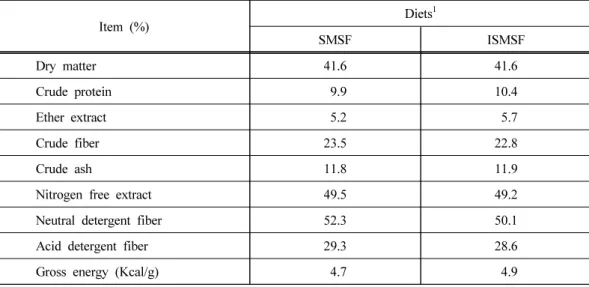
The inoculated SMSF (ISMSF) was fermented at 20℃ for 5 days and stored at room tempera- ture, and then the inoculated SMSF (total bacteria count, 1.0 × 10⁸ to 109 cfu/g) was used to experiments. Visual inspections and pH measurements were made at 0, 1, 24, 48, 72, 96 and 120 h. The chemical compositions of test diets (SMSF and ISMSF) are shown in Table 1.
Table 1. Chemical composition of test diets
Item (%)
Diets1
SMSF ISMSF
Dry matter 41.6 41.6
Crude protein 9.9 10.4
Ether extract 5.2 5.7
Crude fiber 23.5 22.8
Crude ash 11.8 11.9
Nitrogen free extract 49.5 49.2
Neutral detergent fiber 52.3 50.1
Acid detergent fiber 29.3 28.6
Gross energy (Kcal/g) 4.7 4.9
1SMSF, spent mushroom substrate from Flammulina velutipes; ISMSF, SMSF inoculated with microbial additive.
2. Exp. 1: In situ experiments
All procedures involving animals were approved by the Animal Ethics Committee of the National Institute of Animal Science. Three ruminally cannulated Hanwoo steers (mean body
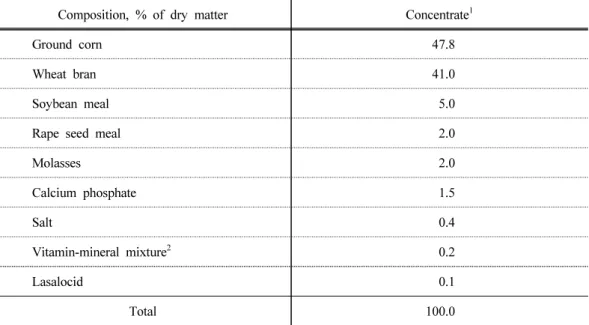
weight = 408 ± 13.0 kg) were housed in individual tie-stalls (127 × 250 × 200 cm). The steers were fed a diet consisting of 3.75 kg/d of a formulated concentrate mixture and 1.25 kg/d of rice straw twice daily (at 0900 and 1700 h). The diet was formulated to meet the recommenda- tions of the NRC (2001) for beef cattle. Prior to the start of experiments, all Hanwoo steers were acclimated to tie-stall barns and the basal diet for 14 days. Animals had free access to water and mineral blocks. The chemical composition and ingredient of the formulated concen- trate diet is shown in Table 2.
Table 2. Chemical and ingredient composition of formulated concentrate diet
Composition, % of dry matter Concentrate1
Ground corn 47.8
Wheat bran 41.0
Soybean meal 5.0
Rape seed meal 2.0
Molasses 2.0
Calcium phosphate 1.5
Salt 0.4
Vitamin-mineral mixture2 0.2
Lasalocid 0.1
Total 100.0
1Concentrate, formulate concentrates mixture.
2Vitamin-mineral premix components: Vitamin A, 2,650,000 IU; Vitamin D3, 530,000 IU; Vitamin E, 1,050 IU;
Niacin, 10,000 mg; Mn, 4,400 mg; Fe, 13,200 mg; I, 440 mg; Co, 440mg.
The spent mushroom substrate from F. velutipes and inoculated SMSF were dried, milled, and passed through a 2-mm mesh screen in a Wiley mill (Model 4, Thomas Scientific, Swedesboro, NJ, USA) before rumen incubation. Each 5-g feed sample (DM basis) was placed in a nylon bag (8 × 15 cm; pore size = 45 µm; surface area = 41.67 mg/cm2; NL 130-030/330PW, NBC, Inc., Tokyo, Japan), tied with a rubber band, and incubated in triplicate in the rumen of Hanwoo steers for 0, 3, 6, 9, 12, 24, 48, 72, 96 and 120 h. All nylon bags were suspended in the rumen in a polyester mesh bag (25 × 40 cm; 3 mm pore size) and removed at the intervals above.
Upon removal, bags were rinsed in cold water to remove ruminal contents, then washed with cold tap water for 30 min. Additional bags were also prepared and machine-rinsed without
ruminal incubation, thereby creating a zero-hour incubation group. After rinsing, the residues were dried at 60℃ in a forced-air oven for 48 h and weighed to determine residual DM.
Parameters of ruminal disappearance were calculated using the following nonlinear model (Ørskov and McDonald, 1979):
P = a + b × (1 − exp−ct), (1)
where P is rumen degradation (%), a is the 45-µm filterable and soluble fraction (%), b is the degradable fraction (%), c is the degradation rate of fraction b (h–1), and t is the incubation time (h).
Effective degradability (ED) of CP and DM was calculated using the following equation:
ED (%) = a + [bc/ (c + k)], (2)
where a, b, and c are constants from the nonlinear model described above, and k is the measured particle passage rate of 0.02 and 0.05 h–1 (Denham et al., 1989).
3. Exp. 2: Feeding trial and total-tract digestibility of nutrients
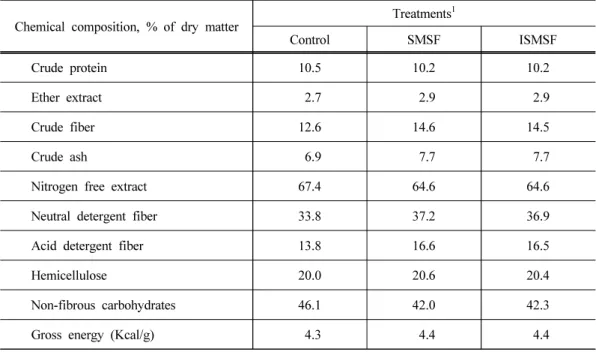
A previous study recommended that SMS level of 6.5% dietary DM in a silage-based total mixed ration for wethers (Xu et al., 2010). In addition, Oh et al. (2010) suggested that SMS could be used as a forage source to replace up to 40% of rice straw without any negative effects on Hanwoo steers. Three healthy Hanwoo steers (mean body weight = 336 ± 69.0 kg) were randomly assigned one of three dietary treatments sequenced in a duplicated 3 × 3 Latin square design. The treatments consisted of control diet (3.75 kg/d formulated concentrate mixture + 1.25 kg/d rice straw; rice straw and concentrates in ratio of 1:3 on a DM base; as fed basis: Table 2), SMSF diet (3.19 kg/d formulated concentrate mixture + 1.25 kg/d rice straw + 0.56 kg/d SMSF; 15% of concentrates replaced by SMSF on a DM base), and ISMSF diet (3.19 kg/d formulated concentrate mixture + 1.25 kg/d rice straw + 0.56 kg/d ISMSF; 15% of concentrates replaced by ISMSF on a DM base). Diets were provided twice daily at 0900 and 1700 h. The chemical composition of experimental diets is shown in Table 3.
Table 3. Chemical compositions of experimental diets
Chemical composition, % of dry matter
Treatments1
Control SMSF ISMSF
Crude protein 10.5 10.2 10.2
Ether extract 2.7 2.9 2.9
Crude fiber 12.6 14.6 14.5
Crude ash 6.9 7.7 7.7
Nitrogen free extract 67.4 64.6 64.6
Neutral detergent fiber 33.8 37.2 36.9
Acid detergent fiber 13.8 16.6 16.5
Hemicellulose 20.0 20.6 20.4
Non-fibrous carbohydrates 46.1 42.0 42.3
Gross energy (Kcal/g) 4.3 4.4 4.4
1Treatments: Control, formulated concentrate mixture 3.75 kg + rice straw 1.25 kg/d; SMSF, formulated concen- trate mixture 3.19 kg + rice straw 1.25 kg + SMSF 0.56 kg/d; ISMSF, formulated concentrate mixture 3.19 kg + rice straw 1.25 kg + ISMSF 0.56 kg/d.
Each experimental period consisted of a 2-week adaptation period, followed by a 1-week sample collection period. Once weighed, fecal subsamples (5%) were collected during the collection period (twice daily at 0930 and 1730 h) and frozen at -20℃ until further analyses.
Fecal samples were dried for 48 h in a forced-air oven at 65℃, ground through a 2-mm mesh screen, and analyzed.
On the final day of each collection period, rumen fluid (approximately 200 mL) was collected from each steer via stomach tubes at 0, 2, 4, 6 and 8 h after morning feeding. The pH of the rumen fluid was measured with a pH meter (Orion Star A211 bench-top pH meter; Thermo Scientific, Bremen, Germany) immediately after collection and subsequently strained through four layers of cheesecloth. The strained rumen fluid (1 mL) was acidified with 0.2 mL of HPO3 and frozen until analysis for ammonia-N and volatile fatty acids (VFA). Concentration of VFA was determined using gas chromatography (Varian CP-3800; Varian, Walnut, Creek, CA, USA) as described by Oh et al. (2010). Ammonia-N concentration was determined using a multiplate spectrophotometer (Bio-Rad, Benchmark PlusTM, Tokyo, Japan) at 630 nm as described by Chaney and Marbach (1962).
4. Chemical composition analysis
All feed samples were dried, milled using a Wiley mill, and passed through a 1-mm mesh screen. The DM was determined by drying the samples to a constant weight at 65℃. Samples were analyzed for crude protein (CP), ether extract (EE), crude fiber (CF), and crude ash (Ash) according to the methods described by the AOAC (2012). The neutral detergent fiber (NDF), acid detergent fiber (ADF) and acid detergent lignin (ADL) were evaluated were performed by the sequential procedure of Van Soest et al. (1991) using a fiber analyzer (ANKOM2000, ANKOM Technology Corporation, Macedon, NY, USA). Hemicellulose (HEM) was calculated as NDF - ADF and cellulose by ADF - ADL. The amount of non-fibrous carbohydrate (NFC) was calculated by subtracting the sum of NDF, CP, EE, and Ash from 100. The concentration of gross energy was measured using bomb calorimetry (Parr 6400 calorimeter, Parr Instrument Company, IL, USA).
5. Statistical analysis
All collected and recorded data were analyzed by one-way analysis of variance (ANOVA) using generalized linear model procedure (GLM) in SAS (Statistical Analysis Systems Institute, Inc., 2003). Experimental results are expressed as mean and standard error of mean. Mean separation was performed using t-test and P-values less than 0.05 were considered statistically significant.
Ⅲ. Results
1. Visual inspection and pH measurement
Data from pH changes on the SMSF and ISMSF diets are shown in Fig. 1. Mold was detected on the SMSF at day 5, however, no visible spoilage was observed in ISMSF until d 5 (data not shown). The pH of SMSF decreased slightly to 5.20 at d 2, but increased to 5.50 at d 5. However, the pH of ISMSF dropped rapidly from 5.60 to 4.50 during the ensiling period on d 2 to 5 (P<0.05). The pH of ISMSF was significantly lower (P<0.05) than that of SMSF from d 1 to 5 (Fig. 1. C).
0 1 2 3 4 5 4.0
4.5 5.0 5.5
6.0 SMSF1
ISMSF2
Days of storage (d)
pH
* * * * *
Fig. 1. The pH changes for the SMSF and ISMSF diets during 5 days of storage.
1SMSF, spent mushroom substrate from Flammulina velutipes; 2ISMSF, SMSF inoculated with microbial additive; * Means differ significantly between treatments (P<0.05).
2. In situ rumen degradation of SMSF and ISMSF diets
The digestibility of DM, CP, NDF, and ADF did not significantly differ between ISMSP and SMSP at all incubation times (Table 4).
Table 4. DM, CP, ADF, and NDF residues at each rumen incubation time in the test diets
Degradability, % Time
Diets1
SEM P-value
SMSF ISMSF
Dry matter
0 28.09 33.38 1.026 0.557
3 30.51 34.43 0.599 0.577
6 31.89 36.23 0.689 0.538
12 35.23 36.72 0.318 0.291
24 42.79 43.02 0.442 0.221
48 51.07 51.24 0.415 0.118
72 56.47 55.98 0.221 0.182
96 59.06 58.11 0.327 0.472
120 61.07 59.46 0.345 0.959
Crude protein
0 53.33 52.70 0.193 0.988
3 57.24 57.34 0.069 0.928
6 58.90 60.70 0.301 0.620
1SMSF, spent mushroom substrate from Flammulina velutipes; ISMSF, SMSF inoculated with microbial additive.
The degradation characteristics of CP and DM in SMSF and ISMSF are shown in Table 5.
The rapidly degradable a fraction of DM in ISMSF (32.61%) was greater (P = 0.040) compared with in SMSF (27.85%). The degradation rate of fraction b (c) of DM in SMSF (0.022 h-1) was faster (P = 0.012) than in ISMSF (0.018 h-1).
Degradability, % Time
Diets1
SEM P-value
SMSF ISMSF
Crude protein
12 60.35 61.41 0.210 0.284
24 63.82 65.50 0.315 0.517
48 67.94 69.61 0.325 0.821
72 73.80 73.0 0.153 0.568
96 74.96 75.16 0.185 0.268
120 73.94 73.84 0.188 0.386
Neutral detergent fiber
0 4.29 5.73 0.411 0.214
3 6.50 6.09 0.144 0.582
6 6.66 7.98 0.343 0.581
12 7.96 8.75 0.305 0.156
24 18.12 16.71 0.667 0.108
48 27.74 25.73 0.598 0.891
72 34.79 33.33 0.344 0.473
96 39.29 36.99 0.663 0.672
120 42.41 40.41 0.375 0.433
Acid detergent fiber
0 3.06 4.78 0.425 0.464
3 5.08 5.69 0.175 0.786
6 5.52 5.94 0.330 0.179
12 5.65 6.59 0.318 0.163
24 15.62 12.26 0.877 0.337
48 23.69 20.31 0.778 0.470
72 28.87 25.76 0.606 0.664
96 31.61 30.04 0.630 0.479
120 29.38 33.14 3.036 0.643
Table 5. The degradation characteristics of crude protein (CP) and dry matter (DM) in the test diets
Item
Diets1
SEM P-value
SMSF ISMSF
a (%) 54.81 54.74 0.184 0.820
b (%) 21.19 19.99 0.489 0.901
a + b (%) 76.01 74.73 0.580 0.725
c (h–1) 0.020 0.030 0.003 0.114
Effective degradability of CP 61.81 62.79 0.312 0.112
a (%) 27.85b 32.61a 1.400 0.040
b (%) 36.05 31.11 1.583 0.235
a + b (%) 63.90 63.72 0.837 0.835
c (h–1) 0.022a 0.018b 0.001 0.012
Effective degradability of DM 38.69 40.80 0.648 0.310
1SMSF, spent mushroom substrate from Flammulina velutipes; ISMSF, SMSF inoculated with microbial additive.
a = rapidly degradable fraction; b = slowly degradable fraction; a + b = potentially degradable fraction; c = degra- dation rate of fraction b. Means with different superscript letters (a, b) within the same row are significantly different (P < 0.05).
3. Ruminal fermentation parameters
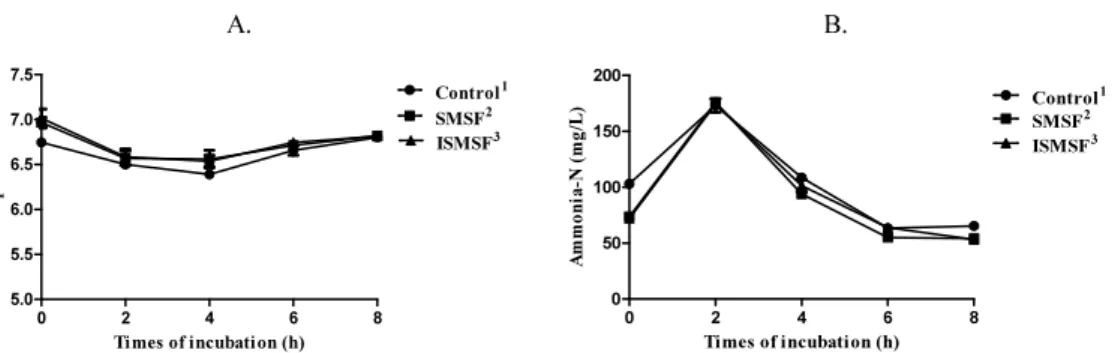
The changes of pH and ammonia-N concentration in the rumen are shown in Fig. 2. No significant differences were observed in ruminal pH and ammonia-N concentration among the treatments at every sampling time (P > 0.05). The rumen pH in all treatments decreased from 0 to 4 h of post-feeding, and then it was increased again (Fig. 2A). The rumen ammonia-N concentration in all treatments increased till 2 h of post-feeding, and it was declined gradually thereafter (Fig. 2B).
There were no significant differences in the concentrations of total or individual VFA between treatments (Table 6). The concentrations of total and individual VFA in all treatments increased at 2 h and then decrease from 4 to 8 h. The acetate : propionate ratio was not affected by the treatments.
A. B.
0 2 4 6 8
5.0 5.5 6.0 6.5 7.0
7.5 Control1
SMSF2 ISMSF3
Times of incubation (h)
pH
0 2 4 6 8
0 50 100 150 200
Control1 SMSF2 ISMSF3
Times of incubation (h)
Ammonia-N (mg/L)
Fig. 2. The changes in pH and ammonia-N concentration in the rumen for the SMSF and ISMSF diets.
1Control, formulated concentrate mixture 3.75 kg + rice straw 1.25 kg/d; 2SMSF, formulated concentrate mixture 3.0 kg + rice straw 1.25 kg + SMSF 0.75 kg/d; 3ISMSF, formulated concentrate mixture 3.0 kg + rice straw 1.25 kg + ISMSF 0.75 kg/d.
Table 6. Effects of experimental diets on ruminal VFA
Time Item
Treatments1
SEM P-value
Control SMSF ISMSF
0
Total VFA, mM 69.2 66.8 65.0 3.320 0.887
Acetate (A), % 46.4 45.3 43.6 2.013 0.868
Propionate (P), % 10.9 10.7 10.1 0.669 0.887
Isobutyrate, % 0.7 0.6 0.7 0.052 0.747
Butyrate, % 9.5 8.5 8.7 0.551 0.772
Isovalerate, % 1.2 1.1 1.3 0.087 0.576
Valerate, % 0.5 0.5 0.6 0.051 0.824
A : P 4.3 4.3 4.5 0.100 0.729
2
Total VFA, mM 97.5 85.8 80.2 5.577 0.458
Acetate (A), % 62.3 54.5 50.7 3.546 0.419
Propionate (P), % 18.0 16.3 15.0 0.983 0.489
Isobutyrate, % 0.4 0.3 0.3 0.046 0.527
Butyrate, % 14.1 12.3 11.9 0.960 0.613
Isovalerate, % 1.3 1.2 1.2 0.083 0.835
Valerate, % 1.3 1.1 1.0 0.054 0.237
A : P 3.4 3.3 3.5 0.065 0.778
1Control, formulated concentrate mixture 3.75 kg + rice straw 1.25 kg/d; SMSF, formulated concentrate mixture 3.19 kg + rice straw 1.25 kg + SMSF 0.56 kg/d; ISMSF, formulated concentrate mixture 3.19 kg + rice straw 1.25 kg + ISMSF 0.56 kg/d.
4. Nutrients digestibility of SMSF and ISMSF diets
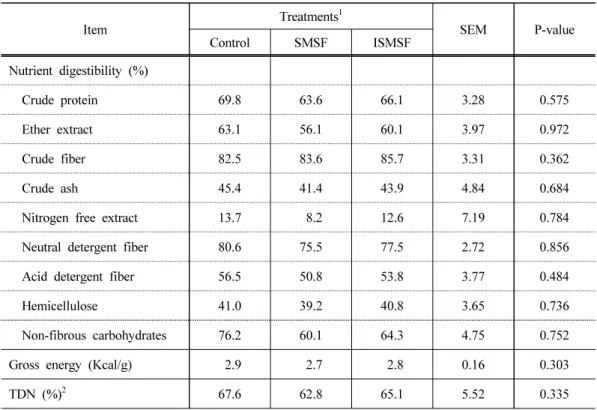
Total-tract digestibility of all nutrients that are CP, EE, ash, NFE, NDF, ADF, HEM, NFC, energy and TDN did not significantly differ between SMSP and ISMSP (Table 7).
Time Item
Treatments1
SEM P-value
Control SMSF ISMSF
4
Total VFA, mM 87.7 87.7 96.4 3.412 0.583
Acetate (A), % 60.1 56.0 63.2 2.125 0.664
Propionate (P), % 16.8 16.3 17.5 0.738 0.826
Isobutyrate, % 0.3 0.3 0.4 0.029 0.996
Butyrate, % 8.3 12.3 12.7 1.012 0.134
Isovalerate, % 1.1 1.1 1.3 0.081 0.531
Valerate, % 1.2 1.1 1.2 0.042 0.701
A : P 3.6 3.6 3.7 0.051 0.639
6
Total VFA, mM 81.3 78.0 75.6 2.935 0.751
Acetate (A), % 56.0 53.2 52.5 2.254 0.817
Propionate (P), % 15.0 14.6 14.1 0.844 0.920
Isobutyrate, % 0.4 0.3 0.4 0.017 0.786
Butyrate, % 8.1 8.1 6.6 1.097 0.836
Isovalerate, % 1.0 1.0 1.1 0.073 0.531
Valerate, % 0.9 0.8 0.9 0.039 0.819
A : P 3.7 3.8 3.7 0.078 0.763
8
Total VFA, mM 74.0 73.3 72.6 4.535 0.993
Acetate (A), % 49.0 48.8 47.6 2.783 0.979
Propionate (P), % 12.6 12.4 12.3 0.853 0.988
Isobutyrate, % 0.3 0.3 0.3 0.028 0.969
Butyrate, % 10.5 10.3 10.7 0.877 0.985
Isovalerate, % 0.8 0.9 1.0 0.063 0.654
Valerate, % 0.7 0.7 0.7 0.038 0.987
A : P 3.9 4.0 4.0 0.103 0.948
Table 7. Total-tract nutrient digestibility of experimental diets
Item
Treatments1
SEM P-value
Control SMSF ISMSF
Nutrient digestibility (%)
Crude protein 69.8 63.6 66.1 3.28 0.575
Ether extract 63.1 56.1 60.1 3.97 0.972
Crude fiber 82.5 83.6 85.7 3.31 0.362
Crude ash 45.4 41.4 43.9 4.84 0.684
Nitrogen free extract 13.7 8.2 12.6 7.19 0.784
Neutral detergent fiber 80.6 75.5 77.5 2.72 0.856
Acid detergent fiber 56.5 50.8 53.8 3.77 0.484
Hemicellulose 41.0 39.2 40.8 3.65 0.736
Non-fibrous carbohydrates 76.2 60.1 64.3 4.75 0.752
Gross energy (Kcal/g) 2.9 2.7 2.8 0.16 0.303
TDN (%)2 67.6 62.8 65.1 5.52 0.335
1Control, formulated concentrate mixture 3.75 kg + rice straw 1.25 kg/d; SMSF, formulated concentrate mixture 3.19 kg + rice straw 1.25 kg + SMSF 0.56 kg/d; ISMSF, formulated concentrate mixture 3.19 kg + rice straw 1.25 kg + ISMSF 0.56 kg/d. 2Total digestible nutrients (TDN), [digestible crude protein + digestible neutral detergent fiber + digestible soluble carbohydrates + (digestible crude fat × 2.25)]
Ⅳ. Discussion
Although our previous study showed the benefits of inoculating SMS with LAB for cattle feed (unpublished), it did not provide a comprehensive evaluation of SMS utility for cattle. We con- ducted the present study to provide new information regarding the feed quality and digestibility of SMS from Flammulina velutipes inoculated with a microbial additive for Hanwoo steers.
In Exp. 1, the pH of ISMSF was lower than that of SMSF during the fermentation period, and ISMSF was well preserved until d 5 (Fig. 1). Similarly, Kim et al. (2008) reported that anaerobic fermentation with mixed microbes (Enterobacter ludwigii, Bacillus cereus, 2 strains of Bacillus subtilis, Saccharomyces cerevisiae and Lactobacillus plantarum) inoculation improved the preservation of SMS. Well-fermented silage has a pH close to 4.0 and high lactic acid concentration, which inhibits the growth of undesirable bacteria and limits the activity of plant
enzymes (McDonald et al., 1991). Jones et al. (1992) reported that microbial inoculation alters the composition of cell wall carbohydrates during the early phases of fermentation, when pH rapidly declines. These results suggested that microbial inoculation of SMS can be an effective strategy for extending the storage period.
The results of the in situ rumen degradation experiment showed DM, CP, NDF, and ADF did not significantly differ between ISMSP and SMSP at all incubation times (Table 4). The rapidly degradable fraction a of DM in ISMSF was greater (P = 0.040) compared with in SMSF, whereas the slowly degradable fraction b of CP and DM was greater in ISMSF (P > 0.05) than in SMSF (Table 5). Interestingly, the degradation rate of fraction b (c) of DM in ISMSF (P = 0.012) was significantly lower than SMSF (Table 5). Adamovieć et al. (1998) suggested that inoculation significantly increased the degradability of OM, ADF, and NDF. In addition, Cushnahan and Mayne (1995) reported that extended fermentation can increase fraction a and reduce fractions b and c. However, applying LAB to the grass at ensiling did not result in a consistent change in silage fermentation characteristics, and bacterial inoculants and additives may have little or no effect on digestibility (McDonald et al., 1991; O’Kiely, 1996). These results can suggest that microbial inoculation of SMS might have small effects on cell components.
In Exp. 2, the changes in pH and ammonia-N and VFA concentrations did not differ among treatments (Fig. 2 and Table 6). Similarly, our preliminary investigation showed that LAB inoculation had no effect on pH, ammonia-N, or VFA concentration in SMS. Keady and Steen (1994) reported that a Lactobacillus plantarum bacterial inoculant had no significant effects on DM, nitrogen and fiber degradability, rumen pH, ammonia, or VFA concentration. However, other studies found that LAB-inoculated grass silage increased ruminal VFA concentration and improved the digestibility of DM, NDF, and ADF (Jaakkola et al., 1991; Stokes, 1992; Keady and Steen, 1996; Yahaya et al., 2004). In addition, Kim et al. (2012) reported that inoculation of SMS with microbial additive (Enterobacter spp. and Bacillus spp.) had higher content of NDF than that of the rice straw, and microbially-fermented SMS are attributed to the increased DM and CP intakes of Hanwoo steers.
Microbe-inoculated SMSF might, in theory, alter the rumen environment and interact with rumen microorganisms; however, our results showed no effects on the rumen environment. In this study, total-tract nutrient digestibility did not significantly differ among the SMSF, ISMSF, and control diets (Table 7). Thus, SMSF inoculated with a microbial additive had no effect on total-tract nutrient digestibility.
Ⅴ. Conclusion
The results of the present study indicate that SMSF, with or without microbial inoculation, had no effect on rumen pH, ammonia-N, VFA concentration, DM degradability, or total-tract nutrient digestibility. Overall, microbial inoculation improved the preservation of SMSF and had no effect on rumen fermentation parameters. In addition, the TDN values of the SMSF and ISMSF diets were slightly lesser than that of the control diet. A 15% dietary inclusion of SMSF and ISMSF may be recommended for Hanwoo beef cattle to supplement formulated concentrate feed and reduce feed costs in cattle production.
Ⅵ. Acknowledgements
This work was carried out with the support of the “Cooperative Research Program for Agri- culture Science & Technology Development (Project title: Feed ingredient database construction and revising standard composition tables of Korean feed, Project No. PJ01184001)”, Rural Development Administration, Republic of Korea.
[Submitted, March. 17, 2017 ; Revised, May. 8, 2017 ; Accepted, July. 19, 2017]
References
1. Adamovieć, M., G. Grubić, I. Milenković, R. Jovanocić, R. Protić, L. Sretenović, and L.
Stoićević. 1998. The biodegradation of wheat straw by Pleurotus ostreatus mushrooms and its use in cattle feeding. Anim. Feed Sci. Tech. 71: 357-362.
2. Association of Official Analytical Chemists. Official methods of analysis. 19 th ed. Arington (VA): AOAC Inc. 2012.
3. Bae, J. S., Y. I. Kim, S. H. Jung, Y. G. Oh, and W. S. Kwak. 2006. Evaluation on Feed- Nutritional Value of Spent Mushroom (Pleurotus osteratus, Pleurotus eryngii, Flammulina velutupes Substrates as a Roughage Source for Ruminants). J. Anim. Sci. Technol. 48: 237- 246.
4. Chaney, A. L. and E. P. Marbach. 1962. Modified reagents for determination of urea and ammonia. Clin. Chem. 8: 130-132.
5. Cushnahan, A., C. S. Mayne, and E. F. Unsworth. 1995. Effects of ensilage of grass on performance and nutrient utilization by dairy cattle 2. Nutrient metabolism and rumen fermentation. Animal Science. 60: 347-359.
6. Denham, S. C., G. A. Morantes, D. B. Bates, and J. E. Moore. 1989. Comparison of two models used to estimate in situ nitrogen disappearance. J. Dairy Sci. 72: 708-714.
7. Fazaeli, H. and A. T. Masoodi. 2006. Spent wheat straw compost of Agaricus bisporus mushroom as ruminant feed. Asian Austral. J. Anim. 19: 845-851.
8. Gal, S. W. and S. J. Cho. 2011. Isolation and characterization of thermophilic bacillus sp.
UJ03 from spent mushroom (flammulina velvtipes) substrates. J. Life Sci. 21: 1481-1486.
9. Jaakkola, S., P. Huhtanen, and K. Hissa. 1991. The effect of cell wall degrading enzymes or formic acid on fermentation quality and on digestion of grass silage by cattle. Grass Forage Sci. 46: 75-87.
10. Jones, B. A., R. D. Hatfield, and R. E. Muck. 1992. Effect of fermentation and bacterial inoculation on lucerne cell walls. J. Sci. Food Agric. 60:147-153.
11. Keady, T. W. J. and R. W. J. Steen. 1996. Effects of applying a bacterial inoculant to silage immediately before feeding on silage intake, digestibility, degradability and rumen volatile fatty acid concentrations in growing beef cattle. Grass Forage Sci. 51: 155-162.
12. Keady, T. W. J. and R. W. J. Steen. 1994. Effects of treating low dry-matter grass with a bacterial inoculant on the intake and performance of beef cattle and studies on its mode of action. Grass Forage Sci. 49: 438-446.
13. Kim, J. S., Y. H. Lee, Y. I. Kim, F. Ahmadi, Y. K. Oh, J. M. Park, and W. S. Kwak. 2016.
Effect of microbial inoculant or molasses on fermentative quality and aerobic stability of sawdust-based spent mushroom substrate. Bioresource Technol. 216: 188-195.
14. Kim, Y. I., J. M. Park, Y. H. Lee, M. Lee, D. Y. Choi, and W. S. Kwak. 2015a. Effect of by-product feed-based silage feeding on the performance, blood metabolites, and carcass characteristics of Hanwoo steers (a field study). Asian Australas J. Anim. Sci. 28: 180-187.
15. Kim, Y. I., J. S. Seok, and W. S. Kwak. 2008. Effect of mixed microbes addition on chemical change and silage storage of spent mushroom substrates. J. Anim. Sci. Technol. 50:
831-848.
16. Kim, Y. I., S. M. Lee, Y. H. Lee, M. Lee, and W. S. Kwak. 2015b. Effects of by-product feed-based silage on feeding, rumination, and excretion in growing Hanwoo heifers. J. Anim, Sci. Technol. 57: 1.
17. Kim, Y. I., Y. H. Lee, K. H. Kim, Y. K. Oh, Y. H. Moon, and W. S. Kwak. 2012. Effects of supplementing microbially-fermented spent mushroom substrates on growth performance and carcass characteristics of Hanwoo steers (a field study). Asian. Australas. J. Anim. Sci.
25: 1575-1581.
18. Kim, Y. I., Y. K. Oh, K. K. Park, and W. S. Kwak. 2014. Ensiling characteristics and the in situ nutrient degradability of a by-product feed-based silage. Asian. Australas. J. Anim.
Sci. 27: 201-208.
19. Kwak, W. S., S. H. Jung, and Y. I. Kim. 2008. Broiler litter supplementation improves storage and feed-nutritional value of sawdust-based spent mushroom substrate. Bioresour Technol. 99: 2947-2955.
20. Kwak, W. S., Y. I. Kim, J. S. Seok, Y. K. Oh, and S. M. Lee. 2009. Molasses and micro- bial inoculants improve fermentability and silage quality of cotton waste-based spent mush- room substrate. Bioresource Technol. 100: 1471-1473.
21. Liu, M. F., L. A. Goonewardene, D. R. C. Bailey, J. A. Basarab, R. A. Kemp, P. F. Arthur, E. K. Okine, and M. Makarechian. 2000. A study on the variation of feed efficiency in station tested beef bulls. Can. J. Anim. Sci. 80: 435-441.
22. McDonald, P., A. R. Henderson, and S. J. E. Heron. 1991. The biochemistry of silage, 2nd edn, Chalcombe Publications, UK, 340.
23. National Research Council. Nutrient Requirements of Dairy Cattle. 7th rev. ed. Natl. Acad.
Sci., Washington DC, USA. 2001.
24. Oh, Y. K., W. M. Lee, C. W. Choi, K. H. Kim, S. K. Hong, S. C. Lee, Y. J. Seol, W. S.
Kwak, and N. J. Choi. 2010. Effects of spent mushroom substrates supplementation on rumen fermentation and blood metabolites in Hanwoo steers. Asian Austral. J. Anim. 23:
1608-1613.
25. Oishi, K., H. Kumagai, and H. Hirooka. 2011. Application of the modified feed formulation to optimize economic and environmental criteria in beef cattle fattening systems with food by-products. Anim. Feed Sci. Tech. 165: 38-50.
26. O’Kiely, P. 1996. Performance of beef cattle offered grass silages made using bacterial inoculants, formic acid or sulphuric acid. Irish J. Agr. Food Res. 1-15.
27. Ørskov, E. R. and I. McDonald. 1979. The estimation of protein degradability in the rumen from incubation measurements weighted according to rate of passage. J. Agric. Sci. 92: 499- 503.
28. Phan, C. W. and V. Sabaratnam. 2012. Potential uses of spent mushroom substrate and its associated lignocellulosic enzymes. Appl. Microbiol Biotechnol. 96: 863-873.
29. Stokes, M.R. 1992. Effects of an enzyme mixture, an inoculant, and their interaction on silage fermentation and dairy production. J. Dairy Sci. 75: 764-773.
30. Van Soest, P. J., J. B. Robertson, and B. A. Lewis. 1991: Methods for dietary fiber, neutral detergent fiber, and nonstarch polysaccharides in relation to animal nutrition. J. Dairy Sci.
74: 3583-3597.
31. Xu, C., Y. Cai, J. Zhang, and H. Matsuyama. 2010. Feeding value of total mixed ration silage with spent mushroom substrate. Anim. Sci. J. 81: 194-198.
32. Yahaya, M. S., M. Goto, W. Yimiti, B. Smerjai, and Y. Kuwamoto. 2004. Additive effects of fermented juice of epiphytic lactic acid bacteria and acetic acid on silo fermentation and ruminal degradability of tropical elephant grass. J. Anim. Vet. Adv. 3: 116-122.