보 문
열대 해양 해면 Cinachyrella sp.와 Plakortis sp.의 공생세균 군집의 계통학적 다양성
정종빈 ・ 박진숙*
한남대학교 생명시스템과학과
Phylogenetic diversity of bacterial community associated with the tropical marine sponges, Cinachyrella sp. and Plakortis sp.
Jong-Bin Jeong and Jin-Sook Park*
Department of Biological Science and Biotechnology, Hannam University, Daejeon 305-811, Republic of Korea
(Received March 3, 2015; Accepted March 25, 2015)
ABSTRACT: The bacterial community structures of two marine sponges, Cinachyrella sp. and Plakortis sp., collected from Chuuk in the South Pacific in February 2012 were analyzed by PCR-DGGE (Denaturing Gradient Gel Electrophoresis) fingerprinting. After isolation of the total genomic DNAs from the sponges, the V3 regions of the 16S rRNA genes were amplified and subjected to DGGE profiling. The two species of sponges displayed different DGGE band patterns. The sequences derived from the DGGE bands revealed 85-100% similarities to known bacterial species in the public database. The bacterial community of Cinachyrella sp. was composed of 6 classes:
Actinobacteria, Bacteroidetes, Chloroflexi, and Proteobacteria (Alpha-, Gamma-, Delta-). The bacterial community of Plakortis sp.
included 7 classes: Actinobacteria, Chloroflexi, Firmicutes, Spirochaetes, and Proteobacteria (Alpha-, Gamma-, Delta-). Though Actinobacteria, Chloroflexi and Proteobacteria were commonly found in both sponges, the predominant bacterial communities differed between the two. Namely, the predominant bacterial groups in Cinachyrella sp. and Plakortis sp. were Proteobacteria and Chloroflexi, respectively. The sponge-associated bacteria are sponge host-specific, as each of the tested sponges from the same geographical location had different predominant bacterial diversity.
Key words: Cinachyrella sp., Plakortis sp., bacterial community, PCR-DGGE, sponge
*For correspondence. E-mail:
[email protected]; Tel.: +82-42-629-8771; Fax: +82-42-629-8769
해면(Porifera)은 화석 기록으로 635만년 전부터 존재하는 계통학적으로 가장 오래된 후생동물 문의 하나로서 전 세계의 저서 생태계에 중요한 요소가 되는 것으로 알려져 있다(Brück et al., 2012; Wang et al., 2013). 또한 전 세계적으로 10,000종 이상이 보고되었고 담수와 해수 그리고 열대에서 극지에 이르 기까지 다양한 환경에서 서식하며, 주로 여과섭식을 위하여 하루 수 천 리터의 물을 여과한다(Hentschel et al., 2006). 여과 를 통해 해수에 있는 다양한 미생물이 해면 내로 유입되어 해 면의 먹이원이 되거나 화학적 방어, 물질대사, 노폐물 처리 등 에 관여하거나 혹은 해면의 물리적 구조에 기여하는 것으로 알려져 있다(Wang, 2006). 특히 해면이 생산하는 2차 대사산
물의 실제 생산자가 공생하는 세균이라는 연구가 보고되면서 해면 공생세균의 군집구조와 다양성에 관한 연구가 활발히 수행되고 있다(Kenedy et al., 2009; Haber and Ilan, 2014). 해 면공생세균은 배양법과 비배양법에 의해 연구되고 있으며 (Sun et al., 2010), 배양법의 경우 초기 실험실 환경에서는 적 은 수의 세균 종만이 배양되었으나, 배양조건과 방법이 개발 되면서 다양한 종의 세균이 배양 가능하게 되었다(Dupont et al., 2013). 그러나 이러한 배양법에도 한계가 있어 16S rRNA gene에 기반한 T-RFLP (terminal restriction fragment length polymorphism), clone library, DGGE (Denaturing Gradient Gel Electrophoresis), 454 pyrosequencing 등 다양한 분자적 방법을 활용하여 난배양 세균을 포함한 해면 공생세균 군집 의 구조를 규명하고 있다(Lee et al., 2010). 다양한 방법을 통
해 밝혀진 해면공생세균은 지금까지 29문(phylum)이 발견되 었으며, 이 중 Proteobacteria, Chloroflexi, Actinobacteria, Acidobacteria, Nitrobacteria, Poribacteria, 6개의 문은 해면 으로부터 자주 관찰되는 세균그룹이다(Dupont et al., 2013).
Cinachyrella 속 해면은 해면동물 중 가장 많은 종을 포함하는 Demospongae 강(class)에 속하는 해면으로 Cinanthrenol A, Cinachyramine과 같은 다양한 천연물질을 생산하는 것으로 알려져 있으며(Shimogawa et al., 2006; Machida et al., 2014), Plakortis 속 해면은 Homoscleromorpha 강, Homosclerophorida 목(order), Plakonidae 과(family)에 속하는 해면으로 이 과의 해면은 alkaloids, glycolipids 그리고 polyketides를 포함하여 구조적으로 새로운 생리활성물질들이 발견이 되고 있어 천연 물학자들에게 많은 주목을 받고 있다(Oh et al., 2013). 본 연구 에서는 남태평양에 위치한 미크로네시아 축(Chuuk)주의 동 일지역에서 채집한 Cinachyrella와 Plakortis 속의 열대 해양 해면을 대상으로 비배양에 근거한 16S rRNA gene PCR- DGGE 방법을 이용하여 공생세균의 계통학적 다양성을 밝히 고 군집구조 차이를 파악하고자 하였다.
재료 및 방법
해면 시료의 채집
해양 해면 Cinachyrella sp.와 Plakortis sp.에 공생하는 세균 의 다양성을 조사하기 위하여 남태평양 미크로네시아 축 (Chuuk)주에서 2012년 2월에 스쿠버 다이빙을 이용하여 약 21-25 m 깊이의 바다에서 해면을 채집하였다. 연구에 사용한 두 종의 해면은 멸균된 인공해수(ASW, artificial sea water)로 3회 세척 후 -20℃에서 동결하여 운반하였다.
Total genomic DNA 추출
채집된 해면은 -70℃에서 24시간 예비 동결한 다음 동결 건 조기에서 -50℃, 0.033 M bar 기압으로 24시간 건조하였다. 동 결 건조된 해면은 멸균된 막자 사발에 넣고 분쇄하였다. 분쇄 한 해면 powder 15 mg에 DW 600 μl을 넣어 1분간 초음파 처리 한 후 lysozyme (Sigma) 10 mg을 첨가하여 37℃에서 20분간 반응시켰다. 이어 5 μl의 10% SDS를 넣어 65℃에서 5분간 처 리한 후 phenol:chloroform (1:1, Sigma)을 넣고 13,000 rpm에 서 5분간 원심분리 하여 얻은 상등액을 DNeasy Blood &
Tissue Kit (Qiagen)로 DNA 추출한 후 DGGE를 위한 PCR 반 응의 주형으로 사용하였다.
16S rRNA gene의 PCR-DGGE 증폭
GC clamp가 추가된 341f (5′-CGC CCG CCG CGC CCC GCG CCC GGC CCG CCG CCC CCG CCC GCC TAC GGG AGG CAG CAG-3′)와 518r (5′-ATT ACC GCG GCT GCT GG-3′)의 primer쌍을 이용하여 16S rRNA gene의 V3 영역을 증폭하였다. PCR 반응 혼합물의 조성은 5 μl 10× reaction buffer, 1 μl의 10 mM dNTPs, 5 unit/μl Taq polymerase (Solgent), 각각의 primer 10 pmol, 그리고 100 ng의 시료 DNA 를 1 μl 첨가하여 최종부피 50 μl이 되도록 하여 PCR 반응을 수 행하였다. My CyclerTM thermal cycler (Bio-Rad)를 이용하여 94℃에서 40초간 냉각, 65℃ (1회 당 0.5℃ touch down)에서 40초간 변성, 72℃에서 1분간 신장, 이 과정을 30회 반복 수행 한 후 최종적으로 72℃에서 10분간 신장시켰다. 증폭된 DNA 의 확인을 위해 PCR 반응액 2 μl를 취하여 2% 아가로즈젤 (Biopure)을 이용하여 Mupid-ex (ADVANCE)로 100 V에서 25분간 1× TAE 완충용액(40 mM Tris-acetate, 1 mM EDTA, pH 8.0)에서 전기영동 하였다. 전기영동 후, EtBr (ethidium bromide, 50 ng/ml)에 10분간 염색하여 Gel Logic 200 (Kodak) 을 이용하여 자외선 조사로 확인하였다. 증폭된 DNA의 크기 를 확인하기 위한 marker로는 100 bp ladder (Intron)를 사용하 였다.
DGGE 전기영동
DGGE는 Bio-Rad Dcode system (Bio-Rad)을 이용하여 수 행하였다. 증폭된 PCR 산물은 bis acrylamide (Bio-Rad)를 포 함한 8% polyacrylamide를 이용하여 30%에서 70%의 농도 구 배 조성(7 M Urea, 40% formamide)으로 전기영동을 수행하 였다. Polyacrylamide 젤은 크기 20 × 13 (W × H cm), 두께 1 mm로 작성하여 PCR 시료는 2× loading dye와 혼합하여 40 μl 의 시료를 loading하였다. 1× TAE 완충용액을 사용하여 60°C, 30 V에서 1시간 안정화시킨 후 60 V로 전압을 올려 14시간 전 기영동을 수행하였다. 전기영동 후 DGGE 젤은 EtBr로 30분 간 염색 후 Gel Logic 200을 이용, 자외선 조사로 확인하였다.
DGGE 밴드의 동정
DGGE 젤 상에서 분리된 밴드를 젤에서 잘라내어 50 μl의 증 류수가 담긴 1.5 ml tube에 담아 상온에 하루 동안 정치하여 DNA를 추출하였다. 이것을 주형으로 GC가 제거된 primer 341f와 518r을 사용하여 위와 동일한 조건으로 PCR을 수행하였 다. 증폭된 산물을 정제한 후 염기서열 분석(Macrogen)을 의뢰 하였다.
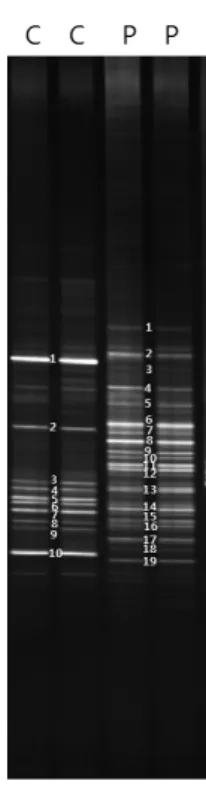
Fig. 1. DGGE banding patterns of amplified 16S rRNA gene obtained from Cinachyrella sp. (C) and Plakortis sp. (P).
계통학적 분석 및 계통수 작성
DGGE 결과로 얻어진 염기서열은 NCBI (the National Center for Biotechnology Information)에 등록된 염기서열을 대상으로 Blast search를 수행하였다. 각 염기서열의 alignment 는 CLUSTALW (Thompson et al., 1994)를 이용하여 정렬하 였고 Molecular Evolutionary Genetics Analysis (MEGA) software version 4.0을 이용하여(Tamura et al., 2007) neighbor- joining 방법(Saitou and Nei, 1987)에 의해 진화거리를 계산하 고 계통수를 추론하였다. 1,000회 반복 bootstrap 분석에 의해 계통수를 확인하였다.
결과 및 고찰
DGGE 밴드 양상
2012년 2월 남태평양 미크로네시아의 축(Chuuk)의 동일 지역에 서식하며 서로 다른 속(genus)에 속하는 두 개체의 해 양 해면 Cinachyrella sp.와 Plakortis sp.의 공생세균의 계통학 적 다양성을 알아보기 위하여 16S rRNA gene PCR-DGGE 방 법을 사용하여 조사하였다. 해면 시료로부터 추출한 유전체 DNA를 주형으로 16S rRNA gene의 V3영역을 증폭하여 194 bp의 예상된 크기의 PCR 산물을 얻었다. 동일 개체의 해면인
경우 동일한 DGGE 밴드 패턴을 나타내어 이 실험의 재현성을 확인할 수 있었다(Fig. 1). DGGE 밴드 유형은 서로 다른 두 속 의 해면 Cinachyrella sp.와 Plakortis sp.에서 서로 다른 패턴을 나타내었으며, Cinachyrella sp.에서 10개, Plakortis sp.에서 19개의 주요 밴드를 확인할 수 있었다(Fig. 1). DGGE 밴드가 나타내는 세균 다양성을 파악하기 위하여 16S rRNA gene의 부분 염기서열을 분석하였다.
염기서열 분석
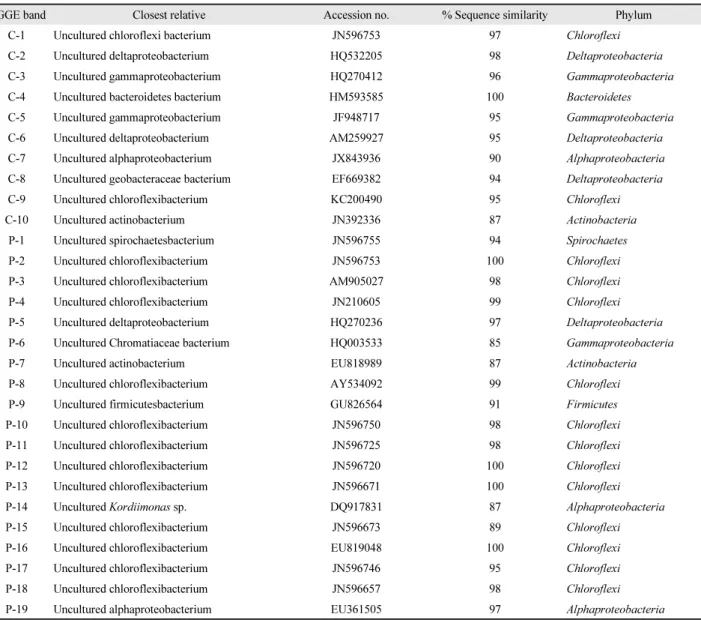
DGGE의 밴드 패턴으로부터 공생세균 군집구조를 분석하 기 위하여, 확인된 DGGE의 밴드에서 DNA를 추출하여 염기 서열을 분석하였다. 총 29개 밴드에 대한 염기서열을 확인 할 수 있었으며, 결정된 서열들은 기존에 알려진 염기서열과 85%에서 100%의 상동성을 나타내었다(Table 1). DGGE 밴 드로부터 분석된 대부분의 서열들은 배양되지 않은 세균 (uncultured bacterium)들과 높은 상동성을 나타내었다. 일반 적으로 자연계에서 실제 배양 가능한 종은 전체 미생물 군집 의 1–10% 이하인 것으로 알려진 바와 같이 본 연구에서 조사 된 두 종의 해면에 존재하는 공생세균 역시 배양되지 않은 세 균이 높은 비율로 존재하는 것을 알 수 있었다.
해면 Cinachyrella sp.의 공생세균의 염기서열은 기존에 알 려진 염기서열과 87–100%의 상동성을 나타내었다(Table 1).
DGGE 밴드에서 C-1과 C-9는 uncultured chloroflexibacterium 과 각각 97%와 95%의 상동성을 나타내었으며 C-2와 C-6은 각각 uncultured deltaproteobacterium과 95%와 98%의 상 동성을 나타내었다. DGGE 밴드 C-3과 C-5는 uncultured gammaproteobacterium과 각각 96%, 95%의 상동성을, C-4는 uncultured bacteroidetesbacterium과 100%, C-7은 uncultured alphaproteobacterium과 90%, 그리고 C-10은 uncultured actinobacerium과 87%의 상동성을 나타내었다.
해면 Plakortis sp.의 공생세균의 염기서열은 기존에 알려진 염기서열과 85–100%의 상동성을 나타내었다(Table 1). DGGE 밴드 P-1은 uncultured spirochaetesbacterium과 94%의 상동 성을 나타내었고, P-2, P-3, P-4, P-8, P-10, P-11, P-12, P-13, P-15, P-16, P-17 그리고 P-18은 uncultured chloroflexibacterium 과 89–100%의 상동성을 나타내었다. DGGE 밴드 P-5는 uncultured deltaproteobacterium과 97%, P-6은 uncultured chromatiaceae bacterium과 85% 그리고 P-7은 uncultured actinobacterium과 87%의 상동성을 각각 나타내었다. DGGE 밴드 P-9는 uncultured firmicutesbacterium과 91%, P-14는 uncultured Kordiimonas sp.와 87% 그리고 P-19는 uncultured alphaproteobacterium과 97%의 상동성을 각각 나타내었다.
Table 1. Phylogenetic affiliation of re-amplified DGGE bands derived from the marine sponges Cinachyrella sp. (C) and Plakortis sp. (P)
DGGE band Closest relative Accession no. % Sequence similarity Phylum
C-1 Uncultured chloroflexi bacterium JN596753 97 Chloroflexi
C-2 Uncultured deltaproteobacterium HQ532205 98 Deltaproteobacteria
C-3 Uncultured gammaproteobacterium HQ270412 96 Gammaproteobacteria
C-4 Uncultured bacteroidetes bacterium HM593585 100 Bacteroidetes
C-5 Uncultured gammaproteobacterium JF948717 95 Gammaproteobacteria
C-6 Uncultured deltaproteobacterium AM259927 95 Deltaproteobacteria
C-7 Uncultured alphaproteobacterium JX843936 90 Alphaproteobacteria
C-8 Uncultured geobacteraceae bacterium EF669382 94 Deltaproteobacteria
C-9 Uncultured chloroflexibacterium KC200490 95 Chloroflexi
C-10 Uncultured actinobacterium JN392336 87 Actinobacteria
P-1 Uncultured spirochaetesbacterium JN596755 94 Spirochaetes
P-2 Uncultured chloroflexibacterium JN596753 100 Chloroflexi
P-3 Uncultured chloroflexibacterium AM905027 98 Chloroflexi
P-4 Uncultured chloroflexibacterium JN210605 99 Chloroflexi
P-5 Uncultured deltaproteobacterium HQ270236 97 Deltaproteobacteria
P-6 Uncultured Chromatiaceae bacterium HQ003533 85 Gammaproteobacteria
P-7 Uncultured actinobacterium EU818989 87 Actinobacteria
P-8 Uncultured chloroflexibacterium AY534092 99 Chloroflexi
P-9 Uncultured firmicutesbacterium GU826564 91 Firmicutes
P-10 Uncultured chloroflexibacterium JN596750 98 Chloroflexi
P-11 Uncultured chloroflexibacterium JN596725 98 Chloroflexi
P-12 Uncultured chloroflexibacterium JN596720 100 Chloroflexi
P-13 Uncultured chloroflexibacterium JN596671 100 Chloroflexi
P-14 Uncultured Kordiimonas sp. DQ917831 87 Alphaproteobacteria
P-15 Uncultured chloroflexibacterium JN596673 89 Chloroflexi
P-16 Uncultured chloroflexibacterium EU819048 100 Chloroflexi
P-17 Uncultured chloroflexibacterium JN596746 95 Chloroflexi
P-18 Uncultured chloroflexibacterium JN596657 98 Chloroflexi
P-19 Uncultured alphaproteobacterium EU361505 97 Alphaproteobacteria
계통학적 분석
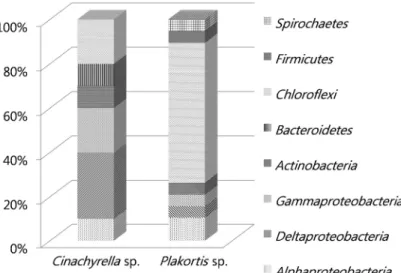
각 DGGE 밴드에서 유래한 16S rRNA gene의 염기서열로부 터 계통수를 작성하고 계통학적 다양성을 분석하였다. 결과, 두 해면에서 유래한 세균그룹은 전체 6문(phylum) 8강(class)으 로 나뉘어졌으며(Fig. 2), 해면 Cinachyrella sp.의 주요 공생세 균 군집은 Alphaproteobacteria (10%), Gammaproteobacteria (20%), Deltaproteobacteria (30%), Actinobacteria (10%), Bacteroidetes (10%), Chloroflexi (20%), 4문 6강으로 구성 되며, 해면 Plakortis sp.의 주요 공생세균의 군집구조는 Alpha- proteobacteria (11%), Gammaproteobacteria (5%), Delta- proteobacteria (5%), Actinobacteria (5%), Chloroflexi (63%), Firmicutes (5%), Spirochaetes (5%)의 5문 7강으로 구성된 것
으로 나타났다(Fig. 3).
두 종의 해면에서 Actinobacteria, Chloroflexi 그리고 Proteo- bacteria (Alpha-, Gamma-, Delta-)는 공통적으로 발견되었으 며(Figs. 2 and 3), 이 3개의 문은 지금까지 밝혀진 해면공생세 균 29개의 문 중 자주 관찰되는 6개의 문에 속하는 세균그룹 이다(Dupont et al., 2013). Proteobacteria의 경우, 해면 Cinacyrella sp.에서는 60%로 나타나 우점 세균그룹이었는데 비하여 Plakortis sp.에서는 21%만을 점유하였다. 한편, Plakortis sp. 해면의 우점 세균 그룹은 Chloroflexi (63%)로, 두 종의 해 면에서 우점 세균그룹에 있어 차이를 나타내었다. 해양 해면 의 공생세균 그룹 중 많은 생리활성 물질을 생산하는 것으로 알려진 Actinobacteria (Imamura et al., 1993; Khan et al., 2012)는 본 실험에 사용된 두 종의 열대 해면에서 공통적으로
Fig. 2. Phylogenetic tree from analysis of 16S rRNA gene sequences of DGGE bands from Cinachyrella sp. and Plakortis sp. Numbers above branches indicate bootstrap values of neighbor-joining analysis (>50%) from 1,000 replicates. The scale bar represents 0.05 substitutions per nucleotide position.
Fig. 3. Comparison of bacterial community based on 16S rRNA gene-V3 in Cinachyrella sp. and Plakortis sp.
발견되었는데 두 종의 해면에서 다양한 생리 활성물질이 생산 된다는 것은 위에서 설명한 바와 같다. 공통 세균 그룹의 하나 인 Chloroflexi는 해면에서 3-hydroxypropionate pathway를 통해 무기물을 유기물로 바꾸는 영양동화작용을 돕는 것으로 알려져 있다(Brock et al., 1984; Brück et al., 2012).
Cinachyrella sp.해면은 주요 공통 세균 그룹 외에 Bacteroidetes
를 더 포함하는 것으로 나타났다. 이 문에 속하는 세균은 해양 생태계에서 매우 다양하고 풍부하게 존재하며 고분자 유기물 질을 분해하는 주요 세균 그룹으로 알려져 있다(Cottrell and Kirchman, 2000; O’Sullivan et al., 2006). Plakortis sp. 해면의 경우, Firmicutes와 Spirochaetes 세균 그룹을 더 포함하여 Cinachyrella sp.와는 다른 공생세균 군집구조를 갖는 것으로
나타났다. 즉, 동일 서식지에서 채집된 Cinachyrella sp.와 Plakortis sp.의 공생세균 군집구조는 해면 종에 따른 차이를 나타내었다.
남태평양 축(Chuuk)의 동일지역에서 채집한 두 종의 해면의 공생세균 군집 다양성에 관한 Park (2010)의 연구에 따르면, Callyspongia sp. 해면에서는 3문 4강이, Hyrtios sp. 해면에서는 6문 7강이 검출되어 공생세균 군집구조에서 차이를 나타내었 다. 또한 홍해에서 채집한 Hyrtios erectus와 Amphimedon sp. 해 면의 공생세균 군집구조의 분석 결과(Radwan et al., 2010)에 서도 각각 7문 9강, 5문 7강의 세균 문이 발견되어 해면 종에 따 른 차이를 나타내었다. 이는 동일 서식지의 해면이라도 종에 따라 공생세균의 군집구조가 서로 다르게 나타난 본 연구 결 과와 일치하는 것이다.
한편, 우리나라 제주도에서 채집한 Cinachyrella sp. (Cho et al., 2010)와 본 연구에 사용된 미크로네시아 축(Chuuk)에서 채집한 Cinachyrella sp.의 공생세균 군집구조를 비교하면 Alphaproteobacteria, Gammaproteobacteria 그리고 Actino- bacteria가 공통으로 존재하였으나, 미크로네시아에서 채집 한 해면의 경우 Deltaproteobacteria, Bacteroidetes 그리고 Chloroflexi 세균그룹이 더 존재하는 것으로 나타났다. 이러한 결과는 동일한 속의 해면일지라도 공생세균은 서식지에 따른 지리적 군집을 형성하며(Zhang et al., 2014), 주변 환경과 생태 학적 필요에 따라 숙주 특이적인 세균의 일부 문이 선택된다는 연구 결과(Radwan et al., 2010)에 상응하는 것으로 볼 수 있다.
pyrosequencing 방법을 이용한 Cuvelier 등(2014)의 연구에 따르면 대서양에서 채집한 Cinachyrella속 해면 6개체의 공생 미생물의 군집구조에서 우점 세균그룹으로 Proteobacteria가 검출되어 본 실험에 사용한 Cinachyrella 해면의 우점 세균그 룹과 일치하였다. 반면, 전체 군집구조에 있어서는 이들의 연 구에서는 17개의 세균그룹이 더 검출된 바, 이는 방법에 따른 차이를 반영한 것으로 생각된다. Pyrosequencing에 의한 경우 0.07% 이상 점유하는 세균 그룹들은 검출이 가능한 것으로 (Cuvelier et. al., 2014) 알려져 있다.
Plakortis속 해면 중 카리브해에서 채집된 P. halichondioides 의 경우(Della Sala et al., 2014), 본 실험에 사용한 Plakortis sp.
의 공생세균 군집구조와 비교할 때 Proteobacteria, Acidobacteria 그리고 Chloroflexi의 공통 세균그룹 외에 Acidobacteria, Nitrospira 그리고 Gemmatimonadetes가 더 검출되었다. 반면 본 실험에 사용한 Plakortis sp.의 경우 Firmicutes와 Spirochaetes 가 더 검출되어 주요 세균군집 구조에 있어 차이를 나타내었 다. 결론적으로 동일지역에서 채집한 서로 다른 두 종의 해면 은 각각 다른 공생세균 군집구조를 나타내어 해면 종에 따른
숙주 특이적 분포를 나타내는 것으로 판단할 수 있다.
공생세균의 숙주특이적 분포의 경향성을 파악하기 위해서 는 다양한 방법을 통하여 다양한 지역으로부터 해면을 채집하 여 분석할 필요가 있다. 본 실험에 사용한 16S rRNA gene에 근 거한 PCR-DGGE 방법은 해면공생세균의 군집구조를 분석하 는데 신속하고 비용 대비 효과적인 방법(Bauvais et al., 2015) 이나 DNA추출 방법에 따라 우점 그룹이 달라진다는 연구가 제시되었고(Hardoim et al., 2009), 최근 pyrosequencing과 같 은 high-throughtput method를 이용할 경우 매우 광범위한 미 생물 군집의 검출이 가능하다. 그러나 젤 전기영동의 밴드 패 턴의 차이를 가시적으로 확인할 수 있는 DGGE 방법은 여전히 해면 공생 세균의 대략적인 군집 구조를 파악하는 데 매우 유 용하다(Poppell et al., 2014). 해면 공생세균 군집구조의 다양 성에 관한 연구는 전 세계 해역으로부터 채집한 다양한 종의 해면을 대상으로 진행되고 있으며(Della Sala et al., 2014;
Dupont et al., 2014), 이는 해면으로부터 생산되는 유용 생리 활성물질을 안정적으로 획득하기 위한 선행 연구로써 매우 중 요하다.
적 요
2012년 2월 남태평양 미크로네시아 축(Chuuk)에서 채집한 두 종의 해양해면 Cinachyrella sp.와 Plakortis sp.의 공생세균 의 군집구조를 PCR-DGGE 방법을 사용하여 조사하였다.
Cinachyrella sp.와 Plakortis sp. 해면의 total genomic DNA에 서 16S rRNA gene-V3 부분을 증폭하여 DGGE를 수행하였으 며, 두 종의 해면에서 서로 다른 밴드 패턴이 나타났다. DGGE 밴드로부터 16S rRNA gene의 부분 염기서열을 분석한 결과, 알려진 균주의 염기서열들과 87-100%의 유사도를 나타내었 다. Cinachyrella sp.의 공생세균 군집구조는 Actinobacteria, Bacteroidetes, Chloroflexi, 그리고 Proteobacteria (Alpha-, Gamma-, Delta-), 6강으로 구성되었다. Plakortis sp.의 공생세균 군집구조는 Actinobacteria, Chloroflexi, Firmicutes, Spirochaetes 그리고 Proteobacteria (Alpha-, Gamma-, Delta-), 7강으로 구 성되었다. 두 종의 해면에서 Actinobacteria, Chloroflexi와 Proteobacteria가 공통적으로 존재하였으나 주요 세균군집은 서로 다른 것으로 나타났다. 즉 Cinachyrella sp.의 경우 Proteobacteria가, Plakortis sp.의 경우, Chloroflexi가 주요 세 균 군집이었다. 동일지역에서 채집한 서로 다른 두 종의 해면 은 각각 다른 공생세균 군집구조를 나타내어 해면 종에 따른 숙주 특이적 분포를 보이는 것으로 나타났다.
감사의 말
이 논문은 2013년 해양수산부 재원으로 한국해양과학기술 진흥원(PJT200254)의 지원을 받아 수행되었으며 이에 감사 드립니다.
References