Citrobacter freundii is a facultative anaerobic and a Gram- negative bacterium of Enterobacteriaceae family, and is an opportunistic pathogen. Bacteriophages infecting C. freundii can be an effective treatment for C. freundii infections. Here, the complete genomic sequence is announced for a lytic bacteriophage CF1 infecting C. freundii isolates.
Keywords: Citrobacter freundii, bacteriophage, bacteriophage CF1, complete genome sequence, PacBio
Citrobacter freundii is an opportunistic pathogenic bacteria of the family Enterobacteriaceae (Wang et al., 2000). Since C.
freundii strains have exhibited an increasing resistance to antibiotics (Lockhart et al., 2007). Bacteriophage that kill such pathogens may be useful in the control and containment of these infection. Therefore, bacteriophages have been considered as an alternative treatment against C. freundii infection. Here, the complete genomic sequence and the genomic features of a
bacteriophage C. freundii CF1 is presented.
Bacteriophage CF1 infecting C. freundii was isolated from a sewage water sample near a livestock farm in Chungcheongnam- do, South Korea. Bacteriophage CF1 infecting C. freundii in the family Myoviridae with Icosahedron head and Contractile tail.
And phage DNA was extracted by incubating the bacteriophage culture with 20 mM EDTA, 50 µg/ml Proteinase K, and 0.5%
(w/v) SDS at 50°C for 1 h, followed by Phenol-Chloroform extraction and ethanol precipitation (Sambrook and Russell, 2001). Phage DNA was then sequenced using a PacBio SMRT system (Macrogen). Quality-controlled trimmed sequence reads were assembled to a single contig at 3845-fold coverage using Canu v1.4. Genes were predicted with RASTtk (Brettin et al., 2015), and the functions of predicted coding-genes were cal- culated with BLASTp searches (https://blast.ncbi.nlm.nih.gov/
Blast.cgi?PAGE=Proteins).
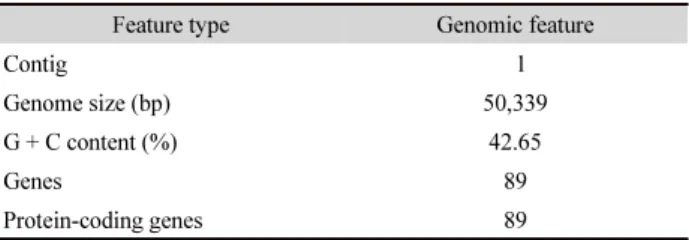
CF1 has a 50,339 bp double-stranded DNA (dsDNA) genome with 89 predicted coding genes and tRNA is not detected. The coding density of the genome is 92.3% and the G + C content of CF1 is 42.7%. This is significantly lower than the G + C content
Korean Journal of Microbiology (2018) Vol. 54, No. 1, pp. 79-80 pISSN 0440-2413
DOI https://doi.org/10.7845/kjm.2018.7099 eISSN 2383-9902
Copyright ⓒ 2018, The Microbiological Society of Korea
Draft genome sequence of lytic bacteriophage CF1 infecting Citrobacter freundii isolates
Youngju Kim
1,2, Seyoung Ko
3, Young Eun Yeon
1, Jaewon Lim
3, Beom Ku Han
1, Hyunil Kim
1, Jeong Keun Ahn
2, and Donghyuk Kim
3*
1
Optipharm Inc., Cheongju 28158, Republic of Korea
2
Department of Microbiology & Molecular Biology, Chungnam National University, Daejeon 34134, Republic of Korea,
3
Department of Genetic Engineering and Graduate School of Biotechnology, College of Life Sciences, Kyung Hee University, Yongin 17104, Republic of Korea
Citrobacter freundii 분리주를 감염시키는 용균 박테리오파지 CF1의 유전체 염기서열 초안
김영주
1,2・ 고세영
3・ 연영은
1・ 임재원
3・ 한범구
1・ 김현일
1・ 안정근
2・ 김동혁
3*
1
㈜옵티팜,
2충남대학교 미생물학과,
3경희대학교 생명공학원/유전공학과
(Received December 22, 2017; Revised January 2, 2018; Accepted January 8, 2018)
*For correspondence.
E-mail: [email protected];Tel.: +82-31-201-2683; Fax: +82-31-203-4969
80
∙Kim et al.미생물학회지 제54권 제1호
of C. freundii CFNIH1 (51.6%), which is the representative genome of C. freundii. A lower G + C content of a bacterio- phage than a G + C content of a host seems to be a commonly represented feature. The Salmonella Felix O1 phage have a G + C content (39.0%), which is much lower than that of the host Salmonella (approximately 52%) (Moreno Switt et al., 2013), and the similar pattern was found between a Felix O1-like phage (Guan et al., 2015) and its host C. freundii (51.6%) (Kumar et al., 2013). Of the 89 predicted coding genes, 34 are hypothetical or conserved genes, leaving 55 coding genes given a putative functions based on BLASTp analysis (Camacho et al., 2009). Analysis of orthologous genes between C. freundii CF1 and another lytic bacteriophage C. freundii Mordin (Guan et al., 2015) having 138 coding genes resulted in only one shared coding gene, which is an endolysin. Endolysin is a lethal bacteriocidal enzyme with an antibiotic capacity by destroying bacterial cell walls (Schmelcher et al., 2012). The genomic location of this endolysin in C. fruendii CF1 is from 23754 to 24248, and the gene name of its ortholog in C. freundii Mordin is Mordin_93. The unexpected bare overlap between two bacteriophages infecting the same host led to a comparison to the representative Citrobacter phage Stevie (NC_027350.1) which has about 50 kb double-stranded DNA genome and 90 coding genes (Shaw et al., 2015). Unlike C. freundii Mordin, Citrobacter phage Stevie is similar to C. freundii CF1 in terms of the genome size and the number of genes. Moreover, the ortholog analysis showed that C. freundii CF1 and Citrobacter phage Stevie share 86 orthologous genes which cover 96.63%
of genes in C. freundii CF1 genome, indicating that the genome of CF1 is quite close to that of Stevie.
Nucleotide sequence accession number
The genome sequence of bacteriophage CF1 was deposited in GenBank with the accession number KY694971.
적 요
본 연구에서는 돼지 축사 근처 하수 오물에서 분리된 그람 음성균이자 항생제 내성을 쉽게 획득하여 병원성을 띄는 균주 인 Citrobacter freundii를 host로 하는 박테리오파지의 유전체 분석을 수행하였다. 본 박테리오파지는 G + C 비율이 42.65%
이며, 50,339 bp로 구성된 유전체 DNA를 지니고 있었다. 이러 한 유전체 DNA에서 89개의 단백질 코딩 유전자가 확인 되었 으며, 이 중 55개의 유전자는 BLASTP 분석으로부터 기능을 가지고 있다고 추정되었다. 또한 RNA는 확인되지 않았다.
References
Brettin, T., Davis, J.J., Disz, T., Edwards, R.A., Gerdes, S., Olsen, G.J., Olson, R., Overbeek, R., Parrello, B., Pusch, G.D., et al. 2015.
RASTtk: a modular and extensible implementation of the RAST algorithm for building custom annotation pipelines and annotating batches of genomes. Sci. Rep. 5, 8365.
Camacho, C., Coulouris, G., Avagyan, V., Ma, N., Papadopoulos, J., Bealer, K., and Madden, T.L. 2009. BLAST+: architecture and applications. BMC Bioinformatics 10, 421.
Guan, J., Snowden, J.D., Cahill, J.L., Rasche, E.S., and Kuty Everett, G.F. 2015. Complete genome sequence of Citrobacter freundii myophage mordin. Genome Announc. 3, e01203-15.
Kumar, S., Kaur, C., Kimura, K., Takeo, M., Raghava, G.P., and Mayilraj, S. 2013. Draft genome sequence of the type species of the genus Citrobacter, Citrobacter freundii MTCC 1658. Genome Announc 1, e00120-12.
Lockhart, S.R., Abramson, M.A., Beekmann, S.E., Gallagher, G., Riedel, S., Diekema, D.J., Quinn, J.P., and Doern, G.V. 2007.
Antimicrobial resistance among Gram-negative bacilli causing infections in intensive care unit patients in the United States between 1993 and 2004. J. Clin. Microbiol. 45, 3352–3359.
Moreno Switt, A.I., Orsi, R.H., den Bakker, H.C., Vongkamjan, K., Altier, C., and Wiedmann, M. 2013. Genomic characterization provides new insight into Salmonella phage diversity. BMC Genomics 14, 481.
Sambrook, J. and Russell, D.W. 2001. Molecular cloning : a laboratory manual. Cold Spring Harbor Laboratory Press, Cold Spring Harbor, N.Y., USA.
Schmelcher, M., Donovan, D.M., and Loessner, M.J. 2012. Bacterio- phage endolysins as novel antimicrobials. Future Microbiol. 7, 1147–1171.
Shaw, J.P., Aviles Medina, C.A., Chen, Y., Luna, A.J., Hernandez, A.C., and Kuty Everett, G.F. 2015. Complete genome of Citrobacter freundii siphophage stevie. Genome Announc. 3, e01434-14.
Wang, J.T., Chang, S.C., Chen, Y.C., and Luh, K.T. 2000. Comparison of antimicrobial susceptibility of Citrobacter freundii isolates in two different time periods. J. Microbiol. Immunol. Infect. 33, 258–262.
Table 1. Genome features of Citrobacter freundii CF1
Feature type Genomic feature
Contig 1
Genome size (bp) 50,339
G + C content (%) 42.65
Genes 89
Protein-coding genes 89