http://dx.doi.org/10.7839/ksfc.2015.12.4.077
The Stress Analysis of Planetary Gear System of Mixer Reducer for Concrete Mixer Truck
Myung Ho Bae
1*, Tae Yeol Bae
2, Yon Sang Cho
3, Ho Yeon Son
4and Dang Ju Kim
4Received: 18 Oct. 2015, Revised: 23 Nov. 2015, Accepted: 4 Dec. 2015
Key Words:Concrete Mixer Truck, Mixer Reducer, Planetary Gear System, Gear Bending Stress, Gear Compressive Stress
Abstract: In general, the gears of mixer reducer for concrete mixer truck make use of the differential type planetary gear system to rotate mixer drum smoothly on the initial conditions. The planetary gear system is very important part of mixer reducer for concrete mixer truck because of strength problem. In the present study, calculating the gear specifications and analyzing the gear bending & compressive stresses of the differential planetary gear system for mixer reducer are necessary to analyze gear bending and compressive stresses confidently, for optimal design of the planetary gear system in respect to cost and reliability. As a result, analyzing actual gear bending and compressive stresses of the planetary gear system using Lewes & Hertz equation and verifying the calculated specifications of the planetary gear system, evaluate the results with the data of allowable bending and compressive stress from the Stress-No. of cycles curves of gears.
* Corresponding author: [email protected]
1 Dept. of Aviation Maintenance, Changwon Moonsung University, Korea
2 Dept. of Mechatronics, Changwon Moonsung University, Korea 3 Dept. of Mechanical Engineering, Dong-A University, Korea 4 DAIHO HYDRAULIC Co., Ltd, Korea
Copyright Ⓒ 2015, KSFC
This is an Open-Access article distributed under the terms of the Creative Commons Attribution Non-Commercial License(http://
creativecommons.org/licenses/by-nc/3.0) which permits unrestricted non-commercial use, distribution, and reproduction in any medium, provided the original work is properly cited.
Nomenclatures
Tmi : equivalent mean torque, (N·m) Nmi : equivalent mean rotating speed, rpm S : actual gear bending stress, N/mm2 P : actual gear compressive stress, N/mm2 Sab : allowable gear bending stress, N/mm2 Sac : allowable gear compressive stress, N/mm2
1. Introduction
Mixer reducer for concrete mixer truck is driven by a
hydraulic motor, as an important device to rotate the mixer drum, and to convert the required torque and rotational speed. Although the increasing initial torque resulting to the inertia moment increases of output section, the compound differential type planetary gear system applies the rotating motion that makes the mixer drum run smoothly which consists of the sun gear, the differential planetary gear and two ring gears. Gear teeth are damaged due to the lack of fatigue strength, compound planetary gears for mixer and by severe operating conditions of a concrete mixer truck that have become a problem.
The concrete mixer truck, is shown in Fig. 1, drum capacity, 6~8m³ class concrete mixer truck. Fig. 2 shows schematic diagram for analytical model of mixer reducer. Table 1 shows the specifications of the mixer reducer.
Several investigations have been reported, as cited by D.E. Imwalle2) “Load equalization in planetary gear systems”. D.L. Seager3) established load distribution calculation of the planetary gears. F. Cunliffe, J.D.
Smith and D.B. Welbourn4) Dynamic tooth loads in
epicyclic gears for planetary gears. Castellani G., and V.P. Castelli5) also cited the gear strength analysis method.
Table 1 Specifications of the mixer reducer
Drum capacity
Hyd. motor max. input torque/speed
Gear ratio
Max. output torque
Installation angle of drum
6~8㎥ 397 N·m
/1,320rpm 132:1 52,400N·m 15~20°
Fig. 1 Drum capacity, 6~8m³ class concrete mixer truck and driving-related parts of the mixer drum
A : sun gear, B : NO.1 pinion gear, C : NO.1 ring gear, D : NO.2 pinion gear, E : NO.2 ring gear, S : carrier
Fig. 2 Schematic diagram of analytical model
Fig. 3 Equation system solving with gear specifications calculation and stress analysis
Coy, J.J., D.P. Townsend, and E.V. Zaretsky6) further emphasized the dynamic capacity and surface pressure durability life of spur and helical gears. Oda, Satoshi and Koji Tsubokura7) similarly stressed the effect of bending endurance strength for addendum modification of spur gears and was likewise investigated. There is also an inclusion of typical bending strength calculation of planetary gears AGMA 218.018) and Gear Handbook by Dudly, Darle W.9) that shows bending strength calculation method of planetary gears.
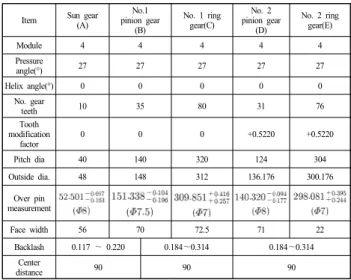
In this study, developing planetary gear specifications calculation program and producing detailed specifications of the planetary gear system for mixer reducer is based on Gear Handbook by Dudly, Darle W.9)
Moreover, developing also the stress analysis program of planetary gear system by Lewes1) & Hertz9) equation and analyzing the safety factor of gear bending and compressive stresses consider required life time of mixer reducer and the S/N curve presented in the Gear Handbook by Dudly, Darle W.9)
It also verified the predictive validity with respect to the developed programs. Fig. 3 shows the equation system solving with gear specifications calculation and strength analysis of the planetary gear system for mixer reducer.
2. Material and analytical method 2.1 Calculation of gear specifications
Table 2 shows the specifications for the planetary gears of mixer reducer by developed programs.
Table 2 Specifications of the planetary gear system
Item Sun gear (A)
No.1 pinion gear
(B)
No. 1 ring gear(C)
No. 2 pinion gear
(D)
No. 2 ring gear(E)
Module 4 4 4 4 4
Pressure
angle(°) 27 27 27 27 27
Helix angle(°) 0 0 0 0 0
No. gear
teeth 10 35 80 31 76
Tooth modification
factor 0 0 0 +0.5220 +0.5220
Pitch dia 40 140 320 124 304
Outside dia. 48 148 312 136.176 300.176
Over pin measurement
Face width 56 70 72.5 71 22
Backlash 0.117 ~ 0.220 0.184~0.314 0.184~0.314
Center
distance 90 90 90
(1)
Working
mode Frequency of use(%) Working
time(h)
Input
Duty cycle Cycle ratio Torque
(N∙m) Speed(rpm)
Input concrete 4 1,136 189.9 1320 89971200 0.125391849
Driving 41 11,644 189.9 264 184440960 0.257053291
Normal
working 12 3,408 241.7 660 134956800 0.188087774
Maximum
working 1 284 284.8 132 2249280 0.003134796
Driving 38 10,792 52.4 264 170945280 0.238244514
Washing 4 1,136 52.4 1980 134956800 0.188087774
Total 100 28,400 - - 717,520,320 1
(2)
(3)
(4)
(5)
(6)
(7)
(8) 2.2 Input equivalent torque/rotation speed analysis
The required service period of life, for a concrete mixer truck is 15 years with the vehicle operation rate of 70%, operating time is set 12 hours for a day, based on the total 28,400 hours, as shown in Table 3.
Equivalent mean torque for the average equivalent load of mixer reducer, Tmi is as follows:
whereas Ti is working torque, N is rotating speed, t is working time, n is power index (n = 20.8).
Table 3 Operating mode and the required life period
Equivalent mean rotating speed for the average equivalent rotating speed of mixer reducer, Nmi is as follows:
whereas Nmi is equivalent rotating speed for the average equivalent rotating speed, Ni is rotating speed, ti
is working time.
From the equation (1) and (2), the equivalent mean torque/rotating speed was calculated 227.6N·m /421.08 rpm.
2.3 Torque and number of rotation analysis
From schematic diagram in Fig. 2, the gear ratio of mixer reducer calculated by relative speed diagram method10) is as follows:
The number of rotation for each planetary gear calculated by relative speed diagram method10) is as follows:
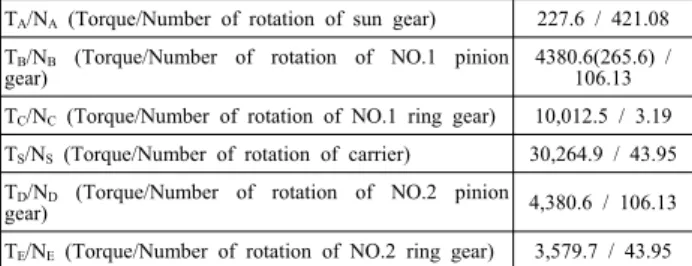
From the above equations, the torque and rotation speed is shown in Table 4.
Table 4 Torque and number of rotation (N·m/rpm)
TA/NA (Torque/Number of rotation of sun gear) 227.6 / 421.08 TB/NB (Torque/Number of rotation of NO.1 pinion
gear) 4380.6(265.6) /
106.13 TC/NC (Torque/Number of rotation of NO.1 ring gear) 10,012.5 / 3.19 TS/NS (Torque/Number of rotation of carrier) 30,264.9 / 43.95 TD/ND (Torque/Number of rotation of NO.2 pinion
gear) 4,380.6 / 106.13
TE/NE (Torque/Number of rotation of NO.2 ring gear) 3,579.7 / 43.95
whereas ZA is number of teeth of sun gear(10), ZB is number of teeth of NO.1 pinion gear(35), ZC is number of teeth of NO.1 ring gear(80), ZD is number of teeth of NO.2 pinion gear(31), ZE is number of teeth of NO.2 ring gear(76)
2.4 Gear bending stress analysis
The actual gear bending stress equation by Lewes1) formula is as follows:
whereas S is actual gear bending stress(N/mm2), T is torque(N·m), Na is length of action in the plane of rotation(mm), F is face width(mm), X is Lewes bending factor(mm), Z is number of teeth.
Allowable gear bending stress equation by Gear Handbook of Dudly, Darle W.9) including gear bending S/N curve is as follows:
whereas Sab is allowable gear bending stress(N/mm2), NF is No. of cycles, C1 is coefficient.
2.5 Gear compressive stress analysis
The actual gear compressive stress P(N/mm2) applied
(9)
(10) to the tip of the planetary gears based on contact formula of Hertz9) is as follows:
whereas α is normal pressure angle, Φ is transverse pressure angle, T is torque on driving gear(N·m), Fc is active face width in contact(mm), Z is No. of teeth on driving gear, CD is operating center distance, Na is length of action in the plane of rotation(mm), A =
, OR is outside radius of gear, BR is base radius of gear.
Allowable gear compressive stress equation by Gear Handbook of Dudly, Darle W.9) including gear compressive S/N curve is as follows:
whereas Sac is allowable gear compressive stress(N/mm2), NF is No. of cycles, C2 is coefficient.
2.6 The results of gear bending and compressive stress analysis
Calculating actual gear bending and compressive stresses of planetary gear system for mixer reducer and considering allowable gear bending and compressive stresses, produce safety factors and verify the problems of gear strength for the calculated specifications of the planetary gear system for mixer reducer.
Fig. 4 shows the results of gear bending stress analysis and Fig. 5 shows the results of gear compressive stress analysis of planetary gear system for mixer reducer. Planetary gear system of mixer reducer for concrete mixer truck consisted of five gears.(A to E)
Fig. 4 The results of gear bending stress analysis
Fig. 5 The results of gear compressive stress analysis
It can be shown that actual gear bending &
compressive stresses of the planetary gear system are under the allowable gear bending and compressive stresses in these S/N curves. Thus, calculation results are set safely and has been verified as valid.
3. Conclusion
(1) In this study, analysis actual gear bending and compressive stresses of the planetary gear system using Lewes & Hertz equation and verifying the calculated specifications of the planetary gear system, evaluate the results with the data of allowable bending and compressive stress from the Stress-No. of cycles curves of gears, based on Gear Handbook of Dudly, Darle W9) for drum capacity, 6~8m³class planetary gear system of mixer reducer for concrete mixer truck.
(2) Considering the result of gear bending and compressive stress analysis of calculated specifications for planetary gear system of mixer reducer for drum capacity, 6~8m³class, concrete mixer truck, the strength of planetary gear system and the developed programs have been verified as valid.
(3) Reducer is an important component for construction machinery industry of the developed programs, calculating the specifications and analyzing the gear bending and compressive stresses of the differential planetary gear system for mixer reducer are expected to be effectively utilized.
Future research on more excellent planetary gear
system of the various reducers for construction machines is expected to be still performed.
Acknowledgement
This work was supported by the Ministry of Trade, Industry & Energy,(project number ; A010600035, A development of mixer drum driving unit for 6 ~ 8 Lube grade concrete mixer truck) and the authors are gratefully appreciative of the support.
References
1) Lewes, Wilfred, “Investigation of Strength of Gear Teeth,” Proc. Eng. Club, Philadelphia, pp. 38-55, 1893.
2) D. E. Imwalle, “Load Equalization in Planetary Gear Systems,” ASME publication at the Mechanisms Conference & International Symposium on Gearing and Transmissions, pp. 232-238, 1972 3) D. L. Seager, “Load Sharing among Planet Gears,”
SAE publication No. 700178, pp. 651-656, 1972 4) F. Cunliffe, J. D. Smith and D. B. Welbourn,
“Dynamic Tooth Loads in Epicyclic Gears,”
Transactions of the ASME Journal of Engineering for Industry, pp. 578-584, 1974.
5) Castellani G., and V. P. Castelli, “Rating Gear Strength,” ASME Paper No. 80-C2/DET-88, pp.
37-43, 1980.
6) Coy, J. J., D. P. Townsend, and E. V. Zaretsky,
“Dynamic Capacity and Surface Fatigue Life for Spur and Helical Gears,” ASME Paper No.
75-Lub-19, pp. 56-73, 1975.
7) Oda, Satoshi and Koji Tsubokura, “Effects of Addendum Modification on Bending Fatigue Strength of Spur Gears(3rd Report, Cast Iron and Cast Steel Gears),” Bull. JSME, Vol. 24, No. 190, Paper No. 190-15, April, pp. 24-30, 1981.
8) AGMA Standard 218.01, “The Pitting Resistance and Bending Strength of Spur and Helical Involute Gear Teeth,” The American Gear Manufacturers Association, pp. 14-20, 1982.
9) D.W. Dudley, The Handbook of Practical Gear Design, 2nd Edition, Mcgraw-Hill, pp. 1.27-1.32, 2.1-2.12, 3.1-3.45, 3.78-3.112, 1984.
10) M. H. Bae, S. K. Jang and S. Y. Lee. Automotive
& Continuously Variable Transmission, 2nd Edition, Sun Hak publication, pp. 37-44, 2009.