중생 다수성 향미 신품종 ‘효원5호’
이영상
1
⋅박용진2
⋅조유현3
⋅박소연4
⋅권순욱4*
1순천향대학교 의료생명공학과, 2공주대학교 식물자원학과, 3㈜ 시드피아, 4부산대학교 식물생명과학과
A Medium Maturing High-Yield Rice Variety with Aroma, ‘Hyowon 5’
Young-Sang Lee
1
, Yong-Jin Park2
, Yoo-Hyun Cho3
, So-Yeon Park4
, and Soon-Wook Kwon4
1Department of Medical Biotechnology, Soonchunhyang University, Asan 31538, Korea
2Department of Plant Resources, Kongju National University, Yesan 32439, Korea
3Seed Pia Co. Suwon 16395, Korea
4Department of Plant Bioscience, Pusan National University, Miryang 50463, Korea
Abstract : ''Hyowon 5’, a new aromatic rice variety with high yield was derived from a cross between 'Dasan’ as a high yield source and ‘IR841-1-1-2’ as a donor for aroma. A general pedigree breeding method was applied to develop Hyowon 5. In F
8generation, a promising line, JS14-12-36-8-5-3-1-1-1, was selected and designated as the name of ‘SP 102’ in 2012. This variety headed on Aug. 14 , which is 3 days later than ‘Hwayoung’ in middle plane. The brown rice of this aromatic variety ‘Hyowon 5’ exhibited 51 odor-active volatiles including a pop corn-flavoring 2-acetyl-1-pyrroline which is exclusively detected in aroma rice varieties. The Culm length and panicle length of this variety was 83.2 cm and 26.4 cm, respectively. This variety has about 14.9 tillers per hill and 124.5 spikelet numbers per panicle. The 1000-grain weight was 20.9 g in brown rice. The yield performance of brown rice was 6.27 MT/ha in local adaptability test.
Keywords : Rice, Hyowon5, aroma, high-yield
*Corresponding author (E-mail: [email protected], Tel: +82- 55-350-5506, Fax: +82-55-350-5509)
(Received on April 8, 2016. Accepted on May 9, 2016.)
Copyright ⓒ 2016 by the Korean Society of Breeding Science
This is an Open-Access article distributed under the terms of the Creative Commons Attribution Non-Commercial License (http://creativecommons.org/licenses/by-nc/3.0) which permits unrestricted non-commercial use, distribution, and reproduction in any medium, provided the original work is properly cited.
서 언
벼의 육종목표는 다수성, 안정성 및 양질성 등으로 대별할 수 있는데, 이러한 목표의 우선순위는 사회와 경제적 여건에 따라 다양하게 변화되어 왔다. 최근에는 국민의 건강을 위한 새로운 기능성 쌀에 대한 요구가 증대되고 있다. 따라서 국내 쌀 소비 기반 확대를 위해서는 기존 수량 및 품질 중심의 밥쌀 시장을 유지하는 것과 함께 다양한 쌀 가공식품 시장 개척을 통한 쌀 소비기반 확충이 필요하다. 향미벼는 팝콘향을 비롯하여 특이한 풍미를 나타내는 벼로서 방글라데시, 인도, 태국 등 동남 아시아 국가에서는 전통적으로 많이 재배되어 고가에 판매되어 왔으며(Buttery et al. 1986) 국내에서도 쌀 이용성 다양화를 위해 유색미 등과 함께 향미 품종육성에 대한 관심이 높아지면서 농촌진흥청에서는 1993년 향미벼 1호(Choi et al. 1995) 육성을
시작으로 1995년과 1996년에는 미향벼, 향남벼 등을 육성하였 으며(Ha et al. 1996, 2003), 이후 향미벼 2호, 아랑향찰, 설향찰, 흑향 등이 육성된 바 있다(Moon et al. 1998, 2003). 최근에는 유색미에 향을 결합한 선향흑미(Kim et al. 2014)가 육성되었으 며, 한국원자력 연구소에서는 감마선 처리를 통해 흑선찰을 육성 한 바 있다(Shin et al. 2001). 국립농업유전자원센터에서는 국내 육성 품종과 국외 수집자원에 대한 이화학적 특성평가 및 벼에서 향기의 주성분으로 보고된 2-acetyl-pyrroline(2AP) 정량분석 및 방향성 화합물의 비교 분석하였으며, 이를 토대로 도입 가능한 우수 육성소재를 보고한 바 있으나(Kim et al 2008, 2009) 아직 도 국내 재배 환경에 적합하며 한국인의 선호도가 높은 향 특성을 갖는 향미벼 품종의 개발은 매우 미흡한 실정이다.
본 연구는 가공용 향미 품종 개발을 위해 수량성이 우수한 다산벼와 Basmati 향미인 IR841-1-1-2를 인공교배하여 다수성 향메벼 특성을 갖는 “효원5호”를 개발하였기에 그 육성 경위와 주요 농업적 특성에 대해 보고한다.
재료 및 방법
생산력 검정
본 시험은 ‘효원5호’와 ‘화영’을 공시하여 2012, 2013년 2년 간 중부지역 2개소와 남부지역에서 1개 지역에서 실시하였다.
재배법은 농촌진흥청 표준재배법에 준하였고, 4월 22일에 파종 하여 5월 21일에 30 × 15 cm의 재식거리로 이앙하였고, 시비량 은 N-P-K = 9-4.5-5.7 kg/10a로 시비하였다. 시험구 표본 채취는 1반복당 30주로 3반복씩 수확하였고, 시험구 배치는 난괴법 3반복으로 하였다.
현미 지방산 조성 분석
지방산 조성비율 분석은 Cho et al.(2006)에 준하여 현미 가루 0.2g을 methylation 처리 후 GC(Gas Chromatography, Varian CP-3800, Palo Alto, CA, USA)를 이용하여 분석하였다.
Column은 CP-SIL 88(50m x 0.25mm)를 사용하였고, 검출기는 flame ionization detector(FID)를 사용하였으며, 분석온도는 210 ℃로 하였다. 주입구는 split ratio를 50:1로 하였고, column 온도는 초기 100℃에서 5분 동안 유지한 후, 분당 4℃씩 180℃
까지 올리고, 180℃에서 5분간 유지한 후, 분당 5℃씩 210℃까 지 올려 20분간 유지하였다. 지방산 조성은 각 지방산 peak area의 상대적인 비율(%)로 나타내었으며, 대조 품종으로는 진 상벼(Hong et al. 2014)를 이용하였다.
기능성 지질 성분 분석
현미 시료의 토코페롤(T), 토코트리에놀(T3), 파이토스테롤 류의 분석은 Bhandari et al.(2012)에 따라 수행되었다. 즉, 현미 가루 0.5g을 ascorbic acid와 함께 ethanol과 KOH와 함께 80도 에서 비누화 반응을 수행하고 hexane으로 이행하는 과정을 3회, 증류수로 세척하는 과정을 3회 수행한 후, Na2SO4에 통과시켜 수분을 제거하고 회전 농축기를 이용하여 hexane을 제거한 후, isooctane 2 ㎖에 완전히 녹인 후 GCMS로 분석하였다. 기능성 지질성분의 분석시 대조 품종으로는 진상벼를 이용하였다.
향기 성분 Profiling 분석
향기성분의 분석은 Sriseadka et al.(2006)의 방법을 변형하 여 수행되었다. 즉, 현미 가루 5g을 headspace vial에 넣고, SPME(solid phasemicroextraction)가 부착된 GC-MS(QP-20 10 Ultra, Shimadzu, Japan)로 volatile profiling을 수행하였다.
Divinylbenzene /Carboxen/PDMS (57348-U, SUPELCO, US A) fiber를 이용한 SPME 분석 시 80℃에서 20분간 pre-heating 된 시료를 동일 온도에서 20분간 향기성분을 흡착(adsorption) 한 후 이를 GCMS injector 내에서 10분간 탈착(desorption)하였 다. Column은 Rtx-5MS(30m x 0.25mm)를 사용하였고, injecti on 온도는 250℃, ion source 온도는 200℃, interface 온도는 270℃로 하였으며, 분당 1.04mL 속도로 helium gas를 흘려주었 다. 향기 성분의 동정은 Wiley(version 9) 및 NIST(version 11) GCMS library를 활용하였으며, n-alkane을 이용한 retentio n index 정보를 추가로 적용하여 수행되었다. 향기분석 시 대조 품종은 추청벼를 이용하였다.
결과 및 고찰
육성경위
‘효원5호’는 향미 특성의 다수성 품종을 육성할 목적으로 개발되었으며, 다수성 품종인 다산벼를 교배모본으로 선정하고, 향 특성을 도입하기 위해 인디카 품종 IR841-1-1-2를 부본으로 선정하였다. 2004년 하계에 인공교배하여 수확된 종자를 JS14 로 표기하여, 2004년 동계에 F1 종자를 파종하여 F2 개체를 확보하였다. 2005년 F2를 집단전개 하여 향 특성을 갖고, 초형이 우수한 개체를 선발하였고, 2006년부터 2011년까지 매년 포장 에서 계통재배 하면서 임성, 초형이 양호하고, 다수성을 갖는 유향 계통(JS14-12-36-8-5-3-1-1-1)을 선발하였다(Fig. 1). 선 발된 계통에 대해 SP102호로 계통명을 부여하고, 2012년~2013 년에 생산력검정을 수행한 결과 품종의 균일성과 재배안정성을 확인하여 우수성이 인정되어 ‘효원5호’라고 명명하였다. ‘효원5 호’의 육성 경위와 육성 계보는 Fig. 1 및 Fig. 2와 같다.
주요특성
출수기 및 주요 농업적 특성
보통기 보비재배에서 ‘효원5호’는 8월 14일에 출수하여 대조 품종인 ‘화영’보다 3일 늦은 중생종이다. 간장은 83.2cm로 ‘화 영’의 77.2cm 보다 6cm 크고, 이삭길이는 26.4cm로 6.6cm 길었다. 주당 이삭수는 14.9개로 ‘화영’과 비슷하였고, 이삭당 벼알수는 124.5개로 ‘화영’보다 26개 많았다. 현미천립중이 20.9g로 ‘화영’의 21.3g 보다 가벼웠다(Table 1).
Year ‘04 ‘04/’05 ‘05 ‘06 ‘07 ‘08 ‘09 ‘10 ‘11 ‘12 ‘13
Gen Cross F
1F
2F
3F
4F
5F
6F
7F
8F
9F
10Dasan / IR841-1
-1-2
JS14
1
12 →
28
1
36 →
500
1 →
12
1
⑤→
9
1
③→
9
①
→
5
①
→
5
①
→
5
SP102 Hyowon 5
Remark Individuals Pedigree nursery OYT RYT
OYT : Observational yield trial. RYT : Replicted yield trial.
Fig. 1. Pedigree diagram of ‘Hyowon 5’.
Suweon 332
Dasan
Hyowon 5 (SP 102) Suweon 333
IR841-1-1-2
Fig. 2. Genealogical diagram of ‘Hyowon 5’.
Variety Heading date Culm length (cm) Panicle length (cm)
No. of Panicles per hill
No. of Spikelets per panicle
1,000 grain weight (g)
Hyowon 5 8/14 83.2 26.4 14.9 124.5 20.9
Hwayoung 8/11 77.2 19.8 14.3 98.4 21.3
Table 1. Major agronomic traits and yield components.
Variety Lodging in field (0-9)
Leaf senescence at maturity
Cold tolerance Neck Blast Bacterial blight Rice stripe virus
Brown planthopper
Hyowon 5 3 Slow M
zM S M S
Hwayoung 3 Slow M M R R S
z
R : Resistant, M : Moderate, S : Susceptible
Table 2. Response to physiological stress and pest resistance.
생리장해 및 병해충 저항성
‘효원5호’는 못자리 불시출수는 관찰되지 않았고, 유묘기 내 냉성과 성숙기 엽 노화는 대조품종과 비슷한 수준을 보였다.
‘효원5호’는 목도열병과 줄무늬 잎마름병에 대해 중간 정도의 저항성을 나타냈으나, 흰잎마름병과 멸구에 대한 저항성은 없는 것으로 나타났다(Table 2).
미질 및 수량성
‘효원5호’는 현미길이가 6.68mm로 대조품종의 5.01mm에 비해 길고, 폭과 두께는 각각 2.29mm, 1.69mm로 대조품종의 2.90mm, 2.02 mm에 비해 좁은 장립형으로 장폭비가 2.91 정도 의 장원형 품종이다(Table 3, Fig. 3). 현미의 아밀로스 함량과 단백질 함량은 각각 19.4%, 8.4%로 대조품종의 18.2%, 7.5%
보다 높았으며, 현미에서 약한 향을 보이는 향미품종이다. ‘효원
Variety
Brown rice
Grain yield (kg/10a) Length
(mm)
Width (mm)
Thick-ness
(mm) L/W ratio Amylose content (%)
Protein content (%)
Hyowon 5 6.68 2.29 1.69 2.91 19.4 8.4 627
Hwayoung 5.01 2.90 2.02 1.73 18.2 7.5 516
Table 3. Grain characteristics of ‘Hyowon 5’.
Variety
Saturated fatty acid (SFA) (%)
Unsaturated fatty acid (USFA)
(%) SFA
(%)
USFA
C14:0 C16:0 C18:0 C18:1 C18:2 C18:3 (%)
Hyowon 5 Chucheong
0.9 0.7
27.0 24.7
1.7 2.1
35.5 32.2
33.5 39.1
1.3 1.2
29.6 27.6
70.4 72.4 Table 4. Fatty acids composition of ‘Hyowon 5’.
Fig. 3. Grain appearance (a): Rough rice- Hwayoung, (b): Rough rice- Hyowon 5, (c): Brown rice- Hwayoung, (d): Brown rice- Hyowon 5.
5호’의 수량성은 2012년부터 2013년 2년간 조사한 결과 627kg/10a로 대조품종 ‘화영’ 516kg/10a의 121.5% 수준이었 다(Table 3).
지방산 조성비율
Table 4에 ‘효원5호’의 지방산 조성 분석 결과를 나타내었다.
주요 포화지방산은 palmitic acid(16:0)였으며, 주요 불포화지방 산은 oleic acid(18:1)와 linoleic acid(18:2)로 나타나 현미에서 의 지방산 조성을 연구하였던 Oh et al.(2010)의 연구결과와 동일하였다. ‘효원5호’의 지방산 조성은 oleic acid, linoleic acid, palmitic acid 순으로 구성비율이 높아 각각 35.5% 33.5%, 27.0%였으며, 포화지방산은 29.6%, 불포화지방산은 70.4%로 나타났다(Table 4). 이는 대조품종인 추청벼와 비교할 때 oleic acid와 palmitic acid의 함량은 다소 높고, linoleic acid의 조성은 다소 낮은 경향이었다.
비타민 E 함량
자연에 존재하는 비타민E는 토코페롤(T)과 토코트리에놀
(T3)의 형태로 존재하며, 각각은 α, β, γ, δ 의 형태를 가지는데, 토코트리에놀이 토코페롤보다 항산화 활성이 더 강한 것으로 알려져 있다(Niki et al. 1996). ‘효원5호’의 비타민 E 함량은 γ-T3(56.4 ㎍ g-1) > α-T(4.7 ㎍ g-1) > α-T3(4.4 ㎍ g-1) >
γ-T(1.1 ㎍ g-1) > β-T(0.4 ㎍ g-1) 순서였고, 총 토코페롤과 총 토코트리에놀 및 총 비타민 E의 함량은 각각 6.2 ㎍ g-1과 60.7 ㎍ g-1 및 66.9 ㎍ g-1으로 나타났다. 이는 대조품종인 진상벼와 비교할 때 토코페롤의 함량은 6.1㎍ g-1정도 낮았으나 토코트리에놀의 함량이 21.5 ㎍ g-1 높아 총 비타민 E 함량은 15.4 ㎍ g-1 높은 결과였다.
스쿠알렌 및 파이토스테롤 함량
스쿠알렌은 심해 상어의 간에서 추출하여 건강보조식품으로 널리 이용되어왔으나 최근에는 식물에서 그 대안을 찾고 있는 생리활성물질이다(Lee 2004). ‘효원5호’의 스쿠알렌 함량은 16.
7㎍ g-1으로 나타났다. 한편 식물에 존재하는 대표적인 파이토스테 롤은 campesterol, stigmasterol, β-sitosterol 등이 알려져 있는 데, ‘효원5호’의 경우 총 파이토스테롤 함량은 359.1 ㎍ g-1이었
Variety Tocopherol ( ㎍ g
-1) Tocotrienol ( ㎍ g
-1)
α-T β-T γ-T Total α-T3 γ-T3 Total
Hyowon 5 Jinsang
4.688 9.931
0.404 0.545
1.067 1.727
6.159 12.203
4.361 8.010
56.369 31.221
60.730 39.232
Table 5. Vitamin E contents of ‘Hyowon 5’. (unit: peak area in TIC mode)
Variety Squalene Campesterol Stigmasterol Sitosterol Total
Phytosterol Hyowon 5
Jinsang
16.68±1.22 45.34±2.34
52.20±0.45 52.70±1.75
67.85±2.37 64.27±4.50
239.01±21.13 218.08±15.15
359.07±19.85 335.05±19.99
Table 6. Squalene and phytosterols contents content in ‘Hyowon 5’. ( ㎍ g-1)
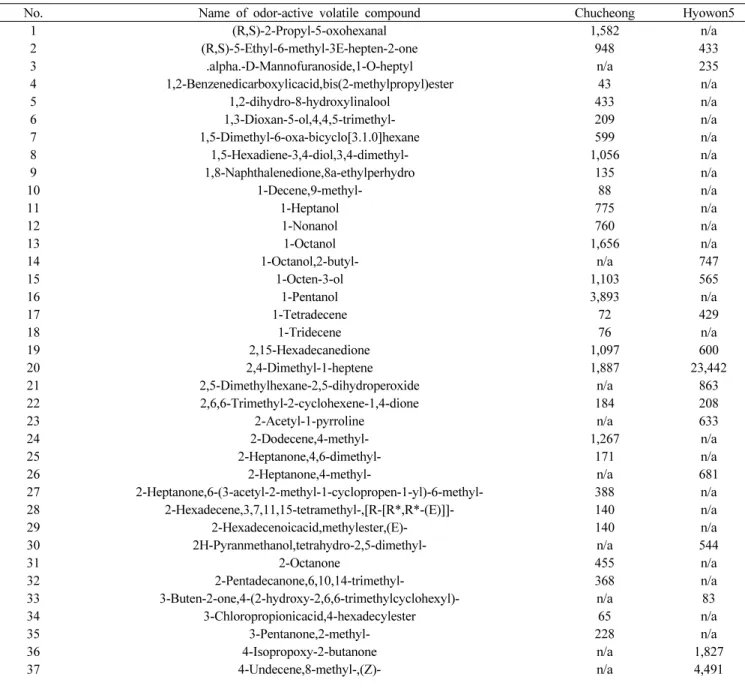
No. Name of odor-active volatile compound Chucheong Hyowon5
1 (R,S)-2-Propyl-5-oxohexanal 1,582 n/a
2 (R,S)-5-Ethyl-6-methyl-3E-hepten-2-one 948 433
3 .alpha.-D-Mannofuranoside,1-O-heptyl n/a 235
4 1,2-Benzenedicarboxylicacid,bis(2-methylpropyl)ester 43 n/a
5 1,2-dihydro-8-hydroxylinalool 433 n/a
6 1,3-Dioxan-5-ol,4,4,5-trimethyl- 209 n/a
7 1,5-Dimethyl-6-oxa-bicyclo[3.1.0]hexane 599 n/a
8 1,5-Hexadiene-3,4-diol,3,4-dimethyl- 1,056 n/a
9 1,8-Naphthalenedione,8a-ethylperhydro 135 n/a
10 1-Decene,9-methyl- 88 n/a
11 1-Heptanol 775 n/a
12 1-Nonanol 760 n/a
13 1-Octanol 1,656 n/a
14 1-Octanol,2-butyl- n/a 747
15 1-Octen-3-ol 1,103 565
16 1-Pentanol 3,893 n/a
17 1-Tetradecene 72 429
18 1-Tridecene 76 n/a
19 2,15-Hexadecanedione 1,097 600
20 2,4-Dimethyl-1-heptene 1,887 23,442
21 2,5-Dimethylhexane-2,5-dihydroperoxide n/a 863
22 2,6,6-Trimethyl-2-cyclohexene-1,4-dione 184 208
23 2-Acetyl-1-pyrroline n/a 633
24 2-Dodecene,4-methyl- 1,267 n/a
25 2-Heptanone,4,6-dimethyl- 171 n/a
26 2-Heptanone,4-methyl- n/a 681
27 2-Heptanone,6-(3-acetyl-2-methyl-1-cyclopropen-1-yl)-6-methyl- 388 n/a
28 2-Hexadecene,3,7,11,15-tetramethyl-,[R-[R*,R*-(E)]]- 140 n/a
29 2-Hexadecenoicacid,methylester,(E)- 140 n/a
30 2H-Pyranmethanol,tetrahydro-2,5-dimethyl- n/a 544
31 2-Octanone 455 n/a
32 2-Pentadecanone,6,10,14-trimethyl- 368 n/a
33 3-Buten-2-one,4-(2-hydroxy-2,6,6-trimethylcyclohexyl)- n/a 83
34 3-Chloropropionicacid,4-hexadecylester 65 n/a
35 3-Pentanone,2-methyl- 228 n/a
36 4-Isopropoxy-2-butanone n/a 1,827
37 4-Undecene,8-methyl-,(Z)- n/a 4,491
Table 7. Volatiles identified in ‘Hyowon 5’. (unit: peak area in TIC mode)
38 5,9-Undecadien-2-one,6,10-dimethyl-,(E)- 82 n/a
39 5-Ethyl-3-nonanol 179 n/a
40 7-Oxabicyclo[4.1.0]heptane,1,5-dimethyl- 268 n/a
41 Benzoicacid,2-formyl-4,6-dimethoxy-,8,8-dimethoxyoct-2-ylester 317 n/a
42 Bicyclo[3.1.1]hept-2-ene,2,6-dimethyl-6-(4-methyl-3-pentenyl)- 79 n/a
43 ButylatedHydroxytoluene 1,509 n/a
44 Carbonicacid,isobutylnonylester 458 n/a
45 Copaene n/a 153
46 Cyclobutane,1,2,3,4-tetramethyl- n/a 553
47 Cyclohexadecane 79 n/a
48 Cyclohexanamine,N-(benzoyloxy)- 41 n/a
49 Cyclopentane,3-hexyl-1,1-dimethyl- n/a 430
50 Decanal 365 n/a
51 Decane n/a 1,596
52 Decane,1,1'-oxybis- 203 n/a
53 Decane,2,3,5-trimethyl- n/a 200
54 Decane,2,3,8-trimethyl- 233 n/a
55 Decane,2,6,7-trimethyl- 41 n/a
56 Decane,3,6-dimethyl- n/a 345
57 D-Limonene 572 n/a
58 Dodecane 241 502
59 Dodecane,2,6,11-trimethyl- 214 n/a
60 Dodecane,4-methyl- n/a 427
61 Ethanone,1-[2-(1-hydroxy-1-methylethyl)cyclopropyl]- 3,265 n/a
62 Formicacid,hexylester 13,920 1,368
63 Furan,2-pentyl- 5,843 454
64 Geranylacetate,2,3-epoxy- 386 n/a
65 Heptane,2,3,5-trimethyl- n/a 430
66 Heptane,2,3-dimethyl- n/a 515
67 Heptane,2,4-dimethyl- n/a 772
68 Heptane,2,5-dimethyl- n/a 1,480
69 Heptane,3,3,5-trimethyl- n/a 1,103
70 Heptane,3-ethyl-5-methylene- n/a 259
71 Heptane,3-methyl- n/a 3,023
72 Heptane,4-methyl- n/a 6,129
73 Heptane,5-ethyl-2,2,3-trimethyl- 93 n/a
74 Hexadecane 208 n/a
75 Hexadecane,1-iodo- n/a 96
76 Hexadecane,2,6,10,14-tetramethyl- 76 n/a
77 Hexanal 4,480 3,571
78 Hexane,2,2,4-trimethyl- n/a 1,538
79 Hexane,2,2,5-trimethyl- n/a 1,787
80 Hexane,2,3,3-trimethyl- 77 n/a
81 Hexane,3,3-dimethyl- n/a 588
82 Isotridecanol- 113 n/a
83 Nonanal 6,555 2,946
84 Nonane,2-methyl-3-methylene- n/a 965
85 Nonane,3-methyl- n/a 179
86 Nonane,5-(1-methylpropyl)- n/a 130
87 Nonane,5-methyl- n/a 922
88 Nonane,5-methyl-5-propyl- n/a 194
89 Octane n/a 1,301
90 Octane,2,4,6-trimethyl- 4,022 n/a
91 Octane,2,5-dimethyl- 399 3,013
92 Octane,3,4,5,6-tetramethyl- 788 n/a
93 Oxime-,methoxy-phenyl-_ 600 n/a
94 o-Xylene 367 765
95 Pentadecane,2,6,10,14-tetramethyl- 182 71
96 Pyridine,2,4,6-trimethyl- 14,317 n/a
97 Pyridine,2,6-dimethyl- 1,771 n/a
98 Sulfurousacid,decyl2-ethylhexylester n/a 232
99 Tetradecane 77 n/a
100 Tricosyltrifluoroacetate 81 n/a
101 Tridemorph n/a 172
102 Undecane n/a 505
103 Undecane,3,6-dimethyl- 233 n/a
으며 각 파이토스테롤별 함량은 β-Sitosterol(239.0 ㎍ g-1) >
Stigmasterol(67.9㎍ g-1) > Campesterol(52.2 ㎍ g-1) 순서였다 (Table 6). Kwak et al.(2013)은 현미유에는 β-Sitosterol>Stigm asterol>Campesterol 순으로 파이토스테롤이 존재하며 발아 전 에 비해 발아 후에 총 파이토스테롤 함량이 증가한다고 보고한 바 있다.
향기 성분 Profiling
‘효원5호’와 추청벼에서 동정된 향기 성분은 총 103개였고, 이중 14개는 두 품종 모두에서 검출되었으며, 37개 성분은 ‘효원 5호’에서 특이적으로 검출되었다(Table 7). 향미의 방향성에 관여하는 물질에 대해 200여종 이상의 휘발성 성분이 보고되었 는데, 2AP와 같이 피롤환을 가진 물질이 결정적으로 향취성을 지배하는 성분이라고 보고되고 있다(Bryant & McClung 2011 Buttery et al. 1986). ‘효원5호’에서는 2AP 성분이 검출된 반면, 대조품종인 추청벼에서는 검출되지 않았다.
재배상 유의점
중생종 다수성 향미 ‘효원 5호’는 도복에 다소 강하지만, 질소 질 비료 과용 시 등숙저하, 숙색불량, 도복, 병해충 발생이 우려되 므로 적정 균형시비를 하여야 하고 적기 기본방제를 하여야 한다. 등숙기간이 길어 수확 전 물떼는 시기를 늦추어야 품질 저하를 막을 수 있다.
적 요
효원5호는 향미 특성의 다수성 품종을 육성할 목적으로 개발 되었으며, 다수성 품종인 다산벼와 인디카 향미 IR841-1-1-2를 인공교배하여 계통육종법으로 육성하여 2012년~2013년에 생
산력검정을 수행한 결과 품종의 균일성과 재배안정성을 확인하 여 우수성이 인정되어 품종으로 출원 및 등록되었다. 효원5호의 출수기는 8월 14일로 중부지역에서 화영벼 보다 늦은 중생종이 다. 간장과 수장은 각각 83.2cm, 26.4cm로 화영벼 보다 길고, 주당 이삭수는 화영벼와 비슷한 14.9개이며, 이삭당 벼알수는 124.5개로 화영벼 보다 많았다. 효원5호는 목도열병과 줄무늬 잎마름병에 대해 중간 정도의 저항성을 나타냈으나, 흰잎마름병 과 멸구에 약하다. 효원5호의 현미 장폭비는 2.91 정도의 장원형 품종이고, 현미천립중이 20.9g이며, 평균 수량은 중부 평야지에 서 보통기 표준재배에서 627kg/10a이다. 현미의 아밀로스 함량 과 단백질 함량은 각각 19.4%, 8.4%으로 화영벼 보다 높았고, 지방산 조성비율은 oleic acid, linoleic acid, palmitic acid 순으 로 각각 35.5% 33.5%, 27.0%이고, 총 비타민 E 함량은 66.89ug/g 이며, 총 파이토스테롤 함량은 359.1 ug/g 정도이다.
효원5호는 벼에서 주요 향기성분인 2-acetyl-pyrroline 을 포함 하는 향미 품종이다.
(품종보호권 등록번호: 제 6183호, 2016. 6. 3)
사 사
본 결과물은 농림축산식품부의 재원으로 농림수산식품기술 기획평가원의 고부가가치식품 기술개발사업의 지원을 받아 연 구되었음(115011-03-1-HD030).
REFERENCES