Korean J Biol Psychiatry 2015;22(1):20-27
Introduction
Panic disorder is characterized by composite features of re- current panic attacks, anticipatory anxiety, cognitive distortion, and avoidance behaviors.1) Several neuroimaging studies of the human brain have demonstrated that significant functional and/or structural alterations in cerebral regions including the temporal lobe (the amygdala, hippocampus, insula, and para- hippocampal gyrus), prefrontal cortex, and cingulate cortex, are related to panic disorder.2-6) These cerebral regions are known to mediate fear response, which may play a major role in the pathogenesis of panic disorder.7)
Along with the advance in neuroimaging techniques, an in- creasing number of studies have revealed that the cerebellum modulates emotion and cognition as well as motor coordina- tion.8-13) Furthermore, the extensive cerebro-cerebellar connec- tions may be a part of the neural circuits involved in emotional and cognitive processing during associative learning.14-17) Re- cent studies have also reported the cerebellar abnormalities in several neuropsychiatric disorders, including schizophrenia, mood disorder, and developmental disorder.18-21)
Despite mounting evidence of cerebellar involvement in emo- tion and cognition, there are no reports focusing solely on the cerebellum in panic disorder. Up till now, the structural and
Reduced Gray Matter Density in the Posterior Cerebellum of Patients with Panic Disorder : A Voxel-Based Morphometry Study
Junghyun H. Lee, MD,
1,2*Yujin Jeon, MD,
3*Sujin Bae, PhD,
4Jee Hyang Jeong, MD,
5Eun Namgung, BS,
3Bori R. Kim, BS,
3Soonhyun Ban, RN, MS,
3Saerom Jeon, BS,
3Ilhyang Kang, MS,
3Soo Mee Lim, MD
61Psychological Trauma Center, Seoul National Hospital, Seoul, Korea
2Department of Psychiatric Rehabilitation, Seoul National Hospital, Seoul, Korea
3Ewha Brain Institute, Ewha Womans University, Seoul, Korea
4Department of Psychiatry, Chung-Ang University Hospital, Seoul, Korea
5Department of Neurology and Medical Research Institute, Ewha Womans University School of Medicine, Seoul, Korea
6Department of Radiology, Ewha Womans University Mokdong Hospital, Seoul, Korea
Objectives It is increasingly thought that the human cerebellum plays an important role in emotion and cognition. Although re- cent evidence suggests that the cerebellum may also be implicated in fear learning, only a limited number of studies have investigated the cerebellar abnormalities in panic disorder. The aim of this study was to evaluate the cerebellar gray matter deficits and their clini- cal correlations among patients with panic disorder.
Methods Using a voxel-based morphometry approach with a high-resolution spatially unbiased infratentorial template, regional cerebellar gray matter density was compared between 23 patients with panic disorder and 33 healthy individuals.
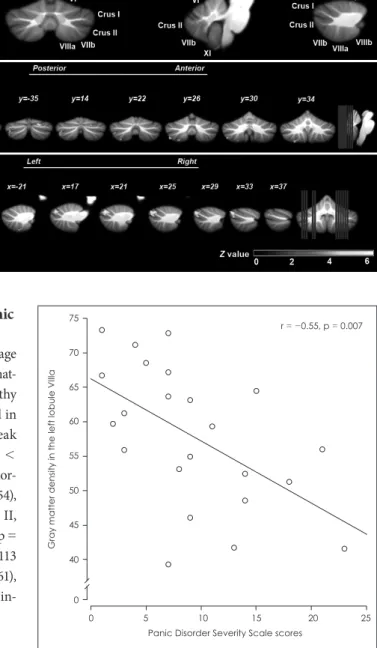
ResultsZZThe gray matter density in the right posterior-superior (lobule Crus I) and left posterior-inferior (lobules Crus II, VIIb, VIIIa) cerebellum was significantly reduced in the panic disorder group compared to healthy individuals (p < 0.05, false discovery rate corrected, extent threshold = 100 voxels). Additionally, the gray matter reduction in the left posterior-inferior cerebellum (lobule VII- Ia) was significantly associated with greater panic symptom severity (r = -0.55, p = 0.007).
ConclusionsZZOur findings suggest that the gray matter deficits in the posterior cerebellum may be involved in the pathogenesis of panic disorder. Further studies are needed to provide a comprehensive understanding of the cerebro-cerebellar network in panic dis- order.
Key WordsZZPanic disorder ㆍCerebellum ㆍVoxel-based morphometry ㆍGray matter.
Received: January 27, 2015 / Revised: February 2, 2015 / Accepted: February 5, 2015 Address for correspondence: Soo Mee Lim, MD
Department of Radiology, Ewha Womans University Mokdong Hospital, 1071 Anyangcheon-ro, Yangcheon-gu, Seoul 158-710, Korea Tel: +82-2-2650-6022, Fax: +82-2-2650-2838, E-mail: [email protected]
*These authors contributed equally to this work.
functional deficits in the cerebellum have been reported merely as unexpected findings in panic disorder.22-26) It is notable, however, that higher glucose metabolism in the cerebellum along with fear network-related cerebral regions was found in patients with panic disorder.22) These alterations of glucose me- tabolism in the brain including the cerebellum were normal- ized after successful cognitive-behavioral therapy.23)
There is increasing evidence that the cerebellum takes part in the fear circuitry by playing a role in associative learning.27)28) Several studies have shown impaired fear conditioning in pa- tients with cerebellar damage.29)30) Moreover, recent functional neuroimaging studies have reported increased activation in the posterior cerebellum during anticipation of an aversive stimu- lus.31-33)
Taken together, we hypothesized that the structural deficits in the cerebellum would contribute to pathogenesis of panic dis- order. We aimed to investigate the differences in cerebellar gray matter density between patients with panic disorder and healthy individuals, using a voxel-based morphometry (VBM)34) meth- od with a high-resolution atlas template of the human cerebel- lum.35)36) We were also interested in assessing the association of the cerebellar gray matter deficits with current panic symptom severity.
Methods
Participants
Twenty-three patients with panic disorder were recruited from an outpatient clinic in Seoul, South Korea (Department of Neuropsychiatry, Seoul National University Hospital). Panic disorder was diagnosed using the Structured Clinical Interview for DSM-IV (SCID-IV).37) Thirty-three healthy individuals were recruited through local newspaper advertisement. Subjects for both groups who met any of the following criteria were exclud- ed: 1) diagnosed with any other Axis I disorder by SCID-IV in- terview, 2) antisocial or borderline personality disorder screened by Personality Disorder Questionnaire-IV,38) 3) current or past history of major medical or neurological illness, and 4) having any contraindication to magnetic resonance imaging (MRI) scanning. After providing information about the study, written informed consent was obtained from all participants. Approval for this study was granted by the ethics committee of the Seoul National University Hospital (H-0805-080-245).
Basic demographic data were collected for all participants, including age, sex, and handedness. The Panic Disorder Sever- ity Scale (PDSS)39)40) and the Zung Self-Rating Anxiety Scale (Z-SAS)41) were used to assess symptom severity in the panic disorder group. Comorbid depressive symptoms were assessed
with the Hamilton Depression Rating Scale.42) Neuropsycho- logical tests including the Digit Symbol Substitution Test, the Digit Span Forward and Backward Test, the Spatial Span Forward and Backward Test, the Trail Making Test-A (TMT-A) and the Trail Making Test-B (TMT-B) were performed in all participants.
Magnetic resonance image acquisition
A three-dimensional spoiled gradient echo pulse sequence was used on a 3.0-T GE VHi scanner (GE Medical System, Milwau- kee, WI, USA) and 248 sagittal T1 images were acquired (repe- tition time = 5.7 ms, echo time = 1.4 ms, inversion time = 400 ms, slice thickness = 0.7 mm, matrix size = 256 × 256, field of view = 22 cm, flip angle = 20°, number of excitation = 1).
Image preprocessing and voxel-based morphometry
All of the image processing was conducted using Statistical Parametric Mapping (SPM 5 : Wellcome Department of Cog- nitive Neurology, University College London, UK) run on MATLAB (Math Works, Natick, MA, USA). Before the pro- cessing, T1 weighted images were reoriented and the origin was set to the anterior commissure by MRIcro (http://www.mricro.com) and resliced to a 1mm isovoxel image by Analyze 5.0. Because the Spatially Unbiased Infratentorial (SUIT) tem- plate can provide a more accurate inter-subjects alignment of the cerebellum, we used the SUIT toolbox version 2.4 (available at http://www.icn.ucl.ac.kr/motorcontrol/imaging/suit.htm)35) in the following processing. Using the isolate function within the SUIT toolbox, the infratentorial structures including the cerebellum and brainstem were cropped. Then, the cropped in- dividual images were normalized into the SUIT template.34) The deformation map produced in the process was used to re- slice and segment the gray matter of the cerebellum.35) The segmented images were modulated to preserve the actual pro- portion of gray matter within a given voxel.35) Each step was carefully reviewed by an experienced researcher (J.Y.J) before progressing into the next step. The final modulated images were smoothed using 4-mm full width at half-maximum isotropic Gaussian kernel.
Statistical analysis
Group differences in demographic and clinical characteris- tics were assessed using the independent t-test for continuous variables and the chi-square test or the Fisher’s exact test for cat- egorical variables. The smoothed images were statistically ana- lyzed using the general linear model and random Gaussian field theory.43) To compare the cerebellar gray matter density between the two groups, we conducted an analysis of covariance using SPM5. We performed global normalisation with proportional
scaling, which removes global gray matter differences for each participant. Age and sex were treated as confounding covari- ates. Statistical analysis was carried out using a general linear model embedded in SPM5. The limit for statistical significance was set at p < 0.05 after false discovery rate correction and an extent threshold of 100 contiguous voxels.
To investigate the relationships between regional cerebellar gray matter deficits and panic disorder, we calculated the Pear- son’s correlation coefficients between the mean gray matter density and the clinical characteristics including panic symp- tom severity and neuropsychological deficits. The mean gray matter density was derived from the first eigenvariates of the clusters showing significant group differences in a VBM analy- sis. Statistical analysis was performed by Stata 12.1 (StataCorp,
College Station, TX, USA). The significance level was defined at an alpha level of 0.05. To account for multiple testing of each cluster, the Bonferroni correction (alpha = 1-0.951/n ; n = num- ber of significant clusters) was applied.
Results
Characteristics of participants
The demographic and clinical characteristics of the study participants and between-group comparison results are sum- marized in Table 1. There were no statistically significant differ- ences in age, sex composition, and handedness between the two groups. The mean score on the PDSS and the Z-SAS in patients with panic disorder was 9.2 ± 6.2 and 42.8 ± 9.7, respectively.
Table 1. Demographic and clinical characteristics between the panic disorder group and healthy individuals
Panic disorder (n = 23) Healthy individuals (n = 33) Statistic p value*
Demographic characteristics
Age, yr, mean ± SD 32.0 ± 6.60 30.7 ± 6.4 t = 0.72 120.47
Female sex, n (%) 10 (43.5) 14 (42.4) χ2 = 0.01 120.94
Right handedness, n (%) 23 (100). 29 (90.6) - 120.26
Clinical characteristics
PDSS scores 9.2 ± 6.2 0- - -
Z-SAS scores 42.8 ± 9.70 0- - -
HDRS scores 4.6 ± 5.1 03.0 ± 4.2 t = 1.23 120.22
Neuropsychological tests, mean ± SD
Trail Making Test-A 40.6 ± 16.8 028.5 ± 12.8 t = 3.02 < 0.01
Trail Making Test-B 107.8 ± 70.10 067.6 ± 41.9 t = 2.65 120.01
Digit Symbol Substitution Test 52.4 ± 15.8 071.8 ± 12.1 t = -4.73 < 0.01
Digit Span Forward Test 8.7 ± 2.4 10.9 ± 2.6 t = -3.07 < 0.01
Digit Span Backward Test 6.0 ± 2.7 09.1 ± 3.5 t = -3.40 < 0.01
Spatial Span Forward Test 7.0 ± 1.4 09.4 ± 2.2 t = -4.49 < 0.01
Spatial Span Backward Test 6.6 ± 1.8 08.5 ± 2.0 t = -3.43 < 0.01
* : statistical values were calculated by χ2 statistics or Fisher’s exact test for categorical variables, t statistics for continuous vari- ables. SD : standard deviation, PDSS : Panic Disorder Severity Scale, Z-SAS : Zung Self-Rating Anxiety Scale, HDRS : Hamilton De- pression Rating Scale
Table 2. Significant clusters of reduced cerebellar gray matter density in the panic disorder group compared with healthy individuals Cluster Cerebellar regions Side MNI coordinates* Cluster size
(voxels) Maximum
t value/z value Uncorrected
p value Corrected p value†
x y z
1 Posterior-superior lobe
(peak voxel : Crus I) R 0.20 -81 -26 1821 6.47/5.52 < 0.001 0.001
2 Posterior-inferior lobe
(peak voxel : Crus II) L -44 -64 -54 144 4.77/4.33 < 0.001 0.006
3 Posterior-inferior lobe
(peak voxel : Crus II) L -37 -78 -42 374 4.29/3.95 < 0.001 0.015
4 Posterior-inferior lobe
(peak voxel : lobule VIIb) L -27 -68 -58 113 4.10/3.80 < 0.001 0.022
5 Posterior-inferior lobe
(peak voxel : lobule VIIa) L -25 -58 -61 163 4.08/3.78 < 0.001 0.023
* : MNI coordinates (mm) of the maximal significant voxel, † : corrected for multiple comparisons with false discovery rate. MNI : Montreal Neurological Institute
Comparisons of gray matter density between the panic disorder group and healthy individuals
After adjusting for the confounding variables including age and sex, we found five clusters of significantly reduced gray mat- ter density in the panic disorder group as compared to healthy individuals (Table 2, Fig. 1). The largest cluster was located in the right posterior-superior cerebellum [lobule Crus I, peak voxel (20, -81, -26), cluster size 1821 voxels, corrected p < 0.001]. The other four clusters were found in the left posterior- inferior cerebellum [lobule Crus II, peak voxel (-44, -64, -54), cluster size 144 voxels, corrected p = 0.006 ; lobule Crus II, peak voxel (-37, -78, -42), cluster size 374 voxels, corrected p = 0.015 ; lobule VIIb, peak voxel (-27, -68, -58), cluster size 113 voxels, p = 0.022 ; lobule VIIIa, peak voxel (-25, -58, -61), cluster size 163 voxels, p = 0.023]. There were no regions of in- creased gray matter density in the panic disorder group.
Relationship between cerebellar gray matter deficits and clinical characteristics
Within-group analysis of patients with panic disorder showed a significant correlation between the PDSS scores and gray mat- ter density reduction in the lobule VIIIa (r = -0.55, p = 0.007) (Fig. 2). The PDSS scores were not significantly correlated with the gray matter density in any other clusters (cluster in the lob- ule Crus I, r = -0.08, p = 0.729 ; clusters in the lobule Crus II, r = -0.46, p = 0.026 and r = -0.32, p = 0.132 ; cluster in the lobule VIIb, r = -0.41, p = 0.051).
Correlations between the neuropsychological tests and the regional gray matter density in the panic disorder group are shown in Table 3. The total time taken to complete the TMT-A was negatively correlated with the gray matter density within both the clusters in the left Crus II (r = -0.65, p < 0.001 ; r =
-0.57, p = 0.004). The Digit Symbol Substitution Test scores and the Digit Span Forward Test scores were positively correlated with the gray matter density in both the left Crus II (r = 0.57, p = 0.005 ; r = 0.63, p = 0.001, respectively) and the left lobule VIIb (r = 0.61, p = 0.002 ; r = 0.57, p = 0.005, respectively). There was also a positive correlation between the Spatial Span Forward scores and the gray matter density in the left Crus II (r = 0.57, p = 0.005). No correlations were found between the neuropsy- chological tests and the cerebellar gray matter density in healthy individuals.
Fig. 1. Voxel-based morphometry comparisons between the panic disorder group and healthy individ- uals. The probabilistic atlas of the cerebellum by Diedrichsen.35) (A) represents the human cerebellar anatomy according to the Schmah- mann’s nomenclature.60) Yellow re- gions in coronal (B) and sagittal (C) planes depict reduced gray matter density in the panic disorder group compared with healthy individuals.
Statistical maps were set at a thresh- old of p < 0.05, false discovery rate corrected with a cluster size thresh- old of 100 voxels.
A
B
C
Fig. 2. Relationship between cerebellar gray matter density and Panic Disorder Severity Scale scores. Regional gray matter den- sity was obtained from the first eigenvariate across all adjusted voxels within the significant cluster that covered the left lobule VII- Ia in the posterior-inferior cerebellar lobe.
Gray matter density in the left lobule VIIIa
75 70 65 60 55 50 45 40
0
0 5 10 15 20 25 Panic Disorder Severity Scale scores
r = -0.55, p = 0.007
Discussion
Our study investigated the cerebellar gray matter deficits and their clinical correlations among patients with panic dis- order. As hypothesized, the cerebellar gray matter density in the posterior-superior and posterior-inferior lobes was mark- edly reduced in the panic disorder group compared with healthy individuals. Additionally, the cerebellar gray matter deficits in the posterior-inferior lobe were significantly associated with greater panic symptoms severity and lower neuropsychological function among patients with panic disorder. The relationship between cerebellar regions and panic disorder has not been previously established. To the best of our knowledge, this is the first study to focus on the structural abnormalities in the cere- bellum in panic disorder by employing the SUIT template for an accurate alignment of the infra-tentorial structures.35)
The cerebellar cortex can be divided into anterior (lobules I-V), posterior-superior (lobule VI/Crus I) and posterior-inferi- or (lobule VIIa-X) lobes by the primary and horizontal fis- sures.44) In our study, the cerebellar gray matter deficits were found in the posterior-superior and the posterior-inferior lobes but not in the anterior lobe. These results may be congruent with the findings from previous studies of functional topogra- phy in the human cerebellum.11)13) The anterior lobe is known to be involved in motor coordination, while the posterior lobe, which is anatomically and functionally connected to the pre- frontal and parietal cortices, is believed to be involved in regu- lating emotion and cognition.11)13)
From medial to lateral, the cerebellum can also be divided into the vermis and the hemispheres.44) Among these subre- gions, the posterior vermal regions have been extensively inves- tigated with respect to fear response. Several animal studies have reported that the posterior vermal regions are involved in the fear conditioning.45)46) Furthermore, increased activation in the vermal regions was found during cholecystokinin tetrapep- tide- or lactate-induced panic attacks among healthy volun-
teers.25)47-49) Recent studies, however, suggest that the posterior cerebellar hemispheres are also likely to play a potential role in the fear conditioning process.11)28) Moers-Hornikx et al.50) re- ported that panic-like behaviors in rats were accompanied by deactivation of the dentate nucleus within the posterior cerebel- lar hemispheres, as well as the fastigial nucleus in the vermis. A meta-analysis of functional neuroimaging studies revealed the different roles of the posterior vermis, which is involved in emo- tional processing and the posterior hemispheres, participating in cognitive processing in the human cerebellum. Another re- cent review of the human cerebellar lesion studies showed that the vermal regions are important in autonomic and somatic re- sponses to fear, whereas the posterior cerebellar hemispheres con- tribute to emotional and cognitive associative learning of fear,28) which is one of the main components of panic disorder.51)52)
Our study showed the gray matter deficits only in the poste- rior hemispheres, but not in the posterior vermis. Considering the previous studies that reported increased activation of the vermis during a panic attack but not during anticipatory anxi- ety,25)47-49) a possible explanation is that the vermal deficits may be related to the panic attack itself. Nevertheless, with a small sample size, caution must be exercised and further studies are needed to verify the different roles of the vermis and the cere- bellar hemispheres in panic disorder.
In the current study, a significant correlation of cerebellar deficits in the lobule VIIIa with symptom severity was observed in patients with panic disorder. Interestingly, this finding is concordant with that in a previous VBM study showing gray matter deficits in the lobule VIIIa as one of the putative state markers in major depressive disorder with panic disorder.26) This study reported duloxetine-induced changes in gray mat- ter density in several brain areas, including the cerebellar lob- ule VIIIa among drug-naïve major depressive disorder with panic disorder patients.26)
The lobule VIIIa may be involved in modulation and storage of information.53) It is notable that the cerebello-parietal loop Table 3. Pearson correlation coefficients between cerebellar gray matter density and neuropsychological functions in the panic disorder group
Gray matter density
Neuropsychological tests Trail Making
Test-A Trail Making Test-B
Digit Symbol Substitution
Test
Digit Span
Forward Test Digit Span
Backward Test Spatial Span
Forward Test Spatial Span Backward Test
Cluster 1 (right Crus I) -0.04 -0.01 -0.07 -0.06 -0.03 -0.09 -0.03
Cluster 2 (left Crus II) -0.65† -0.47 -0.57* -0.63† -0.49 -0.37 -0.41
Cluster 3 (left Crus II) -0.57* -0.49 -0.44 -0.39 -0.45 -0.57* -0.33
Cluster 4 (left lobule VIIb) -0.50 -0.36 -0.61* -0.57* -0.45 -0.28 -0.38
Cluster 5 (left lobule VIIIa) -0.26 -0.16 -0.33 -0.44 -0.23 -0.10 -0.19
Significant p value after Bonferroni correction (alpha = 1-0.951/5). * : corrected p < 0.05, † : corrected p < 0.01
between the lobule VIIIa and the inferior parietal lobe is in- volved in encoding and storage of relevant information during working memory task.53)54) Furthermore, functional MRI acti- vation in the lobule VIIIa was linearly increased with higher memory load and practice-related proficiency.54) Considering that emotional associative learning such as fear conditioning may impose higher cognitive load55) structural deficits in the lobule VIIIa could induce failure of adaptive conditioned re- sponse and contribute to the development of panic symptoms.
We also found significant correlations between the gray matter deficits in the posterior-inferior lobe and cognitive per- formances including memory and information processing, which is mostly in accordance with the results of previous studies of functional topography in the cerebellum.11) Ravizza et al.56) also suggested that the extent of damage to the posteri- or-inferior cerebellum was associated with the storage of work- ing memory. Furthermore, as mentioned above, the up-to-date research has confirmed that the posterior-inferior hemispheres in the cerebellum are crucial for adaptive learning of emotion and cognition.28) These findings enhance our understanding of the role of the posterior-inferior cerebellum in patients with panic disorder. Taken together, it could be conceivably hypoth- esized that the cerebellar deficits in the posterior-inferior lobe may be associated with impairment of emotional and cognitive associative learning, and consequent failure to select relevant information and response with adequate behavior in panic dis- order.
However, more research on this hypothesis needs to be un- dertaken before these assertions can be more clearly under- stood, as some of our findings in this study do not support those of the previous research. Several neuroimaging studies suggest that the posterior-superior cerebellar lobe including the lobule VI and the Crus I also play a role in eye-blink condi- tioning and associative learning. In spite of the largest cluster of gray matter deficits in the posterior-superior lobe, no signifi- cant associations were found with current panic symptoms in this study.
Among several studies using a whole-brain VBM analysis in panic disorder, only a few studies have reported structural def- icits in the cerebellum.22)24)26) The negative findings of previous structural neuroimaging studies could, in part, be due to the insufficiency of the whole-brain template to provide accurate spatial normalization of the cerebellum.35) To address this is- sue, the current study used the SUIT approach that provides high sensitivity and accuracy in the analysis of the cerebel- lum.35)57) However, since the focus of the current study is on the structural abnormalities in the cerebellum, our findings have limitations in providing a comprehensive view of the cerebel-
lar-cerebral network within the neural mechanisms of panic disorder. In addition, the current or previous use of psychotro- pic medication may bring potential confounding effects on cerebellar gray matter deficits.26)58)
Our previous report using the whole-brain VBM analysis in this sample showed decreased gray matter volumes in the basal ganglia but not in the cerebellum.59) Interconnections between the cerebellum and the basal ganglia have long been implicated in the manifestation of motor disorders, through their involve- ment in associative learning.60) Interestingly, recent evidences suggest that the cerebellar interactions with the basal ganglia also contribute to regulation of emotion and cognition.60) Hence, further work is needed to explore how interactions between the cerebellum and the cerebrum contribute to symptoms of panic disorder.
Acknowledgments
This study was supported by a grant from the memorial research foun- dation for the 50th anniversary of Medical College of Ewha Womans University. The corresponding author also acknowledges support made by a Korea National Research Foundation Grant funded by the Minis- try of Education, Science and Technology (2012R1A2A2A01013169).
Conflicts of interest
The authors have no financial conflicts of interest.
REFERENCES
1) American Psychiatric Association. Diagnostic and statistical man- ual of mental disorders: DSM-IV-TR. 4th ed., text revision. Wash- ington, DC: American Psychiatric Association;2000.
2) Massana G, Serra-Grabulosa JM, Salgado-Pineda P, Gastó C, Jun- qué C, Massana J, et al. Amygdalar atrophy in panic disorder pa- tients detected by volumetric magnetic resonance imaging. Neuro- image 2003;19:80-90.
3) Pillay SS, Gruber SA, Rogowska J, Simpson N, Yurgelun-Todd DA.
fMRI of fearful facial affect recognition in panic disorder: the cin- gulate gyrus-amygdala connection. J Affect Disord 2006;94:173-181.
4) Han DH, Renshaw PF, Dager SR, Chung A, Hwang J, Daniels MA, et al. Altered cingulate white matter connectivity in panic disorder patients. J Psychiatr Res 2008;42:399-407.
5) Chechko N, Wehrle R, Erhardt A, Holsboer F, Czisch M, Sämann PG. Unstable prefrontal response to emotional conflict and activa- tion of lower limbic structures and brainstem in remitted panic dis- order. PLoS One 2009;4:e5537.
6) Yoon S, Jun CS, Jeong HS, Lee S, Lim SM, Ma J, et al. Altered corti- cal gyrification patterns in panic disorder: deficits and potential compensation. J Psychiatr Res 2013;47:1446-1454.
7) Gorman JM, Kent JM, Sullivan GM, Coplan JD. Neuroanatomical hypothesis of panic disorder, revised. Am J Psychiatry 2000;157:
493-505.
8) Exner C, Weniger G, Irle E. Cerebellar lesions in the PICA but not SCA territory impair cognition. Neurology 2004;63:2132-2135.
9) Schmahmann JD, Weilburg JB, Sherman JC. The neuropsychiatry of the cerebellum - insights from the clinic. Cerebellum 2007;6:
254-267.
10) Tavano A, Grasso R, Gagliardi C, Triulzi F, Bresolin N, Fabbro F, et al. Disorders of cognitive and affective development in cerebel- lar malformations. Brain 2007;130(Pt 10):2646-2660.
11) Stoodley CJ, Schmahmann JD. Functional topography in the hu- man cerebellum: a meta-analysis of neuroimaging studies. Neuro- image 2009;44:489-501.
12) Stoodley CJ, Valera EM, Schmahmann JD. An fMRI study of intra- individual functional topography in the human cerebellum. Behav Neurol 2010;23:65-79.
13) Stoodley CJ, Schmahmann JD. Evidence for topographic organiza- tion in the cerebellum of motor control versus cognitive and affec- tive processing. Cortex 2010;46:831-844.
14) Ramnani N. The primate cortico-cerebellar system: anatomy and function. Nat Rev Neurosci 2006;7:511-522.
15) Ramnani N. Frontal lobe and posterior parietal contributions to the cortico-cerebellar system. Cerebellum 2012;11:366-383.
16) Ito M. Control of mental activities by internal models in the cere- bellum. Nat Rev Neurosci 2008;9:304-313.
17) Moulton EA, Elman I, Pendse G, Schmahmann J, Becerra L, Bor- sook D. Aversion-related circuitry in the cerebellum: responses to noxious heat and unpleasant images. J Neurosci 2011;31:3795-3804.
18) Nopoulos PC, Ceilley JW, Gailis EA, Andreasen NC. An MRI study of cerebellar vermis morphology in patients with schizophre- nia: evidence in support of the cognitive dysmetria concept. Biol Psychiatry 1999;46:703-711.
19) Okugawa G, Sedvall G, Nordström M, Andreasen N, Pierson R, Magnotta V, et al. Selective reduction of the posterior superior vermis in men with chronic schizophrenia. Schizophr Res 2002;55:61-67.
20) De Bellis MD, Kuchibhatla M. Cerebellar volumes in pediatric maltreatment-related posttraumatic stress disorder. Biol Psychiatry 2006;60:697-703.
21) Monkul ES, Hatch JP, Sassi RB, Axelson D, Brambilla P, Nicoletti MA, et al. MRI study of the cerebellum in young bipolar patients.
Prog Neuropsychopharmacol Biol Psychiatry 2008;32:613-619.
22) Sakai Y, Kumano H, Nishikawa M, Sakano Y, Kaiya H, Imabayashi E, et al. Cerebral glucose metabolism associated with a fear net- work in panic disorder. Neuroreport 2005;16:927-931.
23) Sakai Y, Kumano H, Nishikawa M, Sakano Y, Kaiya H, Imabayashi E, et al. Changes in cerebral glucose utilization in patients with panic disorder treated with cognitive-behavioral therapy. Neuroimage 2006;33:218-226.
24) Asami T, Yamasue H, Hayano F, Nakamura M, Uehara K, Otsuka T, et al. Sexually dimorphic gray matter volume reduction in pa- tients with panic disorder. Psychiatry Res 2009;173:128-134.
25) Eser D, Leicht G, Lutz J, Wenninger S, Kirsch V, Schüle C, et al.
Functional neuroanatomy of CCK-4-induced panic attacks in healthy volunteers. Hum Brain Mapp 2009;30:511-522.
26) Lai CH, Hsu YY. A subtle grey-matter increase in first-episode, drug-naive major depressive disorder with panic disorder after 6 weeks’ duloxetine therapy. Int J Neuropsychopharmacol 2011;14:
225-235.
27) Kim JJ, Jung MW. Neural circuits and mechanisms involved in Pavlovian fear conditioning: a critical review. Neurosci Biobehav Rev 2006;30:188-202.
28) Timmann D, Drepper J, Frings M, Maschke M, Richter S, Gerwig M, et al. The human cerebellum contributes to motor, emotional and cognitive associative learning. A review. Cortex 2010;46:845-857.
29) Maschke M, Drepper J, Kindsvater K, Kolb FP, Diener HC, Tim- mann D. Involvement of the human medial cerebellum in long-term habituation of the acoustic startle response. Exp Brain Res 2000;133:
359-367.
30) Maschke M, Schugens M, Kindsvater K, Drepper J, Kolb FP, Diener HC, et al. Fear conditioned changes of heart rate in patients with medial cerebellar lesions. J Neurol Neurosurg Psychiatry 2002;72:
116-118.
31) Ploghaus A, Tracey I, Clare S, Gati JS, Rawlins JN, Matthews PM.
Learning about pain: the neural substrate of the prediction error for
aversive events. Proc Natl Acad Sci U S A 2000;97:9281-9286.
32) Ploghaus A, Tracey I, Gati JS, Clare S, Menon RS, Matthews PM, et al. Dissociating pain from its anticipation in the human brain. Sci- ence 1999;284:1979-1981.
33) Damasio AR, Grabowski TJ, Bechara A, Damasio H, Ponto LL, Parvizi J, et al. Subcortical and cortical brain activity during the feeling of self-generated emotions. Nat Neurosci 2000;3:1049-1056.
34) Ashburner J, Friston KJ. Voxel-based morphometry--the methods.
Neuroimage 2000;11(6 Pt 1):805-821.
35) Diedrichsen J. A spatially unbiased atlas template of the human cerebellum. Neuroimage 2006;33:127-138.
36) Diedrichsen J, Balsters JH, Flavell J, Cussans E, Ramnani N. A probabilistic MR atlas of the human cerebellum. Neuroimage 2009;
46:39-46.
37) First MB, Spitzer RL, Gibbon M, Williams JBW. Structured clini- cal interview for DSM-IV axis I disorders (SCID-I). Washington, DC: American Psychiatric Press;1997.
38) Hyler SE. PDQ-4+ Personality Questionnaire. New York: New York State Psychiatric Institute;1994.
39) Shear MK, Rucci P, Williams J, Frank E, Grochocinski V, Vander Bilt J, et al. Reliability and validity of the Panic Disorder Severity Scale: replication and extension. J Psychiatr Res 2001;35:293-296.
40) Lim YJ, Yu BH, Kim JH. Korean panic disorder severity scale: con- struct validity by confirmatory factor analysis. Depress Anxiety 2007;24:95-102.
41) Zung WW. A rating instrument for anxiety disorders. Psychosomatics 1971;12:371-379.
42) Hamilton M. A rating scale for depression. J Neurol Neurosurg Psychiatry 1960;23:56-62.
43) Friston KJ, Worsley KJ, Frackowiak RS, Mazziotta JC, Evans AC.
Assessing the significance of focal activations using their spatial extent. Hum Brain Mapp 1994;1:210-220.
44) Larsell O, Jansen J. The Comparative Anatomy and Histology of the Cerebellum: from monotremes through apes. Minneapolis: Univer- sity of Minnesota Press;1967.
45) Sacchetti B, Scelfo B, Strata P. The cerebellum: synaptic changes and fear conditioning. Neuroscientist 2005;11:217-227.
46) Sacchetti B, Baldi E, Lorenzini CA, Bucherelli C. Cerebellar role in fear-conditioning consolidation. Proc Natl Acad Sci U S A 2002;99:
8406-8411.
47) Javanmard M, Shlik J, Kennedy SH, Vaccarino FJ, Houle S, Brad- wejn J. Neuroanatomic correlates of CCK-4-induced panic attacks in healthy humans: a comparison of two time points. Biol Psychia- try 1999;45:872-882.
48) Schunck T, Erb G, Mathis A, Gilles C, Namer IJ, Hode Y, et al.
Functional magnetic resonance imaging characterization of CCK- 4-induced panic attack and subsequent anticipatory anxiety. Neuro- image 2006;31:1197-1208.
49) Reiman EM. The application of positron emission tomography to the study of normal and pathologic emotions. J Clin Psychiatry 1997;
58 Suppl 16:4-12.
50) Moers-Hornikx VM, Vles JS, Lim LW, Ayyildiz M, Kaplan S, Gavilanes AW, et al. Periaqueductal grey stimulation induced pan- ic-like behaviour is accompanied by deactivation of the deep cere- bellar nuclei. Cerebellum 2011;10:61-69.
51) Grillon C. Associative learning deficits increase symptoms of anx- iety in humans. Biol Psychiatry 2002;51:851-858.
52) Grillon C, Lissek S, McDowell D, Levenson J, Pine DS. Reduction of trace but not delay eyeblink conditioning in panic disorder. Am J Psychiatry 2007;164:283-289.
53) Chen SH, Desmond JE. Cerebrocerebellar networks during articu- latory rehearsal and verbal working memory tasks. Neuroimage 2005;24:332-338.
54) Kirschen MP, Chen SH, Schraedley-Desmond P, Desmond JE.
Load- and practice-dependent increases in cerebro-cerebellar acti- vation in verbal working memory: an fMRI study. Neuroimage 2005;
24:462-472.
55) Carter RM, Hofstotter C, Tsuchiya N, Koch C. Working memory and fear conditioning. Proc Natl Acad Sci U S A 2003;100:1399-1404.
56) Ravizza SM, McCormick CA, Schlerf JE, Justus T, Ivry RB, Fiez JA.
Cerebellar damage produces selective deficits in verbal working memory. Brain 2006;129(Pt 2):306-320.
57) Morrell MJ, Jackson ML, Twigg GL, Ghiassi R, McRobbie DW, Quest RA, et al. Changes in brain morphology in patients with obstructive
sleep apnoea. Thorax 2010;65:908-914.
58) Lai CH. Duloxetine related effects of brain structure on a patient of major depressive disorder with panic disorder. Prog Neuropsycho- pharmacol Biol Psychiatry 2010;34:240-241.
59) Yoo HK, Kim MJ, Kim SJ, Sung YH, Sim ME, Lee YS, et al. Putam- inal gray matter volume decrease in panic disorder: an optimized voxel-based morphometry study. Eur J Neurosci 2005;22:2089-2094.
60) Bostan AC, Dum RP, Strick PL. Cerebellar networks with the cerebral cortex and basal ganglia. Trends Cogn Sci 2013;17:241-254.