The Effects of Clinical Nurses' Job Stress, Work-family Conflicts &
Burnout on Depression
Eun-Sook Lee
1, Hee-Sun Kang
2*1
Associate Professor, Department of Nursing, Gyungnam National University of Science & Technology
2
Associate Professor, Department of Nursing, Sunchon National University
임상간호사의 직무스트레스, 직장가정 갈등, 소진이 우울에 미치는 영향
이은숙
1, 강희순
2*1
경남과학기술대학교 간호학과 부교수,
2순천대학교 간호학과 부교수
Abstract The purpose of this study was to investigate the effects of clinical nurses' job stress, work-family conflicts, and burnout on their depression. Data was analyzed using descriptive statistics, t-test, one way ANOVA, Pearson's Correlation Coefficient and Stepwise multiple regression analysis.
The results of this study shows that the job stress of the nurses was higher than average, the work-family conflicts was moderate, burnout was less than moderate, and depression was mild. The higher the job stress, the higher the conflict between workplace and family, the higher the burnout, and the higher the depression was. The main factor impacting upon the mental health of nurses was work-family conflicts followed by burnout. Therefore, it is necessary to develop a program that can prevent job stress and resolve burnout and support work-family conflicts to prevent depression of clinical nurses and to improve quality of life.
Key Words : Clinical Nurses, Job Stress, Work-Family Conflicts, Burnout, Depression
요 약 본 연구의 목적은 임상간호사의 직무스트레스, 직장가정 갈등 및 소진이 우울에 미치는 영향을 알아보고자 하였다. 분석방법은 기술통계, t-test, one way ANOVA, Pearson‘s Correlation Coefficient, Stepwise multiple regression analysis를 이용하였다. 연구결과로는 간호사의 직무스트레스는 중간보다 높은 정도였고, 직장가정 갈등은 중간 정도, 소진은 중간 이하였고, 우울은 가벼운 우울 정도였다. 직무스트레스가 높고, 직장가정 갈등이 높고, 소진이 높을수록 우울이 높은 것으로 나타났다. 간호사의 우울에 영향을 미치는 요인으로는 직장가정 갈등이 가장 큰 것으로 나타났고, 다음으로 소진이 영향을 미치는 것으로 나타났다. 따라서 임상간호사의 우울을 예방하고 삶의 질을 향상시키 기 위하여 직장가정 갈등 해소를 위한 직무스트레스 및 소진을 예방할 수 있는 프로그램 개발이 필요하다.
주제어 : 임상간호사, 직무스트레스, 직장가정갈등, 소진, 우울
*This paper was supported by Sunchon National University Research Fund in 2018
*Corresponding Author : Hee-Sun Kang([email protected])
Received May 28, 2019 Revised June 3, 2019
Accepted August 20, 2019 Published August 28, 2019
1. Introduction
Nurses are professionals who firsthand provide services to patients and are in charge of important roles for patients' satisfaction, and the levels of their stress and depression are higher compared to other professions due to the teamwork among various types of professions and excessive workloads[1]. The job stress and depression experienced by nurses in the clinical field cause not only problems in the health of individual nurses but also problems in the hospital organization such as the reduction of the will to work and job performance efficiency, and dissatisfaction with the job, eventually affecting the provision of good quality nursing services to patients, who are the targets of services[2]. In addition, since nurses are representative professionals of whom the majority are women whose perception of the importance of their roles in their families is higher than that of men, nurses frequently experience work-family conflicts that occur when the sense of responsibility at the work place and that in the family are competitive[3].
Work-family conflict is can arise from increasing and changing roles of individuals in the workplace and in the home. This can be due to social structural changes such as an increase in dual-income families resulting from an increase in women’s social advancement[4].
Work-family conflicts were shown to be inevitably experienced by those nurses who have to carry out social activities and home life simultaneously when they perform multiple roles, and physical, mental, and temporal limitations were shown to aggravate the role-conflicts[5].
Since most nurses are required to work shifts, marriage, childbirth, and nurture are risk factors for work—family conflict, and married nurses are in a more physically difficult situation than married female workers of other occupations due to shift work[6].
Work-family conflicts are an important problem that can lead to the reduction of organizational productivity and declines in members' morale at the work place thereby eventually resulting in resignation in addition to family troubles when not properly dealt with[7]. When persisting, such work-family conflicts lead to job stress and job burnout thereby greatly affecting the business.
Therefore, it is necessary to investigate the issues of work-family conflict arising from shift work for married nurses and to find ways to build family support and work-life balance.
Burnout refers to those factors that appear in the form of negative adaptation due to job stress and work-family conflicts. According to Clark[8], job burnout is a form of job stress responses appearing when stress is no longer bearable and means the syndrome of physical, mental, and emotional burnout including phenomena such as negative self-conception and service attitudes and the loss of interest in the targets. In addition, nurses can be more easily exposed to burnout than those who have other occupations because they are in difficult situations where they should face patients with diverse health needs due to the nature of their work, and their work in three shifts[9]. Nurses’ work is the largest part of clinical medical services, and nurses work with others in various occupations to provide medical services to patients. Due to the nature of work, emotional labor is higher than in other organizations [10]. In addition, due to irregular working patterns such as three shifts, job stresses are much higher than those in other occupations [11].
Job stress is a comprehensive concept that refers to all factors related to stress that can cause stress in working environments. [12]
Clinical nurses are professionals who are
subject to high levels of job stress in the service
industry and have been reported to experience
mental health problems such as anger, anxiety,
and depression as well as physical problems such
as back pain and arthritis due to intense physical
and psychological stress[13,14]. Since the health and feeling of well-being of nurses as professional medical workers can greatly affect not only the quality of the service of patient nursing but also hospital performance, it is very important for nurses to manage their physical and mental well-being[5]. As a result, job stress negatively affects nursing care workers and their caregivers, and this requires active management. At the same time, a caring intervention is required because mental health problems such as depression and anxiety coming from job stress are highly likely to occur.[16]
Meanwhile, depression is the most common response to stress, experienced by about 15% of the world's population[17]. It is on a continuum from normal mood changes to morbid conditions and is an emotional disorder that shows worry, mopishness, a sense failure, a feeling of helplessness, and a sense of worthlessness[18].
The results of a previous study[15] reported that depression was a major mental health problem of clinical nurses and that 73.3% of the subjects who were clinical nurses were at the risk of depression, indicating that clinical nurses' mental health problems are serious and that their mental health and psychological well being are threatened. Depression is an important element that can adversely affect nurses' health and patients' health. Although many studies have been conducted on diverse factors that affect nurses' burnout, studies on nurses' work-family conflicts[9,19,20] are relatively rare and in particular, studies that comprehensively investigated nurses' depression including work-family conflicts[19] are insufficient.
Therefore, understanding the relationship between nurses' work-family conflicts and their burnout is necessary to prepare measures to help nurses successfully carry out their roles both at their work place and in their family, find vocational value and meaning of nursing profession, and stay at hospitals.
The purpose of this study is to figure out the level of depression of clinical nurses and to explore factors that affect depression. The concrete objectives of this study are as follows.
First, figure out the degree of depression of clinical nurses. Second, figure out the levels of job stress, work-family conflicts, burnout, and depression according to the general characteristics of clinical nurses. Third, figure out the correlations between clinical nurses' job stress, work-family conflicts, and burnout and their depression.
Fourth, identify the effects of clinical nurses' job stress, work-family conflicts, and burnout on their depression. This study is a descriptive correlation study to identify the level of depression of clinical nurses and figure out the effects of their job stress, work-family conflict, and burnout on their depression.
2. Study Method
2.1 Study subjects & data collection
The subjects of this study were 272 nurses working at five medical institutions located in Jeonnam, who understood the purpose of the study and agreed to participate in the study.
The multiple regression analysis of the effect
size of 0.15, significance level of .05, power of
0.95, and predictor of 4 using G * power 3.1
program produced 129 sample size. Depending
on the size of the hospital, we collected 300
patients by convenience extraction of 50-70
people. A total of 300 copies of questionnaire
sheets were distributed, but a total of 272 copies
were used for final data analysis, excluding those
questionnaire sheets with poor responses. The
data were collected by conducting self-report
questionnaire surveys after calling or visiting the
nursing departments of the medical institutions
to which the subjects belonged to explain the
purpose of the study and get approval for
cooperation. After explaining the purpose of this study and the ethical protection of study subjects, the questionnaire sheets were given for completion only to those nurses who voluntarily agreed to participate in the study and submitted written consent. In addition, the subjects were informed that their responses to the questionnaire would be strictly kept in secret and that they could discontinue their participation in the study any time.
2.2 Measurement tools
In this study, job stress was measured using the scale made by[20] based on the tool developed by[21] through modification and supplementation. The job stress tool is composed of a total of 23 items in six areas comprising excessive workloads (5 items), professional role conflict (5 items), lack of expertise and skills (3 items), interpersonal problems (5 items), inappropriate treatment and compensation (4 items), and night duty (1 item). Each item was answered with a 5-point scale in which higher scores mean higher levels of job stress. In the study[20] of the reliability of the instrument, Cronbach's α was .85, whereas Cronbach's α in this study was .91.
Work-family conflicts were measured using a tool developed by[22] and modified and supplemented by[23]. The workplace-family conflict measuring tool is composed of a total of 11 items of three sub-types; 3 items of behavior, 3 items of time, and 5 items of tension. Each item was answered with a 5-point scale ranging from 1 point for 'Not at all so' to 5 point for 'Very much so'. Higher scores mean higher degrees of seriousness of conflicts experienced due to working at the work place while working for the family. In the study[23] of the reliability of the instrument, Cronbach's α was .95, whereas Cronbach's α in this study was .86.
The burnout was measured using a tool
named MBI(Maslach Burnout Inventory) developed by[24, 25]. The MBI is composed of a total of 22 items for three sub-factors, which are emotional burnout comprising 9 items, dehumanization comprising 5 items, and declines of the sense of accomplishment comprising 8 items. Each item was measured using a 7-point scale ranging from 1 point for 'None at all' to 6 points for 'Everyday'. Higher scores mean higher levels of burnout and the scores for the declines of the sense of accomplishment were reverse converted before processing. In the study[25] of the reliability of the instrument, Cronbach's α was .76, whereas Cronbach's α in this study was .82.
Depression was measured using the Korean version of the depression screening tool made by[20]
translating PHQ-9(Patient Health Questionnaire-9), which is a major depressive disorder diagnostic tool validated by[27] and proving the reliability and validity. This tool is composed of a total of 9 items.
The subjects are requested to select a score from among 0 to 3 points per item based on the degree of symptoms and the sum of the scores is obtained. This tool has set 10 points out of the full score of 27 points as a cut-off point for depression symptoms. Higher PHQ-9 scores mean severer depressive symptoms. The severity of symptoms is divided into 'no depression' for 0~4 points, 'mild depression' for 5~9 points, 'moderate depression' for 10~19 points, and 'severe depression' for 20~27 points. In the study[26] of the reliability of the instrument, Cronbach's α was .82, whereas Cronbach's α in this study was .81.
2.3 Analysis method
The collected data were statistically processed
using the SPSS WIN 23.0 program. The general
characteristics of the subjects and the degree of
the variables were used frequency, percentage,
mean and standard deviation. Differences in job
stress, work-family conflict, burnout, and depression
according to general characteristics were analyzed by t-test and one-way ANOVA. Sheffe test was used for post-test. Pearson Correlation Coefficient was used to identify the relationship between job stress, workplace family conflict, burnout, and depression, and hierarchical regression analysis was conducted to examine the effect of job stress, workplace family conflict, burnout on depression.
3. Results
3.1 General Characteristics of Participants
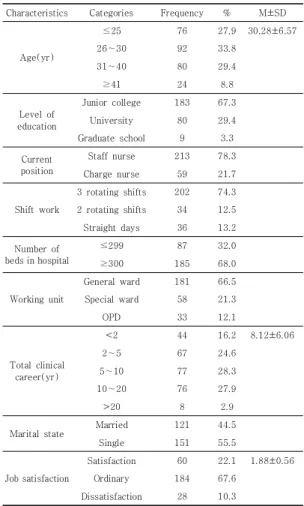
The general characteristics of the subjects are shown in Table 1.
The mean age of the subjects was 30.28 years, and the ages of the 26-30 years accounted for 33.8% and 31-40 years accounted for 29.4%. As for the levels of educations, 67.3% of the subjects graduated from college and as for the positions of the subjects, 78.3% of the subjects were general nurses. As for the shift patterns, three shifts were the most common at 74.3% followed by two shifts at 12.5% and day shifts at 13.2%. As for the sizes of hospitals where the subjects were working, 68% of the subjects were working at hospitals with 300 sickbeds and 32% at hospitals with 299 or fewer sickbeds and as for the types of wards where the subjects were working, 66.5%
of the subjects were working at general wards (internal medicine, surgery, pediatrics, obstetrics and gynecology) and 21.3% at special wards (intensive care units, operating rooms, and emergency rooms). As for the total careers of the nurses, the mean was 8.12 years, the total careers of 28.3% of the nurses were 6-10 years, those of 27.9% of the nurses were 11-20 years, and those of 24.6% of the nurses were 2-5 years. As for the marital status, 55.5% of the nurses were unmarried and 44.5% were married and as for the nurses' satisfaction with their work places, the mean was 1.88 ± 0.56 (out of the full score of 3),
67.6% of the nurses were neutral, 22.1% were satisfied, and 10.3% were dissatisfied.
Characteristics Categories Frequency % M±SD
Age(yr)
≤25 76 27.9 30.28±6.57
26∼30 92 33.8
31∼40 80 29.4
≥41 24 8.8
Level of education
Junior college 183 67.3
University 80 29.4
Graduate school 9 3.3
Current position
Staff nurse 213 78.3
Charge nurse 59 21.7
Shift work
3 rotating shifts 202 74.3 2 rotating shifts 34 12.5
Straight days 36 13.2
Number of beds in hospital
≤299 87 32.0
≥300 185 68.0
Working unit
General ward 181 66.5
Special ward 58 21.3
OPD 33 12.1
Total clinical career(yr)
<2 44 16.2 8.12±6.06
2∼5 67 24.6
5∼10 77 28.3
10∼20 76 27.9
>20 8 2.9
Marital state Married 121 44.5
Single 151 55.5
Job satisfaction
Satisfaction 60 22.1 1.88±0.56
Ordinary 184 67.6
Dissatisfaction 28 10.3
Table 1. General Characteristics of Participants (N=272)
3.2 Level of Job stress, Work-family conflict, Burnout and Depression
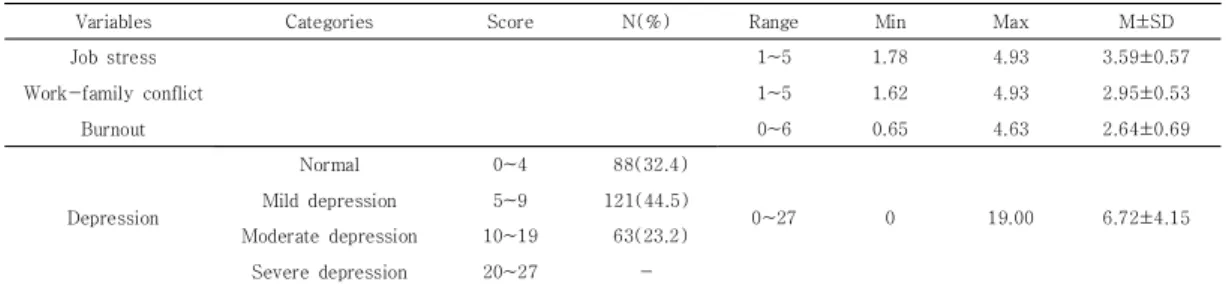
The levels of the subjects' job stress, work-family conflicts, burnout, and depression were as shown in Table 2. The mean score of job stress was 3.59 ± 0.57 points (out of the full score of 5 points), which was slightly higher than the middle. The mean score of work-family conflicts was 2.95 ± 0.53 points (full score; 5),
which was about the middle, that of burnout
was 2.64 ± 0.69 points (full score; 6 points),
which was lower than the middle, and that of
depression was 6.72 ± 4.15 points (full score; 27
points), which corresponds to mild depression. As for the frequency of depression, 32.4% of the nurses were shown to be normal (PHQ-9 0-4), 44.5% showed mild depression (PHQ-9 5-9), and 23.2% showed moderate depression (PHQ-9 10-19).
3.3 Differences of Job stress, Work-family conflict, Burnout and Depression according to Characteristics of Participants
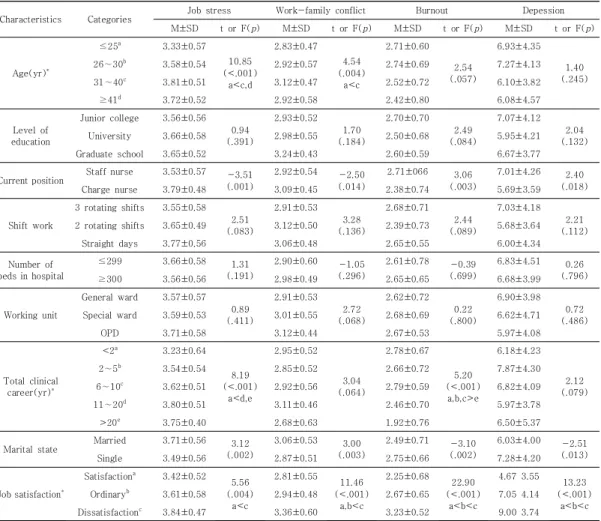
The results of the questionnaire surveys that showed significant differences in job stress, work-family conflicts, burnout, and depression according to the demographic and job-related characteristics of the subjects are as shown in Table 3. Job stress showed significant differences according to ages (F = 10.85, p <.001), current positions (t = -3.51, p = .001), total clinical careers (F = 8.19, p <.001), marital status (F=3.12, p =.002), and job satisfaction (F = 5.56, p = .004).
Differences between groups were examined and the results indicated that the level of stress was higher in the group of nurses aged at least 31 years compared to the group of nurses aged 25 years or less, among chief nurses compared to general nurses, in the group of nurses with at least 11 years of clinical career compared to the group of nurses with clinical careers not exceeding two years, among married nurses compared to unmarried nurses, and in the group of nurses dissatisfied with their job compared to the group of nurses satisfied with their job. The work-family conflicts were significantly different according to ages (F = 4.54, p = .004), current positions (t = -2.50, p = .014), marital status (t =
3.00, p = .003), and job satisfaction (F =11.46 , p
<.001). Differences between groups were examined and the results indicated that the level of work-family conflicts was higher in the group of nurses aged at 31-40 years compared to the group of nurses aged 25 years or less, among chief nurses compared to general nurses, among married nurses compared to general nurses, and in the group of nurses dissatisfied with their job compared to the group of nurses satisfied with their job or neutral nurses. burnout was significantly different according to current positions(t=3.06, p =.003), total clinical careers(F=5.20, p <.001), marital status(t=-3.10, p =.002), and job satisfaction(F=22.90, p <.001). Differences between groups were examined and the results indicated that the level of burnout was higher among general nurses compared to chief nurses, in the group of nurses with total clinical careers not longer than 10 years compared to the group of nurses with clinical careers not shorter than 20 years, among unmarried nurses compared to married nurses, in the group of nurses dissatisfied with their job compared to the group of neutral nurses, and in the group of neutral nurses compared to nurses satisfied with their job. Depression was significantly different according to current positions(t=2.40, p =.018), marital status(t=-2.51, p =.013), and job satisfaction(F=13.23, p <.001). Differences between groups were examined and the results indicated that the level of depression was higher general nurses compared to chief nurses, among unmarried nurses compared to married nurses, in the group of nurses dissatisfied with their job compared to the
Variables Categories Score N(%) Range Min Max M±SD
Job stress 1~5 1.78 4.93 3.59±0.57
Work-family conflict 1~5 1.62 4.93 2.95±0.53
Burnout 0~6 0.65 4.63 2.64±0.69
Depression
Normal 0~4 88(32.4)
0~27 0 19.00 6.72±4.15
Mild depression 5~9 121(44.5)
Moderate depression 10~19 63(23.2)
Severe depression 20~27 -
Table 2. Level of Job stress, Work-family conflict, Burnout and Depression (N =272)
group of neutral nurses, and in the group of neutral nurses compared to nurses satisfied with their job.
3.4 correlations among job stress, work-family conflicts, burnout, and depression
The correlations among job stress, work-family conflicts, burnout, and depression are as shown in Table 4. Depression was shown to be positively correlated with job stress(r=.18), work-family conflict(r=.36), and burnout(r=.43), and it was shown that when the levels of job stress, work-family conflicts, and burnout were higher, the level of depression was higher. burnout showed positive correlations with job stress(r=.23) and work-family
conflict(r=.41) and work-family conflicts showed positive correlations with job stress(r=.34), indicating that the higher the levels of job stress and work-family conflicts, the higher the level of burnout and that the higher the level of job stress, the higher the level of work-family conflicts.
Variables Job stress Work-family
conflict Burnout Depression
r(p) r(p) r(p)
Job stress 1 Work-family
conflict .34(<.001) 1
Burnout .23(<.001) .41(<.001) 1
Depression .18( .004) .36(<.001) .43(<.001) 1
Table 4. Correlations among Variables (N=272)
Characteristics Categories Job stress Work-family conflict Burnout Depession
M±SD t or F(p) M±SD t or F(p) M±SD t or F(p) M±SD t or F(p)
Age(yr)*
≤25a 3.33±0.57
10.85 (<.001)
a<c,d
2.83±0.47 4.54 (.004)
a<c
2.71±0.60 2.54 (.057)
6.93±4.35 1.40 (.245)
26∼30b 3.58±0.54 2.92±0.57 2.74±0.69 7.27±4.13
31∼40c 3.81±0.51 3.12±0.47 2.52±0.72 6.10±3.82
≥41d 3.72±0.52 2.92±0.58 2.42±0.80 6.08±4.57
Level of education
Junior college 3.56±0.56 0.94 (.391)
2.93±0.52 1.70 (.184)
2.70±0.70 2.49 (.084)
7.07±4.12 2.04 (.132)
University 3.66±0.58 2.98±0.55 2.50±0.68 5.95±4.21
Graduate school 3.65±0.52 3.24±0.43 2.60±0.59 6.67±3.77
Current position Staff nurse 3.53±0.57 -3.51 (.001)
2.92±0.54 -2.50 (.014)
2.71±066 3.06 (.003)
7.01±4.26 2.40 (.018)
Charge nurse 3.79±0.48 3.09±0.45 2.38±0.74 5.69±3.59
Shift work
3 rotating shifts 3.55±0.58 2.51 (.083)
2.91±0.53 3.28 (.136)
2.68±0.71 2.44 (.089)
7.03±4.18 2.21 (.112)
2 rotating shifts 3.65±0.49 3.12±0.50 2.39±0.73 5.68±3.64
Straight days 3.77±0.56 3.06±0.48 2.65±0.55 6.00±4.34
Number of beds in hospital
≤299 3.66±0.58 1.31
(.191)
2.90±0.60 -1.05 (.296)
2.61±0.78 -0.39 (.699)
6.83±4.51 0.26 (.796)
≥300 3.56±0.56 2.98±0.49 2.65±0.65 6.68±3.99
Working unit
General ward 3.57±0.57 0.89 (.411)
2.91±0.53 2.72 (.068)
2.62±0.72 0.22 (.800)
6.90±3.98 0.72 (.486)
Special ward 3.59±0.53 3.01±0.55 2.68±0.69 6.62±4.71
OPD 3.71±0.58 3.12±0.44 2.67±0.53 5.97±4.08
Total clinical career(yr)*
<2a 3.23±0.64 8.19 (<.001)
a<d,e
2.95±0.52
3.04 (.064)
2.78±0.67 5.20 (<.001)
a,b,c>e
6.18±4.23
2.12 (.079)
2∼5b 3.54±0.54 2.85±0.52 2.66±0.72 7.87±4.30
6∼10c 3.62±0.51 2.92±0.56 2.79±0.59 6.82±4.09
11∼20d 3.80±0.51 3.11±0.46 2.46±0.70 5.97±3.78
>20e 3.75±0.40 2.68±0.63 1.92±0.76 6.50±5.37
Marital state Married 3.71±0.56 3.12 (.002)
3.06±0.53 3.00 (.003)
2.49±0.71 -3.10 (.002)
6.03±4.00 -2.51 (.013)
Single 3.49±0.56 2.87±0.51 2.75±0.66 7.28±4.20
Job satisfaction*
Satisfactiona 3.42±0.52 5.56 (.004)
a<c
2.81±0.55 11.46 (<.001)
a,b<c
2.25±0.68 22.90 (<.001)
a<b<c
4.67 3.55 13.23 (<.001)
a<b<c
Ordinaryb 3.61±0.58 2.94±0.48 2.67±0.65 7.05 4.14
Dissatisfactionc 3.84±0.47 3.36±0.60 3.23±0.52 9.00 3.74
* p<.05 by Sheffe test
Table 3. Differences of Job stress, Work-family conflict, Burnout and Depression according to Characteristics
of Participants (N=272)
3.5 Factors Predicting Nurses’ Depression
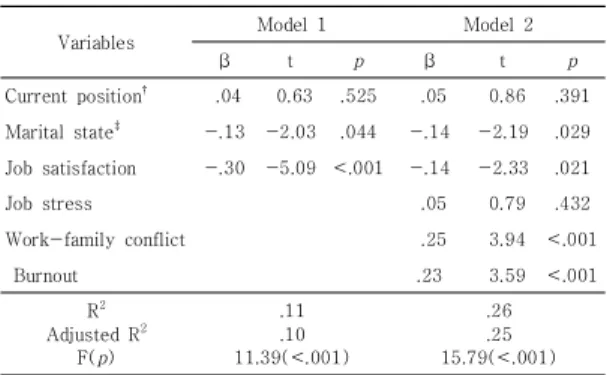
The assumptions of regression analysis were tested and according to the results, the tolerance of independent variables was 0.66 ~ 0.83 and the variance inflation factors (VIF) were shown to be 1.21 ~ 1.51 indicating that there was no problem of multicollinearity. The Durbin-Watson statistic was 1.99, which is close to 2, indicating that there was no autocorrelation between the error terms of the model thereby satisfying the assumption of the normality of residuals. Among the general characteristics of the subjects, positions, marital status, and job satisfaction that were identified to have significant effects on depression were used as control variables, which were inputted in the first stage, and job stress, work-family conflicts, and burnout were inputted in the second stage to analyze their effects on nurses' depression. Among the control variables, positions(general nurse=1, chief nurse=0) and marital status (married=1, unmarried=0), which are discrete variables, were treated as dummy variables. Hierarchical regression analysis was conducted to identify those factors that affect the depression of the subjects and the results are as shown in Table 5. Model 1, which consisted of three control variables, was statistically significant (F=11.39, p<.001), explained 10% of depression, and indicated that significant influencing factors were marital status and job satisfaction. Model 2, into which job stress, work-family conflicts, and burnout were inputted as the second stage, was also statistically significant and its additional explanatory power for depression was 15% (R
2variation=.15, F variation=18.02, p< .001). Influencing factors significant for depression were work-family conflicts and burnout and the factor with the largest explanatory power was work-family conflict( β =.25, p< .001) followed by burnout( β =.23, p= .001).
Variables Model 1 Model 2
β t p β t p
Current position† .04 0.63 .525 .05 0.86 .391 Marital state‡ -.13 -2.03 .044 -.14 -2.19 .029 Job satisfaction -.30 -5.09 <.001 -.14 -2.33 .021
Job stress .05 0.79 .432
Work-family conflict .25 3.94 <.001
Burnout .23 3.59 <.001
R2 Adjusted R2
F(p)
.11 .10 11.39(<.001)
.26 .25 15.79(<.001)
+sample size after listwise deletion analysis
†Current position dummy coded to staff nurse=1, charge nurse=0;
‡Marital state dummy coded to married=1, single=0;