409
©The Korean Society of Food Science and Technology
LC-MS를 이용한 감귤류의 수확 후 처리 살균제 분석
최수정*·김은정·이재인·조인순·박원희·황인숙·김무상·김건희1
서울시보건환경연구원 강남농수산물검사소, 1덕성여자대학교 식품영양학과
Determination of Post-harvest Fungicide in Citrus Fruits Using LC-MS
Su-Jeong Choi*, Eun-Jeong Kim, Jae-In Lee, In-Soon Cho, Won-Hee Park, In-Sook Hwang, Moo-Sang Kim, and Gun-Hee Kim1
Gangnam Agro-marine Products Inspection Center,
Seoul Metropolitan Government Research Institute of Public Health and Environment
1Department of Food and Nutrition, Duksung Women's University
Abstract Post-harvest fungicide residue was measured in citrus fruits. Samples were collected from local markets in Seoul and analyzed using liquid chromatography coupled with mass spectrometry (LC-MS). LC-MS results were validated for the assay of pesticides by using linearity, accuracy, precision, and limits of detection and quantification. The linearity in the concentration ranged from 0.005 to 2.0 mg/kg (R2>0.999). Sample recoveries ranged from 80.2 to 98.3% with relative standard deviations below 4.0% for spiking levels from 0.01 to 1.0 mg/kg. The limits of detection ranged between 0.002 and 0.008 mg/kg, and the limits of quantification ranged between 0.006 and 0.027 mg/kg. The highest residue levels for carbendazim, thiabendazole, imazalil, and azoxystrobinin citrus fruits were 0.541, 0.958, 0.721, and 0.052 mg/kg, respectively. The pesticide residues found in citrus fruits were blow maximum residue limits (MRLs) and are not a serious public health problem.
Keywords: pesticide residue, LC-MS, citrus fruits
서 론
농약은 채소와 과일의 병충해를 예방 또는 관리하기 위해 오 래 전부터 사용되어 왔다. 감귤류에 광범위하게 사용되는 농약은 살균제로써 수확 전 또는 수확 후에 사용되며 그 중 benzimidazole 계와 conazole계 농약은 수확 후 처리 살균제로 많이 쓰인다(1).
국내 농산물은 주로 생산과정에서만 농약을 살포하지만, 수입 과 일은 특성상 오랜 기간 저장 및 보관을 하며 장거리 수송이 요 구되기 때문에 생산과정 뿐 만 아니라 수확 후에도 부패, 변질을 막기 위해 농약, 방부제 등 화학 처리를 하게 되는데 이러한 수 확 후의 저장, 보관 및 수송과정에 별도의 농약처리를 수확 후 처리라고 한다(2).
수확 후 농산물에 직접처리가 허용되고 있는 농약은 methyl bromide, 인화수소, 청산 등의 훈증제이며, 분제, 액제의 직접처 리는 허용되고 있지 않지만, o-phenyl phenol, thiabendazole 등을 식품첨가물로 허가한 나라는 많다. 미국에서는 살충제로서 훈증
제 이외에 chlorpyrifos, pirimiphos-methyl 등이 사용되고, 살균제 로서 captan, thiabendazole, o-phenyl phenol, benomyl 등의 직접 처리가 허가되어 있으며(3), 최근에는 사람과 환경에 보다 안전 한 pyrimethanil, fludioxonil, azoxystrobin 등도 사용되는 추세이다 (4). 우리나라에서도 식품의약품안전처 고시 제 2012-1호에서 수 입 감귤류의 수확 후 처리살균제로 fludioxonil과 azoxystrobin의 잔류허용기준이 신설되었다(5).
감귤류의 잔류농약을 분석하는 방법으로는 GC (gas chromatog- raphy)에 ECD (electron capture detector) (6), NPD (nitrogen- phosphorus detector) (7,8), PFPD (pulsed flame photometric detector) (9) 또는 MS (mass spectrometry) (10,11) 등의 다양한 검출기를 이용한 방법이 있다. 그러나 최근 GC를 이용한 분석에 적합하지 않고, 극성을 띠는 농약들이 사용되는 추세여서 LC (liquid chromatography)에 MS를 결합한 분석법이 많이 쓰이고 있 다(12). 감귤류 농약분석에 쓰이는 질량 분석관은 single quadrupole (13-16), triple quadrupole (17-19), ion trap (20), time of flight (21) 등이 사용되고 있다. MS 검출기의 경우 검출된 농약을 확 인할 수 있는 정보를 제공하며, 우수한 민감도와 선택성을 얻을 수 있다(12).
따라서 본 연구에서는 LC-MS를 이용한 수확 후 살균제 분석 법의 유효성을 검증하고, 확립된 분석법을 이용하여 수입에 의존 하는 오렌지, 레몬, 자몽의 수입 감귤류와 국산 감귤류 잔류량을 확인하여, 잔류 농약에 관한 시민들의 우려해소와 감귤류의 잔류 농약에 관한 기초 자료로 활용하고, 시민들의 올바른 섭취를 위 한 정보를 제공하고자 한다.
*Corresponding author: Su-Jeong Choi, Gangnam Agro-marine Products Inspection Center, Seoul Metropolitan Government Research Institute of Public Health and Environment, Seoul 138- 701, Korea
Tel: 82-2-3401-6291 Fax: 82-2-3401-6742 E-mail: [email protected]
Received March 19, 2013; revised May 14, 2013;
accepted May 23, 2013
재료 및 방법
재료
2012년 1월에서 12월까지 서울에서 유통되고 있는 감귤류 5종 (감귤, 오렌지, 금귤, 자몽, 레몬) 100건의 시료를 수거하여 수확 후 처리 살균제 함량을 분석하였다. 시료는 과일 전체를 분쇄기 (Blixer 5A Plus, Robot Coupe, Jackson, MS, USA)로 분쇄하여
폴리에틸렌 비닐팩에 밀봉 포장하여 냉동(−20oC)보관하면서 사용 하였다(Table 1).
시약 및 장비
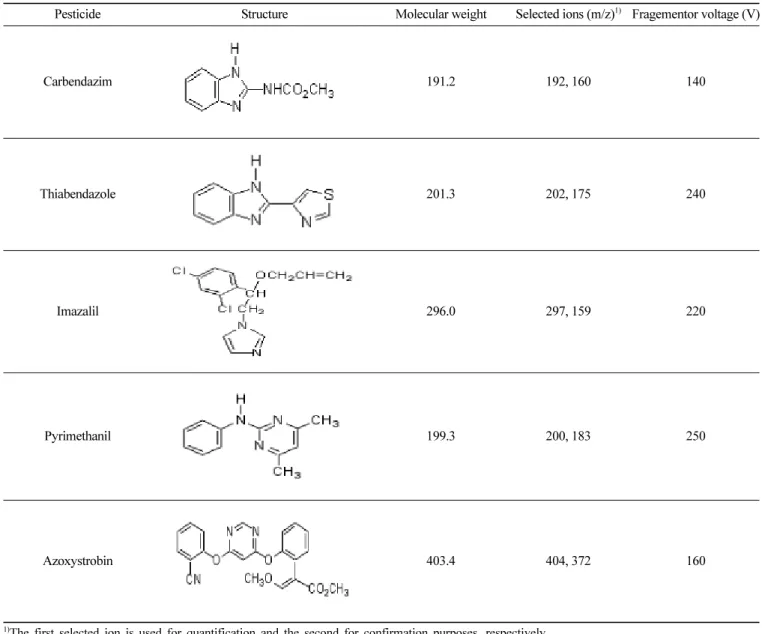
표준품 carbendazim (99.5%), thiabendazole (98.3%), imazalil (97.0%), pyrimethanil (99.0%), azoxystrobin (99.0%)의 화학적 구조 는 Table 2와 같으며, Dr. Ehrenstorfer GmbH사(Augsburg, Ger- many)에서 구입한 것을 사용하였다. 추출 및 분석에 사용되는 ethyl acetate (Wako, Osaka, Japan)는 잔류농약 분석용을 사용하였고, methanol (J.T.Baker, Phillipsburg, NJ, USA)은 HPLC 등급을 사용 하였고, sodium sulfate anhydrous (Wako), formic acid (Fluka, Buchs, Germany)은 모두 특급이상의 것을 사용하였고, 증류수는 초 순수 제조기(ELGA, Marlow, UK)로 제조된 물을 사용하였다.
시료를 여과하기 위해 여과용 필터 1PS와 0.2 µm nylon syringe filter는 Whatman사(Brentford, UK) 제품을 사용하였으며, 추출에 사용된 균질기는 Macro ES (Omni International, Kennesaw, GA, USA)이고, 용매를 제거할 때 사용한 감압 농축기는 EYELA NVC- 2100 (Eyela Co., Tokyo, Japan)였다.
Table 1. The list of citrus fruits Groups Commodity
(No. of Samples)
Origin (No. of Samples)
Citrus fruits
Mandarin (35) Korea (35) Kumquat (7) Korea (7) Orange (31) USA (28), Chile (2),
Republic of South Africa (1) Grapefruit (16) USA (16)
Lemon (11) USA (11)
Total 100
Table 2. Pesticide structure, molecular weight, selected ions for analysis and fragementor voltage
Pesticide Structure Molecular weight Selected ions (m/z)1) Fragementor voltage (V)
Carbendazim 191.2 192, 160 140
Thiabendazole 201.3 202, 175 240
Imazalil 296.0 297, 159 220
Pyrimethanil 199.3 200, 183 250
Azoxystrobin 403.4 404, 372 160
1)The first selected ion is used for quantification and the second for confirmation purposes, respectively.
표준용액의 조제
표준원액 중 carbendazim은 methanol에 녹이고, thiabendazole, imazalil, pyrimethanil, azoxystrobin은 acetonitrile에 녹여 100 mg/L 로 만들어 −20oC에서 냉동 보관하면서 표준원액으로 사용하였으 며, 혼합표준용액은 0.005, 0.025, 0.05, 0.1, 0.25, 0.5, 1.0, 2.0 mg/L 농도가 되도록 이동상으로 희석하여 사용하였다.
추출 및 정제
시료의 전처리 과정은 Fernandez 등(12)의 방법을 적용하였다.
분쇄한 시료 25 g을 달아 균질기에 넣고 sodium sulfate anhydrous 40 g와 ethyl acetate 50 mL를 넣어 2,000 rpm으로 2분간 고속으로 균질화한 후 이를 sodium sulfate anhydrous로 1PS 여과지에 탈수 여과한 후 같은 작업을 2회 반복처리 한 후 용매를 40oC 이하의 수욕 상에서 감압 농축하고 잔류물을 이동상 5 mL에 용해시켜 0.2µm 실린지 필터로 여과하여 기기분석에 사용하였다.
기기분석
본 연구에서 사용한 LC/MS는 1200 series liquid chromatogra- phy/6130 single quadrupole mass selective detector (Agilent, Santa Clara, CA, USA)로 구성된 것을 사용하였고, MS의 이온화 방식은 전자분무이온화(electrospray ionization, ESI)법의 positive mode이고, 이온의 분리 방식으로 사중극자 질량 분리관이 부착 된 LC/MS를 이용한 역상 액체 크로마토그래피에 의하여 분석하 였다. 분리조건으로는 Eclipse plus C18 (3.0×100 mm, 3.5 µm, Agi- lent) 칼럼을 사용하였으며, 이동상은 0.1% formic acid을 포함한 수용액(A)과 0.1% formic acid을 포함한 methanol (B)을 사용하여 초기에 B를 25%의 조성으로 시작하여 11분 까지 B를 75%의 조 성이 되도록 기울기 조건으로 사용하였고, 유속은 0.5 mL/min였다.
전자분무이온화법의 분석조건은 drying gas로 질소(99.99%)를 12 L/min의 유량으로 사용하였고, 기화 온도는 350oC, 40 psi 분 사압력으로 시료를 분무시키고 fragmentor voltage는 Table 2와 같 이 적용하였다. Capillary voltage는 3,500 V였고, 특정이온을 선 택하여 검출하는 selected ion monitoring (SIM)법을 사용하였다 (Table 3).
분석법 유효성 검증
본 실험의 직선성(linearity), 정확성(accuracy), 정밀성(precision),
검출한계(limit of detection) 및 정량한계(limit of quantification)로 유효성 검증을 하였다. 직선성은 혼합표준용액을 0.005, 0.025, 0.05, 0.1, 0.25, 0.5, 1.0, 2.0 mg/L 농도가 되도록 이동상으로 희 석한 후 LC-MS에 주입하여 얻어진 피크면적으로부터 검량선을 작성하였다. 정확성과 정밀성은 농약이 검출되지 않은 시료에 최 종농도가 0.01, 0.1, 1.0 mg/kg으로 농약을 첨가한 후 회수율과 상 대표준편차로 측정하였다. 검출한계와 정량한계는 농약이 검출되 지 않은 감귤에 검출한계와 정량한계의 농도를 추정한 후, 추정 한 검출한계의 1에서 5배 사이의 농도를 첨가하여 전처리 후 검 량선으로부터 농도를 측정하였다. 측정한 값으로부터 표준편차(s) 를 구하고, 검량선에서 얻은 기울기(m)을 바탕으로 검출한계는 3.3 s/m, 정량한계는 10 s/m으로 계산하였으며, 실험은 3회 반복하 여 평균값을 구하였다.
결과 및 고찰
크로마토그램과 질량 스펙트럼
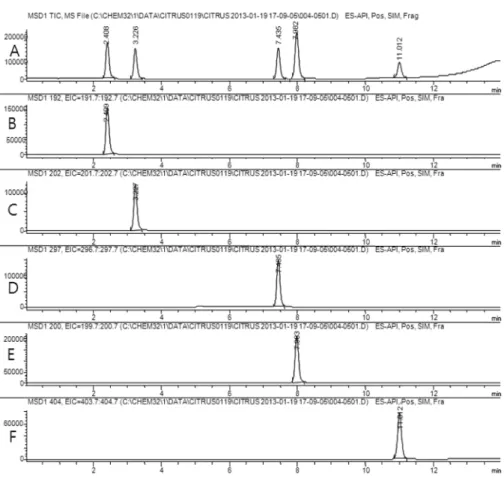
수확 후 처리 살균제 5종의 분리를 위해 LC-MS를 사용하여 표준물질의 크로마토그램과 질량스펙트럼을 확인하였다. 질량분 석기에서 각각의 농약 표준용액을 flow injection analysis (FIA) 방법으로 ESI positive mode에서 fragmentor voltage, scan mass range를 변화시키면서 최적의 이온화가 되는 조건을 찾았다. 그 후 ESI positive mode에서 C18컬럼을 통과시켜 머무름 시간을 확 인하고 농약의 분리가 잘되는 용매조성을 선정하였다. 각각의 표 준 용액 별로 생성이온을 확인하면서 fragmentation이 양호하게 일어나는 fragmentor voltage 값을 재선정하였다. 이 결과로 LC- MS의 전자분무 이온화 방법의 전형적인 스펙트럼으로 [M+H]+가 기준이온(base ion)으로 검출되어 정량이온으로 선택하였고, 특성 이온들은 Table 2와 Fig. 1에 나타냈다. 혼합표준물질의 머무름 시간은 Fig. 2와 같이 carbendazim 2.4분, thiabendazole 3.2분, imazalil 7.4분, pyrimethanil 7.9분, azoxystrobin 11.0분에 검출되었 고, 분석하고자 하는 물질의 분리능과 효율성은 적합하였다.
검량선과 검출한계 및 정량한계
잔류농약 분석을 위한 검량선 작성을 위해 혼합표준용액을 조 제한 후 LC-MS로 분석하였다. 그 결과 Table 4와 같이 carbenda- zim, thiabendazole, imazalil, pyrimethanil, azoxystrobin에서 상관계 Table 3. The operation parameters of the LC-MS for analysis of pesticides
Instrument Parameter Conditions
LC parameter
Column Eclipse plus C18, 3.0×100 mm, 3.5 µm Mobile phase A: 0.1% formic acid in methanol
B: 0.1% formic acid in water Gradient Time (min) 0 2 7 8 9 11 14
Solvent A (%) 25 50 60 60 65 75 25
Flow rate 0.5 mL/min
Injection volume 10 µL
Column temp. 40oC
MS parameter
Polarity ESI+
Drying gas flow 12 L/min
Drying gas Temp. 350oC Ionspary voltage 5,500 V Nebulizer pressure 35 psi Capillary voltage 3,500 V
수(R2) 0.999 이상의 우수한 직선성을 나타냈고, 분석법에 의해 얻은 표준물질의 크로마토그램은 Fig. 2에 나타냈다.
검출한계는 carbendazim은 0.002 mg/kg, thiabendazole은 0.004 mg/kg, imazalil은 0.005 mg/kg, pyrimethanil은 0.008 mg/kg, azox- ystrobin은 0.007 mg/kg였으며, 정량한계는 carbendazim은 0.006 mg/kg, thiabendazole은 0.014 mg/kg, imazalil은 0.016 mg/kg, pyrimethanil은 0.027 mg/kg, azoxystrobin은 0.022 mg/kg였다(Table 4). 이는 국제식품규격위원회(Codex) 및 국내(22)에서 권장하는 기 준인 잔류허용기준의 1/2 또는 0.05 mg/kg 이하의 정량한계에도 적합하였다.
정확성과 정밀성
정확성 및 정밀성 실험을 위해 농약이 검출되지 않은 시료에 표준용액을 첨가 후 전처리 하여 3회 반복 실험하였다. 회수율 실험은 감귤에 최종농도가 검출한계, 검출한계 10배, 검출한계의 100배 농도인 0.01, 0.1, 1.0 mg/kg가 되도록 농약을 첨가하여 분 석하였다. 농약의 각 첨가농도에 따른 회수율은 Table 5와 같이 carbendazim 84.7-98.3%, thiabendazole 85.9-88.0%, imazalil 86.7- 92.1%, pyrimethanil 82.0-90.2%, azoxystrobin 80.2-92.3%, 상대표 준편차는 carbendazim 0.48~3.93%, thiabendazole 0.94-3.15%, imazalil 0.87-2.51%, pyrimethanil 0.58-1.86%, azoxystrobin 0.49- 2.77%을 보였다. 각국 및 국제기구 등에서 연구수행에 활용된 분 석방법에 대한 적합성은 회수율과 상대표준편차 등의 범위를 이 용하여 판단하고 있는데, 국내는 회수율 70-120% 및 상대표준편
차 20% 이하(22), 유럽연합에서 제시한 회수율은 70-120%와 상 대표준편차 20% 이하(23), 국제식품규격위원회는 회수율 60-120%
와 상대표준편차 15~30% 이하 규정하고 있다(24). 본 연구에서 제시한 회수율 최소 80% 이상과 정밀성 4.0% 이하의 변이계수 를 나타내어 국내 및 국제적 기준을 만족하였다.
유통 감귤류 중 수확 후 처리 살균제 잔류량 분석결과 유통 중인 감귤류를 대상으로 수확 후 처리 살균제 잔류량을 조사한 결과는 Table 6에 나타냈다. 총 100건 중 감귤류에서는 91건의 시료에서 잔류농약이 검출되어 91%의 검출률을 나타냈다.
감귤류 종류에 따른 검출농약을 살펴보면 수입 감귤류인 오렌 지, 자몽, 레몬의 경우 thiabendazole과 imazalil이 주로 검출되었 다. 오렌지에 대한 크로마토그램은 Fig. 3에 나타냈고, thiabenda- zole은 최대 0.958 mg/kg, imazalil은 최대 0.689 mg/kg, azox- ystrobin은 최대 0.051 mg/kg 검출되었다. 자몽에서 thiabendazole 은 최대 0.897 mg/kg, imazalil은 최대 0.651 mg/kg, azoxystrobin은 최대 0.032 mg/kg이 검출되었고, 레몬은 thiabendazole 최대 0.286 mg/kg, imazalil 최대 0.721 mg/kg이 검출되었다. 실험결과 국내잔류허용기준(MRL)을 초과한 검체는 없었으나, 수입 감귤류 에 수확 후 살균제로 thiabendazole과 imazalil이 여전히 많이 사 용됨을 알 수 있었다. 스페인산 오렌지에 대한 수확 후 처리 살 균제 분석결과를 보면 Blasco 등(25)의 연구에서는 carbendazim 0.28-0.50 mg/kg, imazalil 0.40-0.42 mg/kg이 검출되었으며, Fernndez 등(26)의 연구에서는 thiabendazole 0.20-1.76 mg/kg, imazalil 0.02- Fig. 1. Mass spectra of pesticide standard solutions by LC-MS. Peak identification: A. Carbendazim, B. Thiabendazole, C. Imazalil, D.
Pyrimethanil, E. Azoxystrobin.
1.34 mg/kg, carbendazim은 0.10-0.26 mg/kg이 검출되어 오렌지에 thiabendazole과 imazalil이 많이 사용됨을 알 수 있었으며, car- bendazim은 국내에서 유통되는 대부분이 미국산 오렌지였고, 미 국은 carbendazim을 Zero tolerance정책으로 사용을 금지하고 있 어 연구결과가 다르게 나타났다. 특히 미국의 경우 재배 시 농약 살포는 우리나라보다 엄격한 절차 및 기준이 적용되지만 수출용
에 한하여 농약 살포가 법적으로 허용되어 있으므로(2), 수확 후 농약에 대한 주의가 필요 할 것이다. 경기도 농산물 잔류농약 통 계연보에 의하면(27) 오렌지, 레몬, 자몽에 imazalil, chlorpyrifos 등이 검출되어 수확 후 처리 살균제와 살충제의 사용이 높은 것 을 알 수 있었다. 현재 우리나라에서 감귤류에 thiabendazole과 imazalil의 잔류허용기준은 각각 10, 5 mg/kg으로 설정되어 있다.
imazalil의 국내허용기준은 미국, 일본, 유럽연합(EU)에서 모두 감 귤에 대해 5 mg/kg으로 규제하고 있으나 thiabendazole에 대한 우 리나라의 허용기준은 10 mg/kg으로 미국과 일본의 기준과는 같 으나 유럽연합의 허용기준 5 mg/kg에 비하면 다소 높다. 따라서 실제로 먹는 부위의 잔류량이 안전하다 하더라도 우리나라도 독 성 등 인체에 미치는 영향을 고려하여 기준을 유럽연합 수준으 로 강화하여야 할 것이다(2).
국내 감귤류의 경우 대표적인 수확 후 처리살균제인 thiabenda- zole과 imazalil은 검출되지 않았으며, 감귤은 carbendazim과 azox- ystrobin이 검출되었고, 각각 최대 0.394, 0.052 mg/kg 검출되었고, 금귤의 경우 carbendazim만 최대 0.541 mg/kg 검출되었다. 실험결 Fig. 2. Total ion chromatogram (TIC) and extracted ion chromatogram (XIC) of pesticide standard solutions (0.1 mg/kg) by LC-MS.
Peak identification: A. Total ion chromatogram (TIC), B. Carbendazim, C. Thiabendazole, D. Imazalil, E. Pyrimethanil, F. Azoxystrobin.
Table 4. Linear equations, correlation coefficients, LODs and LOQs of pesticides1)
Pesticide Linear equation Correlation coefficient (R2) LOD2) (mg/kg) LOQ2) (mg/kg)
Carbendazim y=7626701.9x−217216.7 0.9995 0.002 0.006
Thiabendazole y=7035280.1x+118734.9 0.9998 0.004 0.014
Imazalil y=6394147.2x+208167.6 0.9993 0.005 0.016
Pyrimethanil y=12820472.9x+307705.5 0.9995 0.008 0.027
Azoxystrobin y=5453057.5x+95182.9 0.9996 0.007 0.022
1)Instrument linearity range: 0.005-2.0 mg/L
2)Mean value from 3 measurements
Table 5. Recovery and precision of pesticides in mandarin Pesticides 0.01 mg/kg 0.1 mg/kg 1.0 mg/kg
Recovery (%)1)±RSD (%) Carbendazim 98.3±3.36 91.7±3.93 84.7±0.48 Thiabendazole 87.4±0.94 85.9±3.15 88.0±1.14 Imazalil 92.1±2.51 87.0±0.87 86.7±1.95 Pyrimethanil 90.2±1.86 86.2±1.38 82.0±0.58 Azoxystrobin 92.3±1.84 80.2±0.49 83.6±2.77
1)Mean value from 3 measurements
과 국내 잔류허용기준(MRL)을 초과한 검체는 없었으나, 감귤의 경우 수확 전 농약 살포시 살포 농도에 따라 차이는 있지만 일 반적으로 수확 전 최종 농약사용시기가 최소 7일에서 최대 30일 로 설정되어 있어(28), 검출된 carbendazim과 azoxystrobin은 수확 전 처리된 농약이 잔류함을 알 수 있었다. 경기도 농산물 잔류농 약 통계연보에 의하면(27) 감귤에는 fenitrothion, chlorpyrifos 등 살충제와 EPN, phenthoate, dicofole, methidathion 등 유기염소계 살응애제가 검출되어 살충제와 살응애제의 사용이 높았고, 수확 전 처리한 농약들이 잔류됨을 알 수 있었다.
수입 과일 중 감귤류의 국내연구결과를 보면, Cho 등(3)은 chlorpyrifos 검출률이 높았다고 보고하였고, Yun 등(29)의 연구결 과에서도 오렌지, 레몬 과일 전체에서 chlorpyrifos 28.6%, imazalil
16.7% 검출되었고, 오렌지 과피에서 thiabendazole이 검출되어 수 확 후 처리 농약이 잔류함을 알 수 있었다.
그러나 과일류의 잔류농약은 껍질에 대부분 잔류되어 껍질제 거로 인해 유기인계 농약이 평균 91% 제거효과가 있었고(30), 수 확 후 처리 농약의 경우도 오렌지 과일전체에서 imazalil은 0.181- 1.014 mg/kg이었으나, 껍질을 제거한 과육에서는 0.084 mg/kg으로 감소한 결과를 보여(29) 껍질 제거만으로 농약섭취를 현저히 줄 일 수 있다.
그러므로 감귤류는 흐르는 물에 충분히 씻은 후 껍질을 제거 하고 섭취하며, 농약의 잔류성을 줄이기 위한 방안으로, 다양해 진 검출 농약의 흐름에 맞게 감귤류에 많이 쓰이는 농약에 대한 지속적인 모니터링을 효과적으로 실시하는 노력이 필요하다.
Fig. 3. Total ion chromatogram (TIC) and extracted ion chromatogram (XIC) in orange by LC-MS. Peak identification: A. Total ion chromatogram (TIC), B. Carbendazim, C. Thiabendazole, D. Imazalil, E. Pyrimethanil, F. Azoxystrobin.
Table 6. Summary of pesticide residues monitoring in citrus fruits
Commodity Pesticide No of detected sample Detection range (mg/kg) Average value (mg/kg) MRL (mg/kg)
Mandarin Carbendazim 33 0.008-0.394 0.115 5.0
Azoxystrobin 28 0.007-0.052 0.029 1.0
Orange
Thiabendazole 30 0.018-0.958 0.408 10
Imazalil 30 0.175-0.689 0.332 5.0
Azoxystrobin 28 0.007-0.051 0.038 5.0
Kumquat Carbendazim 2 0.026-0.541 0.283 5.0
Grapefruit
Thiabendazole 14 0.012-0.897 0.361 10
Imazalil 15 0.034-0.651 0.294 5.0
Azoxystrobin 13 0.010-0.032 0.021 7.0
Lemon Thiabendazole 7 0.009-0.286 0.175 10
Imazalil 11 0.002-0.721 0.357 5.0
요 약
국내 유통되는 감귤류 총 100건을 대상으로 LC-MS을 이용하 여 감귤류에 대한 수확 후 처리 농약 잔류량을 조사하였다. 보다 효율적인 농약 분석을 위해 LC-MS를 이용하여 직선성, 정확성, 정밀성, 검출한계 및 정량한계로 분석법의 유효성 검증을 하였 다. 상관계수(R2)는 0.999이상의 우수한 직선성을 보였고, 농약의 회수율은 80.2-98.3%였고, RSD는 0.48-3.93%로 우수한 재현성을 나타냈다. 검출한계는 0.002-0.008 mg/kg였고, 정량한계는 0.006- 0.027 mg/kg였다. 확립된 분석법에 의해 분석한 결과 최고 잔류 수준은 carbendazim은 0.541 mg/kg, thiabendazole은 0.958 mg/kg, imazalil은 0.721 mg/kg, azoxystrobin은 0.052 mg/kg였다. 본 연구 결과에서 나타난 수확 후 처리 살균제는 잔류허용기준(MRL) 이 내에서 안전하게 관리되고 있으나, 농약의 잔류성을 줄이기 위한 지속적인 모니터링이 필요하다.
References
1. Dreassi E, Zanfini A, Zizzari AT, Rosa CL, Botta M, Corbini G.
LC/ESI/MS/MS determination of postharvest fungicide residues in citrus juices. LWT-Food Sci. Technol. 43: 1301-1306 (2010) 2. Yang YS, Seo JM, Kim JP, Oh MS, Chung JK, Kim ES. A sur-
vey on pesticide residues of imported agricultural products circu- lated in Gwangju. J. Fd. Hyg. Safety 21: 52-59 (2006)
3. Cho YS, Kang JB, Kim YH, Jeong JA, Huh JW, Lee SH, Lim YS, Bae HJ, Kang HG, Lee JH, Jung ES, Lee BH, Park YB, Lee JB. A survey on pesticide residues of imported fruits circulated in Gyeonggido. J. Pestic. Sci. 16: 195-201 (2012)
4. Kanetis L, Forster H, Adaskaveg JE. Comparative efficacy of the new postharvest fungicides azoxysrtrobin, fludioxonil and pyrimetha- nil for managing citrus green mold. Plant Dis. 91: 1502-1511 (2007)
5. Food and Drug Administration. KFDAs Notification NO. 2012-1.
Seoul, Korea. p. 27 (2012)
6. Sharif Z, Man YB, Hamid NS, Keat CC. Determination of orga- nochlorine and pyrethroid pesticides in fruit and vegetables using solid phase extraction clean-up cartridges. J. Chromatogr. A 1127:
254-261 (2006)
7. Schirra M, Cabras P, Angioni A, D’hallewin G, Pala M. Residue uptake and storage responses of Tarocco blood oranges after pre- harvest thiabendazole spray and postharvest heat treatment. J.
Agr. Food Chem. 50: 2293-2296 (2002)
8. Schirra M, Cabras P, Angioni A, Melis M. Residue level of imazalil fungicide in lemons following prestorage dip treatment at 20 and 50oC. J. Agr. Food Chem. 44: 2865-2869 (1996)
9. De Nino A, Santelli F, Servidio N, Sindona G, Tagarelli A. Iden- tification and assay of organophosphate in organic oranges by gas chromatography with pulsed flame photometric detection and ion- trap mass spectrometry. J. AOAC Int. 86: 1003-1007 (2003) 10. Liu LB, Hashi Y, Qin YP, Zhou HX, Lin JM. Development of
automated online gel permeation chromatography-gas chromato- graph mass spectrometry for measuring multi residual pesticides in agricultural products. J. Chromatogr. B 845: 61-68 (2007) 11. Lehotay SJ, De Kok A, Hiemstra M, Van Bodegraven P. Valida-
tion of a fast and easy method for the determination of residues from 229 pesticides in fruits and vegetables using gas and liquid chromatography and mass spectrometric detection. J. AOAC Int.
88: 595-614 (2005)
12. Fernandez R, Garrido Frenich A, Martinez Vidal JL, Romero Gonzalez R, Hernandez Torres ME. One-year routine application of a new and rapid method based on ultra performance liquid chromatography-tandem mass spectrometry to the analysis of
selected pesticides in citrus fruits. Anal. Sci. 25: 535-540 (2009) 13. Blasco C, Font G, Pic Y. Evaluation of 10 pesticide residues in
oranges and tangerines from Valencia (Spain). Food Control 17:
841-846 (2006)
14. Blasco C, Font G, Pic Y. Comparison of microextraction proce- dures to determine pesticides in oranges by liquid chromatogra- phy-mass spectrometry. J. Chromatogr. A 970: 201-212 (2002) 15. Valenzuela AI, Popa DS, Redondo MJ, Maes J. Comparison of
various liquid chromatographic methods for the analysis of aver- mectin residues in citrus fruits. J. Chromatogr. A 918: 59-65 (2001)
16. Valenzuela AI, Redondo MJ, Pic Y, Font G. Determination of abamectin in citrus fruits by liquid chromatography-electrospray ionization mass spectrometry. J. Chromatogr. A 871: 57-65 (2000)
17. Hiemstra M, De Kok A. Comprehensive multi-residue method for the target analysis of pesticides in crops using liquid chromatog- raphy-tandem mass spectrometry. J. Chromatogr. A 1154: 3-25 (2007)
18. Hernndez F, Pozo OJ, Sancho JV, Bijlsma L, Barreda M, Pitarch E. Multi residue liquid chromatography tandem mass spectrome- try determination of 52 non gas chromatography-amenable pesti- cides and metabolites in different food commodities. J.
Chromatogr. A 1109: 242-252 (2006)
19. Pozo OJ, Marin JM, Sancho JV, Hernndez F. Determination of abamectin and azadirachtin residues in orange samples by liquid chromatography-electrospray tandem mass spectrometry. J. Chro- matogr. A 992: 133-140 (2003)
20. Blasco C, Font G, Pic Y. Analysis of pesticides in fruits by pres- surized liquid extraction and liquid chromatography-ion trap-triple stage mass spectrometry. J. Chromatogr. A 1098: 37-43 (2005) 21. Grimalt S, Pozo OJ, Sancho JV, Hernndez F. Use of liquid chro-
matography coupled to quadrupole time-of-flight mass spectrome- try to investigate pesticide residues in fruits. Anal. Chem. 79:
2833-2843 (2007)
22. Rural Development Administration. Bulletin of Pesticide Registra- tion Investigator (Guidance of pesticide residue test), Notice of Rural Development Administration No. 2009-1. Suwon, Korea (2009)
23. European commission. Directorate general health and consumer protection. Guidance document on method validation and quality control procedures for pesticide residues analysis in food and feed, SANCO/10684/2009. pp. 12-15 (2010)
24. Codex Alimentarius Commission. Guidelines on good laboratory practice in residue analysis. CAC/GL 40-1993, Rev.1 p. 25 (2003)
25. Blasco C, Font G, Pic Y. Multiple-stage mass spectrometric anal- ysis of six pesticides in oranges by liquid chromatography-atmo- spheric pressure chemical ionization-ion trap mass spectrometry.
J. Chromatogr. A 1043: 231-238 (2004)
26. Fernndez M, Rodrguez R, Pic Y, Maes J. Liquid chromatograpic- mass spectrometric determination of post-harvest fungicides in citrus fruits. J. Chromatogr. A 912: 301-310 (2001)
27. Gyeonggi-do Institute of Health & Environment. 2011 Annual report of the pesticide residues in agricultural products. Gyeo- nggi-do Institute of Health & Environment, Suwon, Korea. pp.
26-28 (2012)
28. Korea Crop Protection Association. Guideline of pesticides use.
Samjeong Press Inc, Seoul, Korea. pp. 1243-1247 (2011)
29. Yun ES, Lee MS, Hong MS, Jung SY, Lee YZ, Kim KS, Chae YZ, Park SG. Report of Seoul Metropolitan Government Research Institute of Public Health and Environment. Aram press, Seoul, Korea. Vol. 41 pp. 117-121 (2005)
30. Lee MG, Shim JH, Ko SH, Chung HR. Research trends on the development of scientific evidence on the domestic maximum residue limits of pesticides. Food Sci. Ind. 43: 41-66 (2010)