530
Copyright © 2020 The Korean Society of Fisheries and Aquatic Science pISSN:0374-8111, eISSN:2287-8815
서 론
태평양대구
(Gadus macrocephalus)
는한국과일본해역및 오호츠크해,
베링해,
알래스카만과캘리포니아연안까지광범위하게분포하고수심
40-500 m
에서서식하는대표적인한해성어종이다
(Westrheim, 1996; NOAA, 2010).
국내연근해어 획량은1982
년에약4,500
톤으로가장높았으나, 1990
년대에 약500
톤이하로급격하게감소하였다.
이에따라대구의자원 회복을위한다양한초기종자생산기술개발연구(Kim et al., 2007; Lee et al., 2007; Gwak, 2010; Choi et al., 2011; Gwak et al., 2012; Shin et al., 2019)
가이루어졌으며,
이를통한수정란 및치어방류사업을통해최근2019
년에는어획량이약1
만톤으로상승하여자원이회복되고있는추세이다
(KOSIS, 2020).
그러나보다안정적이고건강한종자를대량생산하기위해서 는다양한분야의연구가수행될필요가있으며
,
특히초기자어 의영양학적연구가반드시수행되어야한다.
일반적으로난황흡수직후자어의영양결핍과기아는비정 상적인소화기관의발달
,
먹이효율의감소및먹이섭취활동 의감소등과밀접한관계가있다(Heming et al., 1982; Taylor and Freeberg, 1984; Rice et al., 1987; Gisbert et al., 2004).
또한자어의입크기를고려한적정먹이생물의선택과이들 먹이생물내필수영양소의함량은초기개체발생단계의영양 요구량측면에서매우중요하다
(Hamre, 2016).
대부분의해산 어초기자어의먹이로서대량생산과영양강화를통한영양소다양한 Rotifer (Brachionus plicatilis) 영양강화가 태평양 대구(Gadus macrocephalus) 자어의 성장 및 지방산 조성에 미치는 영향
최진·한경식
1·변순규
1·임현정
1·이창환
2·이다연
2·김희성
2*
국립수산과학원 양식관리과, 1국립수산과학원 동해수산연구소, 2경상대학교 해양식품생명의학과
Effect of Different Rotifer Enrichment Products on Survival, Growth, and Fatty Acid Composition of Larval Pacific Cod Gadus macrocephalus
Jin Choi, Gyeong Sik Han
1
, Soon-Gyu Byun1
, Hyun Jeong Lim1
, Chang-Hwan Lee2
, Da-Yeon Lee2
and Hee Sung Kim2
*Aquaculture Management Division, National Institute of Fisheries Science, Busan 46083, Korea
1Aquaculture Industry Research Division, East Sea Fisheries Research Institute, National Institute of Fisheries Science, Gang- neung 25435, Korea
2Department of Marine Seafood and Aquaculture Science, Gyeongsang National University, Tongyeong 53064, Korea
This study compared the survival rates, growth, and fatty acid content of larval Pacific cod Gadus macrocephalus fed with rotifers raised on different enrichment diets. We used four commercial rotifer enrichment products (one domestic, ER1, and three imported, ER2, ER3 and ER4). Twelve 200-L tanks were used, with three replicates per treatment. Larvae were fed rotifers 3 times daily at a rate of 5 rotifers/ml/feeding from 7 to 21 days post-hatch. At the end of the feeding trial, the survival rate and total length of larvae fed ER3 were greater than those of larvae fed ER1, ER2, or ER4. ER3 had the highest proportions of eicosapentaenoic acid (EPA), docosahexaenoic acid (DHA), and polyunsaturated acid (PUFA). Partially reflecting this composition, larvae fed ER3 had the highest proportions of DHA and PUFA. These results show a positive effect of rotifer DHA and PUFA proportions on the survival and growth rates of Pacific cod larvae.
Keywords: Rotifer, Larval pacific cod, Enrichment, Growth, Fatty acid composition
*Corresponding author: Tel: +82. 55. 772. 9154 Fax: +82. 55. 772. 9159 E-mail address: [email protected]
This is an Open Access article distributed under the terms of the Creative Commons Attribution Non-Commercial Licens (http://creativecommons.org/licenses/by-nc/3.0/) which permits unrestricted non-commercial use, distribution, and reproduction in any medium, provided the original work is properly cited.
Received 18 June 2020; Revised 15 July 2020; Accepted 15 July 2020
저자 직위: 최진(연구사), 한경식(연구보조원), 변순규(연구관), 임현정(과장), 이창환(대학생), 이다연(대학생), 김희성(조교수)
https://doi.org/10.5657/KFAS.2020.0530
Korean J Fish Aquat Sci 53(4), 530-537, August 2020
함량조절이용이한
rotifer
와Artemia
를주요먹이생물로공 급한다(Yoshimura et al., 1997; Dhert et al., 2001; Kotani et al., 2009).
특히, rotifer Brachionus plicatilis
는난황흡수후 자어가섭취하기에용이한크기와섭취자극움직임등의특징 을가지고있어개구후첫먹이로서주로공급된다. Rotifer
는Chlorella
또는빵효모를먹이로이용하여대량배양이가능하지만
,
초기자어의발달과생존율향상을위한필수영양소가결 핍이발생하기때문에먹이내필수영양소의함유를위한영양 강화가필요하다(Coutteau and Sorgeloos, 1997; Sargent et al., 1997, 1999a; Cutts et al., 2006).
특히docosahexaenoic acid (DHA, C22:6n-3), eicosapentaenoic acid (EPA, C20:5n-3)
및arachidonic acid (ARA, C20:4n-6)
과같은다가불포화지방산(poly unsaturated fatty acid, PUFA)
은세포막인지질이중층의 주요구성요소로서초기자어의망막과뇌등의신경발달에필 수영양소인것으로알려져있으며(Sargent et al., 1997,1999a;
Benítez-Santana et al., 2007),
자어의변태,
체색소 및 스트레스내성에효과적인것으로알려져있다
(Kanazawa, 1997;
Rainuzzo et al., 1997; Watanabe and Kiron, 1994; Weirich and Reigh, 2001).
이와 같이 초기 자어의 성장과 발달을 위해서는
rotifer
의PUFA
함유를위한영양강화는필수적이기때문에다양한상업용시판영양강화제가개발및판매되고있으며
,
이를이용한영양강화
rotifer
의공급에따른다양한해산어자어의생산성에미치는영향에대한연구가다수수행된바있다
(Coutteau
and Sorgeloos, 1997; Dhert et al., 2001; Sorgeloos et al., 2001;
Harel et al., 2002; Park et al., 2006; Cavalin and Weirich, 2009).
그러나태평양대구자어의첫먹이로서PUFA
가함유 된상업용시판영양강화제를이용한영양강화rotifer
의이용 성에관한연구는미비한실정이다.
따라서본연구에서는다양 한상업용시판영양강화제를이용한rotifer
의영양강화가태 평양대구자어의생존율,
성장및지방산조성에미치는영향 을조사하였다.
재료 및 방법
Rotifer 영양 강화
실험에 이용된
rotifer
는 국립수산과학원 동해수산연구소(Gangneung, Korea)
에서Yoo et al. (2016)
의방법으로약155 L
저온성먹이생물배양장치에서10°C
에순치된rotifer
를이용 하여영양강화하였다.
영양강화는수온10°C
및염분20 psu
배양수가수용된원형배양수조(6 L)
에개체밀도가5,000
개 체/L
가되도록접종하여10°C
로조절된배양기(Cryste, NO- VAPRO Co., Ltd., Gwangmyeong, Korea)
에서24
시간동안영 양강화하였다.
영양강화에이용된영양강화제는국내에서시 판되고있는영양강화제1
종(ER1)
과국외시판용영양강화제3
종(ER2, ER3
및ER4)
을사용하였다.
준비한영양강화제는1
일
2
회,
각로티퍼배양수조에제품사에서권고하는첨가용량 에따라첨가하였으며,
영양강화한rotifer
는담수로잘세척한 후먹이원으로공급하였다.
자어 사육
2019
년1
월 경상남도 진해만에서 어획된대구 어미5
마리 를복부압박을통해확보한성숙란과정액을건식법으로인 공수정하였다.
수정란은세란작업을거친후국립수산과학원 동해수산연구소에위치한여과및살균해수가수용된5
톤원 형polyethylene
수조의바닥에수정란을고르게분산시켜부 화를유도하였다.
부화전까지사육수의평균수온은Seo et al.
(2007)
에따라부화적정수온인7°C
내외를유지하였고,
환수 량은1
회전/
일,
용존산소와 염분은각각9.14±0.26 mg/L
와33.24±0.28 psu
를유지하였다.
수정후272
시간째에부화가 관찰되기 시작하였으며, 288
시간째에거의모든수정란이부 화하였다.
부화한자어는핸들링에매우민감하므로바로사육 실험에이용하지않고,
폐사발생이안정적인시기(
부화후13
일)
까지부화수조에서사육을실시하였으며,
이때먹이의공급 영양강화하지않은rotifer
를1
일3
회, 3-4
개체/mL
밀도로공 급하였다.
이후사육실험을위하여마리당평균6.0 mm
의부 화후14
일령자어를자외선살균기와마이크로필터(ø 50 μm)
로살균및여과한해수(33.4 psu)
가담긴12
개의300 L
원형fiber-reinforced plastic
수조(
수량, 200 L)
에500
마리씩을각각 분산수용하였다.
사육실험기간동안수온은평균7.2°C
를유 지하였고,
환수량은실험시작시에는3 L/min
에서종료시에는5 L/min
로점차적으로증가시켰다.
광주기는12 L (light): 12 D (dark)
조건을유지하였고,
영양강화rotifer
의공급은1
회공급 시5
개체/mL
밀도로1
일3
회(09:00, 13:00
및17:00), 2
주간공 급하였으며총3
반복구로진행하였다.
샘플링 및 성장 평가
2
주간의사육실험종료시각실험수조에서생존한자어50
마 리를무작위로샘플하였으며,
각자어의전장은digital caliper (Mitutoyo Corporation, Kawasaki, Japan)
를 이용하여0.01 mm
단위까지전장을측정하였고,
측정한자어는일반성분및지방산조성분석전까지초저온
(-70°C)
냉동고에보관하였다.
영양강화 rotifer와 자어의 일반성분 및 지방산 분석
일반성분및지방산분석을위해사육실험시작시샘플링한 자어500
마리와종료시자어50
마리및먹이로공급된실험구별영양강화
rotifer
는증류수로깨끗하게세척한후분석에이용하였다
.
일반성분분석은AOAC (1990)
의방법에따라조단 백질(N×6.25)
은KD310-A-1015 KjelROC Analyzer (OPSIS
Liquid LINE, Sweden)
을이용하여분석하였고,
조지질은Sox-
tec extractor (ST 243 Soxtec™; FOSS, Hillerod, Denmark)
를 사용하여Soxhlet
추출법으로분석하였다.
수분은105°C dry
oven
에서24
시간건조시킨후측정하였으며,
회분은550°C
회화로에서
4
시간동안태운후정량하였다.
지방산분석은Folch et al. (1957)
의분석방법에따라chloroform
과methanol
혼합 액(2:1 v/v)
으로영양강화rotifer
와사육종료시자어의총지 질을추출하여BF
3-MeOH (Sigma, St. Louis, MO, USA)
으 로지방산을methylation
시킨후SP-2560 capillary column (100 m × 0.25 mm i.d., 0.2 μm film thickness; Supelco, Belle- fonte, PA, USA)
이장착된perkinElmer clarus 600 gas chro- matograph (Shelton, CT, USA)
으로지방산조성을분석하였다. 통계 분석
SPSS program version 25.0 (SPSS Michigan Avenue, Chi- cago, IL, USA)
를 이용하여One-way ANOVA
와Duncan’s multiple range test (Duncan, 1955)
로서각실험구간의 유의 성을검증하였다.
결 과
시판용영양강화제로영양강화한
rotifer
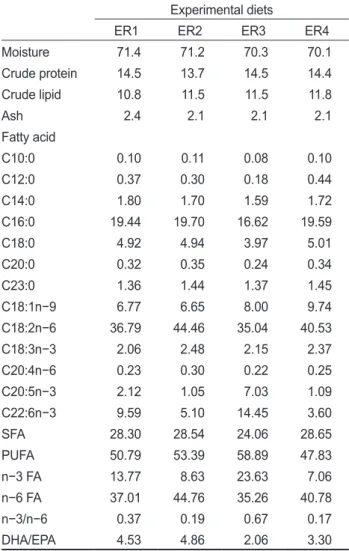
의일반성분및지방 산조성결과는Table 1
에나타내었다.
영양강화rotfier
의수 분,
조단백질,
조지질및회분함량은각각70.1-71.4%, 13.7- 14.5%, 10.8-11.8%
및2.1-2.4%
의 범위로나타났다.
그러나linoleic acid (C18:2n-6)
의함량은ER2
실험구에서44.46%
로 가장높게나타났지만, EPA
와DHA
함량은ER3
실험구가각 각7.03%
와24.06%
로다른실험구에비하여비교적높게나타 났다.
또한ER3
실험구의SFA
과n-6 FA
함량및EPA/DHA
은 다른실험구에비하여낮았으나, PUFA
함량과n-3 FA
함량및n-3/n-6
은다른실험구에비해높게나타났다.
다양한상업용영양강화제로영양강화한
rotifer
를2
주간공 급시자어의생존율과전장은Fig. 1
과Fig. 2
에나타내었다.
생존율은
ER3
공급구가 유의적으로 가장 높게 나타났으며(P<0.05), ER4
공급구가유의적으로가장낮은생존율을보였 다(P<0.05).
전장은ER4
공급구가ER3
공급구보다유의적으 로낮았으나(P<0.05), ER1
과ER2
공급구와는유의적인차이 가나타나지않았다(P>0.05).
시판영양강화제로영양강화한
rotifer
를2
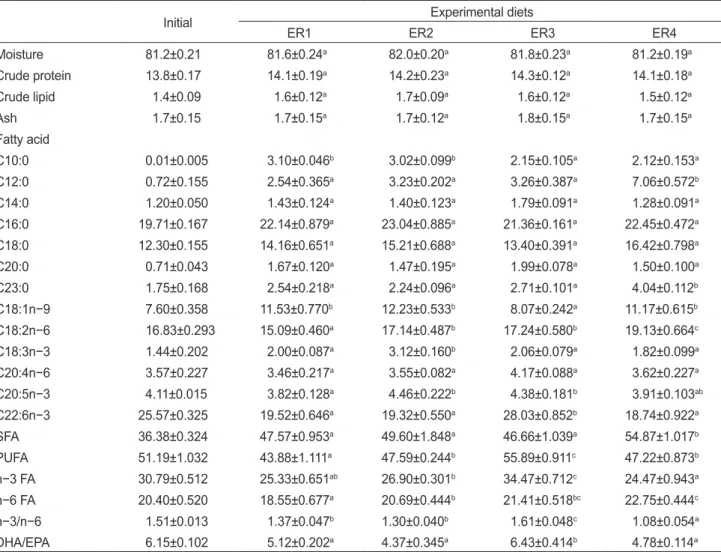
주간공급받은대구자어의일반성분및지방산조성분석결과는
Table 2
에나타내었다
.
사육 종료시자어의 일반성분은 공급된 영양강화rotifer
에따른유의한영향이나타나지않았다(P<0.05). Oleic acid (C18:1n-9)
의함량은ER1, ER2
및ER4
를공급한실험구 가ER3
공급구에비하여유의적으로높게나타났다(P<0.05).
Linoleic acid (C18:2n-6)
의 함량은ER4
를 공급받은 실험구 가 다른모든 실험구에 비하여유의적으로 높게나타났으나(P<0.05), α-linolenic acid (C18:3n-3)
의함량은ER2
를공급받 은실험구가다른모든먹이공급구에비하여유의적으로높게 나타났다(P<0.05). EPA
함량은ER2
와ER3
을공급받은실험 구가ER1
을공급받은실험구에비하여유의적으로높게나타 났으나(P<0.05), ER4
를공급받은실험구와는유의적인차이가나타나지않았다
(P>0.05). DHA
함량은ER3
을공급받은실험 구가나머지다른모든먹이공급구에비하여유의적으로높게 나타났다(P<0.05). SFA
의함량은ER4
공급구가다른먹이공 급구에비하여유의적으로높게나타났으며(P<0.05), PUFA, n-3 FA, n-3/n-6
및DHA/EPA
은ER3
을 공급받은 실험구가ER1, ER2
및ER4
를공급받은실험구에비하여유의적으로높 게나타났다(P<0.05).
고 찰
Rotifer
는Brachionus
속으로인위적으로필수영양소의함량 을영양강화를통하여조절이가능할뿐만아니라다양한기호 적인특성(
부유성,
움직임등)
때문에대다수해산어류자어의Table 1. Proximate composition (% wet weight) and fatty acid composition (% total fatty acids) of rotifers enriched with com- mercial enrichment products
Experimental diets
ER1 ER2 ER3 ER4
Moisture 71.4 71.2 70.3 70.1
Crude protein 14.5 13.7 14.5 14.4
Crude lipid 10.8 11.5 11.5 11.8
Ash 2.4 2.1 2.1 2.1
Fatty acid
C10:0 0.10 0.11 0.08 0.10
C12:0 0.37 0.30 0.18 0.44
C14:0 1.80 1.70 1.59 1.72
C16:0 19.44 19.70 16.62 19.59
C18:0 4.92 4.94 3.97 5.01
C20:0 0.32 0.35 0.24 0.34
C23:0 1.36 1.44 1.37 1.45
C18:1n−9 6.77 6.65 8.00 9.74
C18:2n−6 36.79 44.46 35.04 40.53
C18:3n−3 2.06 2.48 2.15 2.37
C20:4n−6 0.23 0.30 0.22 0.25
C20:5n−3 2.12 1.05 7.03 1.09
C22:6n−3 9.59 5.10 14.45 3.60
SFA 28.30 28.54 24.06 28.65
PUFA 50.79 53.39 58.89 47.83
n−3 FA 13.77 8.63 23.63 7.06
n−6 FA 37.01 44.76 35.26 40.78
n−3/n−6 0.37 0.19 0.67 0.17
DHA/EPA 4.53 4.86 2.06 3.30
ER, enriched rotifer; SFA, saturated fatty acid; PUFA, polyunsatu- rated fatty acid, DHA, docosa hexaenoic acid; EPA, eicosapentae- noic acid.
Table 2. Proximate composition (% wet weight) and fatty acid composition (% of total fatty acids) of larval Pacific cod Gadus morhua fed rotifers enriched with four different enrichment products
Initial Experimental diets
ER1 ER2 ER3 ER4
Moisture 81.2±0.21 81.6±0.24a 82.0±0.20a 81.8±0.23a 81.2±0.19a
Crude protein 13.8±0.17 14.1±0.19a 14.2±0.23a 14.3±0.12a 14.1±0.18a
Crude lipid 1.4±0.09 1.6±0.12a 1.7±0.09a 1.6±0.12a 1.5±0.12a
Ash 1.7±0.15 1.7±0.15a 1.7±0.12a 1.8±0.15a 1.7±0.15a
Fatty acid
C10:0 0.01±0.005 3.10±0.046b 3.02±0.099b 2.15±0.105a 2.12±0.153a
C12:0 0.72±0.155 2.54±0.365a 3.23±0.202a 3.26±0.387a 7.06±0.572b
C14:0 1.20±0.050 1.43±0.124a 1.40±0.123a 1.79±0.091a 1.28±0.091a
C16:0 19.71±0.167 22.14±0.879a 23.04±0.885a 21.36±0.161a 22.45±0.472a
C18:0 12.30±0.155 14.16±0.651a 15.21±0.688a 13.40±0.391a 16.42±0.798a
C20:0 0.71±0.043 1.67±0.120a 1.47±0.195a 1.99±0.078a 1.50±0.100a
C23:0 1.75±0.168 2.54±0.218a 2.24±0.096a 2.71±0.101a 4.04±0.112b
C18:1n−9 7.60±0.358 11.53±0.770b 12.23±0.533b 8.07±0.242a 11.17±0.615b
C18:2n−6 16.83±0.293 15.09±0.460a 17.14±0.487b 17.24±0.580b 19.13±0.664c
C18:3n−3 1.44±0.202 2.00±0.087a 3.12±0.160b 2.06±0.079a 1.82±0.099a
C20:4n−6 3.57±0.227 3.46±0.217a 3.55±0.082a 4.17±0.088a 3.62±0.227a
C20:5n−3 4.11±0.015 3.82±0.128a 4.46±0.222b 4.38±0.181b 3.91±0.103ab
C22:6n−3 25.57±0.325 19.52±0.646a 19.32±0.550a 28.03±0.852b 18.74±0.922a
SFA 36.38±0.324 47.57±0.953a 49.60±1.848a 46.66±1.039a 54.87±1.017b
PUFA 51.19±1.032 43.88±1.111a 47.59±0.244b 55.89±0.911c 47.22±0.873b
n−3 FA 30.79±0.512 25.33±0.651ab 26.90±0.301b 34.47±0.712c 24.47±0.943a
n−6 FA 20.40±0.520 18.55±0.677a 20.69±0.444b 21.41±0.518bc 22.75±0.444c
n−3/n−6 1.51±0.013 1.37±0.047b 1.30±0.040b 1.61±0.048c 1.08±0.054a
DHA/EPA 6.15±0.102 5.12±0.202a 4.37±0.345a 6.43±0.414b 4.78±0.114a
ER, enriched rotifer; SFA, saturated fatty acid; PUFA, polyunsaturated fatty acid, DHA, docosa hexaenoic acid; EPA, eicosapentaenoic acid.
Values (means of triplicate±SE) in the same row sharing a common superscript are not significantly different (P>0.05)
Fig. 2. Total length (mm) of larval Pacific cod Gadus macrocepha- lus fed different enriched rotifers at the end of feeding trial. Values are means of triplicate±SE. Different letters in each bar indicated significant (P<0.05) by Duncan’s multiple range test. ER, enriched rotifer.
Fig. 1. Survival (%) of larval Pacific cod Gadus macrocephalus fed different enriched rotifers at the end of feeding trial. Values are means of triplicate±SE. Different letters in each bar indicated significant (P<0.05) by Duncan’s multiple range test. ER, enriched rotifer.
개구후첫먹이로서널리이용되고있다
(Hagiwara et al., 2001;
Kobayashi et al., 2008; Kotani et al., 2009). Rotifer
의영양강 화는영양소(
지방산등)
조성에효과적으로반영되지만(Frolov et al., 1991; Kotani et al., 2013),
배양조건과영양강화제의종 류에따라몇몇영양소의결핍이나타날수있다(Hamre, 2016).
본연구에서는국내
∙
외시판용영양강화제를통한영양강화가rotifer
의PUFA
함량을증가시키는것으로나타났다.
특히ER3
의
PUFA
함량이다른실험먹이구에비하여높게나타났으며,
필수지방산인
EPA
와DHA
함량또한다른실험구보다높게 나타났다.
이전 다수의 연구결과
(Cho et al., 2001; Faulk and Holt, 2005; Faulk et al., 2005; Park et al., 2006; Garcia et al., 2008)
와유사하게본연구에서도상업용영양강화제를통한영양강 화rotifer
의공급이태평양대구초기자어의생존율,
성장및지 방산조성에영향을미치는것으로나타났다.
일반적으로영양 강화를통한먹이생물내필수지방산함량의차이는해산어자어의생산성에영향을크게미치는것으로알려져있다
(Bau-
tista and De la Cruz, 1988; Sargent et al., 1997, 1999a, 1999b;
Kanazawa, 2003; Tocher, 2003).
본연구에서도사육실험에 이용된각영양강화rotifer
내DHA
와EPA
함량차이에따라 생존율과성장이각각차이가나타났으며, PUFA
함량이높은ER3
공급구가다른먹이공급구에비하여우수한생존율과성장을보였다
.
DHA
및EPA
와같은PUFA
는해산어세포막의인지질층의 주요구성성분이며(Sargent et al., 1999a),
초기자어발달에있 어중요한에너지원으로이용된다(Tocher, 2003). Craig et al.
(1994)
에서PUFA
함량이낮은rotifer
의공급은홍민어(Sciae- nops ocellatus)
자어의성장을감소시켰으며, yellowtail floun- der Limanda ferruginea
는rotifer
영양강화를통한PUFA
함 량의증가가자어의성장향상에효과적으로나타났다(Cope- man et al., 2002).
특히, PUFA
함량이우수한AlgaMac 2000 (Aquafauna Bio-Marine), Aquagrow Advantage
및Aquagrow Advantage+ARA (Advanced BioNutrition Corporation, Co- lumbia, Maryland, USA)
과같은상업용시판영양강화제를이 용한영양강화rotifer
의공급은비교적PUFA
함량이낮은미 세조류(Isochrysis galbana
또는Nannochloris oculate)
를 이 용한 영양강화rotifer
공급보다yellowtail snapper Ocyurus chrysurus
자어의성장을향상시켰다(Faulk et al., 2005). Faulk and Holt (2005)
의연구에서도PUFA
함량이높은상업용영양 강화제인Algamac 2000, Algamac 2000+AquagrowARA
및AlgaMac 3050 (Aquafauna Bio-Marine)
로영양강화한rotifer
를cobia Rachycentron canadum
자어에공급시PUFA
함량이낮은미세조류영양강화
rotifer
공급구보다높은성장을보였다
.
특히냉수성어종인대서양대구(G. morhua)
자어는영양 강화rotifer
의PUFA
함량이증가할수록생존율과성장향상에 효과적이었다(Park et al., 2006).
이처럼시판용영양강화제를이용한
rotifer
의영양강화는PUFA
함량의증가를통한대다수 해산어자어의생존율과성장향상에효과적인것으로사료된 다.
또한태평양대구자어의생산성향상을위해서는먹이생물의
PUFA
영양강화가필수적인것으로사료되지만,
먹이생물내적정
PUFA
함량에대한연구는추후수행될필요가있는것으로판단된다
.
일반적으로해산어부화직후자어의난황내
DHA/EPA
비 율은약2
인것으로알려져있으며(Parrish et al., 1994; Sar- gent et al., 1997),
이에따라대부분의해산어초기자어의영 양강화rotifer
내적정DHA/EPA
비율은2
인것으로알려져있 다(Tocher and Sargent, 1984; Sargent et al., 1999).
본연구에 서또한DHA/EPA
비율이2
인ER3
공급구가다른공급구에비 하여우수한생존율과성장을보였다.
그러나대서양대구자어 는DHA/EPA
비율이증가할수록(10
까지)
생존율과성장향상 에효과적이었으며(Park et al., 2006), yellowtail flounder
자 어는DHA/EPA
비율이8
인공급구가2
인공급구에비해높은 성장과생존율을보였다(Copeman et al., 2002).
그러나turbot
과넙치자어의성장은
DHA/EPA
비율에영향을받지않는것으로나타났다
(Estevez et al., 1999; Furuita et al., 1999).
이와 같이해산어자어의성장과생존율에있어서먹이생물내적정DHA/EPA
비율은종특이적인것으로사료되며,
본연구조건에서태평양대구자어의생산성향상을위한영양강화
rotifer
내
DHA/EPA
비는2
가적절한것으로판단된다.
또한
, Watanabe (1993)
는부화자어가성장과발달함에따라어체내
DHA
함량이감소하기때문에먹이생물의영양강화를통한
DHA
공급의필요성을강조한바있다.
본연구에서는사육실험종료시태평양대구자어의
DHA
함량은ER1, ER2
및ER3
공급구(
각19.52%, 19.32%
및18.74%)
가시작시자어의DHA
함량(25.57%)
에비하여감소하였으나, ER3
을공급받은 자어의DHA
함량(28.03%)
은시작시에비하여다소증가하였 지만큰변화가없는것으로나타났다.
이와유사하게Park et al.
(2006)
의연구에서사육실험시작시대서양대구자어의DHA
함량이사육종료시까지큰변화없이유지된공급구가우수한 성장과생존율을보였으며
,
이는상대적으로높은DHA
함량과 높은DHA/EPA
비율을가진영양강화rotifer
의공급에따른결 과인것으로보고하였다.
그러나본연구에서사육실험종료시자어의
DHA
함량을제외한다른필수지방산인EPA
와ARA
함량은성장과뚜렷한경향이나타나지않았으며
,
이는태평양대구자어의성장과생존율에있어영양강화
rotifer
내필수지방산중
EPA
와ARA
보다DHA
에대한이용성이우수한것으 로판단된다.
이상의결과를고려하면본연구조건에서
DHA/EPA
비율이2
인영양강화rotifer
의공급은태평양대구자어의성장과생 존율을향상시키며, PUFA
함량이높은영양강화제를이용한rotifer
의영양강화는먹이의영양학적가치를향상시킬뿐만아니라태평양대구자어의종자생산에도효과적인것으로판단
된다
.
본연구결과는태평양대구자어를양식생산하는데있어 기초자료로서적극활용될것으로기대되며,
추후보다안정적 인대량종자생산을위한초기먹이생물의필수지방산,
유리아 미노산,
수용성단백질함량등을고려한영양학적연구가필요 한것으로사료된다.
사 사
이논문은
2020
년도국립수산과학원수산과학연구사업동해특산품종양식기술개발
(R2020009)
의지원으로수행된연구입니다
.
References
AOAC (Association of official analytical chemists). 1990. Of- ficial methods of analysis. 17th edition. Washington DC, U.S.A.
Bautista MN and De la Cruz MC. 1988. Linoleic (ω6) and lino- lenic (ω3) acids in the diet of fingerling milkfish (Chanos
chanos Forsskal). Aquaculture 71, 347-358. https://doi.
org/10.1016/0044-8486(88)90204-9.
Benítez-Santana T, Masuda R, Juárez Carillo E, Ganuza E, Va- lencia A, Hernández-Cruz CM and Izquierdo MS. 2007.
Dietary n-3 HUFA deficiency induces a reduced visual re- sponse in gilthead seabream Sparus aurata larvae. Aqua- culture 264, 408-417. https://doi.org/10.1016/j.aquacul- ture.2006.10.024.
Cavalin FG and Weirich CR. 2009. Larval performance of aqua- cultured Florida pompano Trachinotus carolinus fed rotifers
Brachionus plicatilis enriched with selected commercial di-
ets. Aquaculture 292, 67-73. https://doi.org/10.1016/j.aqua- culture.2009.03.042.Cho SH, Hur SB and Jo JY. 2001. Effect of enriched live feeds on survival and growthrates in larval Korean rockfish, Se-
bastes schlegeli Hilgendorf. Aquac Res 32, 199-208. https://
doi.org/10.1046/j.1365-2109.2001.00547.x.
Choi Y, Park H and Oh S. 2011. Effects of stocking density and feeding frequency on the growth of the Pacific cod, Gadus
macrocephalus. Korean J Fish Aquat Sci 44, 58-63. https://
doi.org/10.5657/kfas.2011.44.1.058.
Copeman LA, Parrish CC, Brown JA and Harel M. 2002. Ef- fects of docosahexaenoic, eicosapentaenoic, and arachidon- ic acids on the early growth, survival, lipid composition and pigmentation of yellowtail flounder Limanda ferruginea:
a live food enrichment experiment. Aquaculture 210, 285- 304. https://doi.org/10.1016/S0044-8486(01)00849-3.
Coutteau P and Sorgeloos P. 1997. Manipulation of dietary lipids, fatty acids and vitamins in zooplankton cultures.
Freshw Biol 38, 501-512. https://doi.org/10.1046/j.1365- 2427.1997.00239.x.
Craig SR, Arnold CR and Holt GJ. 1994. The effects of enrich-
ing live foods with highly unsaturated fatty acids on the growth and fatty acid composition of larval red drum Sciae-
nops ocellatus. J World Aquac Soc 25, 424-431. https://doi.
org/10.1111/j.1749-7345.1994.tb00226.x.
Cutts CJ, Sawanboonchun J, Mazorra de Quero C and Bell JG.
2006. Diet induced differences in the essential fatty acid (EFA) compositions of larval Atlantic (Gadus morhua L.) with reference to possible effects of dietary EFAs on lar- val performance. ICES J Mar Sci 63, 302-310. https://doi.
org/10.1016/j.icesjms.2005.11.002.
Dhert P, Rombaut G, Suantika G and Sorgeloos P. 2001. Ad- vancement of rotifer culture and manipulation techniques in Europe. Aquaculture 200, 129-146. https://doi.org/10.1016/
S0044-8486(01)00697-4.
Duncan DB. 1955. Multiple range and multiple F tests. Biomet- rics 11, 1-42.
Estevez A, McEvoy LA, Bell JG and Sargent JR. 1999. Growth, survival, lipid composition and pigmentation of turbot
Scophthalmus maximus larvae fed live-prey enriched in ara-
chidonic and eicosapentaenoic acids. Aquaculture 180, 321- 343. https://doi.org/10.1016/S0044-8486(99)00209-4.Faulk CK and Holt GJ. 2005. Advances in rearing cobia
Rachycentron canadum larvae in recirculating aquacul-
ture systems: live prey enrichment and greenwater culture.Aquaculture 249, 231-243. https://doi.org/10.1016/j.aqua- culture.2005.03.033.
Faulk CK, Holt GJ and Davies DA. 2005. Evaluation of fatty acid enrichment of live food for yellowtail snapper Ocyurus
chrysurus larvae. J World Aquac Soc 36, 271-281. https://
doi.org/10.1111/j.1749-7345.2005.tb00331.x.
Folch J, Lees M and Sloane-Stanley GH. 1957. A simple method for the isolation and purification of total lipids from animal tissues. J Biol Chem 22, 497-509.
Frolov AV, Pankov SL, Geradze KN, Pankova SA and Spe- ktorova LV. 1991. Influence of the biochemical composi- tion of food on the biochemical composition of the rotifer
Brachionus plicatilis. Aquaculture 97, 181-202. https://doi.
org/10.1016/0044-8486(91)90264-8.
Furuita H, Konishi K and Takeuchi T. 1999. Effect of differ- ent levels of eicosapentaenoic and docosahexaenoic acid in
Artemia nauplii on growth, survival and salinity tolerance
of larvae of the Japanese flounder, Paralichthys olivaceus.Aquaculture 170, 59-69. https://doi.org/10.1016/S0044- 8486(98)00386-X.
Garcia AS, Parrish CC and Brown JA. 2008. A comparison among differently enriched rotifers Brachionus plicatilis and their effect on Atlantic cod Gadus morhua larvae early growth, survival and lipid composition. Aquac Nutr 14, 14- 30. https://doi.org/10.1111/j.1365-2095.2007.00500.x.
Gawk W. 2010. Fecundity of Pacific cod Gadus macrocephalus in Jinhae bay during spawning period. Korean J Ichthyol 22, 121-125.
Gwak W, Choi B and Lee So. 2012. Spawning time and early growth of Pacific cod Gadus macrocephalus in Jinhae Bay, Korea. Korean J Ichthyol 24, 110-117.
Gisbert E, Conklin DB and Piedrahita RH. 2004. Effects of de- layed first feeding on thenutritional condition and mortality of California halibut larvae. J Fish Biol 64, 116-132. https://
doi.org/10.1111/j.1095-8649.2004.00289.x.
Hagiwara A, Gallardo WG, Assavaaree M, Kotani T and De Araujo AB. 2001. Live food production in Japan; recent progress and future aspects. Aquaculture 200, 11-127.
https://doi.org/10.1016/S0044-8486(01)00696-2.
Hamre K. 2016. Nutrient profiles of rotifers (Brachionus sp.) and rotifer diets from four different marine fish hatcheries.
Aquaculture 450, 136-142. https://doi.org/10.1016/j.aqua- culture.2015.07.016.
Harel M, Koven W, Lein I, Bar Y, Behrens P, Stubblefield J, Zo- har Y and Place AR. 2002. Advanced DHA, EPA and ARA enrichment materials for marine aquaculture using single cell heterotrophs. Aquaculture 213, 347-362. https://doi.
org/10.1016/S0044-8486(02)00047-9.
Heming TA, McInerney JE and Alderdice DF. 1982. Effect of temperature on initial feeding in alevins of shinook salmon
Oncorhyncus tshawytscha. Can J Fish Aquat Sci 39, 1154-
1562. https://doi.org/10.1139/f82-210.Kanazawa A. 1997. Effects of docosahexaenoic acid and phos- pholipids on stress tolerance of fish. Aquaculture 155, 131- 137. https://doi.org/10.1016/S0044-8486(97)00123-3.
Kanazawa A. 2003. Nutrition of marine fish larvae. J Appl Aqua- cult 13, 103-143. https://doi.org/10.1300/J028v13n01_05.
Kim TJ, Park C, Lee S and Gwak W. 2007. Morphological de- velopment of eggs and larvae of the Pacific cod, Gadus mac-
rocephalus. Korean J Ichthyol 19, 343-349.
Kobayashi T, Nagase T, Hino A, Takeuchi T., 2008. Effect of combination feeding of Nannochloropsis and freshwater
Chlorella on the fatty acid composition of rotifer Brachio- nus plicatilis in a continuous culture. Fish Sci 74, 649-656.
https://doi.org/10.1111/j.1444-2906.2008.01570.x.
KOSIS (Korean Statistical Information Service). 2020.
Expenditure per aquaculture. Retrieved from http://kosis.kr/statisticsList/statisticsListIndex.
do?menuId=M_01_01&vwcd=MT_ZTITLE&parmTabId=
M_01_01#SelectStatsBoxDiv on May 14, 2020.
Kotani T, Genka T, Fushimi H, Hayashi M, Dierckens K and Sorgeloos P. 2009. Effect of cultivation methods on nutri- tional enrichment of euryhaline rotifer Brachionus plicatilis.
Fish Sci 75, 975-984. https://doi.org/10.1007/s12562-009- 0105-1.
Kotani T, Fushimi H, Ohta Y, Miyashima A, Sudoh K, Hayashi M, Satoh N and Satoh S. 2013. Effect of graded levels of dietary DHA included in rotifers Brachionus plicatilis on larviculture performance of red sea bream Pagrus major.
Aquacult Sci 61, 321-330. https://doi.org/10.11233/aqua-
culturesci.61.321.
Lee JY, Lee C, Kim WK, Park SU and Min BH. 2007. Effects of water temperature on egg development, hatching and larval growth rearing of the Pacific cod Gadus macrocephalus. J Aquacult 20, 260-264.
NOAA (National Oceanic and Atmospheric Administration).
2010. Alaska fisheries science center. Retrieved from http://
www.afsc.noaa.gov/species/Pacific_cod. php on Mar 12, 2020.
Park HG, Puvanendran V, Kellett A, Parrish CC and Brown JA. 2006. Effect of enrichedrotifers on growth, survival, and composition of larval Atlantic cod (Gadus morhua).
ICES J Mar Sci 63, 285-295. https://doi.org/10.1016/j.ices- jms.2005.10.011.
Parrish CC, Castell JD, Brown JA, Boston L, Strickland JS and Somerton DC. 1994. Fatty acid composition of Atlantic hali- but eggs in relation to fertilization. Bull Aquac Assoc Can 94, 36-38.
Rainuzzo JR, Reitan KI and Olsen Y. 1997. The significance of lipids at early stages of marine fish: a review. Aqua- culture 155, 103-115. https://doi.org/10.1016/S0044- 8486(97)00121-X.
Rice JA, Crowder LB and Binkowski FB. 1987. Evaluating potential sources of mortality for larval bloater Corengonus
hoyi: starvation and vulnerability to predation. Can J Fish
Aquat Sci 44, 467-472. https://doi.org/10.1139/f87-055.Sargent J, McEvoy LA and Bell JG. 1997. Requirements, pre- sentation and sources of polyunsaturated fatty acids in ma- rine fish larval feeds. Aquaculture 155, 117-127. https://doi.
org/10.1016/S0044-8486(97)00122-1.
Sargent J, Bell G, McEvoy L, Tocher D and Estevez A. 1999a.
Recent developments in the essential fatty acid nutrition of fish. Aquaculture 177, 191-199. https://doi.org/10.1016/
S0044-8486(99)00083-6.
Sargent J, McEvoy L, Estevez A, Bell G, Bell M, Henderson J and Tocher D. 1999b. Lipid nutrition of marine fish dur- ing early development: current status and future directions.
Aquaculture 179, 217-229. https://doi.org/10.1016/S0044- 8486(99)00191-X.
Seo Y, Park M, Kim J and Lee S. 2007. Egg development and juvenile growth of the Pacific cod Gadus macrocephalus (Korean East Sea population). Korean J Fish Aquat Sci 40, 380-386. https://doi.org/10.5657/kfas.2007.40.6.380.
Shin M, Lee S, Jeon H, Joo J and Kwak W. 2019. Effects of starvation and delayed feeding on growth and survival of Pacific cod Gadus macrocephalus larvae. Korean J Ichthyol 22, 121-125.
Sorgeloos P, Dhert P and Candreva P. 2001. Use of the brine shrimp, Artemia spp., in marine fish larviculture. Aqua- culture 200, 147-159. https://doi.org/10.1016/S0044- 8486(01)00698-6.
Taylor WW and Freeberg MH. 1984. Effects of food abundance
on larval lake whitefish, Coregonus lupeaformis Mitchell, growth and survival. J Fish Biol 25, 733-741. https://doi.
org/10.1111/j.1095-8649.1984.tb04919.x.
Tocher D. 2003. Metabolism and functions of lipids and fatty acids in teleost fish. Rev Fish Sci 11, 107-184. https://doi.
org/10.1080/713610925.
Tocher DR and Sargent JR. 1984. Analysis of lipids and fatty acids in ripe roes of some Northwest European marine fish.
Lipids 7, 492-499.
Watanabe T. 1993. Importance of docosahexaenoic acid in ma- rine larval fish. J World Aquacult Soc 24, 152-161. https://
doi.org/10.1111/j.1749-7345.1993.tb00004.x.
Watanabe T and Kiron V. 1994. Prospects in larval fish dietetics.
Aquaculture 124, 223-251. https://doi.org/10.1016/0044- 8486(94)90386-7.
Weirich CR and Reigh RC. 2001. Dietary lipids and stress toler- ance of larval fish. In: Webster CD and Lim C. (Eds.), Nu- trition and fish health. Haworth Press, Inc., Binghampton, New York, NY, U.S.A., 301-312.
Westrheim SJ. 1996. On the Pacific cod Gadus macrocephalus in British Columbia waters, and a comparison with Pacific cod elsewhere, and Atlantic cod G. morhua. Can Tech Rep Fish Aquat Sci 2092, 390.
Yoo H, Byun S, Choi J, Nam M, Lee HM, Kang HW and Lee C. 2016. Optimal enrichment temperature, time and materi- als for L-type rotifer Brachionus plicatilis cultured at a low temperature. J Korean Soc Mar Environ Saf 22, 500-507.
https://doi.org/10.7837/kosomes.2016.22.5.500.
Yoshimura K, Usuki K, Yoshimatsu T, Kitajima C and Hagi- wara A. 1997. Recent development of a high density mass culture system for the rotifer Brachionus rotundiformis Tschugunoff. Hydrobiologia 358, 139-144. https://doi.
org/10.1023/A:1003169414996.