Vol. 25, No. 5 (2015)
215
Effect of Al Alloy Content on Processing of Reaction-Bonded Al
2O
3Ceramics Using Al Alloy Powder
Hyun-Kwuon Lee
†School of Materials Science & Engineering, Kumoh National Institute of Technology, Gumi 730-701, Korea (Received April 10, 2015 : Revised April 21, 2015 : Accepted April 21, 2015)
Abstract
The effect of Al content on the processing of reaction-bonded Al2O3 (RBAO) ceramics using 40v/o ~ 80v/o Al- Zn-Mg alloy powder was studied in order to improve traditional RBAO ceramic processes that use ~ 40v/o pure Al powder.The influence of high Al content in starting Al2O3-Al alloy powder mixtures on its particulate characteristics, reaction-bonding, microstructure, physical and mechanical properties was revealed. Starting Al2O3-Al alloy powder mixtures with 40v/o ~ 80v/o Al alloy powder were milled, reaction-bonded, post-sintered, and characterized. With an increasing Al alloy content, the milling efficiency of Al alloy powder was lowered, resulting in a larger particle size after milling. However, in spite of the larger particle size of Al alloy powder, the oxidation, i.e., reaction-bonding, of the Al alloy was successfully completed via solid and liquid state oxidation, in which the activation energy of the oxidation was nearly the same regardless of Al alloy content. After reaction-bonding and post-sintering at 1600oC, RBAO ceramics from 80v/o Al alloy content showed a relative density of ~97%
and a flexural strength of 251 MPa compared to ~ 96% and 353 MPa for RBAO ceramics from 40v/o Al alloy content, respectively. The lower flexural strength at 80v/o Al alloy content was due to the weak spinel phase that formed from Zn, Mg alloying elements in Al.
Key words
reaction-bonding, RBAO, Al alloy powder, Al2O3 powder, oxidation.1. Introduction
In reaction-bonding Al
2O
3(RBAO) process, compacts of Al
2O
3-Al powder mixture(usually ~40v/o Al in precursor powder) milled by attritor are heat treated in oxidizing atmosphere, usually in air, so that Al oxidizes to small Al
2O
3crystallites, which sinter and bond the originally co-mixed Al
2O
3particles.
1-2)The main features of this process are reduced shrinkage on sintering and relatively high strength compared with conventional Al
2O
3ceramics at a given relative density. The relatively high strength is due to the fine grain size (< 1 μm) that develops during the reaction bonding process. The low shrinkage results from partial compensation for the sintering shrinkage by volume expansion on Al oxidation.
The interesting oxidation behavior in RBAO process was observed during solid-state oxidation of Al. Up to 90 % of Al in precursor powder is oxidized by only solid-state oxidation, dependent on processing parameters, mainly on the particle size of Al after milling process. This large
amount of oxidation is considerably comparable to low oxidation degree (~5 %) of Al in sheet form at tem- peratures lower than melting point. This considerable oxidation is due to higher surface area of Al powder than sheet form of Al, and more importantly microcracks in the oxide skin, providing extra oxygen access. The 39 % of volume expansion by Al to γ-Al
2O
3oxidation, thermal mismatch due to the large difference in thermal ex- pansion coefficients of Al and Al
2O
3, and the curvature- related pressure gradient across the oxide layer give rise to considerable hoop stresses at the interface between Al and the oxide skin. This hoop stresses are strongly dependent on the particle size and increase with de- creasing particle size of Al.
3-5)The metallic Al in Al
2O
3-Al powder compact should be completely oxidized by solid state oxidation of Al for successful RBAO process. Because of bad wettability of liquid Al on Al
2O
3above Tm, the liquid Al is coagulated and is sometimes squeezed-out through open pore network of the body. The out-squeezed liquid Al is not com-
†Corresponding author
E-Mail : [email protected] (H.-K. Lee, Kumoh Nat'l Inst. Tech.)
©Materials Research Society of Korea, All rights reserved.
This is an Open-Access article distributed under the terms of the Creative Commons Attribution Non-Commercial License (http://creative- commons.org/licenses/by-nc/3.0) which permits unrestricted non-commercial use, distribution, and reproduction in any medium, provided the original work is properly cited.
216 Hyun-Kwuon Lee
pletely oxidized even over 1550
oC, hence is detrimental for RBAO process. Because the fraction of solid state oxidation of Al is dependent on Al particle size after milling, the milled Al particle size should be reduced smaller than ~1 μm to complete solid state oxidation.
Therefore, the milling of Al
2O
3-Al powder mixture is known to be decisive processing step controlling overall RBAO process. And it is generally accepted that intensive milling process such as attrition milling should be applied, and that Al content is usually added up to ~40v/o due to bad milling efficiency of metallic Al over ~40v/o.
However, it is also clear that more Al content should be incorporated and utilized in RBAO process con- sidering its potential role. Because Al alloy powder with Zn, Mg, and minor elements is well known to show good wettability of Al on Al
2O
3,
6)this improved wettability can be believed to make also Al oxidation above T
museful in RBAO process, by which relatively large particle size of Al alloy, i.e., that from higher Al alloy content over ~40v/o by less intensive milling, can be usefully applied. The studies on milling characteristics, reaction-bonding and properties of RBAO process using 40v/o Al alloy powder were previously reported.
7-8)In this study 40v/o ~ 80v/o of Al alloy powder is added to Al
2O
3powder for RBAO process, and its effect on milling, reaction-bonding, post-sintering, physical and mechanical properties will be presented.
2. Experimental Procedure
Chemical compositions and particulate characteristics of starting Al-Zn-Mg-Cu alloy powder and Al
2O
3powder and were reported previously,
7)and milling, reaction- bonding and post-sintering procedures were also reported.
8)The Al alloy powder content of 40, 60, 70, and 80v/o was incorporated in Al
2O
3-Al alloy powder mixtures and milled by centrifugal mill using acetone for 12 hr. The average particle size of Al alloy powder used in this study was 6.17 μm.
Particulate morphology of the Al
2O
3-Al alloy powder mixtures after milling was observed by SEM. Average particle size and size distribution of starting powders and powder mixtures after milling were determined by particle size analyzer. Specific surface area was measured by BET method using N
2gas adsorption. Thermal and weight changes during reaction-bonding process were performed by thermogravimetry and differential thermal analysis. Bulk density of reaction-bonded and post- sintered body was determined by Archimedes method.
Microstructural changes after heat treatment were observed by SEM. The specimen for flexural strength measure- ment was prepared with heat treatment by which the highest bulk density could be reached. The flexural
strength of the post-sintered body was measured by 4- point bending method. The inner and outer span was 20 and 40 mm, respectively. The loading rate during measurement was 0.5 mm/min, by which the fracture takes place within 5-10 seconds. The 10 specimens were tested for each experimental condition.
3. Results and Discussions
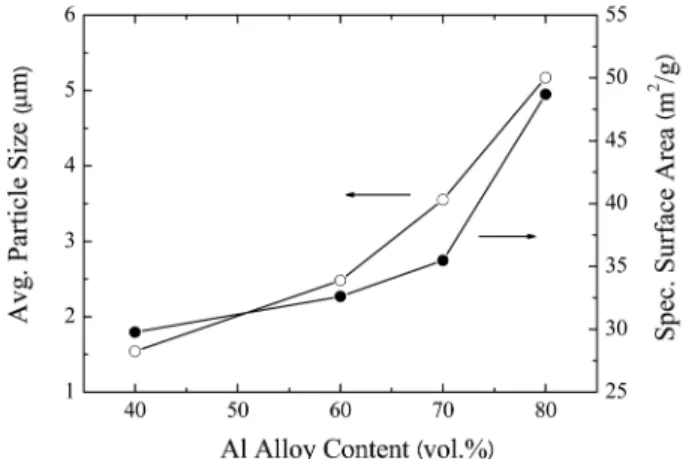
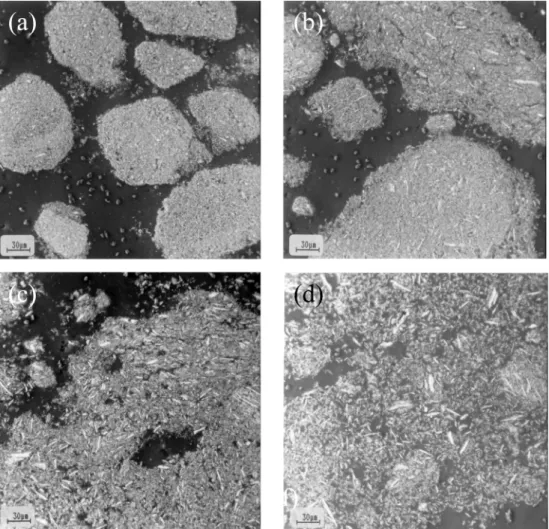
Fig. 1 shows average particle size and specific surface area of Al
2O
3-Al alloy powder mixtures after milling according to Al alloy content, and Fig. 2 shows their particulate microstructures. The increase in average particle size of powder mixtures implies that milling efficiency of Al alloy powder with higher volume content was lowered.
The values of d50 were 1.54 μm for 40v/o, 2.48 μm for 60v/o, 3.55 μm for 70v/o, and 5.17 μm for 80v/o Al alloy content, respectively. However, the specific surface area increased from 29.8 m
2/g for 40v/o to 48.7 m
2/g for 80v/o Al alloy content. Considering reciprocal relationship between particle size and specific surface area, the proportional result in Fig. 1 is interesting. This incon- sistency can be explained from the formation of needle- like Al alloy particle shown in Fig. 2. The apparent particle size of needle-like particle might be determined along its long axis, especially in the measurement by light scattering method as in this study. And specific surface area of needle-like particle is theoretically higher than that of spherical particle. Relatively lower milling efficiency with high Al alloy content results in formation of needle-like Al Alloy particle during milling and its occurrence tends to increase with higher Al alloy content, which results in simultaneous increase of particle size and specific surface area. In Fig. 2(a), added Al alloy powder is shown to be finely milled and its distribution is homogeneous. The powder mixture granules are dense and strongly agglomerated. However, with higher Al
Fig. 1. Average particle size and specific surface area of Al2O3-Al alloy powder mixtures after milling according to Al alloy content.
alloy content up to 80v/o in Fig. 2(b-d), the needle-like Al alloy particles are observed and its occurrence increases. It is also interesting that the structure of agglomerated granules becomes looser with increasing Al
alloy volume content.
Fig. 3 and Fig. 4 show weight changes and oxidation fraction of Al
2O
3-Al alloy powder compacts on reaction
Fig. 2. SEM photographs on cross-sections of Al2O3-Al alloy powder mixtures after milling; (a) 40v/o, (b) 60v/o, (c) 70v/o and (d) 80v/o Al alloy powder, respectively.Fig. 3. Thermogravimetry of Al2O3-Al alloy powder compacts with
Al alloy content and temperature. Fig. 4. Oxidation fraction of Al2O3-Al alloy powder compacts with Al alloy content and temperature.
218 Hyun-Kwuon Lee
bonding with Al alloy content and temperature. The tendency of weight changes in Fig. 3 shows very typical behavior in RBAO process which was previously shown.
8)With increasing content of Al alloy power, weight loss up to ~350
oC increases ( −5.59 % for 40v/o,
−8.37 % for 60v/o, −9.22 % for 70v/o, and −10.26 % for 80v/o Al alloy content) and actual weight gain from
~350
oC also increases (15.99 % for 40v/o, 24.78 % for 60v/o, 30.33 % for 70v/o, and 34.54 % for 80v/o Al alloy content). This increase in weight loss and actual weight gain appears to result from the increase in Al alloy content in Al
2O
3/Al alloy powder mixtures. All oxidations are completed at ~900
oC. The solid-state oxidation fraction of Al alloy decreases with increasing Al alloy content in Al
2O
3/Al alloy powder compact. Each fraction value is shown Fig. 4. However, it is interesting that the values of solid-state oxidation fraction of Al alloy do not differ much from each other, maximum
~5 % of difference, considering large difference in Al alloy content. This feature will be discussed in associ- ation with particulate characteristics of Al alloy powder after milling later.
The phase analysis result of 40v/o Al
2O
3- 60v/o Al alloy powder compact after reaction-bonding and post- sintering at 1600
oC for 2hr is shown in Fig. 5. The main phases formed are α-Al
2O
3and (Mg, Zn)Al
2O
4, and tetragonal ZrO
2. The ZrO
2phase from wearing of TZP milling balls looks well recrystallized to its tetragonal phase. The content of (Mg,Zn)Al
2O
4after post-sintering is determined quantitatively by X-ray fluorescence spec- trometry method and showed 6.7v/o for 40v/o ~12.6v/o for 80v/o Al alloy content. Fig. 6 shows relative density and linear shrinkage of reaction-bonded ceramics after sintering at given temperatures for 2hrs following
reaction bonding at 1000
oC for 3~8 hrs. Relative density increases with increasing sintering temperature at a given Al alloy content, except for 40v/o Al alloy content. At 40v/o, relative density at 1600
oC is lower than that at 1550
oC. Considering relatively small content of Al alloy, reaction-bonding and post-sintering completes at lower temperature of 1550
oC. Further heating to 1600
oC probably causes over-sintering. The relative density de- creases with increasing Alloy content at 1500
oC and 1550
oC, however otherwise increases at 1600
oC. It is assumed that a temperature of 1600
oC is an enough thermal driving force for densification of reaction-bonded Al
2O
3ceramics with Al alloy content over ~60v/o and otherwise temperatures of 1500 and 1550
oC are not enough. Therefore, it is concluded that, according to Al alloy content, there is an optimum sintering temperature, i.e., 1550
oC for 40v/o and 1600
oC for 60v/o, 70v/o, and 80v/o Al alloy content. The relative density of reaction- bonded and post-sintered ceramics at 1600
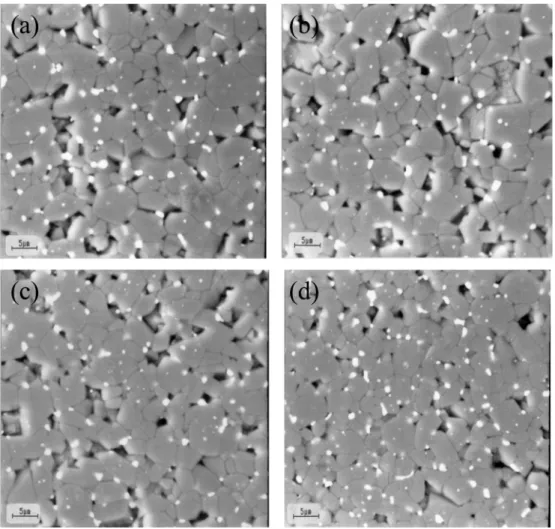
oC for 80v/o Al alloy content are ~97 %. SEM photographs of reaction- bonded and post-sintered Al
2O
3ceramics after sintering at 1600
oC for 2hrs; (a) 40v/o, (b) 60v/o, (c) 70v/o and (d) 80v/o Al alloy powder, respectively are shown in Fig. 7.
Fig. 8 shows flexural strength of reaction-bonded Al
2O
3ceramics after post-sintering at 1600
oC for 2hrs following reaction bonding at 1000
oC for 3~8hrs.
Flexural strength decreases with increasing Al alloy con- tent from 353 MPa for 40v/o to 251 MPa for 80v/o Al alloy content. Considering nearly close values of relative densities (96-97 %), this decrease in flexural strength is probably due to more existence of less strong phases, i.e., (Mg,Zn)Al
2O
4with increasing Al alloy content and also due to particulate characteristics of Al alloy particles after milling process.
Fig. 9 shows activation energy for reaction-bonding of Al
2O
3-Al alloy powder compacts. The activation energy
Fig. 6. Relative density and linear shrinkage of Al2O3-Al alloy powder compacts after post-sintering at each temperature for 2hr.Fig. 5. XRD pattern of 40v/o Al2O3 - 60v/o Al alloy powder compact after reaction-bonding at 1000oC and post-sintering at 1600oC for 2hr.
for solid state oxidation is ~160 - ~170 kJ/mol and ~22 kJ/mol for liquid state oxidation. There are no differences in activation energy with increasing Al alloy content, which means the kinetics of reaction-bonding are identical
regardless of Al alloy content. This also implies that higher content of Al up to 80v/o can be incorporated to RBAO ceramic processing owing to the completion of liquid state oxidation of Al in which Zn, Mg alloying
Fig. 7. SEM photographs of reaction-bonded and post-sintered Al2O3 ceramics after sintering at 1600oC for 2hrs; (a) 40v/o, (b) 60v/o, (c) 70v/o and (d) 80v/o Al alloy powder, respectively.Fig. 8. Flexural strength of reaction-bonded Al2O3 ceramics after post-sintering at 1600oC for 2hr.
Fig. 9. Activation energy of reaction-bonding in Al2O3-Al alloy powder compacts.
220 Hyun-Kwuon Lee
elements in Al play an important role. However, these alloying elements exist as spinel phases in final ceramic body, which results in lower flexural strength with in- creasing Al alloy content.
4. Conclusion
Incorporation of high Al alloy content up to 80v/o in RBAO process was tried to enhance the potential role of convention RBAO process where ~40v/o of pure Al could usually be added. With increasing Al alloy content, milling efficiency of Al alloy powder was lowered, re- sulting in larger particle size after milling. In spite of larger particle size of Al alloy powder, however, the oxidation, i.e., reaction-bonding, of Al alloy was success- fully completed by its solid and liquid state oxidation, in which the activation energy of the oxidation was nearly same regardless of Al alloy content. After reaction- bonding and post-sintering at 1600
oC, RBAO ceramics from 80v/o Al alloy content showed the relative density of ~97 % and the flexural strength of 251 MPa com- paring to ~96 % and 353 MPa for RBAO ceramics from 40v/o Al alloy content, respectively. The lower flexural
strength at 80v/o Al alloy content was due to the weak spinel phase forming from Zn, Mg alloying elements in Al.
Acknowledgement
This paper was supported by Research Fund, Kumoh National Institute of Technology.
References
1. N. Claussen, T. Le and S. Wu, J. Eur. Ceram. Soc., 5, 29 (1989).
2. N. Claussen, N. A. Travitzky and S. Wu, Ceram. Eng.
Sci. Proc., 11, 806 (1990).
3. S. Wu, D. Holz and N. Claussen, J. Am. Ceram. Soc., 76, 970 (1993).
4. D. Holz, S. Wu, S. Scheppokat and N. Claussen, J. Am.
Ceram. Soc., 77, 2509 (1994).
5. N. Claussen, S. Wu and D. Holz, J. Eur. Ceram. Soc., 14, 97 (1994).
6. B. C. Pai, G. Ramani, R. M. Pillai and K. G. Satyana- rayana, J. Mater. Sci., 30, 1903 (1995).
7. H. K. Lee, Korean J. Mater. Res., 23(10), 574 (2013).
8. H. K. Lee, Korean J. Mater. Res., 24(5), 236 (2014).