≪ Research Paper ≫
Characteristics of South Korea’s Geothermal Water in Relation to Its Geological and Geochemical Feature
Chung-Mo Lee1·Se-Yeong Hamm1*·Cholwoo Lee2·Sung-Ja Choi2·Sang Yong Chung3
1Division of Earth Environmental System, Pusan National University, Busan 609-735, Korea
2Korea Institute of Geoscience and Mineral Resources, Daejeon 305-353, Korea
3Department of Earth and Environmental Sciences, Pukyong National University, Busan 608-737, Korea
ABSTRACT
The volcanic type of geothermal water is linked intimately to active or potentially active volcanoes and takes place near the plate boundaries. In contrast to the volcanic type, the geothermal water in Korea has a non-volcanic origin. Korea’s geothermal water is classified into the residual magma (RM) type and deep groundwater (DG) type according to the criterion of 35oC. This study reviewed the relationship between the physical and chemical features of the 281 geothermal water sources in South Korea in terms of the specific capacity, water temperature, and chemical compositions of two different basements (igneous rock and metamorphic rock) as well as the geological structures. According to the spatial relationship between the geothermal holes and geological faults, the length of the major fault is considered a key parameter determining the movement to a deeper place and the temperature of geothermal water. A negligible relationship between the specific capacity (Q/s) and temperature was found for both the RM type and DG type with the greater specific capacities of the RM- and DG-igneous types than the RM- and DG-metamorphic types. No relationship was observed between Q/s and the chemical constituents (K+, Na+, Ca2+, Mg2+, Zn2+, Cl−, SO42−, HCO3−, and SiO2) in the DG-igneous and DG-metamorphic types. Furthermore, weak relationship between temperature and chemical constituents was found for both the RM type and DG type.
Key words : Geothermal water, Residual magma type, Deep groundwater type, Specific capacity, Geology, Chemical constituents
1. Introduction
Hot springs or geothermal springs can be defined as warm or hot groundwater that rises from subsurface with a significantly higher temperature than the normal ground temperature. Normal groundwater has a 1 to 4oC higher temperature than the surface temperature of the area, whereas the temperature of hot spring water is generally at least ~5oC higher than the surface temperature (Kim, 2007).
Article 2 of Korea’s Hot Spring Law (partial revision on 21 July 2011) defines a hot spring as groundwater naturally or artificially issuing from the subsurface with a temperature of 25oC or higher and must have a water quality meeting the presidential regulations of the Republic of Korea.
Since ancient times, geothermal water in Korea has been
known as mineral water with a temperature of 40oC or higher naturally discharging from underground. Geothermal water has been used for balneology starting from the Baekje Kingdom (18 BC–AD 660) (Ministry of Interior, 1988).
Geothermal water in Onyang area was introduced in the book, the History of the Three Countries (‘Samkuksagi’), and the other 43 geothermal water sources were recorded in sixteen old books (Kim, 2007). In addition, Dongrae, Yuseong, Onyang, Yeongsan, Pyeonghae, Pyeongju, Baekcheon, Ycheon, Goseong, Sinju, and Seongju geothermal waters are described in the book, the History of Koryeo (‘Goryeosa’). Since the launch of the Hot Spring Law on 2 March 1981, many new geothermal waters, which had a temperature between 25 and 30oC, were registered. Currently, more than 400 spas are distributed over South Korea.
*Corresponding author : [email protected]
Received : 2014. 4. 3 Reviewed : 2014. 4. 28 Accepted : 2014. 4. 28 Discussion until : 2014. 6. 30
Geothermal water can be divided into volcanic type and non-volcanic type (Jeon et al., 1998). The volcanic type of hot springs is closely linked to volcanoes and plate boundaries around the world. On the other hand, the non- volcanic type geothermal water that occurs inside continental platforms has no direct relationship with volcanic activity. Korea’s geothermal water has been included in the non-volcanic type because Korea is in a stable continental platform ~500 km away from the convergent plate boundary.
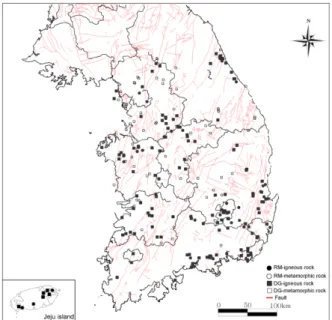
The aim of this study was to characterize 281 geothermal waters in South Korea based on the relationship among geology, geological structure, specific capacity, water temperature, and the chemical constituents (Fig. 1), and classify them into the residual magma (RM) type and deep groundwater (DG) type according to the rock types (igneous rock and metamorphic rock) (Table 1). In this study, a statistical method was applied to the geothermal waters of two different geologies (igneous rock and metamorphic rock) to characterize the specific capacity, temperature, K+, Na+, Ca2+, Mg2+, Zn2+, Cl−, SO42−, HCO3−, and SiO2 (silica that is more accurately expressed as H4SiO4) of the RM and DG types.
2. Methods
A total 281 geothermal waters in the regions of igneous rock (194 geothermal waters) and metamorphic rock (87 geothermal waters) in South Korea (Fig. 1) were examined to determine the statistical relationship between the specific capacity, bottom temperature of the geothermal wells, and chemical constituents of the geothermal waters. The maximum bottom temperature of the geothermal wells in each spa was considered to be the highest and representative temperature in the spa area. The mean concentrations of the chemical constituents of the geothermal wells in the each spa were considered to be representative of a spa. In addition, the properties of the geological structures were found to be related to the geothermal waters.
Fig. 1. Location of the residual magma (RM) and deep groundwater (DG) type geothermal waters in South Korea.
Table 1. Numbers of geothermal water types of residual magma and deep groundwater in igneous and metamorphic rock regions in South Korea
Geothermal water type
Metamorphic rock
Igneous
rock Total
Residual magma 17 51 68
Deep groundwater 70 143 213
Total 87 194 281
Tamanyu (1985) classified non-volcanic geothermal water in Korea into the residual magma (RM) type and deep groundwater (DG) type. According to Tamanyu’s classification, in contrast to the DG type geothermal water, the RM type geothermal waters grouped into those with a
bottom temperature of 35oC or higher. The RM type geothermal waters occur in the regions holding a comparatively high geothermal heat and are associated with the intrusive igneous activities typically in the late Cretaceous and early Cenozoic periods (Fig. 2). In contrast, DG type geothermal water originates from the regions with a slightly high geothermal gradient (~25-30oC/km) and has a considerably lower temperature than the RM type (Table 2). This separation can also be justified based on the distinct temperature change patterns with depth between the two types (Fig. 3).
The 68 RM-type geothermal waters are distributed in the high permeability zones extending to a depth of several kilometers (Table 1): Yangchon spa (Moon et al., 1999), Deoksan spas (Lim et al., 1988a, 1988b 1990a, 1990b, 1990c, 1991, 1998), Ildong spa (Yum, 1991), Cheoksan spas (Sokcho (Nohak) spas (Yum et al., 1991, 1992; Kim et al., 1995), 1992; Kim et al., 1993), Seolak Plaza spas (Bae et al., 1992; Yum et al., 1994), Wonam spas (Lim et al., 1992a; Bae et al., 1993), Bugok spa (Lim et al., 1989), Suanbo spa (Chungju (Suanbo) spa (Lim et al., 1996), Jangjeon spa (Moon et al., 2000), Dongrae spa (Lim et al., 1992; Han et al., 1999), Haeundae spa (Sim et al., 2000), Fig. 2. Geologic structures and RM- and DG-type geothermal
waters of South Korea (Korea Institute of Geoscience and Min- eral Resources, 1995).
Table 2. Descriptive statistics of geothermal waters of specific capacity (Q/s), bottom hole temperature, and chemical compositions of the residual magma (RM) type and deep groundwater (DG) type
RM Q/s T K+ Na+ Ca2+ Mg2+ Zn2+ Cl− SO42− HCO3− SiO2
(m3/d/m) oC (mg/L)
Max 131.94 77.40 329.50 4360.00 1930.00 256.00 2.53 9110.00 3570.00 5360.00 72.80
Min 0.86 35.02 0.23 0.83 1.21 0.00 0.00 0.11 0.17 6.50 10.50
Mean 11.02 41.03 11.28 300.56 101.58 14.04 0.13 398.37 216.29 224.27 29.72
Median 4.72 39.00 1.03 55.40 5.57 0.49 0.04 15.20 14.10 63.16 24.30
St. Dev. 19.60 6.75 44.51 688.20 343.62 46.13 0.36 1387.84 617.50 715.83 14.86
Skewness 4.89 2.79 6.51 4.08 4.68 4.06 5.65 5.11 3.91 6.60 1.10
Kurtosis 28.09 12.49 45.52 20.46 22.41 16.75 36.05 28.61 16.78 46.80 0.67
DG Q/s T K+ Na+ Ca2+ Mg2+ Zn2+ Cl- SO42- HCO3- SiO2
(m3/d/m) oC (mg/L)
Max 375.59 34.71 10260.00 6190.00 3240.00 1325.00 6.02 16400.00 5265.00 4020.00 85.00
Min 0.27 24.19 0.16 0.14 0.64 0.00 0.00 0.02 0.08 0.00 0.00
Mean 13.49 29.88 84.77 246.47 136.50 27.31 0.25 522.89 134.12 128.17 21.38
Median 4.34 29.80 0.82 40.80 11.40 0.67 0.05 10.60 12.95 60.90 19.40
St. Dev. 39.55 2.48 736.27 798.87 460.37 127.99 0.73 2072.76 481.06 324.66 10.71
Skewness 7.02 0.06 13.27 5.27 4.78 7.45 6.35 4.97 7.28 9.37 2.59
Kurtosis 54.10 −0.67 183.14 30.10 24.00 63.56 44.96 26.71 67.35 106.05 10.60
Onyang spa (Lim et al., 1987), Baekam spa (Bae et al., 1993), Yuseong spa (Lim et al., 1990), Mageumsan spa, Yongheung spa (Yum et al., 1996), HwawonsikYum spa (Kim et al., 2001), Yongam spa (Moon et al., 2001), Bukbu spa (Yum and Seong, 1994), and Sogeumgang spa (Lim et al., 1996). A total of 68 RM type geothermal waters were divided into 51 geothermal waters of igneous rock and 17 geothermal waters of metamorphic rock.
On the other hand, 213 DG-type geothermal waters are found all over the nation (Fig. 1). The DG geothermal water occurs as 143 geothermal water springs in igneous rock area and 70 geothermal water sources in metamorphic rock areas (Table 2). Both the RM type and DG type geothermal waters are related mainly to igneous rock. Kim and Choi (1998) also mentioned the close relationship between most hot springs and the Mesozoic granite in Korea.
3. Geological characteristics of geothermal water in South Korea
3.1. Geological features for the occurrence of geothermal water
Korea is composed of four tectonic blocks: Gyeonggi massif, Yeongnam massif, Okcheon fold belt, Gyeongsang sedimentary basin (Lee, 1987; Chough, 2013). The main bedrocks in Gyeonggi massif are composed of Precambrian
metamorphic rocks (e.g., gneiss and schist). Yeongnam massif is also composed of Precambrian metamorphic rocks such as gneiss, schist, and quarzite. Okcheon fold belt is mainly composed of metamorphic rocks probably formed in Paleozoic. Gyeongsang sedimentary basin is formed of Cretaceous sedimentary, volcanic, and granitic rocks.
Jurassic and Cretaceous granites, and Precambrian gneiss occupy about 50% of Korea.
The mean geothermal gradient and heat flow of South Korea are 25.1oC/km and 60± 11 mWm−2, respectively (Kim and Lee, 2007). The southeastern part of South Korea shows high geothermal gradients more than 28oC/km and heat flows higher than 83 mWm−2 (Lim, 1995), relative to the average background surface heat flow of 67 mWm−2 (Chang et al., 1970; Mizutani et al., 1970), as well as a high temperature at depth and high geothermal energy potential (Lee et al., 2010). These high heat flow values in the southeastern part of South Korea are likely to be related to the regional tectonics in the East Sea (Sea of Japan) (Kim and Lee, 2007). Tamanyu (1985) suggested that the RM type geothermal waters are potentially related to dyke swarms. RM type geothermal waters occur in the highly permeable zones extending to several kilometers in depth (Han et al., 1999; Park et al., 2006).
The RM-igneous type geothermal water is mostly associated with the relatively young igneous activity that took place from the late Cretaceous to the early Tertiary periods, typically in the southeastern part of the Korean peninsula (Fig. 1). Gyeongsang basin, which is distributed in the southeastern part of the Korean peninsula, is composed of Cretaceous sedimentary and volcanic rocks that were subsequently intruded by Bulguksa granite and dykes that were produced by the Bulkuksa igneous activity.
As consequence, the source of the RM type geothermal water is the residual heat that is derived from the Bulkuksa igneous activity. Many faults and folds were also created in the Gyeongsang basin by the igneous activity. Mesothermal and epithermal ore deposits of the fissure-filling vein type that were formed in the Gyeongsang basin from late Cretaceous to early Tertiary periods are the products of Bulkuksa igneous activity (Koh et al., 2003). With the residual heat originating from Bulkuksa igneous activity, the RM type geothermal waters are governed by the existence Fig. 3. Example of temperature with depth of (a) the residual
magma type in Bugok spa (Lim et al., 1989) and (b) the deep groundwater type in Yesan spa (Cho and Park, 1991).
of laterally and vertically extended major geological structures that can transmit high temperature from deep places. In contrast, the DG type geothermal water is linked to geological structures developed to a shallow depth and show rare evidence of noteworthy igneous activity.
On the other hand, RM-metamorphic type geothermal water is distributed in the region of the Gyeonggi massif in the northern part of South Korea, which is composed mostly of Precambrian metamorphic rock (Fig. 1).
Based on the geochemical features and temperature, the depth of the geothermal reservoir of the residual magma is inferred as ~2 km in Bugok spa area (Park et al., 2006) or deeper in Dongrae spa area (Han et al., 1999). The inferred hot (100-155oC) reservoir in Bugok spa area may be found at less than 1.8 km depth. In this case, geological structures should be developed to depths of several kilometers, so geothermal water rises up from a geothermal reservoir. In contrast, the DG type is not sustained by high temperature geothermal water because the geological structures are not developed to a deeper zone with any particular heat source.
3.2. Relationship between geological structures and geothermal waters
The seismic moment accumulation rate per unit fault length vs. locking depth (Smith-Konter et al., 2011) as well as fault length vs. surface wave magnitude (Papazachos, 1996) showed positive relationships. Furthermore, log- linear regression among seismic magnitude and surface rupture length, subsurface rupture length, and rupture area showed standard deviations of 0.25-0.35 magnitude units (Wells and Coppersmith, 1994). These manifestations show that a fault with a longer length may be developed to a deeper depth. In this study, the following geological factors were estimated for the 281 geothermal spas: the fault of the
maximum length close to the geothermal hole with the highest bottom temperature/maximum depth, the distance between the longest fault and the geothermal hole, the number of sub-faults crossing the longest fault, and the total length of sub-faults (Table 3, Fig. 2). In the areas of the RM type, the lengths of the longest faults ranged from 2,546 to 140,898 m with an average of 49,285 m (Table 3). The distances from the hole to the longest fault ranged from 140 to 19,276 m with an average of 3,528 m. In addition, the number of sub-faults crossing the longest fault were between 0 and 13 with a mean of 2.02, and the total lengths of the sub-faults reached 5,839 - 192,095 m with an average of 59,003 m.
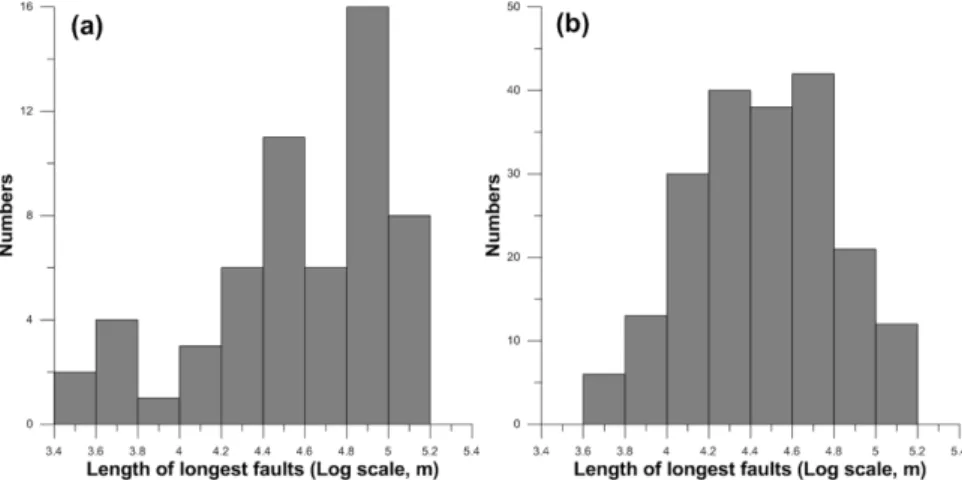
On the other hand, in the areas of the DG type, the lengths of the longest fault ranged from 4,779 - 140,901 m with an average of 40,874 m (Table 3). The distances from the hole to the longest fault ranged from 20 to 24,813 m with an average of 4,774 m. In addition, the number of sub- faults crossing the longest fault was between 0 and 13 (mean 1.93) and the total lengths of the sub-faults reached 2,448-236,116 m (mean 49,038 m). The faults related to the DG type exhibit normal distribution whereas the faults associated to the RM type show negatively skewed distribution that indicates the occurrence of the RM type geothermal water relates with special lengths of faults (e.g., a length of longer than ~44 km) (Fig. 4).
A comparison of the RM type and DG type revealed the average length of the longest fault in the RM type area to be approximately 9 km longer than that in the DG type area.
On the other hand, the distance from the hole to the longest fault, the number of sub-faults crossing the longest fault, and the total length of the sub-faults were similar to each other in the RM type area and DG type area. This suggests that the length of the longest fault dominates both the depth Table 3. Fault properties relative to the residual magma (RM) and deep groundwater (DG) types
Length of the longest fault (m)
Distance between the longest fault (m) and the thermal hole
Nos. of sub- faults
Total length of sub-faults (m)
RM DG RM DG RM DG RM DG
Max. 140,898 140,901 19,276 24,813 13 13 192,095 236,116
Min. 2,546 4,779 140 20 0 0 5,839 2,448
Mean 49,285 40,874 3,528 4,775 2.0 1.9 59,003 49,038
Median 34,689 29,751 1,853 3,153 1.0 1.0 49,429 35,694
St. Dev. 40,769 35,785 4,295 4,825 2.6 2.5 48,305 48,323
and temperature of geothermal water. Therefore, the RM type can have a higher temperature than the DG type.
4. Physical and chemical characteristics of geothermal water in South Korea
4.1. Specific capacity and temperature
In the RM-igneous type, the specific capacity (the ratio of discharge amount to drawdown) ranged from 0.86 to 131.94 m3/d/m (mean 12.16 m3/d/m) and the temperature ranged from 35.06 to 77.40oC (mean 40.67oC) (Table 2, Fig. 5). On the other hand, in the RM-metamorphic type, the specific capacity ranged from 1.31-21.74 m3/d/m (mean 7.44 m3/d/
m) and the temperature ranged from 35.02–51.10oC (mean 40.67oC).
In the DG-igneous rock type, the specific capacity ranged
from 0.30 to 375.59 m3/d/m (mean 14.25 m3/d/m) and the temperatures ranged from 24.30 to 34.71oC (mean 29.90oC) (Fig. 6). In the DG-metamorphic type, the specific capacity ranged from 0.27 to 284.75 m3/d/m (mean 11.98 m3/d/m) and the temperatures ranged from 24.19 to 34.50oC (mean 29.85oC).
As a result, the specific capacity of the RM-igneous type and DG-igneous type were greater than those of the RM- metamorphic type and DG-metamorphic type, respectively.
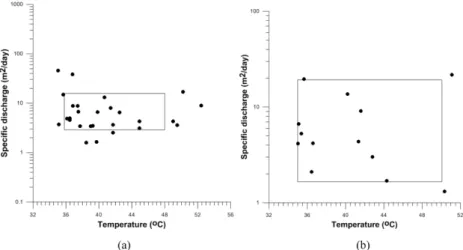
On the other hand, the specific capacity of the DG type was higher than that of the RM type. This might be due to the higher frequency of fractures at a shallow depth until where the DG type is reached. Furthermore, no relationship between the specific capacity and temperature was observed for both the RM type and DG type (Fig. 7).
Fig. 4. Frequency distribution of the length of the longest faults near (a) RM type and (b) DG type.
Fig. 5. Box-whisker diagrams of the specific capacity (Q/s) along the bottom temperature (T) for the RM-type geothermal waters.
4.2. Specific capacity and chemical constituents In general, the chemical properties of geothermal waters and ground waters are subjected to water-rock interactions in the object areas as well as hydrochemical parameters, such as pH, Eh, temperature etc. (Kim and Choi, 1998).
Pearson correlation analysis showed almost no relationship between specific capacity (Q/s) and chemical constituents (K+, Na+, Ca2+, Mg2+, Zn2+, Cl−, SO42−, HCO3−, and SiO2) in the RM-igneous and RM-metamorphic types from which it is inferred that geothermal waters rising up from deep place possess analogous chemical composition regardless its quantity. In the RM-igneous type, Na+ showed high linearity with both Ca2+ (r = 0.872) and Cl− (r = 0.921); Ca2+
exhibited high linearity with Cl− (r = 0.887) (Table 4, Table 5). This phenomenon indicates more dissolution of Na+, Ca2+, and Cl− in deep igneous rock under high-temperature condition due to water-rock interaction.
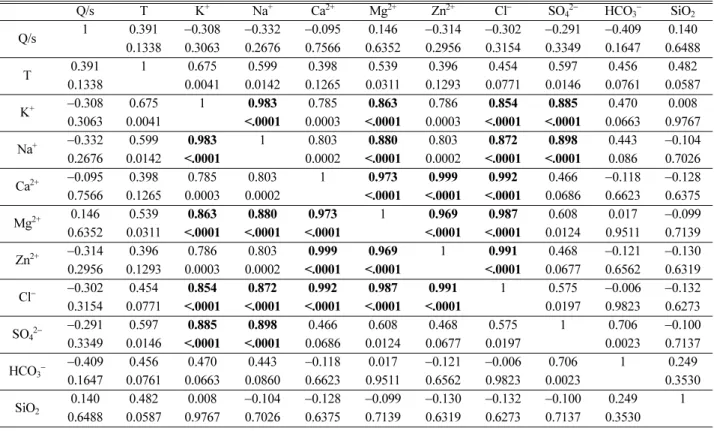
As a result of the Pearson correlation analysis, among the chemical constituents (K+, Na+, Ca2+, Mg2+, Zn2+, Cl−, SO42−, HCO3−, and SiO2) of the RM-metamorphic type, K+ ions showed high linearity with Na+ (r = 0.983), Mg2+
(r = 0.863), Cl− (r = 0.854), and SO42− (r = 0.885) (Table 5).
Na+ ion displayed high linearity with Mg2+ (r = 0.880), Cl− (r = 0.872), and SO42− (r = 0.898). Ca2+ ions showed high linearity with Mg2+ (r = 0.973) and Cl− (r = 0.992). In addition, Mg2+ ions showed high linearity with Cl− (r = 0.987). This correlation analysis indicates more dissolution of Na+, Mg2+, Ca2+, and Cl− in deep metamorphic rock under high- temperature condition due to water-rock interaction.
Fig. 6. Box-whisker diagrams of specific capacity (Q/s) along bottom temperature for the DG-type geothermal waters in (a) igneous rock area, (b) metamorphic rock area, and (c) entire area.
Fig. 7. Relationship between specific capacity and temperature of the residual-magma-type geothermal waters in (a) igneous rock and (b) metamorphic rock. The rectangle indicates the domain of the values within the 95% confidence interval.
Table 4. Pearson correlation coefficient (upper value) and p-value (lower value) of specific capacity (Q/s) and chemical constituents of the igneous residual magma type
Q/s T K+ Na+ Ca2+ Mg2+ Zn2+ Cl- SO42- HCO3- SiO2
Q/s 1 0.148 −0.069 −0.023 −0.065 −0.110 0.075 −0.031 −0.069 0.002 0.168
0.3372 0.6762 0.8897 0.6954 0.5289 0.6548 0.8497 0.6755 0.9893 0.3142
T 0.148 1 −0.076 −0.102 −0.115 −0.034 −0.122 −0.075 −0.144 −0.027 0.138
0.3372 0.6315 0.5203 0.4695 0.8403 0.4548 0.6421 0.3616 0.8667 0.3955
K+ −0.069 −0.076 1 0.039 0.086 0.136 0.590 0.179 0.071 0.051 0.168
0.6762 0.6315 0.8008 0.5746 0.3976 <.0001 0.2443 0.6426 0.7445 0.282
Na+ −0.023 −0.102 0.039 1 0.872 0.676 0.594 0.921 0.588 0.272 −0.078
0.8897 0.5203 0.8008 <.0001 <.0001 <.0001 <.0001 <.0001 0.0745 0.619
Ca2+ −0.065 −0.115 0.086 0.872 1 0.638 0.507 0.887 0.577 0.172 −0.051
0.6954 0.4695 0.5746 <.0001 <.0001 0.0005 <.0001 <.0001 0.2634 0.7452
Mg2+ −0.110 −0.034 0.136 0.676 0.638 1 0.535 0.468 0.486 0.783 0.361
0.5289 0.8403 0.3976 <.0001 <.0001 0.0004 0.0023 0.0013 <.0001 0.0238
Zn2+ 0.075 −0.122 0.590 0.594 0.507 0.535 1 0.427 0.561 0.275 −0.088
0.6548 0.4548 <.0001 <.0001 0.0005 0.0004 0.0043 <.0001 0.0743 0.574
Cl− −0.031 −0.075 0.179 0.921 0.887 0.468 0.427 1 0.355 0.011 −0.107
0.8497 0.6421 0.2443 <.0001 <.0001 0.0023 0.0043 0.0179 0.9451 0.4965
SO42− −0.069 −0.144 0.071 0.588 0.577 0.486 0.561 0.355 1 0.129 −0.190
0.6755 0.3616 0.6426 <.0001 <.0001 0.0013 <.0001 0.0179 0.4049 0.2227
HCO3− 0.002 −0.027 0.051 0.272 0.172 0.783 0.275 0.011 0.129 1 0.370
0.9893 0.8667 0.7445 0.0745 0.2634 <.0001 0.0743 0.9451 0.4049 0.0147
SiO2 0.168 0.138 0.168 −0.078 −0.051 0.361 −0.088 −0.107 −0.190 0.370 1
0.3142 0.3955 0.2820 0.6190 0.7452 0.0238 0.5740 0.4965 0.2227 0.0147
Table 5. Pearson correlation coefficient (upper value) and p-value (lower value) of specific capacity (Q/s) and chemical constituents of the metamorphic residual magma type
Q/s T K+ Na+ Ca2+ Mg2+ Zn2+ Cl− SO42− HCO3− SiO2
Q/s 1 0.391 −0.308 −0.332 −0.095 0.146 −0.314 −0.302 −0.291 −0.409 0.140
0.1338 0.3063 0.2676 0.7566 0.6352 0.2956 0.3154 0.3349 0.1647 0.6488
T 0.391 1 0.675 0.599 0.398 0.539 0.396 0.454 0.597 0.456 0.482
0.1338 0.0041 0.0142 0.1265 0.0311 0.1293 0.0771 0.0146 0.0761 0.0587
K+ −0.308 0.675 1 0.983 0.785 0.863 0.786 0.854 0.885 0.470 0.008
0.3063 0.0041 <.0001 0.0003 <.0001 0.0003 <.0001 <.0001 0.0663 0.9767
Na+ −0.332 0.599 0.983 1 0.803 0.880 0.803 0.872 0.898 0.443 −0.104
0.2676 0.0142 <.0001 0.0002 <.0001 0.0002 <.0001 <.0001 0.086 0.7026
Ca2+ −0.095 0.398 0.785 0.803 1 0.973 0.999 0.992 0.466 −0.118 −0.128
0.7566 0.1265 0.0003 0.0002 <.0001 <.0001 <.0001 0.0686 0.6623 0.6375
Mg2+ 0.146 0.539 0.863 0.880 0.973 1 0.969 0.987 0.608 0.017 −0.099
0.6352 0.0311 <.0001 <.0001 <.0001 <.0001 <.0001 0.0124 0.9511 0.7139
Zn2+ −0.314 0.396 0.786 0.803 0.999 0.969 1 0.991 0.468 −0.121 −0.130
0.2956 0.1293 0.0003 0.0002 <.0001 <.0001 <.0001 0.0677 0.6562 0.6319
Cl− −0.302 0.454 0.854 0.872 0.992 0.987 0.991 1 0.575 −0.006 −0.132
0.3154 0.0771 <.0001 <.0001 <.0001 <.0001 <.0001 0.0197 0.9823 0.6273
SO42− −0.291 0.597 0.885 0.898 0.466 0.608 0.468 0.575 1 0.706 −0.100
0.3349 0.0146 <.0001 <.0001 0.0686 0.0124 0.0677 0.0197 0.0023 0.7137
HCO3− −0.409 0.456 0.470 0.443 −0.118 0.017 −0.121 −0.006 0.706 1 0.249
0.1647 0.0761 0.0663 0.0860 0.6623 0.9511 0.6562 0.9823 0.0023 0.3530
SiO2 0.140 0.482 0.008 −0.104 −0.128 −0.099 −0.130 −0.132 −0.100 0.249 1
0.6488 0.0587 0.9767 0.7026 0.6375 0.7139 0.6319 0.6273 0.7137 0.3530
Pearson correlation analysis revealed almost no relationship between Q/s and the chemical constituents (K+, Na+, Ca2+, Mg2+, Zn2+, Cl−, SO42−, HCO3−, and SiO2) in the DG- igneous and DG-metamorphic types (Table 6, Table 7). This no relationship can be explained by that geothermal water discharge is greatly dependent on permissive geological structure and by that long time is necessary to achieve high concentration of chemical components. In the DG-igneous type, Cl− ions showed very high linearity with Na+ (r = 0.963) and Ca2+ (r = 0.879). This chemical relationship is similar to the case of the RM-igneous type. Pearson correlation analysis of the DG-metamorphic type showed that Na+ ions have a very strong relationship with Mg2+
(r = 0.929) and Cl− (r = 0.957) (Table 7). The result of the correlation analysis of the DG-metamorphic type is analogous to the case of the RM-metamorphic type.
Pearson correlation analysis revealed a stronger relationship between Na+, Ca2+, and Cl− in the igneous rock of both RM and DG types, whereas a stronger relationship was observed between Na+, Ca2+, Cl−, K+, and Mg2+ in the metamorphic
rock of both RM and DG types. In addition, since some geothermal spas are located near the coast of the Korean Peninsula, the effect of saltwater was examined using Na/Cl ratio (Fig. 8). According to the Na/Cl ratio, Haeundae, Jeju Island, and Ganghwa Island spas belonging to the RM type are affected by saltwater. On the other side, a part of the DG-type geothermal spas in Busan City, Sacheon City, Incheon City, Inje in Gangwon Province, Jeju Island, Gunsan City, and Geoje Island demonstrate the influence of saltwater.
4.3. Temperature and chemical constituents
Multi-regression analysis was performed between temperature and chemical constituents (K+, Na+, Ca2+, Mg2+, Zn2+, Cl−, SO42−, HCO3−, and SiO2) of the RM type and DG type (Tables 4 - Table 7).
In the RM-igneous type, a remarkable relationship was not observed between the temperature and chemical constituents with Pearson correlation coefficients of 0.138 (with SiO2) - −0.144 (with SO42−). In the RM-metamorphic Table 6. Pearson correlation coefficient (upper value) and p-value (lower value) of specific capacity (Q/s) and chemical constituents of the igneous deep groundwater type
Q/s T K+ Na+ Ca2+ Mg2+ Zn2+ Cl− SO42− HCO3− SiO2
Q/s 1 0.039 −0.029 0.004 −0.036 −0.027 0.025 −0.010 −0.014 0.002 0.171
0.6557 0.7513 0.9651 0.6907 0.7706 0.7941 0.9126 0.8721 0.9808 0.0691
T 0.039 1 −0.027 0.058 0.059 −0.029 0.090 0.039 0.050 0.078 0.056
0.6557 0.7549 0.4958 0.4939 0.7406 0.3258 0.6603 0.5600 0.3692 0.5458
K+ −0.029 −0.027 1 −0.034 0.305 0.800 −0.019 −0.025 0.771 −0.059 −0.067
0.7513 0.7549 0.6938 0.0003 <.0001 0.8390 0.7783 <.0001 0.4965 0.4681
Na+ 0.004 0.058 −0.034 1 0.784 0.475 0.434 0.963 0.466 0.104 −0.123
0.9651 0.4958 0.6938 <.0001 <.0001 <.0001 <.0001 <.0001 0.2313 0.1819
Ca2+ −0.036 0.059 0.305 0.784 1 0.634 0.329 0.879 0.665 −0.046 −0.180
0.6907 0.4939 0.0003 <.0001 <.0001 0.0002 <.0001 <.0001 0.6012 0.0488
Mg2+ −0.027 −0.029 0.800 0.475 0.634 1 0.263 0.488 0.847 −0.029 −0.157
0.7706 0.7406 <.0001 <.0001 <.0001 0.0047 <.0001 <.0001 0.7491 0.0982
Zn2+ 0.025 0.090 −0.019 0.434 0.329 0.263 1 0.440 0.162 0.025 −0.069
0.7941 0.3258 0.8390 <.0001 0.0002 0.0047 <.0001 0.0743 0.7822 0.4530
Cl− −0.010 0.039 −0.025 0.963 0.879 0.488 0.440 1 0.447 −0.044 −0.183
0.9126 0.6603 0.7783 <.0001 <.0001 <.0001 <.0001 <.0001 0.6210 0.0449
SO42− −0.014 0.050 0.771 0.466 0.665 0.847 0.162 0.447 1 −0.051 −0.183
0.8721 0.5600 <.0001 <.0001 <.0001 <.0001 0.0743 <.0001 0.5556 0.0459
HCO3− 0.002 0.078 −0.059 0.104 −0.046 −0.029 0.025 −0.044 −0.051 1 0.429
0.9808 0.3692 0.4965 0.2313 0.6012 0.7491 0.7822 0.6210 0.5556 <.0001
SiO2 0.171 0.056 −0.067 −0.123 −0.180 −0.157 −0.069 −0.183 −0.183 0.429 1
0.0691 0.5458 0.4681 0.1819 0.0488 0.0982 0.4530 0.0449 0.0459 <.0001
type, the high Pearson correlation coefficient of 0.675 between temperature and K+ was significant. On the other hand, the DG-igneous type and DG-metamorphic type showed even lower Pearson correlation coefficients of 0.058 (with SO42−) - −0.164 (with K+). This low relation- ship between the temperature and chemical constituents
may designate the non-volcanic origin of the geothermal waters. Moreover, this low relationship between temperature and chemical constituents suggests mixing effect on the geothermal water of the RM type (Park et al., 2006).
Resultantly, weak relationship between temperature and chemical constituents was found for both the RM type and Table 7. Pearson correlation coefficient (upper value) and p-value (lower value) of specific capacity (Q/s) and chemical constituents of the metamorphic deep groundwater type
Q/s T K+ Na+ Ca2+ Mg2+ Zn2+ Cl− SO42− HCO3− SiO2
Q/s 1 0.145 −0.060 −0.050 −0.015 −0.048 −0.104 −0.038 −0.013 −0.067 0.108
0.2420 0.6432 0.6992 0.9071 0.7176 0.4155 0.7681 0.9183 0.6049 0.3995
T 0.145 1 −0.164 −0.140 −0.068 −0.117 −0.008 −0.123 0.058 −0.148 −0.028
0.2420 0.1848 0.2575 0.5873 0.3556 0.9510 0.3228 0.6452 0.2370 0.8198
K+ −0.060 −0.164 1 0.840 0.579 0.733 0.755 0.785 0.576 0.392 0.174
0.6432 0.1848 <.0001 <.0001 <.0001 <.0001 <.0001 <.0001 0.0011 0.1590
Na+ −0.050 −0.140 0.840 1 0.665 0.929 0.700 0.957 0.692 0.047 −0.204
0.6992 0.2575 <.0001 <.0001 <.0001 <.0001 <.0001 <.0001 0.7062 0.0982
Ca2+ −0.015 −0.068 0.579 0.665 1 0.370 0.366 0.836 0.653 −0.011 −0.302
0.9071 0.5873 <.0001 <.0001 0.0026 0.0023 <.0001 <.0001 0.9302 0.0131
Mg2+ −0.048 −0.117 0.733 0.929 0.370 1 0.737 0.798 0.626 0.052 −0.136
0.7176 0.3556 <.0001 <.0001 0.0026 <.0001 <.0001 <.0001 0.6847 0.2840
Zn2+ −0.104 −0.008 0.755 0.700 0.366 0.737 1 0.596 0.702 0.338 0.109
0.4155 0.9510 <.0001 <.0001 0.0023 <.0001 <.0001 <.0001 0.0056 0.3793
Cl− −0.038 −0.123 0.785 0.957 0.836 0.798 0.596 1 0.687 −0.042 −0.298
0.7681 0.3228 <.0001 <.0001 <.0001 <.0001 <.0001 <.0001 0.7385 0.0142
SO42− −0.013 0.058 0.576 0.692 0.653 0.626 0.702 0.687 1 −0.016 −0.157
0.9183 0.6452 <.0001 <.0001 <.0001 <.0001 <.0001 <.0001 0.8977 0.2081
HCO3− −0.067 −0.148 0.392 0.047 −0.011 0.052 0.338 −0.042 −0.016 1 0.478
0.6049 0.2370 0.0011 0.7062 0.9302 0.6847 0.0056 0.7385 0.8977 <.0001
SiO2 0.108 −0.028 0.174 −0.204 −0.302 −0.136 0.109 −0.298 −0.157 0.478 1
0.3995 0.8198 0.1590 0.0982 0.0131 0.2840 0.3793 0.0142 0.2081 <.0001
Fig. 8. Relationship between sodium and chloride for (a) residual magma type and (b) deep groundwater type.
DG type. By contrast, temperature in the RM- and DG- metamorphic types showed a little stronger relationship with Na+, Ca2+, Cl−, K+ and Mg2+ concentrations, indicating abundant mafic minerals in the metamorphic rocks.
5. Discussion and conclusions
Korea has only non-volcanic residual magma (RM) type and deep groundwater (DG) type geothermal waters according to the division of 35oC because Korea is located distantly from the convergent plate boundaries. Nevertheless, Korea has more than 400 geothermal spas with temperatures of 25-76oC. In this study, a total of 281 RM and the DG geothermal waters occurring in igneous and metamorphic rock areas were reviewed in terms of the specific capacity, water temperature, and chemical constituents (K+, Na+, Ca2+, Mg2+, Zn2+, Cl−, SO42−, HCO3−, and SiO2).
Considering the lengths of the longest faults near the geothermal hole, the distance from the hole to the longest fault, number of sub-faults crossing the longest fault, and total length of the sub-faults, the average length of the longest fault in the RM type area was found to be ~9 km longer than that in the DG type area. On the other hand, the distance from the hole to the longest fault, the number of sub- fault s crossing the longest fault, and the total length of the sub- fault s were analogous for the RM type area and the DG type area, suggesting that the length of the longest fault is the main parameter determining the vertical movement and temperature of geothermal water. Therefore, the RM type is linked more strongly to higher geothermal heat.
A negligible relationship between the specific capacity (Q/s) and temperature was observed for both the RM type and DG type. Nevertheless, the specific capacities of the RM- and DG-igneous types were greater than those of the RM- and DG-metamorphic types. The RM-type and DG- type showed almost no relationship between Q/s and the chemical constituents (K+, Na+, Ca2+, Mg2+, Zn2+, Cl−, SO42−, HCO3−, and SiO2), being explained by that geothermal water discharge is greatly dependent on permissive geological structure and by that long time is necessary to achieve high concentration of chemical components. Weak relationship between temperature and
chemical constituents was found for both the RM type and DG type whereas temperature in the RM- and DG- metamorphic types showed a little stronger relationship with Na+, Ca2+, Cl−, K+ and Mg2+ concentrations, representing abundant mafic minerals in the metamorphic rocks.
Acknowledgements
This research was supported by Basic Science Research Program through the National Research Foundation of Korea (NRF) funded by the Ministry of Education (NRF- 2013R1A1A2058186).
References
Bae, D.-J., Yum, B.W., Kim, O.-W., and Lee, C.W., 1992, Report of Sokcho (Jangsa) spa, KIGAM (Korea Institute of Geoscience and Mineral Resources), 84 p.
Bae, D.-J. and Lee, C.W., 1993, Report of Goseong (Wonam 4) spa, KIGAM (Korea Institute of Geoscience and Mineral Resources), 60 p.
Chang, C.C., Kim, K.H., and Kong, Y.S., 1970, Heat flow in Korea, Korea Research Institute of Geoscience and Mineral Resources, Report on Geophysical and Geochemical Explora- tion, 4(1), 30-37.
Cho, B.W., Park, J.W., 1991, Report of Yesan spa, KIGAM (Korea Institute of Geoscience and Mineral Resources), 23 p.
Chough, S.K., 2013, Geology and Sedimentology of the Korean Peninsula, Elsevier, 348 p.
Jeon, H.T., Moon, H.S., Kim, G.H., Jeong, M.C., 1998, Environ- mental Geology, Press of Seoul National University, 529 p.
Han, S.J., Hamm, S.-Y., Sung, I.H., Lee, B.D., Cho, B.W., and Cho, M.H., 1999, Geochemical characteristics of geothermal water and groundwater in the Dongrae hot-spring area, J. Eng.
Geol., 9(3), 207-225.
Kim, G.H., 2007, Hot spring of Korea, Press of Ewha Women’s University, 238 p.
Kim, G.H. and Choi, H.J., 1998, A geochemical study on the thermal water and groundwater in the hot spring area, South Korea, J. Korean. Earth Sci. Soc., 19(1), 22-34.
Kim, H.C., Yum, B.W., and Lee, J.C., 2001, Report of Dalseong spa, KIGAM (Korea Institute of Geoscience and Mineral Resources), 67 p.
Kim, H.C., Lee, J.C., Lee, C.O., and Song, J.Y., 1995, Report of Sokcho (Nohak) Spa, KIGAM (Korea Institute of Geoscience