www.earticle.net
Ⅰ. Introduction
Soybean meal (SBM) is an essential component in the feed of farm animals throughout the world.
However, due to the antigenic activity and antinutritional factors, young animals like piglets and calves are sensitive to SBM and poor growth is commonly seen when SBM is used in their diet (Lalles, 1993). In addition the high cost of dried skim milk, dried whey and other animal protein sources like spray dried plasma proteins has lead to the research in reduction of antinutritional factors in SBM. This has lead to development of specially processed soy products such as soy protein concentrate (SPC), soy protein isolate (SPI) and fermented soy protein(FSP).
Fermented soybean meal is prepared by using microbes (fungal or bacterial). A study indicated that fermentation of soybean using several Bacillus spp. resulted in an increase in solubility and in vitro digestibility (Kiers et al., 2003). Improved growth and efficiency of feed utilization was observed in broilers fed full fat soya bean fermented by Aspergillus (Chah et al., 1975). These fermentations are characterized by extensive hydrolysis of protein to amino acids and peptides (Sarkar and Tamang, 1995). Hong et al. (2004) concluded that fermentation with Aspergillus oryzae could improve nutritional quality of soybean meals. This fermented soybean meal has low trypsin inhibitor content and high content of small-size peptide and thus may be a promising alternative to the use of animal-origin protein ingredients.
Effect of Feeding Levels of Microbial Fermented Soya Protein on Hematological Status, Plasma Enzyme Activity and Immune Cell Populations in Weaned Pigs
Young Gwon Kim, Prashant Shinde, Jae Yong Choi, Myung Sang Kwon
1)and Byung Jo Chae
*College of Animal Life Sciences, Kangwon National University
School of Veterinary Medicine
1), Kangwon National University
ABSTRACT
A total of 240 weaned pigs (Landrace ×Yorkshire × Duroc, 22±3 d of age, 5.16±0.90 kg initial body weight) were used to study the effect of feeding level of microbial fermented soya protein on their blood hematology, enzymes and immune cell populations. The microbial (Aspergillus oryzae + Bacillus subtilis) fermented soya protein (FSP) was used. Pigs were allotted to four dietary treatments, each comprising of 4 pens with 15 pigs.
Basal diets consisted of 15% soya bean meal (Control diet); while for treatment diets SBM was replaced with 3, 6 and 9% FSP. The experimental diets were fed from 0 to 14 day after weaning and then a common commercial diet was fed from 15 to 35 day. Blood was collected on 14 and 35 day of experiment and analyzed for hematology, plasma aspartate transaminase (AST), plasma alanine transaminase (ALT) and immune cell populations. Increasing the level of FSP in the diet of pigs linearly decreased distribution of red blood cells (P<0.01), MPV (P<0.05), MO (P<0.05), EO (P<0.05) and BA (P<0.05) on d 14. Linear and quadratic decrease in the RBC (P<0.05), Hb (P<0.05), HCT (P<0.01), PLT (P<0.001) and EO (P<0.05) and linear increase in the MCHC (P<0.001), MPV (P<0.05), WBC (P<0.05) and NE (P<0.05) on d 35 was noted. Pigs fed with 6% FSP had lower (P<0.05) levels of AST and ALT on d 14, while the levels of ALT and AST on d 35 did not differ among the dietary treatments. Thus the results suggest that microbial fermented soya protein affected the hematological indices, immune cell populations and plasma enzymes in weaned pigs.
Keywords: microbial fermented soya protein, weanling pigs, hematology, immune cell populations
* Corresponding author: Byung Jo Chae, Tel: 82-33-250-8616, Fax: 82-33-244-4946, E-mail: [email protected]
[Provider:earticle] Download by IP 118.70.52.165 at Monday, December 20, 2021 8:12 PM
www.earticle.net
Thus it was hypothesized that the FSP which consists of several small peptides might affect the hematological status, blood enzymes and immune populations in weaned pigs. Hence in this study different levels of FSP were fed to weaned pigs from d 0 to 14 and its effect on the hematology, plasma enzyme activities and population of immune cells were studied.
Ⅱ. Materials and Methods
Two hundred and forty weaned pigs (Landrace × Yorkshire × Duroc, 22±3 d of age, 5.16±0.07 kg initial body weight) from the same ancestry but mixed sex were allotted to 4 treatments with 4 replicates in each, comprising 15 pigs per pen. The pigs were housed in
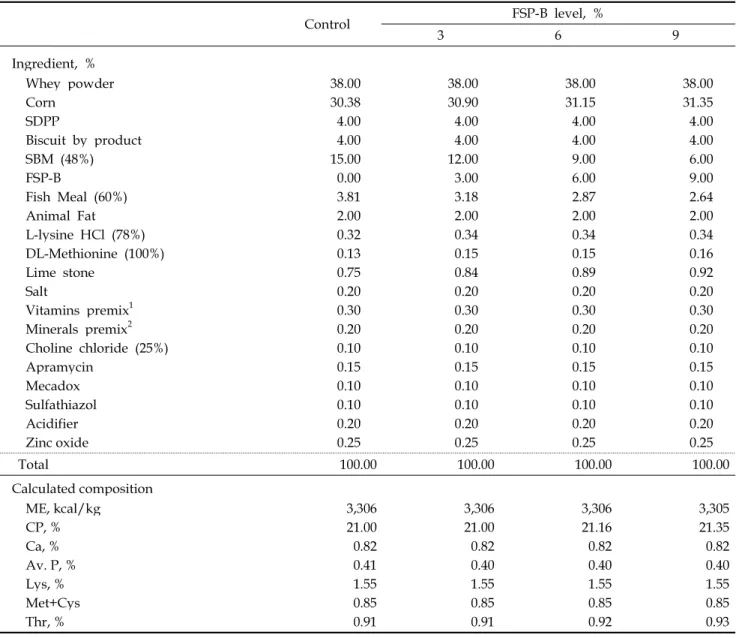
Table 1. Ingredient and chemical composition of the experimental diets used during phase I (d 0 to 14).
Control FSP-B level, %
3 6 9
Ingredient, % Whey powder Corn
SDPP
Biscuit by product SBM (48%) FSP-B
Fish Meal (60%) Animal Fat L-lysine HCl (78%) DL-Methionine (100%) Lime stone
Salt
Vitamins premix
1Minerals premix
2Choline chloride (25%) Apramycin
Mecadox Sulfathiazol Acidifier Zinc oxide
38.00 30.38 4.00 4.00 15.00 0.00 3.81 2.00 0.32 0.13 0.75 0.20 0.30 0.20 0.10 0.15 0.10 0.10 0.20 0.25
38.00 30.90 4.00 4.00 12.00 3.00 3.18 2.00 0.34 0.15 0.84 0.20 0.30 0.20 0.10 0.15 0.10 0.10 0.20 0.25
38.00 31.15 4.00 4.00 9.00 6.00 2.87 2.00 0.34 0.15 0.89 0.20 0.30 0.20 0.10 0.15 0.10 0.10 0.20 0.25
38.00 31.35 4.00 4.00 6.00 9.00 2.64 2.00 0.34 0.16 0.92 0.20 0.30 0.20 0.10 0.15 0.10 0.10 0.20 0.25
Total 100.00 100.00 100.00 100.00
Calculated composition ME, kcal/kg
CP, % Ca, % Av. P, % Lys, % Met+Cys Thr, %
3,306 21.00 0.82 0.41 1.55 0.85 0.91
3,306 21.00 0.82 0.40 1.55 0.85 0.91
3,306 21.16 0.82 0.40 1.55 0.85 0.92
3,305 21.35 0.82 0.40 1.55 0.85 0.93
1
Supplied per kg diet: 9,600IU vitamin A, 1,800IU vitamin D
3, 24mg vitamin E, 1.5mg vitamin B
1, 12mg vitamin B
2, 2.4mg vitamin B
6, 0.045mg vitamin B
12, 1.5mg vitamin K
3, 24mg pantothenic acid, 45 mg niacin, 0.09mg biotin, 0.75mg folic acid, 18 mg ethoxyquin.
2
Supplied per kg diet: 162mg Fe, 96mg Cu, 72mg Zn, 46.49mg Mn, 0.9mg I, 0.9mg Co, 0.3mg Se.
[Provider:earticle] Download by IP 118.70.52.165 at Monday, December 20, 2021 8:12 PM
www.earticle.net
partially slotted and concrete floor pens with a pen size of 1.90 × 2.54 m, with a self feeder and nipple waterer to allow ad libitum access to feed and water. The main objective of this study was to compare different levels of fermented soya protein used in weaned pig’s diet with control diet. The control diet comprised of soyabean meal (SBM), while fungal + bacterial fermented soya protein (FSP-B) was used at 3, 6 and 9% in treatment diets.
Iso-caloric (3300 kcal/kg) and iso-proteinous (21% CP) diets were formulated and lysine content (1.55%) was similar in all the diets. These treatment diets were fed from 0 to 14 day (phase I) post weaning. From d 15 to 35 (phase II) of experiment a common commercial diet as crumbs was fed to all the pigs. The composition of phase I diet is presented in Table 1. All the diets met or slightly exceeded the nutrient requirements as suggested by NRC (1998).
The experiment was conducted for 35 days during which blood was collected on 14 and 35 day post weaning.
Blood was collected by jugular venipuncture from 2 pigs of each pen into disposable Vacutainer tubes containing sodium heparin as anticoagulant (Becton Dickenson, Franklin, NJ) and analyzed for hematological indices and immune cell populations. The hematological indices like red blood cell (RBC), hemoglobin (Hb), hematocrit (HCT), mean corpuscular volume (MCV), mean corpuscular hemoglobin (MCH), mean corpuscular hemoglobin concentration (MCHC), red blood cell distribution (RDW), platelets (PLT), mean platelet volume (MPV), white blood cell (WBC), neutrophil (NE), lymphocyte (LY), monocyte (MO), eosinophil (EO) and basophil (BA) were analyzed using HematocyteTM (Oxford science, Inc., USA). Blood was centrifuged at 3000 × g for 15 min and plasma samples obtained were used for the analysis of aspartate transaminase (AST) and alanine transaminase (ALT) by an automated chemistry analyzer (Fuji Dri-chem 3500i, Japan).
Collected data was subjected for statistical analysis using GLM procedure of SAS (1985) by using statistical software package. The linear and quadratic contrasts of increasing microbial FSP level (0, 3, 6 and 9%) in diet were tested. When significant differences were noted means were separated using LSD’s multiple range test. The
treatments were the main effects, while pens formed the experimental units for all analysis. The level of significance was accepted at P<0.05.
Ⅲ. Results and Discussion
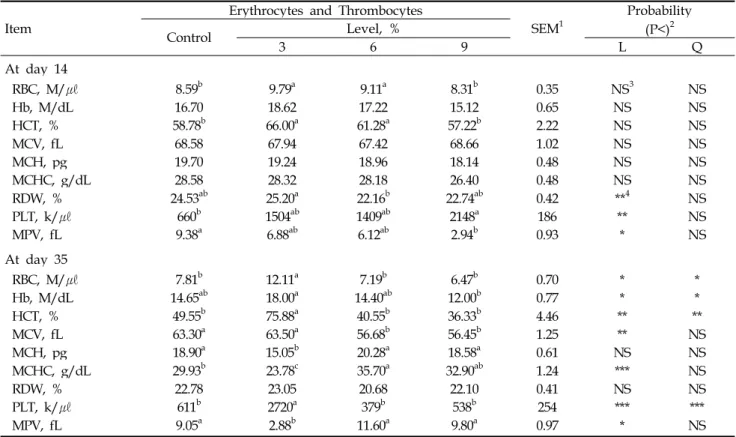
Increasing the dietary level of FSP linearly decreased RDW (P<0.01) and MPV (P<0.05) and increased the PLT (P<0.01) on day 14 (Table 2). Pigs fed 3 and 6% FSP had more RBC and HCT than pigs fed Control and 6% FSP, while pigs fed 6% FSP had lower MPV than Control. At d 35, feeding of FSP had a linearly and quadratic decrease in RBC (P<0.05), Hb (P<0.05), HCT (P<0.01), PLT (P<0.001) and MCV (linear, P<0.01) and linear increase in MCHC (P<0.001) and MPV (P<0.05). When compared among treatments, pigs fed with 3% FSP had the highest RBC, Hb, HCT, MCV and PLT and the lowest values of MCH, MCHC and MPV.
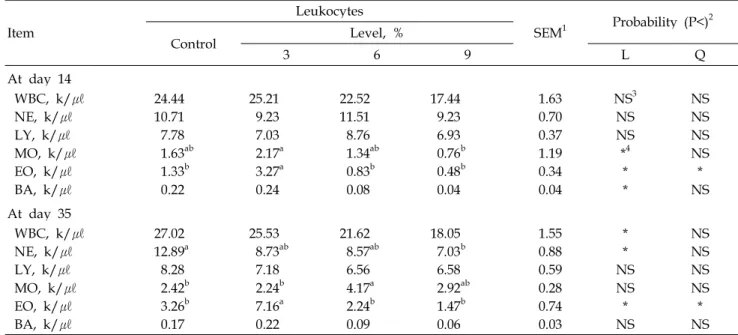
The immune cell populations on d 14 and 35 were affected by dietary FSP levels (Table 3). Linear (P<0.05) decrease in MO, EO, and BA on d 14 with increasing levels of FSP in diet was noted, where in pigs fed 3% FSP had the highest and those fed with 9% FSP had the lowest values of MO, EO and BA. On d 35, linear (P<0.05) decrease in WBC, NE and EO in pigs fed increasing levels of FSP in their diets was noticed. Pigs fed 9% FSP had the lower NE than Control, while those fed 6% FSP had higher MO when compared with pigs fed Control and 3% FSP diets. Also the pigs fed 3% FSP had the highest number of EO when compared to pigs fed other treatment diets. The differences in the immune cell populations on feeding of FSP diets may be due to the different amounts of peptides or proteins caused by microbial fermentation.
At day 14, pigs fed 6% FSP diet had the lowest plasma AST values than other treatments while those fed 3 and 6% FSP had lower plasma ALT values when compared with pigs fed control and 9% FSP diets (Fig. 1).
But on day 35, the plasma levels of AST and ALT did not differ among the pigs fed control and FSP diets.
[Provider:earticle] Download by IP 118.70.52.165 at Monday, December 20, 2021 8:12 PM
www.earticle.net
Table 2. Effects of using different levels of microbial fermented soya protein on the hematological indices in weaned pigs.
Item Erythrocytes and Thrombocytes
SEM
1Probability (P<)
2Control Level, %
3 6 9 L Q
At day 14 RBC, M/㎕
Hb, M/dL HCT, % MCV, fL MCH, pg MCHC, g/dL RDW, % PLT, k/㎕
MPV, fL
8.59
b16.70 58.78
b68.58 19.70 28.58 24.53
ab660
b9.38
a9.79
a18.62 66.00
a67.94 19.24 28.32 25.20
a1504
ab6.88
ab9.11
a17.22 61.28
a67.42 18.96 28.18 22.16
b1409
ab6.12
ab8.31
b15.12 57.22
b68.66 18.14 26.40 22.74
ab2148
a2.94
b0.35 0.65 2.22 1.02 0.48 0.48 0.42 186 0.93
NS
3NS NS NS NS NS
**
4**
*
NS NS NS NS NS NS NS NS NS At day 35
RBC, M/㎕
Hb, M/dL HCT, % MCV, fL MCH, pg MCHC, g/dL RDW, % PLT, k/㎕
MPV, fL
7.81
b14.65
ab49.55
b63.30
a18.90
a29.93
b22.78 611
b9.05
a12.11
a18.00
a75.88
a63.50
a15.05
b23.78
c23.05 2720
a2.88
b7.19
b14.40
ab40.55
b56.68
b20.28
a35.70
a20.68 379
b11.60
a6.47
b12.00
b36.33
b56.45
b18.58
a32.90
ab22.10 538
b9.80
a0.70 0.77 4.46 1.25 0.61 1.24 0.41 254 0.97
*
*
**
**
NS
***
NS
***
*
*
*
**
NS NS NS NS
***
NS
ab
Values with different superscripts of the same row are significantly differ (p<0.05).
1
Pooled standard error means.
2L : linear effects; Q : quadratic effects.
3
Not significant (p>0.05).
4* p<0.05; ** p<0.01; *** p<0.001.
Table 3. Effects of using different levels of microbial fermented soya protein on the immune cell populations in weaned pigs.
[Provider:earticle] Download by IP 118.70.52.165 at Monday, December 20, 2021 8:12 PM
www.earticle.net
Item SEM
1Probability (P<)
Control Level, %
3 6 9 L Q
At day 14 WBC, k/㎕
NE, k/㎕
LY, k/㎕
MO, k/㎕
EO, k/㎕
BA, k/㎕
24.44 10.71 7.78 1.63
ab1.33
b0.22
25.21 9.23 7.03 2.17
a3.27
a0.24
22.52 11.51 8.76 1.34
ab0.83
b0.08
17.44 9.23 6.93 0.76
b0.48
b0.04
1.63 0.70 0.37 1.19 0.34 0.04
NS
3NS NS
*
4*
*
NS NS NS NS
* NS At day 35
WBC, k/㎕
NE, k/㎕
LY, k/㎕
MO, k/㎕
EO, k/㎕
BA, k/㎕
27.02 12.89
a8.28 2.42
b3.26
b0.17
25.53 8.73
ab7.18 2.24
b7.16
a0.22
21.62 8.57
ab6.56 4.17
a2.24
b0.09
18.05 7.03
b6.58 2.92
ab1.47
b0.06
1.55 0.88 0.59 0.28 0.74 0.03
*
* NS NS
* NS
NS NS NS NS
* NS
ab
Values with different superscripts of the same row are significantly differ (p<0.05).
1
Pooled standard error means.
2L : linear effects; Q : quadratic effects.
3
Not significant (p>0.05).
4* p<0.05.
a a
b a
b b
a a
0 10 20 30 40 50 60 70 80
AST ( μ / ℓ) ALT ( μ / ℓ)
a
a a
a a
a a
a
0 1 0 2 0 3 0 4 0 5 0 6 0 7 0 8 0
AST ( μ / ℓ) ALT ( μ / ℓ)
Fig. 1. Effects of using different levels of microbial fermented soya protein on the plasma ALT and AST values in At day 35
At day 14
[Provider:earticle] Download by IP 118.70.52.165 at Monday, December 20, 2021 8:12 PM
www.earticle.net
weaned pigs.
a, b
Means with different superscript are significantly differ (p<0.05). Mean ± standard error is shown.
Acknowledgement
The authors sincerely acknowledge for the financial support provided by the Institute of Animal Resources, Kangwon National University, & Agricultural Research &
Development Promotion Center (ARPC), Korea.
Ⅳ. References
1. Chah, C. C., C. W. Carlson, G. Semeniuk, I. S.
Palmerand and C. W. Hesseltine. 1975.
Growth-promoting effects of fermented soybeans for broilers. Poult. Sci. 54:600-609.
2. Hong, K. J., C. H. Lee and S. W. Kim. 2004. Aspergillus oryzae GB-107 fermentation improves nutritional quality of food soybeans and feed soybean meals. J. Med.
Food. 7:430-435.
3. Kiers, J. L., J. C. Meijer, M. J. R. Nout, F. M. Rombouts, M. J. A. Nabuurs and J. Meulen. 2003. Effect of fermented soya beans on diarrhoea and feed efficiency in weaned piglets. J. Appl. Micro. 95(3):545-555.
4. Lalles, J. P. 1993. Soy products as protein sources for preruminant and young pigs. In: Soy in Animal Nutrition (Ed. J. K. Drackley) Federation of Anim. Sci.
Soc. Savoy, IL. Pp. 106-125.
5. NRC. 1998. Nutrient requirements of swine (10th Ed).
National Academy Press, Washington, DC.
6. Sarkar, P. K. and J. P. Tamang. 1995. Changes in the microbial profile and proximate composition during natural and controlled fermentations of soybeans to produce kinema. Food Chem. 12:317-325.
7. SAS, 1985. SAS User’s Guide: Statistics. SAS Inst. Inc., Cary, NC.
(Received: 2007.11.14, Accepted: 2007.12.17)
[Provider:earticle] Download by IP 118.70.52.165 at Monday, December 20, 2021 8:12 PM