약학희 지 제 4 4 권 제 2 호 128-134(2000) Yakhak Hoeji Vol. 44, No. 2
6 - 엑소메철렌 펜남 유도체의 합성
임 채 욱 # • 박 희 석 • 이 현 수 ■ 임 철 부 중앙대 학교 약학대학 의약화학 교실
(Received March 24, 2000)
Synthesis of 6-Exomethylene Penam Derivatives
Chaeuk In /, Hee Suk Park, Hyun Soo Lee and Chul Bu Yim
D ivision of M edicinal Chemistry, College of Pharmacy, Chung-ang University, Seoul 156-756, Korea
Abstract —— The synthesis of new 6-6xomethyIene penams with triazole ring was described. The 6,6- dibromopenam 5 was treated with CHgMgBr and carbaldehyde 4 to afford the 6-bromo-6-( 1 -hydroxy-1- methyl)penicillanate 6 , which was reacted with acetic anhydride to give acetoxy compound 7. The deac- etobromination of 7 with zinc and acetic acid gave 6-exomethyIenpenams, Z-isomer 8 and E-isomer 9, which were oxidized to sulfones 10 and 11 by m-CPBA. The />-methoxybenzyl compounds 6~11 were deprotected by AICI3 and neutralized to give the sodium salts 12—17.
Keywords □ Triazole, 6-Exomethylenepenam, p-Lactamase inhibitors.
임상세서 널리 사용되고 있는 p-lactam 항생제에 대 한 내성균의 출현으로 기존 항생제의 약효가 감소하여 내성균에 유용한 새로운 항생제 개발의 될요성이 끊임 없이 제기되고 있다.^^ 가장 일반적인 세균의 내성 기 견은 P-lactam 항생제를 파괴시키는 P-lactamase라는 효소를 내성균이 분비하여 항생제의 약효를 제거하는 것이다. 이러한 내성균 문제를 극복하는 방법으로 P- lactamase 효소에 안정한 항생제률 개발히는 방법이 었으나, 이돌도 곧 새로운 P-lactamase 효소에 파괴되 는 경향을 보여 주고 있다. 내성균을 치료할 수 있는 보다 근본적인 방법은 P-lactamase 효소를 파괴하는 P-lactamase 억제제률 개발하고, P-lactam 항생제와 병용 투여하여 P-lactam항생제률 P-lactamase 효소로 부터 보호하는 것이다.
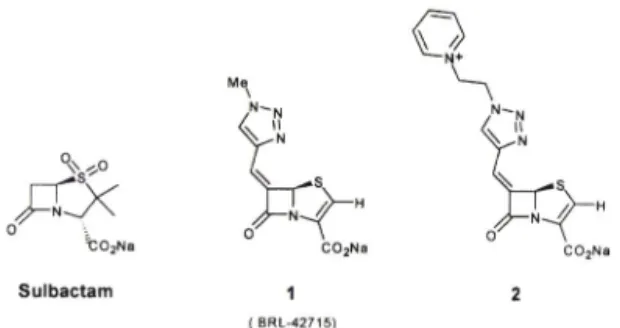
최근에 이러한 p-lactamase 억제제로 davulanic acid, 가 sulbactam카 및 tazobactam"^버 개발되어 임상 에서 사용되고 었다. 최근 p-Lactamase 억제제로 6-
짧본논문에관한문의는이저자서)게로
(
전화) 02-820-5603 (
팩스) 02-815-2199
exomethylene penam유도체둘이 개발되고 있고차 특히, 6-txiazolylmethylene penem인 1(BRL-42715)산'가과 2 는 p-lactamase 억제제에 내성을 갖는 대부분의 p- lactamase에 대하여도 매우 강력한 억제활성을 나타내 었다.은^ 그리고, Chen 등에 의해 exomethylene penam 과 sulfone 구조를 갖는 화합물의 P-lactamase에 대한 우수한 억제 효과가 보고되었다.^^ 이상의 사설을 바탕 으로 하여 본 연구자는 보다 우수한 P-lactamase 억 제활성을 갖는 구조률 탐색할 목적으로 sulbactam과 tazobactam의 penam구조와 1 과 2의 6-triazolylme- thyknc구^ # 결 ^시킨 6-triazolylmethylene penam 유도체를 합성하였다.
실험방법
시약 및 기기
본 설험에서 시용린 시약돌은 Aldrich사와 Fluka사 의 것을 사용하였으며 각중 용매는 특급시약을 시용하 였다. ■H-NMR spectra는 JEOL JNM-EX 90A(90 MHz)와 Varian Gemini 2000(300 MHz)을 사용하여
^OjNa
-N+^
COjNa
Sulbactam
Fig, 1 - Structure of p-Lactamase inhibitors.
얻었고, CDCI3의 경우 TMS(tetramethylsilane)를 내 부 표준물질로 사용하였고 DMSO-d^의 경우 잔류하는 DMSO룰 내부 표준물질로 사용하였다. TLC는 Merck silica gel 60 F254(thickness 0.2 를 사용하였고, Reverse TLC로는 Merck RP-18F254s(thickness 0.25 mm)를 사용하였으며 UV Lamp로 spot을 확인하였다.
용점측정은 Biichi Melting point B-540을: 사용하였고, IR spectra는 Jasco FT/TR 300E을 사용하여 얻었다.
Column chromatography^ silica gel(Merck type 9355, 230-^400mesh)을 사용하였고, 역상 column chromatography 는 Comosil 75 Cig-OPN(42~105 |i, Nacalaitesque, Jaspan)을 사용■하였다.
l-[2-(Benziniidazol-2-yl)thioethyl]-l,2,3-triazole- 4-carbaldehyde(4)
l-(2-Hydroxyethyl)-l,2,3-triazole-4~carbaldehyde(3) 470 g(3330 mmol)을 무수 dichloromethane 100 m/에 녹인 용액에 triethylamine 4.68 m볼 가한 후, -15 2(fC로 냉각하고 반응시켰다. 1 시간 후, trifluo- romethanesulfonic anhydride 5,60 m/(33.29 mmol)를 서서허 가하고 3시간 더 교반하였다. 2-Mercaptoben- zimidazole 5.00g(33.29 mmol)과 triethylamine 4.68 rd 이 녹이■있는 dichloromethane 80 m/용액을 상기 반응흔 합액에 -15~-2(fC에서 4 0 ^ 동안에 적가한 후, 실온에 서 타루 방치하였다. 빈움흔합물을 dichloromethane으로 추출하고 5% NaCl용액으로 세척한 후, 무수 Na2S0 t로 탈수하고 감암 농축하여 얻은 생성물을 실러카겔 컬럼 크 로 마 ^라 피 로 정제하여 화합물 4 3.52g (39%>옳 얻 었다 : Ri=0.30(hexane: ethyiacetate=l:2); mp: 151—
153T; IRCCHCy 3790, 1694 cnT효; 'H-NMRCCDCy 5 3.85(t, 2H, /=6.3Hz), 4.92(t, 2H, /-6.3Hz), 7.08~7.46(m, 4H), 8.91(s, IH), 10.00(s, IH).
/^■Methoxybenzyl 6-Bromo-6-[l-hydroxy-l-[l-[2- (benzimidazol-2-yl)thioethyl]-l,2,3-triazol-4-yl]me- thyl]penicillanate l,l-Dioxide(6)
화합물 5 5.43g(10.62 mmol)을 무수 THF 80 m/에 녹인 용액에 CH3MgBr 425 m/(2.50M ether용액)을 가 한 후, -78*^C에서 20분간 교반하였다. 화합물(4) 2.90 g(10.61 mmol)을 dichloromethane 50 m/에 녹여서 반응액에 가하고, -78X에서 10시간 반응하였다. 10%
NH4Q §■액을 가하여 번응을 정지시키고 ethyl acetate로 추출하여 무수 Na^SOt로 탈수시킨 후 , 감"갑* 농축하여 얻은 생성물을 실러카겔 컬럼 크로마토 그라피로 정 제하여 화합물 6 4.34g(58%)을 얻었다 : Rf=0.16 (hexane: ethylacetate^ 1:2); IRCCHClg) 1804, 1752, 1334 cnT으; 권 -NMRCCDCy 5 1.20(s, 3H), 1.42(s, 3H), 3.45~3.70(m, 5H), 4.40(s, IH ), 4.49~4.75(m, 2H), 4.90--5.35(m, 5H), 5.40 and 5.49(two s, IH), 6.71~6.80(m, 2H), 6.94-*7.73(m, 6H), 7.75 and 7.83(two s, IH).
^Methoxybenzyl 6-Bromo-6-[l-acetoxy-l-[l-[2- (benzimidazol-2-yl)thioethyl]-l,2,3-triazol-4-yl]me- thyljpenicillanate l,l-Dioxide(7)
화합물 6 7.48g(10.60 mmol)을 무수 THF 40 ml 에 녹인 용액에 pyridine 10.23 m/과 acetic anhydride 10.83 g i: 가하고 실온에서 20시간 빈응하였다. 번응 혼 합물을 dichloromethane로 추출하고 1% HC1, 5%
NaHCOg 및 5% NaCl 용액으로 세척한 후, 무수 N a^SO ^ 탈수하고 감압 농축하였다. 생성물을 실리카 겔 컬럼 크로마토 그라괴로 정제하여 화합물 7 5.90g(75%)을 얻었다 : R{=0.57(hexane : ethylacetate
= 1:2); IRCCHCl,) 1807, 1755, 1315 cm~^ 'H- NMRCCDClg) 5 L21(s, 3H), 1.50(s, 3H), 2.18(s, 3H), 3.67~3.80(m, 5H), 4.41 and 4.50(two s, IH), 4.81—
5.03(m, 2H), 5.09~5.19(m, 2H), 5.24 and 5.57(two s, IH), 6.34 and 6.55(two s, IH), 6.80~6.94(m, 2H), 7.23~7.85(m, 6H), 7.86(s, IH).
p-Methoxybenzyl (62)-6-[l-[l-[2-(Benzimida2ol- 2-yl)thioethyl]-l,2,3-triazol-4-yl]methylene]penicil- lanate l,l-Dioxide(8) and />Methoxybenzyl(6E) -6-[l-[l-[2-(Benzimidazol-2-yl)thioethyl]-l,2,3-tri- azol-4-yl]methylene]penicillanate l,l-Dioxide(9)
130 임채욱 • 박희석 • 이현수 • 임철부
화합물 7 5.27g(7.05 mmol)을 CH3CN 60 m/에 녹 이고 acetic acid 0.85 m/을 가한 후, Zn분말 2.30 g i:
넣고 0 T 에서 3시간 반응하였다. 반응액을 dichlo- romethane로 주즐하고 5% NaHCX)3으로 세척한 후, 무수Na^SO^로 탈수하고 농측하^ 얻은 생성물을 설러 카겔 컬럼크로마토 그라피로 정제하여 화합물 8 1.62g(38%)과 화합물 9 a82g(19%)울 얻었다.
화합물 8 : Rf=0.20(ethylacetate~hexane—1:1); IR (CHCI3) 1784, 1754, 1318 crn^; IH-NMRCCDCy 5 1.29(s, 3H), 1.48(s, 3H), 3.69(t, 2H, / - 6.8Hz), 3.79(s, 3H), 4.40(s, IH), 4.83(t, 2H, / = 6.8Hz), 5.16(d, 2H, / = 5.8Hz), 5.57(s, IH ), 6.80~6.95(m, 2H), 7.23~7.69(m, 7H), 7.92(s, IH).
화합물 9 : Rf=0.08(ethylacetate—hexane==l:l); IR (CHCI3) 1773, 1750, 1320 criT*; 'H-NMRCCDCl,) 5 1.26(s, 3H), 1.46(s, 3H), 3.59~3.83(m, 5H), 4.37 (s, IH ), 4.82(t, 2H, / = 7.0Hz), 5.12(s, IH ), 5.17 (d, 2H, /=6.0Hz), 6.83~6,96(m, 2H), 6.98(s, IH), 7.20~7.71(m, 6H), 8.71(s, IH).
/>Methoxybenzyl(6Z)-6-[l-[l-[2-(Benzimidazol- 2-yl)sulfonylethyl]-l,2,3-triazol-4-yl]m ethylene]
penicillanate l,l-D ioxide(10)
화합물 8 0,50 g(0,82 mmol)을 dichloromethane 10 m/에 녹이고, m-chloroperbenzoic add(w2-CPBA) 0 .3 3 ^ 넣고 상온에서 20시간 동안 반응시켰다. 빈응 액을 5% NaHC0;3용액과 물로 세척하고 무수 Na^SO^로 건조시킨 후, 실러카겔 컬럼크로마토 그라괴 로 정제하여 화합물 10을 027g(52%)얻 었 다 : Rf=
0.24(hexane : ethylacetate=1:2); IRCCHClg) 1780, 1751, 1319 cnT사 'H-NMRCCDCy 5 1.32(s, 3H), 1.40(s, 3H), 3.83(s, 3H), 4.20•니 .41(m, 2H), 4.47 (s„ IH), 4.81~5.21(m, 2H), 5.24(d, 2H, /= 4 2 Hz), 5.35(s, IH), 6.89~7.05(m, 2H), 7.15(s, IH), 7.25"-7.85(m, 6H), 7.87(s, IH).
1773, 1753, 1323 cnT오; 'H-NMRCCDCy 6 1.28(s, 3H), 1.50(s, 3H), 3.78(s, 3H), 4.08~4.34(m, 2H), 4.44(s, IH), 4.84-5.23(m, 4H), 5.29(s, IH), 6.80- 6.99(m, 3H), 7.23~7.80(m, 6H), 8.59(s, IH).
Sodium 6-Bromo-6-[l-hydroxy-l-[l-[2-(benzimi- dazol-2-yl)thioethyl]-l,2,3-tria2ol-4-yl]methyl]pe- nicillanate l,l-D ioxide(12)
화합물 6 0.15 g을(0.21 mmol) 무수 dichlorome
thane 8 m/과 anisoie 4 m/에 녹여 -40X로 냉각하 고, 두수 aluminum chloride 0.19g을 넣고 반응시켰 다. 1시간 후, 물을 넣어 반응을 중지시키고 0.1N NaOH용액으로 pH률 7.0으로 조절하였다. 수층을 역 상 column으로 정제하여 얻은 용액을 동결 건조하여 화합물 13 0.08 옳 (62%) 얻었다 : R^027(water:ace- tonitrile=l:2); IR(Nujol) 1775 o t T ' ; 'H-NMR(DMS0- d^) 5 1.40(s, 3H), 1.47(s, 3H), 3.79-3.85(m, 3H), 4.67 and 4.78(two t, 2H, /=6,5Hz), 5.11 and 5.18 (two s, IH), 5.28 and 5.30(two s, IH), 7.46 사 7.73(m, 4H), 8.29 and 8.51(two s, IH).
위와 같은 방법으로 PMB ester 화합물인 7, 8 , 9, 10, 11 을 원료로 사 용 화 합 물 13, 14, 15, 16, 17울 합성하였다.
Sodium 6-Bromo-6-[l-acetoxy-l-[l-[2-(benzimi- dazol-2-yl)thioethyl]-l,2,3-tricizol-4-yl]methyl]pe- nicillanate l,l-D ioxide(13)
수득율 71%:Rf=0.3l(water:acetonitrile=l:2); IR (Nujol) 1771 a n '; 'H-NMRCDMSO-cy 6 135 and L38(two s, 3H), 1.46 and 1.47(two s, 3H), 2.16 and 2.18(two s, 3H), 3.75~3.86(m, 3H), 4.76 and 4.84 (two t, 2H, / = 6.6Hz), 522 and 539(two s, IH), 631 and 6.46(two s, IH), 7^1~7.39(m, 2H), 7.67- 7.70(m, IH), 7.82~7.85(m, IH), 8.48 and 8.50(two s, IH).
p-Methoxybenzyl (6E)-6-[l-[l-[2-(Benzimidazol- 2-yl)sulfonylethyl]-l,2,3-triazol-4-yl]m ethylene]
penicillanate l,l-D io x id e(ll)
화합물 10을 합성한 방법으로 화합물 9 0.73g (1.20 mmol)을 사용하여 화합물 11을 0.33g(43%) 얻었다 : Rf=0.43(ethylacetate니iexane==2:l); IR(CHCy
Sodium (62)-6-[l-[l-[2-(Benzimidazol-2-yl)thioe- thyl]-l,2,3-triazol-4-yl]methylene]penicillanate 1,1- Dioxide(14)
수득율 78% ; Rf=0.75(water: acetonitrile=l:4): IR (Nujol) 1773 cm-오; ^H-NMRCDMSO-d^) 6 1.38(s, 3H), 1.44(s, 3H), 3.75(t, 2H, /=6.5Hz), 3.79(s,
1H), 4.89(t, 2H, /=6,5Hz), 5.74(s, IH), 7.33- 7.40(m, 3HX 7.69(dd, IH , / ,= 6 .6H2, / 2= 2 .7Hz), 7,83(dd, IH ,/ j= 6.6Hz,/2=2.7Hz), 8.46(s, IH).
Sodium (6^-6-[l-[l-[2-(Benziinidazol-2-yl)thioe- th yl]-l,2,3-triazo l-4-y l]m eth ylen e]p en icillan ate l,l-D ioxide(15)
수득율 84%:Rf=0.37(water:acetonitrile=l:2); IR (Nujol) 1766 otT느 ^H-NMRCDMSO-d^) 6 1.38(s,
EljN , R 가
a :
; Trifkioromethanftsulfonic anhydride
Scheme 1 - Synthesis of l-(substituted thioethyl)-1,2,3- txiazole-4-carbaldehyde.
OjPMB
AC
2O
CO2PMB
a >
Scheme 2 - Synthesis of 6-Exomethylene penams.
132 임채욱 • 박희석 • 이현수 • 임철부
3H), 1.46(s, 3H), 3.74~3.81(m, 3H), 4.91(t, 2H, /=6.3Hz), 5.23(s, IH), 7.10(s, IH), 7.30~7.36(m, 2H), 7.66(dd, IH , -8.1Hz, /2=1.8Hz), 7.82(dd, IH , /,= 8 .1 Hz,/2=L 8Hz), 8.83(s, IH).
Sodium (62)-6-[l-[l-[2-(Benzim idazoi-2-yl)sul-
fonylethyl]-l,2,3-triazol-4-yl]m ethylene]penicil- lanate l,l-D ioxide(16)
수득율 79%: Rf=0.32(water : acetonitrile=l:2); IR (Nujol) 1772 cm-효; ^H-NMRCDMSO-d^) 6 L39(s, 3HX 1.44(s, 3H), 3.82(s, IH), 4.19(t, 2H, J=
6.6Hz), 4.89(t, 2H, /=6.6Hz), 5.62(s, IH), 7.20
bOjPMB
6 R , = O H
7 R , = O A c
DAICb
2 ) N a O H
13 R , = O A c
스 서 n
° U p m b
겨 )n
1 ) A IC I, 2 ) N a O H
8 10
14 16
1 ) A IC b
/ ^ 2 ) N a O H ^
, 0 , n J ° '뇌 ^"^
» I
9
11
15 17
a:
P M B = p -M e th o x y b e n zy l
Scheme 3 - Synthesis of 6-Exomethylene penam sodium salts.
(dd, 2H, /i=6.0Hz, / 2= 3.0Hz), 7.28(s, IH), 7.62 (dd, 2H, /,=6.0Hz,/2-3.0Hz), 8.40(s, IH).
Sodium (6£)-6-[l-[l-[2-(Benzimidazol-2-yl)sulfo- nylethyl]-l,2,3-triazol-4-yl]m ethylene]penicilla- nate l,l-D ioxide(17)
수득율 82% : Rf=0.51(water: acetonitrile=l:2); IR (Nujol) 1770 cm"'; ^H-NMR(DMSO-(y 5 1.38(s, 3H), 1.50(s, 3H), 3.85(s, IH), 4.23(t, 2H, / - 6.6Hz), 4.96 (t, 2H, / = 6,6Hz), 5.53(s, IH), 6.99(s, IH), 7.26 (dd, 2H, /,=5.8Hz, / 2= 3 .3Hz), 7.65(dd, 2H, / ,=
5.8Hz, /2=3.3Hz), 8.80(s, IH).
실 험 결 과 및 고찰
/>-Methoxy ester화합물 6 —11온 AICI3로 처러하여 free carboxylic 화합물로 만든 후 , 0.1N NaOH 용액 을 사용하여 pH를 7.0으로 조절하여 sodium salt 용 액을 만들었다(Scheme 3). P-Lactam 링은 염기에 약 하기 때문에 pH 조절에서 0.1N NaOH 용액을 조금 썩 적정해야 한다. 이렇게 얻은 sodium salt 용액을 동결건조하고 역상columii으로 정제 한 후 , 다시 동결 건조하여 화합물 1 2 ^ 7 을 62-83%의 수득율로 합성 하였다.
감사의 말씀
본 연구는 1999년도 중앙대학교 연구지원처 학술연 구비의 지원으로 수행되었으며 이에 감사드럽니다.
Hydroxethyl 화합물 3 을 trifluoromethanesulfonic anhydride로 처리하여 trifluorosulfonyl 유도체로 만 든 후, thiol 화합물과 반응시켜 2-치환 thioethyl 화합 물을 4를 39%의 수득률로 합성하였다(Scheme 1).
6,6-Dibromopenam 화합물 5를 CH3MgBr로 처리 한 후, carbaldehyde 화합물 4와 반응하여 hydroxy 화합물 6을 58% 수득률로 얻었다. 이 화합물의 NMR 스펙트럼에서 triazole과 CHOH의 수소가 singlet이 아니고 2개 이상의 peak률 보여주어서 화합 물 6은' stereoisomer의 흔합물임을 알 수 있었다. 이 isomer들은 silica gel column에서 분리가 되지 않았 다. 화합물 G을 acetic anhydride로 처리하여 acetoxy 화합물 7을 75%의 수득율로 얻었고, 이 화합물외
^H-NMR spectrum 에서 CHO AC 의 peak 가 5 6.34와 6.55에서 크기가 약 3:1인 peak가 관찰되어서 4개의 가능한 stereoisomer 중에서 2개의 isomer가 3:1의 비율로 존재함을 알 수 있었다. 화합물 7을 acetic add와 Zn으로 처리하여 penam sulfone의 6번 위처에 exomethylene의 2중 결합을 도입하였고, Z-isomer는 38% £-isomert- 19%의 수득률로 얻었다. £-isomer에 서 triazole 링의 수소는 P-lactam링의 carbonyl기와 가 까이 있기 때문에 *H-NMR 스펙트럼에서 carbonyl기의 anisotropic 효과쉬) 의하여 peak가 왼쪽으로 이동하였다 (5 8.71). 그러나, Z-isomer에서 triazole 링의 수소는 carbonyl기와 멀러 떨어져 었어서 anisotropic 효과의 영향을 받지 않았다(6 7.92).■아 비숫한 결과가 sulfonyl 화합물 10파 11에서도 발견되었다(Scheme 2).
문 헌
1) Neu» H. C. : The crisis in Antibiotic Resistance, Science. 257, 1064 (1992).
2) Reading, C. and Cole, M. : Clavulanic acid : Ap- lactamase-inhibiting p-lactam from Streptomyces davuligerus. Antimicrob, Agents Chemother. 11, 852 (1977).
3) English, A. R., Retsema, J. A., Girard, A, E., Lynch, J. E. and Barth, W E. : CP-45,899, ap-lactamase inhibitor that extends the antibacterial spectrum of p-lactams: initial bacteriological characterization.
Antimicrob. Agents. Chemother. 14, 414 (1978).
4) Micetich, R. G., Maiti, S. N., Spevak, R, Hall, T. W, Yamabe, S., Ishida, N., Tanaka, M., Yamazaki, T., Nakai, A. and Ogawa, K. : Synthesis and p-lactamase inhibitory properties of 2p-[(l*2,3-triazoI-l-yl)methyl]- 2a-methylpenam-3a-carboxylic acid 1,1-dioxide and related triazolyl derivatives. /. Med. Chem. 30, 1469 (1987).
5) Chen, Y. L., Chang, C. W and Hedberg, K. : Synthesis of a potent p-lactamase inhibitor l,l-dioxo-6-(2- pyridyl)methylenepenicillanic acid and its reaction with sodium methoxide. Tetrahedron Lett. 27, 3449 (1986).
6) Bennett, I. S., Brooks, G., Broom, N. J, R, Calvert, S.
H., Coleman, K. and Francois, I. : 6-(Substituted methylene)penems, potent broad spectrum inhibitors of bacterial p-lactamase V Chiral 1,2,3-triazolyl
134 임채욱 • 박희석 • 이현수 • 임철부
derivatives. J. Antibiotics 44, 969 (1991).
7) Bennett, L, Broom, N. J. E, Bruton, G., Calvert, S., Clarke, B. R, Coleman, K., Edmondson, R., Edwards, R, Jones, D,, Osborne, N. E and Walker, G .: 6- (Substituted methylene)penems, potent broad spectrum inhibitors of bacterial p-lactamase III. Structure- activity relationships of the 5-membered heterocyclic derivatives. J. Antibiotics 44, 331 (1991).
8) Broom, N. J. R,Brooks, G. and Clark, B. E : p- (Substituted methylene) penems Eur. Pat. Appl 321187 A l, (1989).
9) Chen, Y. L., Chang, C. W, Hedberg, K., Guarino, K., Welch, W M. and Kiessling, L. : Structure-activity relationships of 6-(heterocyclyl) methylene penam sulfones; a new class of p-lactamase inhibitors. J.
Antibiotics 40, 803 (1987),
10) Im, C., Micetich, R. G., Daneshtalab., M., Atchison, K-, Phillips, 0. A., Kunugita, C .: Synthesis and beta- lactanase inhibitory activity of 6-[(l-heteroarylthioe- thy 1-1,2,3-triazol-4-yl)-methylene]pena sulfones, ].
Artibiotics 47, 1030 (1994).